dashboard Citroen C4 CACTUS 2016 1.G Owner's Manual
[x] Cancel search | Manufacturer: CITROEN, Model Year: 2016, Model line: C4 CACTUS, Model: Citroen C4 CACTUS 2016 1.GPages: 308, PDF Size: 7.96 MB
Page 8 of 308
6
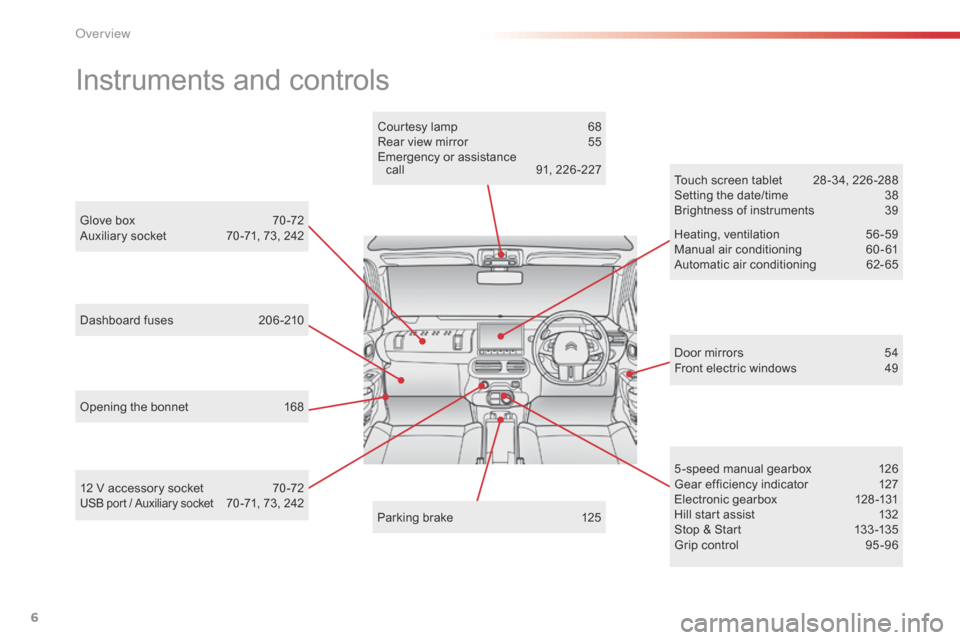
Instruments and controls
Door mirrors 54
Front electric windows 4 9
Opening
the
bonnet
1
68 Touch
screen tablet
2
8 -34, 226 -288
Setting the date/time
3
8
Brightness of instruments
3
9
Heating,
v
entilation
5
6-59
Manual
a
ir
c
onditioning
6
0-61
Automatic air conditioning
6
2- 65
5 -speed manual gearbox
1
26
Gear
efficiency indicator
1
27
Electronic
gearbox
1
28 -131
Hill
start assist
1
32
Stop
& Start
1
33 -135
Grip
control
9
5 -96
Glove
box
7
0 -72
Auxiliary
socket
7
0 -71,
73,
242
Courtesy
lamp
6
8
Rear
view
mirror
5
5
Emergency
or
assistance
c
all
9
1,
226 -227
Parking
brake
1
25
12
V
accessory
socket
7
0 -72
USB port / Auxiliary socket 70 -71, 73, 242
Dashboard
fuses
2
06 -210
O
Page 59 of 308
57
In order for these systems to be fully effective, follow the operation and maintenance guidelines belo w:
F
T
o obtain an even air distribution, take care not to obstruct the exterior air intake grilles
l
ocated at the base of the windscreen, the nozzles, the vents and the air outlets, as well
a
s the air extractor located in the boot.
F
D
o not cover the sunshine sensor, located on the dashboard; this is used for regulation
o
f the air conditioning system.
F
O
perate the air conditioning system for at least 5 to 10 minutes, once or twice a month
t
o keep it in per fect working order.
F
E
nsure that the passenger compartment filter is in good condition and have the filter
e
lements replaced regularly.
W
e recommend the use of a combined passenger compartment filter. Thanks to its
s
pecial active additive, it contributes to the purification of the air breathed by the
o
ccupants and the cleanliness of the passenger compartment (reduction of allergic
s
ymptoms, bad odours and greasy deposits).
F
T
o ensure correct operation of the air conditioning system, you are also advised to have
i
t checked regularly as recommended in the maintenance and warranty guide.
F
I
f the system does not produce cold air, switch it off and contact a CITROËN dealer or a
q
ualified
w
orkshop.
Recommendations for ventilation and air conditioning
If after an extended stop in sunshine, the i nterior t emperature i s v ery h igh, f irst
v
entilate the passenger compartment for
a
few moments.
Put
the air flow control at a setting high
e
nough to quickly change the air in the
p
assenger
c
ompartment.
The
air conditioning system does not
c
ontain chlorine and does not present
a
ny danger to the ozone layer.
The
condensation created by the air
c
onditioning results in a discharge
o
f water under the vehicle which is
p
er fectly normal.
When
towing
the
maximum
load
on
a
steep
gradient
in
high
temperatures,
switching
off
the
a
ir
conditioning
increases
the
available
engine
power
and
so
improves
the
towing
ability.
Stop & Start
The heating and air conditioning s ystems only work when the engine is
r
unning.
To
maintain a comfortable temperature
i
n the passenger compartment, you can
t
emporarily deactivate the Stop & Start
s
ystem.
For
more information on Stop & Start,
r
efer to the corresponding section.
3
Ease of use and comfort
Page 103 of 308

101
Deactivating the passenger's
front airbag
Only the passenger's front airbag can be deactivated.
F
W
ith the ignition off ,
insert the key in the
p
assenger airbag deactivation switch.
F
T
urn it to the "OFF"
p
osition.
F
R
emove the key keeping the switch in the
n
ew position.When
the ignition is on, this warning
l
amp comes in the seat belt warning
l
amps display screen. It stays on
w
hile the airbag is deactivated. To
assure the safety of your child,
t
he passenger's front airbag must be
d
eactivated when you install a rear ward
f
acing child seat on the front passenger
sea
t.
Other wise, the child would risk being
s
eriously injured or killed if the airbag
w
ere deployed.
Reactivating the passenger's
front airbag
When you remove a rearward facing
child sea
t, with the ignition off , turn the switch to
the "ON"
position to reactivate the airbag and
s
o assure the safety of your front passenger in
t
he event of an impact.
Front airbags
Deployment
The airbags are deployed, except the passenger's front airbag if it is deactivated, in the e
vent of a serious front impact to all or part of the
f
ront impact zone A,
in the longitudinal centreline
o
f the vehicle on a horizontal plane and directed
f
rom the front to the rear of the vehicle.
The
front airbag inflates between the thorax and
h
ead of the front occupant of the vehicle and the
s
teering wheel, driver's side, and the dashboard,
p
assenger's side to cushion their for ward
m
ovement.
System
which protects the driver and front
p
assenger in the event of a serious front impact
i
n order to limit the risk of injury to the head and
t
horax.
The driver's airbag is fitted in the centre of the
s
teering wheel; the front passenger's airbag
i
s fitted in the roof to allow more space in the
g
love box.
When the ignition is switched on, this
w
arning lamp comes on in the seat
b
elt warning lamps display screen for
a
pproximately one minute to signal
t
hat the front airbag is activated.
5
Safety
Page 106 of 308
104
Sit in a normal upright position.
W ear a correctly adjusted seat belt.
Do
not leave anything between the
o
ccupants and the airbags (a child, pet,
o
bject...), nor fix or attach anything close to
t
he inflation trajectory of the airbags; this
c
ould cause injuries during their deployment.
Never
modify the original definition of your
v
ehicle, particularly in the area directly
a
round the airbags.
After
an accident or if the vehicle has been
s
tolen or broken into, have the airbag
s
ystems checked.
All
work on the airbag system must be
c
arried out by a CITROËN dealer or a
q
ualified
w
orkshop.
Even
if all of the precautions mentioned
a
re observed, a risk of injury or of minor
b
urns to the head, chest or arms when an
a
irbag is deployed cannot be ruled out. The
b
ag inflates almost instantly (within a few
m
illiseconds) then deflates within the same
t
ime discharging the hot gas via openings
p
rovided for this purpose.Front airbags
Do not drive holding the steering wheel by its spokes or resting your hands on the centre
p
art of the wheel.
Passengers
must not place their feet on the
das
hboard.
Do
not smoke as deployment of the airbags
c
an cause burns or the risk of injury from a
c
igarette or pipe.
Never
remove
or
pierce
the
steering
wheel
or
h
it it violently.
Do
not fit or attach anything to the steering
w
heel, the dashboard or the passenger's
s
un visor as this could cause injuries with
d
eployment of the airbags.
Advice
Lateral airbags
Use only approved covers on the seats, compatible with the deployment the lateral
a
irbags. For information on the range of seat
c
overs suitable for your vehicle, you can
contact
a CITROËN dealer.
For
more information on accessories, refer
t
o the corresponding section.
Do
not fix or attach anything to the seat
b
acks (clothing...). This could cause injury
t
o the chest or arms if the lateral airbag is
d
eployed.
Do
not sit with the upper part of the body any
n
earer to the door than necessary.
Curtain airbags
Do not fix or attach anything to the roof. This could cause injury to the head if the curtain
a
irbag is deployed.
If
fitted on your vehicle, do not remove the
g
rab handles installed on the roof, they play
a
part in securing the curtain airbags.
For the airbags to be fully effective, observe the safety recommendations below:
Safety
Page 208 of 308
206
Before changing a fuse:
F t he cause of the failure must be identified
a
nd
r
ectified,
F
a
ll electrical consumers must be
s
witched off,
F
t
he vehicle must be immobilised with the
ig
nition
o
ff,
F
i
dentify the failed fuse using the tables and
l
ayout drawings in the following pages.
Changing a fuse
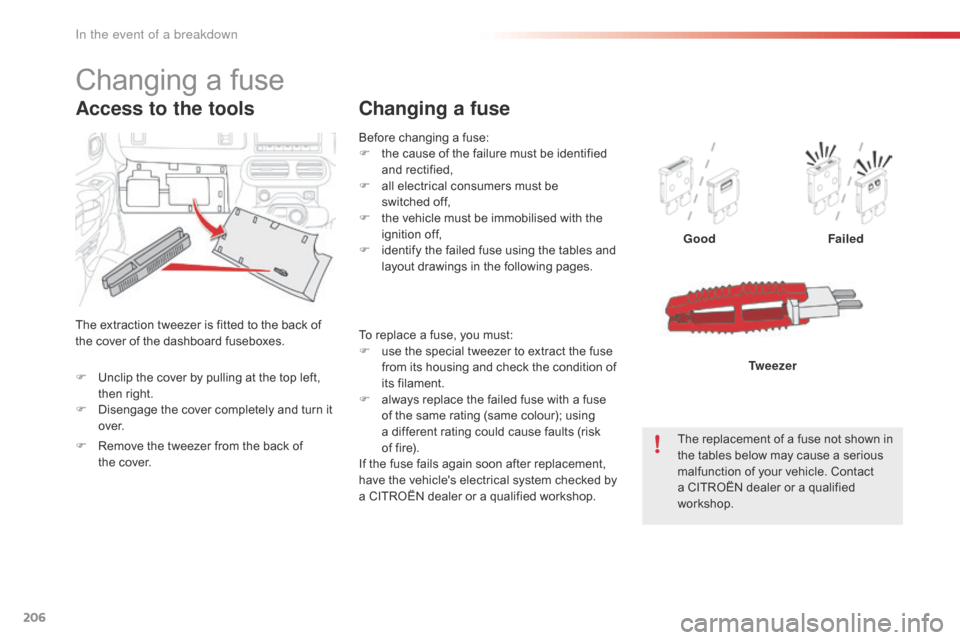
GoodFailed
The replacement of a fuse not shown in
t
he tables below may cause a serious
m
alfunction of your vehicle. Contact
a
CITROËN dealer or a qualified
w
orkshop. Tw e e z e r
Changing a fuse
The extraction tweezer is fitted to the back of t
he cover of the dashboard fuseboxes.
Access to the tools
To replace a fuse, you must:
F u se the special tweezer to extract the fuse
f
rom its housing and check the condition of
it
s
f
ilament.
F
a
lways replace the failed fuse with a fuse
o
f the same rating (same colour); using
a
different rating could cause faults (risk
o
f fire).
If
the fuse fails again soon after replacement,
h
ave the vehicle's electrical system checked by
a
CITROËN dealer or a qualified workshop.
F
U
nclip
the
cover
by
pulling
at
the
top
left,
t
hen
right.
F
D
isengage
the
cover
completely
and
turn
it
o
ve r.
F
R
emove
the
tweezer
from
the
back
of
t
he cover.
In the event of a breakdown
Page 210 of 308
208
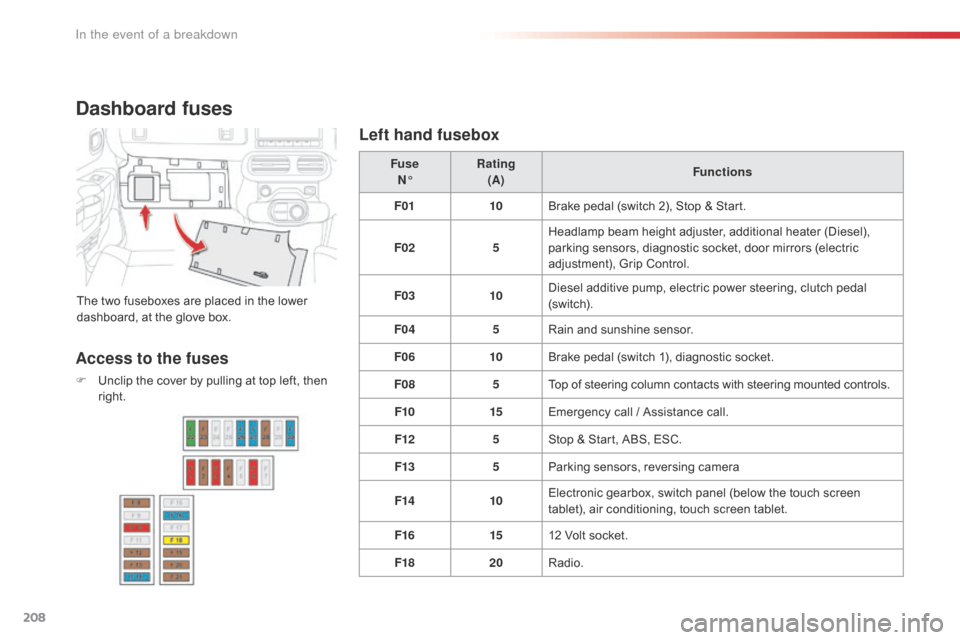
Dashboard fuses
The two fuseboxes are placed in the lower dashboard, at the glove box. Fuse
N° Rating
(A) Functions
F01 10Brake pedal (switch 2), Stop & Start.
F02 5Headlamp beam height adjuster, additional heater (Diesel),
p
arking sensors, diagnostic socket, door mirrors (electric
a
djustment), Grip Control.
F03 10Diesel additive pump, electric power steering, clutch pedal (
sw i tc h).
F04 5Rain
and sunshine sensor.
F06 10Brake
pedal (switch 1), diagnostic socket.
F08 5Top
of steering column contacts with steering mounted controls.
F10 15Emergency
call / Assistance call.
F12 5Stop
& Start, ABS, ESC.
F13 5Parking
sensors, reversing camera
F14 10Electronic
gearbox, switch panel (below the touch screen
t
ablet), air conditioning, touch screen tablet.
F16 1512
Volt socket.
F18 20Radio.
Access to the fuses
F Unclip the cover by pulling at top left, then r
ight.
Left hand fusebox
In the event of a breakdown