weight Citroen C4 CACTUS 2016 1.G Owner's Manual
[x] Cancel search | Manufacturer: CITROEN, Model Year: 2016, Model line: C4 CACTUS, Model: Citroen C4 CACTUS 2016 1.GPages: 308, PDF Size: 7.96 MB
Page 5 of 308
.
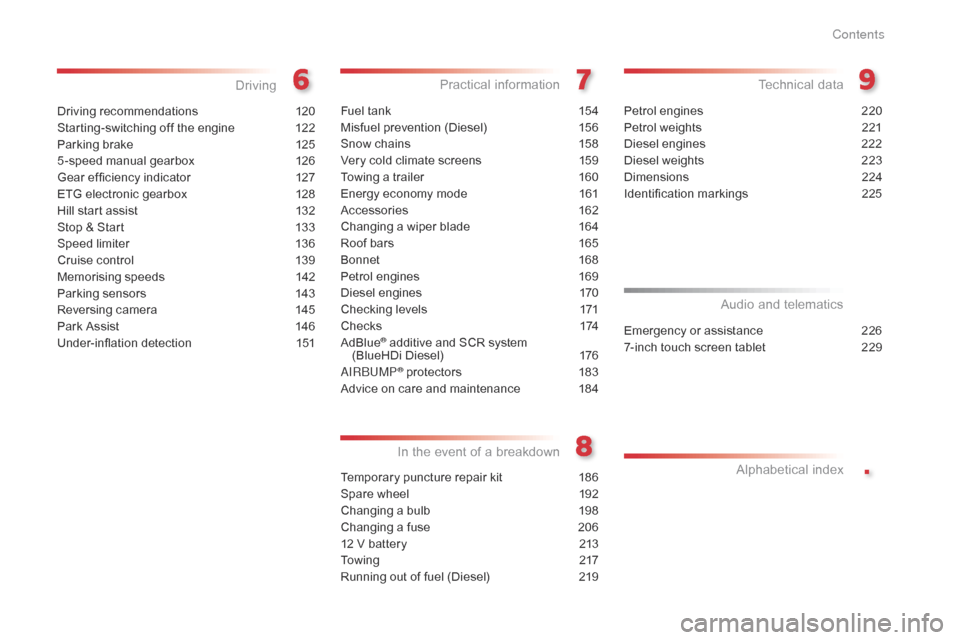
Driving recommendations 120
Starting-switching off the engine
1
22
Parking
brake
1
25
5 -speed
manual gearbox
1
26
Gear
ef ficiency indicator
1
27
ETG
electronic gearbox
1
28
Hill
start assist
1
32
Stop
& Start
1
33
Speed
limiter
1
36
Cruise
control
1
39
Memorising
speeds
1
42
Parking
sensors
1
43
Reversing
camera
1
45
Park
Assist
1
46
Under-inflation
d
etection
1
51
Driving
Fuel tank 154
Misfuel prevention (Diesel)
1
56
Snow
chains
1
58
Very
cold climate screens
1
59
Towing
a trailer
1
60
Energy
economy mode
1
61
Accessories
1
62
Changing
a wiper blade
1
64
Roof
bars
1
65
Bonnet
16
8
Petrol
engines
1
69
Diesel
engines
1
70
Checking
levels
1
71
C h e c k s
1
74
AdBlue
® additive and SCR system
(
BlueHDi Diesel) 1 76
AIRBUMP
® protectors 1 83
Advice
on
care and maintenance
1
84
Practical information
Temporary puncture repair kit 1 86
Spare wheel
1
92
Changing
a bulb
1
98
Changing
a fuse
2
06
12
V battery
2
13
To w i n g
2
17
Running
out of fuel (Diesel)
2
19
In the event o f a b reakdown
Petrol engines 2 20
Petrol weights
2
21
Diesel
engines
2
22
Diesel
weights
2
23
Dimensions
2
24
Identification
ma
rkings
2
25
Technical data
Emergency or assistance 2 26
7-inch touch screen tablet
2
29
Audio and telematics
Alphabetical
in
dex
Contents
Page 10 of 308

8
Running out of fuel, Diesel (priming pump) 2 19
AdBlue
® additive and SCR system (
BlueHDi Diesel) 1 76 -182
Maintenance - Technical data
Checking levels 1 71-173
- o il
-
b
rake fluid
-
c
oolant
-
s
creenwash fluid
-
a
dditive (Diesel with particle filter)
Checking
components
1
74-175
-
b
attery
-
a
ir / passenger compartment filter
-
o
il filter
-
p
article filter (Diesel)
-
b
rake pads / discs
Changing
bu
lbs
1
98-205
-
f
ront lamps
-
r
ear lamps
-
i
nterior
l
ighting Dimensions
2
24
Identification
ma
rkings
2
25
Petrol
weights
2
21
Diesel weights
2
23
Opening the bonnet
1
68
Under
the bonnet, petrol
1
69
Under
the bonnet, Diesel
1
70
Petrol
engines
2
20
Diesel
engines
2
22
12V
battery
2
13 -216
Load reduction, economy mode
1
61
Engine
c
ompartment
f
uses
2
06 -207, 211-212
Over view
Page 107 of 308
105
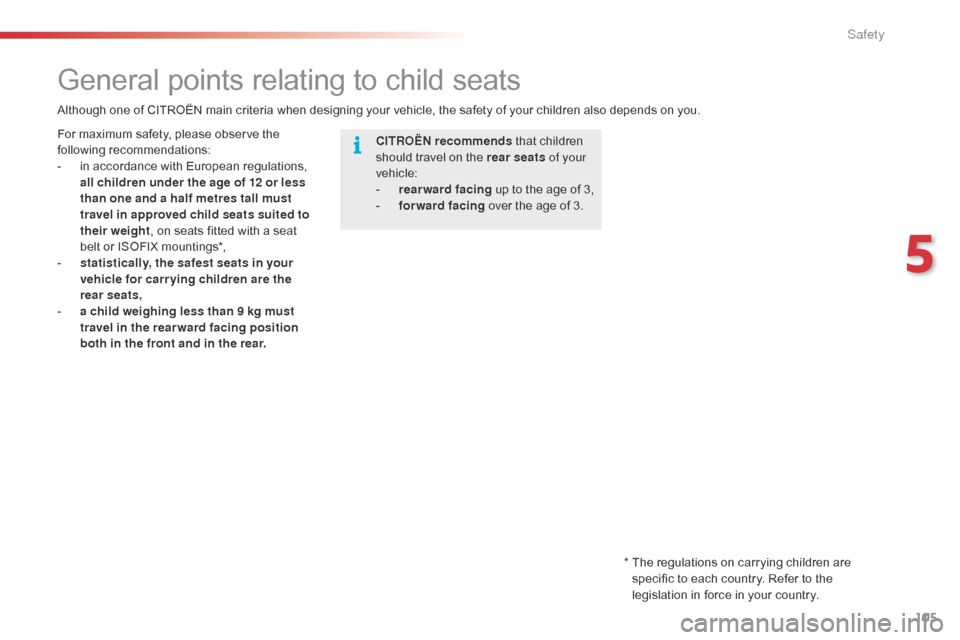
General points relating to child seats
CITROËN recommends that children s
hould travel on the rear seats of your
vehicle:
-
r
earward facing
up to the age of 3,
-
fo
rward facing
over the age of 3.
Although
one
of
CITROËN
main
criteria
when
designing
your vehicle, the safety of your children also depends on you.
For
maximum
safety,
please
observe
the
f
ollowing r
ecommendations:
-
i
n
accordance
with
European
regulations,
a
ll children under the age of 12 or less
than one and a half metres tall must
travel in approved child seats suited to
their weight ,
on
seats
fitted
with
a
seat
b
elt
or
ISOFIX
mountings*,
-
s
tatistically, the safest seats in your
vehicle for carr ying children are the
rear seats,
-
a c
hild weighing less than 9 kg must
travel in the rear ward facing position
both in the front and in the rear.
*
T
he regulations on carrying children are
s
pecific to each country. Refer to the
l
egislation in force in your country.
5
Safety
Page 114 of 308
112
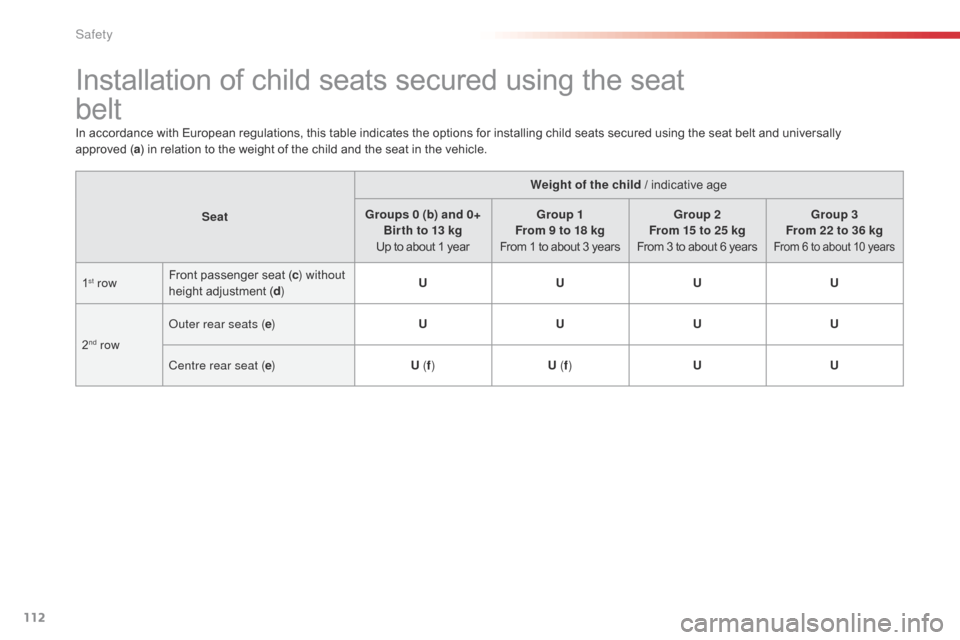
Installation of child seats secured using the seat
bel t
In accordance with European regulations, this table indicates the options for installing child seats secured using the seat belt and universally a
pproved ( a)
in relation to the weight of the child and the seat in the vehicle.
Seat Weight of the child /
indicative age
Groups 0 (b) and 0+ Bir th to 13 kg
Up
to about 1 yearGroup 1
From 9 to 18 kg
From
1 to about 3 yearsGroup 2
From 15 to 25 kg
From
3 to about 6 yearsGroup 3
From 22 to 36 kg
From 6 to about 10 years
1st row Front passenger seat (
c ) without
height adjustment (d ) U
UUU
2
nd row Outer rear seats (
e) UUUU
Centre rear seat ( e) U (f) U (f) U U
Safety
Page 118 of 308
116
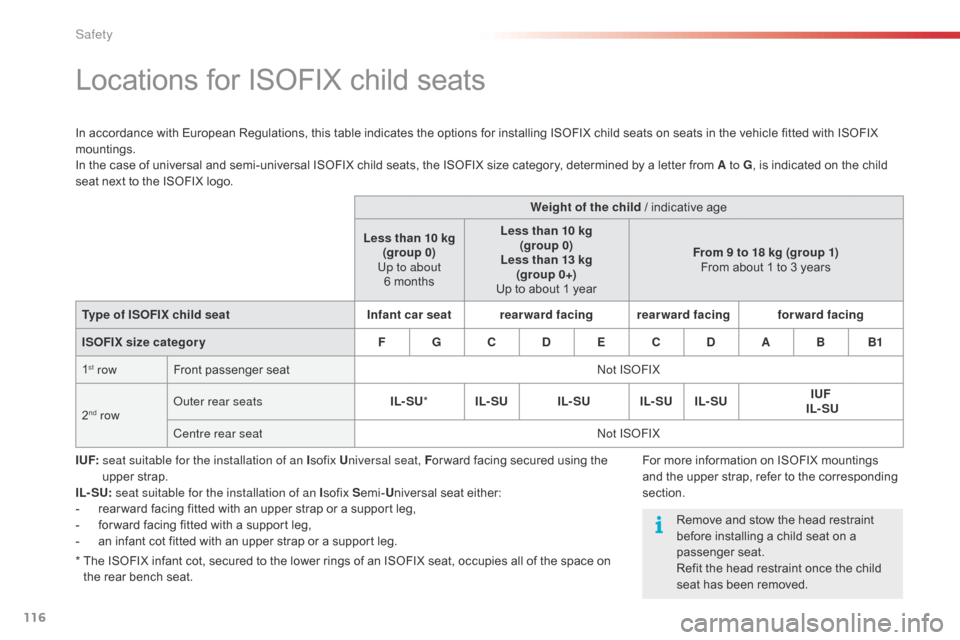
Locations for ISOFIX child seats
In accordance with European Regulations, this table indicates the options for installing ISOFIX child seats on seats in the vehicle fitted with ISOFIX mountings.
In
the case of universal and semi-universal ISOFIX child seats, the ISOFIX size category, determined by a letter from A to G,
is indicated on the child
s
eat next to the ISOFIX logo.
I UF:
s
eat suitable for the installation of an I sofix
Universal seat, F or ward
facing secured using the
u
pper strap.
IL- SU: seat suitable for the installation of an I sofix
Semi- Universal
sea
t
ei
ther:
-
r
ear ward facing fitted with an upper strap or a support leg,
-
f
or ward facing fitted with a support leg,
-
a
n infant cot fitted with an upper strap or a support leg.Weight of the child
/ indicative age
Less than 10 kg (group 0)
Up to about 6 months Less than 10 kg
(group 0)
Less than 13 kg (group 0+)
Up
to about 1 yearFrom 9 to 18 kg (group 1)
From
about 1 to 3 years
Type of ISOFIX child seat Infant car seatrearward facing rearward facing forward facing
ISOFIX size categor y F G C D E C D A B B1
1
st row Front p assenger sea t Not ISOFIX
2
nd row Outer rear seats
IL- SU* IL- SU IL- SU IL- SU IL- SU IUF
IL- SU
Centre rear seat Not ISOFIX
Remove
and stow the head restraint
b
efore installing a child seat on a
p
assenger
sea
t.
Refit
the head restraint once the child
s
eat has been removed.
For
more information on ISOFIX mountings
a
nd the upper strap, refer to the corresponding
s
ection.
*
T
he ISOFIX infant cot, secured to the lower rings of an ISOFIX seat, occupies all of the space on
t
he rear bench seat.
Safety
Page 123 of 308
121
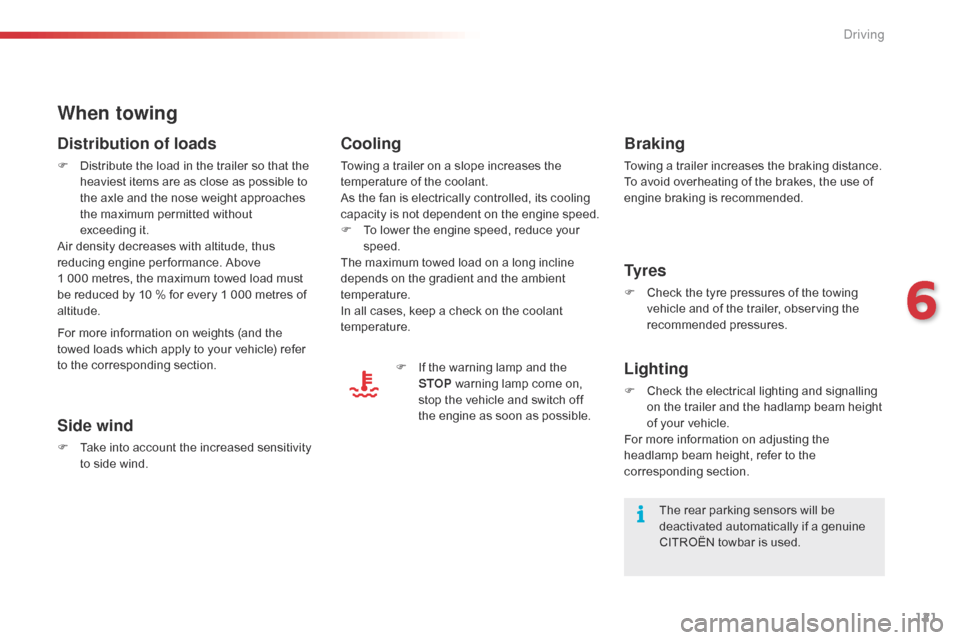
When towing
Distribution of loads
F Distribute the load in the trailer so that the h
eaviest items are as close as possible to
t
he axle and the nose weight approaches
t
he maximum permitted without
e
xceeding it.
Air
density decreases with altitude, thus
r
educing engine per formance. Above
1 0
00 metres, the maximum towed load must
b
e reduced by 10 % for every 1 000 metres of
al
titude.
For
more information on weights (and the
t
owed loads which apply to your vehicle) refer
t
o the corresponding section.
Side wind
F Take into account the increased sensitivity t
o side wind.
Cooling
Towing a trailer on a slope increases the temperature of the coolant.
As
the fan is electrically controlled, its cooling
c
apacity is not dependent on the engine speed.
F
T
o lower the engine speed, reduce your
s
peed.
The
maximum towed load on a long incline
d
epends on the gradient and the ambient
t
emperature.
In
all cases, keep a check on the coolant
t
emperature. F
I
f the warning lamp and the
S
TOP
warning lamp come on,
s
top the vehicle and switch off
t
he engine as soon as possible.
Braking
Towing a trailer increases the braking distance.
T o avoid overheating of the brakes, the use of
e
ngine braking is recommended.
Ty r e s
F Check the tyre pressures of the towing v
ehicle and of the trailer, observing the
re
commended
p
ressures.
Lighting
F Check the electrical lighting and signalling o
n the trailer and the hadlamp beam height
o
f your vehicle.
For
more information on adjusting the
h
eadlamp beam height, refer to the
c
orresponding
s
ection.
The
rear parking sensors will be
d
eactivated automatically if a genuine
C
ITROËN towbar is used.
6
Driving
Page 162 of 308
160
When not towing a trailer, remove the quickly-detachable tow ball before
d
riving.
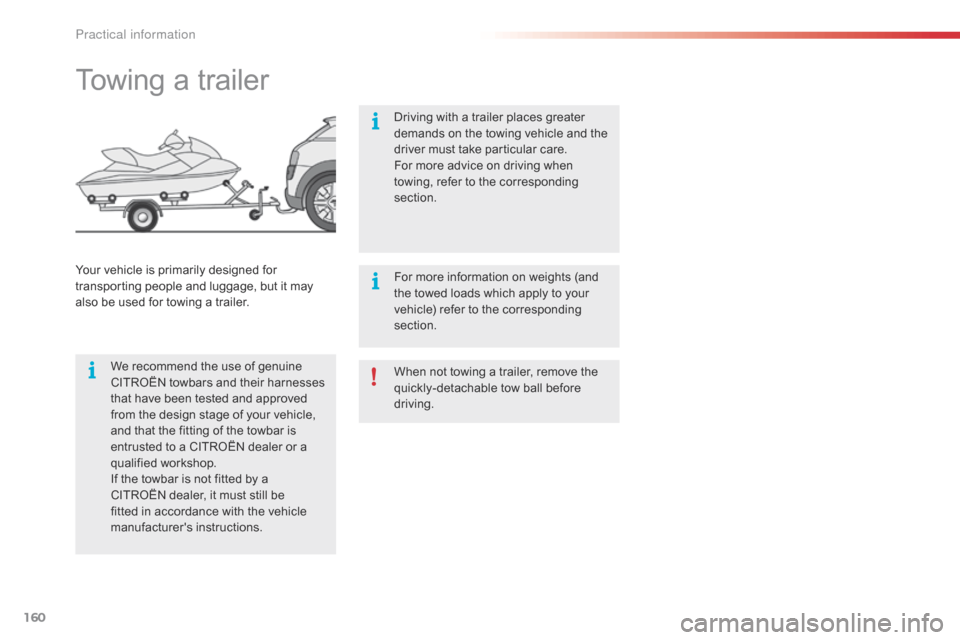
Towing a trailer
We recommend the use of genuine C ITROËN towbars and their harnesses
t
hat have been tested and approved
f
rom the design stage of your vehicle,
a
nd that the fitting of the towbar is
e
ntrusted to a CITROËN dealer or a
q
ualified
w
orkshop.
If
the towbar is not fitted by a
C
ITROËN dealer, it must still be
f
itted in accordance with the vehicle
m
anufacturer's
i
nstructions.
Your
vehicle is primarily designed for
t
ransporting people and luggage, but it may
a
lso
be used for towing a trailer. Driving with a trailer places greater
d
emands on the towing vehicle and the
d
river must take particular care.
For more advice on driving when
t
owing, refer to the corresponding
s
ection.
For more information on weights (and
t
he towed loads which apply to your
v
ehicle) refer to the corresponding
s
ection.
Pr
Page 219 of 308
217
To w i n g
General recommendations
Observe the legislation in force in your country.
E nsure that the weight of the towing vehicle is higher than that of the towed vehicle.
The
driver must remain at the wheel of the towed vehicle and must have a valid driving licence.
When
towing a vehicle with all four wheels on the ground, always use an approved towing arm;
r
ope and straps are prohibited.
The
towing vehicle must move off gently.
When
towing a vehicle with the engine off, there is no longer any power assistance for braking
o
r steering.
In
the following cases, you must always call on a professional recovery service:
-
v
ehicle broken down on a motor way or fast road,
-
f
our-wheel drive vehicle,
-
w
hen it is not possible to put the gearbox into neutral, unlock the steering, or release the
par
king
b
rake,
-
t
owing with only two wheels on the ground,
-
w
here there is no approved towing arm available...
Procedure
for
having
your
vehicle
towed
or
for
towing
another vehicle using a removable towing eye.
The towing eye
is
stowed
under
the
boot
floor,
o
r
may
be
located
under
the
front
passenger
sea
t, d
epending o
n v
ersion.
8
In the event of a breakdown
Page 223 of 308
221
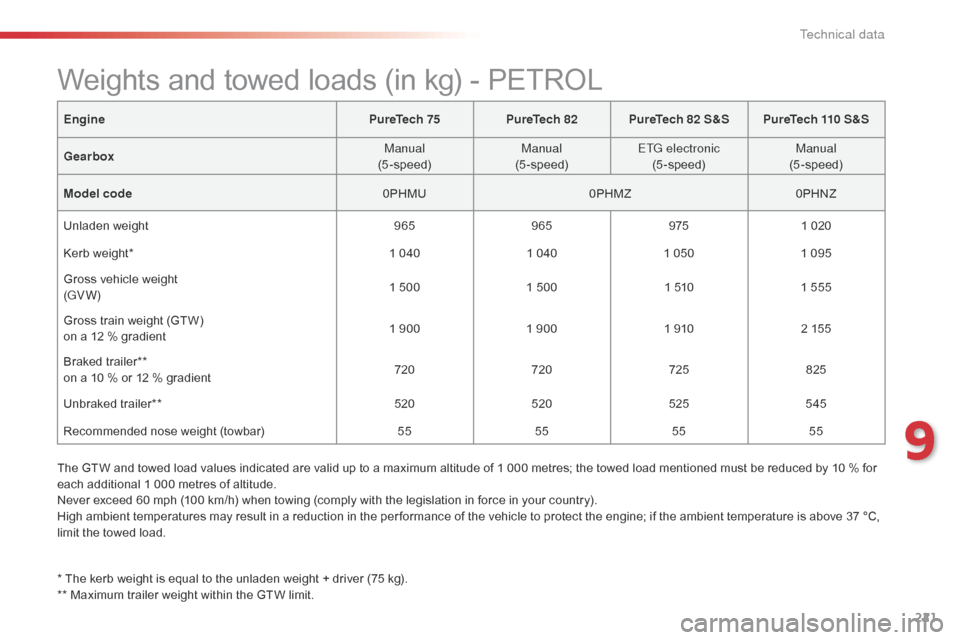
EnginePureTech 75PureTech 82 PureTech 82 S&SPureTech 110 S&S
Gearbox Manual
(5-speed) Manual
(5-speed) ETG electronic
(5-speed) Manual
(5-speed)
Model code 0PHMU0PHMZ0PHNZ
Unladen
weight 965965 9751
020
Kerb
weight* 1
0401
0401
0501
095
Gross
vehicle weight
(GV W) 1
5001
5001
5101
555
Gross
train weight (GTW)
on
a 12 % gradient 1
9001
9001
9102
155
Braked
trailer**
o
n a 10 % or 12 % gradient 720
720 725825
Unbraked
t
railer** 520520 525545
Recommended
nose weight (towbar) 55555555
Weights and towed loads (in kg) - PETROL
The GTW and towed load values indicated are valid up to a maximum altitude of 1 000 metres; the towed load mentioned must be reduced by 10 % for e
ach additional 1 000 metres of altitude.
Never
exceed 60 mph (100 km/h) when towing (comply with the legislation in force in your country).
High
ambient temperatures may result in a reduction in the per formance of the vehicle to protect the engine; if the ambient temperature is above 37 °C,
l
imit the towed load.
*
The kerb weight is equal to the unladen weight + driver (75 kg).
**
Maximum trailer weight within the GTW limit.
9
Technical data
Page 225 of 308
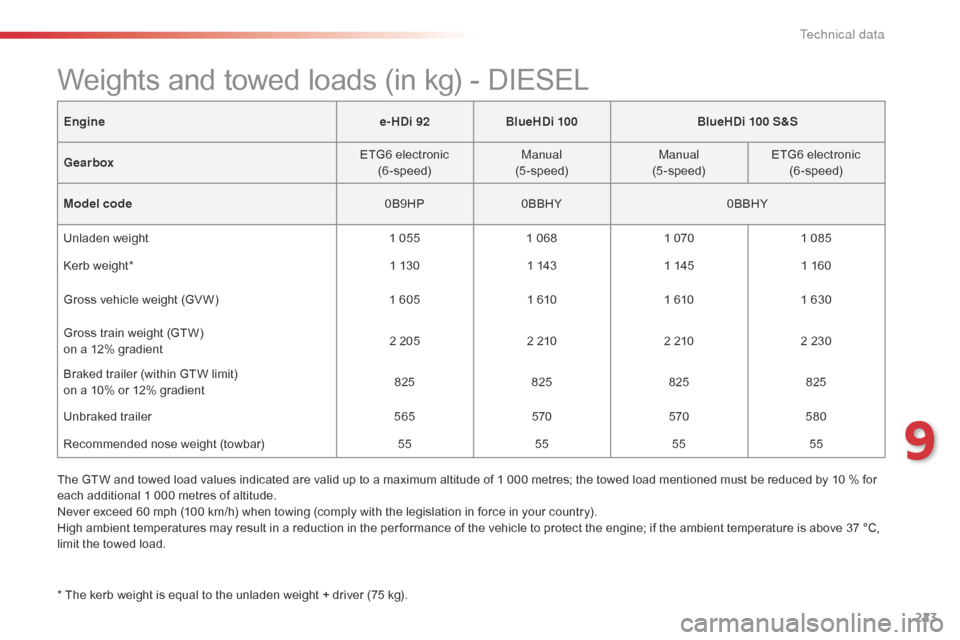
223
Enginee-HDi 92BlueHDi 100 BlueHDi 100 S&S
Gearbox ETG6
e
lectronic
(6-speed) Manual
(5-speed) Manual
(5-speed) ETG6
e
lectronic
(6-speed)
Model code 0B9HP0BBHY 0BBHY
Unladen
weight 1
0551
0681
0701
085
Kerb
weight* 1
1301
1431
1451
160
Gross
vehicle weight (GV W) 1
6051
6101
6101
630
Gross
train weight (GTW)
o
n a 12% gradient 2
2052
2102
2102
230
Braked
trailer (within GTW limit)
on
a 10% or 12% gradient 825
825825825
Unbraked
t
railer 565570570580
Recommended
nose weight (towbar) 55555555
Weights and towed loads (in kg) - DIESEL
* The kerb weight is equal to the unladen weight + driver (75 kg).
T he GTW and towed load values indicated are valid up to a maximum altitude of 1 000 metres; the towed load mentioned must be reduced by 10 % for
e
ach additional 1 000 metres of altitude.
Never exceed 60 mph (100 km/h) when towing (comply with the legislation in force in your country).
High ambient temperatures may result in a reduction in the per formance of the vehicle to protect the engine; if the ambient temperature is above 37 °C,
l
imit the towed load.
9
Technical data