parking brake CITROEN C4 CACTUS 2022 User Guide
[x] Cancel search | Manufacturer: CITROEN, Model Year: 2022, Model line: C4 CACTUS, Model: CITROEN C4 CACTUS 2022Pages: 256, PDF Size: 7.62 MB
Page 103 of 256

101
As a safety precaution and to facilitate
starting the engine:
-
a
lways select neutral,
-
p
ress the clutch pedal.
Automatic gearbox (EAT6)
Six-speed automatic gearbox which offers a
choice between the comfort of fully automatic
operation, enhanced by a sport programme, or
manual gear changing.
Two driving modes are available:
-
a
utomatic operation with electronic
management of the gears by the gearbox,
with a sport programme for a more dynamic
driving style,
-
man
ual operation for sequential changing
of the gears by the driver.
1. Gear selector.
2. "S " (spor t) button.
Gear selector positions
Displays in the instrument panel3.Gear selector positions graphic.
P. Parking.
-
I
mmobilisation of the vehicle, parking brake
on or off.
-
S
tarting the engine.
R. Reverse.
-
R
eversing manoeuvres, vehicle stationary,
engine at idle.
N. Neutral.
-
I
mmobilisation of the vehicle, parking brake
on.
-
S
tarting the engine.
D. Automatic operation.
M +/-. Manual operation with sequential
changing of the six gears.
F
P
ull back to change up a gear.
or
F
P
ush forwards to change down a gear. P.
Parking.
R. Reverse.
N. Neutral.
D. Drive (automatic driving).
S. Sport programme.
1 2 3 4 5 6. Gears engaged during manual
operation
-. Invalid value during manual
operation.
Foot on brake
F Press the brake pedal when
this indicator lamp is displayed
on the instrument panel (e.g.
starting the engine).
When you move the selector to select a
position, the corresponding indicator is
displayed in the instrument panel.
6
Driving
Page 104 of 256

102
Starting the vehicle
F Apply the parking brake.
F Sel ect position P or N .
F
S
tart the engine.
If these conditions are not met, there is an
audible signal, accompanied by the display of a
warning message.
F
W
ith the engine running, press the brake
pedal.
F
R
elease the parking brake.
F
Sel
ect position R , D or M.
F
G
radually release the brake pedal.
The vehicle moves off immediately.
If position N is selected inadvertently while
driving, allow the engine to return to idle,
then select position D to accelerate.
If the temperature is below -23°C, the
engine should be left at idle for four
minutes, to ensure the correct operation
and longevity of the engine and gearbox. When the engine is running at idle, with
the brakes released, if position R
, D or
M is selected, the vehicle moves even
without the accelerator being pressed.
Do not leave children unsuper vised inside
the vehicle when the engine is running.
When carrying out maintenance with the
engine running, apply the parking brake
and select position P .
Automatic operation
F Select position D for automatic changing of
the six gears.
The gearbox then operates in auto-adaptive
mode, without any action needed from the
driver. It continuously selects the most suitable
gear according to the style of driving, the profile
of the road and the load in the vehicle.
For maximum acceleration without touching
the selector, press the accelerator pedal down
fully (kick down). The gearbox changes down
automatically or maintains the gear selected
until the maximum engine speed is reached.
On braking, the gearbox changes down
automatically to provide efficient engine
braking. If you release the accelerator sharply, the
gearbox will not change to a higher gear for
safety reasons.
Never select position N while the vehicle
is moving.
Never select position P or R unless the
vehicle is completely stationary.
Sport programme "S"
F Press button S, after starting the engine.
The gearbox automatically favours a dynamic
style of driving.
S appears in the instrument panel.
Return to standard
automatic operation
F At any time, press the selected button again to quit the programme engaged and return
to auto-adaptive mode.
Manual operation
F Select position M for sequential changing
of the six gears.
Driving
Page 105 of 256

103
F Move the selector towards the + sign to change up a gear.
F
M
ove the selector towards the - sign to
change down a gear.
It is only possible to change from one gear to
another if the vehicle speed and engine speed
permit; otherwise, the gearbox will operate
temporarily in automatic mode.
D disappears, and the gears engaged appear
in succession on the instrument panel.
If the engine speed is too low or too high, the
selected gear flashes for a few seconds, then
the actual gear engaged is displayed.
It is possible to change from position D
(automatic) to position M (manual) at any time.
When the vehicle is stationary or moving
very slowly, the gearbox engages first gear
automatically.
The sport programme is inactive in manual
operation.
Invalid value during manual
operation
This symbol is displayed if a gear
is not engaged correctly (selector
between two positions).
Stopping the vehicle
Before switching off the engine, you can
engage position P or N to place the gearbox in
neutral.
In both cases, apply the parking brake to
immobilise the vehicle.
If the selector is not in position P , when the
driver's door is opened or approximately
45 seconds after the ignition is switched
off, a warning message appears in the
screen.
F
R
eturn the selector to position P ; the
message disappears.
When driving on flooded roads or when
crossing a ford, proceed at walking pace.
Malfunction
When the ignition is on, the lighting
of this warning lamp, associated
with an audible signal and an alert
message on the screen, indicates a
gearbox fault.
In this case, the gearbox switches to back-up
mode and is locked in 3
rd gear. You may feel a
substantial jolt when changing from P to R and
from N to R. This will not cause any damage to
the gearbox. There is a risk of damage to the gearbox:
-
i
f you press the accelerator and brake
pedals at the same time,
-
i
f you force the movement of the
selector from position P to another
position when the battery is flat.
To reduce fuel consumption when at
a prolonged standstill with the engine
running (traffic jam, etc.), put the
selector in position N and apply the
parking brake.
If your vehicle has an automatic gearbox,
never try to start the engine by pushing
the vehicle.
Do not exceed 62 mph (100 km/h), local speed
restrictions permitting.
Contact a CITROËN dealer or a qualified
workshop as soon as possible.
Electronic gearbox
(ETG 6)
Six-speed electronic gearbox offering
automatic gear control, without driver
intervention.
You can temporarily take control of gear
changes at any time, using the steering
mounted control paddles.
6
Driving
Page 107 of 256

105
F Release the parking brake.
F P rogressively release the brake pedal.
The vehicle moves off immediately.
Creep function
This function facilitates manoeuvring of the
vehicle at low speed (when parking, in traffic
jams, etc.).
After pressing control D or R , the vehicle
moves as soon as you take your foot off the
brake pedal , at low speed and with the engine
at idle.
Never leave children unattended in the
vehicle when the engine is running.
The creep function may be temporarily
unavailable if the clutch temperature is too
high or the slope too steep.
Forward drive
F Press control D .
The indicator lamp in the control comes on.
D and the gear engaged appear in the
instrument panel. The gearbox then operates in auto-active
mode, without any inter vention on the part
of the driver. It continuously selects the most
suitable gear according to the following
parameters:
-
f
uel consumption optimisation,
-
d
riving style,
-
r
oad conditions,
-
v
ehicle load.
For optimum acceleration, when
overtaking another vehicle for example,
fully depress the accelerator pedal,
beyond the point of resistance.
Never select neutral (position N ) when
moving.
Do not press the brake and accelerator
pedals at the same time: this could cause
very rapid wear of the clutch.
Temporary control of gear
changing
Reverse gear
You can temporarily take over control of gear
changes using the steering mounted + and -
control paddles: if the engine speed allows, the
gear change is carried out.
This function allows you to anticipate certain
situations, such as overtaking another vehicle
or approaching a bend in the road.
After a few moments with no action on the
control paddles, the gearbox returns to
automatic operation.
To engage reverse gear, the vehicle must be
stationary with your foot on the brake pedal.
F
P
ress control R .
The indicator lamp in the control comes on.
6
Driving
Page 108 of 256

106
There is an audible signal upon
engagement of reverse.
If reverse gear is requested when moving, the
warning lamp N flashes and the gearbox goes
into neutral automatically.
To engage reverse, stop the vehicle then, with
your foot on the brake pedal, press control N ,
then R .
Stopping the vehicle
Before switching off the engine, you can:
-
p ress control N to be in neutral,
or
-
l
eave the vehicle in gear; in this case the
vehicle cannot be moved.
For all parking situations, you must apply
the parking brake to immobilise the
vehicle.
When immobilising the vehicle with the
engine running, you must select neutral N .Before doing anything under the bonnet,
ensure that control N has been pressed
and that the parking brake is applied.
Operating fault
With the ignition on, illumination of
this warning lamp, accompanied by
an audible signal and a message,
indicates a gearbox fault.
Have it checked by a CITROËN dealer or a
qualified workshop.
Gear efficiency indicator
This system helps reduce fuel consumption by
recommending the most appropriate gear.
Operation
Depending on the driving situation and your
vehicle's equipment, the system may advise
you to skip one (or more) gear(s). You can
follow this instruction without engaging the
intermediate gears. The system is only active on vehicles fitted
with a manual gearbox.
On certain BlueHDi Diesel versions with
manual gearbox, in certain driving conditions
the system may suggest changing into neutral
so that the engine can go into standby (STOP
mode with Stop & Start). In this case, N is
displayed in the instrument panel.
Example:
-
Y
ou are in third gear.
-
Y
ou press the accelerator pedal.
-
T
he system may suggest that you engage a
higher gear.
Gear efficiency recommendations are for
information only. In fact, the road layout, the
traffic density and safety remain the deciding
factors when choosing the best gear. The driver
therefore remains responsible for deciding
whether or not to follow the indications issued
by the system.
This function cannot be disabled.
The information appears in the instrument
panel in the form of an arrow.
Driving
Page 109 of 256

107
The system adapts its gear change
recommendation according to the
driving conditions (slope, load, etc.)
and the demands of the driver (power,
acceleration, braking, etc.).
The system never suggests:
-
e
ngaging first gear,
-
enga
ging reverse gear.
-
enga
ging a lower gear.
On vehicle fitted with a manual gearbox,
the arrow may be accompanied by the
gear recommended.
Hill start assist
System which keeps your vehicle stationary
for a short time (approximately two seconds)
when starting on a gradient, the time it takes
to move your foot from the brake pedal to the
accelerator pedal.
It is only active when:
-
t
he vehicle is completely stationary, with
your foot on the brake pedal,
-
c
ertain conditions of gradient are met,
-
t
he driver's door is closed.
The hill start assist system cannot be
deactivated. Do not leave the vehicle while it is being
held temporarily in the hill start assist
phase.
If you need to leave the vehicle with the
engine running, apply the parking brake
manually then ensure that the parking
brake warning lamp is showing fixed on
the instrument panel.
Operating fault
On an ascending slope, with the vehicle
stationar y, the vehicle is held for a shor t
time when you release the brake pedal.
With a manual gearbox
, if you are in first gear
or in neutral.
With an automatic gearbox , if you are in D
or M .
With an electronic gearbox , if you are in D.On a descending slope, with the vehicle
stationary and reverse gear engaged, the
vehicle is held for a shor t time when you
release the brake pedal.
If a fault in the system occurs, this warning
lamp comes on accompanied by a message.
Contact a CITROËN dealer or a qualified
workshop to have the system checked.
Stop & Start
The Stop & Start system puts the engine
t emporarily into standby – STOP mode – during
stops in traffic (red lights, traffic jams, etc.). The
engine restarts automatically – START mode –
as soon as you want to move off.
The restart takes place instantly, quickly and
silently.
6
Driving
Page 110 of 256

108
Per fect for urban use, the Stop & Start system
reduces fuel consumption and exhaust
emissions as well as the noise level when
stationary.
Going into engine STOP
mode
This indicator lamp comes on in the
instrument panel and the engine
goes into standby automatically.
-
W
ith a manual gearbox , at speeds below
2
mph (3 km/h) or with the vehicle stationary
(depending on version), when you place the
gear lever in neutral and release the clutch
pedal,
-
W
ith an automatic gearbox , at speeds
below 2 mph (3 km/h), or when the vehicle
is stationary (depending on version), when
you press the brake pedal or place the gear
selector into position N .
-
W
ith an electronic gearbox , at speeds
below 2 mph (3 km/h), or when the vehicle
is stationary (depending on version), when
you press the brake pedal or place the gear
selector into position N .
Time counter of the Stop & Star t.
(minutes/seconds or hours/minutes) If your vehicle is fitted with this system, a time
counter calculates the sum of the periods in
STOP mode during a journey.
It resets to zero every time the ignition is
switched on.
For your comfort, during parking
manoeuvres, STOP mode is not available
for a few seconds after coming out of
reverse gear.
The Stop & Start system does not affect
the functionality of the vehicle, such as for
example, braking, power steering, etc.
Never refuel with the engine in STOP
mode; you must switch off the ignition with
the "START/STOP" button.
Special cases: STOP mode not
available
STOP mode is not activated when:
- t he vehicle is on a steep slope (uphill or
downhill),
-
t
he driver's door is open,
-
t
he driver's seat belt is not fastened,
-
t
he vehicle has not exceeded 6 mph (10
km/h) since the last engine start,
-
t
he engine is needed to maintain a
comfortable temperature in the passenger
compartment, -
d
emisting is active,
-
s
ome special conditions (battery charge,
engine temperature, braking assistance,
exterior temperature, etc.) where the engine
is needed to control the system.
Going into engine START
mode
This indicator lamp goes off and the
engine starts automatically: In this case, this indicator lamp
flashes for a few seconds then goes
of f.
This operation is perfectly normal.
-
W
ith a manual gearbox , when you fully
depress the clutch pedal.
-
W
ith an automatic gearbox :
•
g
ear selector in position D or M , when
you release the brake pedal,
•
o
r gear selector in position N and brake
pedal released, when you place the gear
selector in position D or M ,
•
o
r when you engage reverse gear.
Driving
Page 141 of 256

139
Installation tips
F If you have to fit the chains during a journey, stop the vehicle on a flat sur face on the side
of the road.
F
A
pply the parking brake and position any
wheel chocks to prevent movement of your
vehicle.
F
F
it the chains following the instructions
provided by the manufacturer.
F
M
ove off gently and drive for a few
moments, without exceeding 31 mph
(50
km/h).
F
S
top your vehicle and check that the snow
chains are correctly tightened.
It is strongly recommended that before
you leave, you practise fitting the snow
chains on a level and dry sur face.
Avoid driving with snow chains on roads
that have been cleared of snow to avoid
damaging your vehicle's tyres and the
road sur face. If your vehicle is fitted with
alloy wheels, check that no part of the
chain or its fixings is in contact with the
wheel rim. Use only the chains designed to be fitted to the
type of wheel fitted to your vehicle:
Very cold climate screens
Removable protective screens which prevent
the accumulation of snow at the radiator
cooling fan.
Before fitting or removing a screen,
ensure that the engine is off and the
cooling fan has stopped.
It is recommended that the screens be
fitted and removed by a CITROËN dealer
or a qualified workshop.
Fitting
Removing
F Unclip one by one the fixing elements of each screen.
Do not forget to remove the very cold
climate screens:
-
w
hen the exterior temperature exceeds
10°C,
-
w
hen towing,
-
a
t speeds above 75 mph (120 km/h).
Original tyre size Chain types
205/55 R16
Maximum 9 mm link
205/50 R17
Cannot be fitted with chains
For more information on snow chains, contact a
CITROËN dealer or a qualified workshop. F
O ffer up the corresponding screen to the
front bumper upper grille.
F
P
ress on the edge to engage its fixing
elements one by one.
Proceed in the same way for the screen on the
lower grille.
7
Practical information
Page 150 of 256
148
As soon as the traffic conditions permit,
regenerate the filter by driving at a speed
of at least 37 mph (60 km/h) until the
warning lamp goes off.
If the warning lamp stays on, this indicates
a low Diesel additive level.
For more information on Checking the
levels and particularly on the level of
Diesel additive, refer to the corresponding
section.
On a new vehicle, the first particle
filter regeneration operations may be
accompanied by a "burning" smell, which
is per fectly normal.
Following prolonged operation of the
vehicle at very low speed or at idle,
you may, in exceptional circumstances,
notice the emission of water vapour at the
exhaust on acceleration. This does not
affect the behaviour of the vehicle or the
environment.
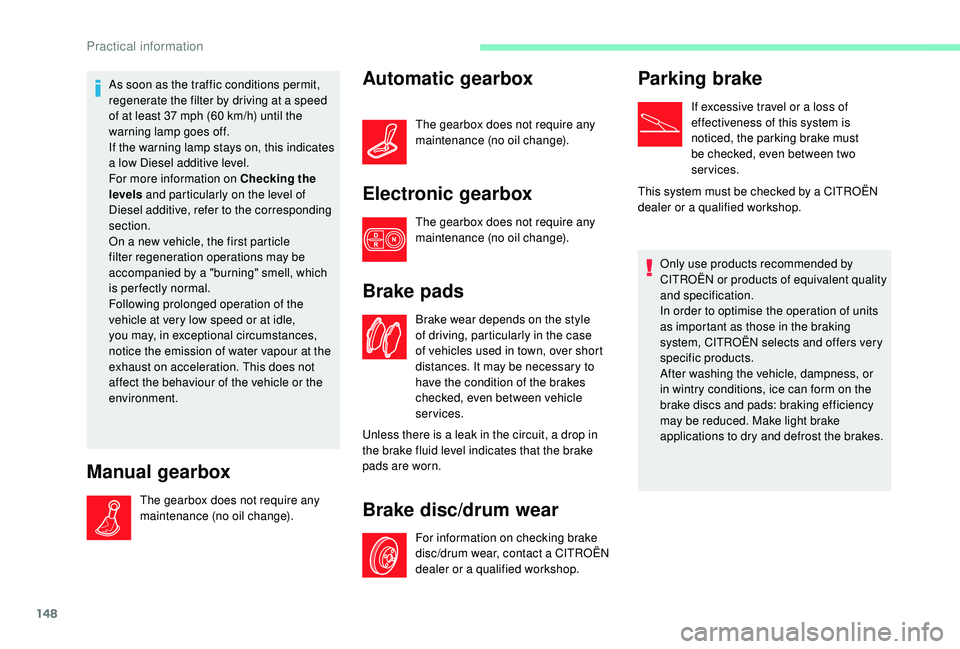
Manual gearbox
The gearbox does not require any
maintenance (no oil change).
Automatic gearbox
The gearbox does not require any
maintenance (no oil change).
Electronic gearbox
The gearbox does not require any
maintenance (no oil change).
Brake pads
Brake wear depends on the style
of driving, particularly in the case
of vehicles used in town, over short
distances. It may be necessary to
have the condition of the brakes
checked, even between vehicle
services.
Unless there is a leak in the circuit, a drop in
the brake fluid level indicates that the brake
pads are worn.
Brake disc/drum wear
For information on checking brake
disc/drum wear, contact a CITROËN
dealer or a qualified workshop.
Parking brake
If excessive travel or a loss of
effectiveness of this system is
noticed, the parking brake must
be checked, even between two
services.
This system must be checked by a CITROËN
dealer or a qualified workshop.
Only use products recommended by
CITROËN or products of equivalent quality
and specification.
In order to optimise the operation of units
as important as those in the braking
system, CITROËN selects and offers very
specific products.
After washing the vehicle, dampness, or
in wintry conditions, ice can form on the
brake discs and pads: braking efficiency
may be reduced. Make light brake
applications to dry and defrost the brakes.
Practical information
Page 156 of 256
154
Under-inflation detection
After repair of the tyre, the warning
lamp will remain on until the system is
reinitialised.
For more information on Tyre under-
inflation detection, refer to the
corresponding section.
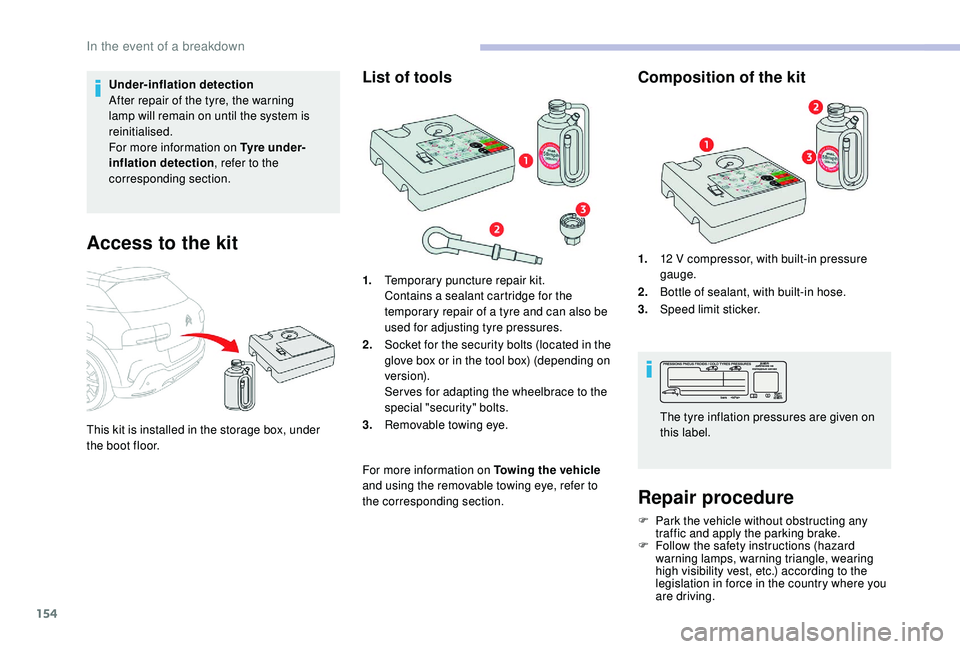
Access to the kit
This kit is installed in the storage box, under
the boot floor.
List of tools
1. Temporary puncture repair kit.
Contains a sealant cartridge for the
temporary repair of a tyre and can also be
used for adjusting tyre pressures.
2. Socket for the security bolts (located in the
glove box or in the tool box) (depending on
ve r s i o n).
Ser ves for adapting the wheelbrace to the
special "security" bolts.
3. Removable towing eye.
For more information on Towing the vehicle
and using the removable towing eye, refer to
the corresponding section.
Composition of the kit
1. 12 V compressor, with built-in pressure
gauge.
2. Bottle of sealant, with built-in hose.
3. Speed limit sticker.
Repair procedure
F Park the vehicle without obstructing any
traffic and apply the parking brake.
F
F
ollow the safety instructions (hazard
warning lamps, warning triangle, wearing
high visibility vest, etc.) according to the
legislation in force in the country where you
are driving. The tyre inflation pressures are given on
this label.
In the event of a breakdown