wheel CITROEN C4 DAG 2013 User Guide
[x] Cancel search | Manufacturer: CITROEN, Model Year: 2013, Model line: C4 DAG, Model: CITROEN C4 DAG 2013Pages: 340, PDF Size: 28.95 MB
Page 91 of 340
4
ACCESS
89
Operating fault
When the ignition is switched on, fi xed
illumination of the indicator lamp in the
button indicates a fault with the system.
Have it checked by a CITROËN dealer
or a qualifi ed workshop.
Locking the vehicle with exterior
perimeter monitoring only
Deactivate the interior volumetric and
anti-tilt monitoring to avoid unwanted
triggering of the alarm in certain cases
such as:
- leaving a pet in the vehicle,
- leaving a window partially open,
- washing your vehicle,
- changing a wheel,
- having your vehicle towed,
- transport by sea.
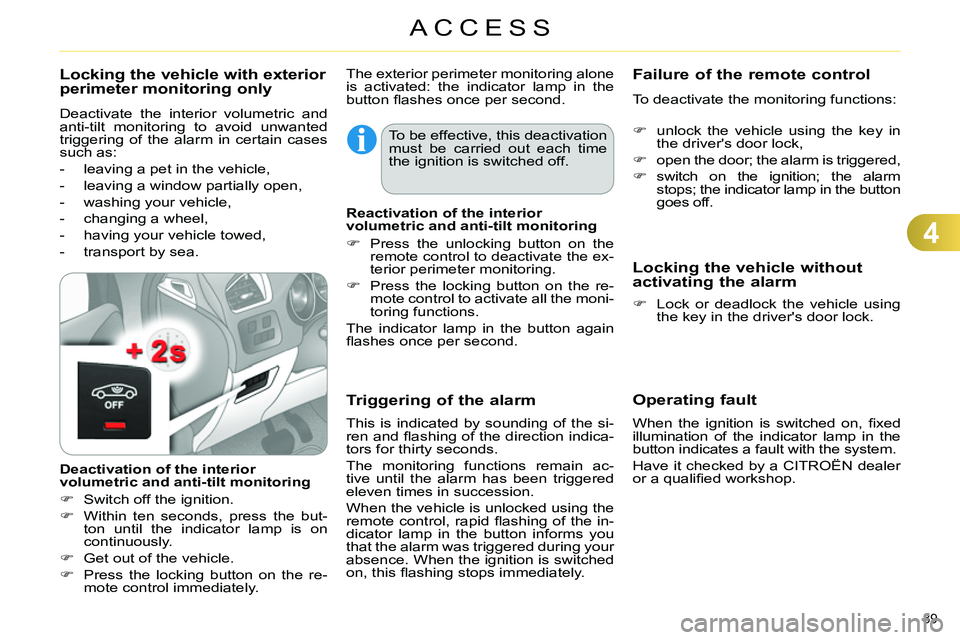
Deactivation of the interior
volumetric and anti-tilt monitoring
Switch off the ignition.
Within ten seconds, press the but-
ton until the indicator lamp is on
continuously.
Get out of the vehicle.
Press the locking button on the re-
mote control immediately. The exterior perimeter monitoring alone
is activated: the indicator lamp in the
button fl ashes once per second.
To be effective, this deactivation
must be carried out each time
the ignition is switched off.
Reactivation of the interior
volumetric and anti-tilt monitoring
Press the unlocking button on the
remote control to deactivate the ex-
terior perimeter monitoring.
Press the locking button on the re-
mote control to activate all the moni-
toring functions.
The indicator lamp in the button again
fl ashes once per second.
Triggering of the alarm
This is indicated by sounding of the si-
ren and fl ashing of the direction indica-
tors for thirty seconds.
The monitoring functions remain ac-
tive until the alarm has been triggered
eleven times in succession.
When the vehicle is unlocked using the
remote control, rapid fl ashing of the in-
dicator lamp in the button informs you
that the alarm was triggered during your
absence. When the ignition is switched
on, this fl ashing stops immediately.
Failure of the remote control
To deactivate the monitoring functions:
unlock the vehicle using the key in
the driver's door lock,
open the door; the alarm is triggered,
switch on the ignition; the alarm
stops; the indicator lamp in the button
goes off.
Locking the vehicle without
activating the alarm
Lock or deadlock the vehicle using
the key in the driver's door lock.
Page 108 of 340
5
VISIBILITY
106
CORNERING LIGHTING
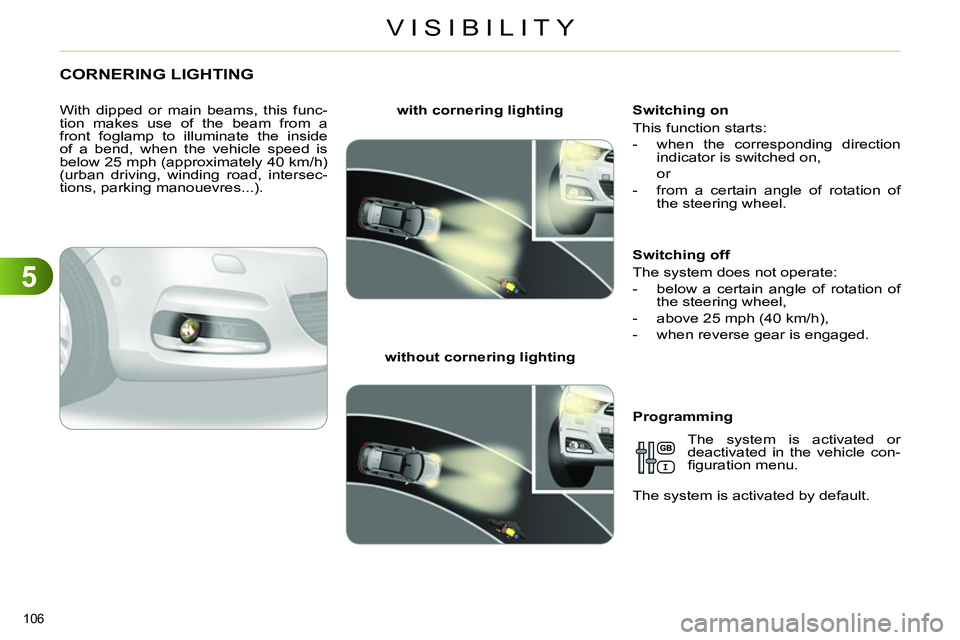
With dipped or main beams, this func-
tion makes use of the beam from a
front foglamp to illuminate the inside
of a bend, when the vehicle speed is
below 25 mph (approximately 40 km/h)
(urban driving, winding road, intersec-
tions, parking manouevres...).
with cornering lighting
without cornering lighting
Switching on
This function starts:
- when the corresponding direction
indicator is switched on,
or
- from a certain angle of rotation of
the steering wheel.
Switching off
The system does not operate:
- below a certain angle of rotation of
the steering wheel,
- above 25 mph (40 km/h),
- when reverse gear is engaged.
Programming
The system is activated or
deactivated in the vehicle con-
fi guration menu.
The system is activated by default.
Page 124 of 340
6
FITTINGS
122
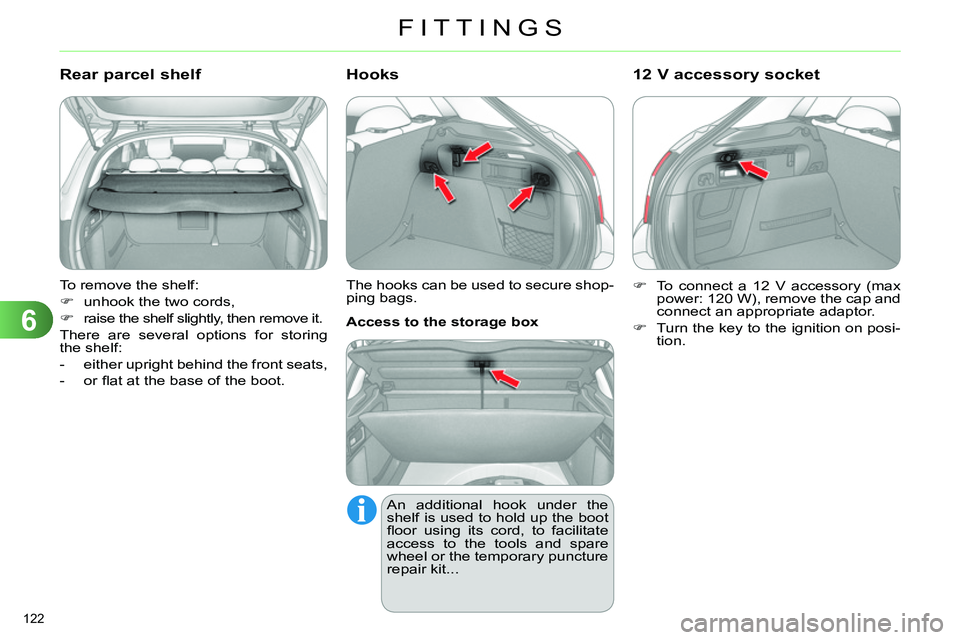
To remove the shelf:
unhook the two cords,
raise the shelf slightly, then remove it.
There are several options for storing
the shelf:
- either upright behind the front seats,
- or fl at at the base of the boot.
Rear parcel shelf
The hooks can be used to secure shop-
ping bags.
Hooks
An additional hook under the
shelf is used to hold up the boot
fl oor using its cord, to facilitate
access to the tools and spare
wheel or the temporary puncture
repair kit...
Access to the storage box
To connect a 12 V accessory (max
power: 120 W), remove the cap and
connect an appropriate adaptor.
Turn the key to the ignition on posi-
tion.
12 V accessory socket
Page 125 of 340
6
FITTINGS
123
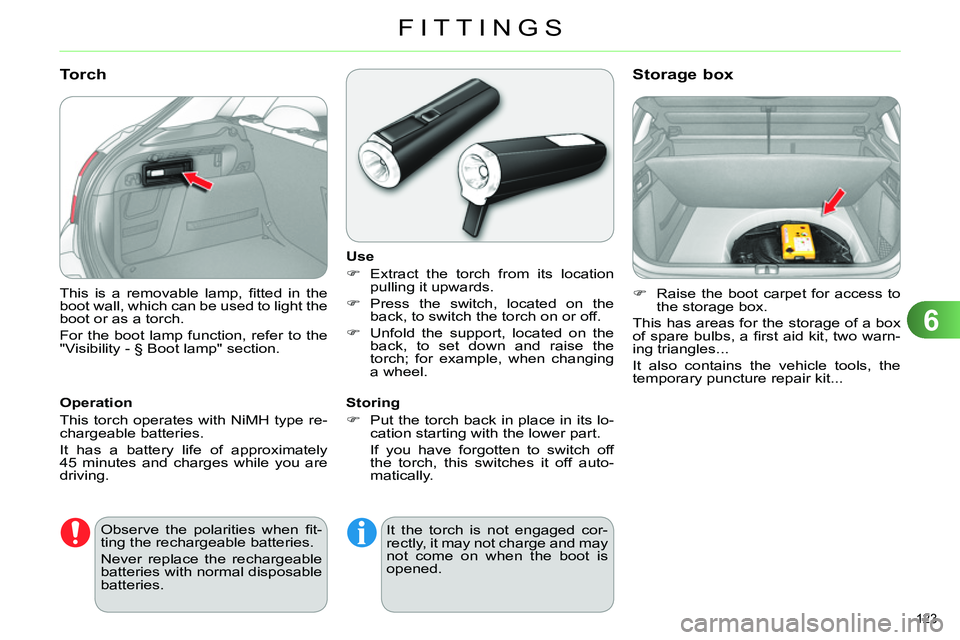
This is a removable lamp, fi tted in the
boot wall, which can be used to light the
boot or as a torch.
For the boot lamp function, refer to the
"Visibility - § Boot lamp" section.
Torch
Operation
This torch operates with NiMH type re-
chargeable batteries.
It has a battery life of approximately
45 minutes and charges while you are
driving.
Use
Extract the torch from its location
pulling it upwards.
Press the switch, located on the
back, to switch the torch on or off.
Unfold the support, located on the
back, to set down and raise the
torch; for example, when changing
a wheel.
Storing
Put the torch back in place in its lo-
cation starting with the lower part.
If you have forgotten to switch off
the torch, this switches it off auto-
matically.
Raise the boot carpet for access to
the storage box.
This has areas for the storage of a box
of spare bulbs, a fi rst aid kit, two warn-
ing triangles...
It also contains the vehicle tools, the
temporary puncture repair kit...
Storage box
Observe the polarities when fi t-
ting the rechargeable batteries.
Never replace the rechargeable
batteries with normal disposable
batteries. It the torch is not engaged cor-
rectly, it may not charge and may
not come on when the boot is
opened.
Page 141 of 340
8
SAFETY
139
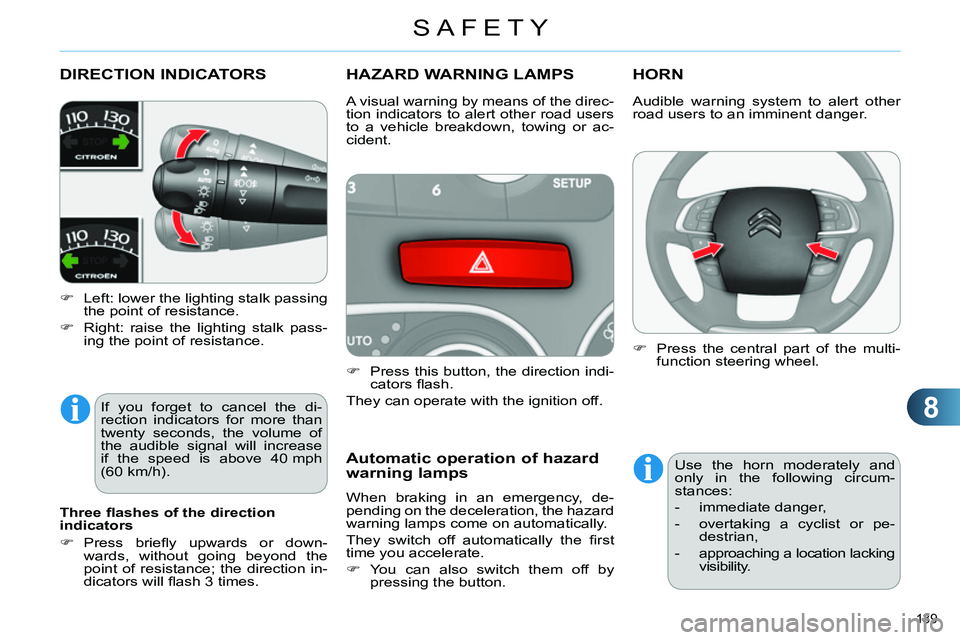
DIRECTION INDICATORS
Left: lower the lighting stalk passing
the point of resistance.
Right: raise the lighting stalk pass-
ing the point of resistance.
HAZARD WARNING LAMPS
Press this button, the direction indi-
cators fl ash.
They can operate with the ignition off.
Automatic operation of hazard
warning lamps
When braking in an emergency, de-
pending on the deceleration, the hazard
warning lamps come on automatically.
They switch off automatically the fi rst
time you accelerate.
You can also switch them off by
pressing the button.
HORN
A visual warning by means of the direc-
tion indicators to alert other road users
to a vehicle breakdown, towing or ac-
cident.
Three fl ashes of the direction
indicators
Press briefl y upwards or down-
wards, without going beyond the
point of resistance; the direction in-
dicators will fl ash 3 times.
If you forget to cancel the di-
rection indicators for more than
twenty seconds, the volume of
the audible signal will increase
if the speed is above 40 mph
(60 km/h). Audible warning system to alert other
road users to an imminent danger.
Press the central part of the multi-
function steering wheel.
Use the horn moderately and
only in the following circum-
stances:
- immediate danger,
- overtaking a cyclist or pe-
destrian,
- approaching a location lacking
visibility.
Page 142 of 340
8
SAFETY
140
BRAKING ASSISTANCE
SYSTEMS
Group of supplementary systems which
help you to obtain optimum braking in
complete safety in emergency situa-
tions:
- anti-lock braking system (ABS),
- electronic brake force distribution
(EBFD),
- emergency braking assistance (EBA).
When braking in an emergency,
press very fi rmly without releas-
ing the pressure.
When replacing wheels (tyres
and rims), ensure that they con-
form to the manufacturer's rec-
ommendations.
When braking in an emergency,
press fi rmly without releasing
the pressure.
Anti-lock braking system
and electronic brake force
distribution
Linked systems which improve the sta-
bility and manoeuvrability of your vehi-
cle when braking, in particular on poor
or slippery surfaces.
Activation
The anti-lock braking system comes
into operation automatically when there
is a risk of wheel lock.
Normal operation of the ABS may make
itself felt by slight vibration of the brake
pedal.
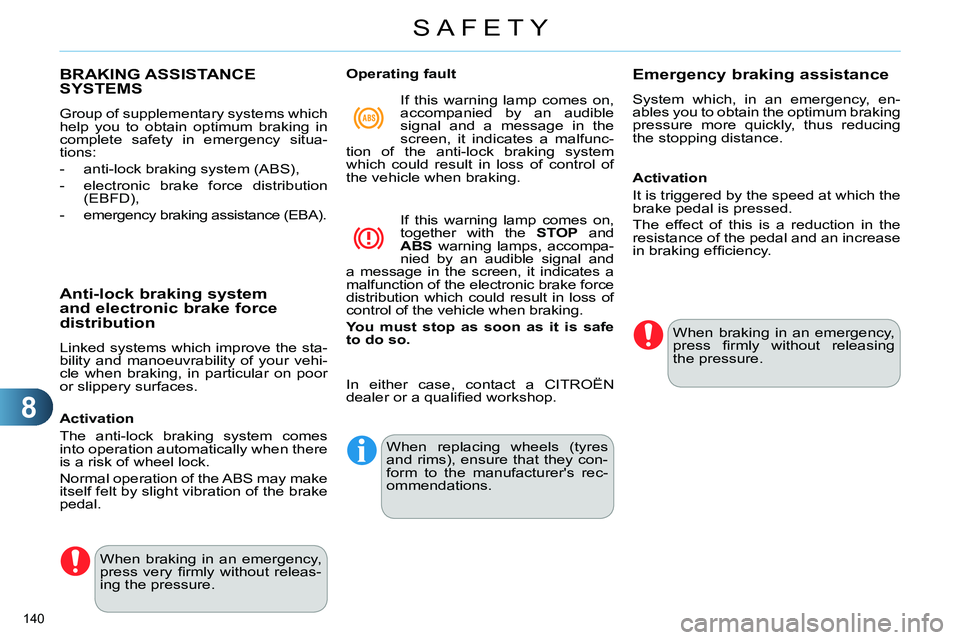
Operating fault
If this warning lamp comes on,
accompanied by an audible
signal and a message in the
screen, it indicates a malfunc-
tion of the anti-lock braking system
which could result in loss of control of
the vehicle when braking.
If this warning lamp comes on,
together with the STOP
and
ABS
warning lamps, accompa-
nied by an audible signal and
a message in the screen, it indicates a
malfunction of the electronic brake force
distribution which could result in loss of
control of the vehicle when braking.
You must stop as soon as it is safe
to do so.
Emergency braking assistance
System which, in an emergency, en-
ables you to obtain the optimum braking
pressure more quickly, thus reducing
the stopping distance.
Activation
It is triggered by the speed at which the
brake pedal is pressed.
The effect of this is a reduction in the
resistance of the pedal and an increase
in braking effi ciency.
In either case, contact a CITROËN
dealer or a qualifi ed workshop.
Page 143 of 340
8
SAFETY
141
TRAJECTORY CONTROL
SYSTEMS (ESP)
Anti-slip regulation (ASR) and
electronic stability control (ESC)
The anti-slip regulation (also known as
traction control) optimises traction to pre-
vent skidding of the wheels, by acting on
the brakes of the driving wheels and on
the engine.
The electronic stability control acts on
the brake of one or more wheels and
on the engine to keep the vehicle on the
trajectory required by the driver, within
the limits of the laws of physics.
Activation
These systems are activated automati-
cally each time the vehicle is started.
They come into operation in the event
of a grip or trajectory problem.
This is indicated by fl ashing of
this warning lamp in the instru-
ment panel.
Intelligent traction control
system ("Snow motion")
Your vehicle has a system to help driving
on snow: intelligent traction control.
This system detects situations of diffi -
cult surface adhesion that could make it
diffi cult to move off or make progress on
deep fresh snow or compacted snow.
In these situations, the intelligent trac-
tion control
limits the amount of wheel
slip to provide the best traction and tra-
jectory control for your vehicle.
In extremely severe conditions (deep
snow, mud, ...), when it proves impos-
sible to move off, it may be useful to
temporarily deactivate the ESP/ASR
systems to allow the wheels to spin
freely and so allow movement of the
vehicle.
Deactivation
In exceptional conditions (starting a
vehicle which is bogged down, stuck in
snow, on soft ground...), if you are un-
able to make progress, it may be ad-
visable to temporarily deactivate these
systems, so that the wheels can spin
freely and allow the vehicle to move.
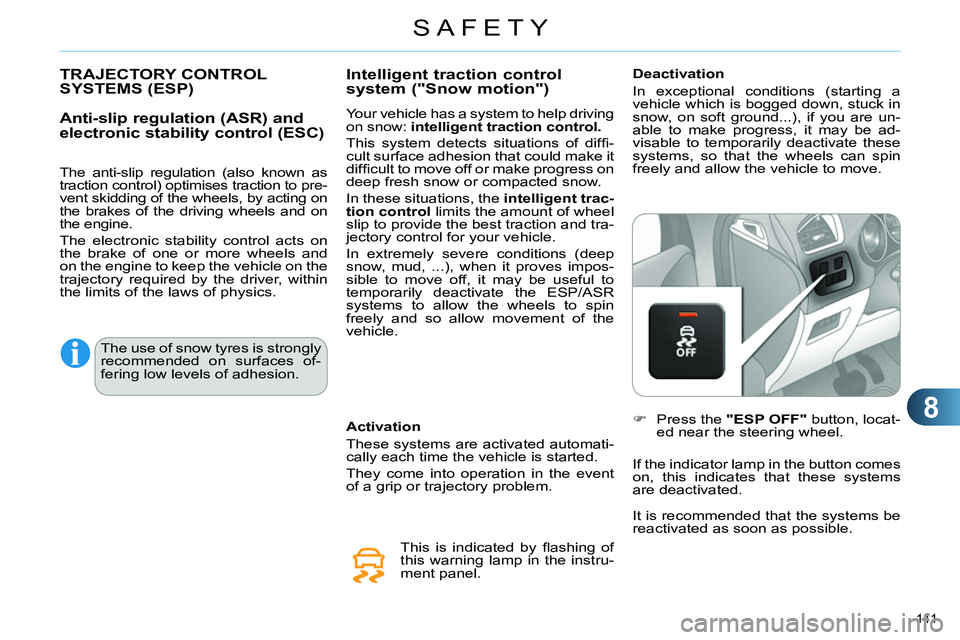
Press the "ESP OFF"
button, locat-
ed near the steering wheel.
If the indicator lamp in the button comes
on, this indicates that these systems
are deactivated.
The use of snow tyres is strongly
recommended on surfaces of-
fering low levels of adhesion.
It is recommended that the systems be
reactivated as soon as possible.
Page 144 of 340
8
SAFETY
142
The trajectory control systems
offer increased safety in normal
driving, but this should not en-
courage the driver to take extra
risks or drive at high speed.
The correct functioning of these
systems is assured provided
that manufacturer's recommen-
dations are observed on:
- wheels (tyres and rims),
- braking components,
- electronic components,
- assembly and repair proce-
dures.
After an impact, have these sys-
tems checked by a CITROËN
dealer or a qualifi ed workshop.
Reactivation
These systems are reactivated au-
tomatically each time the ignition is
switched back on or from 30 mph
(50 km/h).
Press the "ESP OFF"
button again
to reactivate them manually.
If this warning lamp in the instru-
ment panel and the " ESP OFF
"
indicator lamp in the button come
on, accompanied by an audible
signal and a message in the screen, this
indicates a fault with these systems.
Have it checked by a CITROËN dealer
or a qualifi ed workshop.
Operating fault
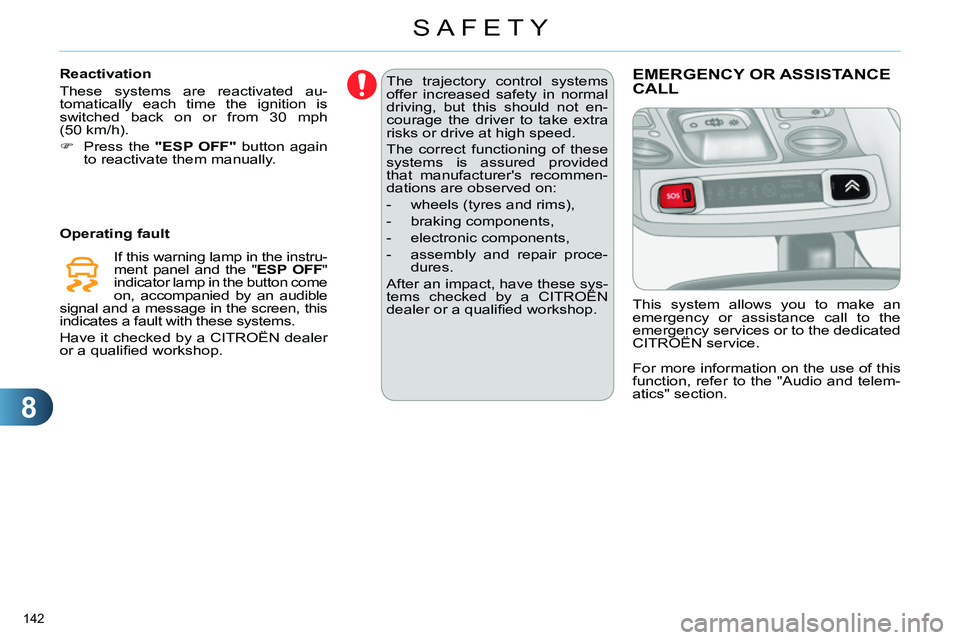
EMERGENCY OR ASSISTANCE
CALL
This system allows you to make an
emergency or assistance call to the
emergency services or to the dedicated
CITROËN service.
For more information on the use of this
function, refer to the "Audio and telem-
atics" section.
Page 148 of 340
8
SAFETY
146
AIRBAGS
System designed to maximise the safe-
ty of the occupants (with the exception
of the rear centre passenger) in the
event of violent collisions. The airbags
supplement the action of the force-limit-
ing seat belts (with the exception of the
centre rear passenger).
If a collision occurs, the electronic de-
tectors record and analyse the front
and side impacts sustained in the im-
pact detection zones:
- in the case of a serious impact, the
airbags are deployed instantly and
contribute towards better protection
of the occupants of the vehicle (with
the exception of the rear centre pas-
senger); immediately after the im-
pact, the airbags defl ate rapidly so
that they do not hinder visibility or
the exit of the occupants,
- in the case of a minor or rear impact
or in certain roll-over conditions, the
airbags will not be deployed; the
seat belt alone contributes towards
ensuring your protection in these
situations.
The airbags do not operate
when the ignition is switched
off.
This equipment will only deploy
once. If a second impact occurs
(during the same or a subse-
quent accident), the airbag will
not be deployed again.
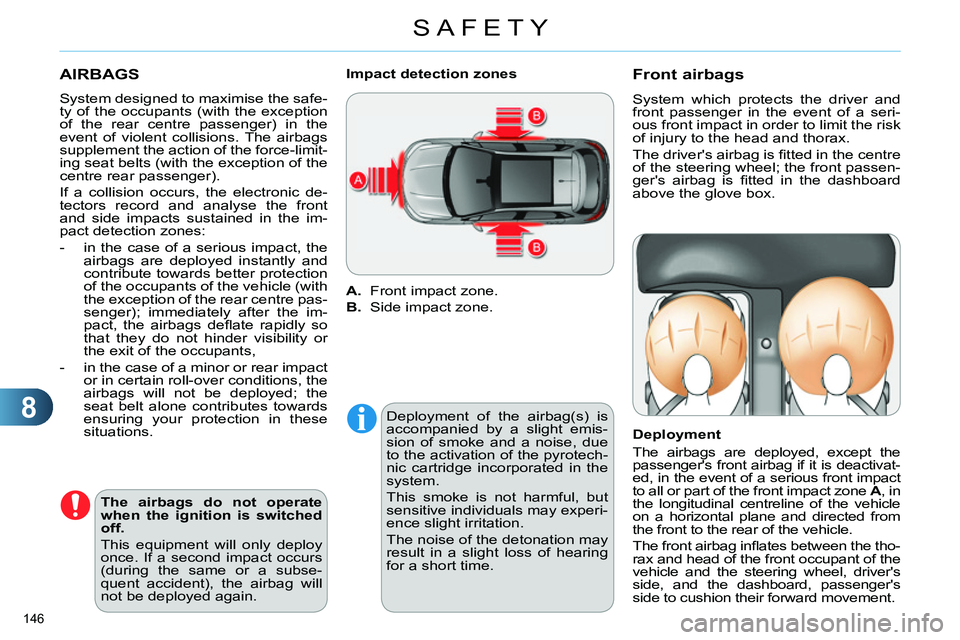
A.
Front impact zone.
B.
Side impact zone.
Impact detection zones
Deployment of the airbag(s) is
accompanied by a slight emis-
sion of smoke and a noise, due
to the activation of the pyrotech-
nic cartridge incorporated in the
system.
This smoke is not harmful, but
sensitive individuals may experi-
ence slight irritation.
The noise of the detonation may
result in a slight loss of hearing
for a short time.
Front airbags
System which protects the driver and
front passenger in the event of a seri-
ous front impact in order to limit the risk
of injury to the head and thorax.
The driver's airbag is fi tted in the centre
of the steering wheel; the front passen-
ger's airbag is fi tted in the dashboard
above the glove box.
Deployment
The airbags are deployed, except the
passenger's front airbag if it is deactivat-
ed, in the event of a serious front impact
to all or part of the front impact zone A
, in
the longitudinal centreline of the vehicle
on a horizontal plane and directed from
the front to the rear of the vehicle.
The front airbag infl ates between the tho-
rax and head of the front occupant of the
vehicle and the steering wheel, driver's
side, and the dashboard, passenger's
side to cushion their forward movement.
Page 151 of 340
8
SAFETY
149
For the airbags to be fully
effective, observe the
following safety rules:
Sit in a normal upright position.
Wear a correctly adjusted seat
belt.
Do not leave anything between
the occupants and the airbags
(a child, pet, object...). This could
hamper the operation of the air-
bags or injure the occupants.
After an accident or if the ve-
hicle has been stolen or broken
into, have the airbag systems
checked.
All work on the airbag system must
be carried out by a CITROËN
dealer or a qualifi ed workshop.
Even if all of the precautions
mentioned are observed, a risk
of injury or of minor burns to the
head, chest or arms when an air-
bag is deployed cannot be ruled
out. The bag infl ates almost in-
stantly (within a few milliseconds)
then defl ates within the same
time discharging the hot gas via
openings provided for this pur-
pose.
Front airbags
Do not drive holding the steering wheel by its spokes or resting your hands on
the centre part of the wheel.
Passengers must not place their feet on the dashboard.
If possible, do not smoke as deployment of the airbags can cause burns or the
risk of injury from a cigarette or pipe.
Never remove or pierce the steering wheel or hit it violently.
Lateral airbags
Use only approved covers on the seats, compatible with the deployment the lat-
eral airbags. For information on the range of seat covers suitable for your vehicle,
you can contact a CITROËN dealer (see "Practical information - § Accessories").
Do not fi x or attach anything to the seat backs (clothing...). This could cause
injury to the chest or arms if the lateral airbag is deployed.
Do not sit with the upper part of the body any nearer to the door than necessary.
Curtain airbags
Do not fi x or attach anything to the roof. This could cause injury to the head if the
curtain airbag is deployed.
If fi tted on your vehicle, do not remove the grab handles installed on the roof, they
play a part in securing the curtain airbags.