ESP CITROEN C4 DAG 2013 Owner's Manual
[x] Cancel search | Manufacturer: CITROEN, Model Year: 2013, Model line: C4 DAG, Model: CITROEN C4 DAG 2013Pages: 340, PDF Size: 28.95 MB
Page 108 of 340
5
VISIBILITY
106
CORNERING LIGHTING
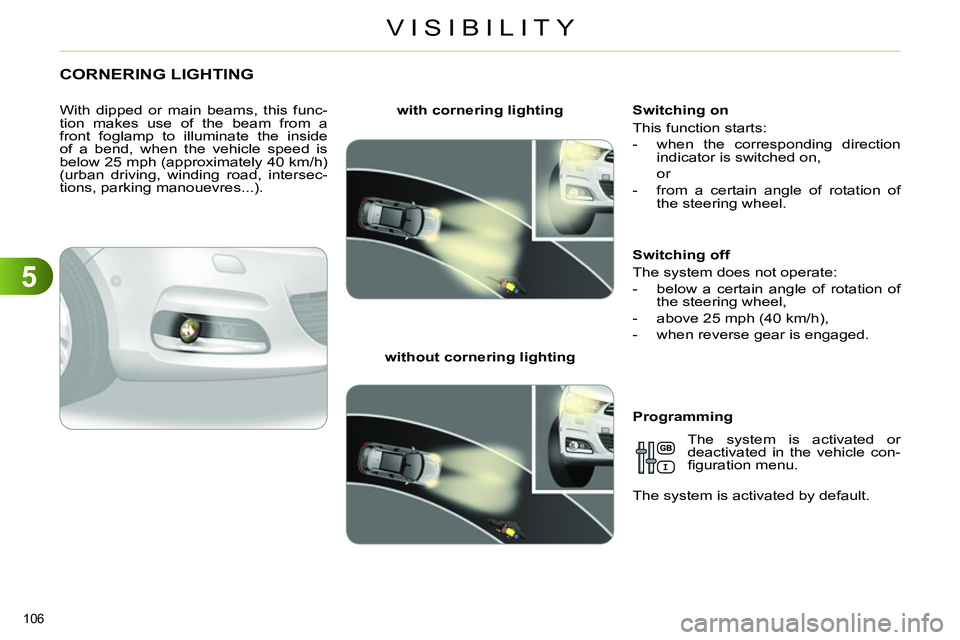
With dipped or main beams, this func-
tion makes use of the beam from a
front foglamp to illuminate the inside
of a bend, when the vehicle speed is
below 25 mph (approximately 40 km/h)
(urban driving, winding road, intersec-
tions, parking manouevres...).
with cornering lighting
without cornering lighting
Switching on
This function starts:
- when the corresponding direction
indicator is switched on,
or
- from a certain angle of rotation of
the steering wheel.
Switching off
The system does not operate:
- below a certain angle of rotation of
the steering wheel,
- above 25 mph (40 km/h),
- when reverse gear is engaged.
Programming
The system is activated or
deactivated in the vehicle con-
fi guration menu.
The system is activated by default.
Page 112 of 340
5
VISIBILITY
110
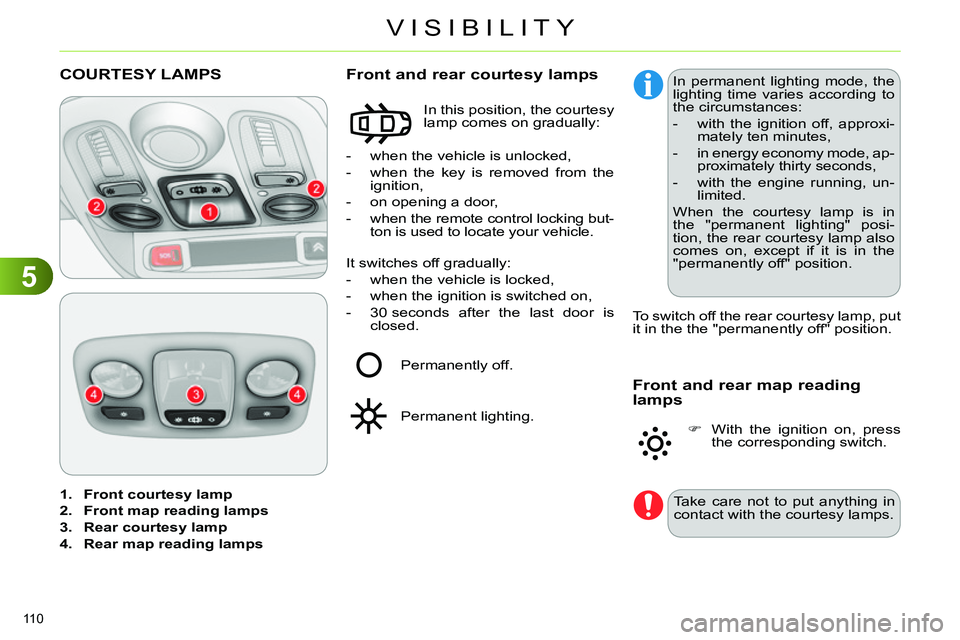
1.
Front courtesy lamp
2.
Front map reading lamps
3.
Rear courtesy lamp
4.
Rear map reading lamps
COURTESY LAMPS
- when the vehicle is unlocked,
- when the key is removed from the
ignition,
- on opening a door,
- when the remote control locking but-
ton is used to locate your vehicle.
Front and rear courtesy lamps
In this position, the courtesy
lamp comes on gradually:
It switches off gradually:
- when the vehicle is locked,
- when the ignition is switched on,
- 30 seconds after the last door is
closed. To switch off the rear courtesy lamp, put
it in the the "permanently off" position.
Permanently off.
Permanent lighting. In permanent lighting mode, the
lighting time varies according to
the circumstances:
- with the ignition off, approxi-
mately ten minutes,
- in energy economy mode, ap-
proximately thirty seconds,
- with the engine running, un-
limited.
When the courtesy lamp is in
the "permanent lighting" posi-
tion, the rear courtesy lamp also
comes on, except if it is in the
"permanently off" position.
Front and rear map reading
lamps
Take care not to put anything in
contact with the courtesy lamps.
With the ignition on, press
the corresponding switch.
Page 130 of 340
7
AR
BG
НИКОГА НЕ инсталирайте детско столче на седалка с АКТИВИРАНА предна ВЪЗДУШНА ВЪЗГЛАВНИЦА. То в а можеда причини СМЪРТ
или СЕРИОЗНО НАРАНЯВАНЕ на детето.
CSNIKDY neumisťujte dětské zádržné zařízení orientované směrem dozadu na sedadlo chráněné AKTIVOVANÝM čelním AIRBAGEM. Hrozí
nebezpečí SMRTI DÍTĚTE nebo VÁŽNÉHO ZRANĚNÍ.
DABrug aldrig en bagudvendt barnestol på et sæde der er beskyttet af en aktiv airbag. Død eller alvorlig skade på barnet kan forekomme.
DEVerwenden Sie NIEMALS einen Kindersitz oder Babyschale gegen die Fahrtrichtung bei AKTIVIERTEM Airbag, TOD oder ERNSTHAFTE
VERLETZUNGEN können die Folge sein.
ELΜη χρησιμοποιείτε ΠΟΤΕ παιδικό κάθισμα με την πλάτη του προς το εμπρός μέρος του αυτοκινήτου, σε μια θέση που προστατεύεται από
ΜΕΤΩΠΙΚΟ αερόσακο που είναι ΕΝΕΡΓΟΣ. Αυτό μπορεί να έχει σαν συνέπεια το ΘΑΝΑΤΟ ή το ΣΟΒΑΡΟ ΤΡΑΥΜΑΤΙΣΜΟ του ΠΑΙΔΙΟΥ
ENNEVER use a rearward facing child restraint on a seat protected by an ACTIVE AIRBAG in front of it, DEATH or SERIOUS INJURY to the CHILD
can occur
ESNO INSTALAR NUNCA EL SISTEMA DE RETENCIÓN PARA NIÑOS DE ESPALDAS AL SENTIDO DE LA CIRCULACIÓN SOBRE UN ASIENTO
PROTEGIDO CON UN COJÍN INFLABLE FRONTAL ( AIRBAG ) ACTIVADO. ESTO PUEDE CAUSAR LA MUERTE DEL BEBE O HERIRLO
GRAVEMENTE.
ETÄrge kasutage kunagi lapse turvatooli seljaga sõidusuunas sõiduki istmel mis on kaitstud AKTIVEERITUD TURVAPADJAGA. See võib
põhjustada lapsele RASKEID VIGASTUSI või SURMA.
FIÄLÄ KOSKAAN aseta lapsen turvaistuinta selkä ajosuuntaan istuimelle, jonka edessä suojana on käyttöön aktivoitu TURVATYYNY. Sen
laukeaminen voi aiheuttaa LAPSEN KUOLEMAN tai VAKAVAN LOUKKAANTUMISEN.
FRNE JAMAIS installer de système de retenue pour enfants faisant face vers l’arrière sur un siège protégé par un COUSSIN GONFLABLE frontal
ACTIVÉ.
Cela peut provoquer la MORT de l’ENFANT ou le BLESSER GRAVEMENT
HRNIKADA ne postavljati dječju sjedalicu leđima u smjeru vožnje na sjedalo zaštićeno UKLJUČENIM prednjim ZRAČNIM JASTUKOM. To bi moglo
uzrokovati SMRT ili TEŠKU OZLJEDU djeteta.
HUSOHA ne használjon menetiránynak háttal beszerelt gyermekülést olyan ülésen, amely AKTIVÁLT ÁLLAPOTÚ (BEKAPCSOLT)
FRONTLÉGZSÁKKAL van védve. Ez a gyermek halálát vagy súlyos sérülését okozhatja.
ITNON installare MAI seggiolini per bambini posizionati in senso contrario a quello di marcia su un sedile protetto da un AIRBAG frontale
ATTIVATO. Ciò potrebbe provocare la MORTE o FERITE GRAVI al bambino.
LTNIEKADA neįrenkite vaiko prilaikymo priemonės su atgal atgręžtu vaiku ant sėdynės, kuri saugoma VEIKIANČIOS priekinės ORO PAGALVĖS.
Išsiskleidus oro pagalvei vaikas gali būti MIRTINAI arba SUNKIAI TRAUMUOTAS.
LVNAV PIEĻAUJAMS uzstādīt uz aizmuguri vērstu bērnu sēdeklīti priekšējā pasažiera vietā, kurā ir AKTIVIZĒTS priekšējais DROŠĪBAS GAISA
SPILVENS.
Tas var izraisīt BĒRNA NĀVI vai radīt NOPIETNUS IEVAINOJUMUS.
CHILD SAFETY
128
Page 143 of 340
8
SAFETY
141
TRAJECTORY CONTROL
SYSTEMS (ESP)
Anti-slip regulation (ASR) and
electronic stability control (ESC)
The anti-slip regulation (also known as
traction control) optimises traction to pre-
vent skidding of the wheels, by acting on
the brakes of the driving wheels and on
the engine.
The electronic stability control acts on
the brake of one or more wheels and
on the engine to keep the vehicle on the
trajectory required by the driver, within
the limits of the laws of physics.
Activation
These systems are activated automati-
cally each time the vehicle is started.
They come into operation in the event
of a grip or trajectory problem.
This is indicated by fl ashing of
this warning lamp in the instru-
ment panel.
Intelligent traction control
system ("Snow motion")
Your vehicle has a system to help driving
on snow: intelligent traction control.
This system detects situations of diffi -
cult surface adhesion that could make it
diffi cult to move off or make progress on
deep fresh snow or compacted snow.
In these situations, the intelligent trac-
tion control
limits the amount of wheel
slip to provide the best traction and tra-
jectory control for your vehicle.
In extremely severe conditions (deep
snow, mud, ...), when it proves impos-
sible to move off, it may be useful to
temporarily deactivate the ESP/ASR
systems to allow the wheels to spin
freely and so allow movement of the
vehicle.
Deactivation
In exceptional conditions (starting a
vehicle which is bogged down, stuck in
snow, on soft ground...), if you are un-
able to make progress, it may be ad-
visable to temporarily deactivate these
systems, so that the wheels can spin
freely and allow the vehicle to move.
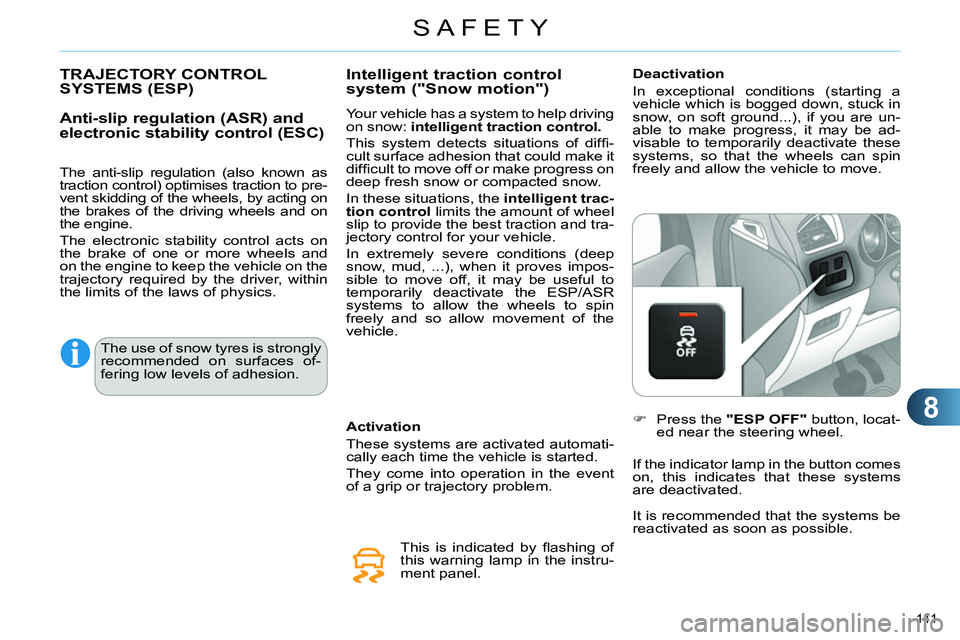
Press the "ESP OFF"
button, locat-
ed near the steering wheel.
If the indicator lamp in the button comes
on, this indicates that these systems
are deactivated.
The use of snow tyres is strongly
recommended on surfaces of-
fering low levels of adhesion.
It is recommended that the systems be
reactivated as soon as possible.
Page 144 of 340
8
SAFETY
142
The trajectory control systems
offer increased safety in normal
driving, but this should not en-
courage the driver to take extra
risks or drive at high speed.
The correct functioning of these
systems is assured provided
that manufacturer's recommen-
dations are observed on:
- wheels (tyres and rims),
- braking components,
- electronic components,
- assembly and repair proce-
dures.
After an impact, have these sys-
tems checked by a CITROËN
dealer or a qualifi ed workshop.
Reactivation
These systems are reactivated au-
tomatically each time the ignition is
switched back on or from 30 mph
(50 km/h).
Press the "ESP OFF"
button again
to reactivate them manually.
If this warning lamp in the instru-
ment panel and the " ESP OFF
"
indicator lamp in the button come
on, accompanied by an audible
signal and a message in the screen, this
indicates a fault with these systems.
Have it checked by a CITROËN dealer
or a qualifi ed workshop.
Operating fault
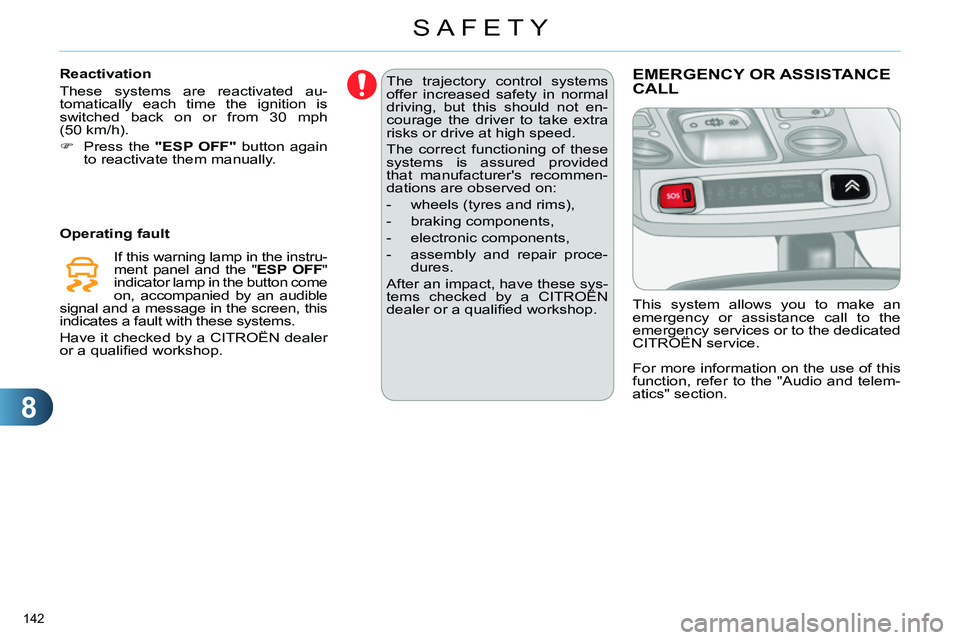
EMERGENCY OR ASSISTANCE
CALL
This system allows you to make an
emergency or assistance call to the
emergency services or to the dedicated
CITROËN service.
For more information on the use of this
function, refer to the "Audio and telem-
atics" section.
Page 145 of 340
8
SAFETY
143
Seat belt not fastened / unfastened
warning lamp in the instrument panel
When the ignition is switched on,
this warning lamp comes on in
the instrument panel if the driver
and/or the front passenger has
not fastened their seat belt.
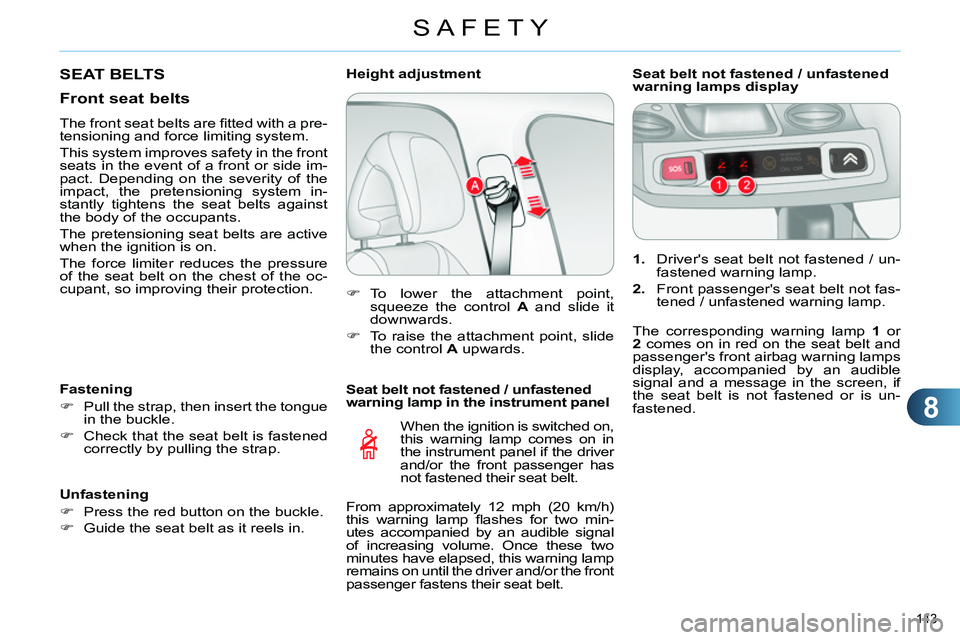
1.
Driver's seat belt not fastened / un-
fastened warning lamp.
2.
Front passenger's seat belt not fas-
tened / unfastened warning lamp.
Seat belt not fastened / unfastened
warning lamps display
To lower the attachment point,
squeeze the control A
and slide it
downwards.
To raise the attachment point, slide
the control A
upwards.
Height adjustment
SEAT BELTS
Front seat belts
The front seat belts are fi tted with a pre-
tensioning and force limiting system.
This system improves safety in the front
seats in the event of a front or side im-
pact. Depending on the severity of the
impact, the pretensioning system in-
stantly tightens the seat belts against
the body of the occupants.
The pretensioning seat belts are active
when the ignition is on.
The force limiter reduces the pressure
of the seat belt on the chest of the oc-
cupant, so improving their protection.
Fastening
Pull the strap, then insert the tongue
in the buckle.
Check that the seat belt is fastened
correctly by pulling the strap.
Unfastening
Press the red button on the buckle.
Guide the seat belt as it reels in.
The corresponding warning lamp 1
or
2
comes on in red on the seat belt and
passenger's front airbag warning lamps
display, accompanied by an audible
signal and a message in the screen, if
the seat belt is not fastened or is un-
fastened.
From approximately 12 mph (20 km/h)
this warning lamp fl ashes for two min-
utes accompanied by an audible signal
of increasing volume. Once these two
minutes have elapsed, this warning lamp
remains on until the driver and/or the front
passenger fastens their seat belt.
Page 146 of 340
8
SAFETY
144
Rear seat belts
The rear seats are each fi tted with a
three-point seat belt, with force limiter
and, for the outer seats, an effort limiter.
Fastening
Pull the strap, then insert the tongue
in the buckle.
Check that the seat belt is fastened
correctly by pulling the strap.
Unfastening
Press the red button on the buckle.
Guide the seat belt as it reels in.
On the outer seat belts, raise the
bar to the top of the backrest to
prevent the tongue from knocking
against the side trim.
This warning lamp comes on in
the instrument panel when one
or more rear passengers unfas-
ten their seat belt.
Seat belt unfastened warning lamp
in the instrument panel
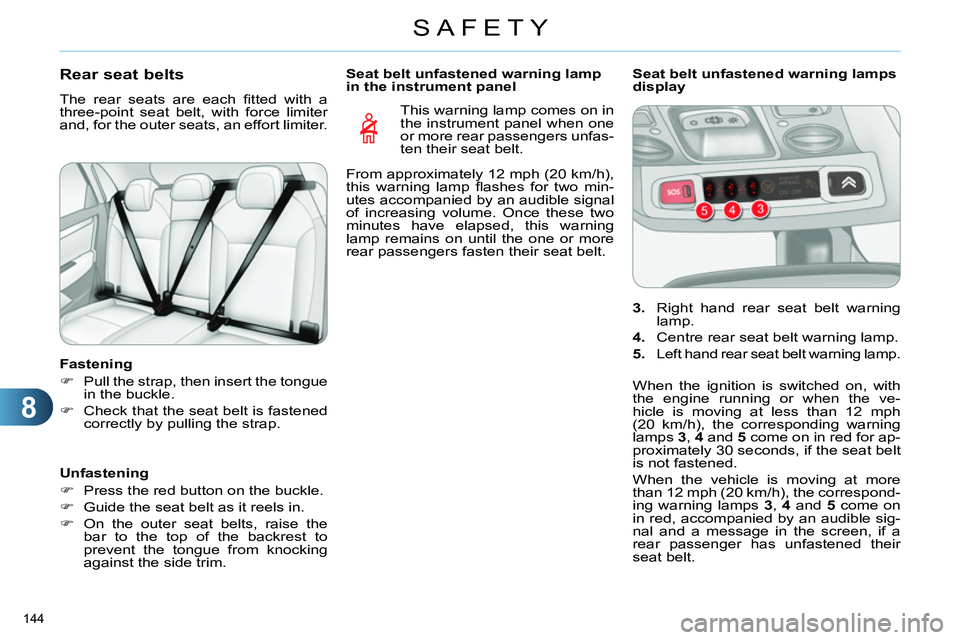
3.
Right hand rear seat belt warning
lamp.
4.
Centre rear seat belt warning lamp.
5.
Left hand rear seat belt warning lamp.
Seat belt unfastened warning lamps
display
When the ignition is switched on, with
the engine running or when the ve-
hicle is moving at less than 12 mph
(20 km/h), the corresponding warning
lamps 3
, 4
and 5
come on in red for ap-
proximately 30 seconds, if the seat belt
is not fastened.
When the vehicle is moving at more
than 12 mph (20 km/h), the correspond-
ing warning lamps 3
, 4
and 5
come on
in red, accompanied by an audible sig-
nal and a message in the screen, if a
rear passenger has unfastened their
seat belt.
From approximately 12 mph (20 km/h),
this warning lamp fl ashes for two min-
utes accompanied by an audible signal
of increasing volume. Once these two
minutes have elapsed, this warning
lamp remains on until the one or more
rear passengers fasten their seat belt.
Page 150 of 340
8
SAFETY
148
Lateral airbags
System which protects the driver and
front passenger in the event of a seri-
ous side impact in order to limit the risk
of injury to the chest, between the hip
and the shoulder.
Each lateral airbag is fi tted in the seat
backrest frame, door side.
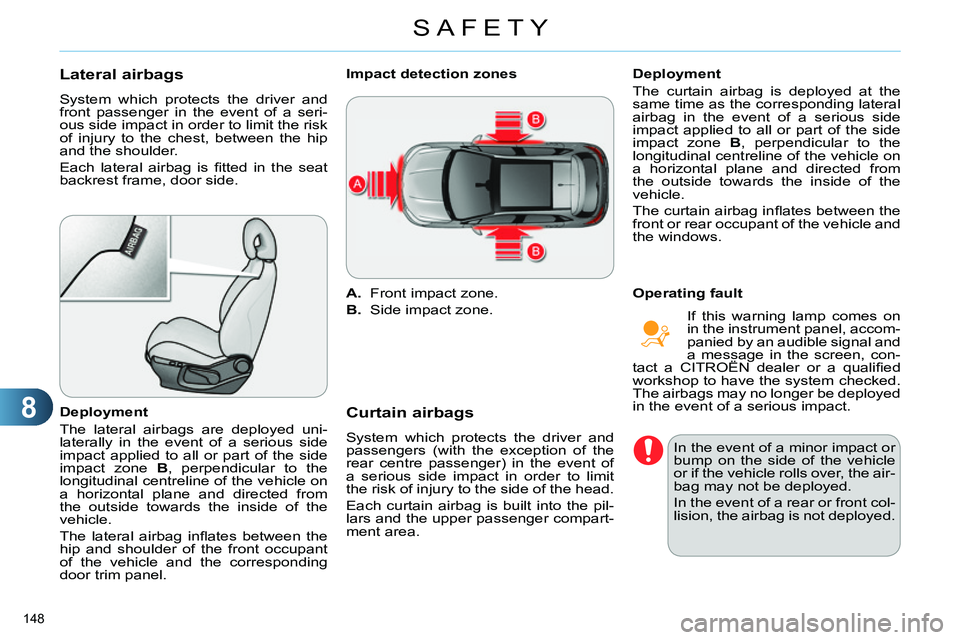
Deployment
The lateral airbags are deployed uni-
laterally in the event of a serious side
impact applied to all or part of the side
impact zone B
, perpendicular to the
longitudinal centreline of the vehicle on
a horizontal plane and directed from
the outside towards the inside of the
vehicle.
The lateral airbag infl ates between the
hip and shoulder of the front occupant
of the vehicle and the corresponding
door trim panel.
A.
Front impact zone.
B.
Side impact zone.
Impact detection zones
Curtain airbags
System which protects the driver and
passengers (with the exception of the
rear centre passenger) in the event of
a serious side impact in order to limit
the risk of injury to the side of the head.
Each curtain airbag is built into the pil-
lars and the upper passenger compart-
ment area.
Deployment
The curtain airbag is deployed at the
same time as the corresponding lateral
airbag in the event of a serious side
impact applied to all or part of the side
impact zone B
, perpendicular to the
longitudinal centreline of the vehicle on
a horizontal plane and directed from
the outside towards the inside of the
vehicle.
The curtain airbag infl ates between the
front or rear occupant of the vehicle and
the windows.
Operating fault
If this warning lamp comes on
in the instrument panel, accom-
panied by an audible signal and
a message in the screen, con-
tact a CITROËN dealer or a qualifi ed
workshop to have the system checked.
The airbags may no longer be deployed
in the event of a serious impact.
In the event of a minor impact or
bump on the side of the vehicle
or if the vehicle rolls over, the air-
bag may not be deployed.
In the event of a rear or front col-
lision, the airbag is not deployed.
Page 163 of 340
9
DRIVING
161
AUTOMATIC GEARBOX
Six speed automatic gearbox which of-
fers a choice between the comfort of
fully automatic operation, enhanced by
sport and snow programmes, or manu-
al gear changing.
Four driving modes are offered:
- automatic
operation for electronic
management of the gears by the
gearbox,
- sport
programme for a more dy-
namic style of driving,
- snow
programme to improve driving
when traction is poor,
- manual
operation for sequential
changing of the gears by the driver.
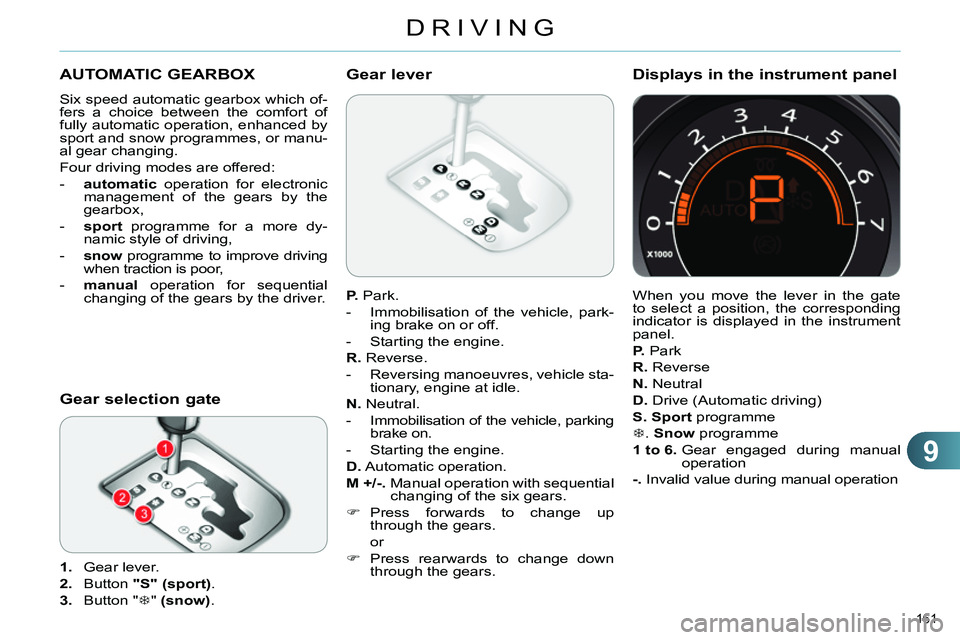
Gear selection gate
1.
Gear lever.
2.
Button "S"
(sport)
.
3.
Button "
" (snow)
.
P.
Park.
- Immobilisation of the vehicle, park-
ing brake on or off.
- Starting the engine.
R.
Reverse.
- Reversing manoeuvres, vehicle sta-
tionary, engine at idle.
N.
Neutral.
- Immobilisation of the vehicle, parking
brake on.
- Starting the engine.
D.
Automatic operation.
M +/-
. Manual operation with sequential
changing of the six gears.
Press forwards to change up
through the gears.
or
Press rearwards to change down
through the gears.
Gear lever
When you move the lever in the gate
to select a position, the corresponding
indicator is displayed in the instrument
panel.
P.
Park
R.
Reverse
N.
Neutral
D.
Drive (Automatic driving)
S.
Sport
programme
. Snow
programme
1 to 6.
Gear engaged during manual
operation
-.
Invalid value during manual operation
Displays in the instrument panel
Page 167 of 340
9
DRIVING
165
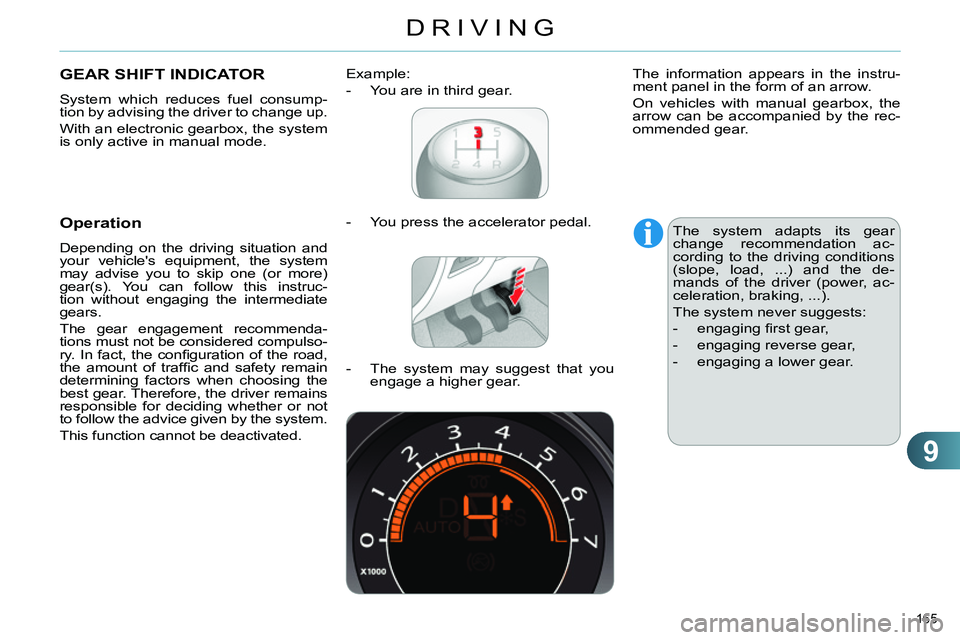
GEAR SHIFT INDICATOR
System which reduces fuel consump-
tion by advising the driver to change up.
With an electronic gearbox, the system
is only active in manual mode.
Operation
Depending on the driving situation and
your vehicle's equipment, the system
may advise you to skip one (or more)
gear(s). You can follow this instruc-
tion without engaging the intermediate
gears.
The gear engagement recommenda-
tions must not be considered compulso-
ry. In fact, the confi guration of the road,
the amount of traffi c and safety remain
determining factors when choosing the
best gear. Therefore, the driver remains
responsible for deciding whether or not
to follow the advice given by the system.
This function cannot be deactivated.
- You press the accelerator pedal.
Example:
- You are in third gear.
- The system may suggest that you
engage a higher gear.
The information appears in the instru-
ment panel in the form of an arrow.
On vehicles with manual gearbox, the
arrow can be accompanied by the rec-
ommended gear.
The system adapts its gear
change recommendation ac-
cording to the driving conditions
(slope, load, ...) and the de-
mands of the driver (power, ac-
celeration, braking, ...).
The system never suggests:
- engaging fi rst gear,
- engaging reverse gear,
- engaging a lower gear.