towing Citroen C4 PICASSO 2016 2.G User Guide
[x] Cancel search | Manufacturer: CITROEN, Model Year: 2016, Model line: C4 PICASSO, Model: Citroen C4 PICASSO 2016 2.GPages: 527, PDF Size: 13.72 MB
Page 176 of 527
174
C4-Picasso-II_en_Chap04_conduite_ed01-2016
Limits of operation
The system cannot exceed the limits of the laws of physics.
It is recommended that the system be
deactivated when the "space-saver" spare
wheel
is in use.
The system should not be activated when
towing
a trailer.
In certain critical situations, the system will
encourage
the driver to immediately take back
c
ontrol:
-
i
f the vehicle in front slows down too much
or too suddenly, and the driver does not
brake,
-
i
f a vehicle comes between your vehicle
and
the vehicle in front. As
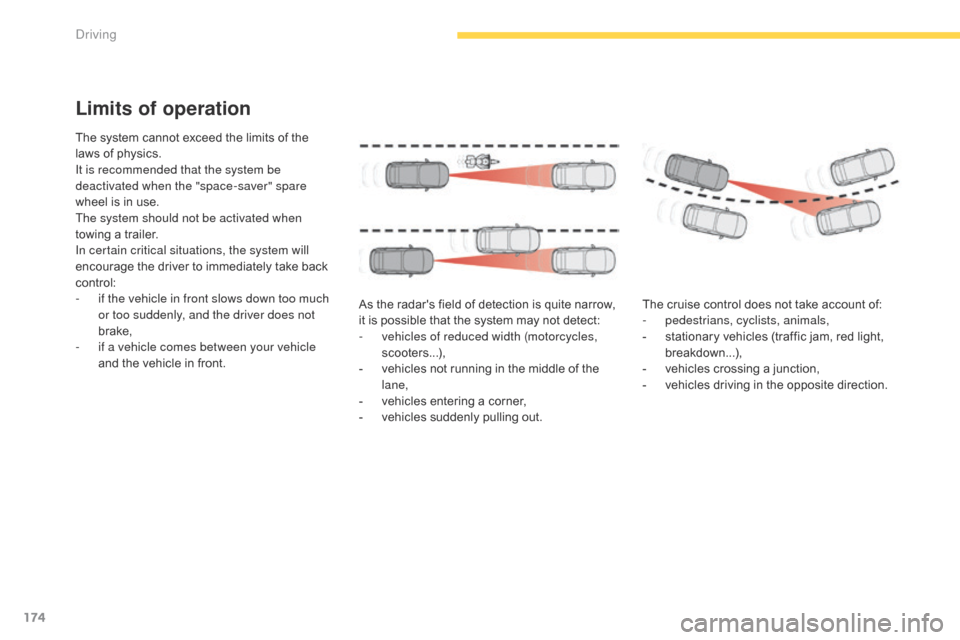
the radar's field of detection is quite narrow,
i
t is possible that the system may not detect:
-
v
ehicles of reduced width (motorcycles,
scooters...),
-
v
ehicles not running in the middle of the
lan
e,
-
v
ehicles entering a corner,
-
v
ehicles suddenly pulling out.The
cruise control does not take account of:
-
p
edestrians, cyclists, animals,
-
s
tationary vehicles (traffic jam, red light,
b
reakdown...),
-
v
ehicles crossing a junction,
-
v
ehicles driving in the opposite direction.
Driving
Page 184 of 527
182
C4-Picasso-II_en_Chap04_conduite_ed01-2016
Blind spot monitoring system
Activation / Deactivation
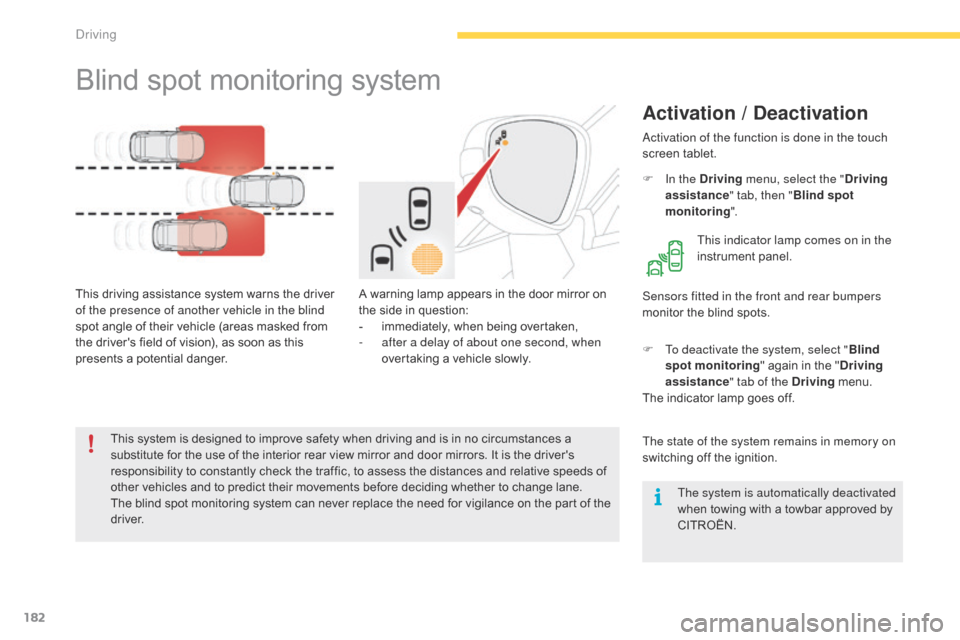
A warning lamp appears in the door mirror on the side in question:
-
i
mmediately, when being overtaken,
-
a
fter a delay of about one second, when
overtaking
a vehicle slowly.
This
driving
assistance
system
warns
the
driver
o
f the presence of another vehicle in the blind
spot
angle
of
their
vehicle
(areas
masked
from
t
he
driver's
field
of
vision),
as
soon
as
this
p
resents
a
potential
danger. Sensors fitted in the front and rear bumpers
monitor
the blind spots.
This
system
is
designed
to
improve
safety
when driving and is in no circumstances a
s
ubstitute
for
the
use
of
the
interior
rear
view
mirror and door mirrors. It is the driver's
r
esponsibility
to
constantly
check
the
traffic,
to assess the distances and relative speeds of
o
ther
vehicles
and
to
predict
their
movements before deciding whether to change lane.
The
blind
spot
monitoring
system
can
never
replace the need for vigilance on the part of the
d
river. Activation of the function is done in the touch
screen
t
ablet.
F
I
n the Driving
menu, select the " Driving
assistance " tab, then "Blind spot
monitoring ".
This indicator lamp comes on in the
instrument
pan
el.
The state of the system remains in memory on
switching off the ignition.
F
T
o deactivate the system, select "Blind
spot monitoring "
again in the "Driving
assistance " tab of the Driving
menu.
The
indicator lamp goes off.
The system is automatically deactivated
when
towing with a towbar approved by
CIT
ROËN.
Driving
Page 201 of 527
199
C4-Picasso-II_en_Chap04_conduite_ed01-2016
The system is deactivated by pressing the control.
The
system is deactivated automatically:
-
o
n switching off the ignition,
-
i
f the engine stalls,
-
i
f no manoeuvre is started within 5 minutes
of selection of the type of manoeuvre,
-
a
fter a prolonged stop of the vehicle during
a
manoeuvre,
-
i
f the road wheel anti-slip regulation (ASR)
i
s
t
riggered,
-
i
f the speed of the vehicle exceeds the
s
tated limit,
-
w
hen the driver interrupts movement of the
steering
w
heel,
-
a
fter 4 manoeuvre cycles,
-
o
n opening the driver's door,
-
i
f one of the front wheels encounters an
obstacle.
The
operation indicator lamp goes off in the
i
nstrument panel and a message is displayed
a
ccompanied by an audible signal.
The
driver should then take back control of the
v
ehicle's
s
teering.
Deactivation
The system is switched off automatically:
- w hen towing a trailer, connected
e
lectrically,
-
i
f the driver's door is opened,
-
i
f the speed of the vehicle is above 42 mph
(70
km/h).
To
switch the system of for a prolonged period,
c
ontact a CITROËN dealer or a qualified
workshop.
Operating faults
In the event of a fault with the power
steering, this warning lamp flashes in
t
he instrument panel, accompanied
by
a message.
Contact a CITROËN dealer or a qualified
workshop.
Switching off
If the lateral distance between your
vehicle and the space is too great, the s
ystem may not be able to measure the
space.
Anything
projecting beyond the envelope
o
f the vehicle (a ladder on the roof, for
example)
is not taken into account by the
P
ark Assist system during a manoeuvre.
In bad weather or in winter, ensure that
the sensors are not covered by road
dirt,
ice or snow.
In the event of a fault, have the system
checked
by a CITROËN dealer or a
q
ualified
w
orkshop.
If
the
system
is
deactivated
during
a
ma
noeuvre, the drive should reactivate
it
to
repeat
the
measurement. In
the
event
of
a
fault,
this
warning
l
amp flashes for a few seconds,
accompanied
by
an
audible
signal.
If
the
fault
occurs
during
the
use
o
f
the
system,
the
warning
lamp
g
oes off. High pressure jet washing
When
washing your vehicle, keep the
l
ance at least 30 cm away from the
sen
sors.
4
Driving
Page 226 of 527
224
C4-Picasso-II_en_Chap06_securite_ed01-2016
Hazard warning lamps
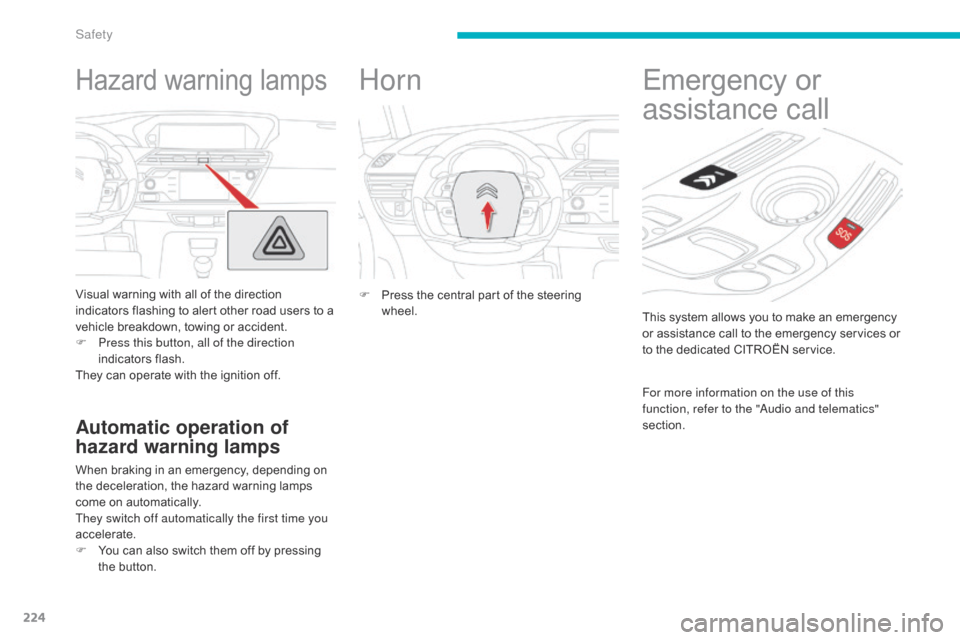
Visual warning with all of the direction i
ndicators flashing to alert other road users to a
v
ehicle breakdown, towing or accident.
F
P
ress this button, all of the direction
indicators
f
lash.
They
can operate with the ignition off.
Automatic operation of
hazard warning lamps
When braking in an emergency, depending on the deceleration, the hazard warning lamps
c
ome on automatically.
They switch off automatically the first time you
accelerate.
F
Y
ou can also switch them off by pressing
t
he button.
Horn
F Press the central part of the steering w
heel. This
system allows you to make an emergency
o
r assistance call to the emergency services or
t
o the dedicated CITROËN service.
Emergency or
a
ssistance call
For more information on the use of this
function, refer to the "Audio and telematics"
section.
Safety
Page 231 of 527
229
C4-Picasso-II_en_Chap06_securite_ed01-2016
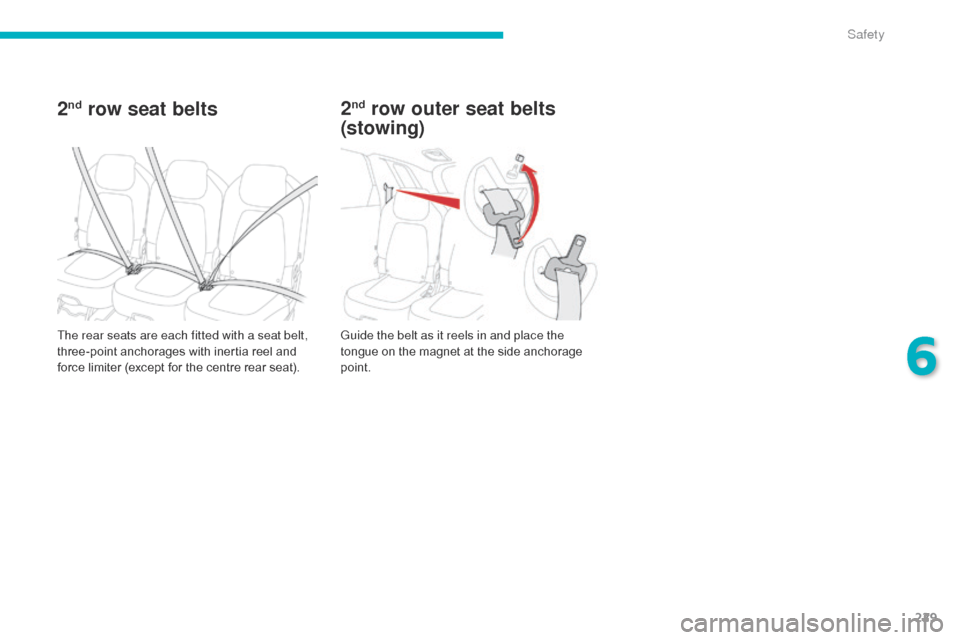
2nd row seat belts
The rear seats are each fitted with a seat belt,
three-point anchorages with inertia reel and
f
orce limiter (except for the centre rear seat).Guide the belt as it reels in and place the
tongue
on the magnet at the side anchorage
po
int.
2nd row outer seat belts
(stowing)
6
Safety
Page 232 of 527
230
C4-Picasso-II_en_Chap06_securite_ed01-2016
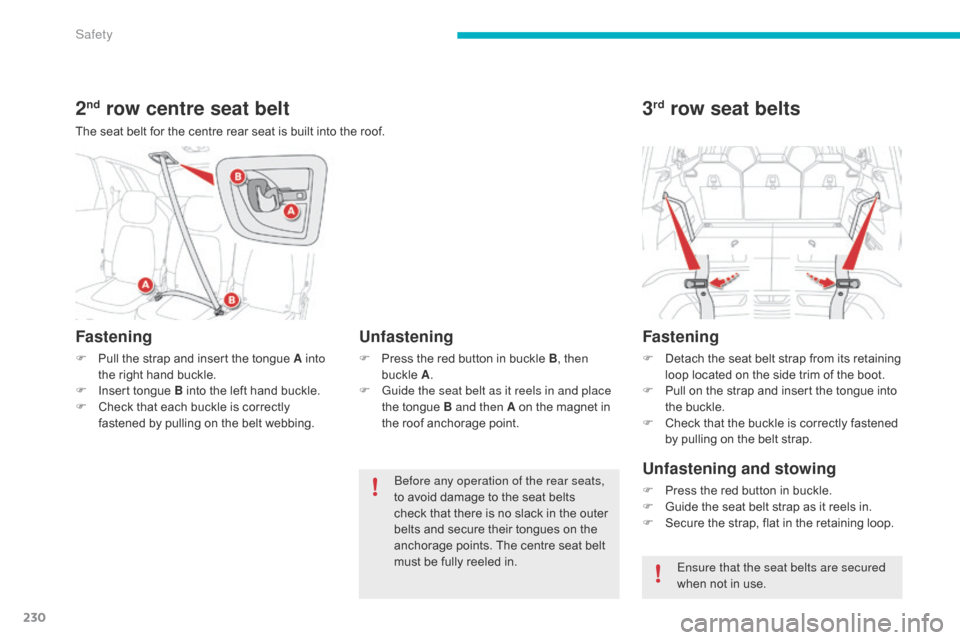
2nd row centre seat belt
The seat belt for the centre rear seat is built into the roof.
Fastening
F Pull the strap and insert the tongue A into
the right hand buckle.
F
I
nsert tongue B into the left hand buckle.
F
C
heck that each buckle is correctly
f
astened by pulling on the belt webbing.
Unfastening
F Press the red button in buckle B, then
buckle A .
F
G
uide the seat belt as it reels in and place
the
tongue B and then A on the magnet in
t
he roof anchorage point.
Before any operation of the rear seats,
to
avoid damage to the seat belts
c
heck that there is no slack in the outer
b
elts and secure their tongues on the
a
nchorage points. The centre seat belt
m
ust be fully reeled in.
3rd row seat belts
Fastening
F Detach the seat belt strap from its retaining l
oop located on the side trim of the boot.
F
P
ull on the strap and insert the tongue into
t
he buckle.
F
C
heck that the buckle is correctly fastened
b
y pulling on the belt strap.
Unfastening and stowing
F Press the red button in buckle.
F G uide the seat belt strap as it reels in.
F
S
ecure the strap, flat in the retaining loop.
Ensure that the seat belts are secured
when
not in use.
Safety
Page 266 of 527
264
C4-Picasso-II_en_Chap07_info-pratiques_ed01-2016
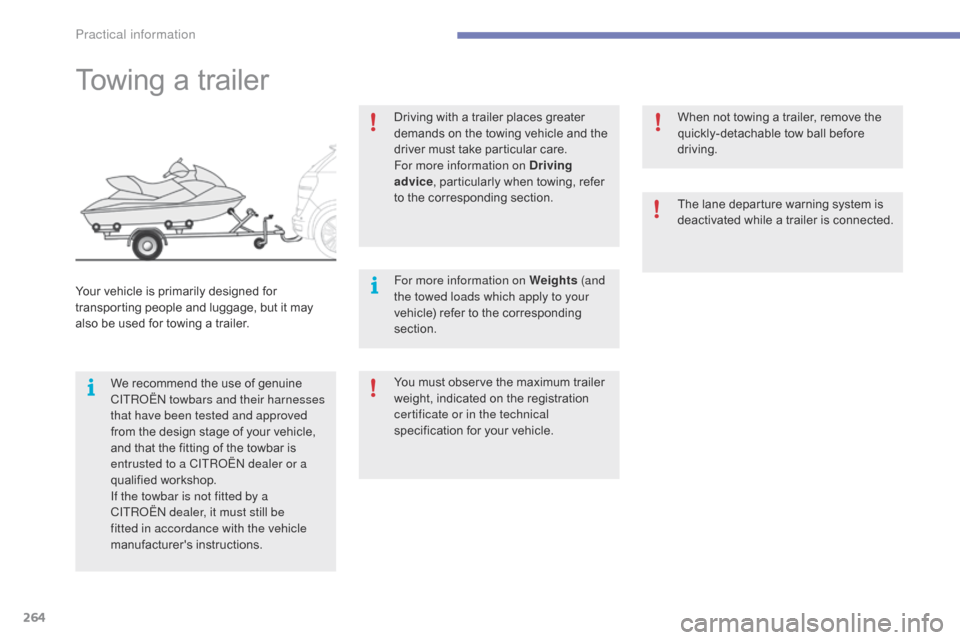
Towing a trailer
We recommend the use of genuine CITROËN towbars and their harnesses
that have been tested and approved
from
the design stage of your vehicle,
a
nd that the fitting of the towbar is
e
ntrusted to a CITROËN dealer or a
qualified
w
orkshop.
If the towbar is not fitted by a
CITROËN dealer, it must still be
fitted in accordance with the vehicle
manufacturer's
i
nstructions.
Your
vehicle is primarily designed for
t
ransporting people and luggage, but it may
a
lso
be used for towing a trailer. Driving with a trailer places greater
d
emands on the towing vehicle and the
d
river must take particular care.
For more information on Driving
advice , particularly when towing, refer
t
o the corresponding section.
For more information on Weights (and
the towed loads which apply to your
vehicle) refer to the corresponding
s
ection.
You must observe the maximum trailer w
eight, indicated on the registration
c
ertificate or in the technical
specification
for your vehicle.When
not towing a trailer, remove the
q
uickly-detachable tow ball before
d
riving.
The lane departure warning system is
d
eactivated while a trailer is connected.
Practical information
Page 268 of 527
266
C4-Picasso-II_en_Chap07_info-pratiques_ed01-2016
Accessories
A wide range of accessories and genuine parts is available from the CITROËN dealer network.
T hese accessories and parts are all suitable for your vehicle and benefit from CITROËN's recommendation and warranty.
"Comfort"
Door deflectors, sun blind, insulated module,
coat hanger fixed to head restraint, mobile
r
eading lamp, mirror for caravan, front and rear
par
king
s
ensors,
p
rogrammable
a
dditional
h
eating, smoker's kit, solar film for rear door
w
indows, portable scented air freshener...
"Transport systems"
Boot carpet, boot liner, boot net, boot
spacers, transverse roof bars, ski carrier, roof
b
oxes, towbars, towbar wiring harnesses,
b
icycle carriers for towbar and roof bars,
towbars
with fixed and detachable towball,
s
eparation net, sliding carrier, boot organiser
(
Grand C4 Picasso)...
If
a towbar and wiring harness are fitted
o
utside the CITROËN dealer network, the
i
nstallation must be done strictly in line with the
manufacturer's
r
ecommendations.
If your vehicle has a detachable towball, it is
recommended that the ball be removed when
not
towing.
"Styling"
Gear lever knobs, aluminium foot rest, alloy wheels, door sill finishers, interior mirror
shells...
"Security and safety"
Anti-intrusion alarm, vehicle tracking system, c hild seats and booster cushions, breathalyser,
first
aid kit, fire extinguisher, warning triangle,
h
igh visibility vest, wheel security bolts, snow
c
hains, non-slip covers, winter tyres, foglamp
k
it, security film for front door windows, dog
g
uard, pet seat belt...
"Protection"
Mats*, seat covers compatible with lateral
airbags, mud flaps, door protective mouldings,
b
umper protection strips, vehicle cover, boot
sill protector, door sill protectors, seat and boot
protective
covers for pets...
The
rear bodywork has been designed to avoid
s
p r ay.
*
T
o avoid any risk of jamming the pedals:
-
e
nsure that mats are correctly positioned
and secured,
-
n
ever fit one mat on top of another.
Practical information
Page 285 of 527
283
C4-Picasso-II_en_Chap08_en-cas-panne_ed01-2016
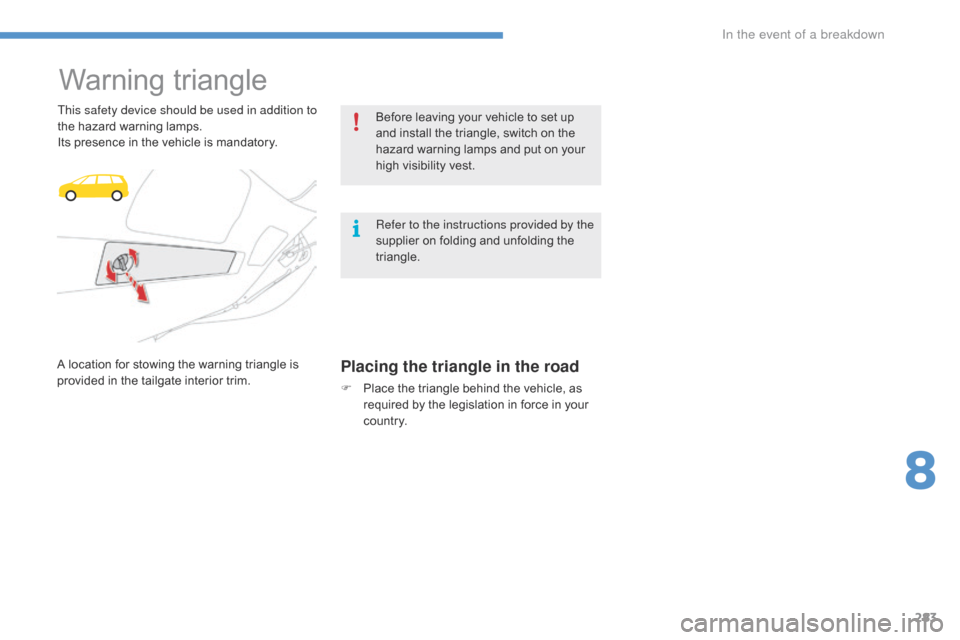
Warning triangle
This safety device should be used in addition to
the hazard warning lamps.
Its
presence in the vehicle is mandatory.
A
location for stowing the warning triangle is
p
rovided in the tailgate interior trim.
Placing the triangle in the road
F Place the triangle behind the vehicle, as r
equired by the legislation in force in your
c
o unt r y.Before
leaving your vehicle to set up
a
nd install the triangle, switch on the
h
azard warning lamps and put on your
h
igh visibility vest.
Refer to the instructions provided by the
supplier on folding and unfolding the
t
riangle.
8
In the event of a breakdown
Page 286 of 527
284
C4-Picasso-II_en_Chap08_en-cas-panne_ed01-2016
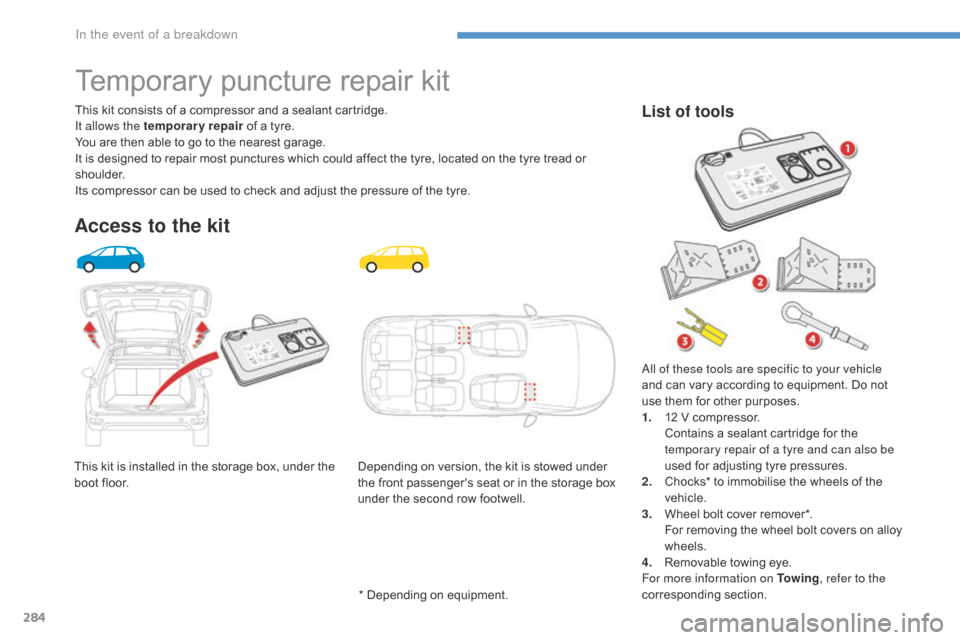
This kit is installed i n t he s torage b ox, u nder t he b
oot floor.
This
kit consists of a compressor and a sealant cartridge.
It allows the temporary repair
of a tyre.
You are then able to go to the nearest garage.
It is designed to repair most punctures which could affect the tyre, located on the tyre tread or
s
houlder.
Its compressor can be used to check and adjust the pressure of the tyre.
Temporary pu
ncture r epair k it
Access to the kit
Depending on version, the kit is stowed under t
he front passenger's seat or in the storage box
u
nder the second row footwell.
List of tools
* Depending on equipment. A ll of these tools are specific to your vehicle
and can vary according to equipment. Do not
u
se them for other purposes.
1.
1
2 V compressor.
C
ontains a sealant cartridge for the
t
emporary repair of a tyre and can also be
used for adjusting tyre pressures.
2.
C
hocks* to immobilise the wheels of the
v
ehicle.
3.
W
heel bolt cover remover*.
F
or removing the wheel bolt covers on alloy
w
heels.
4.
R
emovable towing eye.
For more information on To w i n g , refer to the
corresponding s ection.
In the event of a breakdown