inflation pressure Citroen C4 PICASSO RHD 2014.5 1.G Owner's Manual
[x] Cancel search | Manufacturer: CITROEN, Model Year: 2014.5, Model line: C4 PICASSO RHD, Model: Citroen C4 PICASSO RHD 2014.5 1.GPages: 428, PDF Size: 10.03 MB
Page 6 of 428
4
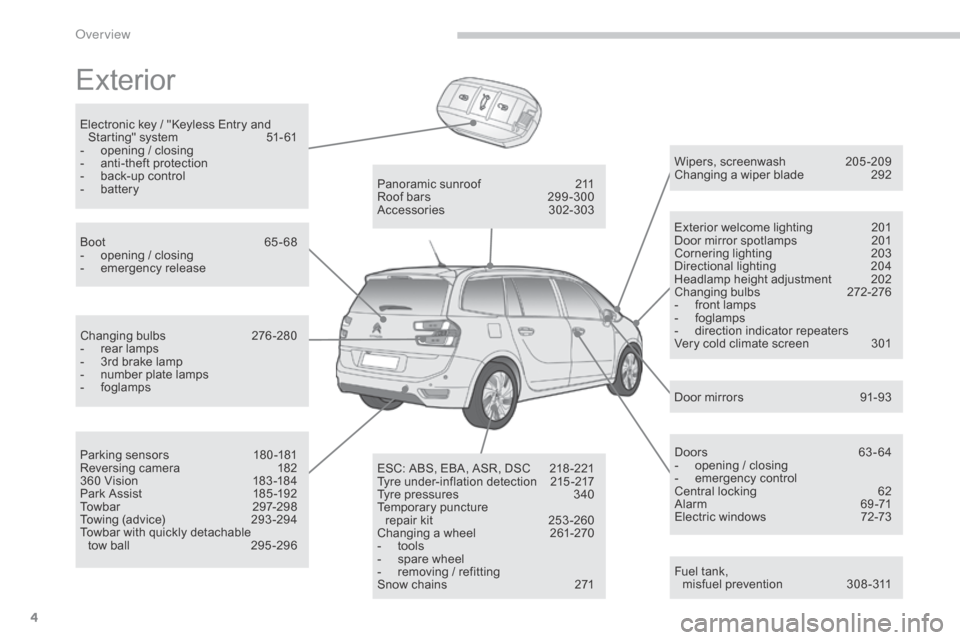
Exterior
Fuel tank,
mi sfuel p revention 3 08-311
Wipers,
screenwash
2
05 -209
Changing a wiper blade
2
92
Exterior welcome lighting
2
01
Door mirror spotlamps
2
01
Cornering lighting
2
03
Directional
l
ighting
2
04
Headlamp height adjustment
2
02
Changing
bu
lbs
2
72-276
-
f
ront lamps
-
fo
glamps
-
d
irection indicator repeaters
Very cold climate screen
3
01
Door mirrors
9
1-93
Panoramic
sunroof
2
11
Roof
bars
2
99 -300
Accessories
3
02-303
ESC:
ABS,
EBA,
ASR,
DSC
2
18 -221
Tyre
under-inflation
detection
2
15 -217
Tyre
pressures
3
40
Temporary
pu
ncture
r
epair
kit
2
53 -260
Changing
a
wheel
2
61-270
-
t
ools
-
s
pare
wheel
-
r
emoving
/
refitting
Snow
chains
2
71
Changing
bu
lbs
2
76-280
-
r
ear
lamps
-
3
rd
brake
lamp
-
n
umber
plate
lamps
-
fo
glamps
Parking
sensors
1
80 -181
Reversing
camera
1
82
360
Vision
1
83 -184
Park
Assist
1
85 -192
Towbar
29
7-298
Towing
(advice)
2
93 -294
Towbar
with
quickly
detachable
t
ow ball
2
95 -296
Boot
6
5-68
-
o
pening
/
closing
-
em
ergency
r
elease
Electronic
key
/
"Keyless
Entry
and
S
tarting"
system
5
1- 61
-
o
pening
/
closing
-
a
nti-theft
protection
-
b
ack-up
control
-
b
attery
Doors
6
3 - 64
-
o
pening / closing
-
em
ergency
c
ontrol
Central locking
6
2
Alarm
6
9-71
Electric windows
7
2-73
over view
Page 39 of 428

37
Under-inflationfixed, accompanied by a
n audible signal and
a
message. The
pressure in one or more tyres is t
oo low.Check
the tyre pressures as soon as possible.
This check should preferably be carried out when the
t
yres are cold.
You
must reinitialise the system after the adjustment
o
f one or more tyre pressures and after changing one
o
r more wheels.
For
more information, refer to the "Under-inflation
d
etection"
s
ection.
+ flashing
then fixed,
a
ccompanied by the
S
ervice warning lamp.The
system has fault: the tyre
p
ressures are no longer monitored.Check
the tyre pressures as soon as possible.
Have
the system checked by a CITROËN dealer or a
q
ualified
w
orkshop.
Warning / indicator lamp
StateCause Action / Observations
Foot on the
brake pedal *fixed.
The
brake pedal is not pressed. With an electronic gearbox, press the brake pedal to
s
tart the engine (lever in position N).
If
you wish to release the parking brake without
p
ressing the brake pedal, this warning lamp will
r
emain on.
With
an automatic gearbox, press the brake pedal to
m
ove the gear selector out of position P.
flashing. With
an electronic gearbox, if you
h
old the vehicle on an incline using
t
he accelerator for too long, the
c
lutch overheats.Use
the brake pedal and/or the parking brake.
Foot on the
clutch * fixed.
In
the STOP mode of Stop & Start,
c
hanging to START mode is refused
b
ecause the clutch pedal is not fully
d
own.You
must declutch fully to allow the change to engine
S
TART mode.
*
Only
with the type 1 instrument panel.
1
Monitoring
Page 217 of 428

215
Under-inflation detection
The system monitors the pressures in the four t
yres, once the vehicle is moving.
It
compares the information given by the four
w
heel speed sensors with reference values,
which must be reinitialised ever y time the
tyre pressures are adjusted or a wheel
changed .
The
system triggers an alert as soon as it
d
etects a drop in the inflation pressure of one
o
r more tyres. The
under-inflation detection system
d
oes not replace the vigilance or the
r
esponsibility of the driver.
This
system does not avoid the need to
c
heck the tyre pressures (including the
s
pare wheel) every month as well as
b
efore a long journey.
Driving
with under-inflated tyres impairs
r
oad holding, extends braking distances
a
nd causes premature tyre wear,
p
articularly under arduous condition
(
high loading, high speed, long journey).
System
which automatically checks the pressures of the tyres while driving.
The inflation pressures defined for
y
our vehicle can be found on the tyre
p
ressure label.
See
the "Identification markings"
s
ection.
Tyre
pressures should be checked
w
hen the tyres are "cold" (vehicle
s
topped for 1 hour or after a journey of
l
ess than 6 miles (10 km) at moderate
s
peeds).
Other wise
(when hot), add 0.3 bar to
t
he pressures shown on the label.
Driving
with under-inflated tyres
i
ncreases fuel consumption.
6
Safety
Page 218 of 428

216
Under-inflation alertReinitialisation
This is given by fixed illumination of t
his warning lamp, accompanied by
a
n audible signal and, depending on
e
quipment, the display of a message. It
is necessary to reinitialise the system every t
ime one or more tyre pressure is adjusted, and
a
fter changing one or more wheels.
A
label attached to the middle pillar, driver's
s
ide, gives a reminder of this.
F
R
educe speed immediately, avoid
e
xcessive steering movements and sudden
b
raking.
F
S
top the vehicle as soon as it is safe
to
do
so. F
I n the event of a puncture, use the
temporary
puncture repair kit or the spare
w
heel (depending on equipment),
or
F
i
f you have a compressor, such as the one
i
n the temporary puncture repair kit, check
t
he pressures of the four tyres when cold,
or
F
i
f it is not possible to make this check
i
mmediately, drive carefully at reduced
s
peed.
The
loss of pressure detected does not
a
lways cause visible bulging of the tyre.
D
o
not satisfy yourself with just a visual
c
heck. The
alert is maintained until the system
i
s
r
einitialised.
Safety
Page 219 of 428

217
Reinitialisation of the system is done in the the touch screen tablet, with the ignition on and the
v
ehicle stationary.
F
Sel
ect the " Driving assistance "
menu.
F
I
n the secondary page, press
"U
nder-inflation initialisation ".
F
C
onfirm the instruction by pressing "Ye s ",
an
audible signal and a message confirm
th
e
r
einitialisation.
The
new pressure settings registered
a
re considered to be reference values by
t
he system.
Operating fault
The flashing and then fixed illumination of the u nder-inflation w arning lam p a ccompanied b
y illumination of the "service" warning lamp
i
ndicates a fault with the system.
In
this case, under-inflation monitoring of the
t
yres is no longer assured.
Have
the system checked by a CITROËN
d
ealer or a qualified workshop.
Before
doing anything to the system,
t
he pressures of the four tyres must be
c
hecked and the system reinitialised.
The
under-inflation
alert
can
only
be
c
onsidered
reliable
if
reinitialisation
of
t
he
system
is
done
with
the
the
four
tyre
p
ressures
correctly
set.
Snow chains
The system does not have to be r einitialised after fitting or removing
sn
ow
c
hains.
Before
reinitialising the system, ensure
t
hat the pressures of the four tyres are
correct for the use of the vehicle and in
l
ine with the recommendations on the
t
yre pressure label.
The under-inflation detection system
d
oes not give a warning if a pressure is
i
ncorrect at the time of reinitialisation.
6
Safety
Page 257 of 428

255
A. "Sealant" or "Air" position selector.
B. on "
I" / off "O" s witch.
C.
D
eflation button.
D.
P
ressure gauge (in bar and p.s.i.).
E.
C
ompartment
h
ousing:
-
a
cable with adaptor for 12 V socket,
-
v
arious inflation adaptors for
a
ccessories, such as balls,
bicycle tyres...
Description of the kit
The speed limit sticker I must be affixed t o the vehicle's steering wheel to remind
y
ou that a wheel is in temporary use.
Do
not exceed a speed of 50 mph
(
80 km/h) when driving with a tyre
r
epaired using this type of kit.
F.
S
ealant
c
artridge.
G.
W
hite pipe with cap for repair.
H.
B
lack pipe for inflation.
I.
S
peed limit sticker.
The
tyre
inflation
pressures
are
given
on
this
lab
el.
The
vehicle's
electric
system
allows
the
c
onnection
of
a
compressor
for
long
e
nough
to
inflate
a
tyre
after
a
puncture
r
epair
or
for
inflating
a
small
inflatable
a
ccessory.
7
Practical information
Page 259 of 428

257
F Switch on the compressor by moving t
he switch B to position "I" until the tyre
pressure
reaches 2.0 bars.
T
he sealant is injected into the tyre under
p
ressure; do not disconnect the pipe from
t
he valve during this operation (risk of
sp
lashing).
If
after around 5 to 7 minutes the
p
ressure is not attained, this indicates
t
hat the tyre is not repairable; contact
a
CITROËN dealer or a qualified
w
orkshop for assistance. F
R emove the kit and screw the cap back on t
he white pipe.
T
ake care to avoid staining your vehicle
w
ith traces of fluid. Keep the kit to hand.
F
D
rive immediately for approximately
t
hree miles (five kilometres), at reduced
s
peed (between 15 and 35 mph
(20
and 60 km/h)), to plug the puncture.
F
S
top to check the repair and the tyre
p
ressure using the kit.
Tyre under-inflation
detection
After repair of the tyre, the warning lamp will remain on until the system is
r
einitialised.
For
more information, refer to the
"
Under-inflation
d
etection"
s
ection.
7
Practical information
Page 260 of 428
258
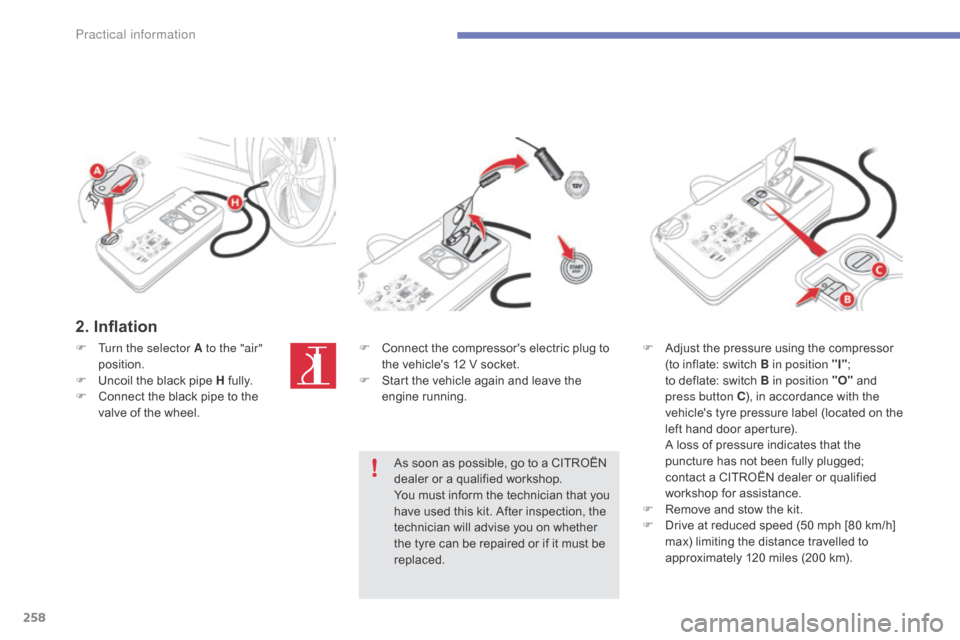
2. Inflation
F Turn the selector A to the "air" position.
F
U
ncoil the black pipe H
f
ully.
F
C
onnect the black pipe to the
v
alve of the wheel. F
C onnect the compressor's electric plug to t
he vehicle's 12 V socket.
F
S
tart the vehicle again and leave the
e
ngine
r
unning.
As
soon as possible, go to a CITROËN
d
ealer or a qualified workshop.
You
must inform the technician that you
h
ave used this kit. After inspection, the
t
echnician will advise you on whether
t
he tyre can be repaired or if it must be
r
eplaced.F
A djust the pressure using the compressor (
to inflate: switch B in position "I";
t
o deflate: switch B in position "O"
and
p
ress button C),
in accordance with the
v
ehicle's
t
yre pressure label (located on the
l
eft hand door aperture).
A
loss of pressure indicates that the
p
uncture has not been fully plugged;
c
ontact a CITROËN dealer or qualified
w
orkshop for assistance.
F
R
emove and stow the kit.
F
D
rive at reduced speed (50 mph [80 km/h]
m
ax) limiting the distance travelled to
a
pproximately 120 miles (200 km).
Practical information
Page 262 of 428
260
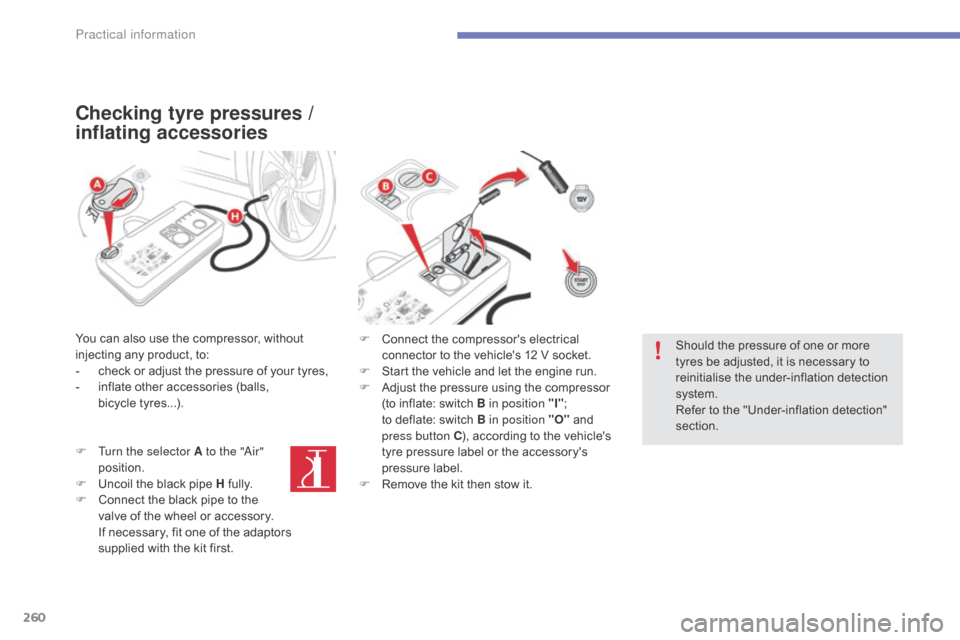
Checking tyre pressures /
inflating accessories
You can also use the compressor, without injecting any product, to:
-
c
heck or adjust the pressure of your tyres,
-
i
nflate other accessories (balls,
b
icycle tyres...).
F
T
urn the selector A to the "
ai
r"
position.
F
U
ncoil the black pipe H
f
ully.
F
C
onnect the black pipe to the
v
alve of the wheel or accessory.
I
f necessary, fit one of the adaptors
s
upplied with the kit first. F
C onnect the compressor's electrical
c
onnector to the vehicle's 12 V socket.
F
S
tart the vehicle and let the engine run.
F
A
djust the pressure using the compressor
(
to inflate: switch B in position "I";
t
o deflate: switch B in position "O"
and
p
ress button C),
according to the vehicle's
t
yre pressure label or the accessory's
p
ressure label.
F
R
emove the kit then stow it.Should
the pressure of one or more
t
yres be adjusted, it is necessary to
r
einitialise the under-inflation detection
s
ystem.
Refer
to the "Under-inflation detection"
s
ection.
Practical information
Page 342 of 428

340
Identification markingsVarious visible markings for the identification of your vehicle.
A.
V
ehicle Identification Number (VIN)
under the bonnet.
T
his number is engraved on the chassis
n
ear the right hand front wheel arch. The
tyre pressures must be checked
w
hen the tyres are cold, at least once
a
month.
If the tyre pressures are too low, this
increases
fuel consumption.
C.
M
anufacturer's label.
T
his self-destroying label on the middle
d
oor pillar, right or left hand side, contains
th
e
f
ollowing
i
nformation:
-
t
he manufacturer's name,
-
t
he European whole vehicle type
a
pproval number,
-
t
he vehicle identification number (VIN),
-
t
he maximum authorised weight (gross
ve
hicle
w
eight),
-
t
he maximum authorised weight with
t
railer (gross train weight),
-
t
he maximum front axle weight,
-
t
he maximum rear axle weight.D.
T
yre/paint label.
T
his label on the middle door pillar, driver's
s
ide, contains the following information:
-
t
he tyre inflation pressures, laden and
u
nladen,
-
t
he tyre sizes (including the tyre load
i
ndex and speed rating),
-
t
he inflation pressure for the spare
w
heel,
-
t
he paint colour code.
B.
V
ehicle Identification Number (VIN) on
the windscreen lower cross member.
T
his number is indicated on a self-
adhesive
label which is visible through the
w
indscreen.
Technical data