air condition Citroen C4 PICASSO RHD 2014.5 1.G User Guide
[x] Cancel search | Manufacturer: CITROEN, Model Year: 2014.5, Model line: C4 PICASSO RHD, Model: Citroen C4 PICASSO RHD 2014.5 1.GPages: 428, PDF Size: 10.03 MB
Page 100 of 428

98
Air intake / Air recirculation
The intake of exterior air prevents the formation of mist on the windscreen and side windows.
The recirculation of interior air isolates the
passenger
compartment from exterior odours
a
nd smoke.
F
P
ress the button to recirculate
the
interior air. The indicator
l
amp comes on.
F
P
ress the button again to permit
t
he intake of exterior air. The
i
ndicator lamp goes off to confirm
t
his. The
air conditioning is designed to ope
rate effectively in all seasons,
with
the windows closed.
Air conditioning On / Off
Switching on
Switching off
The air conditioning does not operate when the air flow adjustment is set to
o
f f. F
P
ress this button, the associated
i
ndicator lamp comes on.
Avoid
driving
too
long
without
r
ecirculation
of
interior
air
(risk
of
m
isting
and
deterioration
of
air
quality).
This
function
allows
hot
or
cold
air
to
be
d
elivered
selectively
and
more
quickly.
It
enables you to:
-
l
ower the temperature, in summer,
-
i
ncrease the effectiveness of the demisting
i
n winter, above 3°C.
F
Press the button again, the associated indicator lamp switches off.
Air distribution adjustment
These buttons are used to arrange the distribution of air in the passenger
c
ompartment by combining several air outlets.
Windscreen.
The
air distribution can be adapted by using
s
everal buttons: illumination of the indicator
l
amp confirms the presence of fan boosted air
i
n the direction indicated, the indicator lamp off
i
ndicates the absence of fan boosted air in the
d
irection
i
ndicated.
For
a uniform distribution of air in the
p
assenger compartment, the three buttons can
b
e activated simultaneously.
Footwells.
Central
and side vents.
Comfort
Page 101 of 428

99
Dual-zone automatic air conditioning
This air conditioning system operates with the engine running, but the ventilation and its controls are available with the ignition on.
Operation
of the air conditioning and regulation of temperature, air flow and air distribution in the
p
assenger compartment are automatic.
Press the button for the " Air conditioning"
menu to display the controls for the air conditioning
s
ystem.Temperature adjustment
1. Automatic mode.
2. D river's side temperature adjustment.
3.
P
assenger's
s
ide
t
emperature
a
djustment. The
driver and front passenger can each set
t
he
t
emperature.
F
P
ress one of these buttons
to increase the value.
F
P
ress one of these buttons
to decrease the value.
The value indicated corresponds to a level of
c
omfort and not to a precise temperature.
It is recommended that you avoid a left /right
s
etting difference of more than 3.
Depending on the colour scheme chosen, the system controls page is displayed differently:
4. A ir conditioning On / Off.
5. A ir d istribution a djustment.
6.
A
ir flow adjustment.
7.
A
ir intake / air recirculation.
3
Comfort
Page 102 of 428

100
In cold weather with the engine cold, the air flow is increased gradually until
t
he system has warmed up, in order
t
o limit the delivery of cold air into the
p
assenger
c
ompartment.
On
entering the vehicle, if the interior
t
emperature is much colder or warmer
t
han the comfort value setting, there
i
s no need to alter the value displayed
i
n order to reach more quickly the
r
equired level of comfort. The system
c
ompensates automatically and
c
orrects the temperature difference as
q
uickly as possible.
This
setting is associated with AUTO mode
o
nly.
However, on deactivation of AUTO mode,
t
he
indicator for the last setting remains on.
Changing the setting does not reactivate AUTO
m
ode
if deactivated.
When
the
indicator
lamp
in
the
button
is
on,
the
a
ir
conditioning
system
operates
automatically:
t
he
system
manages
the
temperature,
air
f
low
and
air
distribution
in
the
passenger
c
ompartment
in
an
optimum
way
according
to
t
he
comfort
level
you
have
selected.
It
is
possible
to
modulate
the
intensity
of
the
a
utomatic
comfort
programme
by
choosing
one
o
f
three
mode
settings
offered
in
a
secondary
p
age
of
the
" Air conditioning "
menu.
F
P
ress the "AUTO"
button
to
activate
or
deactivate
the
a
utomatic
mode
of
the
air
c
onditioning
system.
Automatic comfort
programme
To change the current setting, shown by the g
reen indicator lamp, press the button for the
de
sired
m
ode:"Soft":
provides soft and quiet
o
peration by limiting air flow.
"Normal":
o
ffers
t
he
b
est
c
ompromise
b
etween a comfortable temperature
a
nd quiet operation (default setting).
"Fast":
provides strong and effective
a
ir flow.
Comfort
Page 104 of 428

102
Avoid prolonged operation of the air recirculation function (risk of misting
a
nd of deterioration of the air quality).
"Mono" function
The comfort setting for the passenger's side can be indexed to the driver's comfort setting
(
mono-zone).
From
the secondary page of the "Air
conditioning "
menu:
F
P
ress this button to activate /
d
eactivate the "Mono" function.
T
he indicator lamp in the button
i
s on when the function is
activated.
The
function is deactivated automatically when
t
he
p
assenger
u
ses
t
heir
t
emperature
se
tting
b
uttons.
It
allows
you:
-
i
n
summer,
to
lower
the
temperature,
-
i
n
winter,
above
3
°C,
to
improve
demisting.
Switching off
F
P
ress the "A /C "
button
again
to
deactivate
t
he
air
conditioning.
W
hen
the
indicator
lamp
under
the
button
i
s
off,
the
air
conditioning
function
is
d
eactivated.
Switching on
F
P
ress the " A/C" button to activate the air
conditioning
W
hen
the
indicator
lamp
under
the
button
i
s
on,
the
air
conditioning
function
is
a
ctivated.
The
air
conditioning
cannot
operate
when
the
a
ir
flow
is
set
to
off.
Air conditioning On/Off
The air conditioning is designed to o perate efficiently in all seasons, with
the
windows closed. The
intake of exterior air avoids misting of the w
indscreen and side windows.
Air intake/Air recirculation
Air recirculation prevents exterior odours and s
moke from entering the passenger compartment.
This
function also allows faster heating
o
r cooling of the air in the passenger
c
ompartment. F
P
ress this button to choose
the
mode for air entry to the
p
assenger
c
ompartment.
When
the indicator lamp under the button is off,
t
he intake of exterior air is active.
When
the indicator lamp under the button is
o
n, air recirculation is activated, the intake of
e
xterior air is off.
Comfort
Page 105 of 428

103
"Rear" function
F Press this button to activate / d
eactivate the "Rear" function.
T
he indicator lamp in the button
i
s on when the function is
activated.
Settings for
passengers in
the
3
rd row of seats
From the secondary page of the "A ir
conditioning "
menu:
This
function gives rear passengers access to
t
he adjustment controls and allows.
-
t
he distribution of air conditioned air to the
v
ents for the 2
nd row of seats,
-
t
he
distribution
of ambient air to the vents
f
or
the
3
rd row of seats.
F
T
urn the upper wheel to open or close the
rear
vent.
F
T
urn the lower knob to reduce (to the left)
o
r increase (to the right) the air flow.
Settings for passengers in
the 2nd row of seats
F Press the vent cover.
F A djust the flow of air to the two vents using
t
he four-position wheel (off, low, medium,
h
i g h).
F
D
irect the vent by turning the cover.
3
Comfort
Page 106 of 428

104
Front demist - defrost
F Press this button to demist or d
efrost the windscreen and side
w
indows as quickly as possible.
T
he indicator lamp in the button
c
omes on.
With
Stop & Start, when demisting has
b
een activated, the STOP mode is not
a
vailable.
The
system automatically manages the air
c
onditioning (depending on version), air
f
low
and
air intake, and provides optimum
d
istribution towards the windscreen and side
w
indows.
F
T
o switch it off press this button, the
indicator
lamp goes off.Ventilation with ignition on
function
With the ignition on, you can use the ventilation system and have access to the "Air
conditioning "
menu to adjust the air flow and
a
ir distribution in the passenger compartment.
This
function is available for a few minutes,
d
epending on the state of charge of the battery
o
f your vehicle.
This
function does not activate the air
c
onditioning.
You
can make use of the residual heat in the
e
ngine to warm the passenger compartment
u
sing the temperature setting buttons.
Comfort
Page 111 of 428
109
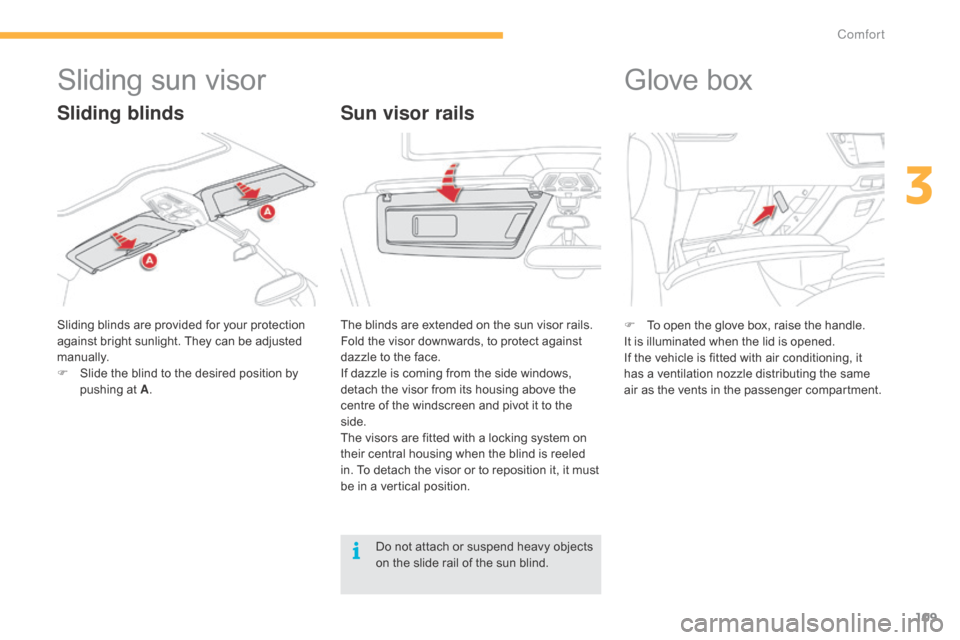
Sliding sun visor
Sliding blinds are provided for your protection against bright sunlight. They can be adjusted
m
anually.
F
S
lide the blind to the desired position by
p
ushing at A.
Sun visor rails
Glove box
F To open the glove box, raise the handle.
It is illuminated when the lid is opened.
If
the vehicle is fitted with air conditioning, it
h
as a ventilation nozzle distributing the same
a
ir as the vents in the passenger compartment.
The
blinds
are
extended
on
the
sun
visor
rails.
Fold
the
visor
downwards,
to
protect
against
d
azzle
to
the
face.
If
dazzle
is
coming
from
the
side
windows,
d
etach
the
visor
from
its
housing
above
the
c
entre
of
the
windscreen
and
pivot
it
to
the
si
de.
The
visors
are
fitted
with
a
locking
system
on
t
heir
central
housing
when
the
blind
is
reeled
i
n.
To
detach
the
visor
or
to
reposition
it,
it
must
b
e
in
a
vertical
position.
Sliding blinds
Do not attach or suspend heavy objects o n the slide rail of the sun blind.
3
Comfort
Page 159 of 428

157
The vehicle being followed may not be detected in certain conditions such as, for example:
-
w
hen turning,
-
w
hen
c
hanging
lan
e,
-
w
hen the vehicle in front is out of the range
o
f the sensor (maximum range: around
1
00 m).
Operating limits
In the event of a fault with the system, this warning lamp is displayed a
ccompanied by a message.
Operating fault
Have the system checked by a CITROËN dealer or a qualified workshop.
At
the first use of the system after
r
epair, a message may be displayed
i
ndicating that the system is initialising.
T
he system is not available while this is
i
n progress. As soon as the message
d
isappears the system is operational
a
gain. If the message does not
d
isappear, contact a CITROËN dealer
o
r a qualified workshop. The
operation of the radar, located in
t
he front bumper, may be disturbed by
a
ccumulations of grime (dust, mud...) o
r in certain weather conditions (snow, i
ce...).
The
message "SYSTEM INACTIVE:
V
isibility reduced" is displayed to signal
t
hat the system has been put into
s
t a n dby.
Clean
the front bumper regularly.
4
Driving
Page 217 of 428

215
Under-inflation detection
The system monitors the pressures in the four t
yres, once the vehicle is moving.
It
compares the information given by the four
w
heel speed sensors with reference values,
which must be reinitialised ever y time the
tyre pressures are adjusted or a wheel
changed .
The
system triggers an alert as soon as it
d
etects a drop in the inflation pressure of one
o
r more tyres. The
under-inflation detection system
d
oes not replace the vigilance or the
r
esponsibility of the driver.
This
system does not avoid the need to
c
heck the tyre pressures (including the
s
pare wheel) every month as well as
b
efore a long journey.
Driving
with under-inflated tyres impairs
r
oad holding, extends braking distances
a
nd causes premature tyre wear,
p
articularly under arduous condition
(
high loading, high speed, long journey).
System
which automatically checks the pressures of the tyres while driving.
The inflation pressures defined for
y
our vehicle can be found on the tyre
p
ressure label.
See
the "Identification markings"
s
ection.
Tyre
pressures should be checked
w
hen the tyres are "cold" (vehicle
s
topped for 1 hour or after a journey of
l
ess than 6 miles (10 km) at moderate
s
peeds).
Other wise
(when hot), add 0.3 bar to
t
he pressures shown on the label.
Driving
with under-inflated tyres
i
ncreases fuel consumption.
6
Safety
Page 222 of 428

220
Dynamic stability control (DSC)
and anti-slip regulation (ASR)Activation
These systems are activated automatically each time the vehicle is started.
As
soon as they detect a problem of grip or
t
rajectory, these systems act on the operation if
t
he engine and brakes.
Deactivation
In exceptional conditions (starting a vehicle which is bogged down, stuck in snow, on soft
g
round...), it may be advisable to deactivate
t
he DSC and ASR, so that the wheels can turn
f
reely and regain grip.
This
is
indicated
by
flashing
of
this
w
arning
lamp
in
the
instrument
panel. Reactivate
the systems as soon as the level of
g
rip permits. F
P
ress this button.
This
indicator lamp and the indicator
l
amp in the button come on.
The
DSC and ASR systems no longer act
o
n the operation of the engine and on the
b
rakes in the event of a involuntary change of
t
rajectory.
DSC/ASR
The DSC and ASR systems offer increased s afety in normal driving, but they should not
e
ncourage the driver to take extra risks or drive
a
t high speed.
It
is in conditions of reduced grip (rain, snow,
i
ce) that the risk of loss of grip increases.
I
t is therefore important for your safety to
k
eep the DSC and ASR systems activated
i
n all conditions, and particularly in difficult
c
onditions. The
correct operation of these systems
d
epends on observation of the manufacturer's
r
ecommendations regarding as much the
w
heels (tyres and rims), braking and electronic
c
omponents as the assembly and repair
p
rocedures used by CITROËN dealers.
To benefit in full from the effectiveness of the
D
SC and ASR systems in wintry conditions,
t
he vehicle must be fitted with four snow
t
yres, allowing the the vehicle to retain neutral
b
ehaviour on the road.
Safety