gearbox Citroen C4 PICASSO RHD 2014.5 1.G User Guide
[x] Cancel search | Manufacturer: CITROEN, Model Year: 2014.5, Model line: C4 PICASSO RHD, Model: Citroen C4 PICASSO RHD 2014.5 1.GPages: 428, PDF Size: 10.03 MB
Page 129 of 428

127
Electronic key left in the
reader
If the electronic key is left in the reader, on opening the driver's door a message
a
ppears to warn you.
In
the event of an emergency only,
t
he engine can be switched off
w
ithout any conditions. To do this,
p
ress the "START/STOP" button for
a
bout three seconds.
In this case the steering column locks
a
s soon as the vehicle stops.
Emergency stop
F Immobilise
the vehicle.
F P lace the gear selector lever at N for
vehicles
with an electronic gearbox, P or N
for
an automatic gearbox, or neutral with a
m
anual
g
earbox.
Switching off the engine
If the vehicle is not immobilised, the engine will not stop.
F
b
r
iefly press the "
START/STOP"
button.
T
he engine stops and the
s
teering column locks.
F
R
emove the electronic key from the reader.
Switching off the engine leads to a loss
o
f braking assistance.
4
Driving
Page 130 of 428

128
Starting-switching off the engine with the "Keyless Entry
a
nd Starting" system
F Place the gear selector lever at N for
vehicles with an electronic gearbox, P or N
with
an automatic gearbox, or neutral with
a m
anual
g
earbox.
F
W
ith the electronic key inside the vehicle
(
it is not necessary to put it in the reader),
p
ress the brake pedal for vehicles with
a
n electronic or automatic gearbox, or
f
ully declutch for vehicles with a manual
g
earbox. For Diesel vehicles
, in
temperatures below zero the
e
ngine will not start until the
p
reheater warning lamp has
g
one off.
If
this warning lamp comes on
a
fter pressing "START/STOP",
y
ou should hold the brake or
c
lutch pedal down until the
w
arning lamp goes off and do
n
ot press the START/STOP
bu
tton
ag
ain.
Starting the engine
If one of the starting conditions is not met, a reminder message appears in t
he instrument panel screen. In some
c
ircumstances, it is necessary to turn
t
he steering wheel slightly while pressing
t
he "START/STOP" button to assist
u
nlocking of the steering; a message
w
arns you when this is needed.
F
b
r
iefly press the "
START/STOP"
button.
T
he steering column unlocks
a
nd the engine starts more or
l
ess instantly (see the advice for
D
iesel
v
ersions).
The presence of the "Keyless Entry and
S
tarting" system electronic key in the
r
ecognition zone is essential.
For
safety reasons, do not leave this
z
one with the vehicle running. If
the electronic key is not detected in
t
he zone, a message is displayed. Move
t
he electronic key into the zone so that
t
he engine can be started.
Driving
Page 131 of 428

129
Emergency starting
When the electronic key is in the recognition zone and, after pressing the "START/STOP"
b
utton, the engine does not start:
F
P
lace the gear selector at N for vehicles
with
an electronic gearbox, P or N for
vehicles
with an automatic gearbox or
n
eutral for vehicles with a manual gearbox.
F
W
ith
the
electronic
key
inside
t
he vehicle, press the "
S TA R T/
STOP "
button.
T
he
engine
stops
and
the
s
teering
column
locks.
F
I
mmobilise
the
vehicle.
F
P
lace
the
gear
selector
lever
at
N for
vehicles
with
an
electronic
gearbox,
P or N
with
an
automatic
gearbox,
or
neutral
with
a m
anual
g
earbox.
Switching off the engine
If the vehicle is not immobilised, the e
ngine will not stop.
do n
ot leave your vehicle with the
electronic
key still inside. F
I
nsert the electronic key in the reader.
F
P
ress the brake pedal on vehicles with an
e
lectronic or automatic gearbox, or fully
d
eclutch with a manual gearbox.
F
P
ress the "START/STOP" button.
T
he engine starts.
Switching
off the engine leads to a loss
o
f braking assistance.
4
Driving
Page 134 of 428

132
Electric parking brake
In the event of a battery failure, the
electric parking brake no longer works.
As
a safety measure, if the parking
b
rake is not applied, immobilise the
v
ehicle by engaging a gear or placing a
c
hock at one of the wheels.
Contact
a CITROËN dealer or a
q
ualified
w
orkshop.
Indicator lamp
This indicator lamp comes on in the instrument panel and in the control
l
ever to confirm the application of the
par
king
b
rake.
The
system
provides,
in
automatic
operation,
t
he
application
of
the
parking
brake
on
s
witching
off
the
engine
and
release
as
the
v
ehicle
moves
off.
The
driver
can
take
over
at
any
time
to
apply
o
r
release
the
parking
brake,
by
operating
the
c
ontrol
lever:
-
b
y
briefly
pulling the control lever to apply
the
brake,
-
b
y
briefly
pushing the control lever, while
pressing
the
foot
brake,
to
release.
Automatic
mode
is
activated
by
default.
The
technology
adopted
for
the
electric
p
arking
brake
does
not
allow
the
fitment
o
f
wheels
smaller
than
16
inches. It
goes
off
to confirm the release of the parking
b
rake.
The
indicator lamp in the control lever flashes
d
uring
manual application or release.
After
the
parking brake has been applied, the
s
imultaneous flashing of the two indicator
l
amps
in
the instrument panel and the control
l
ever
alerts you to the need to fully secure your
v
ehicle
by
engaging a gear (with a manual
o
r
electronic gearbox) or by placing the gear
s
elector in position P with an automatic
g
earbox,
or by fitting a chock to one of the
w
heels.
(E.g.: parking on a very steep slope or
o
n
a
slope with a low battery).
driving
Page 135 of 428

133
Label on door panel
Before leaving the vehicle, check that parking brake is applied: the indicator
l
amps in the instrument panel and
t
he control lever must be on fixed, not
f
lashing.
If
the parking brake is not applied, there
i
s an audible signal and a message is
d
isplayed on opening the driver's door.
Never
leave a child alone inside the
v
ehicle with the ignition on, as they
c
ould release the parking brake.When
towing, parking on a steep s
lope, or if your vehicle is heavily
laden,
turn the wheels towards the kerb
a
nd engage a gear (with a manual or
e
lectronic gearbox) or place the gear
s
elector in position P with an automatic
g
earbox.
For
towing, you vehicle is approved for
p
arking on slopes of up to 12%.
Manual operation
Application of of the parking brake is confirmed by illumination of the
b
rake indicator lamp and the P
indicator
lamp in the control lever,
a
ccompanied by the display of the
m
essage "Parking brake applied".
Manual release
With the ignition on or the engine running, to release the parking brake:
F
p
ress the brake pedal,
F
w
hile maintaining pressure on the brake
p
edal, briefly push the control lever.
The
complete release of the parking brake
i
s confirmed by the brake indicator lamp and
t
he P indicator lamp in the control lever going
o
ff,
a
ccompanied
b
y
t
he
d
isplay
o
f
t
he
m
essage
"
Parking brake released".
If you push the control lever without
pressing
the brake pedal, the parking
b
rake will not be released and a
m
essage is displayed.
Manual application
With the vehicle stationary: briefly pull the control lever.
Confirmation of the instruction is signaled by flashing of the indicator lamp in the control
l
eve r.
4
Driving
Page 136 of 428

134
With the vehicle stationary, the parking brake is automatically applied when the engine
is switched off
by pressing the START/STOP
b
utton. Application
of of the parking brake
i
s confirmed by illumination of the
b
rake indicator lamp and the P
indicator
lamp in the control lever,
a
ccompanied by the display of the
m
essage "Parking brake applied".
With
the engine stalled or in STOP
m
ode of Stop & Start, automatic
a
pplication does not take place.
In
automatic mode, you can manually
a
pply
o
r
r
elease
t
he
p
arking
b
rake
u
sing
t
he control lever.
Automatic operation
Automatic release
The complete release of the parking brake is confirmed by the brake
i
ndicator lamp and the P indicator
l
amp in the control lever going off,
a
ccompanied by the display of the
m
essage "Parking brake released".
When stationary with the engine running, do not depress the accelerator pedal unnecessarily, y
ou risk releasing the parking brake.
Ensure first that the engine is running and the driver's door is properly closed.
The
electric parking brake releases
automatically and progressively when you
press
the accelerator:
F
M
anual gearbox: fully depress the clutch
p
edal, engage 1
st or reverse gear; press t
he
accelerator
pedal and let up the clutch
ped
al.
F
E
lectronic
gearbox: select position A, M or
R
then
press
the
accelerator pedal.
F
A
utomatic
gearbox: select position D, M or
R
then
press
the
accelerator.
Automatic application
With an electronic or automatic g earbox, if the brake does not release
a
utomatically, check that the front doors
a
re correctly closed.
Driving
Page 140 of 428

138
SituationsConsequences
Display
of
the
message
" Parking brake fault "
and of the
fo
llowing
w
arning
lam
ps: The
Parking Brake is faulty, the manual and automatic functions may not operate.
When stationary ,
to immobilise your vehicle:
-
P
ull and hold the control lever for about 7 to 15 seconds, until the warning lamp
c
omes on in the instrument panel.
If
this procedure does not work, you should make your vehicle safe:
-
P
ark on a level sur face.
-
E
ngage a gear with a manual or electronic gearbox, or place the gear selector in
p
osition P with an automatic gearbox.
-
I
f possible, fit a wheel chock.
Call
on a CITROËN dealer or a qualified workshop.
Display
of
the
message
" Parking brake fault "
and of the
fo
llowing
w
arning
lam
ps: -
T
he parking brake does not have its full per formance to securely hold the vehicle
i
n all situations.
You
should make your vehicle safe:
-
P
ark on a level sur face.
-
E
ngage a gear with a manual or electronic gearbox, or place the gear selector in
p
osition P with an automatic gearbox.
-
I
f possible, fit a wheel chock.
Call
on a CITROËN dealer or a qualified workshop.
The
flashing of the P warning lamps on starting the vehicle indicates that the parking
b
rake is not correctly applied.
As
soon as possible, stop the vehicle and try to completely release the parking brake,
u
sing the control lever, with your foot on the brake pedal.
Display
of
the
message
" Battery fault "
and the following
w
arning
lam
p: -
T
he state of charge of the battery is very low and requires immobilisation of the
v
ehicle in a safe place: engage a gear with a manual gearbox or fit a chock to
o
ne of the wheels.
-
O
nce the battery is completely discharged, the controls do not operate: to
r
elease the parking brake, call on a CITROËN dealer or a qualified workshop.
Driving
Page 141 of 428
139
Hill start assist
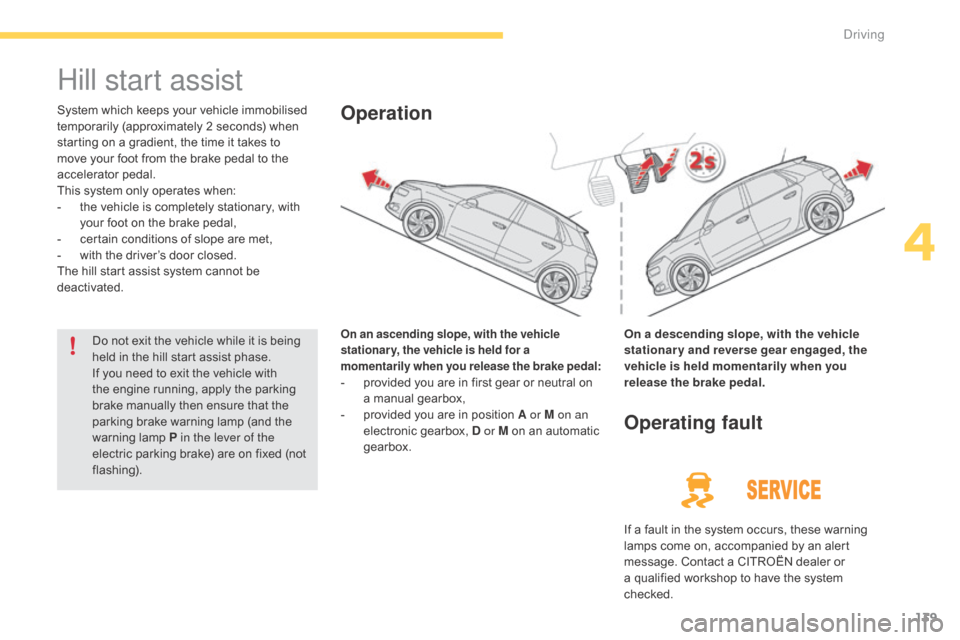
System which keeps your vehicle immobilised temporarily (approximately 2 seconds) when
s
tarting on a gradient, the time it takes to
m
ove your foot from the brake pedal to the
a
ccelerator
ped
al.
This
system only operates when:
-
t
he vehicle is completely stationary, with
y
our foot on the brake pedal,
-
c
ertain conditions of slope are met,
-
w
ith the driver’s door closed.
The
hill start assist system cannot be
d
eactivated.
On an ascending slope, with the vehicle
stationar y, the vehicle is held for a
momentarily when you release the brake pedal:
- provided you are in first gear or neutral on a
manual gearbox,
-
p
rovided you are in position A or M on an
electronic
ge
arbox,
D
or M on an automatic
g
earbox.
Operation
On a descending slope, with the vehicle
stationary and reverse gear engaged, the
vehicle is held momentarily when you
release the brake pedal.
Operating fault
If a fault in the system occurs, these warning lamps come on, accompanied by an alert
m
essage. Contact a CITROËN dealer or
a
qualified workshop to have the system
c
hecked.
Do
not
exit
the
vehicle
while
it
is
being
h
eld
in
the
hill
start
assist
phase.
If
you
need
to
exit
the
vehicle
with
t
he
engine
running,
apply
the
parking
b
rake
manually
then
ensure
that
the
p
arking
brake
warning
lamp
(and
the
w
arning
lam
p
P
in the lever of the
electric
parking
brake)
are
on
fixed
(not
f
lashing).
4
driving
Page 142 of 428

140
5-speed manual
g
earbox
Engaging reverse gear
F With clutch pedal fully down, place the gear l
ever in neutral.
F
P
ush the gear lever to the right then
ba
ckwards.
Only
engage reverse gear when the
v
ehicle is stationary with the engine at idle.
As
a safety precaution and to facilitate
s
tarting of the engine:
-
a
lways select neutral,
-
p
ress the clutch pedal.
6-speed manual
g
earbox
Engaging 5th or 6th gear
F Move the lever fully to the right to engage 5th or 6th ge a r.
Only engage reverse gear when the
v
ehicle is stationary with the engine at idle.
As
a safety precaution and to facilitate
s
tarting of the engine:
-
a
lways select neutral,
-
p
ress the clutch pedal.
Engaging reverse gear
Failure to follow this advice may cause permanent damage to the gearbox
(
engagement
o
f
3rd or 4th gear by m
i st a ke).
F
R
aise the ring under the knob and move
t
he gear lever to the left then for wards.
Driving
Page 143 of 428

141
Electronic gearbox
Electronic gearbox system which offers a c
hoice between the comfort of fully automatic
o
peration
an
d
m
anual
g
ear
c
hanging.
There
are two driving modes:
-
a
utomated
mode for automatic control
o
f the gears by the gearbox, without any
a
ction on the part of the driver
-
m
anual
mode for sequential gear changing
b
y the driver using the steering mounted
p
addles.
In
automated mode, you can temporarily take
ov
er control of gear changing. R.
R
everse
F
W
ith your foot on the brake, move the
s
elector lever.
N.
N
eutral.
F
W
ith your foot on the brake, select this
p
osition to start the engine.
A.
A
utomated mode.
F
M
ove the selector lever to position A to
select
this mode.
M.
M
anual mode with sequential manual gear
c
hanging.
F
M
ove the selector lever to position M to
select
this mode, then use the steering
m
ounted control paddles to change gear.Gear selector lever
+. Change up paddle to the right of the s
teering w heel.
F
P
ull the "+"
steering mounted paddle
t
owards you to change up a gear.
-.
C
hange down paddle to the left of the
s
teering
w
heel.
F
P
ull the "-"
steering mounted paddle
t
owards you to change down a gear.
Steering mounted control paddles
The steering mounted paddles cannot be used to select neutral or to engage
o
r
d
isengage
r
everse
g
ear.
4
Driving