towing Citroen C4 PICASSO RHD 2014.5 1.G Owner's Manual
[x] Cancel search | Manufacturer: CITROEN, Model Year: 2014.5, Model line: C4 PICASSO RHD, Model: Citroen C4 PICASSO RHD 2014.5 1.GPages: 428, PDF Size: 10.03 MB
Page 5 of 428
Direction indicators 213
Hazard warning lamps
2
13
H or n
2
13
Emergency
or assistance call
2
14
Warning
triangle
2
14
Under-inflation
d
etection
2
15
ESC
system
2
18
Seat
belts
2
22
Airbags
2
27
Child
seats
2
33
Deactivating
the passenger's front airbag
2
35
ISOFIX
mountings
2
44
Child
lock
2
52
Safety
Temporary puncture repair kit 253
Changing a wheel
2
61
Snow
chains
2
71
Changing
a bulb
2
72
Changing
a fuse
2
81
12
V battery
2
88
Energy
economy mode
2
91
Changing
a wiper blade
2
92
Towing
the vehicle
2
93
Towbar
with quickly detachable towball
2
95
Towing
a trailer
2
97
Roof
bars
2
99
Very
cold climate screen
3
01
Accessories
3
02
Practical information
Bonnet 305
Petrol engines
3
06
Diesel
engines
3
07
Fuel
3
08
Misfuel
prevention (Diesel)
3
10
Running
out of fuel (Diesel)
3
12
Checking
levels
3
13
C h e c ks
3
17
AdBlue
® additive and SCR system
(
BlueHDi Diesel) 3 19
Checks
Petrol engines 3 28
Petrol weights
3
30
Diesel
engines
3
32
Diesel
weights
3
35
Dimensions
3
38
Identification
ma
rkings
3
40
Technical data
Emergency or assistance 3 41
7-inch touch screen tablet
3
43
Audio and telematics
Lighting controls 1 93
Automatic illumination of headlamps
1
98
Automatic
headlamp dipping
1
99
Daytime
running lamps
2
01
Headlamp
adj
ustment
2
02
Directional
l
ighting
2
04
Wiper
controls
2
05
Screenwash
2
07
Automatic
rain sensitive wipers
2
08
Courtesy
lamps
2
10
Panoramic
sunroof
2
11
Interior
mood lighting
2
12
Visibility
Alphabetical
in
dex
Contents
Page 6 of 428
4
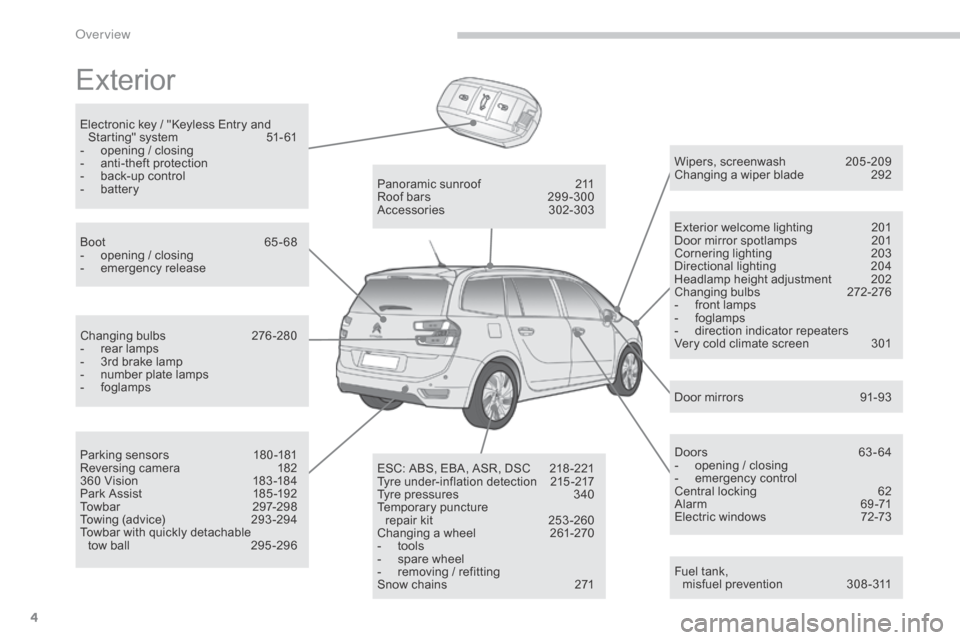
Exterior
Fuel tank,
mi sfuel p revention 3 08-311
Wipers,
screenwash
2
05 -209
Changing a wiper blade
2
92
Exterior welcome lighting
2
01
Door mirror spotlamps
2
01
Cornering lighting
2
03
Directional
l
ighting
2
04
Headlamp height adjustment
2
02
Changing
bu
lbs
2
72-276
-
f
ront lamps
-
fo
glamps
-
d
irection indicator repeaters
Very cold climate screen
3
01
Door mirrors
9
1-93
Panoramic
sunroof
2
11
Roof
bars
2
99 -300
Accessories
3
02-303
ESC:
ABS,
EBA,
ASR,
DSC
2
18 -221
Tyre
under-inflation
detection
2
15 -217
Tyre
pressures
3
40
Temporary
pu
ncture
r
epair
kit
2
53 -260
Changing
a
wheel
2
61-270
-
t
ools
-
s
pare
wheel
-
r
emoving
/
refitting
Snow
chains
2
71
Changing
bu
lbs
2
76-280
-
r
ear
lamps
-
3
rd
brake
lamp
-
n
umber
plate
lamps
-
fo
glamps
Parking
sensors
1
80 -181
Reversing
camera
1
82
360
Vision
1
83 -184
Park
Assist
1
85 -192
Towbar
29
7-298
Towing
(advice)
2
93 -294
Towbar
with
quickly
detachable
t
ow ball
2
95 -296
Boot
6
5-68
-
o
pening
/
closing
-
em
ergency
r
elease
Electronic
key
/
"Keyless
Entry
and
S
tarting"
system
5
1- 61
-
o
pening
/
closing
-
a
nti-theft
protection
-
b
ack-up
control
-
b
attery
Doors
6
3 - 64
-
o
pening / closing
-
em
ergency
c
ontrol
Central locking
6
2
Alarm
6
9-71
Electric windows
7
2-73
over view
Page 97 of 428

95
In order for these systems to be fully effective, follow the operation and maintenance guidelines belo w:
F
T
o obtain an even air distribution, take care not to obstruct the exterior air intake grilles
l
ocated at the base of the windscreen, the nozzles, the vents and the air outlets, as well
a
s the air extractor located in the boot.
F
D
o not cover the sunshine sensor, located on the dashboard; this is used for regulation
o
f the air conditioning system.
F
O
perate the air conditioning system for at least 5 to 10 minutes, once or twice a month
t
o keep it in per fect working order.
F
E
nsure that the passenger compartment filter is in good condition and have the filter
e
lements replaced regularly.
W
e recommend the use of a combined passenger compartment filter. Thanks to its
s
pecial active additive, it contributes to the purification of the air breathed by the
o
ccupants and the cleanliness of the passenger compartment (reduction of allergic
s
ymptoms, bad odours and greasy deposits).
F
T
o ensure correct operation of the air conditioning system, you are also advised to have
i
t checked regularly as recommended in the maintenance and warranty guide.
F
I
f the system does not produce cold air, switch it off and contact a CITROËN dealer or a
q
ualified
w
orkshop.
Recommendations for ventilation and air conditioning
If after an extended stop in sunshine, the i nterior t emperature i s v ery h igh, f irst
v
entilate the passenger compartment for
a
few moments.
Put
the air flow control at a setting high
e
nough to quickly change the air in the
p
assenger
c
ompartment.
The
air conditioning system does not
c
ontain chlorine and does not present
a
ny danger to the ozone layer.
The
condensation created by the air
c
onditioning results in a discharge
o
f water under the vehicle which is
p
er fectly normal.
When
towing
the
maximum
load
on
a
steep
gradient
in
high
temperatures,
switching
off
the
a
ir
conditioning
increases
the
available
engine
power
and
so
improves
the
towing
ability.
Stop & Start
The heating and air conditioning s ystems only work when the engine
i
s running. To maintain a comfortable
t
emperature in the passenger
c
ompartment, you can temporarily
d
eactivate the Stop & Start system
(see
the corresponding section).
3
Comfort
Page 116 of 428
114
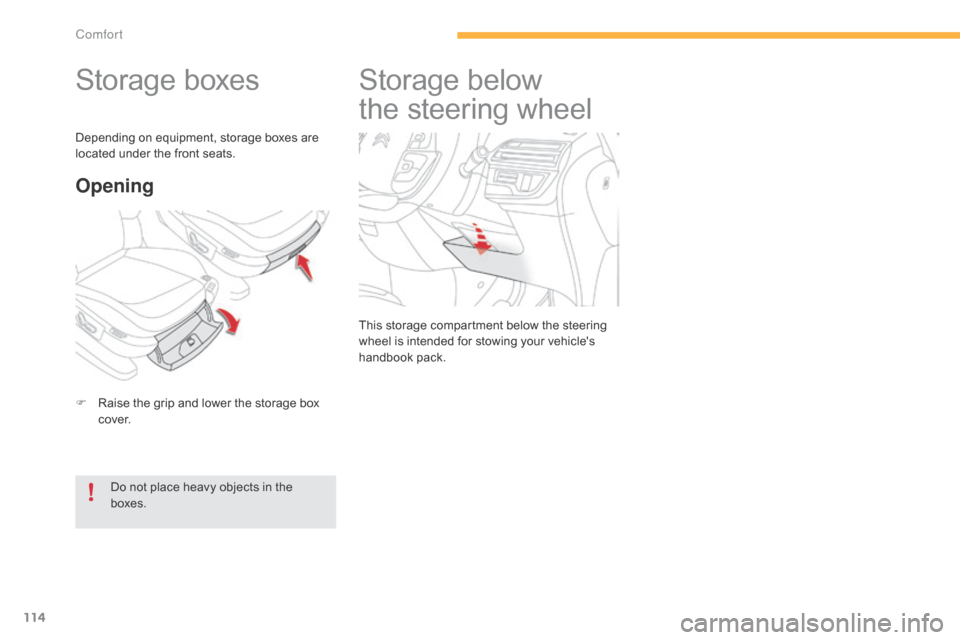
Storage boxes
F Raise the grip and lower the storage box c
ove r.
Opening
Do not place heavy objects in the boxes.
Depending
on equipment, storage boxes are
l
ocated under the front seats.
Storage belo
w
t
he steering wheel
This storage compartment below the steering w
heel is intended for stowing your vehicle's
han
dbook
pa
ck.
Comfort
Page 123 of 428
121
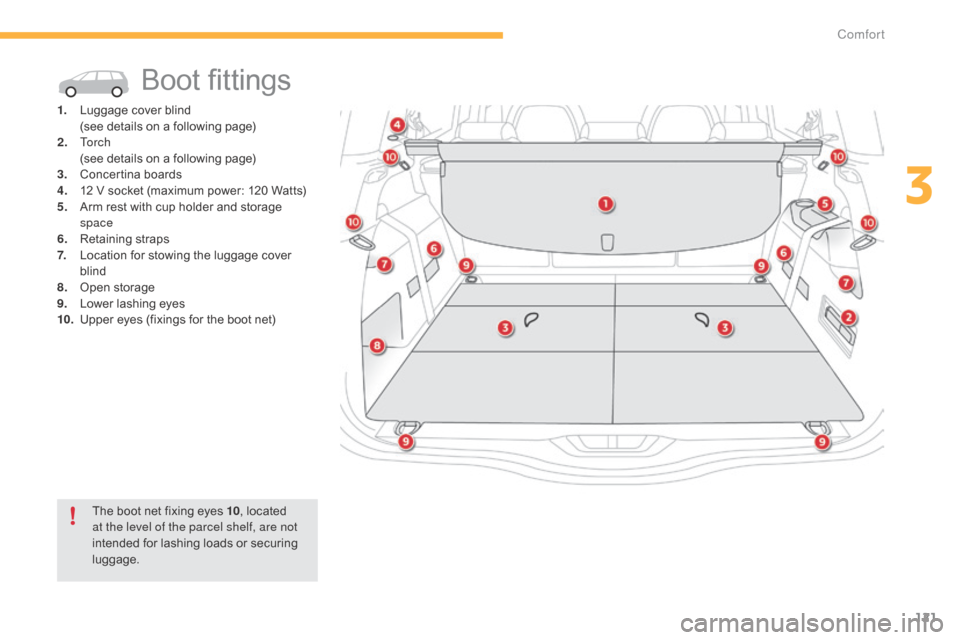
Boot fittings
1. Luggage cover blind (
see details on a following page)
2.
T
o r c h
(
see details on a following page)
3.
C
oncertina
b
oards
4.
1
2 V socket (maximum power: 120 Watts)
5.
A
rm rest with cup holder and storage
spa
ce
6.
R
etaining
s
traps
7.
L
ocation for stowing the luggage cover
b
lind
8.
O
pen
s
torage
9.
L
ower lashing eyes
10.
U
pper eyes (fixings for the boot net)
The
boot net fixing eyes 10,
located
a
t the level of the parcel shelf, are not
intended
for lashing loads or securing
l
uggage.
3
Comfort
Page 125 of 428
123
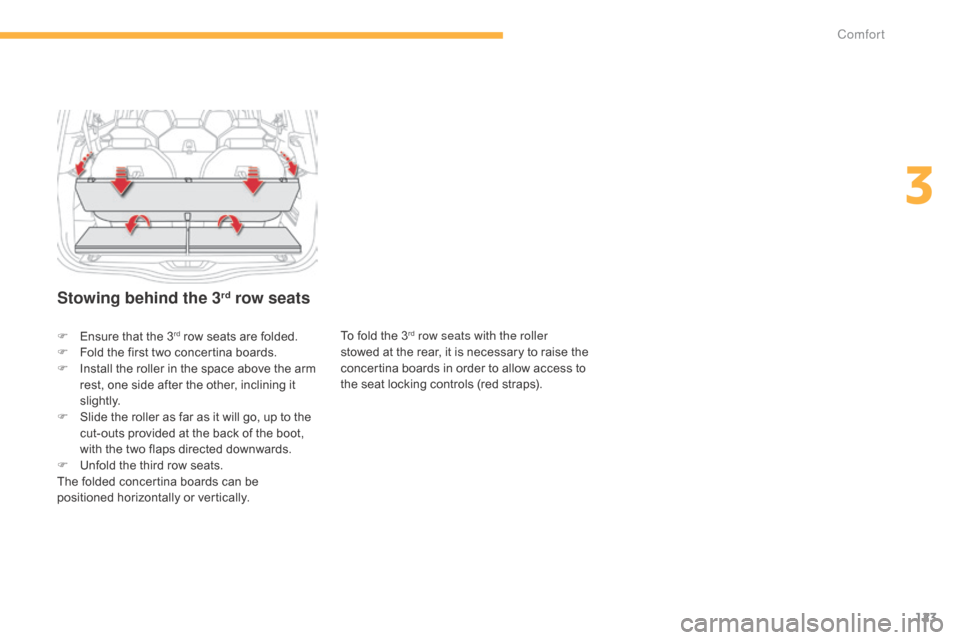
Stowing behind the 3rd row seats
To fold the 3rd row seats with the roller
stowed
at
the
rear, it is necessary to raise the
c
oncertina
boards in order to allow access to
t
he
seat
locking controls (red straps).
F
E
nsure
that
the
3rd row seats are folded.
F
F
old
the
first
two
concertina boards.
F
I
nstall
the
roller
in
the space above the arm
r
est,
one
side
after the other, inclining it
s
li g ht l y.
F
S
lide
the
roller
as
far as it will go, up to the
c
ut-outs
provided
at the back of the boot,
w
ith
the
two
flaps
directed downwards.
F
U
nfold
the
third
row seats.
The
folded
concertina
boards can be
p
ositioned
horizontally or vertically.
3
Comfort
Page 135 of 428

133
Label on door panel
Before leaving the vehicle, check that parking brake is applied: the indicator
l
amps in the instrument panel and
t
he control lever must be on fixed, not
f
lashing.
If
the parking brake is not applied, there
i
s an audible signal and a message is
d
isplayed on opening the driver's door.
Never
leave a child alone inside the
v
ehicle with the ignition on, as they
c
ould release the parking brake.When
towing, parking on a steep s
lope, or if your vehicle is heavily
laden,
turn the wheels towards the kerb
a
nd engage a gear (with a manual or
e
lectronic gearbox) or place the gear
s
elector in position P with an automatic
g
earbox.
For
towing, you vehicle is approved for
p
arking on slopes of up to 12%.
Manual operation
Application of of the parking brake is confirmed by illumination of the
b
rake indicator lamp and the P
indicator
lamp in the control lever,
a
ccompanied by the display of the
m
essage "Parking brake applied".
Manual release
With the ignition on or the engine running, to release the parking brake:
F
p
ress the brake pedal,
F
w
hile maintaining pressure on the brake
p
edal, briefly push the control lever.
The
complete release of the parking brake
i
s confirmed by the brake indicator lamp and
t
he P indicator lamp in the control lever going
o
ff,
a
ccompanied
b
y
t
he
d
isplay
o
f
t
he
m
essage
"
Parking brake released".
If you push the control lever without
pressing
the brake pedal, the parking
b
rake will not be released and a
m
essage is displayed.
Manual application
With the vehicle stationary: briefly pull the control lever.
Confirmation of the instruction is signaled by flashing of the indicator lamp in the control
l
eve r.
4
Driving
Page 138 of 428

136
Emergency braking
In the event of a failure of the main service brake or in an exceptional situation (e.g. driver
t
aken ill, under instruction, etc) a continuous
p
ull on the control lever will brake the vehicle.
B
raking takes place while the control lever is
b
eing pulled. It is interrupted if the control lever
i
s
r
eleased.
The
ABS and DSC systems provide stability of
t
he vehicle during emergency braking.
If
the emergency braking malfunctions, the
m
essage "Parking brake control faulty" will be
d
isplayed.
If
a failure of the ABS and DSC systems
o
ccurs, signalled by the illumination of one
o
r both warning lamps in the instrument
p
anel, then stability of the vehicle is no longer
g
uaranteed.
In
this event, stability must be assured by the
d
river by repeating alternate "pull-release"
a
ctions on the control lever until the vehicle is
immobilised. The
emergency braking should only be
u
sed in an exceptional situation.
Repeat
this
procedure
to
reactivate
automatic
ope
ration.
Reactivation
of
automatic
operation
is
c
onfirmed
by
the
indicator
lamp
in
the
i
nstrument
panel
going
off.
Deactivating automatic
operation
In some situations, such as very cold weather o r towing (caravan, recovery), it may be
n
ecessary to deactivate automatic operation of
t
he system.
F
S
tart the engine.
F
A
pply the parking brake with the control
l
ever, if it is released.
F
T
ake your foot off the brake pedal.
F
P
ush and hold the control lever in the
r
elease direction for at least 10 seconds
a
nd no more than 15 seconds.
F
R
elease the control lever.
F
P
ress and hold the brake pedal.
F
P
ull the control lever in the apply direction
f
or 2 seconds.
Deactivation
of the automatic functions
i
s confirmed by illumination of this
i
ndicator lamp in the instrument panel.
F
R
elease the control lever and the brake
ped
al. From
this point the parking brake can only b
e applied and released manually using the
c
ontrol lever.
Driving
Page 166 of 428

164
Flashing of the dashes indicates a fault with the cruise control.
Have
it checked by a CITROËN dealer or a
q
ualified
w
orkshop.
Operating fault
Exceeding the programmed
speed
If the cruise speed setting is exceeded, the displayed speed flashes.
The
display becomes steady again once the
v
ehicle returns to the cruise speed setting.
Switching off
F Turn wheel 1 to the "0" position. T
he display of information related to the
c
ruise control disappears. When
the cruise control is switched on,
b
e careful if you maintain the pressure
o
n one of the programmed speed
c
hanging buttons: this may result in
a
very rapid change in the speed of
y
our vehicle.
do n
ot use the cruise control on
slippery roads or in heavy traffic.
On a steep descent, the cruise control
w
ill not be able to prevent the vehicle
from exceeding the programmed speed.
On steep climbs or when towing, the
p
rogrammed speed may not be reached
o
r maintained.
The
use of mats not approved by
C
ITROËN may inter fere with the
o
peration of the cruise control.
To
avoid any risk of jamming of the
ped
als:
-
e
nsure that the mat is secured
c
o r r e c t l y,
-
n
ever fit one mat on top of another.
Driving
Page 181 of 428

179
F To deactivate the system, press t
his button again; its indicator
l
amp goes off as well as the
a
ssociated indicator in the
in
strument
pan
el. In
the event of a fault, the symbol for t
he button changes to alert mode and
t
he warning lamp flashes for a few
m
oments then goes off.
Operating fault
Have it checked by a CITROËN dealer or a qualified w orkshop.
The
system
is
automatically
deactivated
w
hen
towing
with
a
towbar
approved
by
CIT
ROËN. The
system may suffer temporary
i
nterference in certain weather
conditions (rain, hail...).
In particular, driving on a wet sur face
o
r moving from a dry area to a wet area
c
an cause false alerts (for example, the
p
resence of a fog of water droplets in t
he blind spot angle is interpreted as a v
ehicle).
In
bad or wintry weather, ensure that
t
he sensors are not covered by mud, ice
o
r snow.
Take
care not to cover the warning zone
i
n the door mirrors or the detection
z
ones on the front and rear bumpers
w
ith adhesive labels or other objects;
t
hey may hamper the correct operation
o
f the system.
The
state
of
the
system
remains
in
memory
on
s
witching
off
the
ignition.
High pressure jet wash
When
washing your vehicle, direct the
l
ance at least 30 cm away from the
sen
sors.
4
Driving