lock Citroen C4 PICASSO RHD 2015 1.G Repair Manual
[x] Cancel search | Manufacturer: CITROEN, Model Year: 2015, Model line: C4 PICASSO RHD, Model: Citroen C4 PICASSO RHD 2015 1.GPages: 428, PDF Size: 10.09 MB
Page 277 of 428
275
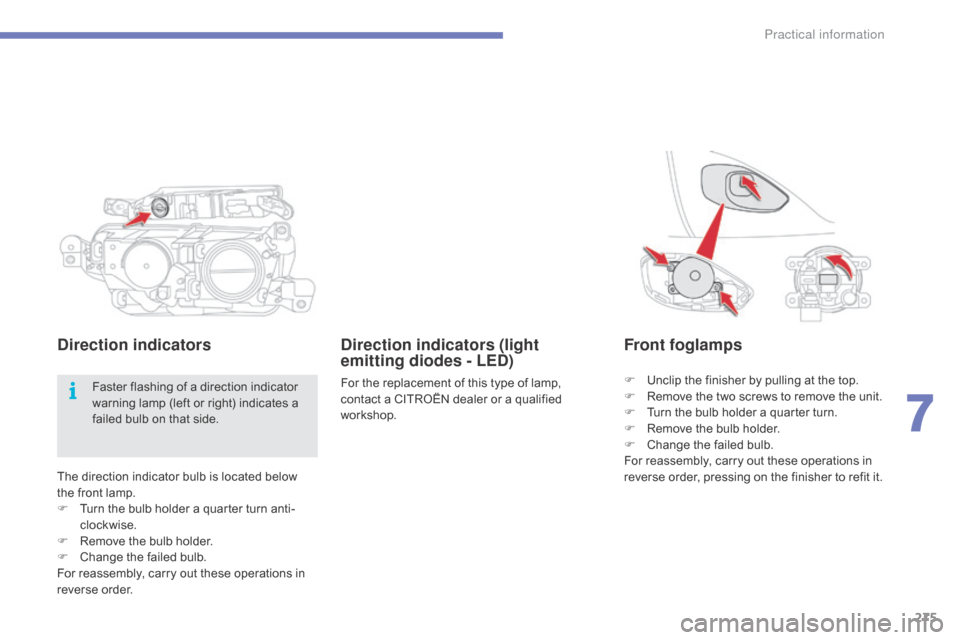
The direction indicator bulb is located below the front lamp.
F
T
urn the bulb holder a quarter turn anti-
clockwise.
F
R
emove the bulb holder.
F
C
hange the failed bulb.
For
reassembly, carry out these operations in
r
everse
o
rder.
Direction indicators Front foglamps
F Unclip the finisher by pulling at the top.
F R emove the two screws to remove the unit.
F
T
urn the bulb holder a quarter turn.
F
R
emove the bulb holder.
F
C
hange the failed bulb.
For
reassembly, carry out these operations in
r
everse order, pressing on the finisher to refit it.
Faster
flashing
of
a
direction
indicator
w
arning
lamp
(left
or
right)
indicates
a
f
ailed
bulb
on
that
side.
Direction indicators (light
emitting diodes - LED)
For the replacement of this type of lamp, c ontact a CITROËN dealer or a qualified
w
orkshop.
7
Practical information
Page 279 of 428
277
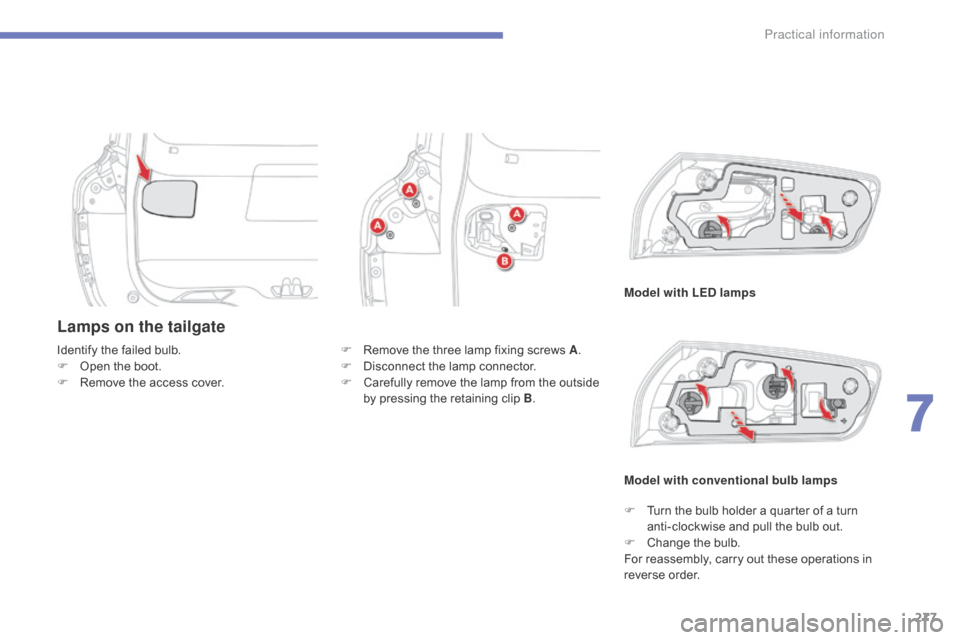
Lamps on the tailgate
Model with LED lamps
Identify
the
failed
bulb.
F
O
pen
the
boot.
F
R
emove
the
access
cover.
Model with conventional bulb lamps
F
R
emove
the
three
lamp
fixing
screws
A .
F
D
isconnect
the
lamp
connector.
F
C
arefully
remove
the
lamp
from
the
outside
b
y
pressing
the
retaining
clip
B .
F
T
urn the bulb holder a quarter of a turn
a
nti-clockwise and pull the bulb out.
F
C
hange the bulb.
For
reassembly, carry out these operations in
r
everse
o
rder.
7
Practical information
Page 281 of 428
279
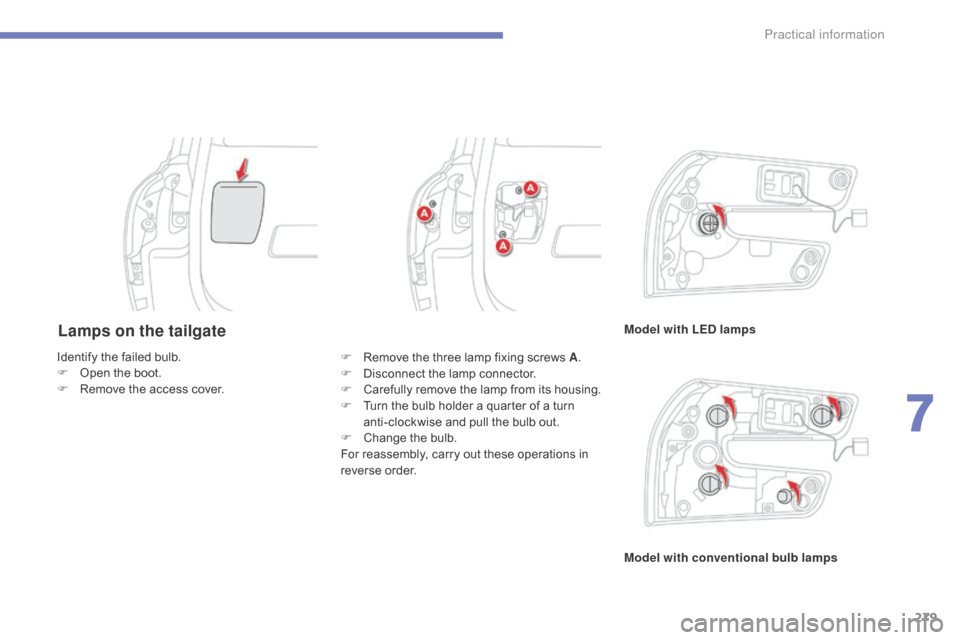
Lamps on the tailgateModel with LED lamps
Model with conventional bulb lamps
Identify
the
failed
bulb.
F
O
pen
the
boot.
F
R
emove
the
access
cover. F
R
emove
the
three
lamp
fixing
screws
A .
F
D
isconnect
the
lamp
connector.
F
C
arefully
r
emove
t
he
l
amp
f
rom
i
ts
h
ousing.
F
T
urn
the
bulb
holder
a
quarter
of
a
turn
a
nti-clockwise
and
pull
the
bulb
out.
F
C
hange
the
bulb.
For
reassembly,
carry
out
these
operations
in
r
everse
o
rder.
7
Practical information
Page 292 of 428
290
The batteries contain harmful substances such as sulphuric acid and lead. They m
ust be disposed of in accordance
w
ith regulations and must not, in any
c
ircumstances, be discarded with household
w
aste.
Take
used remote control batteries and
v
ehicle batteries to a special collection point.
Protect your eyes and face before handling the battery.
All
operations on the battery must be
c
arried out in a well ventilated area and
a
way from naked flames and sources
o
f sparks, so as to avoid the risk of
e
xplosion or fire.
Do
not try to charge a frozen battery;
t
he battery must first be thawed out to
a
void the risk of explosion. If the battery
h
as been frozen, before charging have
i
t checked by a CITROËN dealer or a
q
ualified workshop who will check that
t
he internal components have not been
d
amaged and the casing is not cracked,
w
hich could cause a leak of toxic and
c
orrosive acid.
Do
not reverse the polarity and use only
a
12 V charger.
Do
not disconnect the terminals while
t
he engine is running.
Do
not charge the batteries without
d
isconnecting the terminals first.
Wash
your hands after wards.
It
is
advisable
to
disconnect
the
battery
i
f
the
vehicle
is
to
be
left
unused
for
m
ore
than
one
month.
do n
ot push the vehicle to start the
engine
if you have an electronic or
a
utomatic gearbox.Charging the battery using
a battery charger
F Disconnect the battery from the vehicle.
F F ollow the instructions for use provided by
t
he manufacturer of the charger.
F
C
onnect the battery starting with the
n
egative terminal (-).
F
C
heck that the terminals and connectors
a
re clean. If they are covered with sulphate
(
whitish or greenish deposit), remove them
a
nd clean them.
With
Stop & Start, the battery does not
h
ave to be disconnected for charging.
Do
not
apply
excessive
force
on
the
t
ab
as
locking
will
not
be
possible
if
the
c
lamp
is
not
positioned
correctly;
start
t
he
procedure
again.
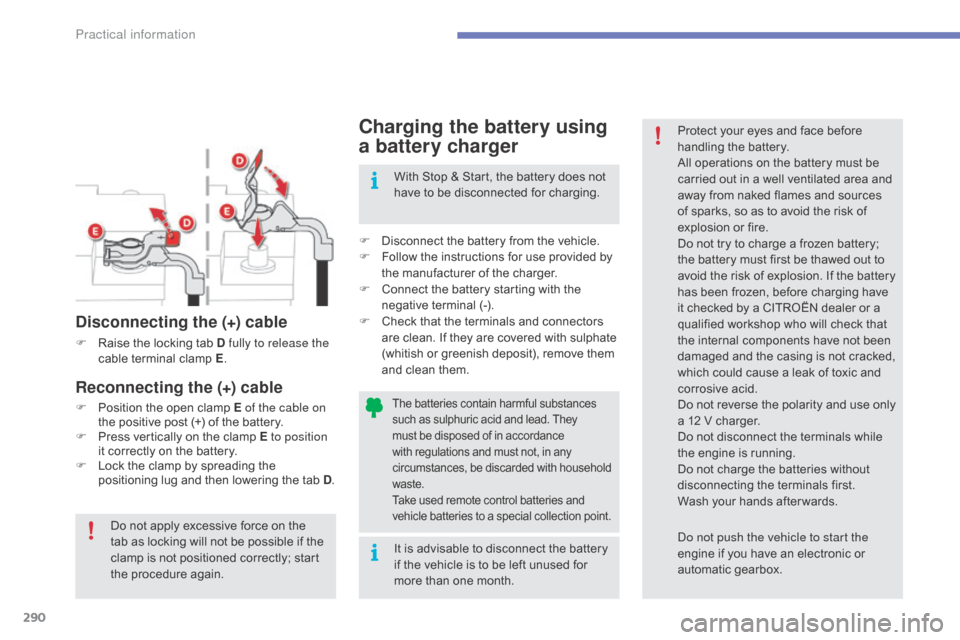
Disconnecting the (+) cable
F Raise the locking tab D fully to release the
cable t erminal c lamp E.
Reconnecting the (+) cable
F Position the open clamp E of the cable on
the positive post (+) of the battery.
F
P
ress vertically on the clamp E to position
it
correctly on the battery.
F
L
ock the clamp by spreading the
p
ositioning lug and then lowering the tab D.
Practical information
Page 295 of 428
293
Towing the vehicle
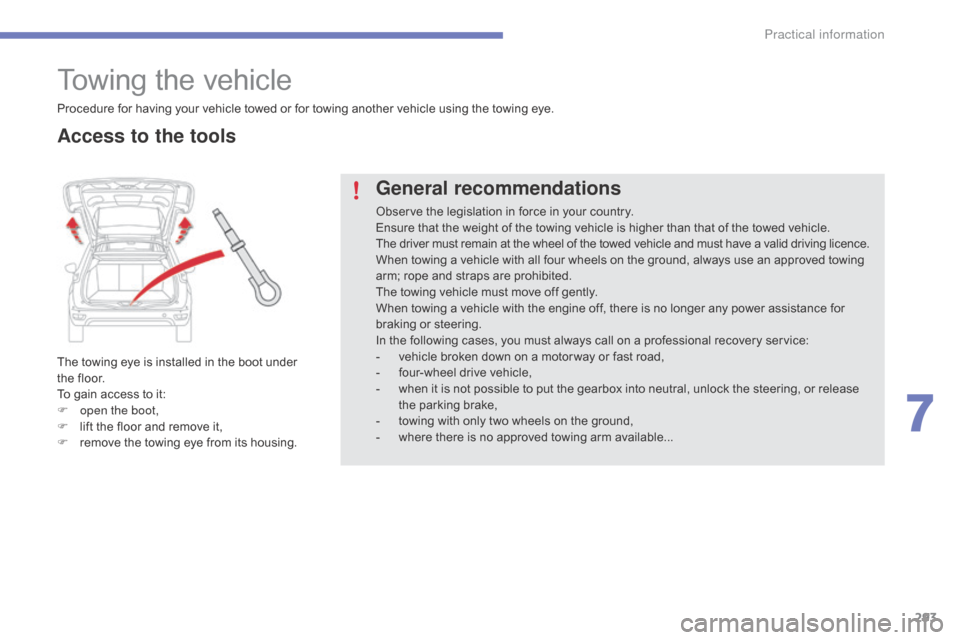
The towing eye is installed in the boot under the floor.
To
gain access to it:
F
o
pen the boot,
F
l
ift the floor and remove it,
F
r
emove the towing eye from its housing.
General recommendations
Observe the legislation in force in your country.
E nsure that the weight of the towing vehicle is higher than that of the towed vehicle.
The
driver must remain at the wheel of the towed vehicle and must have a valid driving licence.
When
towing a vehicle with all four wheels on the ground, always use an approved towing
a
rm; rope and straps are prohibited.
The
towing vehicle must move off gently.
When
towing a vehicle with the engine off, there is no longer any power assistance for
b
raking or steering.
In
the following cases, you must always call on a professional recovery service:
-
v
ehicle broken down on a motor way or fast road,
-
f
our-wheel drive vehicle,
-
w
hen it is not possible to put the gearbox into neutral, unlock the steering, or release
t
he parking brake,
-
t
owing with only two wheels on the ground,
-
w
here there is no approved towing arm available...
Procedure
for
having
your
vehicle
towed
or
for
towing
another vehicle using the towing eye.
Access to the tools
7
Practical information
Page 296 of 428

294
Towing another vehicle
F On the rear bumper, unclip the cover by p
ressing at the bottom.
F
S
crew the towing eye in fully.
F
I
nstall the towing bar.
F
S
witch on the hazard warning lamps on
b
oth vehicles.
F
M
ove off gently, drive slowly and for a short
di
stance.
F
O
n
the
front
bumper,
unclip
the
cover
by
p
ressing
on
the
left.
F
S
crew
the
towing
eye
in
fully.
F
I
nstall
the
towing
bar.
F
P
lace
the
gear
lever
in
neutral
(position
N
on
an
electronic
or
automatic
gearbox).
Towing your vehicle
Failure to observe this instruction could r esult in damage to certain components
(
braking, transmission...) and the
a
bsence of braking assistance the next
t
ime the engine is started.
F
U
nlock the steering by turning the key
i
n
the ignition one notch and release the
par
king
b
rake.
F
S
witch on the hazard warning lamps on
b
oth vehicles.
F
M
ove off gently, drive slowly and for a short
di
stance.
Practical information
Page 297 of 428
295
Towbar with quickly detachable towball
Fitting
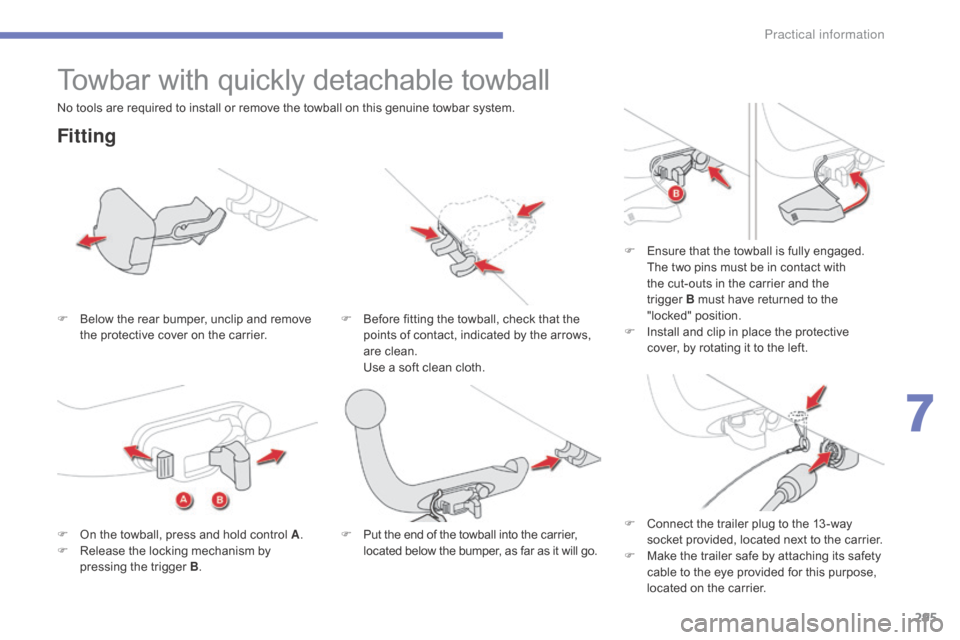
F Below the rear bumper, unclip and remove t
he protective cover on the carrier.F
B efore fitting the towball, check that the p
oints of contact, indicated by the arrows,
a
re clean.
U
se a soft clean cloth.F
E
nsure that the towball is fully engaged.
T
he two pins must be in contact with
t
he cut-outs in the carrier and the
t
rigger
B must have returned to the "
locked" p osition.
F I nstall and clip in place the protective
c
over, by rotating it to the left.
F
O
n the towball, press and hold control A.
F
R
elease the locking mechanism by
p
ressing the trigger B. F
P
ut the end of the towball into the carrier,
l
ocated below the bumper, as far as it will go.
No
tools are required to install or remove the towball on this genuine towbar system.
F
C
onnect the trailer plug to the 13 -way
s
ocket provided, located next to the carrier.
F
M
ake the trailer safe by attaching its safety
c
able to the eye provided for this purpose,
l
ocated on the carrier.
7
Practical information
Page 298 of 428
296
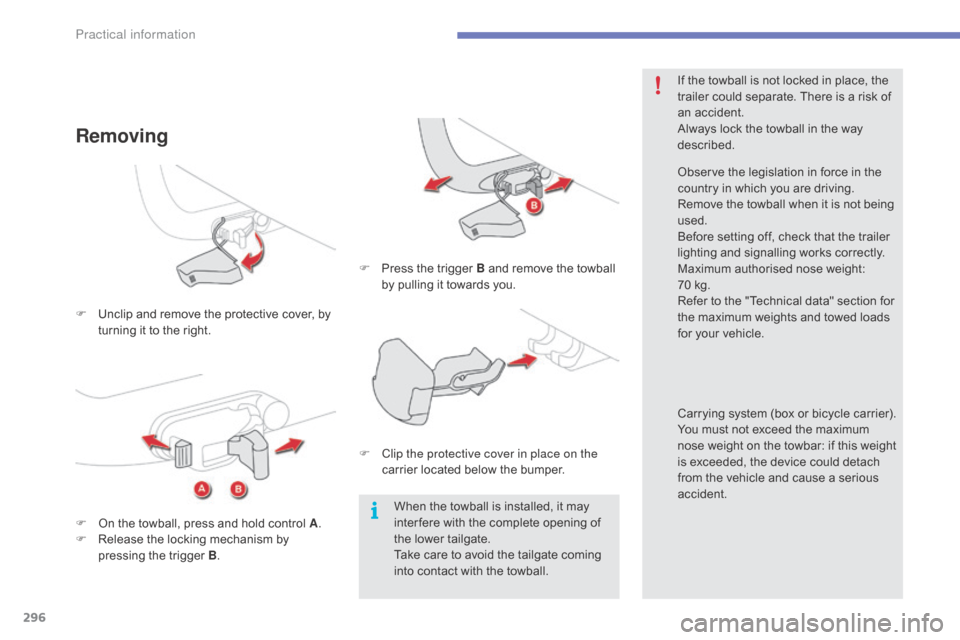
F Unclip and remove the protective cover, by t
urning it to the right.
Removing
F Press the trigger B and remove the towball b
y pulling it towards you.
F
O
n
the
towball,
press
and
hold
control
A .
F
R
elease
the
locking
mechanism
by
p
ressing
the
trigger
B . F
C
lip the protective cover in place on the
carrier
located below the bumper.If
the towball is not locked in place, the
t
railer could separate. There is a risk of
a
n accident.
Always lock the towball in the way
de
scribed.
Observe the legislation in force in the
c
ountry in which you are driving.
Remove the towball when it is not being
u
sed.
Before setting off, check that the trailer l
ighting and signalling works correctly.
Maximum authorised nose weight:
7
0 kg.
Refer
to the "Technical data" section for
t
he maximum weights and towed loads
f
or your vehicle.
Carrying
system (box or bicycle carrier).
You
must not exceed the maximum
n
ose weight on the towbar: if this weight
i
s exceeded, the device could detach
f
rom the vehicle and cause a serious
a
ccident.
When
the towball is installed, it may
i
nter fere with the complete opening of
t
he lower tailgate.
Take
care to avoid the tailgate coming
i
nto contact with the towball.
Practical information
Page 328 of 428
326
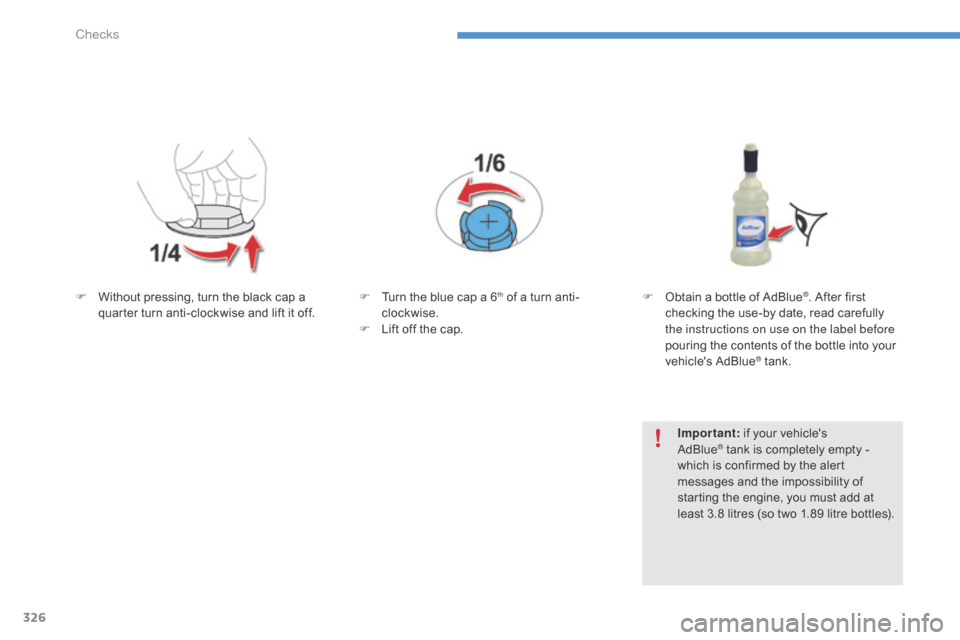
F Without pressing, turn the black cap a q
uarter turn anti-clockwise and lift it off.
Important:
if your vehicle's
Ad
Blue
® tank is completely empty - w
hich
is
confirmed by the alert
m
essages and the impossibility of
s
tarting
the engine, you must add at
l
east
3.8 litres (so two 1.89 litre bottles).
F
T
urn
the
blue
cap
a
6
th of a turn anti-
c
lockwise.
F
L
ift
off
the
cap. F
O btain a bottle of AdBlue®. After first c
hecking
the
use-by
date,
read carefully
t
he instructions on use on the label before
pouring
the
contents
of
the bottle into your
v
ehicle's
Ad
Blue
® tank.
Checks
Page 329 of 428
327
Never dispose of AdBlue® additive b
ottles
in
the
household
waste. Place
t
hem
in
a
special
container provided
t
his
p
urpose
o
r
t
ake
t
hem
t
o
y
our
d
ealer.
Important:
w
hen topping up after
running out of additive ,
signalled
b
y
the
message
"Top
up
emissions
a
dditive:
Starting
prevented", you must
w
ait
for
approximately
5
minutes before
s
witching
on
the
ignition,
without
opening the driver's door, unlocking
the vehicle, placing the key of the
"Keyless Entr y and Star ting" system
inside the vehicle or inser ting the
electronic key in the reader.
Switch
on
the
ignition,
wait for
1
0 seconds,
then
start
the engine.
If
any
additive
is
split
or
splashed,
wash
i
mmediately
w
ith
c
old
w
ater
o
r
w
ipe
w
ith
a
damp
cloth.
If
the
additive
has
crystallised,
clean
it
o
ff
using
a
sponge
and
hot
water.
F
A
fter
emptying
the
bottle,
wipe
away
any
s
pillage
around
the
tank
filler
using
a
damp
c
loth.
F
R
efit
the
blue
cap
to
the
tank
and
turn
it
a
6th of a turn clockwise, to its stop.
F
R
efit the black cap and turn it a quarter of
a
turn clockwise without pressing. Ensure
t
hat the indicator on the cap lines up with
t
he indicator on the support.
F
D
epending on equipment, return the spare
w
heel and/or the storage box to the bottom
o
f
the boot.
F
R
efit the boot carpet and close the tailgate.
8
Checks