instrument panel Citroen C4 RHD 2011 2.G Workshop Manual
[x] Cancel search | Manufacturer: CITROEN, Model Year: 2011, Model line: C4 RHD, Model: Citroen C4 RHD 2011 2.GPages: 316, PDF Size: 9.93 MB
Page 165 of 316
9
DRIVING
163
The cruise control system cannot,
in any circumstances, replace
the need to respect speed limits,
nor can it replace the need for
vigilance and responsibility on the
part of the driver.
You are advised to keep your
feet near the pedals at all times.
CRUISE CONTROL
System which automatically maintains
the speed of the vehicle at the value
programmed by the driver, without any
action on the accelerator pedal.
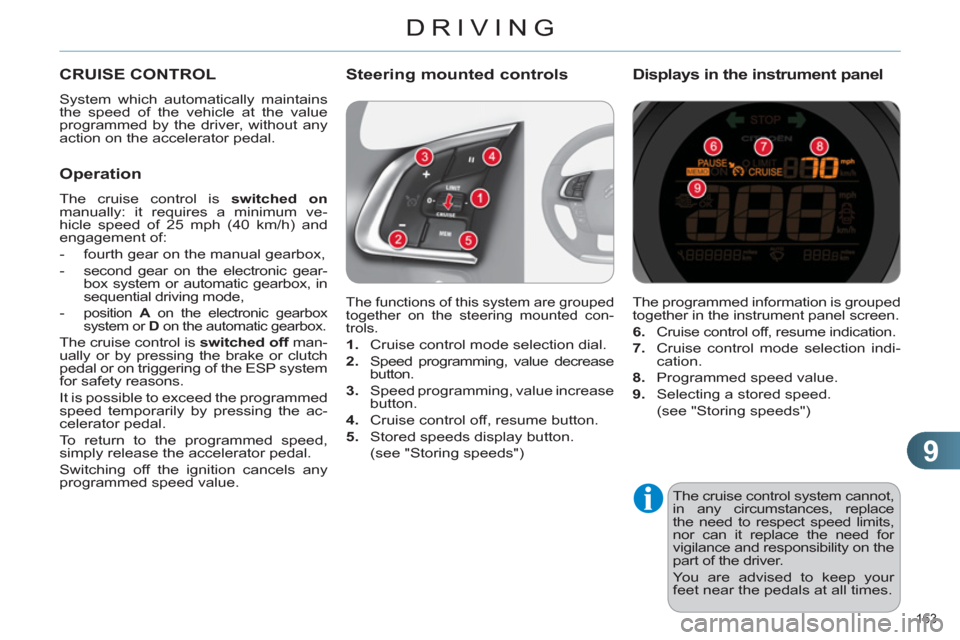
The functions of this system are grouped
together on the steering mounted con-
trols.
1.
Cruise control mode selection dial.
2.
Speed programming, value decrease
button.
3.
Speed programming, value increase
button.
4.
Cruise control off, resume button.
5.
Stored speeds display button.
(see "Storing speeds")
Steering mounted controls
The programmed information is grouped
together in the instrument panel screen.
6.
Cruise control off, resume indication.
7.
Cruise control mode selection indi-
cation.
8.
Programmed speed value.
9.
Selecting a stored speed.
(see "Storing speeds")
Displays in the instrument panel
Operation
The cruise control is switched on
manually: it requires a minimum ve-
hicle speed of 25 mph (40 km/h) and
engagement of:
- fourth gear on the manual gearbox,
- second gear on the electronic gear-
box system or automatic gearbox, in
sequential driving mode,
-
position A
on the electronic gearbox
system or D
on the automatic gearbox.
The cruise control is switched off
man-
ually or by pressing the brake or clutch
pedal or on triggering of the ESP system
for safety reasons.
It is possible to exceed the programmed
speed temporarily by pressing the ac-
celerator pedal.
To return to the programmed speed,
simply release the accelerator pedal.
Switching off the ignition cancels any
programmed speed value.
Page 167 of 316
9
DRIVING
165
PARKING SPACE SENSORS
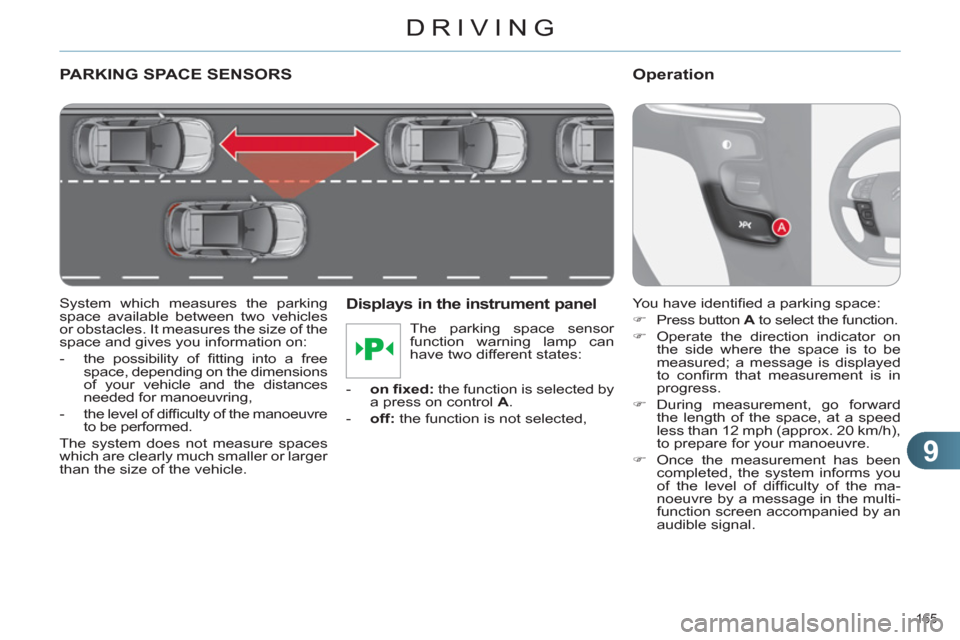
System which measures the parking
space available between two vehicles
or obstacles. It measures the size of the
space and gives you information on:
- the possibility of fi tting into a free
space, depending on the dimensions
of your vehicle and the distances
needed for manoeuvring,
- the level of diffi culty of the manoeuvre
to be performed.
The system does not measure spaces
which are clearly much smaller or larger
than the size of the vehicle.
Displays in the instrument panel
- on fi xed:
the function is selected by
a press on control A
.
- off:
the function is not selected,
The parking space sensor
function warning lamp can
have two different states:
Operation
You have identifi ed a parking space:
)
Press button A
to select the function.
)
Operate the direction indicator on
the side where the space is to be
measured; a message is displayed
to confi rm that measurement is in
progress.
)
During measurement, go forward
the length of the space, at a speed
less than 12 mph (approx. 20 km/h),
to prepare for your manoeuvre.
)
Once the measurement has been
completed, the system informs you
of the level of diffi culty of the ma-
noeuvre by a message in the multi-
function screen accompanied by an
audible signal.
Page 170 of 316

9
DRIVING
168
In addition to the rear parking sensors,
the front parking sensors are triggered
when an obstacle is detected in front
and the speed of the vehicle is still below
6 mph (10 km/h).
The sound emitted by the speaker (front
or rear) indicates whether the obstacle
is in front or behind.
The front parking sensors are interrupted
if the vehicle stops for more than three
seconds in forward gear, if no further ob-
stacles are detected or when the speed
of the vehicle exceeds 6 mph (10 km/h).
Front parking sensors
Deactivation/Activation of the front
and rear parking sensors
The function is deactivated by pressing
this button. The indicator lamp in the
button comes on.
Pressing this button again reactivates
the function. The indicator lamp in the
button goes off.
Operating fault
The function will be deactivated
automatically if a trailer is being
towed or a bicycle carrier is fi t-
ted (vehicle fi tted with a towbar
or bicycle carrier recommended
by CITROËN).
In bad weather or in winter, en-
sure that the sensors are not
covered with mud, ice or snow.
When reverse gear is engaged,
an audible signal (long beep) in-
dicates that the sensors may be
dirty.
When the vehicle is moving at a
speed below 6 mph (10 km/h),
certain sound sources (motor-
cycle, lorry, pneumatic drill, etc.)
may trigger the audible signals
of the parking sensor system.
In the event of a malfunction
of the system, when reverse
gear is engaged this warn-
ing lamp is displayed in the
instrument panel and/or a message ap-
pears in the screen, accompanied by
an audible signal (short beep).
Contact a CITROËN dealer or a qualifi ed
workshop.
Page 176 of 316
10
CHECKS
174
CHECKING LEVELS
Check all of these levels regularly and
top them up if necessary, unless other-
wise indicated.
If a level drops signifi cantly, have the corre-
sponding system checked by a CITROËN
dealer or a qualifi ed workshop.
When working under the bon-
net, take care, as certain areas
of the engine may be extremely
hot (risk of burns).
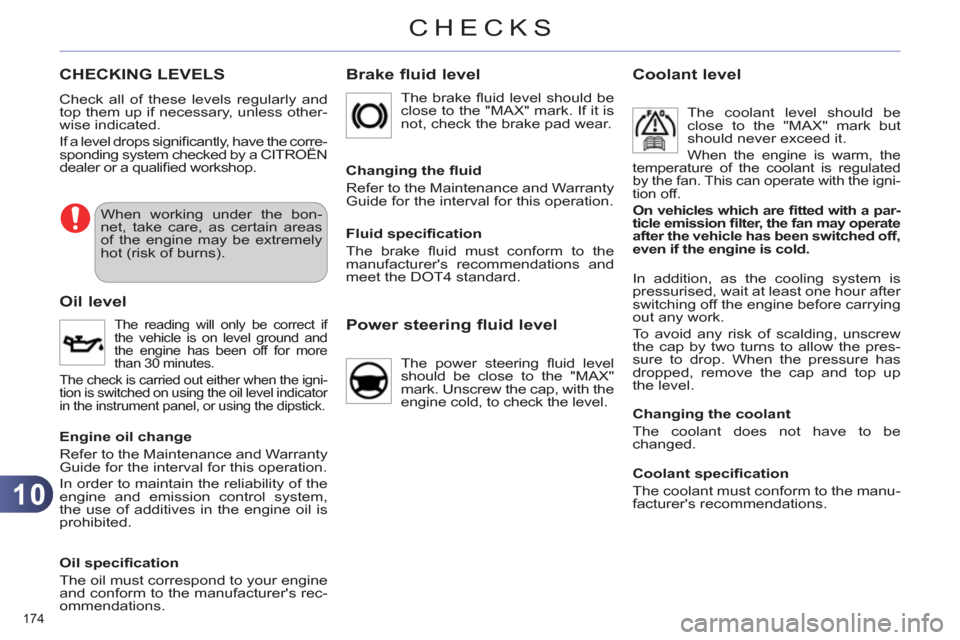
The reading will only be correct if
the vehicle is on level ground and
the engine has been off for more
than 30 minutes.
The check is carried out either when the igni-
tion is switched on using the oil level indicator
in the instrument panel, or using the dipstick.
Oil level
Engine oil change
Refer to the Maintenance and Warranty
Guide for the interval for this operation.
In order to maintain the reliability of the
engine and emission control system,
the use of additives in the engine oil is
prohibited.
Oil specifi cation
The oil must correspond to your engine
and conform to the manufacturer's rec-
ommendations.
Brake fluid level
The brake fl uid level should be
close to the "MAX" mark. If it is
not, check the brake pad wear.
Changing the fl uid
Refer to the Maintenance and Warranty
Guide for the interval for this operation.
Fluid specifi cation
The brake fl uid must conform to the
manufacturer's recommendations and
meet the DOT4 standard.
Power steering fluid level
The power steering fl uid level
should be close to the "MAX"
mark. Unscrew the cap, with the
engine cold, to check the level.
Coolant level
The coolant level should be
close to the "MAX" mark but
should never exceed it.
When the engine is warm, the
temperature of the coolant is regulated
by the fan. This can operate with the igni-
tion off.
On vehicles which are fi tted with a par-
ticle emission fi lter, the fan may operate
after the vehicle has been switched off,
even if the engine is cold.
In addition, as the cooling system is
pressurised, wait at least one hour after
switching off the engine before carrying
out any work.
To avoid any risk of scalding, unscrew
the cap by two turns to allow the pres-
sure to drop. When the pressure has
dropped, remove the cap and top up
the level.
Changing the coolant
The coolant does not have to be
changed.
Coolant specifi cation
The coolant must conform to the manu-
facturer's recommendations.
Page 177 of 316
10
CHECKS
175
Used products
Avoid prolonged contact of used
oil or fl uids with the skin.
Most of these fl uids are harmful
to health or indeed very corrosive.
Do not discard used oil or fl uids
into sewers or onto the ground.
Take used oil to a CITROËN
dealer or a qualifi ed workshop
(France) or to an authorised
waste disposal site.
Additive level (Diesel with particle emissions filter)
According to your version of instrument
panel, the additive reservoir low level is
indicated by:
Topping up
The reservoir must be topped up with-
out delay by a CITROËN dealer or a
qualifi ed workshop.
- fi xed illumination of the par-
ticle emissions fi lter warning
lamp, accompanied by an au-
dible signal and a message
that the particle emissions fi l-
ter additive level is too low,
- fi xed illumination of the
service warning lamp, ac-
companied by an audible
signal and a message that
the particle emissions fi lter additive level is too low. or
Screenwash/headlamp washlevel
Specifi cation of the fl uid
To ensure optimum cleaning and to
avoid freezing, the fl uid should never be
topped up or replaced by plain water.
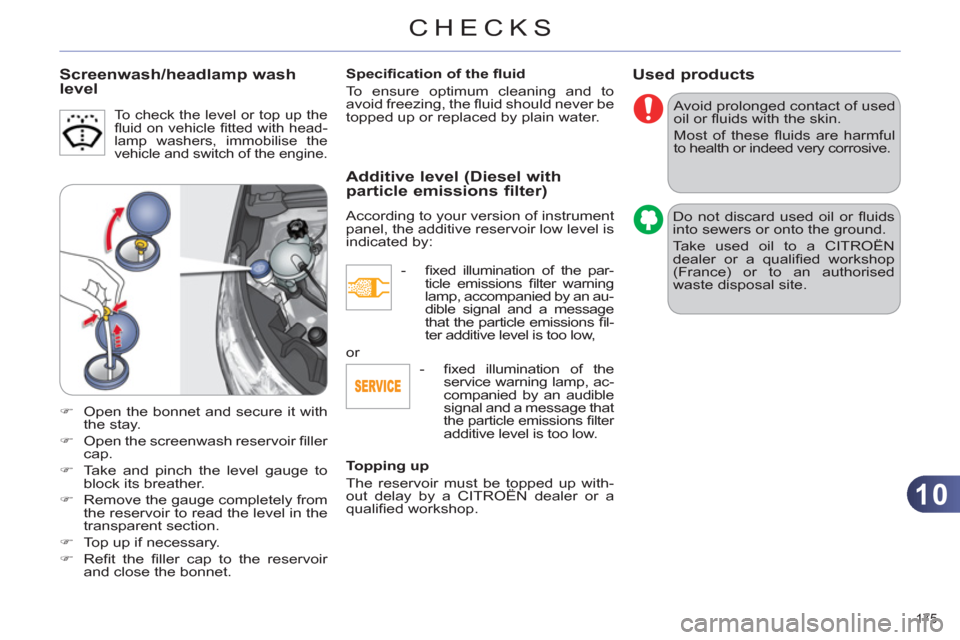
To check the level or top up the
fl uid on vehicle fi tted with head-
lamp washers, immobilise the
vehicle and switch of the engine.
)
Open the bonnet and secure it with
the stay.
)
Open the screenwash reservoir fi ller
cap.
)
Take and pinch the level gauge to
block its breather.
)
Remove the gauge completely from
the reservoir to read the level in the
transparent section.
)
Top up if necessary.
)
Refi t the fi ller cap to the reservoir
and close the bonnet.
Page 178 of 316
10
CHECKS
176
CHECKS
Unless otherwise indicated, check
these components in accordance with
the Maintenance and Warranty Guide
and according to your engine.
Otherwise, have them checked by a
CITROËN dealer or a qualifi ed workshop.
Battery
The battery does not require
any maintenance.
However, check that the ter-
minals are clean and correctly
tightened, particularly in sum-
mer and winter.
When carrying out work on the battery,
refer to the "Practical information" sec-
tion for details of the precautions to be
taken before disconnecting the battery
and following its reconnection.
Air filter and passenger compartment filter
Refer to the Maintenance and
Warranty Guide for details of
the replacement intervals for
these components.
Oil filter
Replace the oil fi lter each time
the engine oil is changed.
Refer to the Maintenance and
Warranty Guide for details of
the replacement interval for
this component.
Particle emission filter (Diesel)
According to your version of instrument
panel, the start of saturation of the par-
ticle emissions fi lter is indicated by:
- fi xed illumination of the par-
ticle emissions fi lter warning
lamp, accompanied by an au-
dible signal and a message
that there is a risk of blockage
of the particle emissions fi lter,
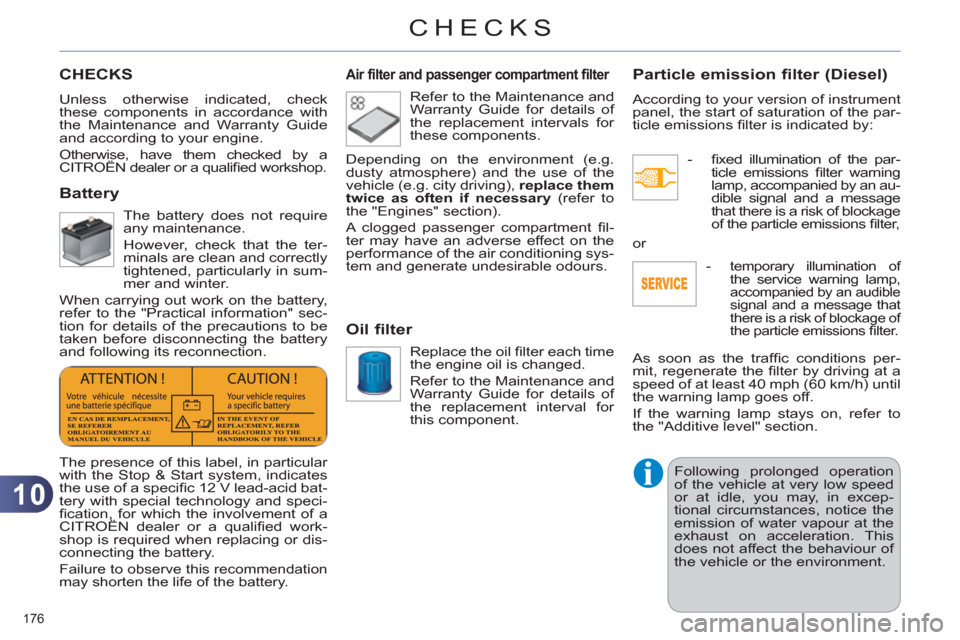
The presence of this label, in particular
with the Stop & Start system, indicates
the use of a specifi c 12 V lead-acid bat-
tery with special technology and speci-
fi cation, for which the involvement of a
CITROËN dealer or a qualifi ed work-
shop is required when replacing or dis-
connecting the battery.
Failure to observe this recommendation
may shorten the life of the battery.
Depending on the environment (e.g.
dusty atmosphere) and the use of the
vehicle (e.g. city driving), replace them
twice as often if necessary
(refer to
the "Engines" section).
A clogged passenger compartment fi l-
ter may have an adverse effect on the
performance of the air conditioning sys-
tem and generate undesirable odours.
As soon as the traffi c conditions per-
mit, regenerate the fi lter by driving at a
speed of at least 40 mph (60 km/h) until
the warning lamp goes off.
If the warning lamp stays on, refer to
the "Additive level" section.
Following prolonged operation
of the vehicle at very low speed
or at idle, you may, in excep-
tional circumstances, notice the
emission of water vapour at the
exhaust on acceleration. This
does not affect the behaviour of
the vehicle or the environment. or
-
temporary illumination of
the service warning lamp,
accompanied by an audible signal and a message that
there is a risk of blockage of
the particle emissions fi lter.
Page 187 of 316
11
PRACTICAL INFORMATION
185
Removing a wheel
Parking the vehicle
Immobilise the vehicle where it
does not block traffi c: the ground
must be level, stable and non-
slippery ground.
Apply the parking brake unless it
has been programmed to auto-
matic mode, switch off the igni-
tion and engage fi rst gear * to lock
the wheels.
Check that the braking warning
lamps on the instrument panel
are on (not fl ashing).
If necessary, place a chock under
the wheel diagonally opposite the
wheel to be changed.
The occupants must get out of
the vehicle and wait where they
are safe.
Never go underneath a vehicle
raised using a jack; use an axle
stand.
*
position R
for the electronic gearbox
system; P
for the automatic gearbox.
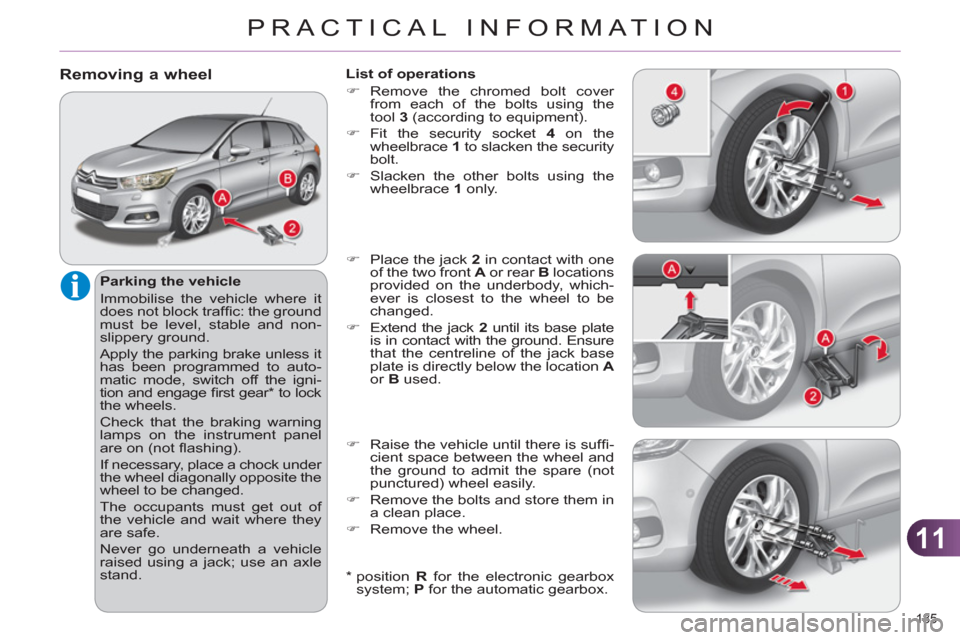
List of operations
)
Remove the chromed bolt cover
from each of the bolts using the
tool 3
(according to equipment).
)
Fit the security socket 4
on the
wheelbrace 1
to slacken the security
bolt.
)
Slacken the other bolts using the
wheelbrace 1
only.
)
Place the jack 2
in contact with one
of the two front A
or rear B
locations
provided on the underbody, which-
ever is closest to the wheel to be
changed.
)
Extend the jack 2
until its base plate
is in contact with the ground. Ensure
that the centreline of the jack base
plate is directly below the location A
or B
used.
)
Raise the vehicle until there is suffi -
cient space between the wheel and
the ground to admit the spare (not
punctured) wheel easily.
)
Remove the bolts and store them in
a clean place.
)
Remove the wheel.
Page 307 of 316
305
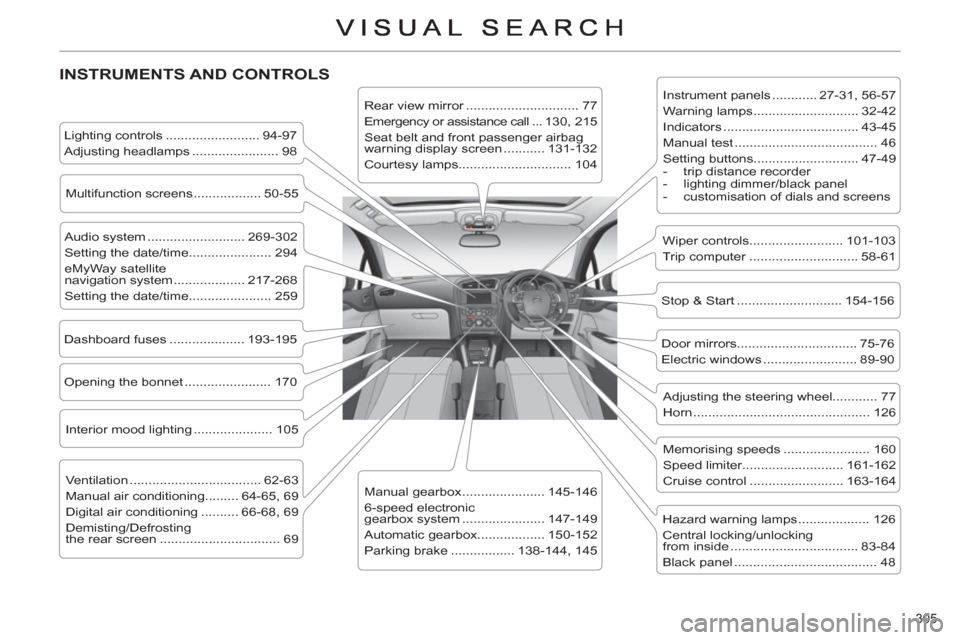
INSTRUMENTS AND CONTROLS
Instrument panels ............ 27-31, 56-57
Warning lamps ............................ 32-42
Indicators .................................... 43-45
Manual test ...................................... 46
Setting buttons............................ 47-49
- trip distance recorder
- lighting dimmer/black panel
- customisation of dials and screens
Lighting controls ......................... 94-97
Adjusting headlamps ....................... 98
Stop & Start ............................ 154-156
Door mirrors ................................ 75-76
Electric windows ......................... 89-90
Dashboard fuses .................... 193-195
Opening the bonnet ....................... 170
Adjusting the steering wheel............ 77
Horn ............................................... 126
Audio system .......................... 269-302
Setting the date/time...................... 294
eMyWay satellite
navigation system ................... 217-268
Setting the date/time...................... 259
Manual gearbox ...................... 145-146
6-speed electronic
gearbox system ...................... 147-149
Automatic gearbox.................. 150-152
Parking brake ................. 138-144, 145
Wiper controls......................... 101-103
Trip computer ............................. 58-61
Rear view mirror .............................. 77
Emergency or assistance call ...130, 215
Seat belt and front passenger airbag
warning display screen ........... 131-132
Courtesy lamps.............................. 104
Interior mood lighting ..................... 105
Hazard warning lamps ................... 126
Central locking/unlocking
from inside .................................. 83-84
Black panel ...................................... 48
Multifunction screens .................. 50-55
Ventilation ................................... 62-63
Manual air conditioning......... 64-65, 69
Digital air conditioning .......... 66-68, 69
Demisting/Defrosting
the rear screen ................................ 69
Memorising speeds ....................... 160
Speed limiter........................... 161-162
Cruise control ......................... 163-164
Page 310 of 316
308
ALPHABETICAL INDEX
E EBA (Emergency braking
assistance) ...............................128
Economy mode ..........................199
Electric parking brake .........138-141
Electric seats ................................71
Electric window controls ...............89
Electronic brake force distribution
(EBFD) .....................................128
Electronic engine
immobiliser ...........................80, 82
Electronic gearbox
system ......................147, 154, 177
Emergency boot release ..............88
Emergency braking system ........128
Emergency call ...................130, 216
Emergency warning lamps .........126
eMyWay .....................................217
Energy economy mode ..............199
Engine compartment ..........172, 173
Engine compartment
fusebox .....................................195
Engine oil level
indicator ........................43, 46, 174
Engines .............................. 207, 211
Environment .....63, 69, 82, 152, 175
ESP/ASR ....................................129
F Filling with fuel ........................92, 93
Fittings, boot ............................... 115
Fitting speakers ..........................204
Flashing
indicators ............97, 126, 188, 190
Front airbags ......................134, 137
Front armrest .......................111, 112
Front foglamps .....95, 100, 187, 190
Front head restraints ....................72
Front parking sensors ................168F Front seats ..............................70-73
Front wash-wipe .........................102
Fuel ..............................................93
Fuel fi ller fl ap ..........................92, 93
Fuel gauge ...................................92
Fuel tank ................................92, 93
Fuses .........................................193
G G.P.S. ..................................223-235
Gear effi ciency indicator .............146
Gear lever, automatic gearbox ...150
Gear lever, electronic gearbox
system ......................................147
Gear lever, manual gearbox .......145
Glove box ...................................108
Grab handles ..............................107
Guidance .............................223-235
H Halogen headlamps ...................187
Hands-free telephone .........240, 283
Hazard warning lamps ...............126
Headlamp adjustment ..................98
Headlamps, directional .........99, 187
Headlamp wash .........................102
Heated seats ................................72
Heating ...................................64, 66
Height and reach adjustment,
steering wheel ............................77
Hill start assist ............................153
Hooks ......................................... 116
I Indicator/warning lamps ..........32-42
Indicators, direction ....126, 188, 191
Infl ating accessories
(using the kit) ............................182
Inputs for
audio system ............108, 257, 281
Installing speakers .....................204I Instrument panel lighting ..............48
Instrument
panels ................. 27-30, 46, 49, 56
Instrument panel
screen .......................... 27-30, 146
Intelligent Traction Control .........129
Interior fi ttings .....................107, 108
Interior mood lighting ..................105
ISOFIX child seats ..............122-124
ISOFIX mountings ......................122
J Jack ............................................183
K Keeping children
safe ..... 90, 118-125, 133, 135, 139
Key in ignition warning .................80
Key with remote control ...........78-82
L Labels, identifi cation ...................214
Lamps, warning and
indicator ..........................32, 39, 42
Lateral airbags ...................136, 137
Level, brake fl uid ........................174
Level, power steering fl uid .........174
Levels and checks ...............172-177
Lighting, guide-me home ........96, 97
Lighting, interior ..................104, 105
Lighting bulbs
(replacement) ....................187-192
Lighting dimmer .................27-30, 48
Lighting stalk ..........................94, 97
Load reduction mode .................199
Locating your vehicle ...................80
Locking from the inside ................83
Locking the boot ...........................88
Long objects, transporting .......... 114
Luggage retaining strap ............. 115