warning Citroen C4 RHD 2012 2.G Manual PDF
[x] Cancel search | Manufacturer: CITROEN, Model Year: 2012, Model line: C4 RHD, Model: Citroen C4 RHD 2012 2.GPages: 324, PDF Size: 28.17 MB
Page 165 of 324
9
DRIVING
163
The system may suffer tem-
porary interference in certain
weather conditions (rain, hail...).
In particular, driving on a wet sur-
face or moving from a dry area to
a wet area can cause false alerts
(for example, the presence of a
fog of water droplets in the blind
spot angle is interpreted as a ve-
hicle).
In bad or wintry weather, ensure
that the sensors are not covered
by mud, ice or snow.
Take care not to cover the warn-
ing zone in the door mirrors or
the detection zones on the front
and rear bumpers with adhesive
labels or other objects; they may
hamper the correct operation of
the system.
)
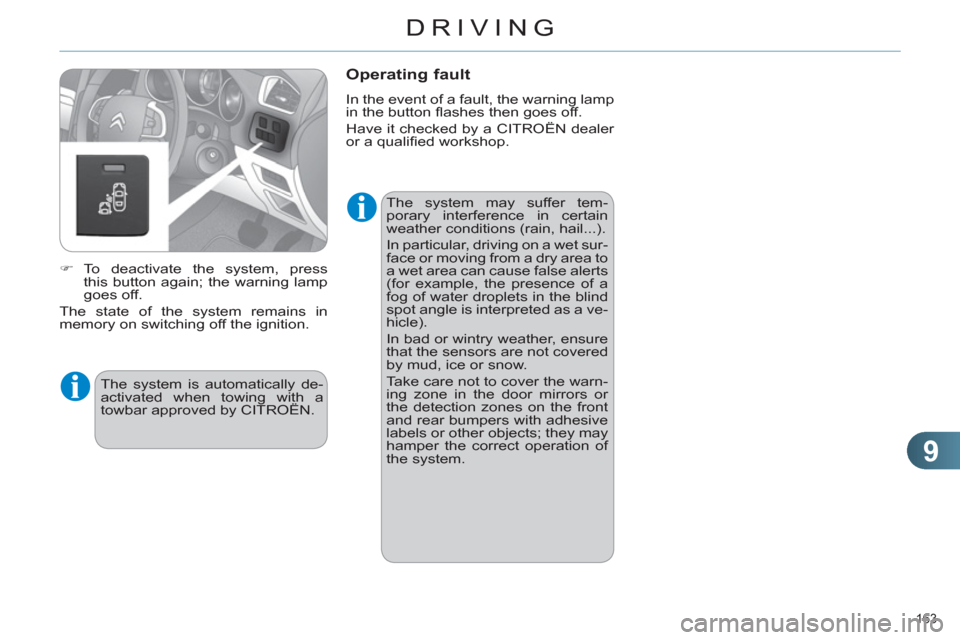
To deactivate the system, press
this button again; the warning lamp
goes off.
The state of the system remains in
memory on switching off the ignition.
Operating fault
In the event of a fault, the warning lamp
in the button fl ashes then goes off.
Have it checked by a CITROËN dealer
or a qualifi ed workshop.
The system is automatically de-
activated when towing with a
towbar approved by CITROËN.
Page 171 of 324
9
DRIVING
169
PARKING SPACE SENSORS
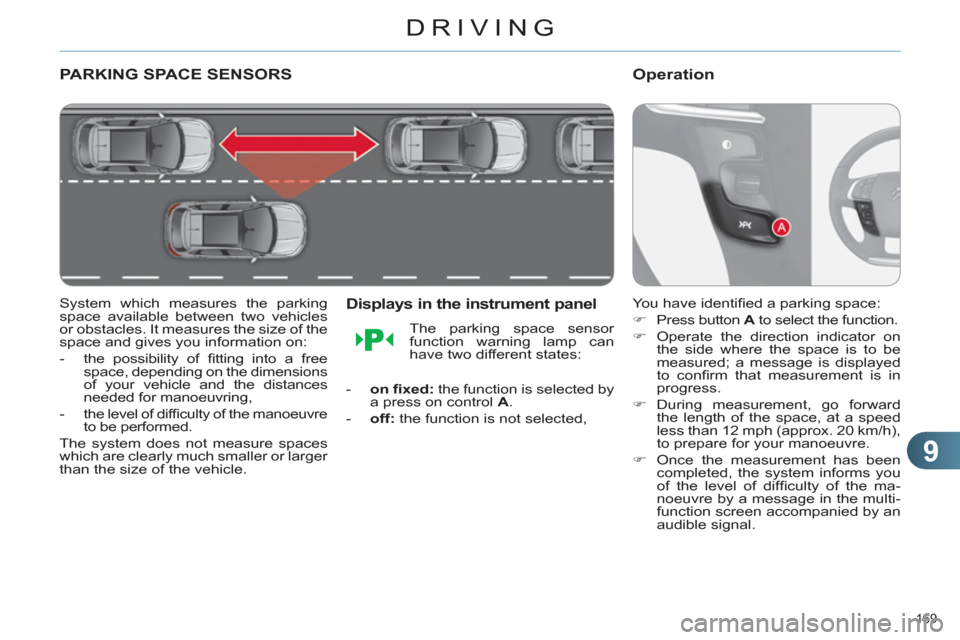
System which measures the parking
space available between two vehicles
or obstacles. It measures the size of the
space and gives you information on:
- the possibility of fi tting into a free
space, depending on the dimensions
of your vehicle and the distances
needed for manoeuvring,
- the level of diffi culty of the manoeuvre
to be performed.
The system does not measure spaces
which are clearly much smaller or larger
than the size of the vehicle.
Displays in the instrument panel
- on fi xed:
the function is selected by
a press on control A
.
- off:
the function is not selected,
The parking space sensor
function warning lamp can
have two different states:
Operation
You have identifi ed a parking space:
)
Press button A
to select the function.
)
Operate the direction indicator on
the side where the space is to be
measured; a message is displayed
to confi rm that measurement is in
progress.
)
During measurement, go forward
the length of the space, at a speed
less than 12 mph (approx. 20 km/h),
to prepare for your manoeuvre.
)
Once the measurement has been
completed, the system informs you
of the level of diffi culty of the ma-
noeuvre by a message in the multi-
function screen accompanied by an
audible signal.
Page 181 of 324
10
CHECKS
179
Used products
Avoid prolonged contact of used
oil or fl uids with the skin.
Most of these fl uids are harmful to
health or indeed very corrosive.
Do not discard used oil or fl uids
into sewers or onto the ground.
Take used oil to a CITROËN
dealer or a qualifi ed workshop
(France) or to an authorised
waste disposal site.
Additive level (Diesel with
particle emissions filter)
According to your version of instrument
panel, the additive reservoir low level is
indicated by:
Topping up
The reservoir must be topped up with-
out delay by a CITROËN dealer or a
qualifi ed workshop.
- fi xed illumination of the par-
ticle emissions fi lter warning
lamp, accompanied by an au-
dible signal and a message
that the particle emissions fi l-
ter additive level is too low,
- fi xed illumination of the
service warning lamp, ac-
companied by an audible
signal and a message that
the particle emissions fi lter additive level is too low. or
Screenwash/headlamp wash
level
Specifi cation of the fl uid
To ensure optimum cleaning and to
avoid freezing, the fl uid should never be
topped up or replaced by plain water.
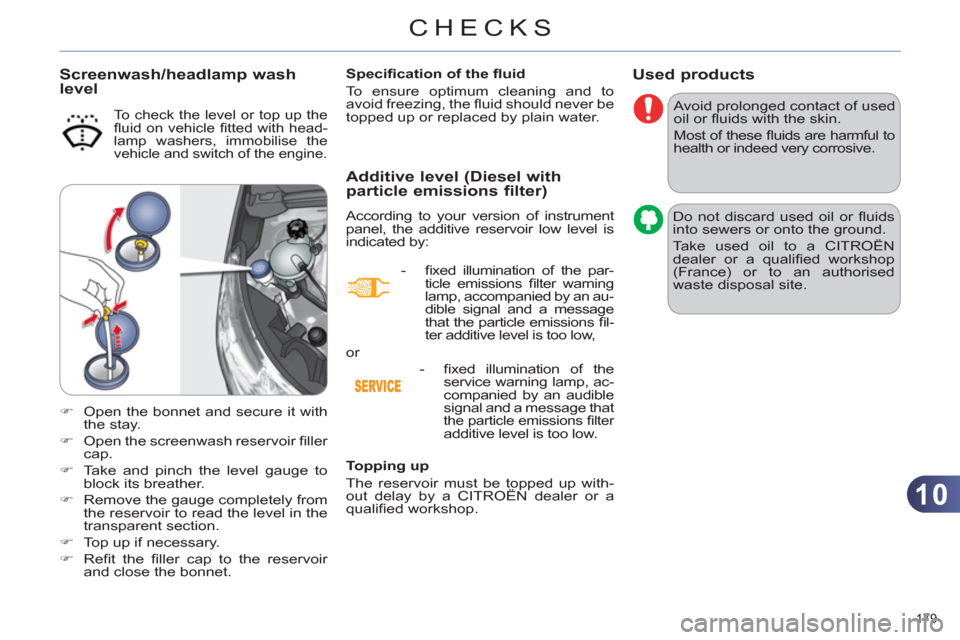
To check the level or top up the
fl uid on vehicle fi tted with head-
lamp washers, immobilise the
vehicle and switch of the engine.
)
Open the bonnet and secure it with
the stay.
)
Open the screenwash reservoir fi ller
cap.
)
Take and pinch the level gauge to
block its breather.
)
Remove the gauge completely from
the reservoir to read the level in the
transparent section.
)
Top up if necessary.
)
Refi t the fi ller cap to the reservoir
and close the bonnet.
Page 182 of 324
10
CHECKS
180
CHECKS
Unless otherwise indicated, check
these components in accordance with
the servicing booklet and according to
your engine.
Otherwise, have them checked by a
CITROËN dealer or a qualifi ed workshop.
Battery
The battery does not require
any maintenance.
However, check that the ter-
minals are clean and correctly
tightened, particularly in sum-
mer and winter.
When carrying out work on the battery,
refer to the "Practical information" sec-
tion for details of the precautions to be
taken before disconnecting the battery
and following its reconnection.
Air filter and passenger compartment filter
Refer to the servicing booklet
for details of the replacement
intervals for these compo-
nents.
Oil filter
Replace the oil fi lter each time
the engine oil is changed.
Refer to the servicing booklet
for details of the replacement
interval for this component.
Particle emission filter (Diesel)
According to your version of instrument
panel, the start of saturation of the par-
ticle emissions fi lter is indicated by:
- fi xed illumination of the par-
ticle emissions fi lter warning
lamp, accompanied by an au-
dible signal and a message
that there is a risk of blockage
of the particle emissions fi lter,
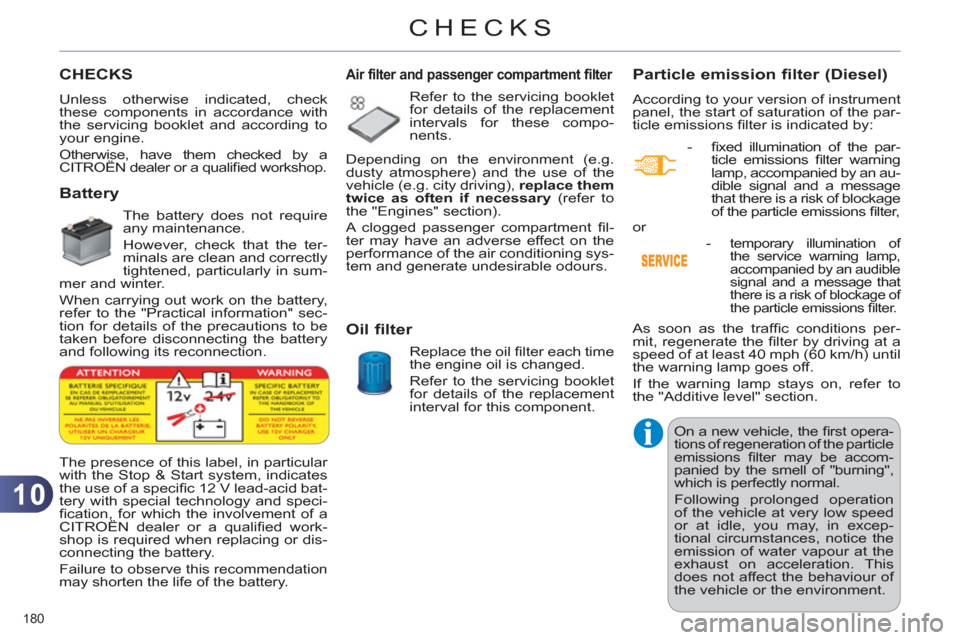
The presence of this label, in particular
with the Stop & Start system, indicates
the use of a specifi c 12 V lead-acid bat-
tery with special technology and speci-
fi cation, for which the involvement of a
CITROËN dealer or a qualifi ed work-
shop is required when replacing or dis-
connecting the battery.
Failure to observe this recommendation
may shorten the life of the battery.
Depending on the environment (e.g.
dusty atmosphere) and the use of the
vehicle (e.g. city driving), replace them
twice as often if necessary
(refer to
the "Engines" section).
A clogged passenger compartment fi l-
ter may have an adverse effect on the
performance of the air conditioning sys-
tem and generate undesirable odours.
As soon as the traffi c conditions per-
mit, regenerate the fi lter by driving at a
speed of at least 40 mph (60 km/h) until
the warning lamp goes off.
If the warning lamp stays on, refer to
the "Additive level" section.
On a new vehicle, the fi rst opera-
tions of regeneration of the particle
emissions fi lter may be accom-
panied by the smell of "burning",
which is perfectly normal.
Following prolonged operation
of the vehicle at very low speed
or at idle, you may, in excep-
tional circumstances, notice the
emission of water vapour at the
exhaust on acceleration. This
does not affect the behaviour of
the vehicle or the environment. or
-
temporary illumination of
the service warning lamp,
accompanied by an audible
signal and a message that
there is a risk of blockage of
the particle emissions fi lter.
Page 186 of 324
11
PRACTICAL INFORMATION
184
Tyre under-infl ation detection
If the vehicle is fi tted with tyre
under-infl ation detection, the
under-infl ation warning lamp will
remain on after the wheel has been
repaired until the system is reini-
tialised by a CITROËN dealer or a
qualifi ed workshop.
If after around 5 to 7 minutes
the pressure is not attained, this
indicates that the tyre is not re-
pairable; contact a CITROËN
dealer or a qualifi ed workshop
for assistance.
)
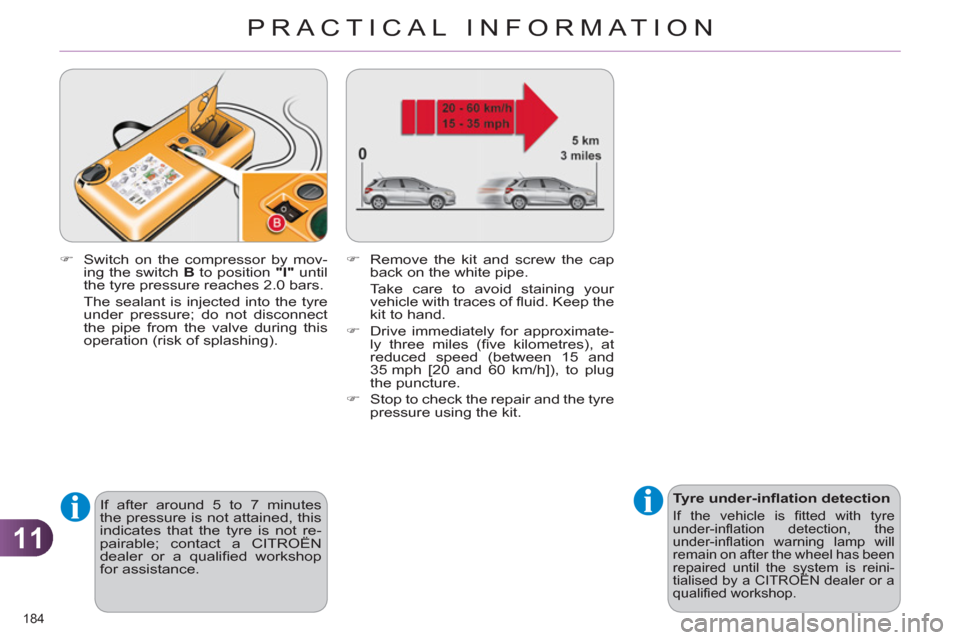
Switch on the compressor by mov-
ing the switch B
to position "I"
until
the tyre pressure reaches 2.0 bars.
The sealant is injected into the tyre
under pressure; do not disconnect
the pipe from the valve during this
operation (risk of splashing).
)
Remove the kit and screw the cap
back on the white pipe.
Take care to avoid staining your
vehicle with traces of fl uid. Keep the
kit to hand.
)
Drive immediately for approximate-
ly three miles (fi ve kilometres), at
reduced speed (between 15 and
35 mph [20 and 60 km/h]), to plug
the puncture.
)
Stop to check the repair and the tyre
pressure using the kit.
Page 191 of 324
11
PRACTICAL INFORMATION
189
Removing a wheel
Parking the vehicle
Immobilise the vehicle where it
does not block traffi c: the ground
must be level, stable and non-
slippery ground.
Apply the parking brake unless it
has been programmed to auto-
matic mode, switch off the ignition
and engage fi rst gear * to lock the
wheels.
Check that the braking warning
lamps in the instrument panel
are on (not fl ashing).
The occupants must get out of
the vehicle and wait where they
are safe.
If necessary, place a chock under
the wheel diagonally opposite the
wheel to be changed.
Never go underneath a vehicle
raised using a jack; use an axle
stand.
*
position R
for the electronic gearbox
system; P
for an automatic gearbox.
List of operations
)
Remove the chromed bolt cover
from each of the bolts using the
tool 3
(according to equipment).
)
Fit the security socket 4
on the
wheelbrace 1
to slacken the secu-
rity bolt.
)
Slacken the other bolts using the
wheelbrace 1
only.
)
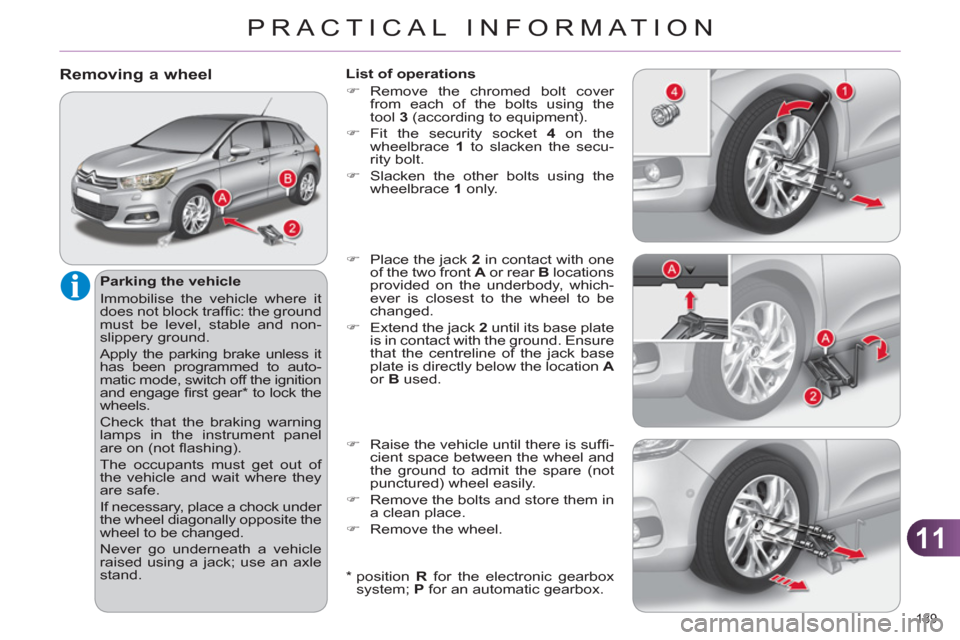
Place the jack 2
in contact with one
of the two front A
or rear B
locations
provided on the underbody, which-
ever is closest to the wheel to be
changed.
)
Extend the jack 2
until its base plate
is in contact with the ground. Ensure
that the centreline of the jack base
plate is directly below the location A
or B
used.
)
Raise the vehicle until there is suffi -
cient space between the wheel and
the ground to admit the spare (not
punctured) wheel easily.
)
Remove the bolts and store them in
a clean place.
)
Remove the wheel.
Page 194 of 324
11
PRACTICAL INFORMATION
192
Amber coloured bulbs, such as
the direction indicators, must be
replaced with bulbs of identical
specifi cations and colour.
When refi tting, close the protec-
tive cover carefully to preserve
the sealing of the headlamp.
Changing direction indicator bulbs
Model with halogen headlamps
Rapid fl ashing of the direction
indicator warning lamp (right
or left) indicates the failure of a
bulb on that side.
Access to bulbs
)
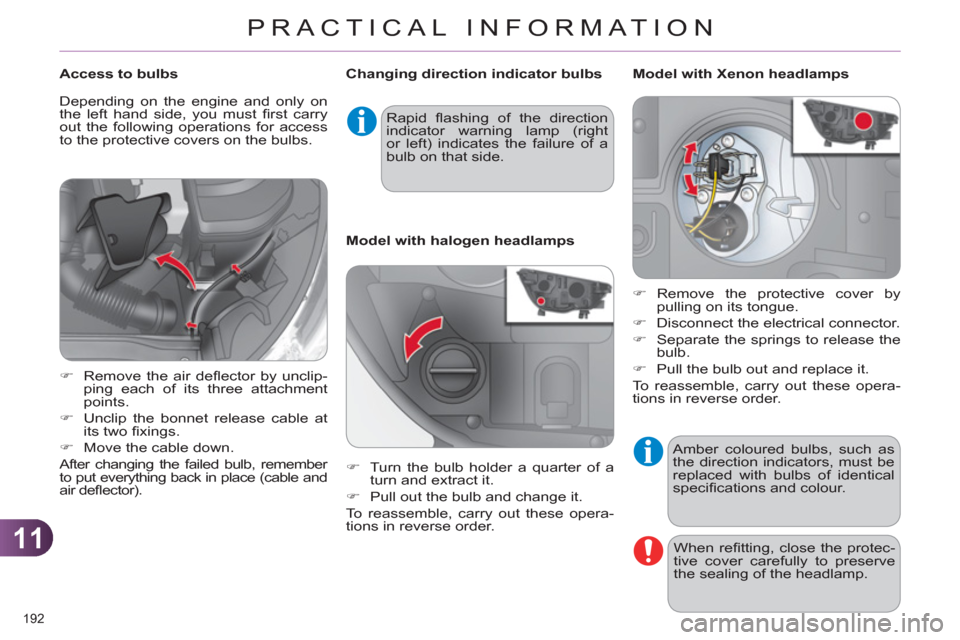
Remove the air defl ector by unclip-
ping each of its three attachment
points.
)
Unclip the bonnet release cable at
its two fi xings.
)
Move the cable down.
After changing the failed bulb, remember
to put everything back in place (cable and
air defl ector). Depending on the engine and only on
the left hand side, you must fi rst carry
out the following operations for access
to the protective covers on the bulbs.
)
Turn the bulb holder a quarter of a
turn and extract it.
)
Pull out the bulb and change it.
To reassemble, carry out these opera-
tions in reverse order.
Model with Xenon headlamps
)
Remove the protective cover by
pulling on its tongue.
)
Disconnect the electrical connector.
)
Separate the springs to release the
bulb.
)
Pull the bulb out and replace it.
To reassemble, carry out these opera-
tions in reverse order.
Page 208 of 324
11
PRACTICAL INFORMATION
206
)
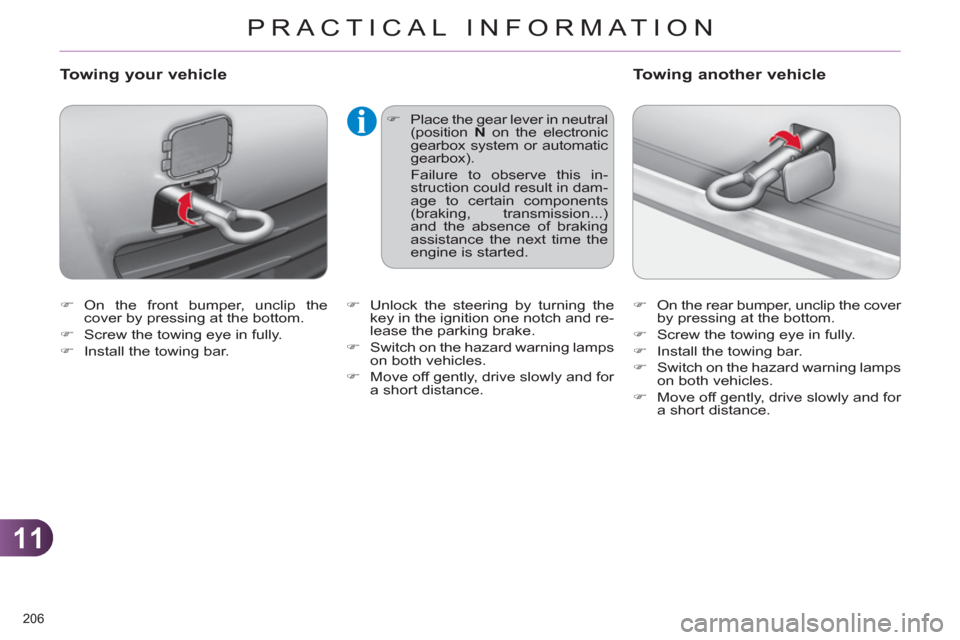
On the front bumper, unclip the
cover by pressing at the bottom.
)
Screw the towing eye in fully.
)
Install the towing bar.
Towing your vehicle
)
Place the gear lever in neutral
(position N
on the electronic
gearbox system or automatic
gearbox).
Failure to observe this in-
struction could result in dam-
age to certain components
(braking, transmission...)
and the absence of braking
assistance the next time the
engine is started.
)
On the rear bumper, unclip the cover
by pressing at the bottom.
)
Screw the towing eye in fully.
)
Install the towing bar.
)
Switch on the hazard warning lamps
on both vehicles.
)
Move off gently, drive slowly and for
a short distance.
Towing another vehicle
)
Unlock the steering by turning the
key in the ignition one notch and re-
lease the parking brake.
)
Switch on the hazard warning lamps
on both vehicles.
)
Move off gently, drive slowly and for
a short distance.
Page 209 of 324
11
PRACTICAL INFORMATION
207
TOWING A TRAILER,
A CARAVAN, ETC.
We recommend the use of genu-
ine CITROËN towbars and their
harnesses that have been tested
and approved from the design
stage of your vehicle, and that
the fi tting of the towbar is en-
trusted to a CITROËN dealer or
a qualifi ed workshop.
If the towbar is not fi tted by a
CITROËN dealer, it is impera-
tive that it is fi tted in accordance
with the vehicle manufacturer's
instructions. The rear parking sensors will
be deactivated automatically if
a genuine CITROËN towbar is
used.
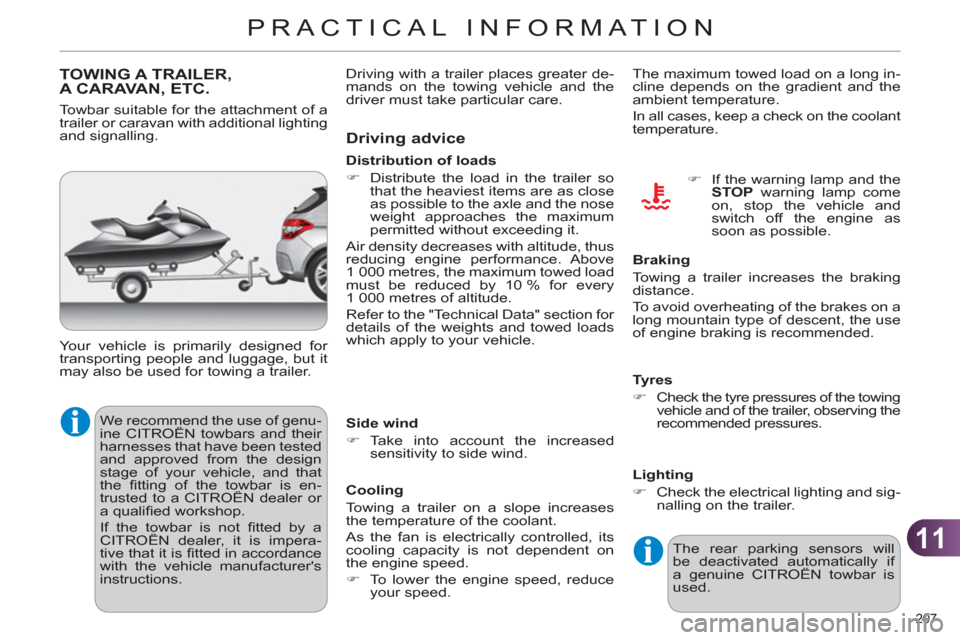
Towbar suitable for the attachment of a
trailer or caravan with additional lighting
and signalling.
Your vehicle is primarily designed for
transporting people and luggage, but it
may also be used for towing a trailer. Driving with a trailer places greater de-
mands on the towing vehicle and the
driver must take particular care.
Driving advice
Distribution of loads
)
Distribute the load in the trailer so
that the heaviest items are as close
as possible to the axle and the nose
weight approaches the maximum
permitted without exceeding it.
Air density decreases with altitude, thus
reducing engine performance. Above
1 000 metres, the maximum towed load
must be reduced by 10 % for every
1 000 metres of altitude.
Refer to the "Technical Data" section for
details of the weights and towed loads
which apply to your vehicle.
Side wind
)
Take into account the increased
sensitivity to side wind.
Cooling
Towing a trailer on a slope increases
the temperature of the coolant.
As the fan is electrically controlled, its
cooling capacity is not dependent on
the engine speed.
)
To lower the engine speed, reduce
your speed. The maximum towed load on a long in-
cline depends on the gradient and the
ambient temperature.
In all cases, keep a check on the coolant
temperature.
)
If the warning lamp and the
STOP
warning lamp come
on, stop the vehicle and
switch off the engine as
soon as possible.
Braking
Towing a trailer increases the braking
distance.
To avoid overheating of the brakes on a
long mountain type of descent, the use
of engine braking is recommended.
Tyres
)
Check the tyre pressures of the towing
vehicle and of the trailer, observing the
recommended pressures.
Lighting
)
Check the electrical lighting and sig-
nalling on the trailer.
Page 211 of 324
11
PRACTICAL INFORMATION
209
ACCESSORIES
A wide range of accessories and genu-
ine parts is available from the CITROËN
dealer network.
These accessories and parts have
been tested and approved for reliability
and safety.
They are all adapted to your vehicle and
benefi t from CITROËN's recommenda-
tion and warranty.
Conversion kits
You can obtain an "Enterprise" kit to
convert a trade vehicle to a private car
and vice-versa.
"Comfort":
door defl ectors, side window blinds,
rear screen blind, isotherm module,
coat hanger fi xed to head restraint,
moveable courtesy mirror, reading
lamp, mirror for caravan, speed limiter/
cruise control, parking sensors...
"Transport systems":
boot carpet, boot liner, boot net, boot
spacers, transverse roof bars, bicycle
carrier, ski carrier, roof boxes, towbars,
towbar wiring harnesses...
"Styling":
gear lever knobs, aluminium foot rest,
alloy wheels, wheel embellishers,
chrome exhaust tailpipe, chrome mirror
shells, chrome door aperture fi nishers,
tailgate lower chrome fi nisher...
*
To avoid any risk of jamming the pedals:
- ensure that mats are correctly posi-
tioned and secured,
- never fi t one mat on top of another.
"Security and safety":
anti-intrusion alarm, microwave sensor,
anti-tilt sensor, stolen vehicle tracking
system, child seats and booster cushions,
breathalyser, fi rst aid kit, fi re extinguisher,
warning triangle, high visibility vest, dog
guard, wheel security bolts, snow chains,
non-slip covers, front foglamp kit...
"Protection":
mats * , seat covers compatible with lateral
airbags, door sill protectors, mud fl aps,
door protective rubbing strips, bumper pro-
tection strips, vehicle cover...
If a towbar and wiring harness
are fi tted outside the CITROËN
dealer network, the installation
must be done using the vehicle's
electrical pre-equipment and
in line with the manufacturer's
recommendations.