warning Citroen C4 RHD 2014 2.G Repair Manual
[x] Cancel search | Manufacturer: CITROEN, Model Year: 2014, Model line: C4 RHD, Model: Citroen C4 RHD 2014 2.GPages: 328
Page 165 of 328
9
DRIVING
163
STOP & START
The Stop & Start system puts the en-
gine temporarily into standby - STOP
mode - during stops in the traffi c (red
lights, traffi c jams, or other...). The en-
gine restarts automatically - START
mode - as soon as you want to move
off. The restart takes place instantly,
quickly and silently.
Perfect for urban use, the Stop & Start
system reduces fuel consumption and
exhaust emissions as well as the noise
level when stationary.
Operation
Going into engine STOP mode
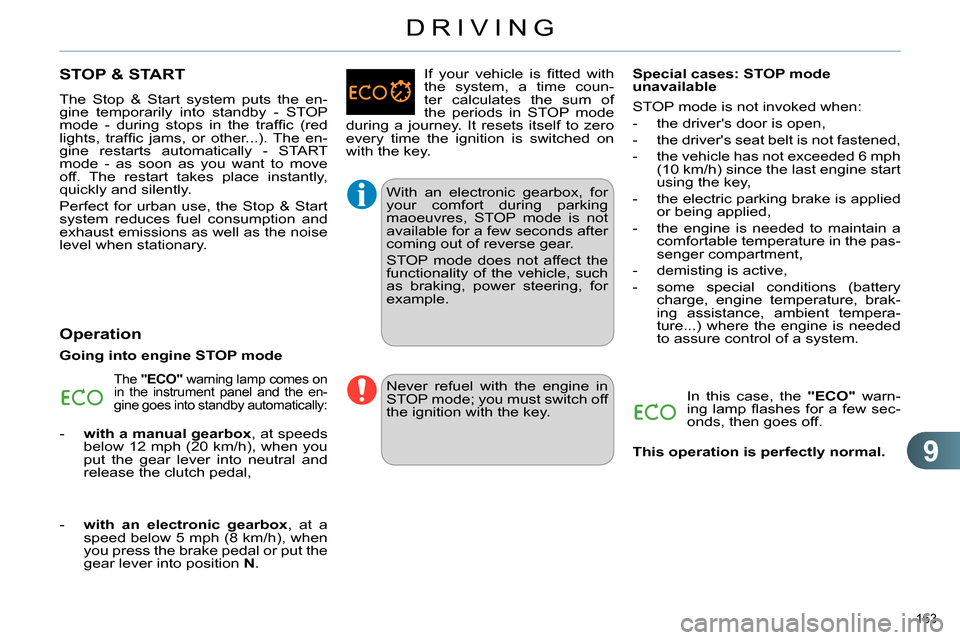
The "ECO"
warning lamp comes on
in the instrument panel and the en-
gine goes into standby automatically:
- with a manual gearbox
, at speeds
below 12 mph (20 km/h), when you
put the gear lever into neutral and
release the clutch pedal, If your vehicle is fi tted with
the system, a time coun-
ter calculates the sum of
the periods in STOP mode
d uring a journey. It resets itself to zero
every time the ignition is switched on
with the key.
- with an electronic gearbox
, at a
speed below 5 mph (8 km/h), when
you press the brake pedal or put the
gear lever into position N
. With an electronic gearbox, for
your comfort during parking
maoeuvres, STOP mode is not
available for a few seconds after
coming out of reverse gear.
STOP mode does not affect the
functionality of the vehicle, such
as braking, power steering, for
example.
Special cases: STOP mode
unavailable
STOP mode is not invoked when:
- the driver's door is open,
- the driver's seat belt is not fastened,
- the vehicle has not exceeded 6 mph
(10 km/h) since the last engine start
using the key,
- the electric parking brake is applied
or being applied,
- the engine is needed to maintain a
comfortable temperature in the pas-
senger compartment,
- demisting is active,
- some special conditions (battery
charge, engine temperature, brak-
ing assistance, ambient tempera-
ture...) where the engine is needed
to assure control of a system.
In this case, the "ECO"
warn-
ing lamp fl ashes for a few sec-
onds, then goes off. Never refuel with the engine in
STOP mode; you must switch off
the ignition with the key.
This operation is perfectly normal.
Page 166 of 328
9
DRIVING
164
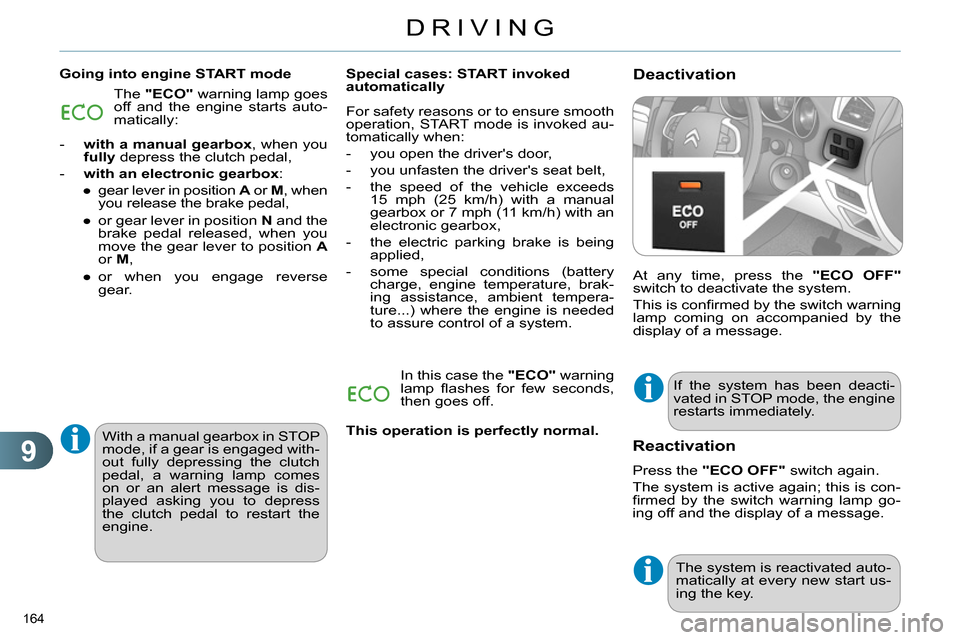
Deactivation
Going into engine START mode
At any time, press the "ECO OFF"
switch to deactivate the system.
This is confi rmed by the switch warning
lamp coming on accompanied by the
display of a message.
Special cases: START invoked
automatically
If the system has been deacti-
vated in STOP mode, the engine
restarts immediately. The "ECO"
warning lamp goes
off and the engine starts auto-
matically:
- with a manual gearbox
, when you
fully
depress the clutch pedal,
- with an electronic gearbox
:
●
gear lever in position A
or M
, when
you release the brake pedal,
●
or gear lever in position N
and the
brake pedal released, when you
move the gear lever to position A
or M
,
●
or when you engage reverse
gear.
For safety reasons or to ensure smooth
operation, START mode is invoked au-
tomatically when:
- you open the driver's door,
- you unfasten the driver's seat belt,
- the speed of the vehicle exceeds
15 mph (25 km/h) with a manual
gearbox or 7 mph (11 km/h) with an
electronic gearbox,
- the electric parking brake is being
applied,
- some special conditions (battery
charge, engine temperature, brak-
ing assistance, ambient tempera-
ture...) where the engine is needed
to assure control of a system.
In this case the "ECO"
warning
lamp fl ashes for few seconds,
then goes off.
With a manual gearbox in STOP
mode, if a gear is engaged with-
out fully depressing the clutch
pedal, a warning lamp comes
on or an alert message is dis-
played asking you to depress
the clutch pedal to restart the
engine.
Reactivation
Press the "ECO OFF"
switch again.
The system is active again; this is con-
fi rmed by the switch warning lamp go-
ing off and the display of a message.
The system is reactivated auto-
matically at every new start us-
ing the key.
This operation is perfectly normal.
Page 167 of 328
9
DRIVING
165
Maintenance
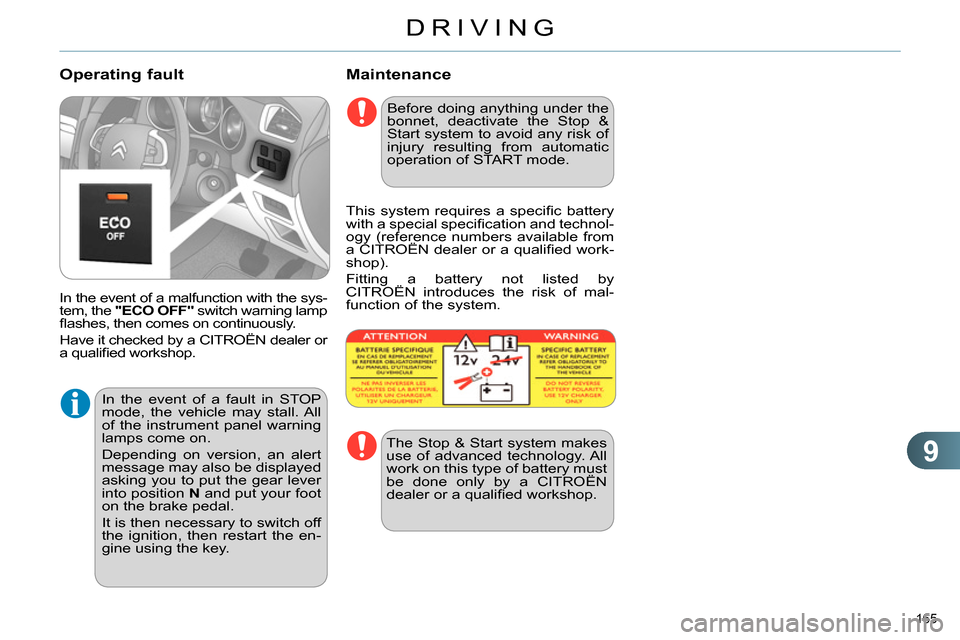
In the event of a malfunction with the sys-
tem, the "ECO OFF"
switch warning lamp
fl ashes, then comes on continuously.
Have it checked by a CITROËN dealer or
a qualifi ed workshop.
Operating fault
Before doing anything under the
bonnet, deactivate the Stop &
Start system to avoid any risk of
injury resulting from automatic
operation of START mode.
This system requires a specifi c battery
with a special specifi cation and technol-
ogy (reference numbers available from
a CITROËN dealer or a qualifi ed work-
shop).
Fitting a battery not listed by
CITROËN introduces the risk of mal-
function of the system.
The Stop & Start system makes
use of advanced technology. All
work on this type of battery must
be done only by a CITROËN
dealer or a qualifi ed workshop.
In the event of a fault in STOP
mode, the vehicle may stall. All
of the instrument panel warning
lamps come on.
Depending on version, an alert
message may also be displayed
asking you to put the gear lever
into position N
and put your foot
on the brake pedal.
It is then necessary to switch off
the ignition, then restart the en-
gine using the key.
Page 168 of 328

9
DRIVING
166
BLIND SPOT SENSORS
This driving assistance system warns
the driver of the presence of another
vehicle in the blind spot angle of their
vehicle (areas masked from the driver's
fi eld of vision), as soon as this presents
a potential danger.
Operation
On switching on the ignition, or en-
gine running, press this button to
activate the function; the warning
lamp comes on.
This system is designed to im-
prove safety when driving and is
in no circumstances a substitute
for the use of the interior rear
view mirror and door mirrors. It
is the driver's responsibility to
constantly check the traffi c, to
asses the distances and relative
speeds of other vehicles and to
predict their movements before
deciding whether to change
lane.
The blind spot sensor system
can never replace the vigilance
and responsibility of the driver.
Sensors fi tted in the front and rear bum-
pers monitor the blind spots. A warning lamp appears in the door
mirror on the side in question:
- immediately, when being overtaken,
- after a delay of about one second,
when overtaking a vehicle slowly.
Page 169 of 328
9
DRIVING
167
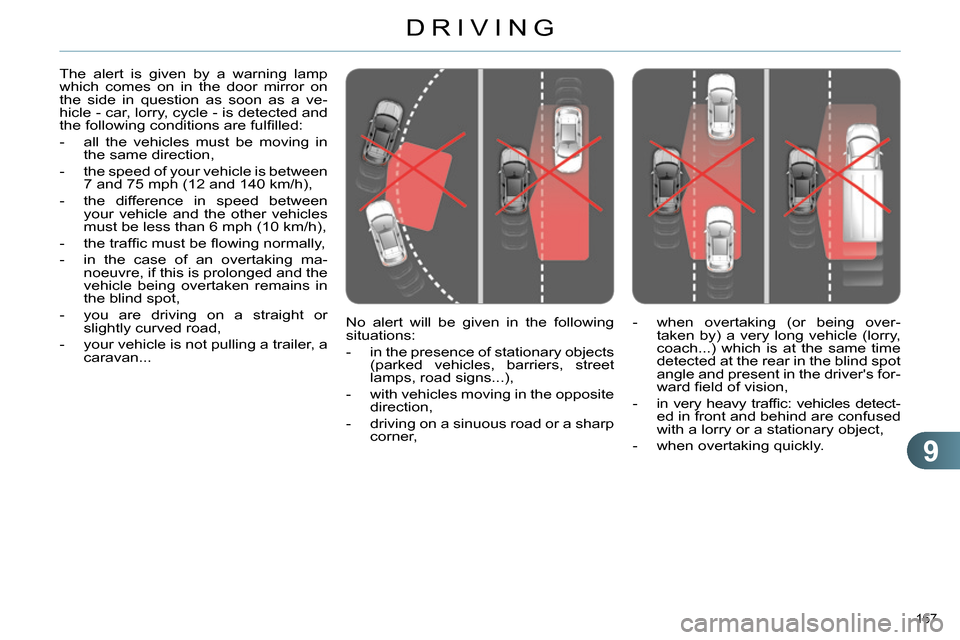
No alert will be given in the following
situations:
- in the presence of stationary objects
(parked vehicles, barriers, street
lamps, road signs...),
- with vehicles moving in the opposite
direction,
- driving on a sinuous road or a sharp
corner, The alert is given by a warning lamp
which comes on in the door mirror on
the side in question as soon as a ve-
hicle - car, lorry, cycle - is detected and
the following conditions are fulfi lled:
- all the vehicles must be moving in
the same direction,
- the speed of your vehicle is between
7 and 75 mph (12 and 140 km/h),
- the difference in speed between
your vehicle and the other vehicles
must be less than 6 mph (10 km/h),
- the traffi c must be fl owing normally,
- in the case of an overtaking ma-
noeuvre, if this is prolonged and the
vehicle being overtaken remains in
the blind spot,
- you are driving on a straight or
slightly curved road,
- your vehicle is not pulling a trailer, a
caravan...
- when overtaking (or being over-
taken by) a very long vehicle (lorry,
coach...) which is at the same time
detected at the rear in the blind spot
angle and present in the driver's for-
ward fi eld of vision,
- in very heavy traffi c: vehicles detect-
ed in front and behind are confused
with a lorry or a stationary object,
- when overtaking quickly.
Page 170 of 328

9
DRIVING
168
The system may suffer tem-
porary interference in certain
weather conditions (rain, hail...).
In particular, driving on a wet sur-
face or moving from a dry area to
a wet area can cause false alerts
(for example, the presence of a
fog of water droplets in the blind
spot angle is interpreted as a ve-
hicle).
In bad or wintry weather, ensure
that the sensors are not covered
by mud, ice or snow.
Take care not to cover the warn-
ing zone in the door mirrors or
the detection zones on the front
and rear bumpers with adhesive
labels or other objects; they may
hamper the correct operation of
the system.
To deactivate the system, press
this button again; the warning lamp
goes off.
The state of the system remains in
memory on switching off the ignition.
Operating fault
In the event of a fault, the warning lamp
in the button fl ashes then goes off.
Have it checked by a CITROËN dealer
or a qualifi ed workshop.
The system is automatically de-
activated when towing with a
towbar approved by CITROËN.
Page 176 of 328

9
DRIVING
174
PARKING SPACE SENSORS
System which measures the parking
space available between two vehicles
or obstacles. It measures the size of the
space and gives you information on:
- the possibility of fi tting into a free
space, depending on the dimensions
of your vehicle and the distances
needed for manoeuvring,
- the level of diffi culty of the manoeuvre
to be performed.
The system does not measure spaces
which are clearly much smaller or larg-
er than the size of the vehicle.
Displays in the instrument panel
- on fi xed:
the function is selected by
a press on control A
.
- off:
the function is not selected,
The parking space sensor
function warning lamp can
have two different states:
Operation
You have identifi ed a parking space:
Press button A
to select the function.
Operate the direction indicator on
the side where the space is to be
measured; a message is displayed
to confi rm that measurement is in
progress.
During measurement, go forward
the length of the space, at a speed
less than 12 mph (approx. 20 km/h),
to prepare for your manoeuvre.
Once the measurement has been
completed, the system informs you
of the level of diffi culty of the ma-
noeuvre by a message in the multi-
function screen accompanied by an
audible signal.
Page 186 of 328
10
CHECKS
184
Used products
Avoid prolonged contact of used
oil or fl uids with the skin.
Most of these fl uids are harmful
to health or indeed very corro-
sive.
Do not discard used oil or fl uids
into sewers or onto the ground.
Take used oil to a CITROËN
dealer or a qualifi ed workshop
(France) or to an authorised
waste disposal site.
Additive level (Diesel with
particle emissions filter)
The additive reservoir low level is indi-
cated by:
Topping up
The reservoir must be topped up with-
out delay by a CITROËN dealer or a
qualifi ed workshop.
- fi xed illumination of the par-
ticle emissions fi lter warning
lamp, accompanied by an au-
dible signal and a message
that the particle emissions
fi lter additive level is too low.
Screenwash / headlamp wash
fluid level
Specifi cation of the fl uid
To ensure optimum cleaning and to
avoid freezing, the fl uid should never be
topped up or replaced by plain water.
In wintry conditions, the use of a fl uid
with an ethyl alcohol or methanol base
is recommended.
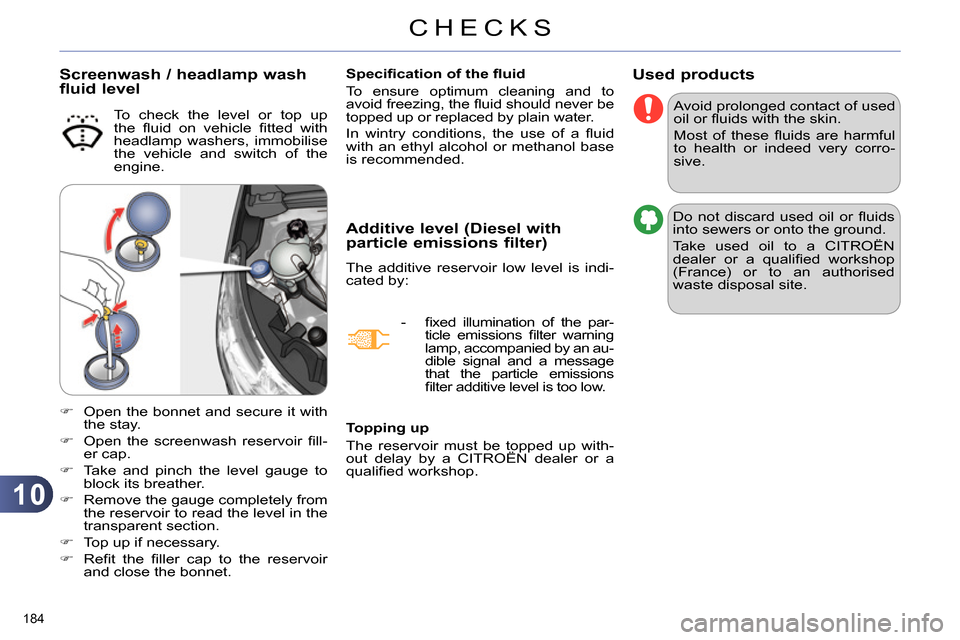
To check the level or top up
the fl uid on vehicle fi tted with
headlamp washers, immobilise
the vehicle and switch of the
engine.
Open the bonnet and secure it with
the stay.
Open the screenwash reservoir fi ll-
er cap.
Take and pinch the level gauge to
block its breather.
Remove the gauge completely from
the reservoir to read the level in the
transparent section.
Top up if necessary.
Refi t the fi ller cap to the reservoir
and close the bonnet.
Page 187 of 328
10
CHECKS
185
CHECKS
Particle emission filter (Diesel)
The start of saturation of the particle
emissions fi lter is indicated by:
- fi xed illumination of the par-
ticle emissions fi lter warning
lamp, accompanied by an
audible signal and a message
that there is a risk of blockage
of the particle emissions fi lter.
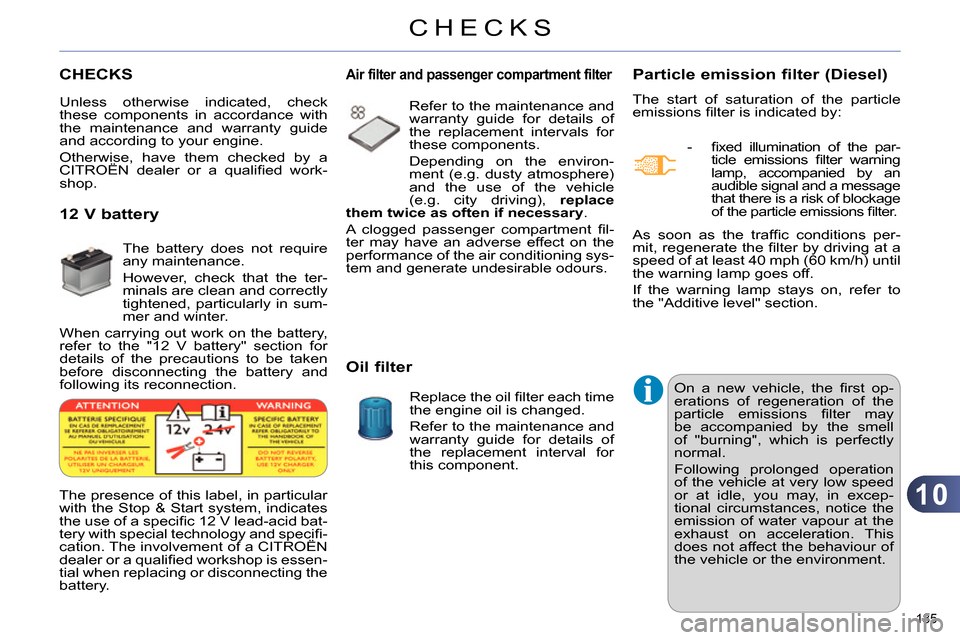
The presence of this label, in particular
with the Stop & Start system, indicates
the use of a specifi c 12 V lead-acid bat-
tery with special technology and specifi -
cation. The involvement of a CITROËN
dealer or a qualifi ed workshop is essen-
tial when replacing or disconnecting the
battery. On a new vehicle, the fi rst op-
erations of regeneration of the
particle emissions fi lter may
be accompanied by the smell
of "burning", which is perfectly
normal.
Following prolonged operation
of the vehicle at very low speed
or at idle, you may, in excep-
tional circumstances, notice the
emission of water vapour at the
exhaust on acceleration. This
does not affect the behaviour of
the vehicle or the environment. As soon as the traffi c conditions per-
mit, regenerate the fi lter by driving at a
speed of at least 40 mph (60 km/h) until
the warning lamp goes off.
If the warning lamp stays on, refer to
the "Additive level" section.
Unless otherwise indicated, check
these components in accordance with
the maintenance and warranty guide
and according to your engine.
Otherwise, have them checked by a
CITROËN dealer or a qualifi ed work-
shop.
Air filter and passenger compartment filter
Refer to the maintenance and
warranty guide for details of
the replacement intervals for
these components.
Depending on the environ-
ment (e.g. dusty atmosphere)
and the use of the vehicle
(e.g. city driving), replace
them twice as often if necessary
.
A clogged passenger compartment fi l-
ter may have an adverse effect on the
performance of the air conditioning sys-
tem and generate undesirable odours.
Oil filter
Replace the oil fi lter each time
the engine oil is changed.
Refer to the maintenance and
warranty guide for details of
the replacement interval for
this component.
12 V battery
The battery does not require
any maintenance.
However, check that the ter-
minals are clean and correctly
tightened, particularly in sum-
mer and winter.
When carrying out work on the battery,
refer to the "12 V battery" section for
details of the precautions to be taken
before disconnecting the battery and
following its reconnection.
Page 191 of 328
11
PRACTICAL INFORMATION
189
Tyre under-infl ation detection
If the vehicle is fi tted with tyre under-
infl ation detection, the under-infl ation
warning lamp will remain on after the
wheel has been repaired until the
system is reinitialised by a CITROËN
dealer or a qualifi ed workshop.
If after around 5 to 7 minutes the
pressure is not attained, this in-
dicates that the tyre is not repair-
able; contact a CITROËN dealer
or a qualifi ed workshop for as-
sistance.
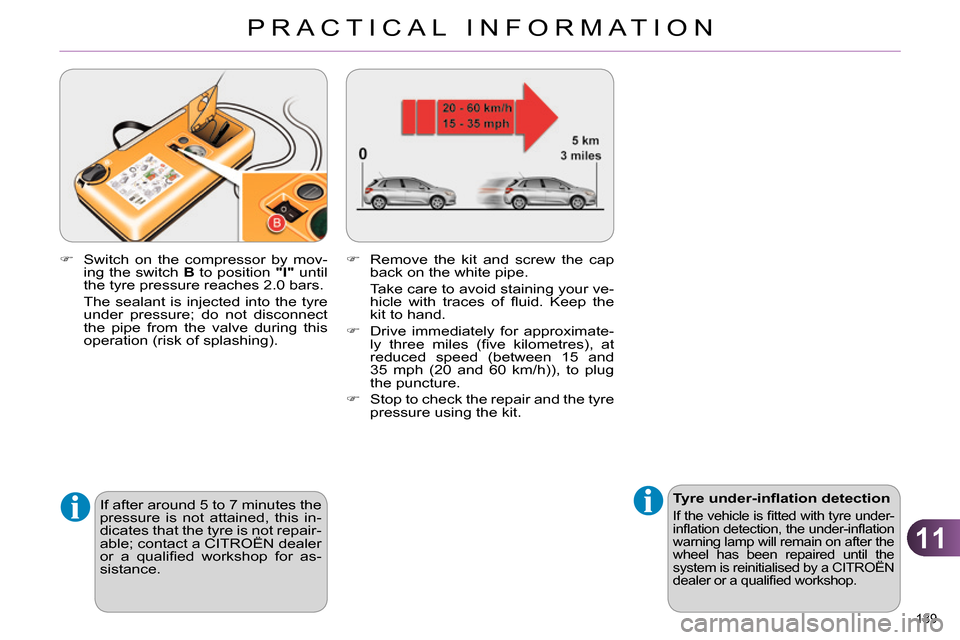
Switch on the compressor by mov-
ing the switch B
to position "I"
until
the tyre pressure reaches 2.0 bars.
The sealant is injected into the tyre
under pressure; do not disconnect
the pipe from the valve during this
operation (risk of splashing).
Remove the kit and screw the cap
back on the white pipe.
Take care to avoid staining your ve-
hicle with traces of fl uid. Keep the
kit to hand.
Drive immediately for approximate-
ly three miles (fi ve kilometres), at
reduced speed (between 15 and
35 mph (20 and 60 km/h)), to plug
the puncture.
Stop to check the repair and the tyre
pressure using the kit.