run flat Citroen C4 RHD 2015 2.G Owner's Manual
[x] Cancel search | Manufacturer: CITROEN, Model Year: 2015, Model line: C4 RHD, Model: Citroen C4 RHD 2015 2.GPages: 328, PDF Size: 12.72 MB
Page 5 of 328
3
Direction indicators 117
Hazard warning lamps 1 17
Horn
1
17
Braking
assistance systems
1
18
Trajectory
control systems
1
19
Emergency
or assistance call
120
Front
seat belts
121
Airbags
124
8 - SAFETY 1 17 127
Driving recommendations 128
Starting-switching off the engine 129
Electric
parking brake
132
Manual
parking brake
138
Manual
gearbox
138
Electronic
gearbox
139
Automatic
gearbox
142
Hill
start assist
145
Gear
efficiency indicator
146
T
yre under-inflation detection
147
Stop
& Start
149
Blind
spot sensors
152
Speed
limiter
156
Cruise
control
158
Parking
space sensors
160
Parking
sensors
162
9 - DRIVING 128 163
Fuel tank 165
Misfuel prevention (Diesel) 167
Running
out of fuel (Diesel)
168
Bonnet
169
Petrol
engines
170
Diesel
engines
171
Checking
levels
172
Checks
175
AdBlue® additive and SCR
system (BlueHDi Diesel) 177
10 - CHECKS 164 183
Temporary puncture repair kit 184
Changing a wheel 189
Snow
chains
195
Changing
a bulb
196
Changing
a fuse
202
12
V battery
206
Energy
economy mode
209
Changing
a wiper blade
209
Fitting
roof bars
210
V
ery cold climate screen
210
T
owing the vehicle
21
1
Towing
a trailer
213
Audio
pre-equipment
214
Accessories
215
11 - PRACTICAL
INFORMATION 184 216
Petrol engines 217
Petrol weights 219
Diesel
engines
221
Diesel
weights
223
Dimensions
225
Identification
markings
226
12 - TECHNICAL
DATA 217 226
Emergency or assistance 227
eMyW ay 229
Audio
system
285
AUDIO and
TELEMATICS 227 318
ALPHABETICAL
INDEX
319
323
CONTENTS
Page 146 of 328
99
144
Manual operation
F Select position M for sequential
changing of the six gears.
F
Push
the
lever
towards
the
+
sign
to
change
up a gear.
F
Pull
the
lever
towards
the
-
sign
to
change
down a gear.
It
is
only
possible
to
change
from
one
gear
to
another
if
the
vehicle
speed
and
engine
speed
permit;
otherwise,
the
gearbox
will
operate
temporarily
in
au
-
tomatic
mode.D
disappears
and
the
gears
engaged
appear
in
succes
-
sion
in the instrument panel.
If
the
engine
speed
is
too
low
or
too
high,
the
gear
selected
flashes
for
a
few
seconds,
then
the
ac
-
tual
gear engaged is displayed.
It
is
possible
to
change
from
position
D
(automatic)
to
position
M
(manual)
at
any
time.
When
the
vehicle
is
stationary
or
mov
-
ing
very
slowly
,
the
gearbox
selects
gear
M1 automatically.
The
sport
and
snow
programmes
do
not
operate in manual mode.Invalid value during manual
operation
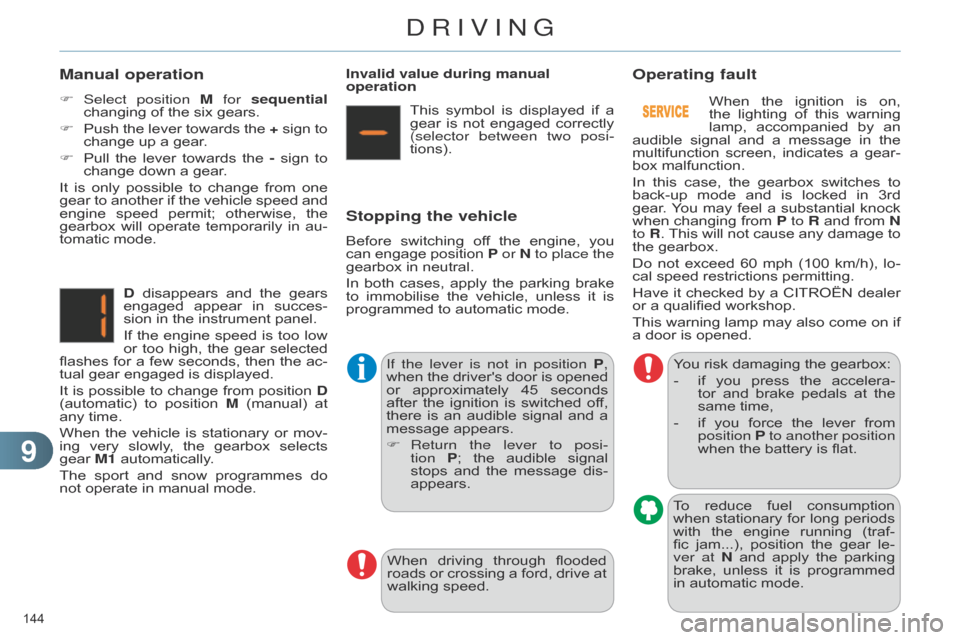
This symbol is displayed if a
gear
is
not
engaged
correctly
(selector between two posi
-
tions).
Stopping the vehicle
Before switching of f the engine, you can
engage position P or N to place the
gearbox
in neutral.
In
both
cases,
apply
the
parking
brake
to
immobilise
the
vehicle,
unless
it
is
programmed
to automatic mode.
If the lever is not in position P,
when
the
driver's
door
is
opened
or
approximately
45
seconds
after
the
ignition
is
switched
of
f,
there
is
an
audible
signal
and
a
message
appears.
F
Return
the lever to posi-
tion
P
;
the
audible
signal
stops
and
the
message
dis
-
appears. You
risk damaging the gearbox:
-
if
you
press
the
accelera
-
tor
and
brake
pedals
at
the
same
time,
-
if
you
force
the
lever
from
position P
to another position
when
the battery is flat.
When
the
ignition
is
on,
the
lighting
of
this
warning
lamp,
accompanied
by
an
audible
signal
and
a
message
in
the
multifunction
screen,
indicates
a
gear
-
box malfunction.
In
this
case,
the
gearbox
switches
to
back-up
mode
and
is
locked
in
3rd
gear
.
Y
ou
may
feel
a
substantial
knock
when
changing
from
P
to R
and
from
N
to R. This will not cause any damage to the
gearbox.
Do
not
exceed
60
mph
(100
km/h),
lo
-
cal
speed restrictions permitting.
Have
it
checked
by
a
CITROËN
dealer
or
a qualified workshop.
This
warning
lamp
may
also
come
on
if
a
door is opened.
Operating fault
To reduce fuel consumption when
stationary for long periods
with
the
engine
running
(traf
-
fic
jam...),
position
the
gear
le
-
ver at
N
and
apply
the
parking
brake,
unless
it
is
programmed
in
automatic mode.
When
driving
through
flooded
roads
or
crossing
a
ford,
drive
at
walking
speed.
DRIVING
Page 189 of 328
1111
187
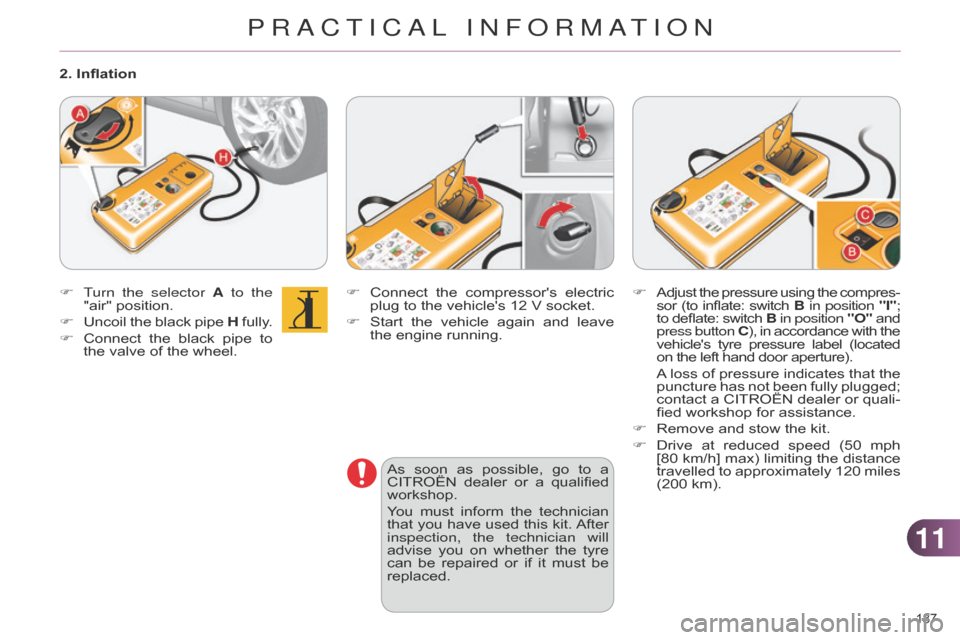
F Connect the compressor's electric plug
to the vehicle's 12 V socket.
F
Start
the
vehicle
again
and
leave
the
engine running.
As
soon
as
possible,
go
to
a
CITROËN
dealer
or
a
qualified
workshop.
Y
ou
must
inform
the
technician
that
you
have
used
this
kit.
After
inspection, the technician will
advise
you
on
whether
the
tyre
can
be
repaired
or
if
it
must
be
replaced.
F
T
urn the selector A to the
"air"
position.
F
Uncoil
the
black
pipe
H
fully
.
F
Connect
the
black
pipe
to
the
valve
of
the
wheel.
2. Inflation
F Adjust the pressure using the compres -
sor (to inflate: switch B in position
"I";
to
deflate:
switch
B
in
position
"O"
and press button
C),
in
accordance
with
the vehicle's
tyre
pressure
label
(located on
the left hand door aperture).
A loss
of
pressure
indicates
that
the
puncture
has
not
been
fully
plugged;
contact
a
CITROËN
dealer
or
quali
-
fied
workshop for assistance.
F
Remove
and stow the kit.
F
Drive
at
reduced
speed
(50
mph
[80
km/h]
max)
limiting
the
distance
travelled
to
approximately
120
miles
(200
km).
PRACTICAL INFORMATION
Page 190 of 328
1111
188
Removing the cartridge
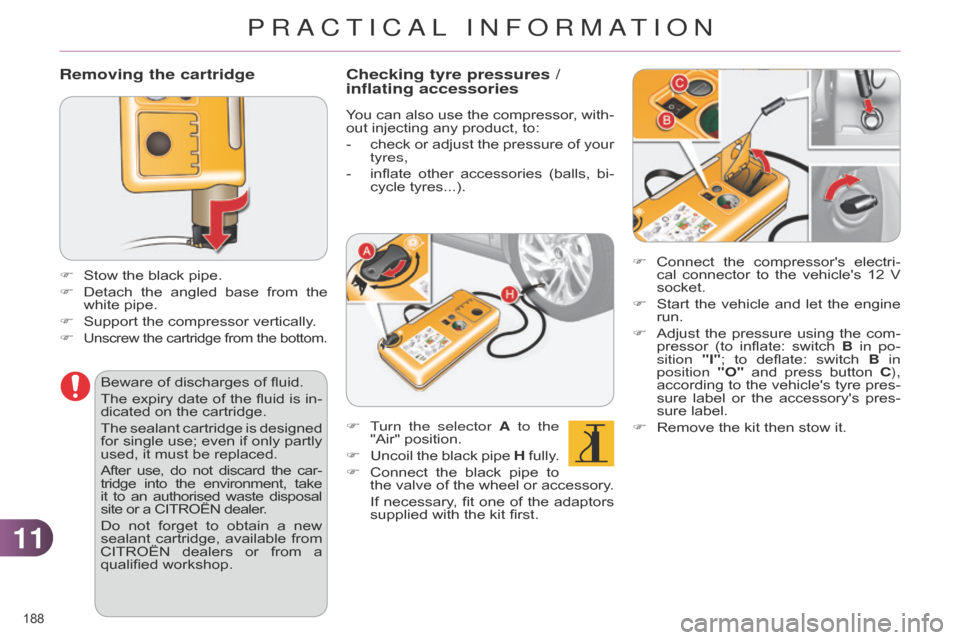
F Stow the black pipe.
F
Detach
the
angled
base
from
the
white
pipe.
F
Support
the compressor vertically.
F
Unscrew the cartridge from the bottom.
F Connect the compressor's electri -
cal connector to the vehicle's 12 V
socket.
F
Start
the
vehicle
and
let
the
engine
run.
F
Adjust
the
pressure
using
the
com
-
pressor
(to
inflate:
switch
B
in po-
sition "I";
to
deflate:
switch
B
in
position "O"
and
press
button
C
),
according
to
the
vehicle's
tyre
pres
-
sure
label
or
the
accessory's
pres
-
sure
label.
F
Remove
the kit then stow it.
Beware
of
discharges
of
fluid.
The
expiry
date
of
the
fluid
is
in
-
dicated
on
the
cartridge.
The
sealant
cartridge
is
designed
for
single
use;
even
if
only
partly
used,
it
must
be
replaced.
After
use,
do
not
discard
the
car
-
tridge
into
the
environment,
take it
to
an
authorised
waste
disposal site
or
a
CITROËN
dealer.
Do
not
forget
to
obtain
a
new
sealant
cartridge,
available
from
CITROËN
dealers
or
from
a
qualified
workshop.
Checking tyre pressures /
inflating accessories
You can also use the compressor , with -
out injecting any product, to:
-
check
or
adjust
the
pressure
of
your
tyres,
-
inflate
other
accessories
(balls,
bi
-
cycle
tyres...).
F
T
urn the selector A to the
"Air"
position.
F
Uncoil
the
black
pipe
H
fully
.
F
Connect
the
black
pipe
to
the
valve
of
the
wheel
or
accessory
.
If
necessary
,
fit
one
of
the
adaptors
supplied
with the kit first.
PRACTICAL INFORMATION
Page 197 of 328
1111
195
SNOW CHAINS
In wintry conditions, snow chains im -
prove traction as well as the behaviour
of
the vehicle when braking. Advice on installation
F
If
you
have
to
fit
the
chains
during
a
journey
,
stop
the
vehicle
on
a
flat
surface
on the side of the road.
F
Apply
the
parking
brake
and
posi
-
tion
any
wheel
chocks
to
prevent
movement
of your vehicle.
F
Fit
the
chains
following
the
instruc
-
tions
provided by the manufacturer.
F
Move
of
f
gently
and
drive
for
a
few
moments,
without
exceeding
30 mph
(50 km/h).
F
Stop
your
vehicle
and
check
that
the snow
chains are correctly tightened.
The
snow
chains
must
be
fitted
only
to
the
front
wheels.
They
must
never
be
fitted
to
"space-
saver"
type spare wheels.
Take
account
of
the
legislation
in
force in your country on the use
of
snow
chains
and
the
maxi
-
mum
running speed authorised.Avoid
driving
with
snow
chains
on
roads
that
have
been
cleared
of
snow
,
to
avoid
damaging
your
vehicle's
tyres
and
the
road
sur
-
face.
If
your
vehicle
is
fitted
with
alloy
wheels,
check
that
no
part
of
the
chain
or
its
fixings
is
in
contact
with the wheel rim.
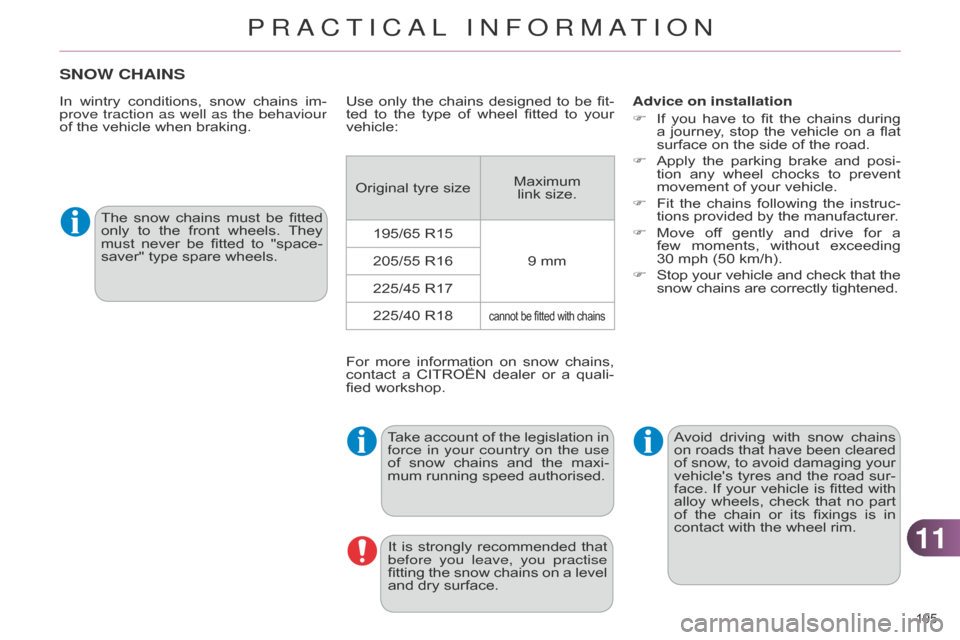
Use
only the chains designed to be fit -
ted to the type of wheel fitted to your
vehicle:
Original
tyre sizeMaximum
link
size.
195/65
R159
mm
205/55
R16
225/45
R17
225/40
R18
cannot be fitted with chains
For more information on snow chains, contact
a CITROËN dealer or a quali -
fied
workshop.
It
is
strongly
recommended
that
before you leave, you practise
fitting
the
snow
chains
on
a
level
and
dry surface.
PRACTICAL INFORMATION
Page 209 of 328
1111
207
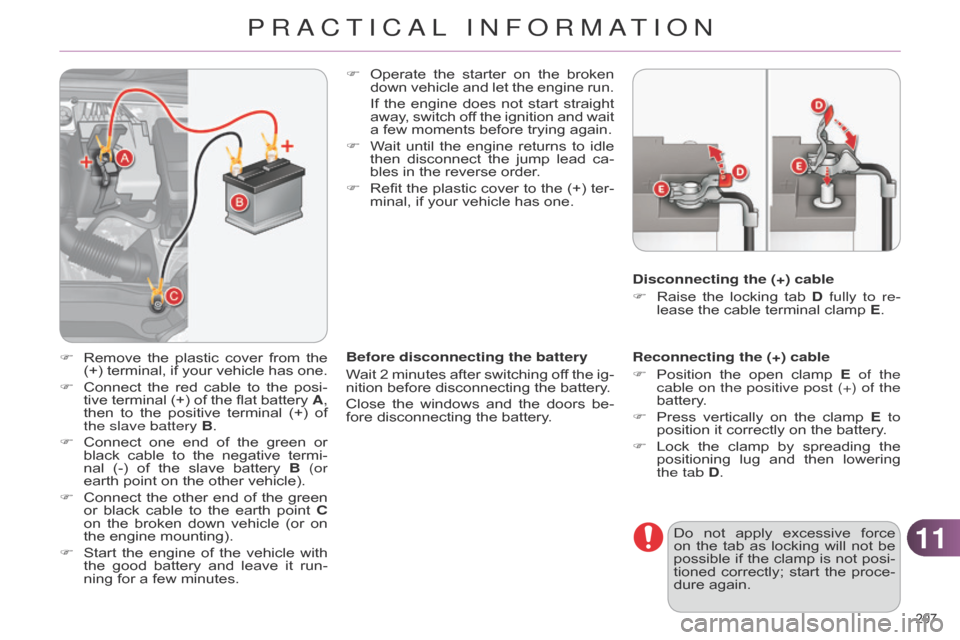
Reconnecting the (+) cable
F
Position
the
open
clamp
E
of the
cable on the positive post (+) of the
battery.
F
Press
vertically
on
the
clamp
E
to
position
it correctly on the battery.
F
Lock
the
clamp
by
spreading
the
positioning
lug
and
then
lowering
the tab
D.
F
Operate
the
starter
on
the
broken
down
vehicle
and
let
the
engine
run.
If
the
engine
does
not
start
straight
away
,
switch
of
f
the
ignition
and
wait
a
few
moments
before
trying
again.
F
W
ait
until
the
engine
returns
to
idle
then
disconnect
the
jump
lead
ca
-
bles
in
the
reverse
order.
F
Refit
the
plastic
cover
to
the
(+)
ter
-
minal,
if
your
vehicle
has
one.
Before disconnecting the battery
Wait
2
minutes
after
switching
of
f
the
ig
-
nition
before
disconnecting
the
battery.
Close
the
windows
and
the
doors
be
-
fore
disconnecting
the
battery. Disconnecting the (+) cable
F
Raise
the
locking
tab
D
fully to re-
lease the cable terminal clamp E.
Do
not
apply
excessive
force
on
the
tab
as
locking
will
not
be
possible
if
the
clamp
is
not
posi
-
tioned
correctly;
start
the
proce
-
dure
again.
F
Remove
the
plastic
cover
from
the
(+)
terminal,
if
your
vehicle
has
one.
F
Connect
the
red
cable
to
the
posi
-
tive
terminal
(+)
of
the
flat
battery
A
,
then
to
the
positive
terminal
(+)
of
the slave battery
B.
F
Connect
one
end
of
the
green
or
black
cable
to
the
negative
termi
-
nal (-)
of
the
slave
battery
B
(or
earth
point
on
the
other
vehicle).
F
Connect
the
other
end
of
the
green
or
black
cable
to
the
earth
point
C
on
the
broken
down
vehicle
(or
on
the
engine
mounting).
F
Start
the
engine
of
the
vehicle
with
the
good
battery
and
leave
it
run
-
ning
for
a
few
minutes.
PRACTICAL INFORMATION
Page 211 of 328
1111
209
LOAD REDUCTION MODE
System which manages the use of cer -
tain functions according to the level of
charge
remaining in the battery.
When the vehicle is being driven, the load
reduction function temporarily de -
activates certain functions, such as the
air
conditioning,
the
heated
rear
screen...
The deactivated functions are reactivat -
ed automatically as soon as conditions
permit.
ENERGY ECONOMY MODE
System which manages the period of use of certain functions to conserve a
sufficient
level of charge in the battery.
After
the
engine
has
stopped,
you
can
still
use
functions
such
as
the
audio
equipment,
windscreen
wipers,
dipped
beam
headlamps,
courtesy
lamps,
e
tc.
for
a
maximum
combined
period
of
thirty minutes.
Switching to economy mode
Once this period has elapsed, a message appears
in the screen indicating that the vehicle
has
switched
to
economy
mode and
the
active
functions
are
put
on
standby
.
If the telephone is being used at the
same time on the navigation
system,
it
will
be
interrupted
after 10
minutes.
A
flat
battery
prevents
the
en
-
gine
from
starting
(refer
to
the
corresponding
paragraph).
Exiting economy mode
These functions are reactivated auto -
matically the next time the vehicle is
driven.
F
In
order
to
resume
the
use
of
these functions
immediately
,
start
the
engine and
let it run for a few minutes.
The
time
available
to
you
will
then
be double
the
period
for
which
the
engine is
left
running.
However
,
this
period
will
always
be
between
five
and
thirty
minutes.
This
period
may
be
greatly
re
-
duced
if
the
battery
is
not
fully
charged.
CHANGING A WIPER BLADE
Before removing a front wiper
blade
F Within one minute after switching of
f the ignition, operate the wiper
stalk
to
position
the
wiper
blades
vertically
on the windscreen.
Removing
F Raise the corresponding wiper arm.
F
Unclip
the wiper blade and remove it.
Fitting
F Put the corresponding new wiper blade
in place and clip it.
F
Fold
down the wiper arm carefully.
After fitting a front wiper blade
F Switch on the ignition.
F
Operate
the
wiper
stalk
again
to
park
the wiper blades.
PRACTICAL INFORMATION