park assist CITROEN C5 2011 User Guide
[x] Cancel search | Manufacturer: CITROEN, Model Year: 2011, Model line: C5, Model: CITROEN C5 2011Pages: 348, PDF Size: 10.72 MB
Page 105 of 348
103
C5_en_Chap04_conduite_ed01-2016
Hill start assist
System which keeps your vehicle immobilised
temporarily (approximately 2 seconds) when
starting on a gradient, the time to move your
foot from the brake pedal to the accelerator
pedal.
This function is only active when:
-
t
he vehicle is completely stationary, with
your foot on the brake pedal,
-
i
n certain conditions on a gradient,
-
w
ith the driver’s door closed.
The hill start assist function cannot be
deactivated.Operation
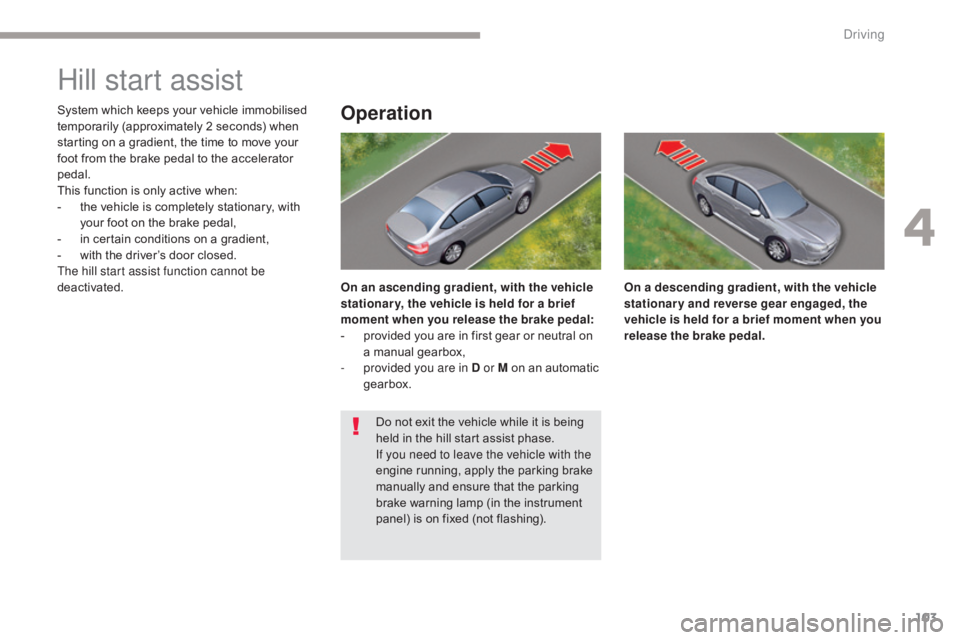
On an ascending gradient, with the vehicle
stationar y, the vehicle is held for a brief
moment when you release the brake pedal:
-
p
rovided you are in first gear or neutral on
a manual gearbox,
-
p
rovided you are in D or M on an automatic
gearbox. On a descending gradient, with the vehicle
stationary and reverse gear engaged, the
vehicle is held for a brief moment when you
release the brake pedal.
Do not exit the vehicle while it is being
held in the hill start assist phase.
If you need to leave the vehicle with the
engine running, apply the parking brake
manually and ensure that the parking
brake warning lamp (in the instrument
panel) is on fixed (not flashing).
4
Driving
Page 113 of 348
111
C5_en_Chap04_conduite_ed01-2016
- with a manual gearbox, when you fully
depress the clutch pedal,
-
w
ith an automatic gearbox:
●
g
ear selector in position D or M , when
you release the brake pedal,
●
o
r gear selector in position N and brake
pedal released, when you place the gear
selector in position D or M ,
●
o
r when you engage reverse gear.
Going into engine START
mode
The "ECO" warning lamp goes off
and the engine starts automatically:
Special cases: START invoked
automatically
In this case the "ECO" warning
lamp flashes for few seconds, then
goes off.
This operation is perfectly normal. For safety reasons or to ensure smooth
operation, START mode is invoked
automatically when:
-
y
ou open the driver's door,
-
y
ou unfasten the driver's seat belt,
-
t
he speed of the vehicle exceeds 16 mph
(25 km/h) with a manual gearbox or 2 mph
(3 km/h) with an automatic gearbox for
BlueHDi Diesel versions,
-
t
he electric parking brake is being applied,
-
s
ome special conditions (battery charge,
engine temperature, braking assistance, air
conditioning setting...) where the engine is
needed to assure control of a system.
Special cases: STOP mode
unavailable
In this case, the "ECO" warning
lamp flashes for a few seconds, then
goes off.
This operation is perfectly normal. STOP mode is not invoked when:
-
t
he vehicle is on a steep slope
(up or down),
-
t
he driver's door is open,
-
t
he driver's seat belt is not fastened,
-
t
he vehicle has not exceeded 6 mph
(10 km/h) since the last engine start using
the key,
-
t
he electric parking brake is applied or
being applied,
-
t
he engine is needed to maintain a
comfortable temperature in the passenger
compartment,
-
d
emisting is active,
-
s
ome special conditions (battery charge,
engine temperature, braking assistance,
exterior temperature...) where the engine is
needed to assure control of a system.
With a manual gearbox in STOP mode,
if a gear is engaged without fully
depressing the clutch pedal, a warning
lamp comes on or an alert message
is displayed asking you to depress the
clutch pedal to restart the engine.
4
Driving
Page 129 of 348

127
C5_en_Chap04_conduite_ed01-2016
Parking sensors
Operation
The parking sensors system cannot, in
any circumstances, replace the need for
vigilance on the part of the driver.
This system detects any obstacle (person,
vehicle, tree, barrier...) located in front of or
behind the vehicle, however, it will not be able
to detect obstacles located immediately below
the bumper.
An object, such as a stake, a roadworks cone
or any other similar object may be detected at
the start of the manoeuvre but may no longer
be detected when the vehicle moves nearer
to it.
At the front and/or at the rear
This system is comprised of proximity sensors,
installed in the front and/or rear bumper.
Visual and audible assistance
The proximity information is indicated by:
- a
n audible signal which becomes more rapid
as the vehicle approaches the obstacle,
-
a d
iagram in the multifunction screen, with
blocks which move closer to the vehicle.
The obstacle is located in relation to the emission
of the audible signal by the speakers; front or rear
and right or left.
When the distance between the vehicle and
the obstacle is less than approximately thirty
centimetres, the audible signal becomes
continuous and/or the "Danger" symbol appears,
depending on the multifunction screen version.
In bad weather or in winter, ensure
that the sensors are not covered with
mud, ice or snow. When reverse gear is
engaged, an audible signal (long beep)
indicates that the sensors may be dirty.
When the speed of the vehicle is below
about 6 mph (10 km/h), some sources
of noise (motorcycle, lorry, pneumatic
drill, ...) may trigger the audible parking
sensor signals. The parking sensors are switched on
:
-
b
y engaging reverse gear,
-
a
t a speed below 6 mph (10 km/h) in
forward gear.
This is accompanied by an audible signal and
the display of the vehicle in the multifunction
screen.
The parking sensors are switched off :
-
w
hen you exit reverse gear,
-
w
hen the speed is higher than 6 mph
(10
km/h) in for ward gear,
-
w
hen the vehicle has been stationary for
more than three seconds in for ward gear.
4
Driving
Page 241 of 348
239
C5_en_Chap08_en-cas-de-panne_ed01-2016
Towing the vehicle
Procedure for having your vehicle towed or for towing another vehicle using a removable towing eye.
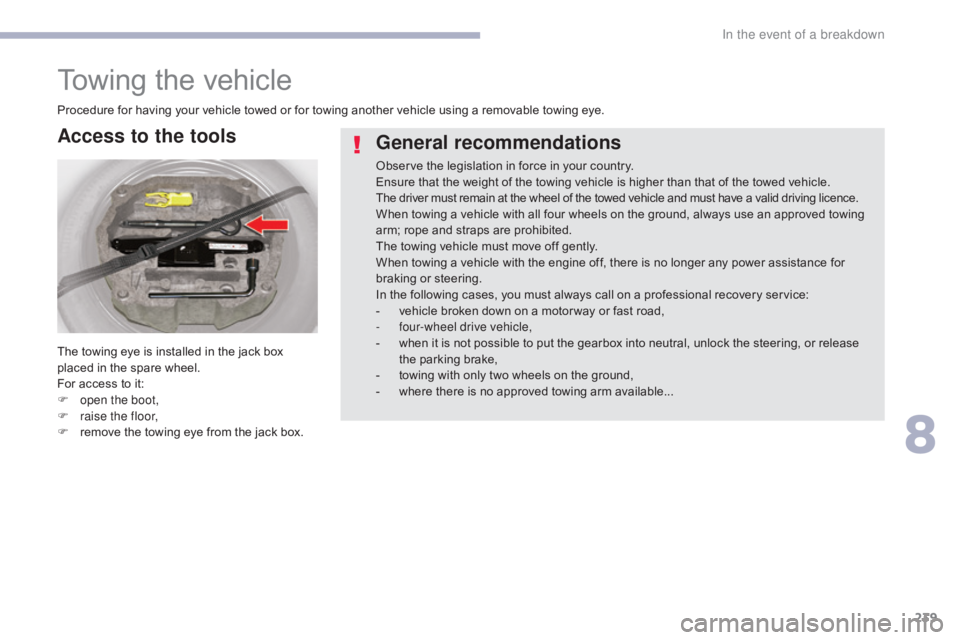
The towing eye is installed in the jack box
placed in the spare wheel.
For access to it:
F
o
pen the boot,
F
r
aise the floor,
F
r
emove the towing eye from the jack box.
Access to the tools General recommendations
Observe the legislation in force in your country.
Ensure that the weight of the towing vehicle is higher than that of the towed vehicle.
The driver must remain at the wheel of the towed vehicle and must have a valid driving licence.
When towing a vehicle with all four wheels on the ground, always use an approved towing
arm; rope and straps are prohibited.
The towing vehicle must move off gently.
When towing a vehicle with the engine off, there is no longer any power assistance for
braking or steering.
In the following cases, you must always call on a professional recovery service:
-
v
ehicle broken down on a motor way or fast road,
-
f
our-wheel drive vehicle,
-
w
hen it is not possible to put the gearbox into neutral, unlock the steering, or release
the parking brake,
-
t
owing with only two wheels on the ground,
-
w
here there is no approved towing arm available...
8
In the event of a breakdown