heating CITROEN C5 AIRCROSS 2020 Handbook (in English)
[x] Cancel search | Manufacturer: CITROEN, Model Year: 2020, Model line: C5 AIRCROSS, Model: CITROEN C5 AIRCROSS 2020Pages: 292, PDF Size: 8.59 MB
Page 72 of 292
70
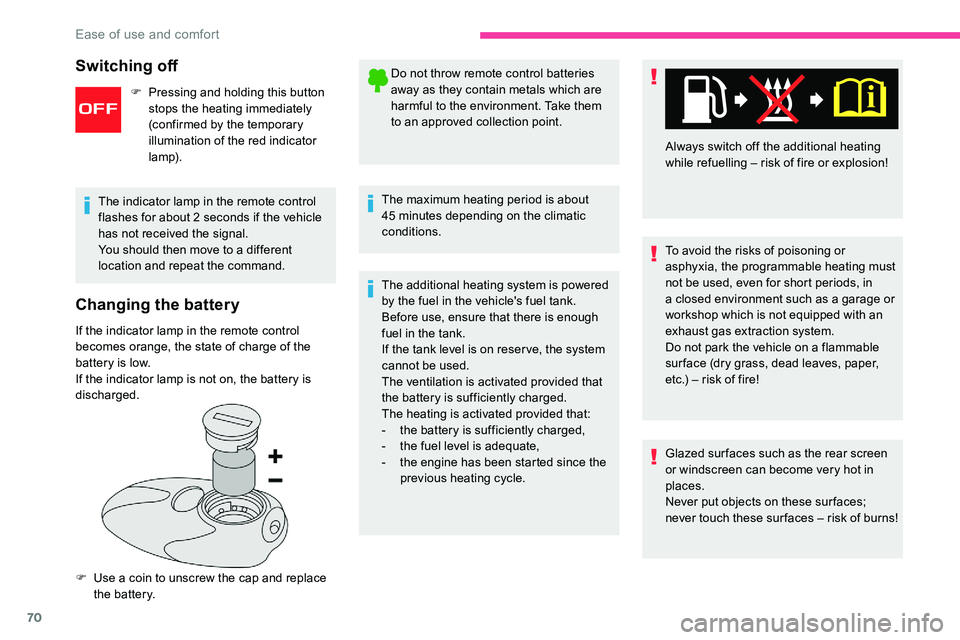
Changing the battery
If the indicator lamp in the remote control
becomes orange, the state of charge of the
battery is low.
If the indicator lamp is not on, the battery is
discharged.
F
U
se a coin to unscrew the cap and replace
the battery. Do not throw remote control batteries
away as they contain metals which are
harmful to the environment. Take them
to an approved collection point.
The maximum heating period is about
45 minutes depending on the climatic
conditions.
The additional heating system is powered
by the fuel in the vehicle's fuel tank.
Before use, ensure that there is enough
fuel in the tank.
If the tank level is on reser ve, the system
cannot be used.
The ventilation is activated provided that
the battery is sufficiently charged.
The heating is activated provided that:
-
t
he battery is sufficiently charged,
-
t
he fuel level is adequate,
-
t
he engine has been started since the
previous heating cycle. To avoid the risks of poisoning or
asphyxia, the programmable heating must
not be used, even for short periods, in
a
closed environment such as a garage or
workshop which is not equipped with an
exhaust gas extraction system.
Do not park the vehicle on a
flammable
sur face (dry grass, dead leaves, paper,
etc.) – risk of fire!
Glazed sur faces such as the rear screen
or windscreen can become very hot in
places.
Never put objects on these sur faces;
never touch these sur faces – risk of burns! Always switch off the additional heating
while refuelling – risk of fire or explosion!
The indicator lamp in the remote control
flashes for about 2 seconds if the vehicle
has not received the signal.
You should then move to a different
location and repeat the command.
Switching off
F Pressing and holding this button stops the heating immediately
(confirmed by the temporary
illumination of the red indicator
lamp).
Ease of use and comfort
Page 75 of 292

73
Operation
The charger works with the engine running and
in STOP mode of Stop & Start.
Charging is managed by the smartphone.
For versions with Keyless Entry and Starting,
operation of the charger may be interrupted
when opening a door or switching off the
ignition.
Charging
F With the charging area clear, place a device
at its centre.
The system only supports charging one
portable device at a
time.
Once the portable device is detected, the
charge indicator lamp comes on in green. It
stays lit for the whole time that the battery is
being charged. Do not leave any metal objects (coins,
keys, vehicle remote control, etc.) in
the charging area while a
device is
being charged – risk of overheating or
interrupting the charging process!Checking operation
The status of the indicator lamp allows the
operation of the charger to be monitored.
Status of the
indicator lamp Meaning
Off Engine switched off.
No compatible portable
device detected.
Charging finished.
Fixed, green Compatible portable
device detected.
Charging.
Flashing, orange Foreign object detected
in the charging zone.
Portable device not
correctly centred in the
charging zone. Fixed, orange
Fault with the portable
device's battery meter.
Temperature of the
portable device's battery
too high.
Charger fault.
Front armrest
It includes a refrigerated storage space
( depending on version) and is illuminated when
the cover is opened. If the indicator lamp is lit orange:
-
r
emove the portable device, then reposition
it in the middle of the charging zone.
or
-
r
emove the portable device and try again in
a quarter of an hour.
If the problem persists, have the system
checked by a CITROËN dealer or a qualified
workshop.
3
Ease of use and comfort
Page 118 of 292

116
Driving recommendations
F Observe the driving regulations and remain vigilant whatever the traffic conditions.
F
M
onitor your environment and keep your
hands on the wheel to be able to react to
anything that may happen any time.
F
D
rive smoothly, anticipate the need for
braking and maintain a
longer safety
distance, especially in bad weather.
F
S
top the vehicle to carry out operations
that require close attention (such as
adjustments).
F
D
uring long trips, take a break every two
hours.
Important!
Never leave the engine running in
a closed space without sufficient
ventilation. Internal combustion engines
emit toxic exhaust gases such as carbon
monoxide. Danger of poisoning and death! In severe wintry conditions (temperature
below -23°C), let the engine run for
4
minutes before moving off, to ensure
the correct operation and durability of the
mechanical components of your vehicle
(engine and gearbox).
Never drive with the parking brake
applied . Risk of overheating and damage
to the braking system!
Never park the vehicle or leave the
engine running on a flammable sur face
(dr y grass, dead leaves, etc.). The
exhaust system of your vehicle is very
hot, even several minutes after the engine
stops. Risk of fire!
Never leave a
vehicle unattended with
the engine running. If you have to leave
your vehicle with the engine running, apply
the parking brake and put the gearbox into
neutral or position N or P (depending on
the type of gearbox). Never leave children inside the vehicle
unsupervised
.
On flooded roads
We strongly advise against driving on flooded
roads, as this could cause serious damage
to the engine or gearbox, as well as to the
electrical systems of your vehicle.
If you are obliged to drive on a
flooded road:
F
c
heck that the depth of water does not
exceed 15
cm, taking account of waves that
might be generated by other users,
F
d
eactivate the Stop & Start function,
F
d
rive as slowly as possible without stalling.
In all cases, do not exceed 6
mph (10 km/h),
F
d
o not stop and do not switch off the engine.
Driving
Page 119 of 292
117
In case of towing
Driving with a trailer places greater
d emands on the towing vehicle and
requires extra care from the driver.
Respect the maximum towable weights.
At altitude: reduce the maximum load
by 10% per 1,000
metres of altitude; the
decreased air density at altitude reduces
engine performance.
New vehicle: do not pull a
trailer
before having driven at least 620
miles
(1,000
kilometres). If the outside temperature is high, let the
engine idle for 1
to 2 minutes after the
vehicle comes to a stop, to help it to cool.
Before setting off
Nose weight
On leaving the flooded road, as soon as safety
conditions allow, make several light brake
applications to dry the brake discs and pads.
If in doubt about the state of your vehicle,
contact a
CITROËN dealer or a qualified
workshop.
F
D
istribute the load in the trailer so that the
heaviest items are as close as possible to
the axle and the nose weight (at the point
where it joins your vehicle) approaches the
maximum permitted without exceeding it.
Ty r e s
F Check the tyre pressures of the towing vehicle and of the trailer, observing the
recommended pressures.
Lighting
F Check the electrical signalling on the trailer and the headlamp beam height of your
vehicle.
If a
genuine CITROËN towing device is
used, the rear parking sensors will be
deactivated automatically to avoid the
audible signal.
When driving
Cooling
Towing a trailer uphill increases the
t emperature of the coolant. The maximum
towable load depends on the gradient and the
exterior temperature. The cooling capacity of
the fan does not increase with engine speed.
F
R
educe speed and lower the engine speed,
so as to limit the heating-up.
In all cases, pay attention to the coolant
temperature.
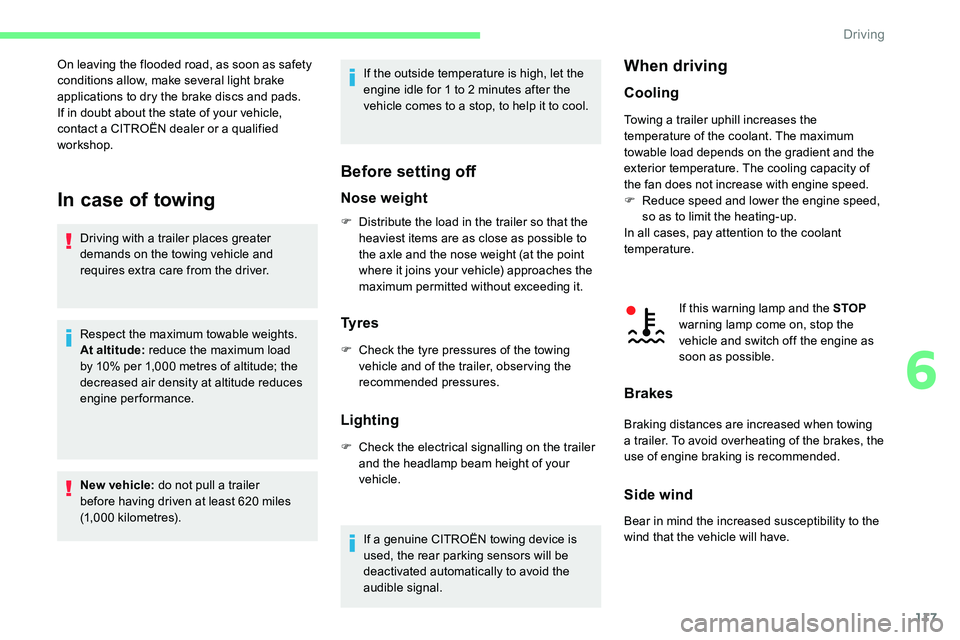
If this warning lamp and the STOP
warning lamp come on, stop the
vehicle and switch off the engine as
soon as possible.
Brakes
Braking distances are increased when towing
a trailer. To avoid overheating of the brakes, the
use of engine braking is recommended.
Side wind
Bear in mind the increased susceptibility to the
wind that the vehicle will have.
6
Driving
Page 120 of 292
118
Anti-theft protection
Electronic immobiliser
The keys include an electronic engine
immobiliser system, whose secret code must
be recognised in order for starting to be
possible.
If the system malfunctions, indicated by the
display of a message, the engine will not start.
Contact the CITROËN dealer.
Starting/Switching off the
engine with the key
Key ignition switch
Avoid attaching heavy objects to the key
or the remote control, which would weigh
down on its blade in the ignition switch
and could cause a
malfunction.
Ignition on position
It allows the use of the vehicle's electric
equipment or portable devices to be charged.
Once the state of charge of the battery drops
to the reser ve level, the system switches to
energy economy mode: the power supply is
cut off automatically to preser ve the remaining
battery charge.
Switching off the engine leads to a
loss of
braking assistance.
Starting the engine
F Insert the key into the ignition switch; the system recognises the code.
F
U
nlock the steering column by
simultaneously turning the steering wheel
and the key.
In certain cases, you may have to apply
significant force to move the steering
wheel (wheels on full lock, for example).
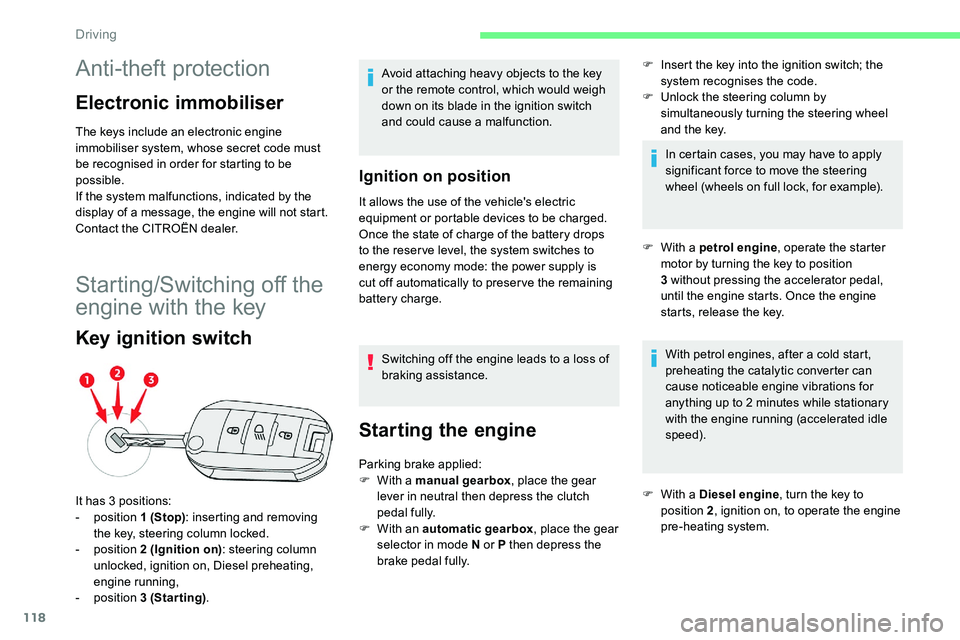
It has 3
positions:
-
position 1 (Stop): inserting and removing
the key, steering column locked.
-
position 2 (Ignition on) : steering column
unlocked, ignition on, Diesel preheating,
engine running,
-
position 3 (Starting) . Parking brake applied:
F
W
ith a
manual gearbox , place the gear
lever in neutral then depress the clutch
pedal fully.
F
W
ith an automatic gearbox , place the gear
selector in mode N or P then depress the
brake pedal fully. F
W
ith a petrol engine , operate the starter
motor by turning the key to position
3
without pressing the accelerator pedal,
until the engine starts. Once the engine
starts, release the key.
With petrol engines, after a cold start,
preheating the catalytic converter can
cause noticeable engine vibrations for
anything up to 2 minutes while stationary
with the engine running (accelerated idle
speed).
F
W
ith a Diesel engine , turn the key to
position 2 , ignition on, to operate the engine
pre-heating system.
Driving
Page 122 of 292

120
Starting/Switching off the
engine with Keyless Entry
and Starting
The electronic key must be present in the
passenger compartment.
If it is not detected, a message is
displayed.
Move the electronic key so that the engine
can be started or stopped.
If there is still a problem, refer to the "Key
not detected – Back-up starting or Back-
up switch-off " section.
Starting the engine
F Press the " START/STOP" button while
maintaining pressure on the pedal until the
engine starts.
For Diesel engines , when the temperature is
below zero and/or the engine is cold, starting
will only occur once the preheater warning
lamp is off.
F
Y
ou should keep the pedal fully depressed
and not press the " START/STOP" button
again until the engine is running.
If one of the starting conditions is not met, a
message is displayed.
In some circumstances, you are alerted by
a
message that it is necessary to turn the
steering wheel while pressing the " S TA R T/
STOP " button, to help unlock the steering
column.
With petrol engines , after a
cold start,
preheating the catalytic converter can
cause noticeable engine vibrations for
anything up to 2
minutes while stationary
with the engine running (accelerated idle
speed).Switching off the engine
F Immobilise the vehicle, engine at idle.
F W ith a manual gearbox , ideally put the
gear lever into neutral.
F
W
ith an automatic gearbox , ideally select
mode P or N .
F
P
ress the " START/STOP " button.
In some circumstances, it is necessary to turn
the steering wheel to lock the steering column.
On certain versions with the EAT8
automatic
gearbox, the steering column does not lock, but
the gearbox locks in mode P .
If the vehicle is not immobilised, the
engine will not stop.
Never leave your vehicle with the
electronic key still inside.
Switching off the engine leads to a
loss of
braking assistance.
F
W
ith a
manual gearbox , place the gear
lever in neutral and depress the clutch pedal
fully.
or
F
W
ith an automatic gearbox , select mode P
or N and press the brake pedal. If this warning lamp comes on after
pressing the "
START/STOP " button:
Driving
Page 216 of 292
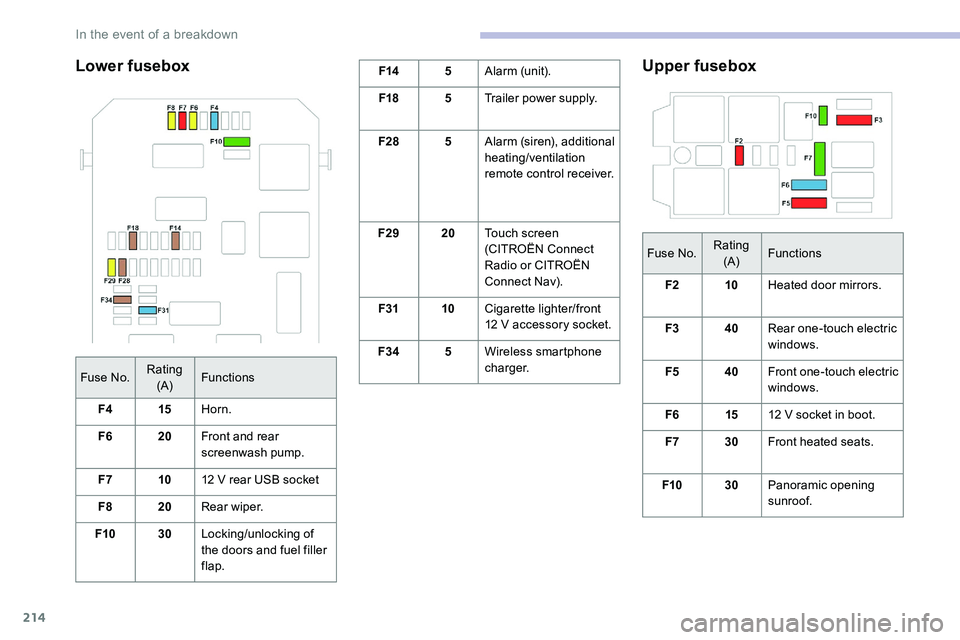
214
Lower fuseboxF145Alarm (unit).
F18 5Trailer power supply.
F28 5Alarm (siren), additional
heating/ventilation
remote control receiver.
F29 20Touch screen
(CITROËN Connect
Radio or CITROËN
Connect Nav).
F31 10Cigarette lighter/front
12
V accessory socket.
F34 5Wireless smartphone
charger.Upper fusebox
Fuse No. Rating
(A) Functions
F2 10Heated door mirrors.
F3 40Rear one-touch electric
windows.
F5 40Front one-touch electric
windows.
F6 1512
V socket in boot.
F7 30Front heated seats.
F10 30Panoramic opening
sunroof.
Fuse No.
Rating
(A) Functions
F4 15Horn.
F6 20Front and rear
screenwash pump.
F7 1012
V rear USB socket
F8 20Rear wiper.
F10 30Locking/unlocking of
the doors and fuel filler
flap.
In the event of a breakdown
Page 284 of 292
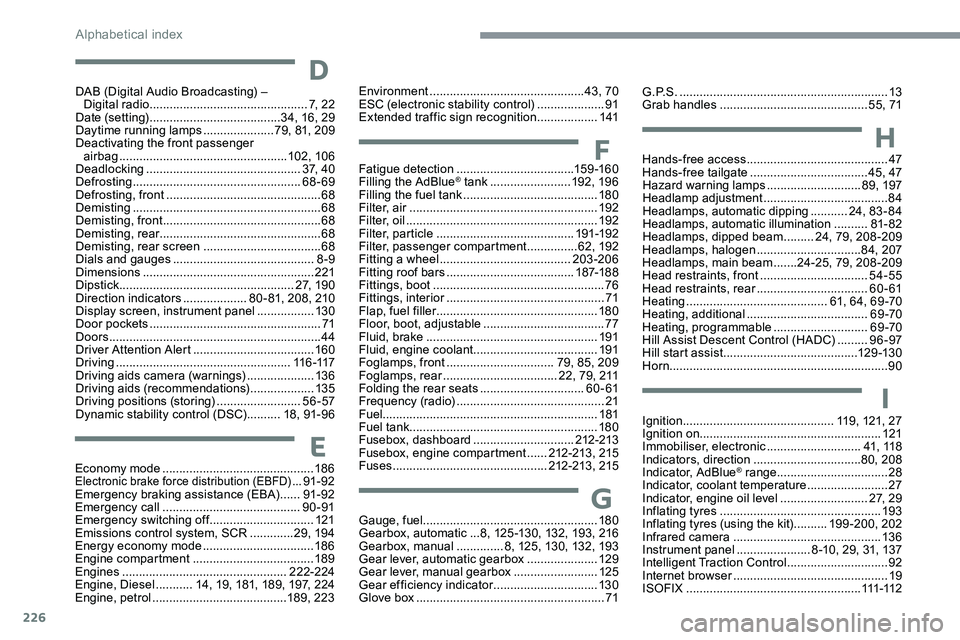
226
Gauge, fuel.................................................... 18 0
Gearbox, automatic ...8, 125 -130, 132, 193, 216
Gearbox, manual
..............8, 125, 130, 132, 193
Gear lever, automatic gearbox
.....................12 9
Gear lever, manual gearbox
.........................125
Gear efficiency indicator
............................... 13
0
Glove box
........................................................ 71G
FFatigue detection ................................... 15 9 -16 0
Filling the AdBlue® tank ........................ 192, 19 6
Filling the fuel tank ........................................ 18 0
Filter, air
........................................................ 192
Filter, oil
................
......................................... 192
Filter, particle
......................................... 191-192
Filter, passenger compartment
...............62, 192
Fitting a
wheel
....................................... 203-206
Fitting roof bars
...................................... 187-188
Fittings, boot
................................................... 76
Fittings, interior
............................................... 71
F
lap, fuel filler
................................................ 18 0
Floor, boot, adjustable
.................................... 77
Fluid, brake
................................................... 191
Fluid, engine coolant
..................................... 191
Foglamps, front
................................ 79, 85, 209
Foglamps, rear
.................................. 2
2, 79, 211
Folding the rear seats
............................... 60 - 61
Frequency (radio)
............................................ 21
Fuel ................................................................ 181
Fuel tank ........................................................ 18 0
Fusebox, dashboard
.............................. 212-213
Fusebox, engine compartment
......212-213, 215
Fuses
.............................................. 21
2-213, 215
D
E
DAB (Digital Audio Broadcasting) – Digital radio ............................................... 7, 2 2
Date (setting)
....................................... 34, 16, 29
Daytime running lamps
.....................79, 81, 209
Deactivating the front passenger airbag
.................................................. 102, 10 6
Deadlocking
.............................................. 3 7, 4 0
Defrosting
.................................................. 68-69
Defrosting, front
.............................................. 68
Demisting
........................................................ 68
Demisting, front
............................................... 68
D
emisting, rear
................................................ 68
Demisting, rear screen
...................................68
Dials and gauges
...............................
...........8-9
Dimensions
..............................
.....................221
Dipstick
................
.................................... 2 7, 1 9 0
Direction indicators
...................80 - 81, 208, 210
Display screen, instrument panel
.................13 0
Door pockets
...............................
....................71
Doors
............................................................... 44
Driver Attention Alert
.................................... 160
Driving
.................................................... 11 6 -117
Driving aids camera (warnings)
....................13 6
Driving aids (recommendations)
...................13 5
Driving positions (storing)
.........................56-57
Dynamic stability control (DSC)
..........18, 91- 9 6
Economy mode
............................................. 18
6
Electronic brake force distribution (EBFD) ...91-92
Emergency braking assistance (EBA)
...... 91-92
Emergency call
......................................... 90 -91
Emergency switching off
............................... 121
Emissions control system, SCR
............. 29, 19 4
Energy economy mode
................................. 18
6
Engine compartment
.................................... 18
9
Engines
................................................. 222-224
Engine, Diesel
........... 14, 19, 181, 189, 197, 224
Engine, petrol
...............................
......... 189, 223 Environment
..............................................
43, 70
ESC (electronic stability control)
....................
91
E
xtended traffic sign recognition
..................
141
Hands-free access
..........................................
47
Hands-free tailgate
...................................
45, 47
Hazard warning lamps
............................
89, 197
Headlamp adjustment
.....................................
84
Headlamps, automatic dipping
...........
24, 83 - 84
Headlamps, automatic illumination
..........
81- 82
Headlamps, dipped beam
.........
24, 79, 208 -209
Headlamps, halogen
...............................
84, 207
Headlamps, main beam
.......
24-25, 79, 208-209
Head restraints, front ................................
54-55
Head restraints, rear .................................
60 - 61
Heating
.......................................... 61
, 6 4, 69 -70
Heating, additional
....................................
69 -70
Heating, programmable
............................
69 -70
Hill Assist Descent Control (HADC) .........
96 -97
Hill start assist ........................................
12 9 -13 0
Horn ................................................................. 90
H
G . P. S . .............................................................. 13
Grab handles ............................................ 5 5, 71
I
Ignition ............................................. 119, 121, 27
Ignition on ...................................................... 121
Immobiliser, electronic
............................41, 11 8
Indicators, direction
................................80, 208
Indicator, AdBlue
® range ................................. 28
Indicator, coolant temperature ........................ 27
Indicator, engine oil level
.......................... 2 7, 2 9
Inflating tyres
................................................ 193
Inflating tyres (using the kit)
.......... 1
99-200, 202
Infrared camera
............................................ 13 6
Instrument panel
...................... 8 -10, 29, 31, 137
Intelligent Traction Control
.............................. 92
Internet browser
.............................................. 19
I
SOFIX
.................................................... 111 -112
Alphabetical index