steering Citroen C5 RHD 2012 (RD/TD) / 2.G Owner's Guide
[x] Cancel search | Manufacturer: CITROEN, Model Year: 2012, Model line: C5 RHD, Model: Citroen C5 RHD 2012 (RD/TD) / 2.GPages: 340, PDF Size: 39.41 MB
Page 145 of 340

IX!
143
DRIVING
STOP & START
The Stop & Start system puts the en-
gine temporarily into standby - STOP
mode - during stops in the traffi c
(red lights, traffi c jams, or other...).
The engine restarts automatically -
START mode - as soon as you want
to move off. The restart takes place
instantly, quickly and silently.
Perfect for urban use, the Stop &
Start system reduces fuel consump-
tion and exhaust emissions as well
as the noise level when stationary.
Operation
- with the electronic
gearbox
system
, at speeds below 4 mph
(6 km/h), press the brake pedal or
put the gear lever in position N
.
Going into engine STOP mode
The "ECO"
warning lamp comes
on in the instrument panel and
the engine goes into standby:
If your vehicle is fi tted
with the system, a time
counter calculates the
sum of the periods in
STOP mode during a journey. It rests
itself to zero every time the ignition
is switched on with the key.
For your comfort, during parking
maoeuvres, STOP mode is not
available for a few seconds after
coming out of reverse gear.
STOP mode does not affect the func-
tionality of the vehicle, such as for ex-
ample, braking, power steering...
Never refuel with the engine in
STOP mode; you must switch
off the ignition with the key.
Special cases: STOP mode not
available
In this case, the "ECO"
warning lamp fl ashes for a
few seconds then goes off.
This operation is perfectly normal.
STOP mode is not invoked when:
- the driver's door is open,
- the driver's seat belt is not fas-
tened,
- the vehicle has not exceeded
6 mph (10 km/h) since the last
engine start using the key,
- the electric parking brake is ap-
plied or being applied,
- the engine is needed to maintain
a comfortable temperature in the
passenger compartment,
- demisting is active,
- some special conditions (battery
charge, engine temperature,
braking assistance, ambient
temperature...) where the engine
is needed to assure control of a
system.
Page 152 of 340
IX
150
DRIVING
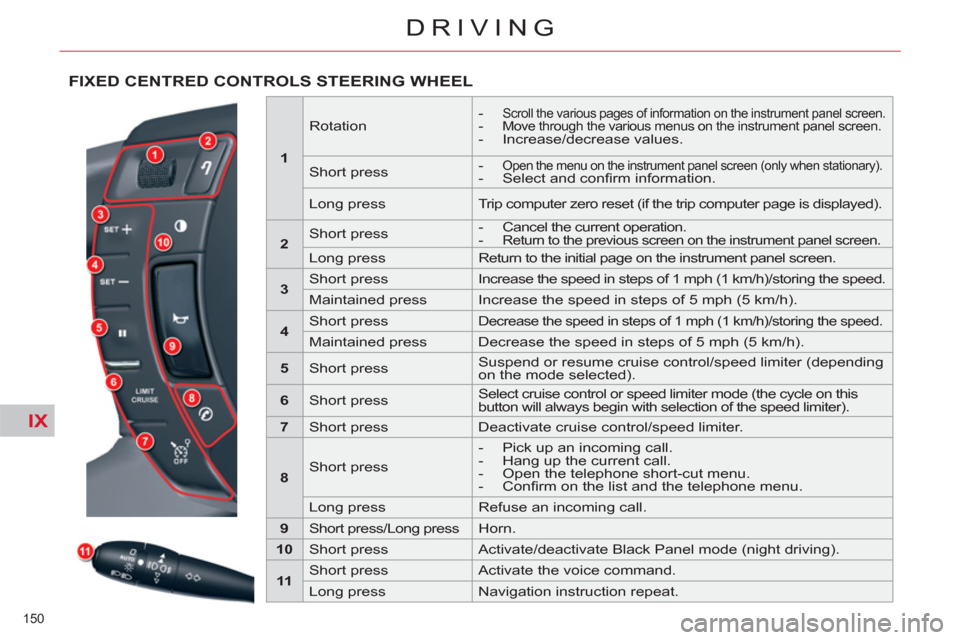
FIXED CENTRED CONTROLS STEERING WHEEL
1
Rotation
-
Scroll the various pages of information on the instrument panel screen.
- Move through the various menus on the instrument panel screen.
- Increase/decrease values.
Short press
-
Open the menu on the instrument panel screen (only when stationary).
- Select and confi rm information.
Long press Trip computer zero reset (if the trip computer page is displayed).
2
Short press
- Cancel the current operation.
-
Return to the previous screen on the instrument panel screen.
Long press Return to the initial page on the instrument panel screen.
3
Short press Increase the speed in steps of 1 mph (1 km/h)/storing the speed.
Maintained press Increase the speed in steps of 5 mph (5 km/h).
4
Short press
Decrease the speed in steps of 1 mph (1 km/h)/storing the speed.
Maintained press Decrease the speed in steps of 5 mph (5 km/h).
5
Short press Suspend or resume cruise control/speed limiter (depending
on the mode selected).
6
Short press Select cruise control or speed limiter mode (the cycle on this
button will always begin with selection of the speed limiter).
7
Short press Deactivate cruise control/speed limiter.
8
Short press
- Pick up an incoming call.
- Hang up the current call.
- Open the telephone short-cut menu.
- Confi rm on the list and the telephone menu.
Long press Refuse an incoming call.
9
Short press/Long press Horn.
10
Short press Activate/deactivate Black Panel mode (night driving).
11
Short press Activate the voice command.
Long press Navigation instruction repeat.
Page 154 of 340

IX
152
DRIVING
SPEED LIMITER
System which prevents the vehi-
cle from exceeding the speed pro-
grammed by the driver.
When the limit speed is reached, the
accelerator pedal no longer has any
effect.
The speed limiter is switched on
manually: a speed of at least 20 mph
(approx. 30 km/h) must be pro-
grammed.
The speed limiter can in no way re-
place respect for speed limits or vigi-
lance and responsibility on the part
of the driver.
Steering mounted controls
The speed limiter switches are lo-
cated on the left-hand side of the
steering wheel.
Displays in the instrument panel
The speed limiter information is dis-
played in zone A
of the instrument
panel.
Programming
)
Press on button 4
to select speed
limiter mode " LIMIT
".
The selection is confi rmed by the
display of the function in zone A
of
the instrument panel.
Activation
)
Press on button 3
when the de-
sired maximum speed is dis-
played.
The information "ON"
then appears
in zone A
.
When the function is selected, the
last memorised speed and the infor-
mation "PAUSE"
are displayed.
With the engine running, you can ad-
just the memorised maximum speed,
displayed in zone A
, by pressing on:
)
Button 1
to increase the memo-
rised maximum speed.
)
Button 2
to decrease the memo-
rised maximum speed. Successive presses will modify the
maximum speed in steps of 1 mph
and a continuous press in steps of
5 mph.
Page 156 of 340

IX
154
DRIVING
CRUISE CONTROL
System which automatically main-
tains the vehicle speed programmed
by the driver, without any action on
the accelerator pedal.
The cruise control is switched on
manually: the vehicle speed must be
at least 25 mph (40 km/h) and you
must be in at least:
- 4th gear for manual gearboxes,
- 2nd gear for automatic gearboxes.
Displays in the instrument
panel
The programmed information is
grouped together in zone A
of the
instrument panel.
Programming
)
Press button 4
to select cruise
control mode " CRUISE
".
Steering mounted controls
The cruise control switches are lo-
cated on the left-hand side of the
steering wheel. The selection is confi rmed by the
display of the function in zone A
of
the instrument panel.
When the function is selected, no
cruising speed has yet been
memorised.
Once the desired speed has been
reached using the accelerator, press
button 1
or button 2
. The cruising
speed is then memorised and cruise
control is activated. The cruising
speed is displayed in zone A
of the
instrument panel, and "ON"
is dis-
played.
Adjustment of the memorised
speed while cruise control is
in operation
You can adjust the memorised speed,
displayed in zone A
, by pressing:
- Button 1
to increase the speed.
- Button 2
to reduce the speed.
Successive presses will modify the
cruise speed in steps of 1 mph and a
continuous press in steps of 5 mph. You can then release the accelera-
tor pedal. The vehicle will automati-
cally keep to the speed chosen.
The vehicle speed may vary slightly
from that memorised.
If during cruise control the system
cannot keep to the cruise speed
(e.g. on a steep descent), then the
speed fl ashes. If necessary, brake to
curb your speed.
Page 169 of 340

XX
PETROL ENGINES
The various caps and covers allow
access for checking fl uid levels and
for replacing certain components.
1.
Screenwash and headlamp wash
reservoir.
2.
Power steering fl uid reservoir or
power steering and suspension
fl uid reservoir.
3.
Engine coolant header tank.
4.
Engine oil dipstick.
5.
Engine oil fi ller cap.
6.
Brake fl uid reservoir.
7.
Battery.
8.
Air fi lter.
1.6i THP
1.6i VTi
167
CHECKS
Page 170 of 340

X
!
168
CHECKS
Vehicles fi tted with the 2.0i 16v
engine may be fi tted with metal
spring suspension. In this case,
a different power steering fl uid reser-
voir is fi tted.
2.0i 16V
1.
Screenwash and headlamp wash
reservoir.
2.
Power steering fl uid reservoir or
power steering and suspension
fl uid reservoir.
3.
Engine coolant header tank.
4.
Engine oil dipstick.
5.
Engine oil fi ller cap.
6.
Brake fl uid reservoir.
7.
Battery.
8.
Air fi lter.
Page 171 of 340

X
!
169
CHECKS
DIESEL ENGINES
The various caps and covers allow
access for checking fl uid levels, for
replacing certain components and
for priming the fuel system.
1.
Screenwash and headlamp wash
reservoir.
2.
Power steering fl uid reservoir or
power steering and suspension
fl uid reservoir, depending on
equipment.
3.
Engine coolant header tank.
4.
Engine oil dipstick.
5.
Engine oil fi ller cap.
6.
Air fi lter.
7.
Brake fl uid reservoir.
8.
Battery.
As the Diesel fuel system
operates under high pressure,
any work on the fuel system is
prohibited.
Vehicles fi tted with the HDi 140
engine may be fi tted with metal
spring suspension. In this case, a
different power steering fl uid reser-
voir is fi tted.
HDi 110
/ e-HDi 110
HDi 140
Page 172 of 340

X!
170
CHECKS
HDi 160 - HDi 200 engines
(with particle emissions filter)
1.
Screenwash and headlamp wash
reservoir.
2.
Power steering and suspension
fl uid reservoir.
3.
Engine coolant header tank.
4.
Engine oil dipstick.
5.
Engine oil fi ller cap.
6.
Air fi lter.
7.
Brake fl uid reservoir.
8.
Battery.
As the Diesel fuel system ope-
rates under high pressure:
- All work on the fuel system is
prohibited.
- HDi engines make use of ad-
vanced technology.
All maintenance and repairs require
special qualifi cations which only a
CITROËN dealer can guarantee.
HDi 160
HDi 200
Page 173 of 340

X!
171
CHECKS
V6 HDi 240 engine (with
particle emissions filter)
V6 HDi 240
1.
Screenwash and headlamp wash
reservoir.
2.
Power steering and suspension
fl uid reservoir.
3.
Engine coolant header tank.
4.
Engine oil dipstick.
5.
Engine oil fi ller cap.
6.
Air fi lter.
7.
Brake fl uid reservoir.
8.
"+" and "-" terminals for emergency
starting with a slave battery.
As the Diesel fuel system ope-
rates under high pressure:
- All work on the fuel system is
prohibited.
- HDi engines make use of ad-
vanced technology.
All maintenance and repairs require
special qualifi cations which only a
CITROËN dealer can guarantee.
Page 174 of 340
X!
172
CHECKS
CHECKING LEVELS
Check all of these levels regularly
and top them up if necessary, unless
otherwise indicated.
If a level drops signifi cantly, have
the corresponding system checked
by a CITROËN dealer or a qualifi ed
workshop.
Oil level
Oil change
Refer to the servicing booklet for de-
tails of the interval for this operation.
Oil specifi cation
The oil must correspond to your
engine and conform to the manufac-
turer's recommendations.
Brake fluid level
Fluid change
Refer to the servicing booklet for de-
tails of the interval for this operation.
This fl uid must be changed regu-
larly. Fluid which has been used for
too long may cause a loss of braking
effi ciency.
Fluid specifi cation
The brake fl uid must conform to the
manufacturer's recommendations
and meet the DOT4 standard.
The reading will only be
correct if the vehicle is on
level ground and the engine
has been off for more than
30 minutes.
The check is carried out either when
the ignition is switched on using the
oil level indicator in the instrument
panel, or using the dipstick.
Check this level also between each
scheduled service and before long
journeys.
Take care when doing anything
under the bonnet, as some parts
of the engine can be extremely hot
(risk of burns). The brake fl uid level should
be close to the "MAX" mark.
If it is not, check the brake
pad wear.
In order to maintain the reliability
of the engine and emission con-
trol system, the use of additives
in the engine oil is prohibited.
Power steering fluid or power
steering and suspension
fluid level
This fl uid must be topped up
by a CITROËN dealer or a
qualifi ed workshop.
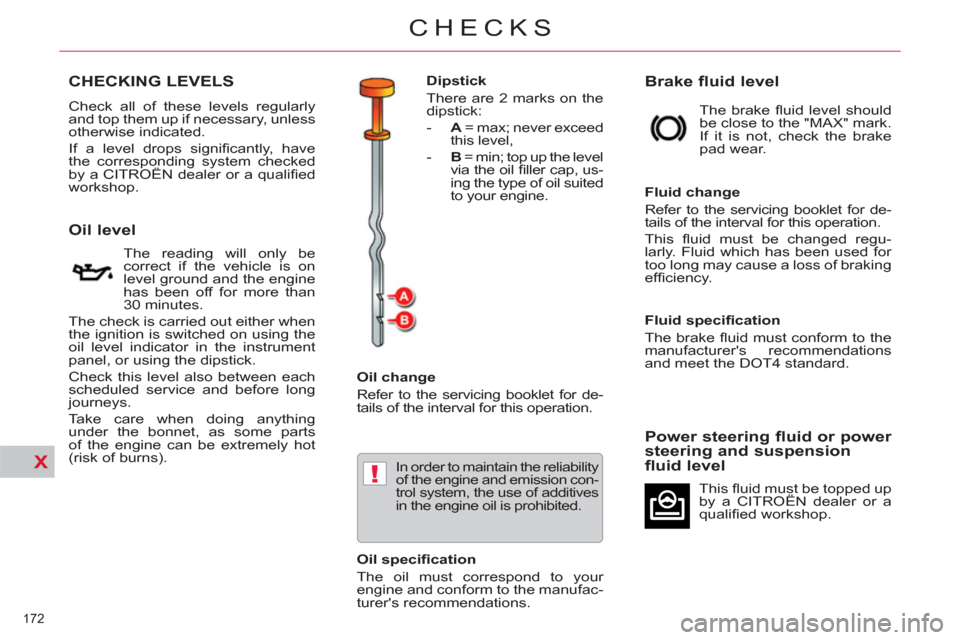
Dipstick
There are 2 marks on the
dipstick:
- A
= max; never exceed
this level,
- B
= min; top up the level
via the oil fi ller cap, us-
ing the type of oil suited
to your engine.