fuel Citroen CX 1974 1.G Owner's Manual
[x] Cancel search | Manufacturer: CITROEN, Model Year: 1974, Model line: CX, Model: Citroen CX 1974 1.GPages: 394
Page 105 of 394
Downloaded from www.Manualslib.com manuals search engine 10 OPERATION No MA.IE. 144-00 : Characteristics o/ the K L=Jetronic )) electronic
/uel iujectian system. AIR-FLOW SENSOR ( 1) :
The role of the air-flow sensor is to supply the E.C.U. with a signal proportional in voltage to the quantity of air
drawn in.
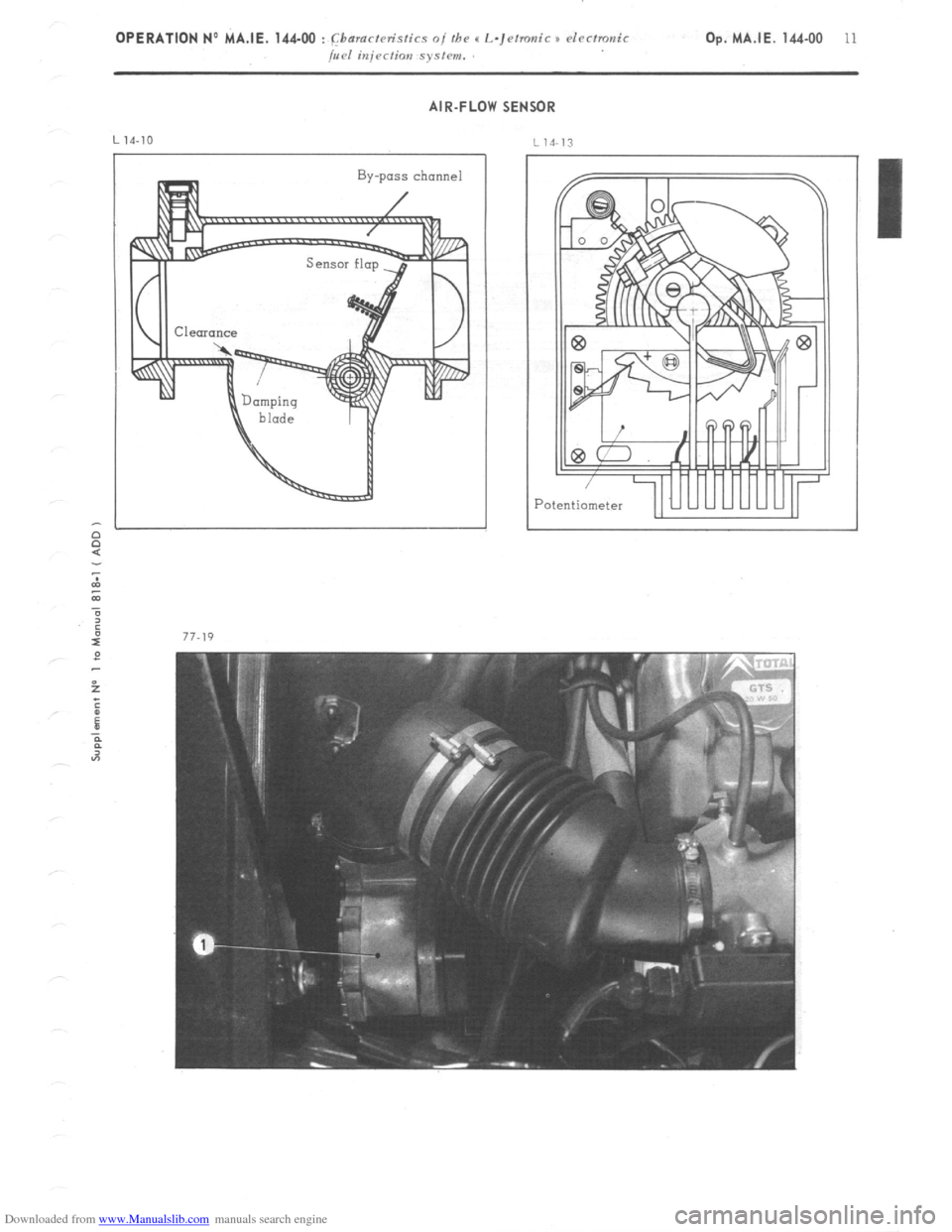
With the engine running, the sensor flap is maintained at an angular position determined by the intensity of the-air- ,
flow, against the resistive action of a spiral spring. The resistance to deflection of the sensor flap, produced by the
spiral spring, is calculated so as to compensate for any mechanical friction ( bearings, bushes ) and to limit the
pressure drop at the flap.
The movement of the sensor flap is damped by a blade rigidly attached to it. This damping blade rotates inside a
housing in which it is a close fit. The operating clearance determines the degree of damping. The use of a damping
blade cancels the effects on the angular position of the sensor flap of pressure variation’s in the inlet collector.
A potentiometer, actuated by the sensor flap spindle, transforms movement of the sensor flap into an electrical circuit which is transtiitted to the E.C.U.. The voltage of the electrical ‘current is inversely proportional to the
amount of air drawn-in.
In order to cancel the effects of any combustion taking place in the inlet manifold, a one-way valve is incorporated in the sensor flap.
Thanks to a by-pass channel, a small quantity of the air drawn ,in by-passes the sensor flap. This offers the possibility
of determining the air/lfuel mixture at idling speed by’varying the diameter of the by-pass channel, since the air going
through the by-pass is not measured. The switch for the pump ( engine running ) and the air temperature sensor are
located in the air-flow sensor.
Page 106 of 394
Downloaded from www.Manualslib.com manuals search engine OPERATION No MA.IE. 14400 : @ nracteristics of the I( L-~elronic x cl~~tronic
fuel injrction sysfem. Op. MA.IE. 14400 11
AIR-FLOW SENSOR
‘otentiometer ~~uuuuLluu~
Page 107 of 394
Downloaded from www.Manualslib.com manuals search engine 12 OPERATION No MAJE. 144.00 : Charactvis~ics o/the x L-~etmnic I) dectmnic
fuel injection system.
INJECTORS
L 14-21
I
Page 108 of 394
Downloaded from www.Manualslib.com manuals search engine INJECTORS ( i ) :
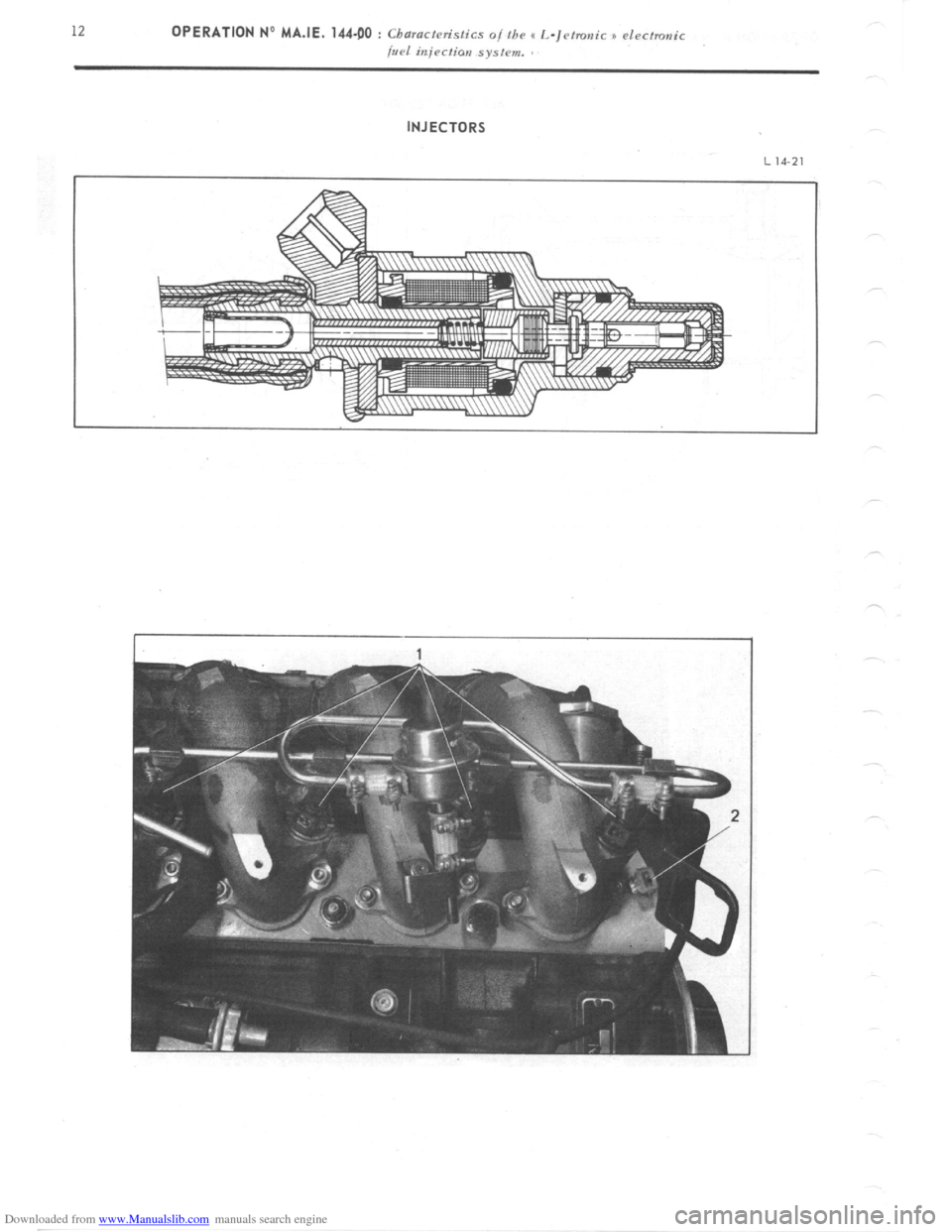
Each cylinder is supplied by an electro-magnetically controlled injector which is fitted in the inlet duct;
the injector vaporises the fuel upstream of the inlet valve. In the case of the (( L-Jetronic )) system. all the
injectors operate simultaneously. However, in order to ensure regular fuel supply to the cylinders, there are
two injections for each rotation of the camshaft, each one supplying half the metered quantity of fuel required I
for the complete engine cycle.
The injector consists of a valve housing and an injector needle fitted with a magnetic core. The mobile magnetic
/
core is in one piece with the needle which in turn is compressed against the air-tight injector housing seat by
a helicoidal spring. At the rear end of the injector, there is a solenoid. and at the front a guide for the injector
needle.
Impulses coming from the E.C.U. create a magnetic.field in the solenoid; the magnetic core is attracted, and the
needle lifts off its seat the fuel under pressure is free to pass through, The movement of the magnetic core is
approximately 0.15 mm.
The duration of opening is determined by the E.C.U. as a function of the operating conditions of the engine at the
moment in question{. TEMPERATURE SENSORS t(
When the engine is started, for a temperature of approximately - 20” C, it needs two to three times more fuel than
when it has reached normal operating temperature. The enrichment of the mixture must be reduced as the engine
warms up, and must cease as soon as the engine has reached normal operating temperature. In’order to start off
this regulating procedure, the engine temperature must be communicated to the E.C.U. ( Electronic Control Unit ).
This is the object .of the temperature sensors.
The temperature sensor consists of a hollow threaded rod in which is located an NTC Thermistor made in semi-
conducting material. The letters .NTC, which signify (( negative temperature coefficient )) characterise its specific
property : its electrical resistance decreases as the temperature increases.
The (( L-Jetronic 1) system is fitted with.a water temperature sensor ( 2) and an air temperature sensor, the latter
situated in the air-flow sensor.
Page 109 of 394
Downloaded from www.Manualslib.com manuals search engine COLD START INJECTOR
When the engine is cold, fuel settles on the inlet distribution chamber, and on the cylinder walls. Therefore, the
quantity of fuel which mixes with the inlet air is smaller than in an engine which has reached normal running
temperature. The mixture thus obtained will not ignite.
The cold-start injector enriches the mixture in each inlet duct by vaporizing fuel in the inlet manifold. However,
it only comes into operation when the starter motor is actuated, and when a thermal switch located inthe engine
coolanthas simultaneously closed the circuit.
‘A helicoidal spring compresses the mobile core of,the electro-magnet and its seal fuel cannot pass through.
When the magnetic core is attracted, the injector seat is freed-off, the fuel flows past the core. and.reached the
spiral effect injector, which injects the fuel, simultaneously giving it a spiral motion, and vaporizing it very finely. ‘THERMAL SWITCH
The thermal switch cuts out the operation of the cold-start injector when the temperature of the engine reaches
ir 35” C,,For any temperature below t 35’ C, the thermal switch limits the duration of injection. The maximum
duration is approximately 7.5 sets. at - 20’ C. Duration of injection is reduced as temperature increases
The variation in duration, determined by the thermal switch,.is obtained by means of a bi-metallic strip heated
by an electrical resistance. The bi-metallic strip cuts out the circuit according to the temperature reached after
it has heated for a certain amount of time.
Page 112 of 394
Downloaded from www.Manualslib.com manuals search engine OPERATION No MA.IE. 144-00 : Chnract~~ristics o/ the H I,-jctrortic P dectrnr~ir
/i/c,1 iujcctim splcm. Op. MA.IE. 144-00 17
SUPPLEMENTARY AIR CONTROL ( 1 ) :
I’ / -...’ , _, ._,, ! .’ ! . .
At idling speed and when cold, the engine must produce more torque so as to counteract increased resistance
caused by friction. In addition to an enriched air fuel mixture, the engine also needs, when starting from cold
and during the warming-up period, to be supplied with supplementary air. The E.C.U. compensates for this
supplementary air by providing more fuel; the engine therefore has a larger amount of mixture at its disposal
to reach normal running temperature. The supplementary air control fitted in parallel with the throttle butterfly
supplies the supplementary air. The supplementary air control is heated only when the engine is running, and
its heater winding is supplied electrically as long as the ignition is switched on.
The location of the supplementary air control ‘on the engine block was selected for its good heat transfer charac-
teristics, and so as to subject the unit to the changing ambient temperature of the engine.
The opening section of the supplementary air control is automatically .adjusted according to the temperature, so
that the required idling speed is maintained regardless of engine temperature. When the latter increases, the air
channel is gradually reduced, until it is completely closed when the coolant temperature reaches approximately
+ 60” C. ->.:.. .-. : --.
,
The supplementary air control is situated at a representative spot fo.r engine running temperature. A bi-metal
spring actuates a rotary valve thereby altering the size of the air passage. Electric heating has the advantage
of allowing the. supplementary air to be adjusted at pre-set times. SWITCH ON THROTTLE BUTTERFLY SPINDLE :
,‘1 3 >_
The switch on the throttle butterfly spindle contains two contacts the idling speed contact, and the.full load contact.
The control contact, which.slides along a slot, closes the idling speed contact or the full load contact for a given
position of ‘the butterfly. The’ E.C.U. analyses the signals received so as to adjust the duration of injection.
Page 113 of 394
Downloaded from www.Manualslib.com manuals search engine ELECTRIC PETROL PUMP
The petrol pump is of the multi roller-vane type, driven by an electric motor which is energized as long as the
ignition is switched on. The rotor, which is fitted eccentrically in the pump housing, has metal roller vanes in
grooves around t.he periphery which, when they are forced outwards under the action of the centrifugal force, ensure
the system-is sealed.
Fuel is drawn into the cavities which,appear in between the roller-vanes, and is then forced into the injection
piping.
The electric motor is submerged’ in fuel. However, there .is no fire risk, since there is never any combustible
mixture in the pump housing. The pump supplies more fuel than the engine consumes under full load, so that
there is always sufficient pressure in the fuel system, whatever the engine speed. Excess fuel flows back to
the tank.
Once the ignition is on, the pump operates at the same time as the starter motor. Once the engine is running, the
airflow sensor energizes the pump.
Thanks to this type of.system, if an injector is faulty ( leaks ) the cylinder in question cannot be flooded if one
has ommitted to switch the ignition off. PETROL FILTER (1) :
A fuel filter, fitted between the pump and the injectors, prevents any impurities from reaching the injectors. PETROL PRESSURE REGULATOR ( 2 ) :
The fuel pressure is maintained constant by the pressure regulator. It comprises a metal housing
is a diaphragm., One side of the dipphragm.is subjected to the fuel under pressure, and the other 2
to the action of a calibrated spring. inside which
side is subjected
When the fuel pressure is in excess of 2 bars ( 29 psi ), the diaphragm lifts and allows fuel to flow back to the
tank.
The pressure provided by the regulator is pre-adjusted at the factory. The chamber on the side of the spring is
connected via a flexible pipe to the inlet manifold. Therefore, the difference between the pressure in the inlet
manifold and that of the fuel is maintained constant.
For any engine load, the drop in pressure at the injectors is therefore the same.
Page 116 of 394
Downloaded from www.Manualslib.com manuals search engine Op. MA.IE. 144-O 1 I - PRECAUTIONS TO BE TAKEN WHEN WORKII;(G ON A VEHICLE FITTED WITH THE (t L-JETRONIC n
SYSTEM.
1.
Do not run the engine if the battery leads are improperly secured
2. Do not use a quick-start charging trolley for starting the engine
3. Never disconnect the battery with the engine running
4. When charging the battery, disconnect the leads
5. Before checking the injection system, check the ignition : (advance, advance curve, proper grade of plugs 1
6. Remove the E C U before putting the vehicle through a paint-stoving oven
7. Check the conditions of the various connections
8. Never disconnect the E,C U. while the ignition is on
9. When checking compression, disconnect the positive terminal of the coil (in order to stop the injection signal). 10.
When carrying out a check requiring an ohmmeter, use exclusively a battery-powered ohmmeter. II. FAULT-FINDING.
1. THE ENGINE DOES NOT START, OR IS DIFFICULT TO START . . . . . . . . . . . . . . . . . . . . . . . . . . . . . . . . . . . . . . . . . . . . . . . . . . . . . . . . P. 2
2. THE ENGINE STARTS, THEN STOPS . . . . . . . . . . . . . . . . . . . . . . . . . . . . . . . . . . . . . . . . . . . . . . . . . . . . . . . . . . . . . . . . . . . . . . . . . . . . . . . . . . . . . . . . . . . . . . . . . . . . . . P. 3
3. UNSTABLE OR INCORRECT IDLING SPEED, EXCESSIVE FUEL CONSUMPTION ........................ P:5
-4. ENGINE MISFIRES AT .ALL SPEEDS ........................................................................................................
P. 7
5. LACK OF POWER . . . . . . . . . . . . . . . . . . . . . . . . . . . . . . . . . . . . . . . . . . . . . . . . . . . . . . . . . . . . . . . . . . . . . . . . . . . . . . . . . . . . . . . . . . . . . . . . . . . . . . . . . . . . . . . . . . . . . . . . ................ P. 9
Page 122 of 394
Downloaded from www.Manualslib.com manuals search engine -3-
UNSTABLE OR INCORRECT IDLING SPEEI
I
EXCESSIVE FUEL CONSUMPTION
(3
P.T.O.
Page 131 of 394
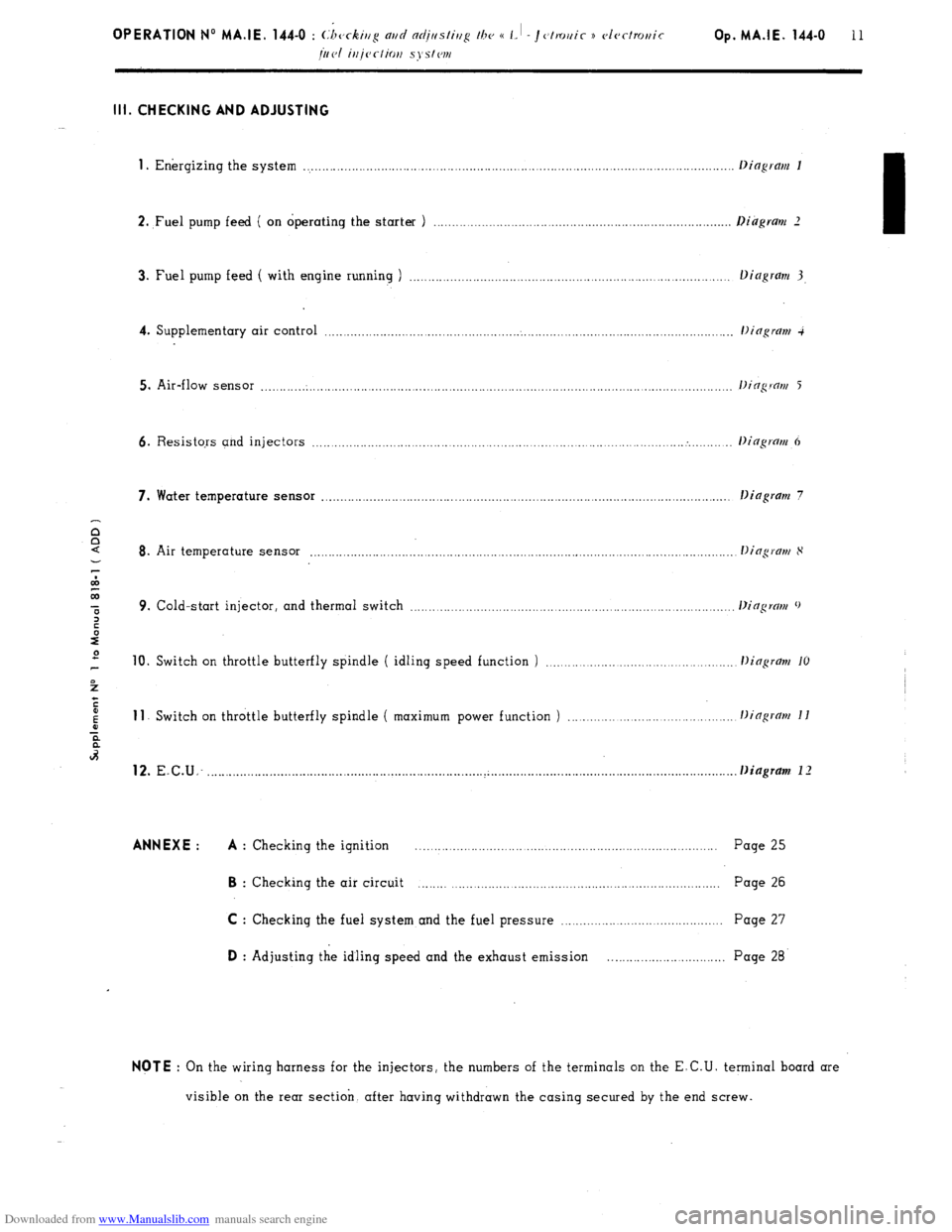
Downloaded from www.Manualslib.com manuals search engine Ill. CHECKING AND ADJUSTING
1
. Energizing the system ..................................................................................................................
2. ,Fuel pump feed ( on operating the starter ) .............................................................................
3. Fuel pump feed ( with engine running ) ...................................................................................
4. Supplementary air control ...........................................................................................................
5. Air-flow sensor ............................................................................................................................
6. Resistors and injectors ................................................................................................... . ........
7. Water temperature sensor ............................................................................................................ .
Dingram 7
8. Air temperature sensor ...............................................................................................................
9. Cold-start injector, and thermal switch ...................................................................................
10. Switch on throttle butterfly spindle ( idling speed function ) ............................................ 11
Switch on throttle butterfly spindle ( maximum power function ) ...................................... 12.
E.C.U: ......................................................................... ..~ ............................................................... . . Diagram 1 I ANNEXE : A
: Checking the ignition .................................................................................. Page 25 B
: Checking the air circuit ................................................................................ Page 26
C : Checking the fuel system and the fuel pressure ........................................... Page 27 D
: Adjusting the idling speed and the exhaust emission .............................. Page 28 NOTE
: On the wiring harness for the injectors, the numbers of the terminals on the E.C.U. terminal board are
visible on the rear section. after having withdrawn the casing secured by the end screw.