height Citroen CX 1974 1.G Owner's Manual
[x] Cancel search | Manufacturer: CITROEN, Model Year: 1974, Model line: CX, Model: Citroen CX 1974 1.GPages: 394
Page 254 of 394

Downloaded from www.Manualslib.com manuals search engine OPERATION No MA. 430-00 : (lsnmr/eris/irs nvrl .s/jrrinl /c,n/uws 0, /he susfiv,,sias Op. MA. 430-00 3
MANUAL HEIGHT CONTROL
‘hi anual height control quadrant :
I. High position
II. Intermediate high position
III. Normal driving position
IV Low position
G Assembly diagram for manual height control
:
L.43.2
Seen along Fl
Page 255 of 394
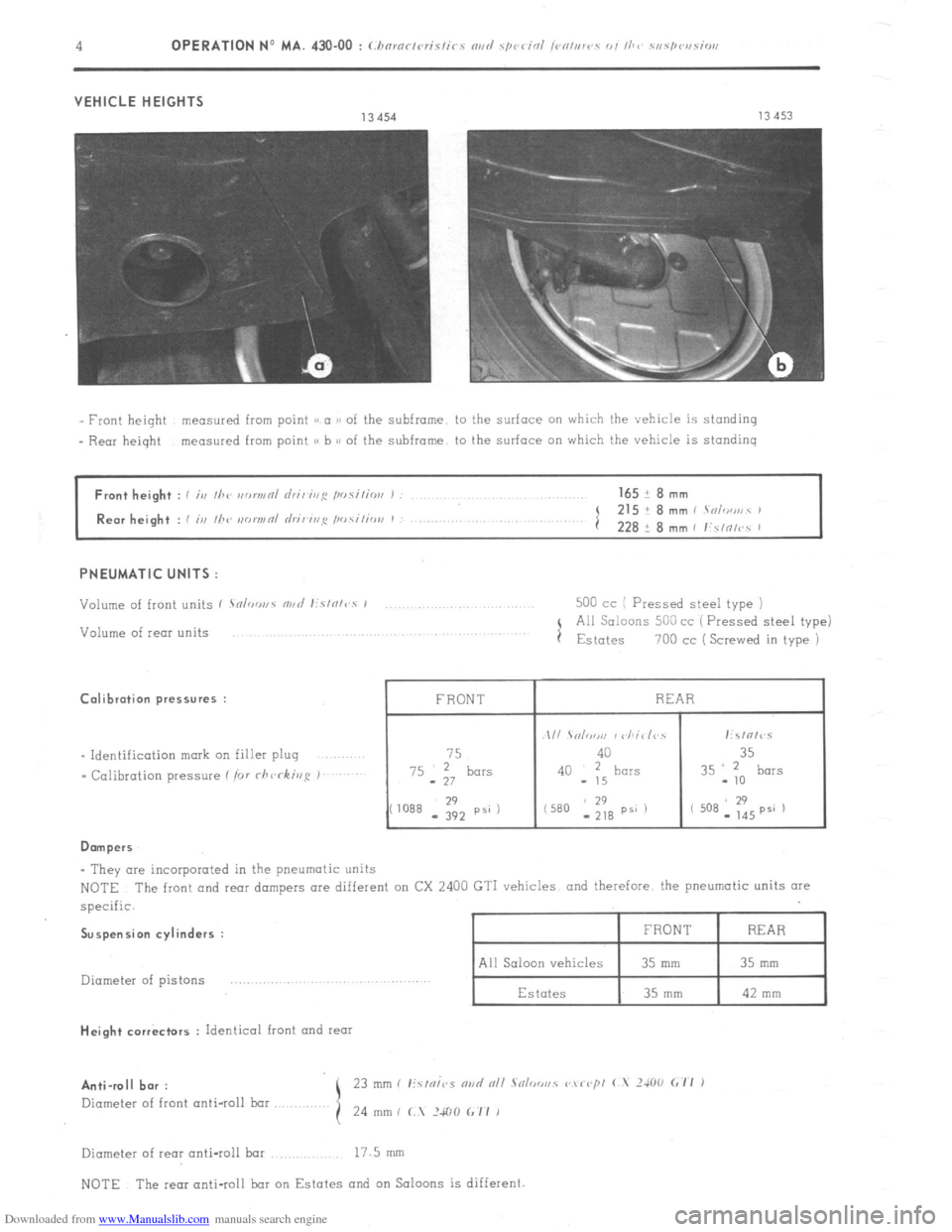
Downloaded from www.Manualslib.com manuals search engine VEHICLE HEIGHTS 13454
- Front height measured from point SG a 8) of the subfrome. to the surface on which the vehicle is stondinq
_ Rear height measured from point (, b )B of the subfrome to the surface on which the vehicle is standinq Calibration pressures :
FRONT REAR
\// \~~lr~r,,i J v/xii
/c,.5 I:\lol,‘s
_ Identification mark on filler plug 75 40 35
- Calibration pressure ( /or rhc’rkiqg 1. 75 2 bars 40 2 bars
- 27 - 15 35 1 ;, bars
(1088 _ ;;, P51 1
(580 : ;;, P51 i ( 508; :',, PSP 1 Dampers
- They are incorporated in the pneumatic units
NOTE The front and rear dampers ore different on CX 2400 GTI vehicles and therefore the pneumatic units are PNEUMATIC UNITS :
Volume of front units i Soloor, mid I:s/fll<,s 1
500 cc f Pressed steel type )
Volume of rear units
i All Saloons 500 cc ‘j Pressed steel type)
Estates 700 cc (Screwed in type i
I
specific. Suspension cylinders :
Diameter of pistons ,,,, Height
corr&tors : Identical front and rear Anti-roll bar :
23 mm i lisfoir~s mid o/l Salormc <~,c,,,,, ( Y ‘Xl(i VII I
Diameter of front anti-roll bar.
i 24 mm , (. 2400 (.‘/I J
Diameter of rear anti-roll bar 17.5 mm
NOTE The rear anti-roll bar on Estates and on Saloons is different.
Page 256 of 394
Downloaded from www.Manualslib.com manuals search engine OPERATION No MA. 430.00 : c ,,<,,a< ,<,r;s,;rs mi/ .s/wrin/ ,vn/srrs oi /he srmf~rw.~ion Op. MA. 430-00 5
II. SPECIAL FEATURES
Adjusting the anti-roll bars :
A, t/xv ,ms,
- Lateral positioning equal protrusion on either side to within 2 mm
- Anti-roll bar bearing preload 300 N ( 30kg) ( 66 lb )
- Lateral clearance of anti-roll bar. under pressure of 500 N i 50kq I( 110 fb i 0.2 to 1 mm
,I, l/X“ rcnr :
- Lateral positioning same thickness of shim on both sides. within 1 mm
- Shimming, if necessary. level with the split collars to within 0.6 mm
Greasing of the suspension piston con-rod ioint :
( Carried out with LHM liquid contained in the dust cover )
- Front suspension cylinder
- Rear suspension cylinder
Upper front wheelarm stops :
WARNING ‘,hc ,,,;,,,i<~, ~,op ,,,I (i, he ii,,, r/ 01 //I< ,,I?<,<‘/ wd. 7cm3
25 cm3
Tightening torques :
- Anti-roll bar link-rod on upper wheelarm. i Bush nut 3 doNm ( 21 11 2 ft.lb )
NYLSTOP nut 4.5 to 5daNd32 1/‘2to 36ft.lb)
- Link-rod on anti-roll bar 4.5 to SdaNm(32 1/2to36ft.lb)
. Screw securing front anti-roll bar bearing 2.7 daNm ( 19 l/2 ft.lb )
^ - Clamps for adjusting pie-load on front anti-roll bar 13 doNm ( 9 l/2 ft.lb)
b2 - 1.5 daNm [ 11 ft.lb i
0 Clomp for height corrector control
rod ( front and rem )
”
6 daNm ( 43 l/ 2 ft.lb ) - . An+iwroff bar 0” rear &&arm ( rear fixing
points ) I /nc<’ nvrl /hrcn,l~r
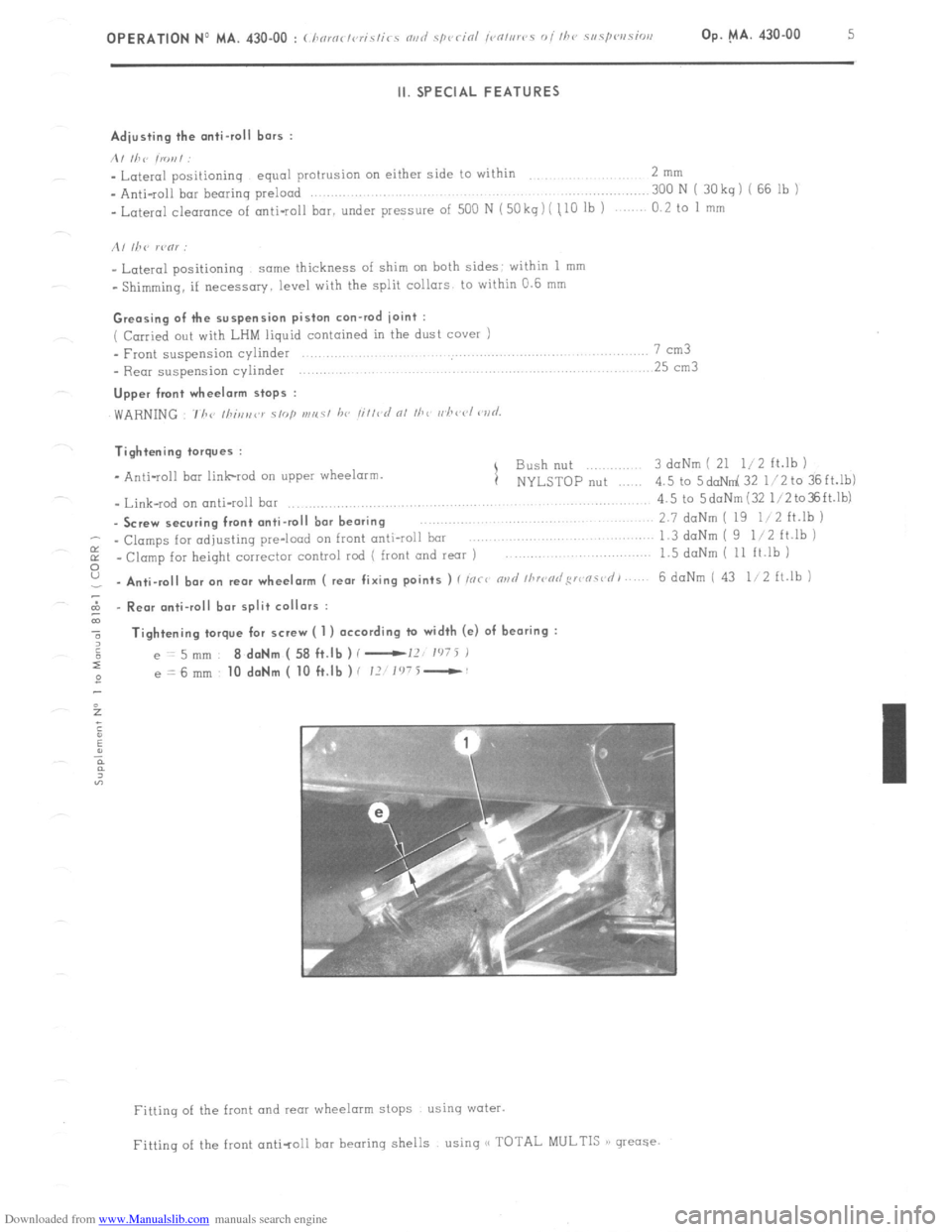
- Rear anti-roll bar split collars :
cc
-5 Tightening torque for screw ( 1 )
according to width (e) of bearing :
:
2
e = 5 mm 8 d.aNm ( 58 ft.lb ) f -I’, I’JiS,
P
e-6mm lOdoNm( lOft.lb)i 121Vi-’
Fitting of the front and rear wheelarm stops using water
Fitting of the front anti-011 bar bearing shells using ,< TOTAL MULTIS I) grease.
Page 257 of 394
Downloaded from www.Manualslib.com manuals search engine OPERATION No MA. 430-O : Checking md ndjusting the suspcusion and its control. 06. MA. 430-O i
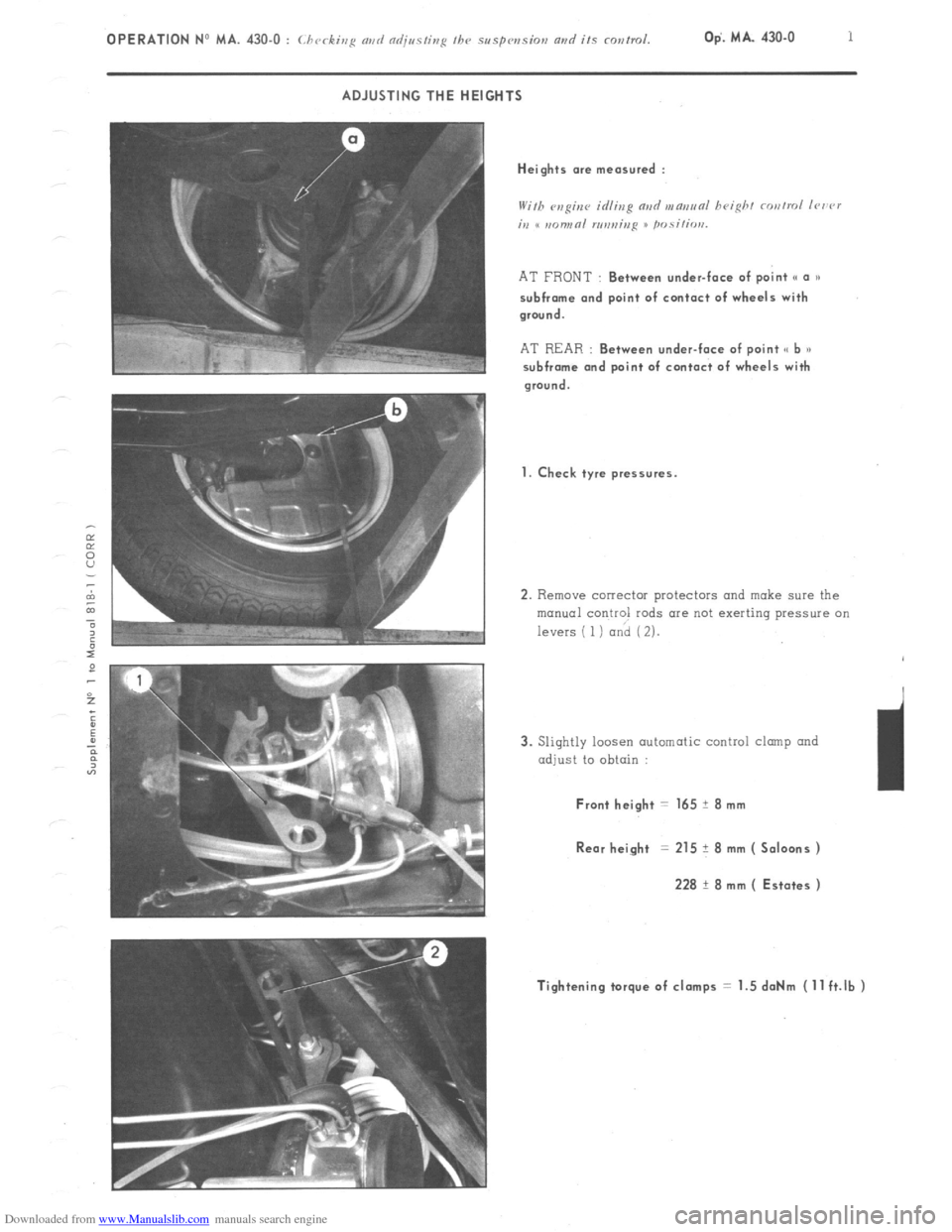
ADJUSTING THE HEIGHTS
AT FRONT : Between under-face of point (c o ))
subfrome ond point of contoct of wheels with
ground.
AT REAR : Between under-face of point <( b a)
subfrome ond point of contact of wheels with
ground.
1. Check tyre pressures.
2. Remove corrector protectors and make sure the
manual control rods are not exerting pressure on
levers ( 1) and ( 2).
3. Slightly loosen automatic control clump and
adjust to obtain :
3
Front height = 165 ? 8 mm
Rear height = 215 ? 8 mm ( Saloons )
228 t 8 mm ( Estates )
Tightening torque of clomps = 1.5 doNm (11 ft.lb )
Page 258 of 394
Downloaded from www.Manualslib.com manuals search engine 2 OPERATION No MA. 430-O : ~hwki~zg nrtd nrijustittg the suspwrsiott ntd its cotttrol
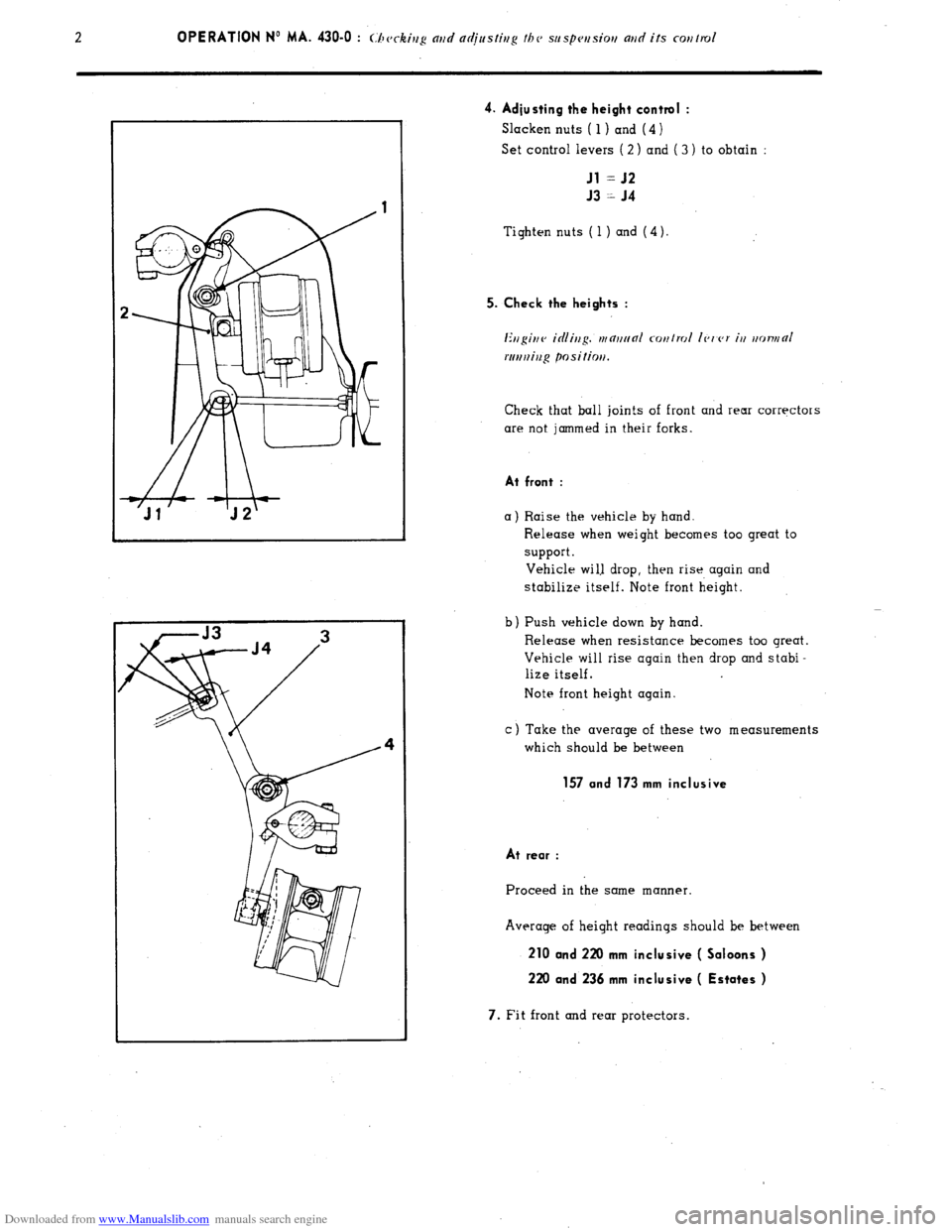
4. Adjusting the height control :
Slacken nuts ( 1) and (4 )
Set control levers ( 2 ) and ( 3 ) to obtain :
Jl = J2
J3 = J4
Tighten nuts ( 1 ) and (4).
5. Check the heights :
Ertgittv icilittg. tttnttt~nl cotttrol Ic,t’c,r itt ttotvttO/
rtrrtttiug positiott.
Check that ball join!s of front and rear corrqctors
are not jammed in their forks.
At front :
a) Raise the vehicle by hand.
b Release when weight becomes too great to
support.
Vehicle wi1.l drop, then rise again and
stabilize itself. Note front height.
Push vehicle down by hand
Release when resistance becomes too great.
Vehicle will rise again then drop and stabi-
lize itself.
Note front height again.
c) Take the average of these two measurements
which should be between
157 and 173 mm inclusive
At rear :
Proceed in the same manner.
Average of height readings should be between
210 and 220 mm inclusive ( Saloons )
220 and 236 mm inclusive ( Estates )
7. Fit front and rear protectors.
Page 283 of 394
Downloaded from www.Manualslib.com manuals search engine Op. MA. 453-O 1
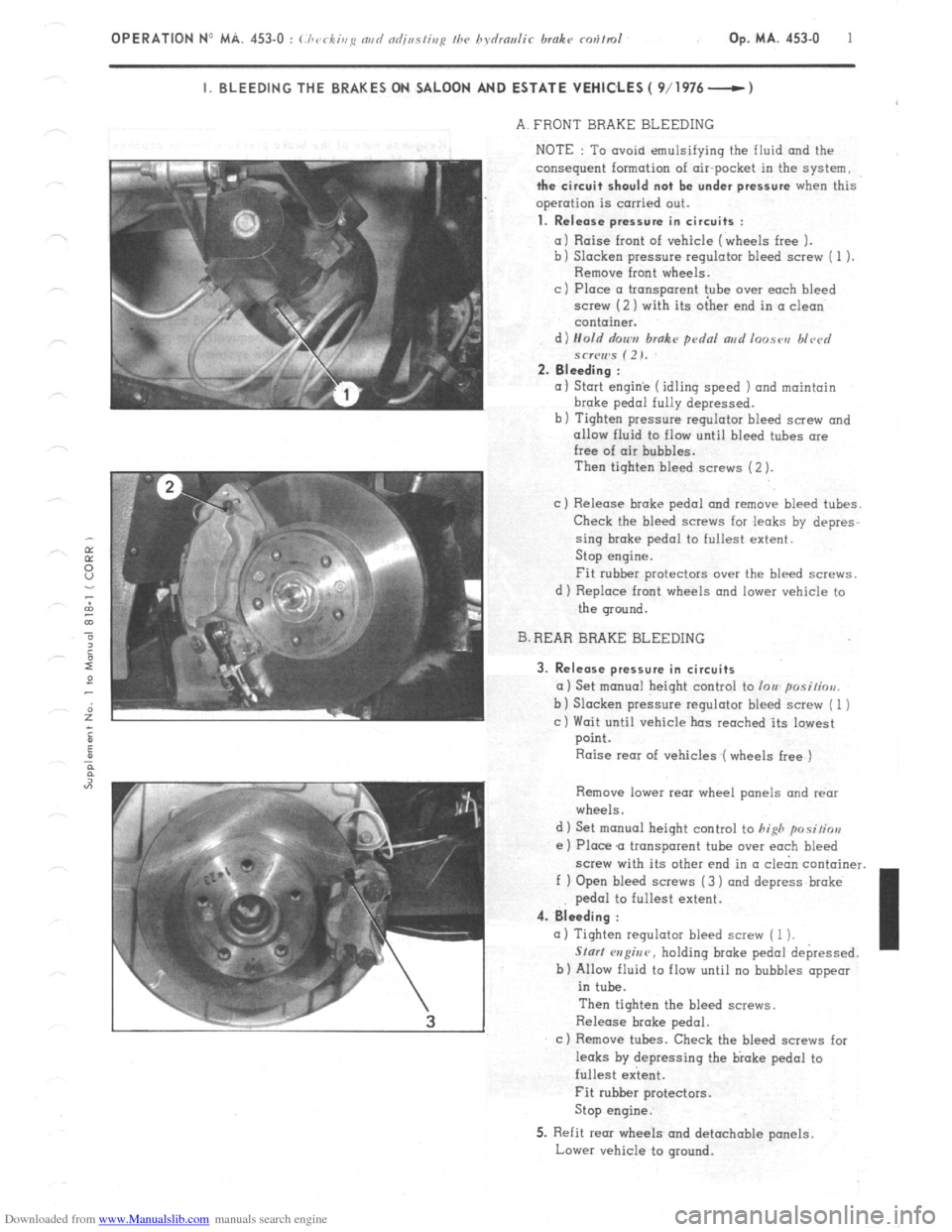
I. BLEEDING THE BRAKES ON SALOON AND ESTATE VEHICLES ( 9/1976- )
A. FRONT BRAKE BLEEDING
NOTE : To avoid emulsifying the fluid
and the
consequent formation of air-pocket in the system,
the circuit should not be under pressure when this
operation is carried out.
1. Release pressure in circuits :
a) Raise front of vehicle (wheels free 1.
b) Slacken pressure regulator bleed screw ( 1 ).
Remove front wheels.
c ) Place CI transparent tube over each bleed
screw (2 ) with its oiher end in CI clean
container.
d) Hold r/on,,,
brake pdnl ar,d loose,, blvcrl
*cr(Iws (2). 2. Bleeding :
(I 1 Start engin’e (idling speed 1 and maintain brake
pedal fully depressed.
b) Tighten pressure regulator bleed screw and
allow fluid to flow until bleed tubes ore
free of air bubbles.
Then tighten bleed screws (2 ).
c) Release broke pedal and remove bleed tubes.
Check the bleed screws for .leaks by depres-
sing brake pedal to fullest extent.
Stop engine.
Fit rubber protectors over the bleed screws.
d 1 Replace front wheels and lower vehicle to
the ground.
B. REAR BRAKE BLEEDING
3. Release pressure in circuits
a) Set monuol height control to lou posi/iou.
b 1 Slacken pressure regulator bleed screw ( 1 )
c) Wait until vehicle has reoched.its lowest
point.
Raise rear of vehicles (wheels free )
Remove lower rear wheel panels and rear
wheels.
d 1 Set manual height control to
hifih positior,
e ) Place Q transparent tube over each bleed
screw with its other end in (I cl&n container.
f ) Open bleed screws (3 ) and depress broke
pedal to fullest extent. 4. Bleeding :
(I) Tighten regulator bleed screw ( 1 1.
Slur/ w?@nr, holding broke pedal depressed.
b) Allow fluid to flow until no bubbles appear
in tube.
Then tighten the bleed screws.
Release brake pedal.
c ) Remove tubes. Check the bleed screws for
leaks by depressing the bloke pedal to
fullest extent. I
Fit rubber protectors.
Stop engine.
5. Refit rear wheels and detachable panels.
Lower vehicle to ground.
Page 284 of 394
Downloaded from www.Manualslib.com manuals search engine 2 OPERATION N” MA. 453-O : (./ ‘cc ,,,g md ndjaslisg I/w hsdrmlir hrnkr rev/m/
k.
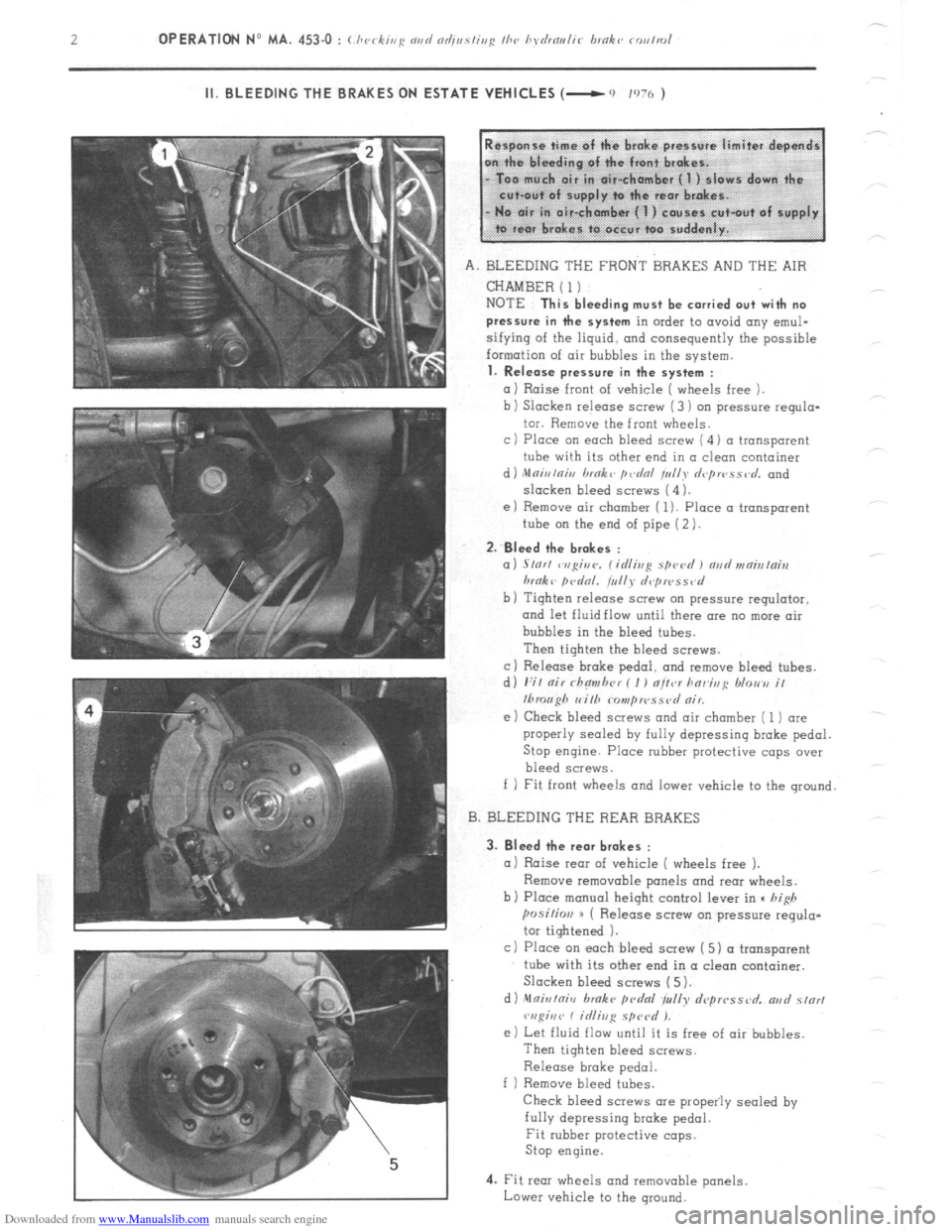
II. BLEEDING THE BRAKES ON ESTA ,TE VEHICLES (- 0 ,970 )
A. BLEEDING THE FRONT BRAKES AND THE AIR
CHAMBER ( 1)
NOTE
This bleeding must be carried out with no
pressure in the system
in order to avoid any emul-
sifying of the liquid. and consequently the possible
formation of air bubbles in the system.
1. Release pressure in the system :
a 1 Raise front of vehicle ( wheels free ).
b ) Slacken release screw (3 ) on $ressure requlo-
tor. Remove the front wheels.
c 1 Place on each bleed screw ( 4 1 a transparent
tube wi!h its other end in a clean container
d ) ,Mnir,lnh, brnk L p&d /u//y d<~pwss,~d. and
slacken bleed screws (4 ).
e) Remove air chamber ( 1). Place a transparent
tube on the end of pipe (2 ).
2.
Bleed the br.kes :
a) S/or/ ~v,gir,c,. C id/ivg spevd I md vrnialni,r
hrnk L firdnl. tullr d,~pwss<~d
b) Tighten release screw on pressure regulator.
and let fluid flow until there are no more air
bubbles in the bleed tubes.
Then tighten the bleed screws.
c) Release broke pedo1, and remove bleed tubes.
d) I:;/ nir rhnmhrr ( I ) nltcr hnr~htg /dorm i/
Ibrouph I, i/h Nmp IPSS ?,I nir.
e ) Check bleed screws and air chamber ( 1) are
properly sealed
by fully depressing brake pedal.
Stop engine. Place rubber protective caps over
bleed screws.
f 1 Fit front wheels and lower vehicle to the ground
B. BLEEDING THE REAR BRAKES
3.
Bleed the rear brakes :
a 1 Raise rear of vehicle ( wheels free ).
Remove removable panels and rear wheels.
b) Place manual height control lever in c high
posi~im H ( Release screw on pressure regula-
tor tightened 1.
c) Place on each bleed screw ( 5) a transparent
tube with its other end in a clean container.
Slacken bleed screws (5).
d) nlfliuiniv broke pcdfll ~yrrlly depwssvd. ar,d s/or,
vspiuv C idiivg sprcd ).
e) Let fluid flow until it is free of air bubbles.
Then tighten bleed screws.
Release brake pedal.
f ) Remove bleed tubes.
Check bleed screws are propeily sealed by
fully depressing broke pedal.
Fit rubber protective cops.
Stop engine.
4. Fit rear wheels and removable panels
Lower vehicle to the ground.
Page 285 of 394
Downloaded from www.Manualslib.com manuals search engine OPERATION No MA. 453=0 : Ch J k’ ( c zng and adjjusfing thr hydraulk brake rontrol Op. MA. 453-O 3
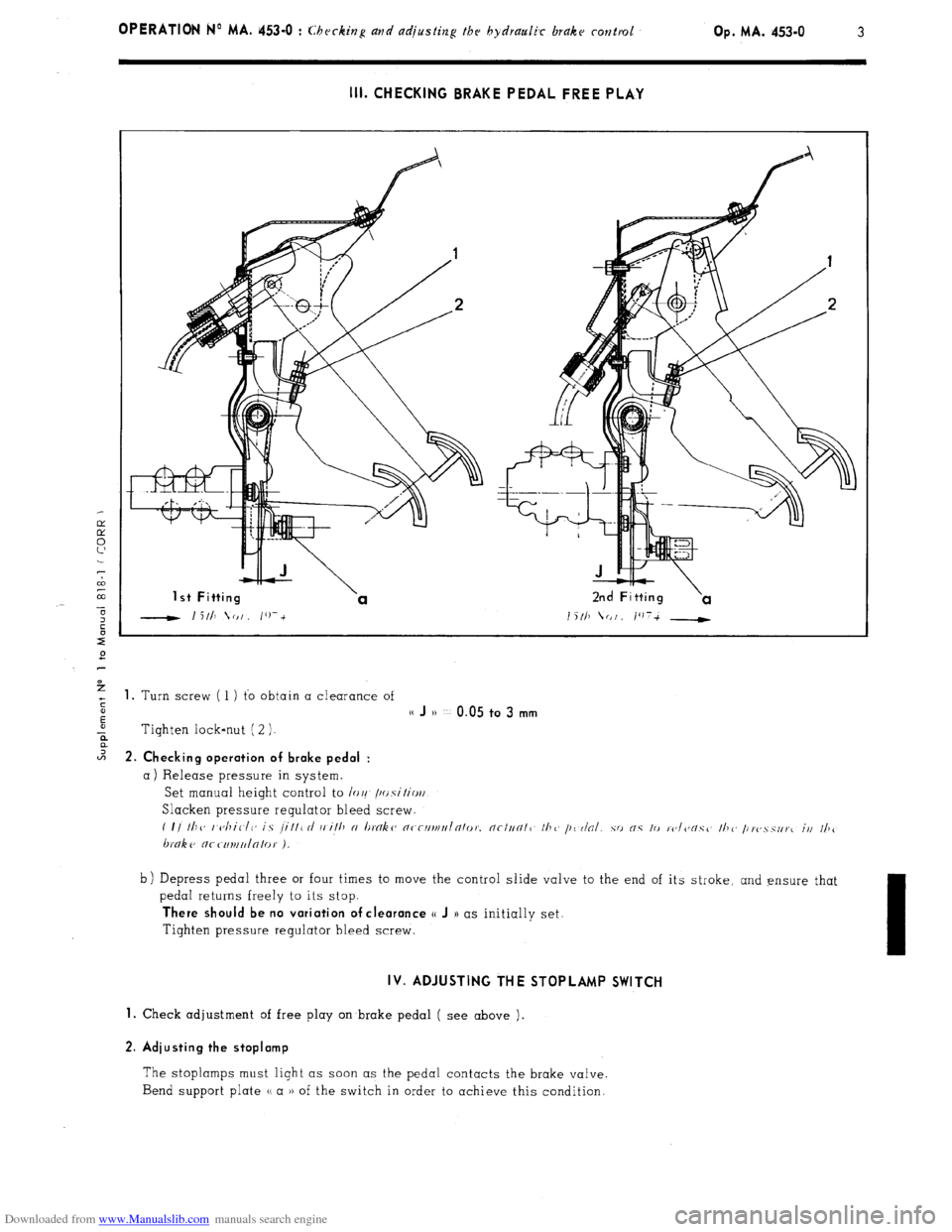
III. CHECKING BRAKE PEDAL FREE PLAY
1 st Fitting 2nd Fitting
1 5 111 (I I /‘)7-t __t i%
+ 1. Turn screw ( 1 ) to obtain a clearance of
s
E
(( J )) ~~ 0.05 to 3 mm
-ii Tighten lock-nut ( 2 ).
2 2. Ch k’ ec Ing operation of brake pedal :
a) Release pressure in system.
Set manual height control to /or! /~~.s\‘itio~/
Slacken pressure regulator bleed screw.
( I/ Ill<, I <~/liClC~ is /ill1 rl i, ill, N I~tYlk~~ n~-rllrlll,Inlo,~. nc/un/1 II?<, /I< r/al.
hnke nr c111uu/n/0,. ).
b) Depress pedal three or four times to move the control slide valve to the end of its stroke, and ensure that
pedal returns freely to its stop.
There should be no variation of clearance o J )) as initially set.
Tighten pressure regulator bleed screw.
IV. ADJUSTING THE STOPLAMP SWITCH
1.
Check adjustment of free play on brake pedal ( see above ).
2. Adiusting the stoplamp
The stoplamps must light as soon as the pedal contacts the brake valve.
Bend support plate u a )) of the switch in order to achieve this condition.
Page 358 of 394
Downloaded from www.Manualslib.com manuals search engine OPERATION No MA. 540-O : (hcrking and diusfing the hradlmnps. Op. MA. 540.0 1 ADJUSTING THE HEADLAMPS USING A << REGLOSCOPE >> OR I< REGLOLUX n TYPE APPARATUS
I. CONDITIONS FOR ADJUSTMENT
With the vehicle empty and in running order :
a) Ensure that the tyre ore correctly inflated
and heights correctly adjusted.
Place vehicle on CI flat level surface.
Run the engine at idling speed and set manual.
height control to normal running position.
1 Place the instrument on the same level as that
of the vehicle and opposite the headlamp to be
adjusted. 2. ADJUSTMENT
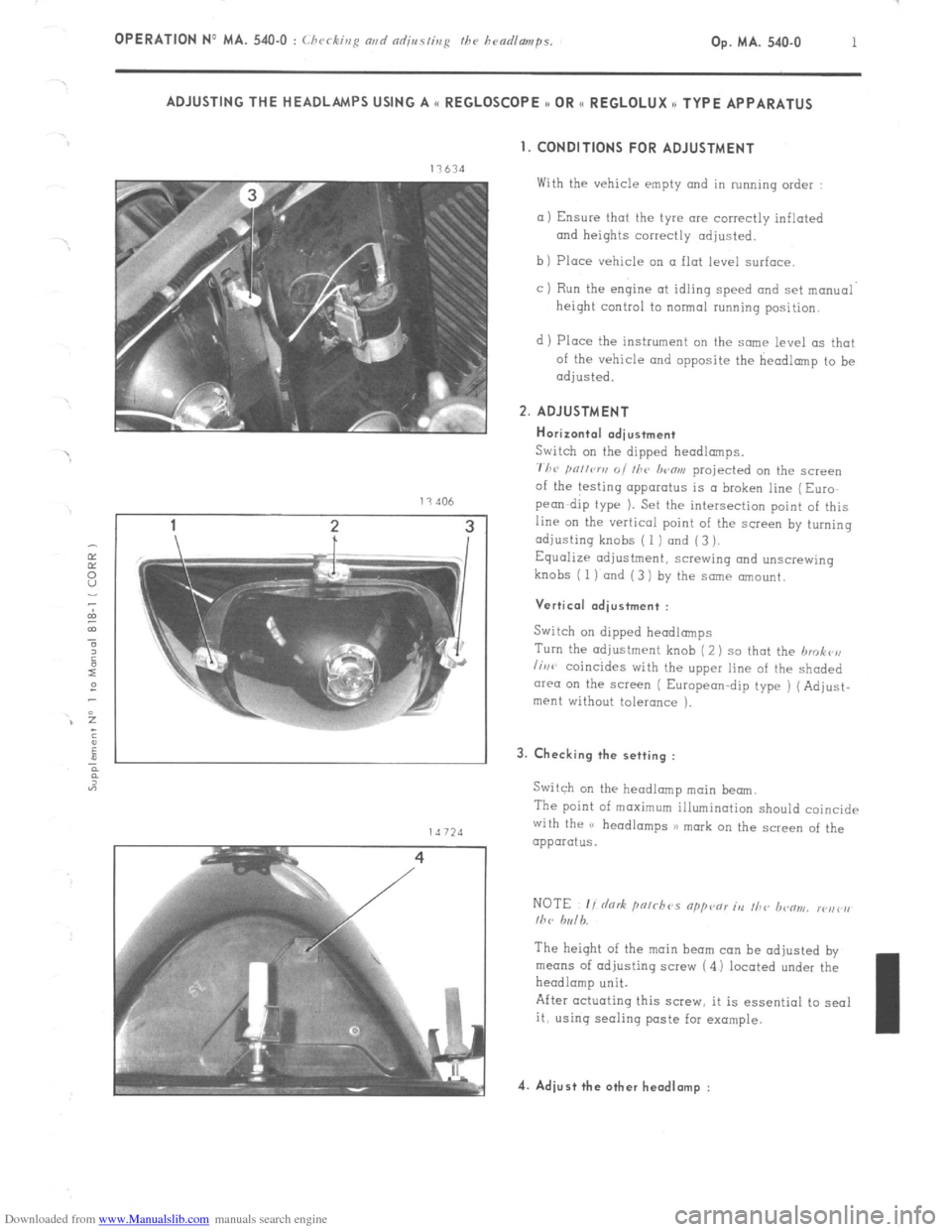
Horizontal adiustment
Switch on the dipped headlamps.
711~ pn,lcrv 01 111~ lwflrn projected on the screen
of the testing apparatus is a broken line (Euro
pea-dip type 1. Set the intersection point of this
line on the vertical point of the screen by turning
adjusting knobs ( 1 ) and (3 ).
Equalize adjustment, screwing and unscrewing
knobs (
1) and (3 1 by the same amount.
Vertical .dius+ment :
Switch on dipped headlamps
Turn the adjustment knob (2) so that the hrokr’n
lirw coincides with the upper line of the shaded
cwea on the screen ( European-dip type ) (Adjust-
ment without tolerance ). 3. Checking the setting :
Switch on the headlamp main beam.
The point of maximum illumination should coincide
with the (’ headlamps 3) mark on the screen of the
apparatus.
The height of the main beam can be adjusted by
means of adjusting screw (4 1 located under the
headlamp unit.
After actuating this screw, it is essential to seal
it, using seoling paste far example. 4. Adiust the other headlamp :
Page 361 of 394
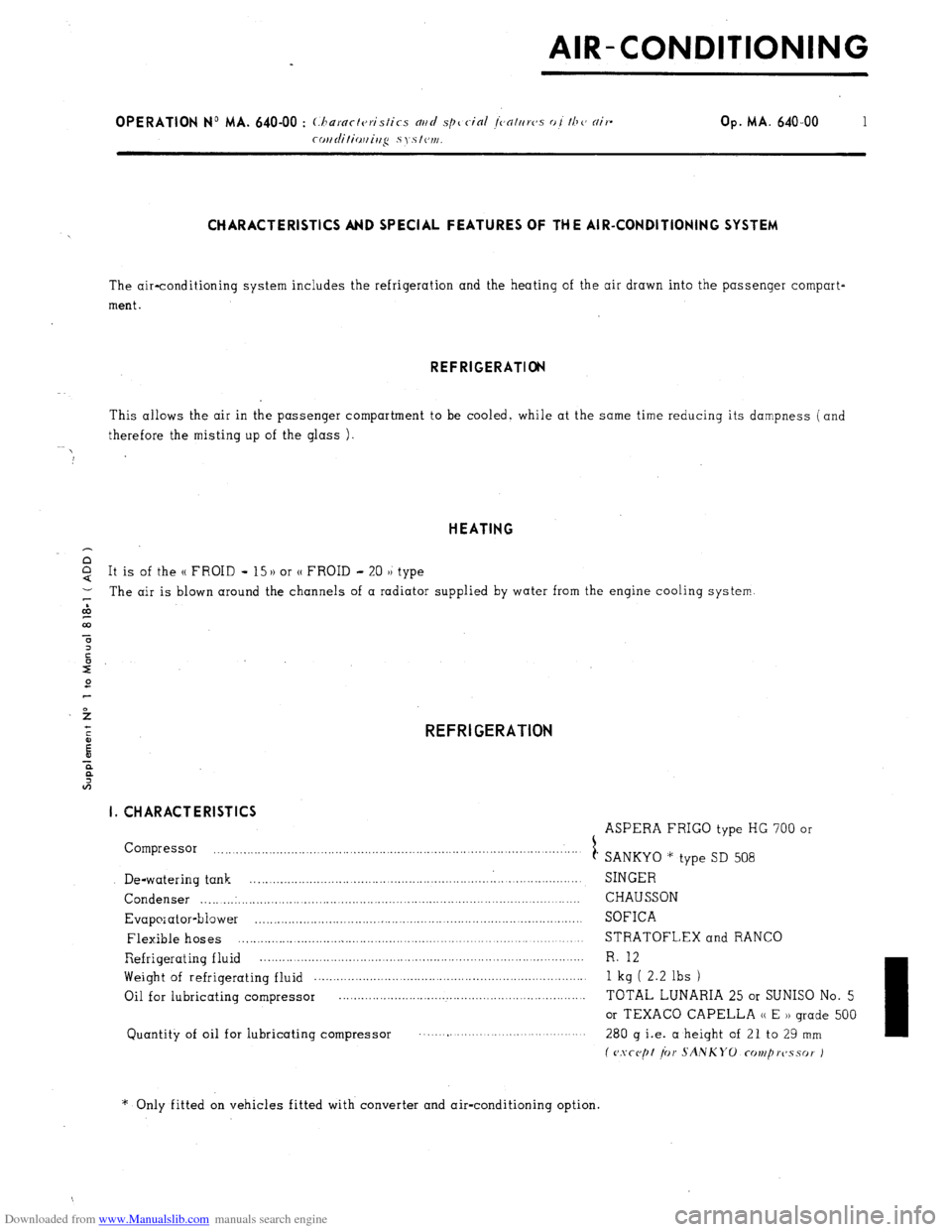
Downloaded from www.Manualslib.com manuals search engine AIR-CONDITIONING
CHARACTERISTICS AND SPECIAL FEATURES OF THE AIR-CONDITIONING SYSTEM
The air-conditioning system includes the refrigeration and the heating of the air drawn into the passenger compart-
ment. REFRIGERATION
This allows the air in the passenger compartment to be cooled, while at the same time reducing its dampness (and
therefore the misting up of the glass ) HEATING
It is of the (( FROID - 15)) or (( FROID - 20 )) type
1 The air is blown around the channels of a radiator supplied by water from the engine cooling system.
&
co
5
3
t
E REFRIGERATION
E I. CHARACTERISTICS
ASPERA FRIGO type HG 700 or
Compressor
1 .
SANKYO * type SD 508
De-watering tank . SINGER
Condenser _.. ._..: _._...... . . . . . . . . . . . CHAUSSON
Evaporator-blower , SOFICA
Flexible hoses ..,_.,....,............................................................................... STRATOFLEX and RANCO
Refrigerating fluid . R. 12 Weight
of refrigerating fluid _..._.._._._..,_..__.................................................... 1 kg ( 2.2 lbs )
Oil for lubricating compressor TOTAL LUNARIA 25 or SUNISO No. 5
or TEXACO CAPELLA (( E )) grade 500
Quantity of oil for lubricating compressor ,
280 g i.e. a height of 21 to 29 mm
f
CJSCC,~~ ior SANKYO UIVI~WSSO~ J
* Only fitted on vehicles fitted with converter and air-conditioning option.