brake Citroen CX 1981 1.G User Guide
[x] Cancel search | Manufacturer: CITROEN, Model Year: 1981, Model line: CX, Model: Citroen CX 1981 1.GPages: 394
Page 220 of 394
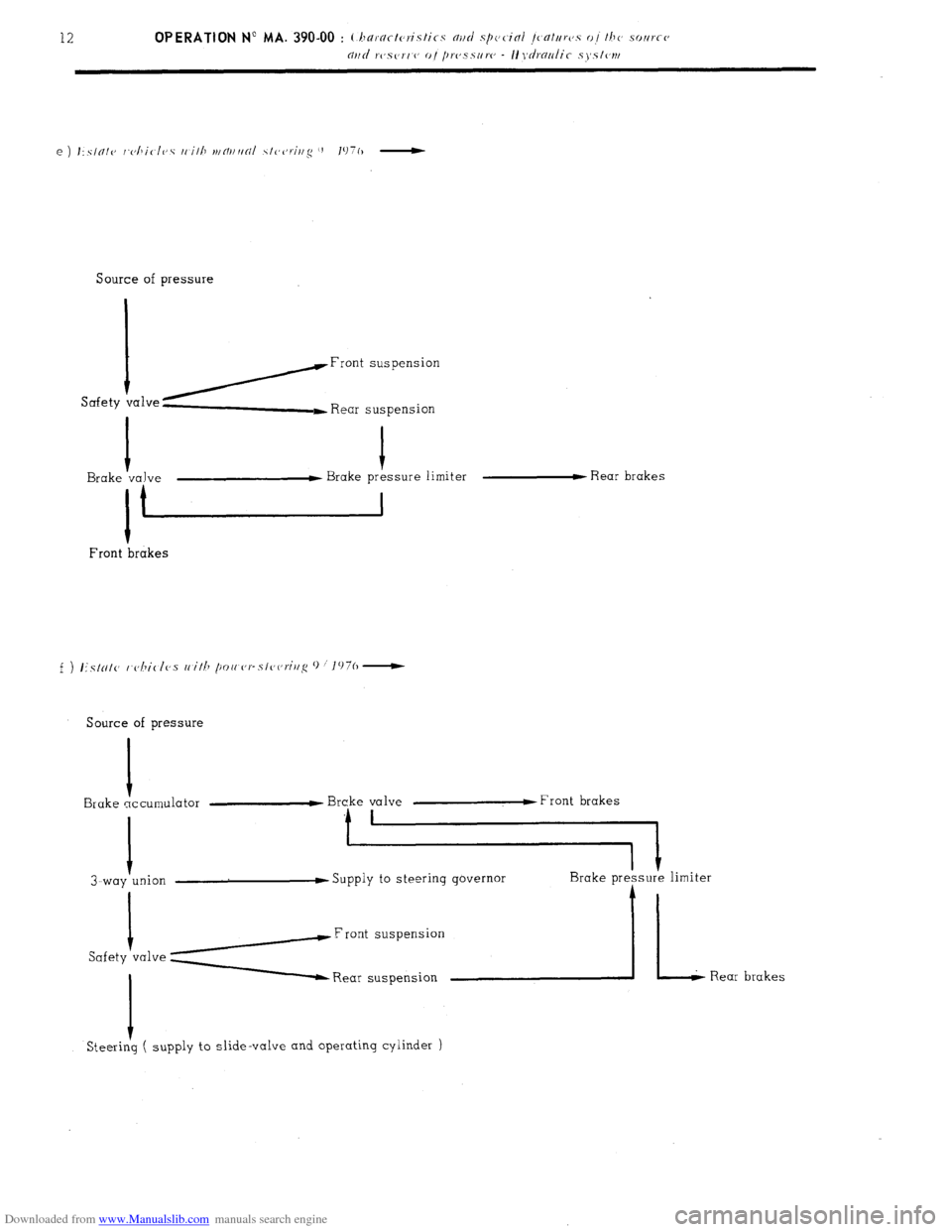
Downloaded from www.Manualslib.com manuals search engine Source of pressure
Safety ialveYFront suspension
t
L Rear suspension
I I
Brake valve w Brake pressure limiter w Rear brakes
I t
Front ‘brakes
Source of pressure
I
Brake accumulator
I
3-way union F Brake valve w Front brakes
Supply to steering governor
Safety I
va1ve y Rear suspension
I
Steering ( supply to slide-valve and operating cylinder )
Page 229 of 394
Downloaded from www.Manualslib.com manuals search engine OPERATION No MA. 390-O : Checkin
P the hydraulic componm~s on the ucbicle Op. MA. 390-O 3
f Mama sleeting wbi&s I
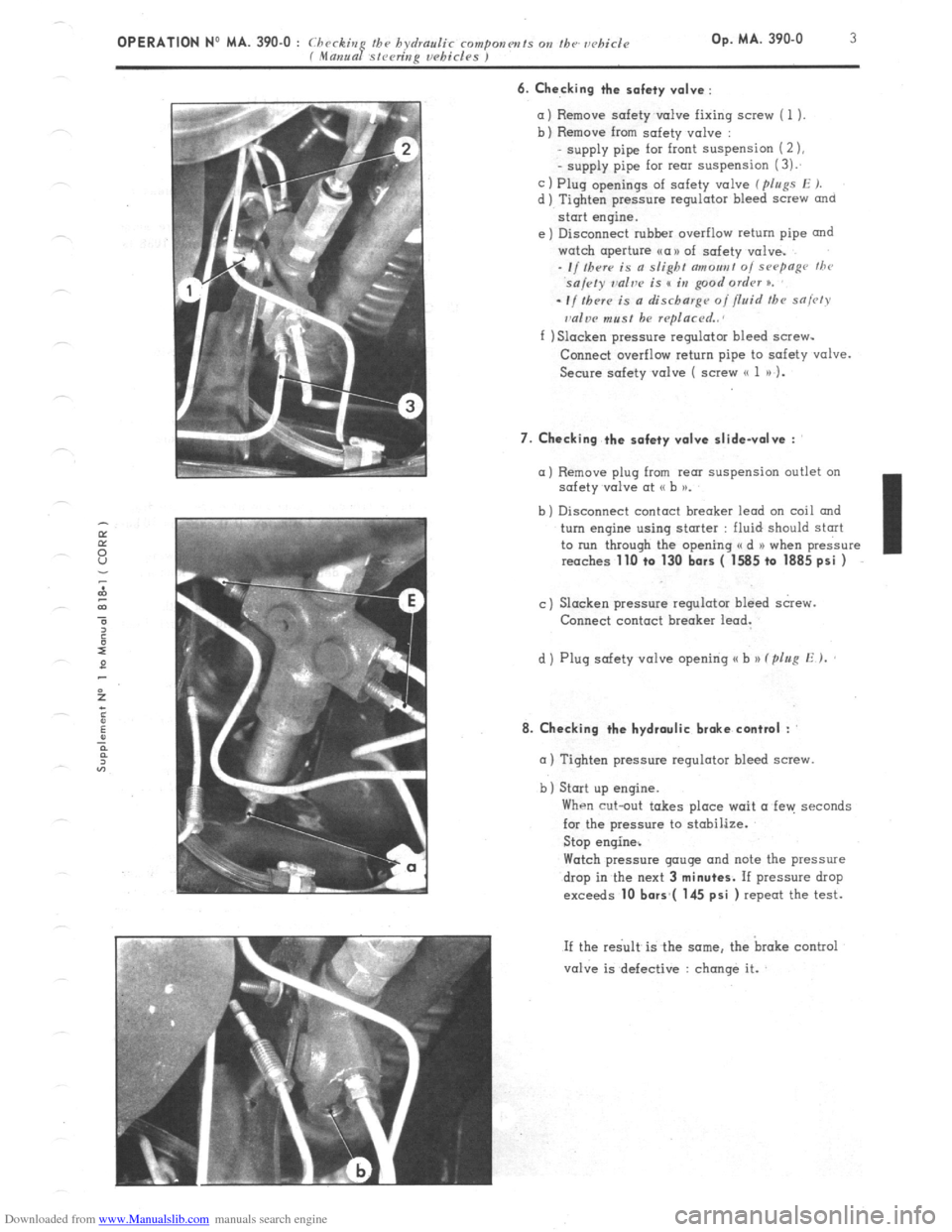
6. Checking the safety valve :
=I
bl
Cl
dl
Remove safety v&e fixing screw ( 1 ).
Remove from safety valve :
supply pipe for front suspension (2 ),
- supply pipe for rem suspension (3):
Plug openings of safety valve ( pIugs E J.
Tighten pressure regulator bleed screw
and
start engine.
Disconnect rubher overflow return pipe and
watch aperture ~a>> of safety valve.
- I/ Iherr is a slight c7moa,,t 0, sHymge thr
sa/cty ~dve is s in good ordrv n.
el
-If thrr~ is a discharge of fluid the sniw
dw must be rqlacrd..
f ) Slacken pressure regulator bleed screw-
Conned overflow return pipe to safety valve.
Secure safety valve ( screw (( 1 a) 1.
7. Checking the safety valve slidevolve :
a) Remove plug from rem suspension outlet on
safety v&e at G b >a.
b ) Disconnect contact breaker lead on coil and
turn engine using stmter : fluid should start
to run through the opening a d N when pressure
reaches
1lLl +o 130 bars ( 1585 to 1885 psi )
c) Slacken pressure regulator bleed screw.
Connect contact breaker lead.
d ) Plug safety valve opening u b )) (plug E ).
8. Checking the hydraulic brake contml :
m ) Tighten pressure regulator bleed screw.
b) Start up engine.
When cut-out takes place wait a fen: seconds
for the pressure to stobilize.
Stop engine%
Watch pressure gauge and note the pressure
drop in the next 3
minutes. If pressure drop
exceeds 10 bors*( 145 psi ) repeat the test.
If the re< is the same. the broke control
valve is defective : change it.
Page 230 of 394
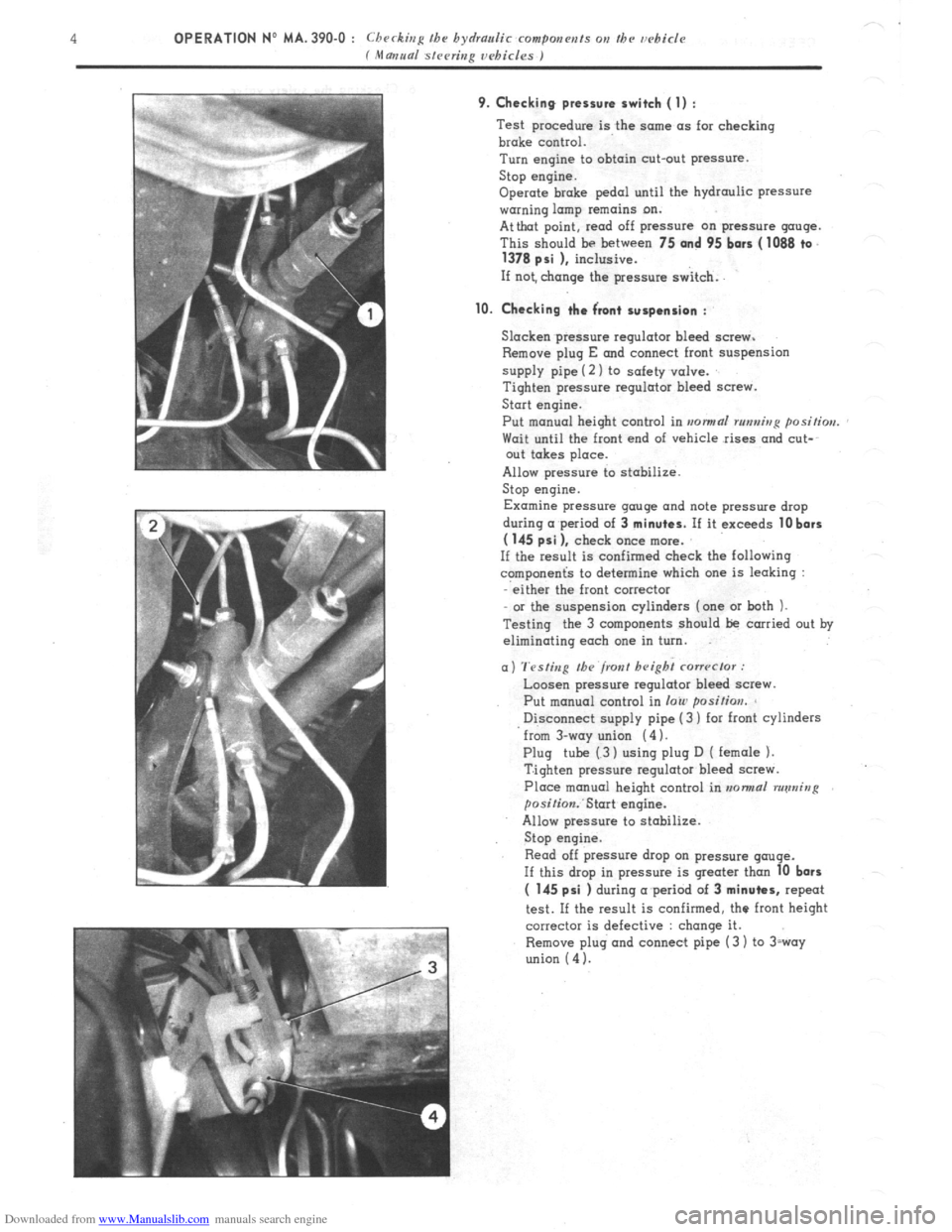
Downloaded from www.Manualslib.com manuals search engine 9. Checking pressure switch (1) : Test procedure is the sctme as for checking
broke control.
Turn engine to obtain cut-out pressure.
Stop engine.
Operate brake pedal until the hydraulic pressure
warning lamp remains on.
Attbat point, read off pressure on pressure gauge.
This should be between 75
and 95 bars ( 1088 ta.
1378 psi 1, inclusive.
If not, change the pressure switch.
10. Checking the Front suspension : Slacken.pressure regulator bleed screw.
Remove plug E and connect front suspension
supply pipe (2 ) to safety valve.
Tighten pressure regulator bleed screw.
Start engine.
Put manual height control in
rronnaf rtmni>rp positim. Wait until the front end of vehicle rises and cut-
out takes place.
Allow pressure to stabilize.
Stop engine.
Examine pressure gauge and note pressure drop
during wperiod of 3
minutes. If it exceeds 10 bars
( 145 psi 1, check once more.
If the result is confirmed check the following
c?mponenG to determine which one is leaking :
either the front corrector
or the suspension cylinders (one or both ).
Testing the 3 components should be carried out by
eliminating each one in turn.
(I) Testing the front height cmwclor : Loosen pressure regulator bleed saew.
Put manual control in
loin position. Disconnect supply pipe (3 ) for front cylinders
from 3-way union (4 ).
Plug tube (3 ) using plug D ( female 1.
Tighten pressure regulator bleed scwe.
Place manual height control in normal running
posiGon:Start engine.
Allow pressure to stabilize.
Stop engine.
Read off pressure drop on pressure qtruqe.
If this drop in pressure is greater than
10 bars (
145 psi ) during a period of 3 minutes, repeat
test. If the result is confirmed, the front height
corrector is defective : change it.
Remove plug and connect pipe (3 ) to 3roy
union
(4 ).
Page 231 of 394
Downloaded from www.Manualslib.com manuals search engine Slacken pressure regulator bleed screw.
Put manual height control in /VII. position
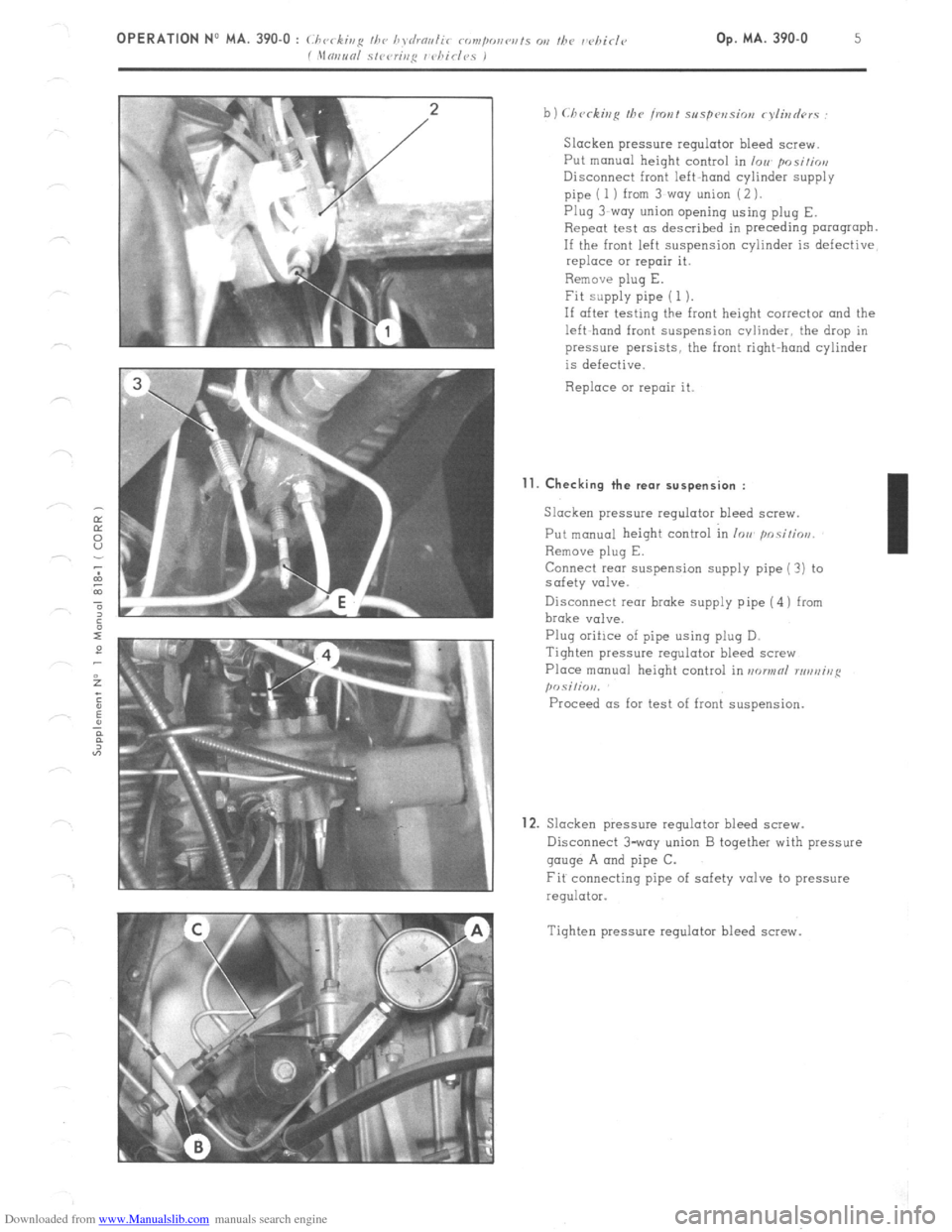
Disconnect front left-hand cylinder supply
pipe ( 1 ) from 3~woy union (2 ).
Plug 3-way union opening using plug E.
Repeat test as described in preceding parograpb.
If the front left suspension cylinder is defective
replace 01 repair it.
Remove plug E.
Fit supply pipe ( 1 ).
If after testing the front height corrector and the
left-hand front suspension cvlinder, the drop in
pressure persists, the front right-hand cylinder
is defective.
Replace or repair it. Il.
Checking the rear suspension :
Slacken pressure regulator bleed screw.
Put manual height control in IOU pnsi!ios,
Remove plug E.
Connect rear suspension supply pipe (?) to
safety valve.
Disconnect rear brake supply pipe (4) from
brake valve.
Plug oriilce of pipe using plug D.
Tighten pressure regulator bleed screw
Place manual height control in aorwnl rrruniug
posilio,,.
Proceed as for test of front suspension.
12. Slacken pressure regulator bleed screw.
Disconnect 3-way union B together with pressure
gauge A and pipe C.
Fit connecting pipe of safety valve to pressure
regulator.
Tighten pressure regulator bleed screw.
Page 236 of 394
Downloaded from www.Manualslib.com manuals search engine OPERATION No MA. 410-O : ( /,c
1
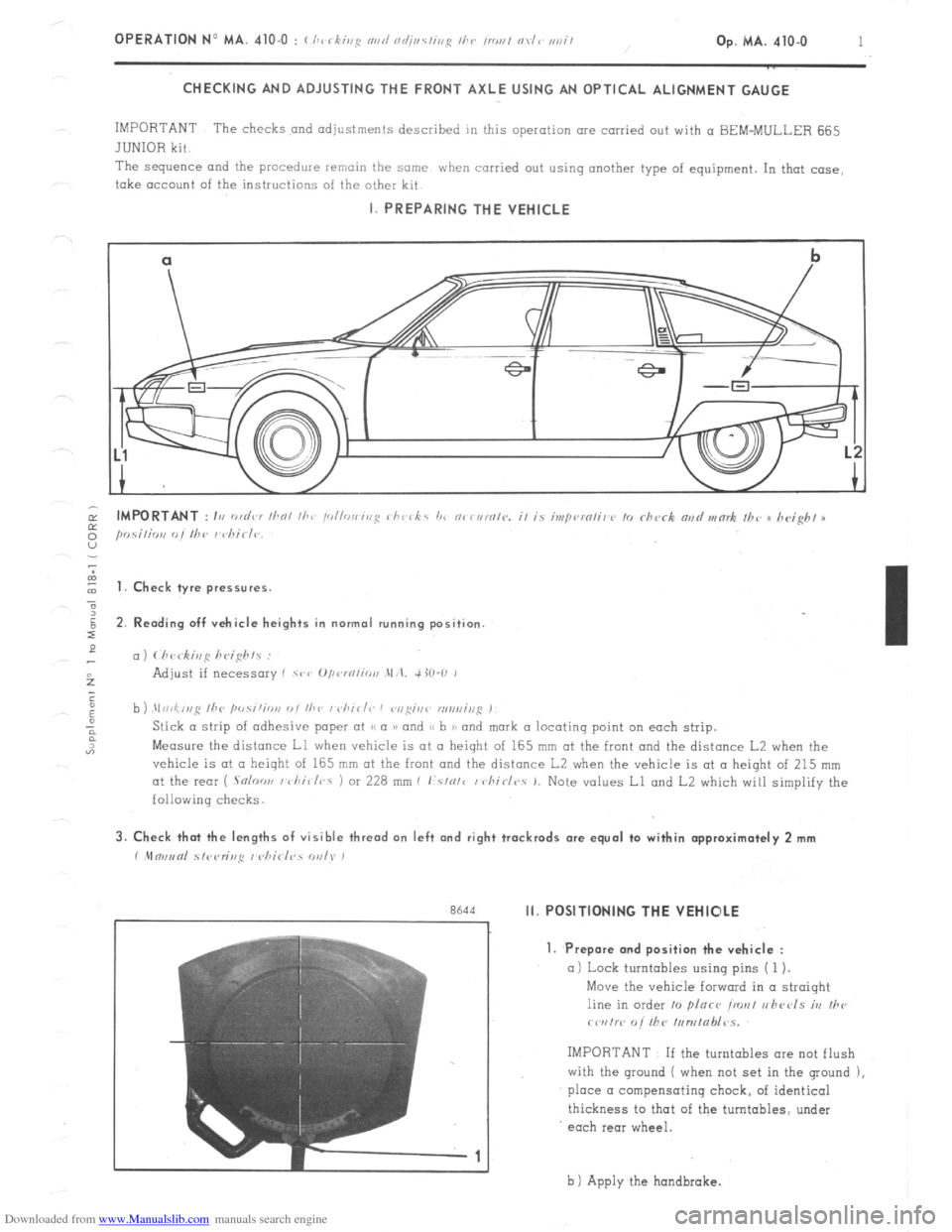
CHECKING AND ADJUSTING THE FRONT AXLE USING AN OPTICAL ALIGNMENT GAUGE
IMPORTANT The checks and adjustments described in this operation are carried out with a BEM-MULLER 665
JUNIOR kit
The sequence and
the procedure remain the same when carried out using another type of equipment. In that case,
take account of the instructions of the other kit I. PREPARING THE VEHICLE
cl
b
-.
I t 1. Check tyre pressures.
2. Rending off vehicle heights in normal running position
c,)
b ) .\I ri,f,,,g /he ,w.s;‘;o,,
Measure the distance Ll when vehicle is at II height of 165 mm at the front and the distance L2 when the
vehicle is at CL height of 165 mm at the front and the distance L2 when the vehicle is at a height of 215 mm
at the rear ( .Snloo,, I vhi~/r,s 1 or 228 mm I I:.s/o/c / chirlr,. 1. Note values Ll and L2 which will simplify the
following checks. 3. Check that the lengths of visible thread on left and right trackrods are equal to within approximately 2 mm
r .Mm,,tnl 51<,<,r;r,,q I <,hirl?s WI). )
r
Rh‘td Ii. POSITIONING THE VEHIOLE
7
-1 1. Prepare and position the vehicle :
a) Lock turntables using pins ( 1 ).
Move the vehicle forward in a straight
line in order 10 plnce ironl r,hccls iv
Ihe
rwrtw o/’ fhC /,,n,tab/~s.
IMPORTANT If the turntables ore not flush
with the ground ( when not set in the ground ),
place a compensating chock, of identical
thickness to that of the turntables, under
each rear wheel.
b 1 Apply the hondbrake.
Page 273 of 394
Downloaded from www.Manualslib.com manuals search engine BRAKE VALVE
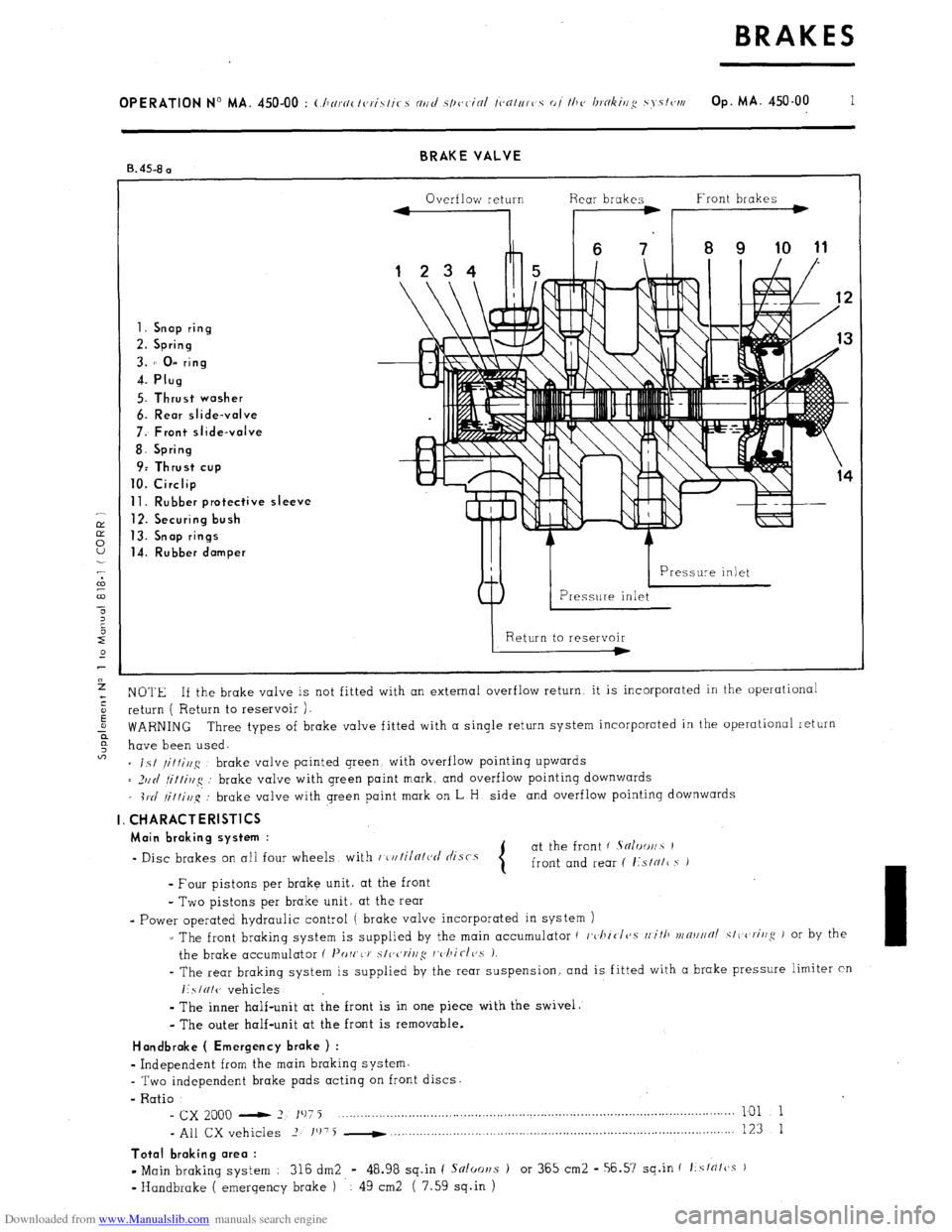
B. 45-8 a
Overflow return Rear brakes Front brakes
1. Snap ring
2. Spring
3. 1’ 0” ring
4. Plug
5. Thrust washer
6. Rear slide-valve
7: Front slide-valve
8. Spring
9: Thrust cup
10. Circlip
11. Rubber protective sleeve
12. Securing bush
13. Snap rings
14. Rubber damper
NOTE If the brake valve is not fitted with an external overflow return, it is incorporated in the operational
return ( Return to reservoir ).
WARNING Three types of brake valve fitted with a single return system incorporated in the operational return
have been used.
= is/
/it/i//g brake valve painted green with overflow pointing upwards
= _)IIII
fi/tirlg : brake valve with green paint mark, and overflow pointing downwards
_ i1.d
/it/i,l~q’: brake valve with green paint mark on L H side and overflow pointing downwards
I. CHARACTERlSTlCS
Main braking system :
- Disc brakes on all four wheels with r~u/iln/ct/ tlisrs at the front ( Sn/oo//~ I
front and rear ( I:sIN/~ s i
- Four pistons per brake unit. at the front
- Two pistons per brake unit, at the rear
- Power operated hydraulic control ( brake valve incorporated in system )
z The front braking system is supplied by the main accumulator ( c,~l~icI~~.s
rli/ll vrn~l//~/ SIC criug J or by the
the brake accumulator ( I’orr,< J’
s/ccrivg rc,/~iclc,s 1.
- The rear braking system is supplied by the rear suspension. and is fitted with a brake pressure limiter cn
I:SIUI(J vehicles
-
The inner half-unit at the front is in one piece with the swivel.
- The outer half-unit at the front is removable.
Handbroke ( Emergency brake ) :
w
Independent from the main braking system.
- Two independent brake pads acting on front discs.
- Ratio
- cx 2000 - 2 197 j ___._....._..._..._.........,............................................................................... 101 1
- All CX vehicles 2 1’j75 -
. . . . . . 123 1
Total braking area :
- Main braking system : 316 dm2 - 48.98 sq.in ( Snloor~s ) or 365 cm2 - 56.57 sq.in f f:sfrffcss )
v
Handbrake ( emergency brake ) 49 cm2 ( 7.59 sq.in )
Page 274 of 394

Downloaded from www.Manualslib.com manuals search engine FRONT BRAKE UNlT
L. 45-3
3.5 daNm 2.3ta Z5daNm
w-l 25 112 fi.lb 16 1 ’ /2 / to left lb
Page 275 of 394

Downloaded from www.Manualslib.com manuals search engine REAR BRAKE UNIT f .\N/w~//.v )
1.2 to 4.7 doNm
130 l/2 to
34 ft.lb ) face
J
md threod
greased
Page 276 of 394

Downloaded from www.Manualslib.com manuals search engine REAR BRAKE UNIT f /i.\/o/
Page 277 of 394
Downloaded from www.Manualslib.com manuals search engine OPERATION No MA. 450-00 : Ch nrnclcrislics ortd sp~~c-i~l (c~c~trlrc>s 01 the hokiug S SI~IN Op. MA. 450.00 5
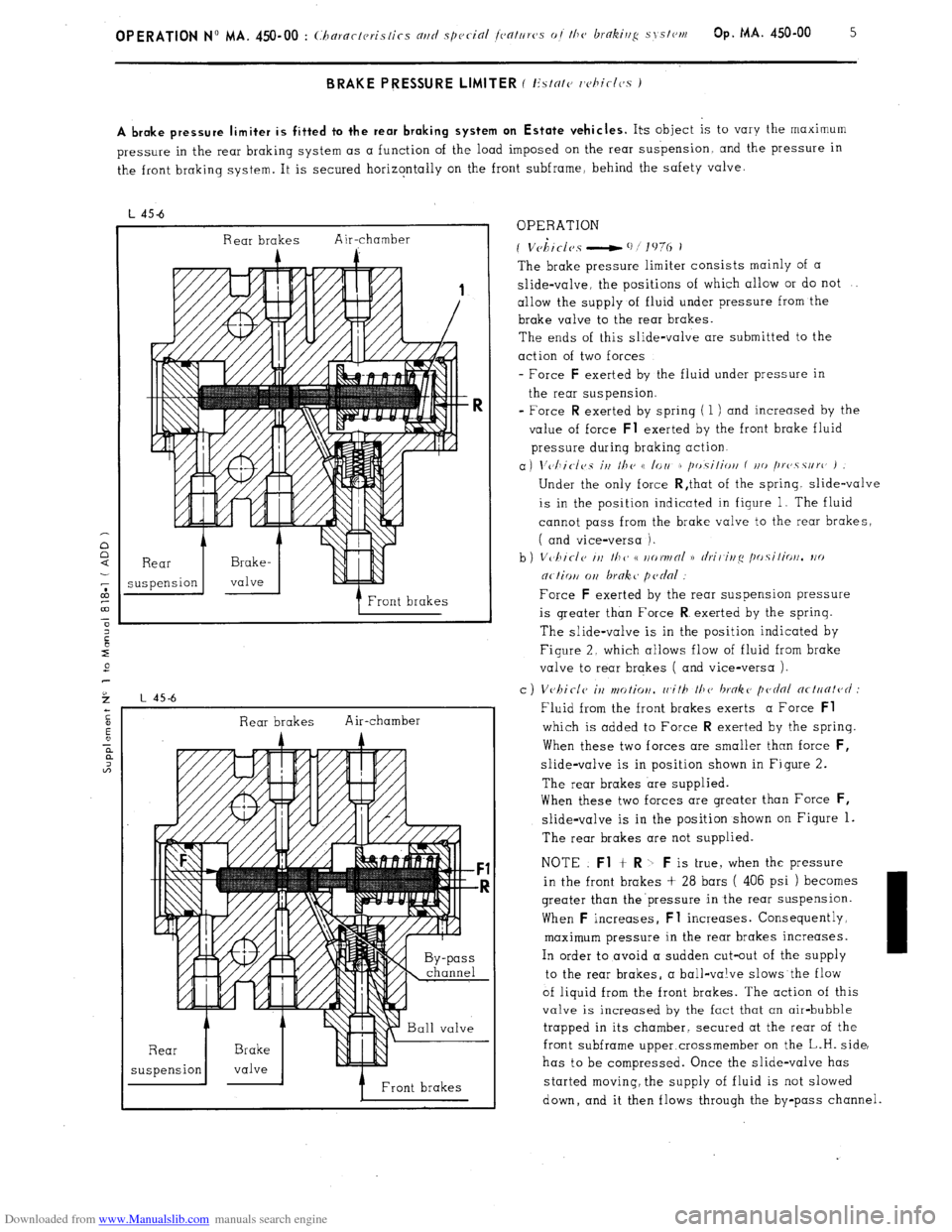
A brake pressure limiter is fitted to the rear braking system on Estate vehicles.
Its object is to vary the maximum
pressure in the rear braking system as a function of the load imposed on the rear suspension and the pressure in
the front braking system. It is secured horizontally on the front subframe, behind the safety valve.
L 45-6
Rear brakes Air-chamber
A
Front brakes
Rear brakes Air-chamber
A A --
7 Front brakes OPERATION
* I
f Vchtclcs - ‘I/]‘,?(, i
The brake pressure limiter consists mainly of a
slide-valve, the positions of which allow or do not
allow the supply of fluid under pressure from the
brake valve to the rear brakes.
The ends of this slide-valve are submitted to the
action of two forces
- Force F
exerted by the fluid under pressure in
the rear suspension.
= Force R
exerted by spring ( 1 ) and increased by the
value of force Fl
exerted by the front brake fluid
pressure during braking action.
a) \‘~~I~i~-/~~s irt Ilte t( lorl r /tr,.silioti f t/o /trc~.s.surc’ )
Under the only force R,that of the spring. slide-valve
is in the position indicated in figure 1. The fluid
cannot pass from the brake valve to the rear brakes,
( and vice-versa ).
Force
F exerted by the rear suspension pressure
is greater than Force R
exerted by the sprinq.
The slide-valve is in the position indicated by
Figure 2. which allows flow of fluid from brake
valve to rear brakes ( and vice-versa ).
c ) Vvhiclc il2 ntotior/. rr,ith 111~’ broke pednl ncl~~fit~~c/ :
Fluid from the front brakes exerts a Force Fl
which is added to Force R exerted by the spring.
When these two forces are smaller than force F,
slide-valve is in position shown in Figure 2.
The rear brakes are supplied.
When these two forces are greater than Force
F,
slide-valve is in the position shown on Figure 1.
The rear brakes are not supplied.
NOTE Fl
+ R -b F is true, when the pressure
in the front brakes + 28 bars ( 406 psi ) becomes
greater than the’pressure in the rear suspension.
When F
increases, Fl increases. Consequently,
maximum pressure in the rear brakes increases.
In order to avoid a sudden cut-out of the supply
to the rear brakes, a ball-valve slows the flow
of liquid from the front brakes. The action of this
valve is increased by the fact that an air-bubble
trapped in its chamber, secured at the rear of the
front subframe upper.crossmember on the L.H. side,
has to be compressed. Once the slide-valve has
started moving, the supply of fluid is not slowed
down, and it then flows through the by-pass channel.