Adjust CITROEN CX 1988 Owner's Manual
[x] Cancel search | Manufacturer: CITROEN, Model Year: 1988, Model line: CX, Model: CITROEN CX 1988Pages: 648, PDF Size: 95.8 MB
Page 212 of 648
CHECKING AND ADJUSTING
THE INJECTION SYSTEM
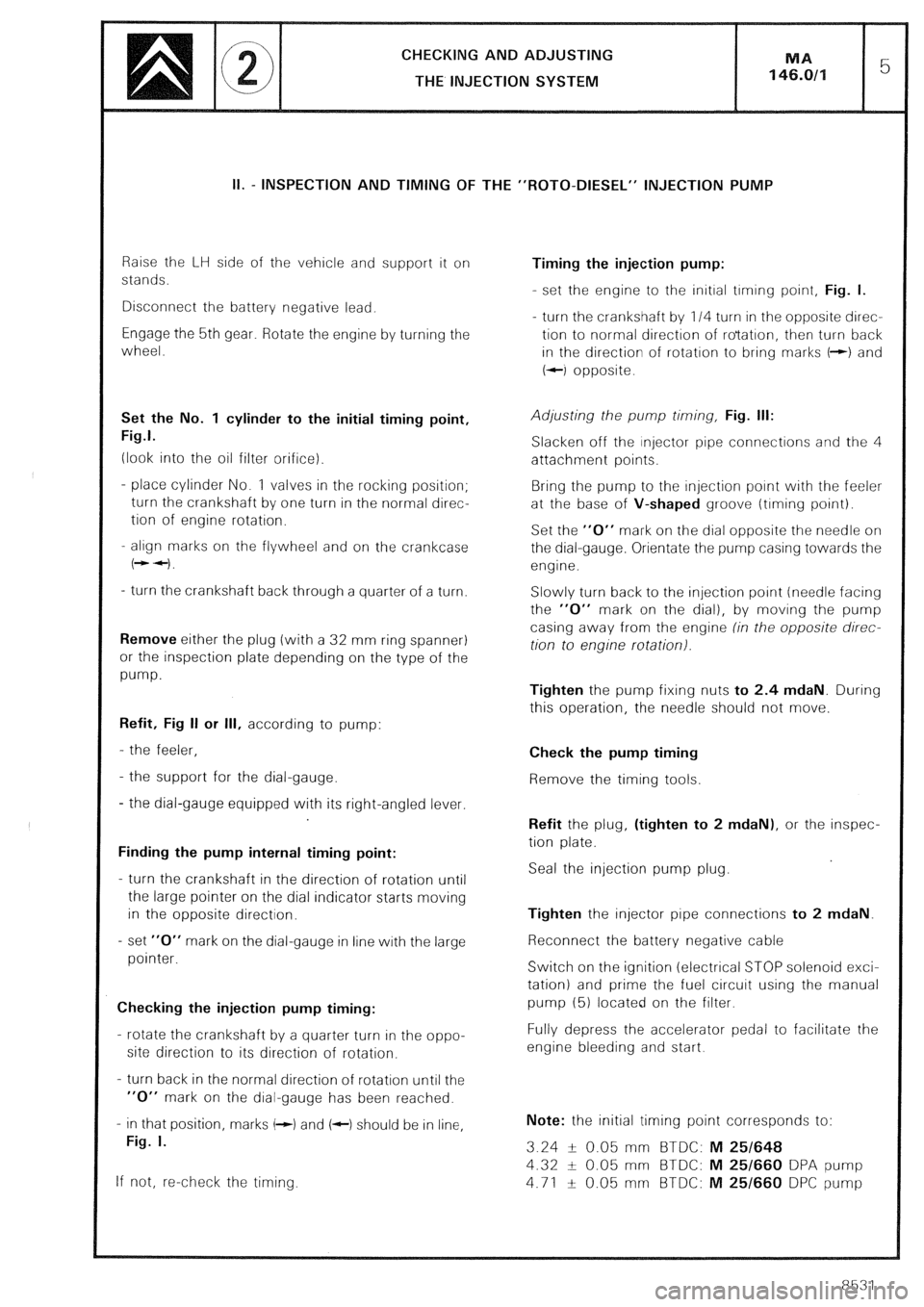
II. - INSPECTION AND TIMING OF THE “ROT0-DIESEL” INJECTION PUMP
Raise the LH side of the vehicle and support it on
stands.
Disconnect the battery negative lead.
Engage the 5th gear. Rotate the engine by turning the
wheel.
Set the No. 1 cylinder to the initial timing point,
Fig.1.
(look into the oil filter orifice).
- place cylinder No. 1 valves in the rocking position;
turn the crankshaft by one turn in the normal direc-
tion of engine rotation.
- align marks on the flywheel and on the crankcase
(++I.
- turn the crankshaft back through a quarter of a turn.
Remove either the plug (with a 32 mm ring spanner)
or the inspection plate depending on the type of the
pump.
Refit, Fig II or Ill, according to pump:
- the feeler,
- the support for the dial-gauge.
- the dial-gauge equipped with its right-angled lever.
Finding the pump internal timing point:
- turn the crankshaft in the direction of rotation until
the large pointer on the dial indicator starts moving
in the opposite direction.
- set “0” mark on the dial-gauge in line with the large
pointer.
Checking the injection pump timing:
- rotate the crankshaft by a quarter turn in the oppo-
site direction to its direction of rotation.
- turn back in the normal direction of rotation until the
“0” mark on the dial-gauge has been reached.
- in that position, marks (-1 and (c) should be in line,
Fig. I.
If not, re-check the timing. Timing the injection pump:
- set the engine to the initial trming point, Fig. I.
- turn the crankshaft by 114 turn in the opposite direc-
tion to normal direction of ro’tatron, then turn back
in the direction of rotation to bring marks t-+) and
+-I opposite.
Adjusting the pump timing, Fig. Ill:
Slacken off the injector pipe connections and the 4
attachment points.
Bring the pump to the injection point with the feeler
at the base of V-shaped groove (timing point).
Set the “0” mark on the dial opposite the needle on
the dial-gauge. Orientate the pump casing towards the
engine.
Slowly turn back to the injection point (needle facing
the “0” mark on the dial), by moving the pump
casing away from the engine (in the opposite direc-
tion to engine rotation).
Tighten the pump fixing nuts to 2.4 mdaN. During
this operation, the needle should not move.
Check the pump timing
Remove the timing tools.
Refit the plug, (tighten to 2 mdaN), or the inspec-
tion plate.
Seal the injection pump plug.
Tighten the injector pipe connections to 2 mdaN.
Reconnect the battery negative cable
Switch on the ignition (electrical STOP solenoid exci-
tation) and prime the fuel circuit using the manual
pump (5) located on the filter.
Fully depress the accelerator pedal to facilitate the
engine bleeding and start.
Note: the initial timing point corresponds to:
3.24 -L- 0.05 mm BTDC: M 25/648
4.32 + 0.05 mm BTDC: M 25/660 DPA pump
4.71 f 0.05 mm BTDC: M 25/660 DPC pump
8531
Page 213 of 648
CHECKING AND ADJUSTING
THE INJECTION SYSTEM
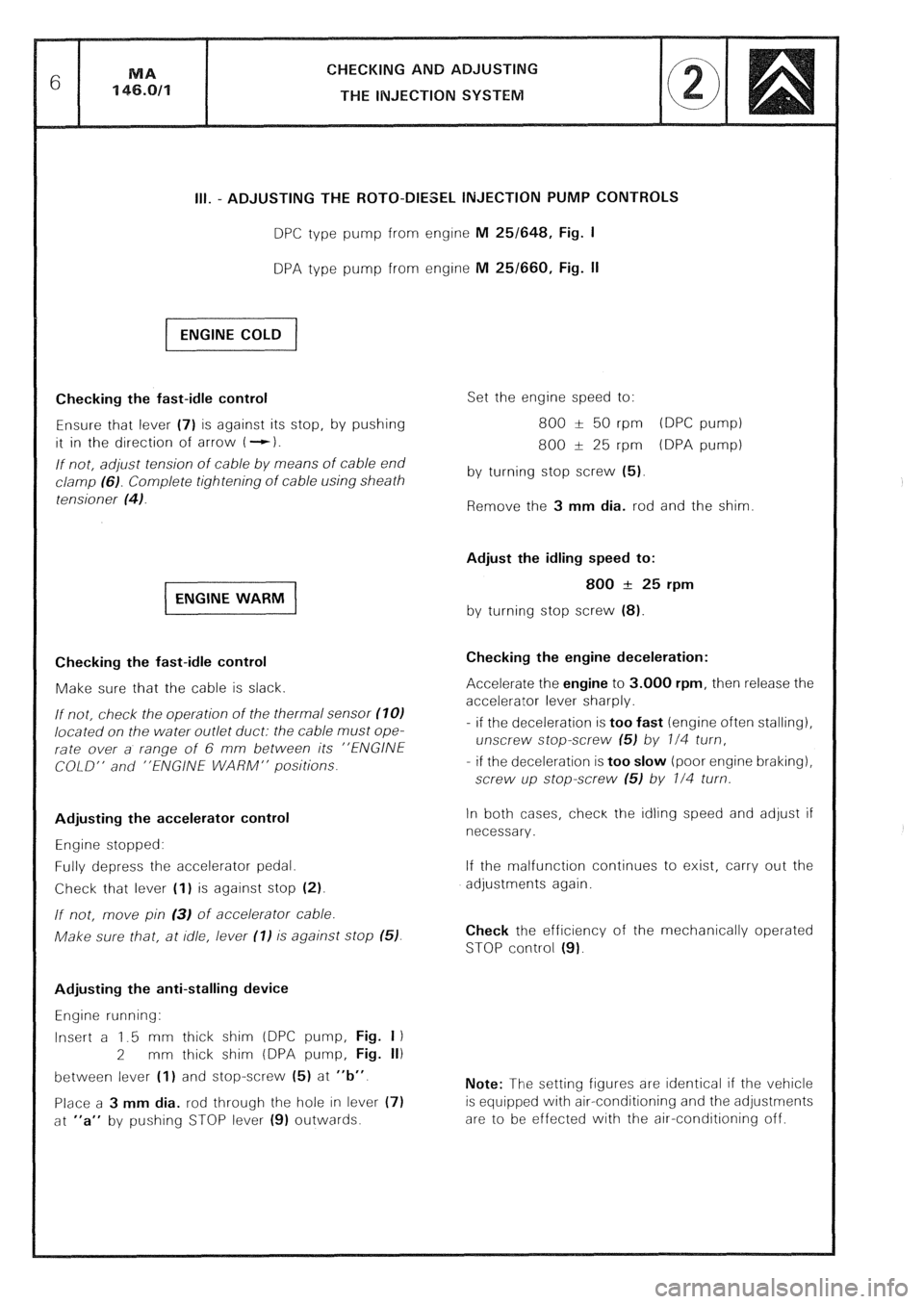
III. - ADJUSTING THE ROTO-DIESEL INJECTION PUMP CONTROLS
DPC type pump from engine M 25/648, Fig. I
DPA type pump from engine M 25/660, Fig. II
Checking the fast-idle control
Ensure that lever (7) is against its stop, by pushing
it in the direction of arrow (-).
If not, adjust tension of cab/e by means of cable end
clamp (6). Complete tightening of cable using sheath
tensioner (41.
Checking the fast-idle control
Make sure that the cable is slack.
If not, check the operation of the thermal sensor (101
located on the water outlet duct: the cable must ope-
rate over a range of 6 mm between its “ENGINE
COLD” and “ENGINE WARM” positions.
Adjusting the accelerator control
Engine stopped:
Fully depress the accelerator pedal.
Check that lever (I) is against stop (2).
If not, move pin (3) of accelerator cable.
Make sure that, at idle, lever (I) is against stop (5).
Adjusting the anti-stalling device
Engine running:
Insert a 1.5 mm thick shim (DPC pump, Fig. I)
2 mm thick shim (DPA pump, Fig. II)
between lever (I) and stop-screw (5) at “b”.
Place a 3 mm dia. rod through the hole in lever (7)
at “a” by pushing STOP lever (9) outwards. Set the engine speed to:
800 t 50 rpm (DPC pump)
800 f 25 rpm (DPA pump)
by turning stop screw (5).
Remove the 3 mm dia. rod and the shim
Adjust the idling speed to:
800 + 25 rpm
by turning stop screw (8).
Checking the engine deceleration:
Accelerate the engine to 3.000 rpm, then release the
accelerator lever sharply.
- if the deceleration is too fast (engine often stalling),
unscrew stop-screw (5) by 114 turn,
- if the deceleration is too slow (poor engine braking),
screw up stop-screw (51 by l/4 turn.
In both cases, check the idling speed and adjust if
necessary.
If the malfunction continues to exist, carry out the
adjustments again.
Check the efficiency of the mechanically operated
STOP control (9).
Note: The setting figures are identical if the vehicle
is equipped with air-conditioning and the adjustments
are to be effected with the air-conditioning off.
Page 218 of 648
REMOVING/REFITTING D.P.A. AND D.P.C.
ROT0 DIESEL INJECTION PUMPS MA
146.1/l 5
REFITTING
Prepare
- the pump (see Op. @ MA 146.0/l/
Fit
- the pump with the mounting studs in the middle of
the slots,
- the pump fixing nuts but do not tighten home.
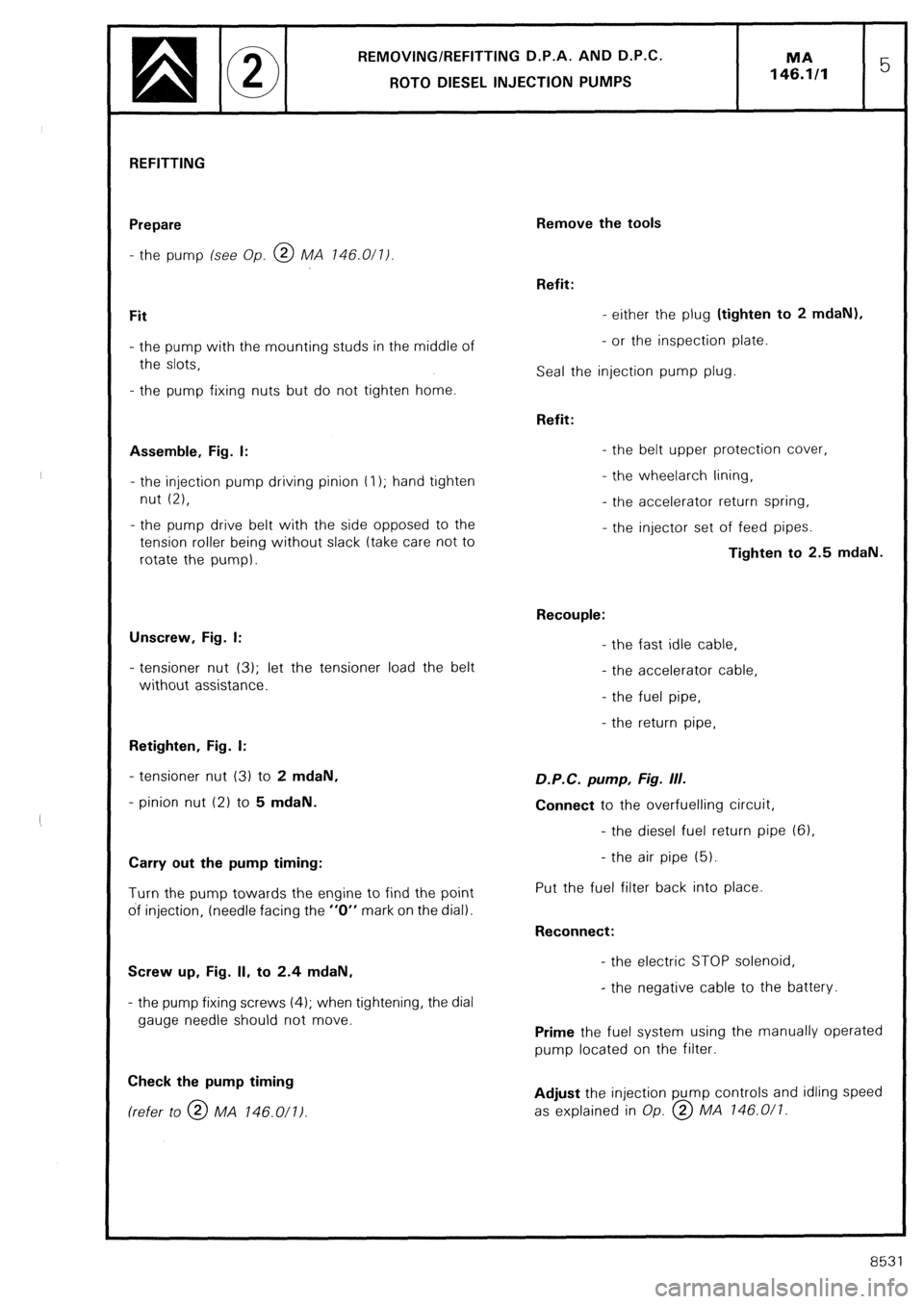
Assemble, Fig. I:
- the injection pump driving pinion t I); hand tighten
nut (2),
- the pump drive belt with the side opposed to the
tension roller being without slack (take care not to
rotate the pump).
Unscrew, Fig. I:
- tensioner nut (3); let the tensioner load the belt
without assistance.
Retighten, Fig. I:
- tensioner nut (3) to 2 mdaN,
- pinion nut (2) to 5 mdaN.
Carry out the pump timing:
Turn the pump towards the engine to find the point
of injection, (needle facing the “0” mark on the dial).
Screw up, Fig. II, to 2.4 mdaN,
- the pump fixing screws (4); when tightening, the dial
gauge needle should not move.
Check the pump timing (refer to @ MA 146.011)
Remove the tools
Refit:
- either the plug (tighten to 2 mdaN),
- or the inspection plate.
Seal the injection pump plug.
Refit:
- the belt upper protection cover,
- the wheelarch lining,
- the accelerator return spring,
- the injector set of feed pipes.
Tighten to 2.5 mdaN.
Recouple:
- the fast idle cable,
- the accelerator cable,
- the fuel pipe,
- the return pipe, D.P.C. pump, Fig. III.
Connect to the overfuelling circuit,
- the diesel fuel return pipe (61,
- the air pipe (5).
Put the fuel filter back into place.
Reconnect:
- the electric STOP solenoid,
- the negative cable to the battery.
Prime the fuel system using the manually operated
pump located on the filter.
Adjust the injection pump controls and idling speed
as explained in Op. @ MA 146.0/l.
8531
Page 233 of 648

GENERAL FEATURES
OF THE TRANSISTORISED IGNITION SYSTEM
TRANSISTORISED IGNITION
PRINCIPLE OF OPERATION
The plug spark is triggered by distributor (1) which comprises a coil located inside the field of a magnetic circuit
permanent magnet. The magnetic circuit has four fixed branches and four movable branches driven by the distribu-
tor shaft.
When the movable branches, in their rotation, come opposite the fixed ones, a variation of the magnetic field is
brought and current is induced into the sensor winding.
This current, in turn, triggers electronic module (2)
which builds up the current in ignition coil (3) primary winding
and then cuts it off, thus creating a high tension current in the coil secondary winding and triggering a spark from
the plug selected by the distributor rotor arm. IGNITION DISTRIBUTOR (I!
The advance curves are specific for each engine type
N: Distributor rpm
D = Vacuum Dl, in m.bars A:
Distributor degrees 02, in mm.hg
Pick-up coil resistance: 1100 Q sr 10% (990 to 1210 02)
Setting the distributor static timing on the engine is impossible owing to design.
A revolution of the distributor is required to create a variation of the magnetic field which will send a signal to the
module. Consequently, when fitting a distributor, place it in mid-slot; start the engine and adjust the distributor
by means of a timing light or a diagnosis console.
The duration and amplitude of the signal depend on the speed, therefore the DWELL ratio
is not significant.
The air gap between the branches is non-adjustable and it cannot be measured ELECTRONIC MODULE (2)
Intended to operate with the magnetically-triggered distributor.
Do not carry out a check with an ohmmeter since the results would not be significant.
Do not operate the module without cooling (aluminium plate heat sink and heat conductor grease).
The operation of the ignition system is possible with the engine stopped: - connect an earthed sparking plug to
the coil HT lead; short ” + 12 volts” pulses on module red lead (path 5) (with all leads connected, cap lifted) will
generate a spark from the plug: simulation of a signal from the distributor pick up).
Do not operate the module and coil without a plug and HT lead, (It could result in the module being destroyed). IGNITION COIL (3)
The coil must not be kept alive under 12 volts without its module (overheating).
The coil current flow is generated by the module which then reduces it, prior to cutting it off when the engine
ignition timing occurs.
Only use a rev. counter with a UT induction clip.
Page 259 of 648
CHECKING THE TRANSISTORISED IGNITION MA
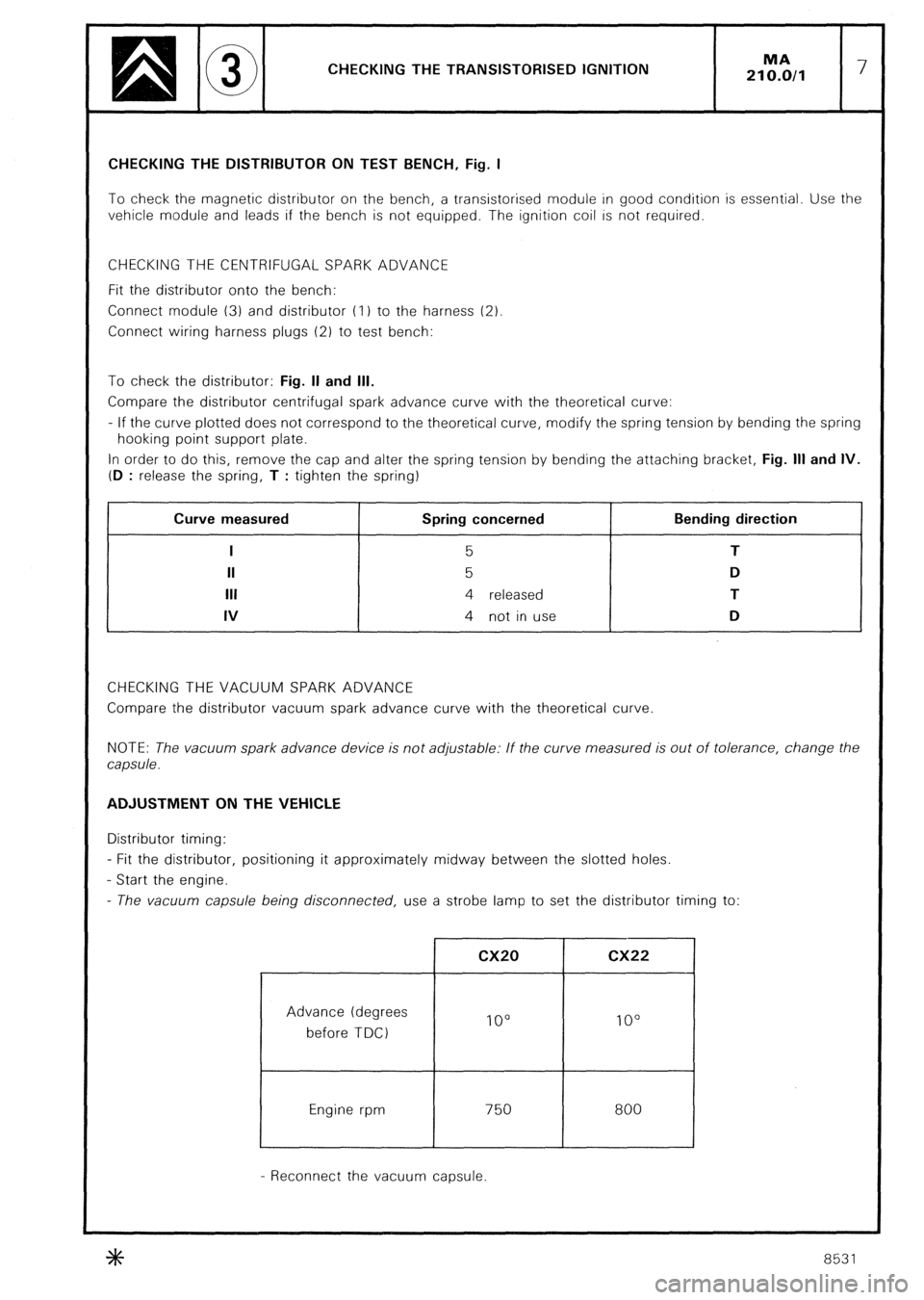
210.0/l 7 CHECKING THE DISTRIBUTOR ON TEST BENCH, Fig. I
To check the magnetic distributor on the bench, a transistorised module in good condition is essential. Use the
vehicle module and leads if the bench is not equipped. The ignition coil is not required.
CHECKING THE CENTRIFUGAL SPARK ADVANCE
Fit the distributor onto the bench:
Connect module (3) and distributor (I 1 to the harness (2)
Connect wiring harness plugs (2) to test bench:
To check the distributor: Fig. II and Ill.
Compare the distributor centrifugal spark advance curve with the theoretical curve:
- If the curve plotted does not correspond to the theoretical curve, modify the spring tension by bending the spring
hooking point support plate.
In order to do this, remove the cap and alter the spring tension by bending the attaching bracket, Fig. Ill and IV.
(D
: release the spring, T : tighten the spring) , Curve measured
I
II
Ill
IV Spring concerned
5
5
4 released
4 not in use Bending direction
T
D
T
D
CHECKING THE VACUUM SPARK ADVANCE
Compare the distributor vacuum spark advance curve with the theoretical curve
NOTE: The vacuum spark advance device is not adjustable: If the curve measured is out of tolerance, change the
capsule. ADJUSTMENT ON THE VEHICLE
Distributor timing:
- Fit the distributor, positioning it approximately midway between the slotted holes.
- Start the engine.
- The vacuum capsule being disconnected, use a strobe lamp to set the distributor timing to:
Advance (degrees
before TDC)
Engine rpm cx20 cx22
IO0 lo0
750
I 800
- Reconnect the vacuum capsule.
8531
Page 278 of 648
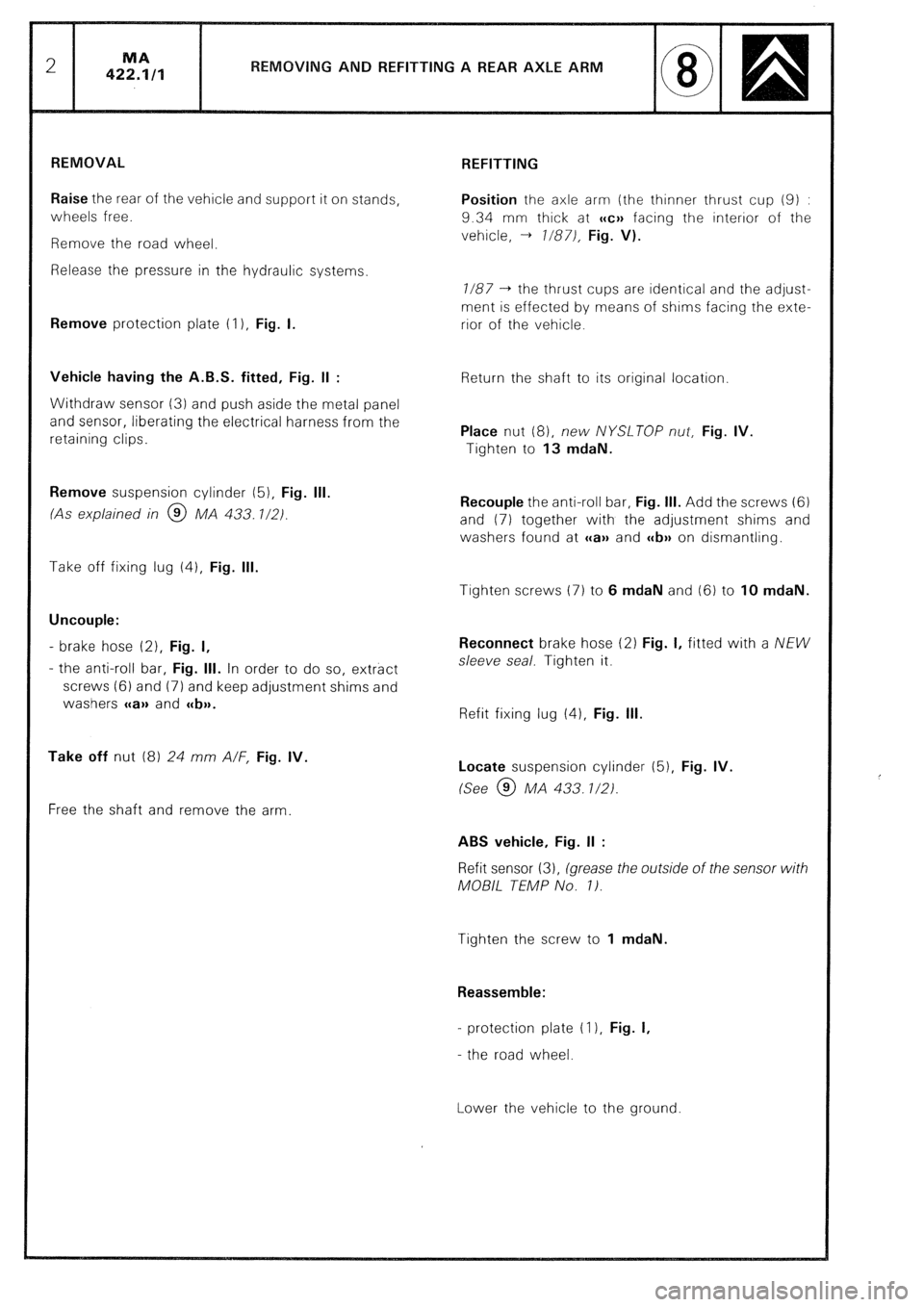
2 IVIA
422.1/l OVING AND REFITTING A REAR AXLE ARM
REMOVAL
Raise the rear of the vehicle and support it on stands,
wheels free.
Remove the road wheel.
Release the pressure in the hydraulic systems.
Remove protection plate (I 1, Fig. I.
Vehicle having the A.B.S. fitted, Fig. II :
Withdraw sensor (3) and push aside the metal panel
and sensor, liberating the electrical harness from the
retaining clips.
Remove suspension cylinder (5), Fig. Ill.
(As explained in @ MA 433. l/2/.
Take off fixing lug (41, Fig. Ill.
Uncouple:
- brake hose (21, Fig. I,
- the anti-roll bar, Fig. Ill. In order to do so, extract
screws (6) and (7) and keep adjustment shims and
washers c(a)) and ccbal.
Take off nut (8) 24 mm A/F, Fig. IV.
Free the shaft and remove the arm. REFITTING
Position the axle arm (the thinner thrust cup (9) :
9.34 mm thick at CCCH facing the interior of the
vehicle, -+ l/87), Fig. V).
l/87 -+ the thrust cups are identical and the adjust-
ment is effected by means of shims facing the exte-
rior of the vehicle.
Return the shaft to its original location.
Place nut (8), new NYSLTOP nul, Fig. IV.
Tighten to 13 mdaN.
Recouple the anti-roll bar, Fig. Ill. Add the screws (6)
and (7) together with the adjustment shims and
washers found at c(a)) and c(b)) on dismantling.
Tighten screws (7) to 6 mdaN and (6) to 10 mdaN.
Reconnect brake hose (2) Fig. I, fitted with a NEW
sleeve seal. Tighten it.
Refit fixing lug (41, Fig. Ill.
Locate suspension cylinder (51, Fig. IV.
(See @ MA 433. l/2/.
ABS vehicle, Fig. II :
Refit sensor (31, (grease the outside of the sensor with
MOBIL TEMP No. I).
Tighten the screw to 1 mdaN.
Reassemble:
- protection plate (I 1, Fig. I,
- the road wheel.
Lower the vehicle to the ground.
Page 287 of 648
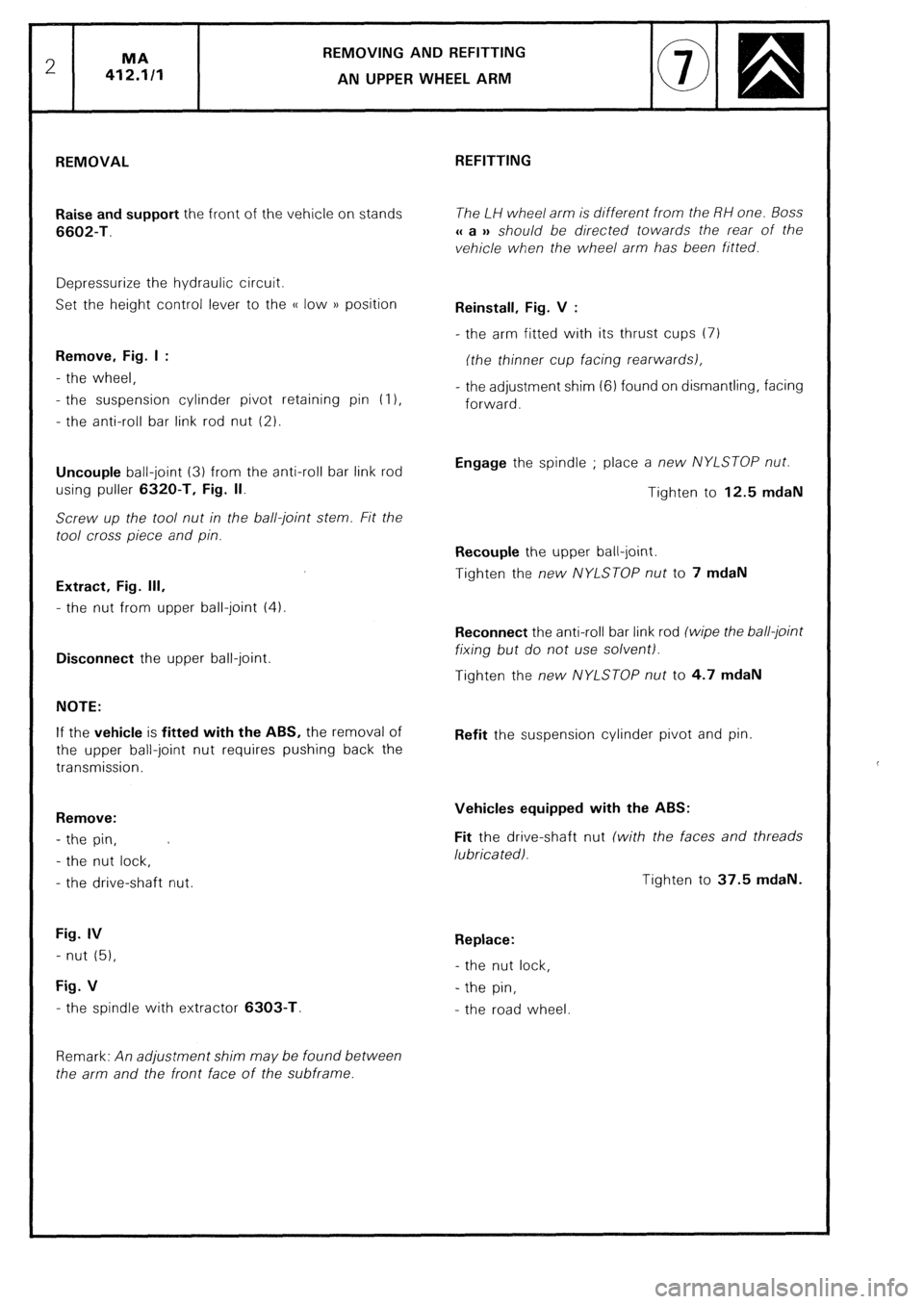
REMOVING AND REFITTING
AN UPPER WHEEL ARM
REMOVAL
Raise and support the front of the vehicle on stands
6602-T.
Depressurize the hydraulic circuit.
Set the height control lever to the (( low )) position
Remove, Fig. I :
- the wheel,
- the suspension cylinder pivot retaining pin (I 1,
- the anti-roll bar link rod nut (2).
Uncouple ball-joint (3) from the anti-roll bar link rod
using puller 6320-T. Fig. II.
Screw up the tool nut in the ball-joint stem. Fit the
tool cross piece and pin.
Extract, Fig. Ill,
- the nut from upper ball-joint (4).
Disconnect the upper ball-joint.
NOTE:
If the vehicle is fitted with the ABS, the removal of
the upper ball-joint nut requires pushing back the
transmission.
Remove:
- the pin, C
- the nut lock,
- the drive-shaft nut.
Fig. IV
- nut (51,
Fig. V
- the spindle with extractor 6303-T.
Remark: An adjustment shim may be found between
the arm and the front face of the subframe. REFITTING
The LH wheel arm is different from the RH one. Boss
u a )a should be directed towards the rear of the
vehicle when the wheel arm has been fitted.
Reinstall, Fig. V :
- the arm fitted with its thrust cups (7)
frhe thinner cup facing rearwardsl,
- the adjustment shim (6) found on dismantling, facing
forward.
Engage the spindle ; place a new NYLSTOP nut.
Tighten to 12.5 mdaN
Recouple the upper ball-joint.
Tighten the new NYLSTOP nut to 7 mdaN
Reconnect the anti-roll bar link rod (wipe the ball-joint
fixing but do nor use solventl.
Tighten the new NYLSTOP nut to 4.7 mdaN
Refit the suspension cylinder pivot and pin.
Vehicles equipped with the ABS:
Fit the drive-shaft nut (with the faces and threads
lubricated).
Tighten to 37.5 mdaN.
Replace:
- the nut lock,
- the pin,
- the road wheel
Page 290 of 648
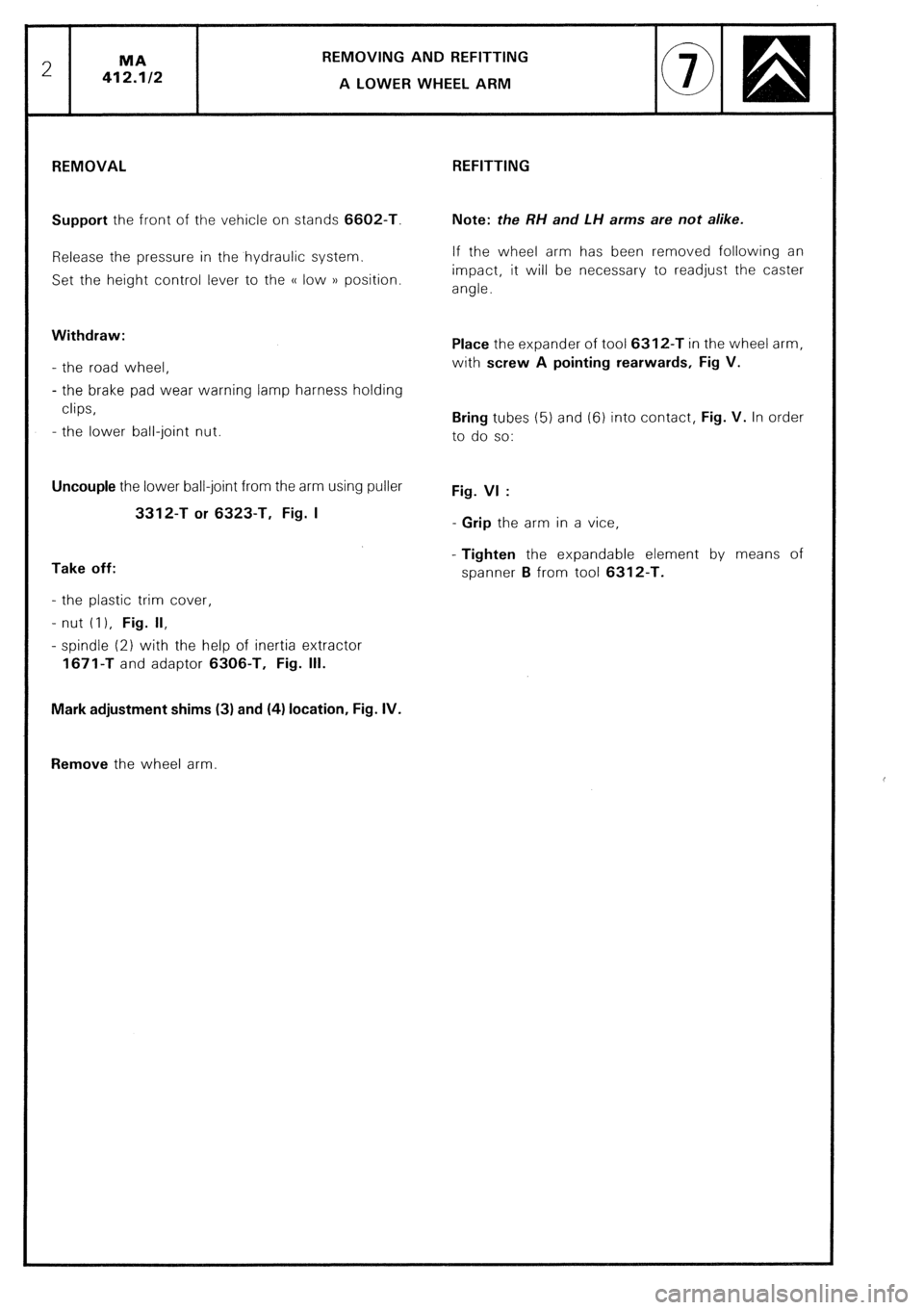
REMOVING AND REFITTING
REMOVAL
Support the front of the vehicle on stands 6602-T.
Release the pressure in the hydraulic system.
Set the height control lever to the (( low )) position.
Withdraw:
- the road wheel,
- the brake pad wear warning lamp harness holding
clips,
- the lower ball-joint nut.
Uncouple the lower ball-joint from the arm using puller
3312-T or 6323-T, Fig. I
Take off:
- the plastic trim cover,
- nut (I 1, Fig. II,
- spindle (2) with the help of inertia extractor
1671-T and adaptor 6306-T, Fig. Ill.
Mark adjustment shims (3) and (4) location, Fig. IV.
Remove the wheel arm. REFITTING
Note: the RH and LH arms are not alike.
If the wheel arm has been removed following an
impact, it will be necessary to readjust the caster
angle.
Place the expander of tool 6312-T in the wheel arm,
with screw A pointing rearwards, Fig V.
Bring tubes (5) and (6) into contact, Fig. V. In order
to do so:
Fig. VI :
- Grip the arm in a vice,
- Tighten the expandable element by means of
spanner B from tool 6312-T.
Page 293 of 648
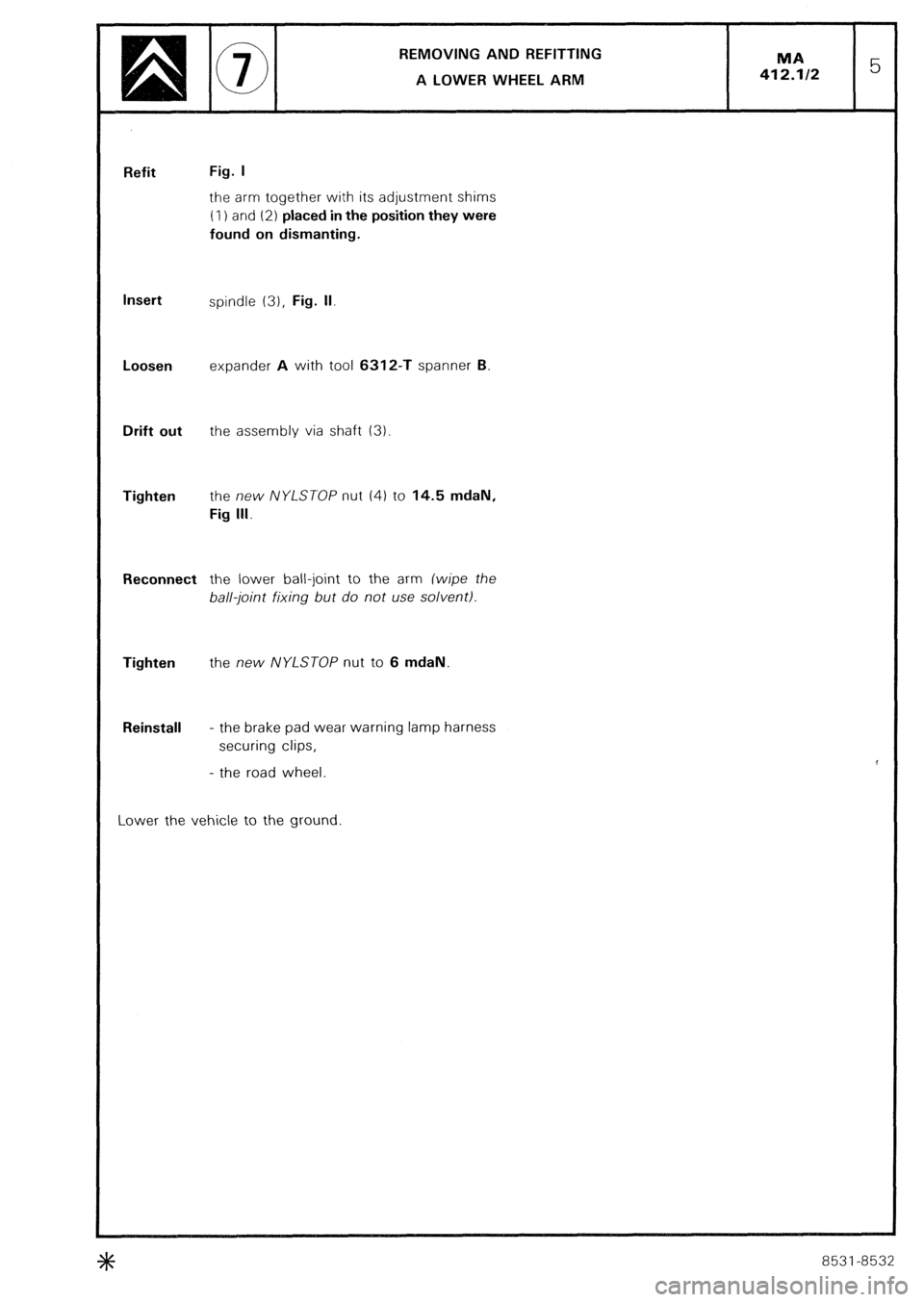
REMOVING AND REFITTING
A LOWER WHEEL ARM
Refit
Insert
Loosen
Drift out
Tighten
Reconnect
Tighten
Reinstall Fig. I
the arm together with its adjustment shims
(7 1 and (2) placed in the position they were
found on dismanting.
spindle (31, Fig. II
expander A with tool 6312-T spanner B.
the assembly via shaft (3)
the new NYLSTOP nut (4) to 14.5 mdaN,
Fig Ill.
the lower ball-joint to the arm hvipe the
ball-joint fixing but do not use solvent).
the new NYLSTOP nut to 6 mdaN.
- the brake pad wear warning lamp harness
securing clips,
- the road wheel.
Lower the vehicle to the ground
Jfc 8531-8532
Page 311 of 648

REMOVING AND REFITTING A SWIVEL
REFITTING Replace, Fig. IV:
Wipe the ball-joint fixings and location, do not use - flexible pipe (I I) into its fixing bracket,
solvent. - washer (I 0).
Recouple the upper ball-joint with the swivel. Tighten nut (9) to 2.2 mdaN.
Refit, Fig. I: Recouple:
- washer (I),
- Fig. IV, connection (I 2) provided with a new sea/.
- nut (2).
- Fig. V, the steering ball-joint.
Tighten to 7 mdaN (New NYLSTOP nut).
Refit:
Introduce the drive-shaft end into the wheel hub - washer (I 31,
(lubricate the hub seal lips). - nut (14) (New NYLSTOP one).
Couple up the lower ball-joint. Tighten to 6 mdaN.
Tighten to 6 mdaN the new NYLSTOP nut. Reconnect:
-cup (171,
Reconnect the brake pad wear warning lamp harness. - spring (I 61,
-cable (15).
Refit, Fig. II and Ill:
Adjust the handbrake (as indicated in @ 454.011).
- electrical harness fixing bracket (4).
- earth lead (5).
- screw (3). Put the drive-shaft nut into place.
- metal panel (6). (Faces and threads lubricated).
Lock the hub, utilizing tool 6310-T Fig. VI.
ABS vehicles, Fig. Ill:
Tighten to 37.5 mdaN.
Reinstall sensor (7) (spread MOB/L TEMP No. 1
grease over the outside of the sensor.
Bleed the front brakes (see @ 453.0/l/.
Tighten screw (8) to 1 mdaN.
Fit the wheel.
Lower the vehicle to the ground.
8531-8532