ESP Citroen DS3 2012 1.G Owner's Guide
[x] Cancel search | Manufacturer: CITROEN, Model Year: 2012, Model line: DS3, Model: Citroen DS3 2012 1.GPages: 332, PDF Size: 9.57 MB
Page 162 of 332

Gear shift indicator *
Operation
The system intervenes only when driving economically.
Depending on the driving situation and your
vehicle's equipment, the s
ystem may advise you to skip one or more gears. You can
follow this instruction without engaging the
intermediate gears.
The gear engagement recommendations mustnot be considered compulsory. In fact, the configuration of the road, the amount of trafficand safety remain determining factors whenchoosing the best gear. Therefore, the driver remains responsible for deciding whether or not
to follow the advice given by the system.
This function cannot be deactivated.
- The s
ystem may suggest that you engage a
higher gear, if appropriate.
The in
formation appears in the instrument panel in the form of an arrow accompanied bythe suggested gear.
In the case of driving which makesparticular demands on the performance of the engine (firm pressure on theaccelerator pedal, for example, whenover taking...), the system will notrecommend a gear change. The system never suggests:
- engaging first gear,
- engaging reverse gear,
- engaging a lower gear.
*
Accordin
g to engine.
Example:
- You are in third
gear.
- You press the accelerator pedal
moderatel
y.
Page 169 of 332

167
Driving
When you move the lever in the gate to select
a position, the corresponding indicator is
displa
yed in the instrument panel.P. Park
R.Reverse
N. Neutral D.Drive (Automatic driving)
S.Sport programme7.Snowprogramme1 2 3 4.Gears engaged during manual operation-.
Invalid value during manual operation
Displays in the instrument panel
Foot on brake
)
Press the brake pedal when this
indicator lamp is displayed in the
instrument panel (e.g.: star tingthe engine).
Moving off
If position Nis engaged inadvertently while driving, allow the engine to return to idle then engage position Dto accelerate.
When the engine is running at idle, withthe brakes released, if position R, D
or Mis selected, the vehicle moveseven without the accelerator being pressed.
When the engine is running, never leave children in the vehicle withoutsupervision.
When carrying out maintenance with the engine running, apply the parkingbrake and select position P.P
)
Apply the parking brake. )
Select position Por N.)
Start the engine.
If this procedure is not followed, an audible
signal is heard, accompanied by a message in
the multifunction screen.) With the engine running, press the brake
pedal.
) Release the parking brake.)
Select position R , D
or M . )
Gradually release the brake pedal.
The vehicle moves off immediately.
Page 176 of 332
System which prevents the vehicle fromexceeding the speed programmed by the driver.
When the programmed speed limit is reached, pressing the accelerator pedal in the normalmanner no longer has any effect.
The speed limiter is switched onmanually:
it requires a programmed speed of at least
20 mph (30 km/h). The speed limiter is switched off by manual foperation of the control.
The programmed speed can be exceeded
temporaril
y by pressing the accelerator firmly.
To return to the programmed speed, simply slow down to a speed below the programmed speed.
The programmed speed remains in the memorywhen the ignition is switched off.
Speed limiter
The speed limiter cannot, in any circumstances,replace the need to respect speed limits, nor can it replace the need for vigilance and responsibility on the par t of the driver.
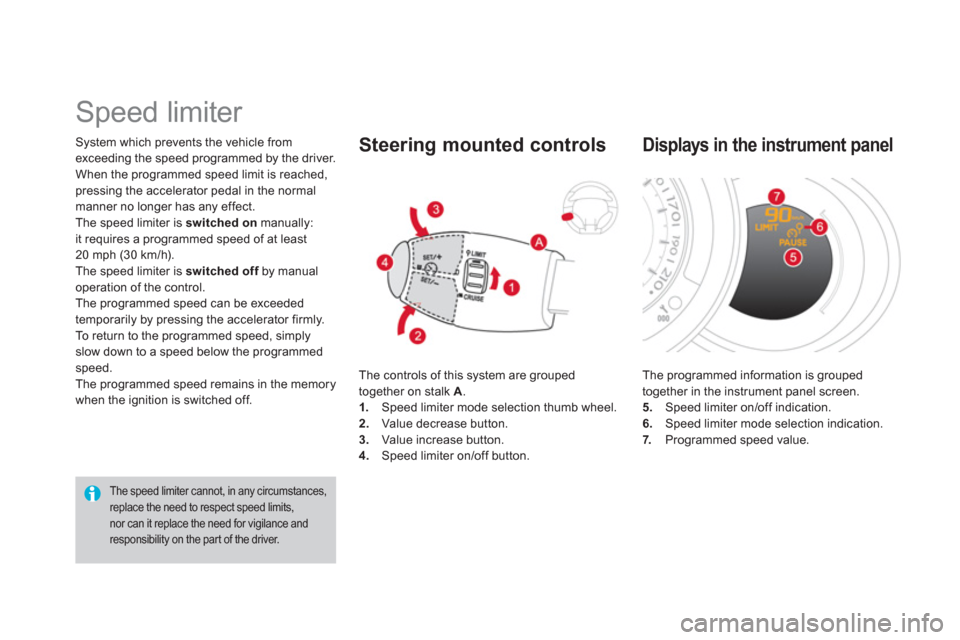
The controls of this system are grouped
together on stalk A
.
1
.Speed limiter mode selection thumb wheel.
2. Value decrease button. 3.
Value increase button. 4.Speed limiter on/off button.
Steering mounted controls
The programmed information is grouped
together in the instrument panel screen.
5
. Speed limiter on/off indication.
6. Speed limiter mode selection indication.
7. Programmed speed value.
Displays in the instrument panel
Page 178 of 332
Cruise control
System which automatically maintains the
speed of the vehicle at the value programmed
by the driver, without any action on the accelerator pedal.
The cruise control is switched on
manually:
it requires a minimum vehicle speed of 25 mph
(40 km/h), as well as the engagement of:
- fourth gear on a manual gearbox,
- second gear on a or automatic or electronic
gearbox, in sequential mode,
-
position A
on an electronic gearbox or position D
on an automatic gearbox.
The cruise control is switched offmanuallyfor by pressing the brake or clutch pedal or
on triggering of the ESP system for safety reasons. It is possible to exceed the programmed speed
temporarily by pressing the accelerator pedal.
To return to the programmed speed, simply
release the accelerator pedal.
Switching off the ignition cancels any programmed speed value. The controls o
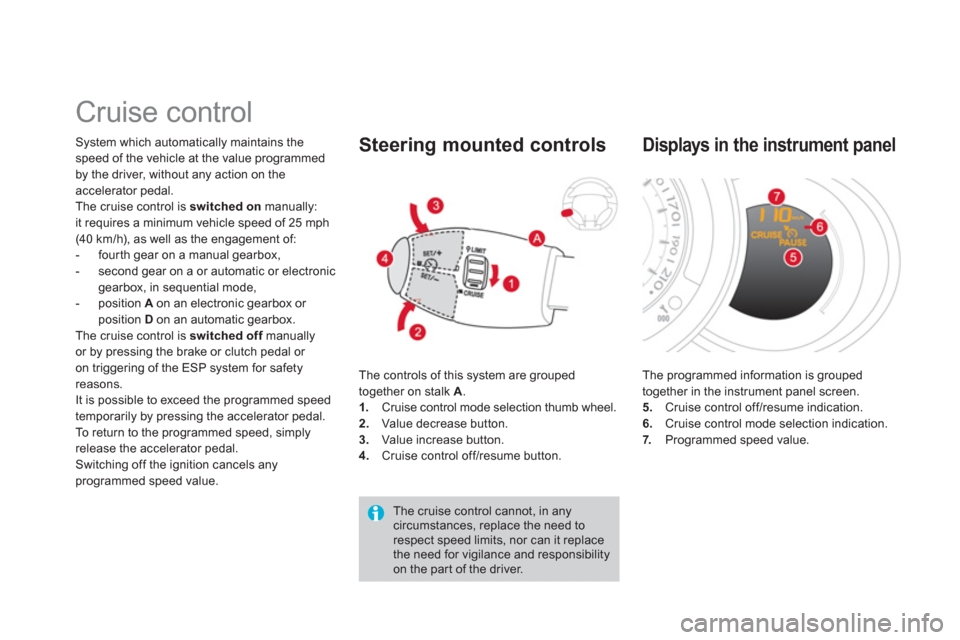
f this system are grouped
together on stalk A
.
1.Cruise control mode selection thumb wheel.
2. Value decrease button. 3.
Value increase button. 4.Cruise control off/resume button.
Steering mounted controls
The cruise control cannot, in anycircumstances, replace the need to respect speed limits, nor can it replace the need for vigilance and responsibilityon the part of the driver. The programmed in
formation is grouped
together in the instrument panel screen.
5. Cruise control off/resume indication.
6. Cruise control mode selection indication.
7. Programmed speed value.
Displays in the instrument panel
Page 180 of 332
Rear parking sensors
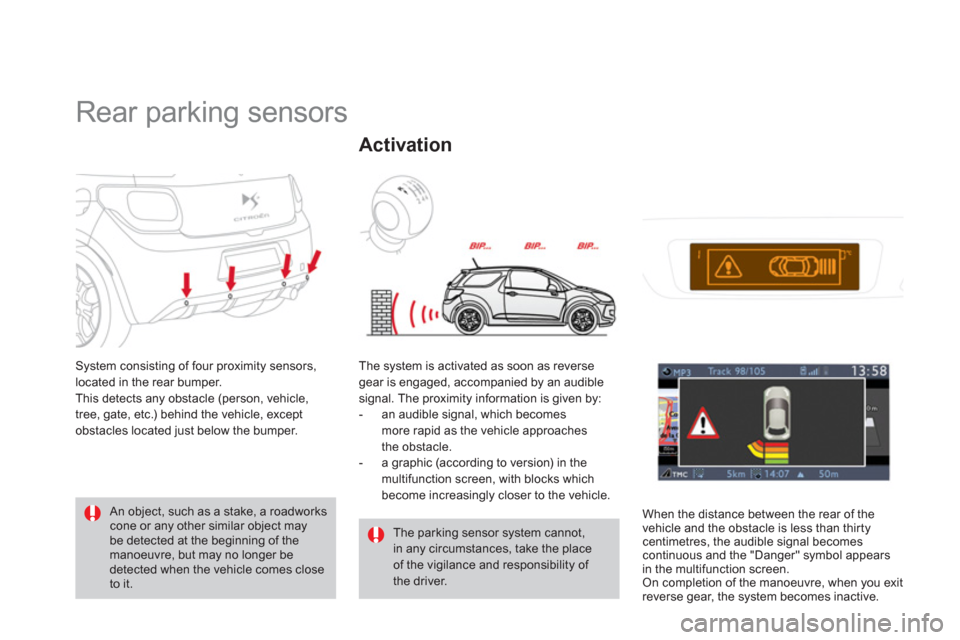
System consisting of four proximity sensors,
located in the rear bumper.
This detects an
y obstacle (person, vehicle,
tree, gate, etc.) behind the vehicle, except
obstacles located just below the bumper.
An object, such as a stake, a roadworks cone or any other similar object may be detected at the beginning of themanoeuvre, but may no longer be detected when the vehicle comes close to it.
The parking sensor system cannot, in any circumstances, take the place of the vigilance and responsibility of the driver. The system is activated as soon as reverse
gear is engaged, accompanied by an audible
signal. The proximity information is given by:
- an audible signal, which becomes
more rapid as the vehicle approaches
th
e obstacle.
- a graphic (according to version) in the
multifunction screen, with blocks whichbecome increasingly closer to the vehicle.
Activation
When the distance between the rear of thevehicle and the obstacle is less than thirtycentimetres, the audible signal becomescontinuous and the "Danger" symbol appears
in the multifunction screen.
On completion of the manoeuvre, when you exit
reverse gear, the system becomes inactive.
Page 181 of 332
179Driving
ProgrammingOperating faults
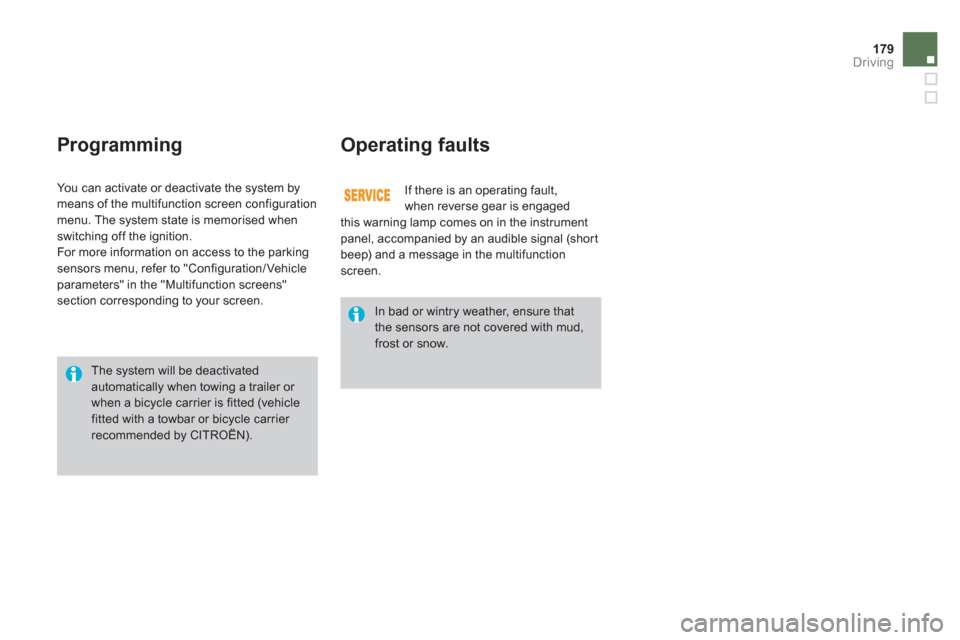
If there is an operating fault,
when reverse gear is engaged
this warning lamp comes on in the instrumentpanel, accompanied by an audible signal (short
beep) and a message in the multifunction screen. You can activate or deactivate the s
ystem bymeans of the multifunction screen configuration menu. The system state is memorised when
switching off the ignition.
For more information on access to the parkingsensors menu, refer to "Configuration/Vehic leparameters" in the "Multifunction screens"section corresponding to your screen.
The system will be deactivated automatically when towing a trailer or when a bicycle carrier is fitted (vehiclefitted with a towbar or bicycle carrier recommended by CITROËN).
In bad or wintry weather, ensure that the sensors are not covered with mud,frost or snow.
Page 189 of 332
187
Checks
Checking levels
Check all of these levels regularly and top them up if necessary, unless other wise indicated.
If a level drops si
gnificantly, have the corresponding system checked by a CITROËN dealer or a qualified workshop.
Oil level
Engine oil change
Refer to the servicing booklet for details of theinterval for this operation.
In order to maintain the reliability of the engine and emission control system, the use of additives in the engine oil is prohibited.
Oil grade
The oil must be suitable for your engine and conform to the manufacturer'srecommendations.
Brake fluid level
Changing the fl uid
Refer to the servicing booklet for details of the
interval for this operation.
Fluid specifi cation
The brake fluid must conform to themanufacturer's recommendations and meet theDOT4 standard.
Th
e brake fluid level should be closeto the "MA X" mark. If it is not, check
the brake pad wear. The reading will only be correct if
the vehicle is on level ground and
the engine has been off for more than30 minutes.
The check is carried out either when the ignition is switched on using the oil level indicator in
the instrument panel, or using the dipstick.
It is normal to top up the engine oil between services. CITROËNrecommends that you check the oil
level and top up if necessary, every 3 000 miles (5 000 kilometres).
Page 213 of 332
211Practical information
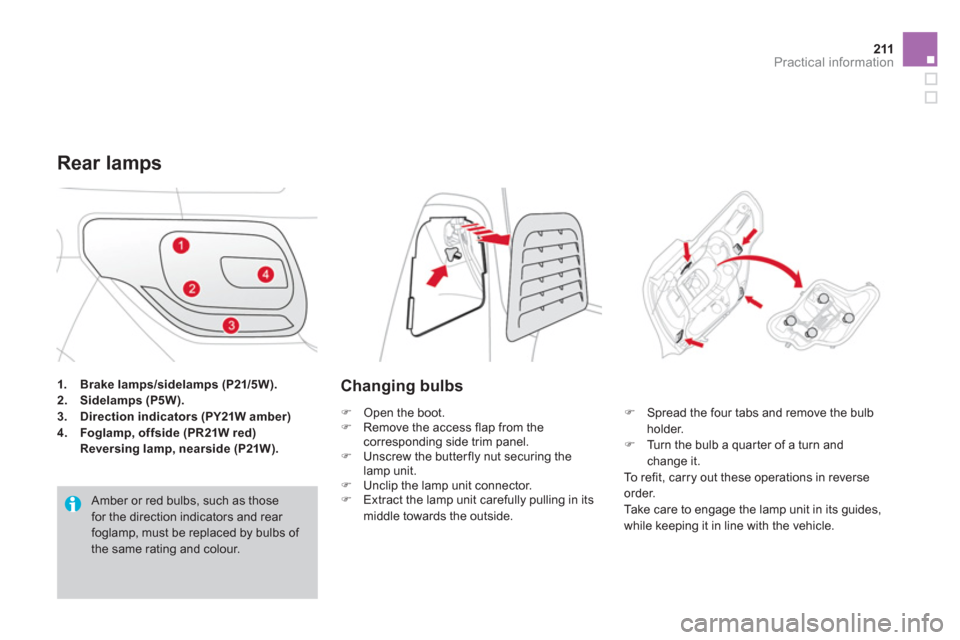
1.Brake lamps/sidelamps (P21/5W).2.Sidelamps (P5W).3.Direction indicators (PY21W amber)
4.Foglamp, offside (PR21W red)Reversing lamp, nearside (P21W).
Rear lamps
Amber or red bulbs, such as thosefor the direction indicators and rear foglamp, must be replaced by bulbs of the same rating and colour.
Changing bulbs
) Open theboot. )
Remove the access flap from the corresponding side trim panel.)
Unscrew the butter fly nut securing thelamp unit.)
Unclip the lamp unit connector.)
Extract the lamp unit carefully pulling in its
middle towards the outside.
) Spread the four tabs and remove the bulbholder. )
Turn the bulb a quar ter of a turn andchange it.
To r efit, carry out these operations in reverseorder.
Take care to engage the lamp unit in its guides,
while keepin
g it in line with the vehicle.
Page 216 of 332

Changing a fuse
Installing electricalaccessories
Your vehicle's electrical system isdesigned to operate with standard or optional equipment.
Before installing other electricalequipment or accessories on your vehicle, contact a CITROËN dealer or aqualified workshop.
CITROËN will not accept responsibilityfor the cost incurred in repairing your
vehicle or for rectifying malfunctions resulting from the installation of accessories not supplied and notrecommended by CITROËN andnot installed in accordance with its instructions, in particular when the combined consumption of all of the additional equipment connected exceeds 10 milliamperes.
The extraction tweezer and the s
pare fuse
locations are on the back of the dashboardfusebox cover.
For access to them:)unclip the cover by pulling on the side, )remove the cover completely,)remove the tweezer.
Access to the tools
Before changing a fuse,the cause of the failure must be identifiedand rectified. )
Identify the faulty fuse by checking thecondition of its filament.
Changing a fuse
GoodFailed
)
Use the special tweezer to extract the fuse from its housing.)
Always replace the failed fuse with a fuse of the same rating.)
Check that the number marked on the
box, the rating marked on the fuse and the
tables below all agree.
Page 219 of 332

217Practical information
Engine compartment
fusebox
The fusebox is located in the enginecompartment near the battery (left-hand side).Access to the fuses
)
Unclip the cover.
)
Change the fuse (see correspondingparagraph). )
When you have finished, close the cover carefully to ensure the sealing of the fuse box.
All work on the fuses in the box located on the battery, must be doneby a CITROËN dealer or a qualifiedworkshop.