trailer Citroen DS3 2014 1.G Owner's Manual
[x] Cancel search | Manufacturer: CITROEN, Model Year: 2014, Model line: DS3, Model: Citroen DS3 2014 1.GPages: 376, PDF Size: 12.55 MB
Page 7 of 376
DS3_en_Chap00a_sommaire_ed01-2014
cHEcKS
PR A
cT
IcA
L
INFORMATION TEcH
NIcA L dA TAAUdI O ANd
T ELEMATI
c
S
190 Fuel tank
192 M isfuel prevention (Diesel)
193
R
unning out of fuel (Diesel)
194
a
d
blu
e
® additive and SCR
system
(BlueHDi Diesel)
202
T
emporary puncture repair
k
it
207
C
hanging a wheel
214
S
now chains
215
C
hanging
a bu
lb
224
C
hanging
a f
use
231
b
at
tery
234
E
nergy
economy mode
235
C
hanging a wiper blade
236
T
owing
the vehicle
238
T
owing
a trailer
240
a
d
vice on care and
maintenance
242
ac
cessories 247
bo
nnet
249
Pe
trol engines
250 D iesel eng ines
251 C hecking levels
255
C
hecks 260
Pe
trol engines
263
Pe
trol weights
266 LP G e ngine
267 L PG weights
268
D
iesel
eng
ines
270
D
iesel
eng
ines
272
D
imensions
2 74
I
dentification
ma
rkings279
E
mergency or assistance
281
eMyWay
335 A udio system
0120130100 11
Page 17 of 376
15
DS3_en_Chap00c_eco-conduite_ed01-2014
Limit the causes of excess consumption
Spread loads throughout the vehicle; place the heaviest items in the bottom of the boot, as close as possible to the rear seats.
Limit
the loads carried in the vehicle and reduce wind resistance (roof
b
ars, roof rack, bicycle carrier, trailer...). Use a roof box in preference.
Remove
roof bars and roof racks after use.
At
the end of winter, remove snow tyres and refit your summer tyres.
Observe the recommendations on
maintenance
Check the tyre pressures regularly, when cold, referring to the label in the door aperture, driver's side.
Carry
out this check in particular:
-
b
efore a long journey,
-
a
t each change of season,
-
a
fter a long period out of use.
Don't
forget the spare wheel and the tyres on any trailer or caravan.
Have
your vehicle serviced regularly (engine oil, oil filter, air filter,
p
assenger compartment filter...) and observe the schedule of
o
perations recommended in the maintenance and warranty guide.
With
a Blue HDi Diesel engine, if the SCR system is faulty your vehicle
b
ecomes polluting; go to a CITROËN dealer or a qualified workshop
w
ithout delay to have the emissions of nitrous oxides brought back to
t
he legal level.
When
refuelling, do not continue after the third cut-off of the nozzle to
a
void any over flow.
At
the wheel of your new vehicle, it is only after the first 1 800 miles
(3
000 kilometres) that you will see the fuel consumption settle down to
a
consistent average.
Eco-driving
Page 129 of 376
127
DS3_en_Chap06_conduite_ed01-2014
ProgrammingOperating faults
If there is an operating fault, when r
everse gear is engaged this w
arning
lamp comes on in the instrument panel,
a
ccompanied by an audible signal (short beep)
a
nd
a
message in the multifunction screen.
You
can
activate
or
deactivate
the
system
by
m
eans
of
the
multifunction
screen
configuration
m
enu.
The
system
state
is
memorised
when
s
witching
off
the
ignition.
For
more
information
on
access
to
the
parking
s
ensors
menu,
refer
to
" Vehicle
configuration"
o
r
" Vehicle
parameters"
section
for
your
m
ultifunction
s
creen.
The
system
will
be
deactivated
a
utomatically
when
towing
a
trailer
or
w
hen a bicycle carrier is fitted (vehicle
fitted with a towbar or bicycle carrier
recommended
by
CITROËN). In bad or wintry weather, ensure that
the
sensors are not covered with mud,
f
rost
or snow.
driving
Page 163 of 376
161
DS3_en_Chap08_securite_ed01-2014
Operating faults
In the event of an impact to the windscreen at the sensor, deactivate
the
system and contact a CITROËN
d
ealer or a qualified workshop to have
y
our windscreen replaced.
Never
try to remove, adjust or test
t
he sensor.
on
ly a CITR
oË
N dealer or a qualified
workshop
is able to work on the system.
When
towing a trailer or when the
v
ehicle is being towed, the system must
b
e deactivated.
Do not stick or other wise fix any object on the windscreen in front of the sensor.
Sensor fault
The operation of the laser sensor may suffer inter ference from accumulations of dirt or
m
isting of the windscreen. In this case you are
w
arned by the display of a message.
Use
the windscreen demisting and regularly
c
lean the area of the windscreen in front of the
sensor.
System fault
In the event of a malfunction of the system, you a re warned by an audible signal and the display
o
f the message "Automatic braking system
fault" .
Have
the system checked by a CITROËN
d
ealer or a qualified workshop.
Safety
Page 227 of 376
225
DS3_en_Chap10_info-pratiques_ed01-2014
dashboard fusebox
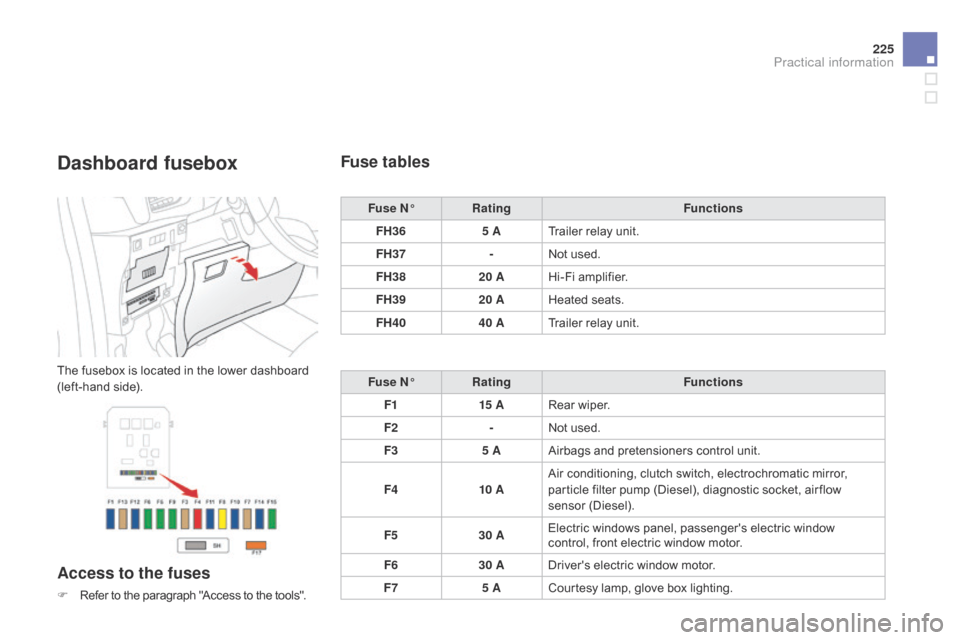
The fusebox is located in the lower dashboard (left-hand side).
Access to the fuses
F Refer to the paragraph "Access to the tools".
Fuse tables
Fuse N°Rating Functions
FH36 5 ATrailer
relay unit.
FH37 -Not
used.
FH38 20 AHi-Fi
amplifier.
FH39 20 AHeated
s
eats.
FH40 40 ATrailer
relay unit.
Fuse N° Rating Functions
F1 15 ARear
wiper.
F2 -Not
used.
F3 5 AAirbags
and pretensioners control unit.
F4 10 AAir
conditioning, clutch switch, electrochromatic mirror,
p
article filter pump (Diesel), diagnostic socket, air flow
sen
sor
(
Diesel).
F5 30 AElectric
windows panel, passenger's electric window
c
ontrol, front electric window motor.
F6 30 ADriver's
electric window motor.
F7 5 ACourtesy
lamp, glove box lighting.
Practical information
Page 228 of 376
DS3_en_Chap10_info-pratiques_ed01-2014
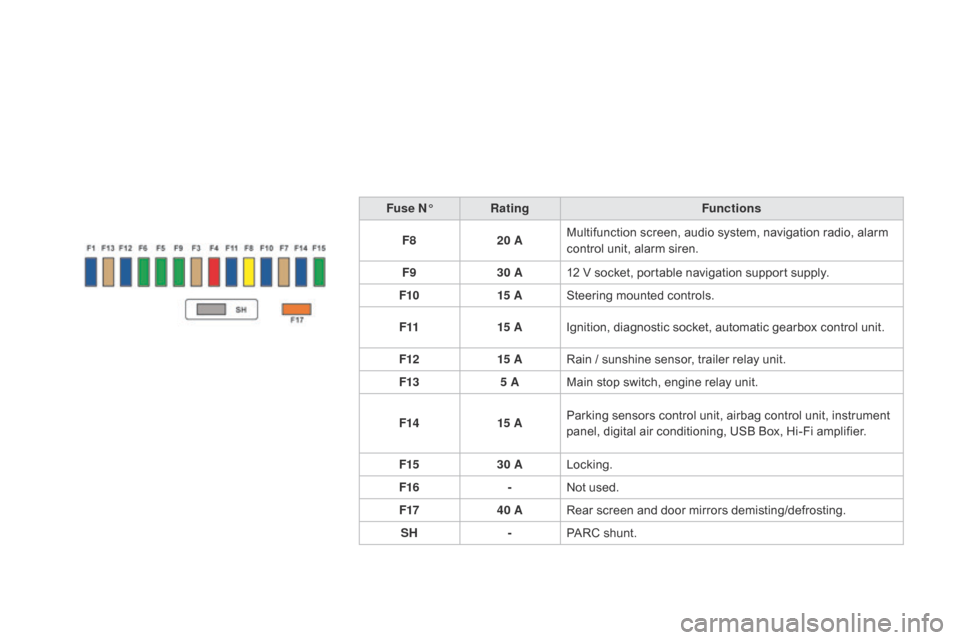
Fuse N°Rating Functions
F8 20 AMultifunction
screen, audio system, navigation radio, alarm
c
ontrol unit, alarm siren.
F9 30 A12
V socket, portable navigation support supply.
F10 15 ASteering
mounted controls.
F11 15 AIgnition,
diagnostic socket, automatic gearbox control unit.
F12 15 ARain
/ sunshine sensor, trailer relay unit.
F13 5 AMain
stop switch, engine relay unit.
F14 15 AParking
sensors control unit, airbag control unit, instrument
p
anel, digital air conditioning, USB Box, Hi-Fi amplifier.
F15 30 ALocking.
F16 -Not
used.
F17 40 ARear
screen and door mirrors demisting/defrosting.
SH -PARC
shunt.
Page 240 of 376
DS3_en_Chap10_info-pratiques_ed01-2014
Towing a trailer
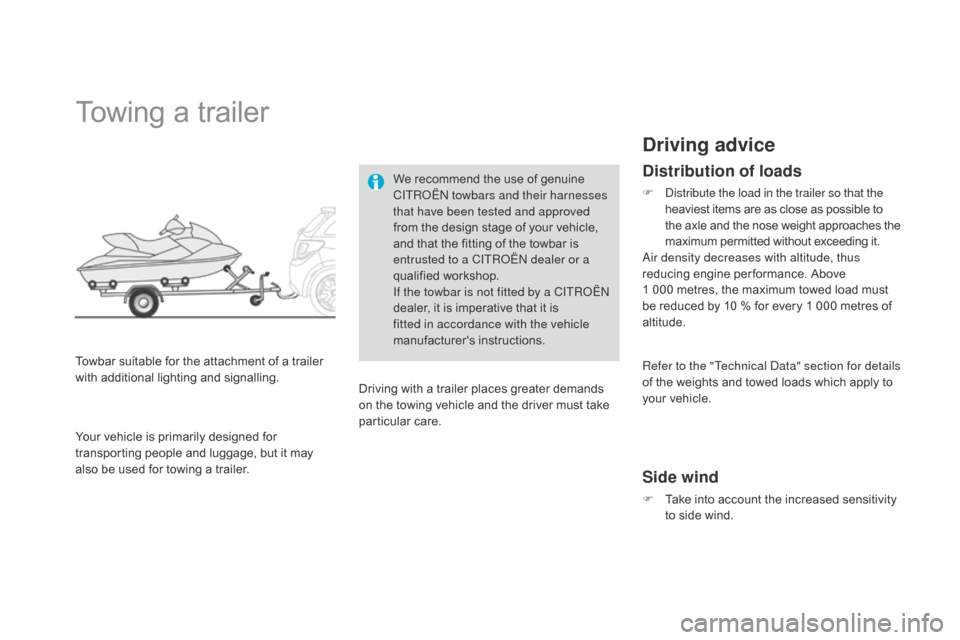
Towbar suitable for the attachment of a trailer with a dditional l ighting an d s ignalling. We
recommend the use of genuine
C
ITR
oË
N towbars and their harnesses
that have been tested and approved
from the design stage of your vehicle,
a
nd that the fitting of the towbar is
e
ntrusted to a CITR
oË
N dealer or a
qualified
w
orkshop.
If the towbar is not fitted by a CITR
oË
N
dealer, it is imperative that it is
f
itted in accordance with the vehicle
manufacturer's
i
nstructions.
Driving with a trailer places greater demands
o
n the towing vehicle and the driver must take
par
ticular
c
are.
driving advice
distribution of loads
F Distribute the load in the trailer so that the heaviest items are as close as possible to t
he axle and the nose weight approaches the
m
aximum permitted without exceeding it.
ai
r density decreases with altitude, thus
reducing
engine per formance. Above
1
000 metres, the maximum towed load must
b
e reduced by 10 % for every 1 000 metres of
al
titude.
Side wind
F Take into account the increased sensitivity t
o side wind.
Your
vehicle
is
primarily
designed
for
t
ransporting
people
and
luggage,
but
it
may
a
lso
be
used
for
towing
a
trailer. Refer to the "Technical Data" section for details
of the weights and towed loads which apply to
y
our vehicle.
Page 241 of 376
239
DS3_en_Chap10_info-pratiques_ed01-2014
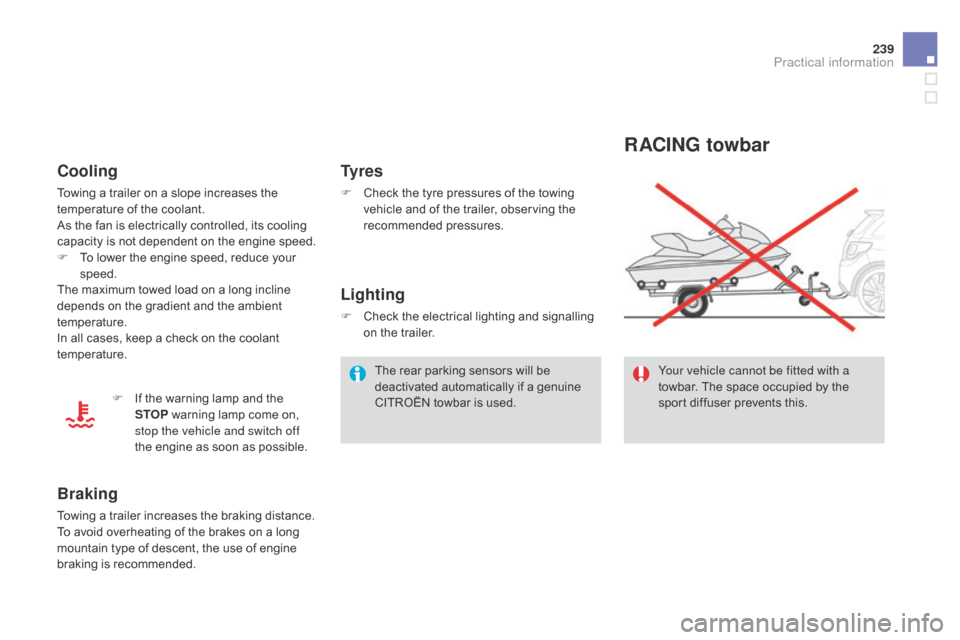
RAcING towbar
Your vehicle cannot be fitted with a
towbar. The space occupied by the
s
port diffuser prevents this.
Ty r e s
F Check the tyre pressures of the towing v
ehicle and of the trailer, observing the
re
commended
p
ressures.
cooling
Towing a trailer on a slope increases the temperature of the coolant.
As
the fan is electrically controlled, its cooling
c
apacity is not dependent on the engine speed.
F
T
o lower the engine speed, reduce your
s
peed.
The
maximum towed load on a long incline
d
epends on the gradient and the ambient
t
emperature.
In
all cases, keep a check on the coolant
t
emperature.
Braking
Towing a trailer increases the braking distance.
T o avoid overheating of the brakes on a long
m
ountain type of descent, the use of engine
b
raking is recommended.
Lighting
F Check the electrical lighting and signalling o
n the trailer.
The
rear parking sensors will be
d
eactivated automatically if a genuine
C
ITROËN towbar is used.
F
I
f
the
warning
lamp
and
the
S
TOP
warning
lamp
come
on,
s
top the vehicle and switch off
the
engine
as
soon
as
possible.
Practical information
Page 260 of 376
DS3_en_Chap12_caracteristiques_ed01-2014
Technical data
This section contains the specifications of your vehicle depending on its engine and gearbox, such as the maximum power and torque, unladen
a
nd maximum weights, trailer weights, exterior dimensions and all of its
i
dentification
ma
rkings.
Page 265 of 376
263
DS3_en_Chap12_caracteristiques_ed01-2014
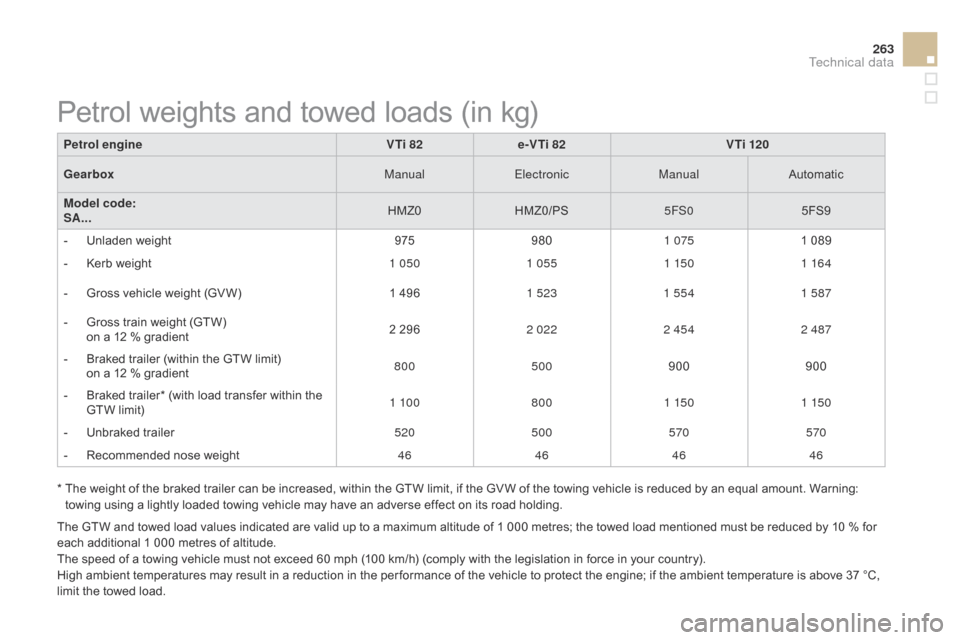
* The weight of the braked trailer can be increased, within the GTW limit, if the GV W of the towing vehicle is reduced by an equal amount. Warning: t
owing using a lightly loaded towing vehicle may have an adverse effect on its road holding.
The
GTW and towed load values indicated are valid up to a maximum altitude of 1 000 metres; the towed load mentioned must be reduced by 10 % for
e
ach additional 1 000 metres of altitude.
The
speed of a towing vehicle must not exceed 60 mph (100 km/h) (comply with the legislation in force in your country).
High
ambient temperatures may result in a reduction in the per formance of the vehicle to protect the engine; if the ambient temperature is above 37 °C,
l
imit the towed load.
Petrol engine
VTi 82e-VTi 82 V Ti 120
Gearbox ManualElectronic ManualAutomatic
Model code:
SA... HMZ0
HMZ0/PS 5FS05FS9
-
U
nladen weight
9759801 075 1 089
-
K
erb weight
1 0501 055 1 1501 16 4
-
G
ross vehicle weight (GV W)
1 496
1 523 1 554 1 587
-
G
ross train weight (GTW)
o
n a 12 % gradient
2 296
2 022 2 454 2 487
-
B
raked trailer (within the GTW limit)
o
n a 12 % gradient
800
500900 900
-
B
raked trailer* (with load transfer within the
G
TW limit)
1 10 0
8001 150 1 150
-
U
nbraked trailer
520500 570570
-
R
ecommended nose weight
46464646
Petrol weights and towed loads (in kg)
Technical data