ECU Citroen DS3 2015 1.G User Guide
[x] Cancel search | Manufacturer: CITROEN, Model Year: 2015, Model line: DS3, Model: Citroen DS3 2015 1.GPages: 415, PDF Size: 11.95 MB
Page 157 of 415
155
DS3_en_Chap06_securite_ed01-2015
Operating limits
The system only detects vehicles that are stationary or moving in the same direction as
y
our vehicle.
It
does not detect small vehicles
(
bicycles, motorcycles), pedestrians or
a
nimals, nor non-reflective stationary
ob
jects.
The
system is not triggered or is interrupted if
t
he
d
river:
-
a
ccelerates strongly
-
o
r turns the steering wheel suddenly
(
avoiding
m
anoeuvre).With the monochrome screen C
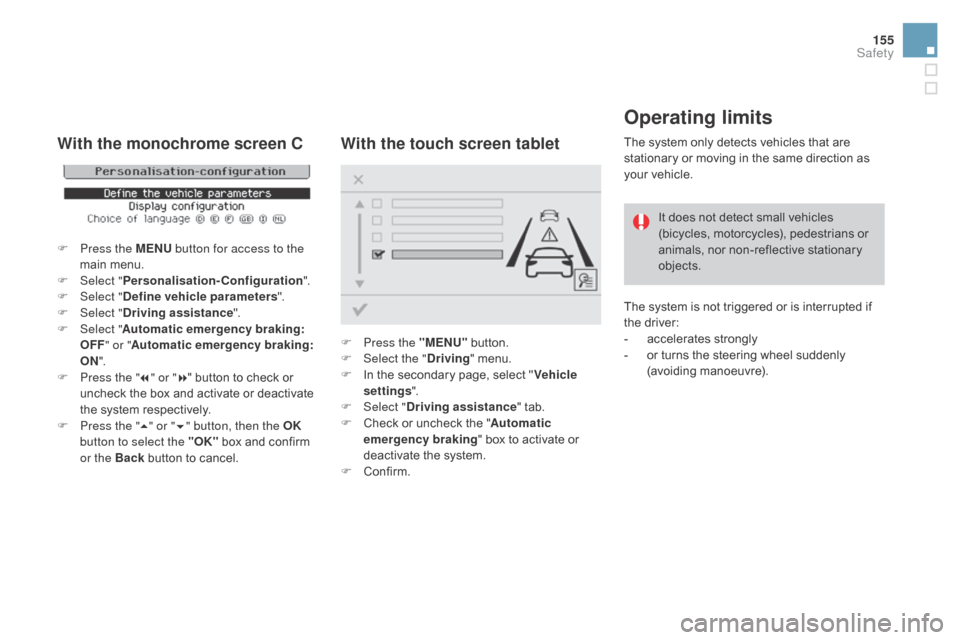
F Press the MEn U button for access to the
main menu.
F
Sel
ect "Personalisation-Configuration ".
F
Sel
ect "
def
ine vehicle parameters ".
F
Sel
ect "
dr
iving assistance ".
F
Sel
ect "Automatic emergency braking:
OFF " or " Automatic emergency braking :
O
n".
F
P
ress the " 7" or " 8"
button to check or
u
ncheck the box and activate or deactivate
t
he system respectively.
F
P
ress the " 5" or " 6" button, then the OK
button to select the "OK"
box and confirm
o
r the Back
button to cancel.
With the touch screen tablet
F Press the "MEnU" button.
F Sel ect the "dr iving"
menu.
F
I
n the secondary page, select "Vehicle
settings ".
F
Sel
ect "
dr
iving assistance "
tab.
F
C
heck or uncheck the "Automatic
emergency braking "
box to activate or
d
eactivate the system.
F
C
onfirm.
Safety
Page 159 of 415
157
DS3_en_Chap06_securite_ed01-2015
Seat belts
Front seat belts
The front seat belts are fitted with a
pretensioning and force limiting system.
This
system improves safety in the front
s
eats in the event of a front or side impact.
D
epending on the severity of the impact, the
p
retensioning system instantly tightens the seat
b
elts against the body of the occupants.
The
pretensioning seat belts are active when
t
he ignition is on.
The
force limiter reduces the pressure of the
s
eat belt on the chest of the occupant, so
improving
their protection.
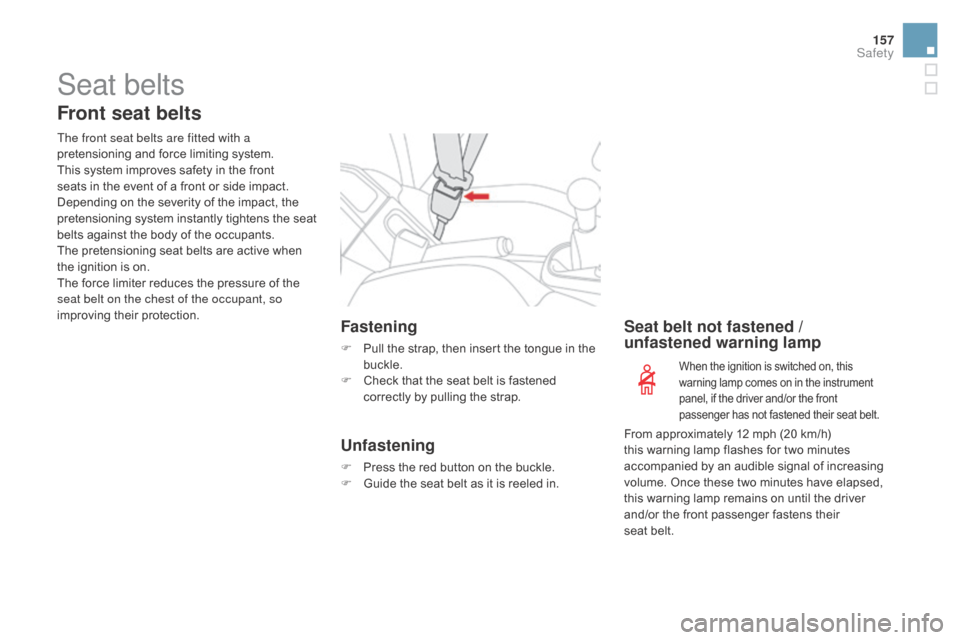
Fastening
F Pull the strap, then insert the tongue in the buc
kle.
F
C
heck that the seat belt is fastened
c
orrectly by pulling the strap.
Unfastening
F Press the red button on the buckle.
F G uide the seat belt as it is reeled in.
Seat belt not fastened /
unfastened warning lamp
When the ignition is switched on, this warning lamp comes on in the instrument p
anel, if the driver and/or the front
p
assenger has not fastened their seat belt.
From approximately 12 mph (20 km/h) this warning lamp flashes for two minutes
a
ccompanied by an audible signal of increasing
v
olume. Once these two minutes have elapsed,
t
his warning lamp remains on until the driver
a
nd/or the front passenger fastens their
seat
belt.
Safety
Page 161 of 415
159
DS3_en_Chap06_securite_ed01-2015
The driver must ensure that passengers use the seat belts correctly and that they are all
restrained
securely before setting off.
Wherever you are seated in the vehicle,
always fasten your seat belt, even for short
journeys.
Do
not interchange the seat belt buckles as
t
hey will not fulfil their role fully.
The seat belts are fitted with an inertia reel
permitting
automatic adjustment of the length
o
f the strap to your size. The seat belt is
s
towed automatically when not in use.
Before and after use, ensure that the seat
belt
is reeled in correctly.
The
lower part of the strap must be
p
ositioned as low as possible on the pelvis.
The
upper part must be positioned in the
h
ollow of the shoulder.
The
inertia reels are fitted with an automatic
l
ocking device which comes into operation in
t
he event of a collision, emergency braking
o
r if the vehicle rolls over. You can release
t
he device by pulling the strap firmly and then
r
eleasing it so that it reels in slightly.In
order to be effective, a seat belt must:
- b e tightened as close to the body as
p
ossible,
-
b
e pulled in front of you with a smooth
m
ovement, checking that it does not
t
wist,
-
b
e used to restrain only one person,
-
n
ot bear any trace of cuts or fraying,
-
n
ot be converted or modified to avoid
a
ffecting
it
s
p
erformance.
In
a
ccordance
w
ith
c
urrent
s
afety
r
egulations,
f
or all repairs on your vehicle's seat belts, go
t
o a qualified workshop with the skills and
e
quipment needed, which a CITROËN dealer
i
s able to provide.
Have
your seat belts checked regularly by
a
CITROËN dealer or a qualified workshop,
p
articularly if the straps show signs of
d
amage.
Clean the seat belt straps with soapy water or
a
textile cleaning product, sold by CITROËN
d
ealers.
After
folding or moving a seat or rear bench
s
eat, ensure that the seat belt is positioned
and
reeled in correctly.Recommendations
for children
Use a suitable child seat if the passenger is less than 12 years old or shorter than one
and
a half metres.
Never
use the same seat belt to secure
m
ore than one person.
Never
allow a child to travel on your lap.
For
more information, refer to the "Child
sea
ts"
se
ction.
In the event of an impact
depending on the nature and
seriousness of the impact , the
pretensioning
device may be deployed
b
efore and independently of the airbags.
D
eployment of the pretensioners is
a
ccompanied by a slight discharge of
h
armless smoke and a noise, due to the
a
ctivation of the pyrotechnic cartridge
i
ncorporated in the system.
In
all cases, the airbag warning lamp
c
omes on.
Following
an impact, have the seat belts
s
ystem
c
hecked,
a
nd
i
f
n
ecessary
r
eplaced,
b
y a CITROËN dealer or a qualified
w
orkshop.
Safety
Page 163 of 415
161
DS3_en_Chap06_securite_ed01-2015
Front airbags
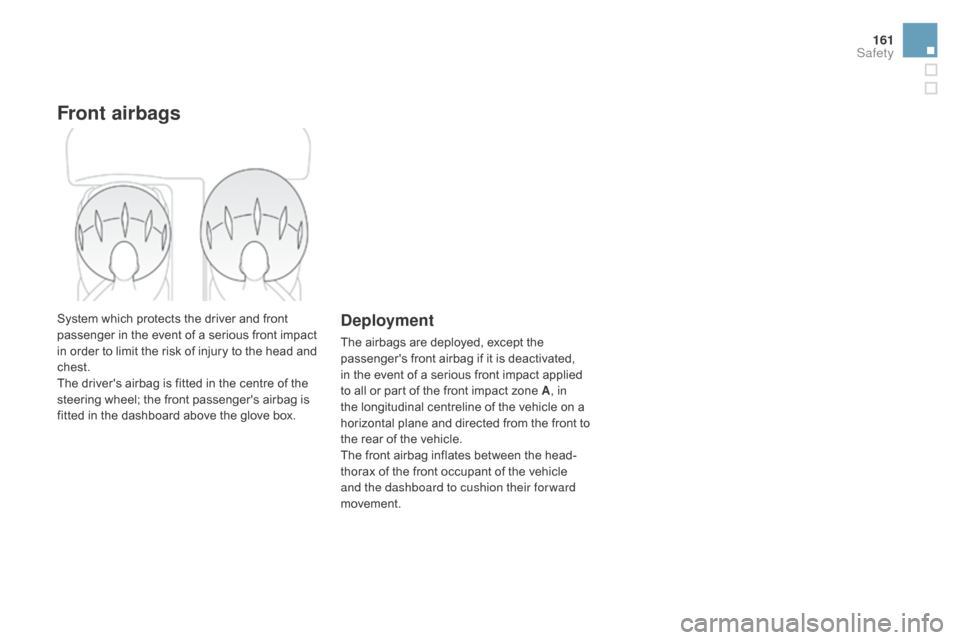
System which protects the driver and front passenger in the event of a serious front impact
i
n order to limit the risk of injury to the head and
c
hest.
The
driver's airbag is fitted in the centre of the
s
teering wheel; the front passenger's airbag is
f
itted in the dashboard above the glove box.deployment
The airbags are deployed, except the passenger's front airbag if it is deactivated,
i
n the event of a serious front impact applied
t
o all or part of the front impact zone A, in
the
longitudinal centreline of the vehicle on a
h
orizontal plane and directed from the front to
t
he rear of the vehicle.
The
front airbag inflates between the head-
thorax
of the front occupant of the vehicle
an
d the dashboard to cushion their forward
movement.
Safety
Page 165 of 415
163
DS3_en_Chap06_securite_ed01-2015
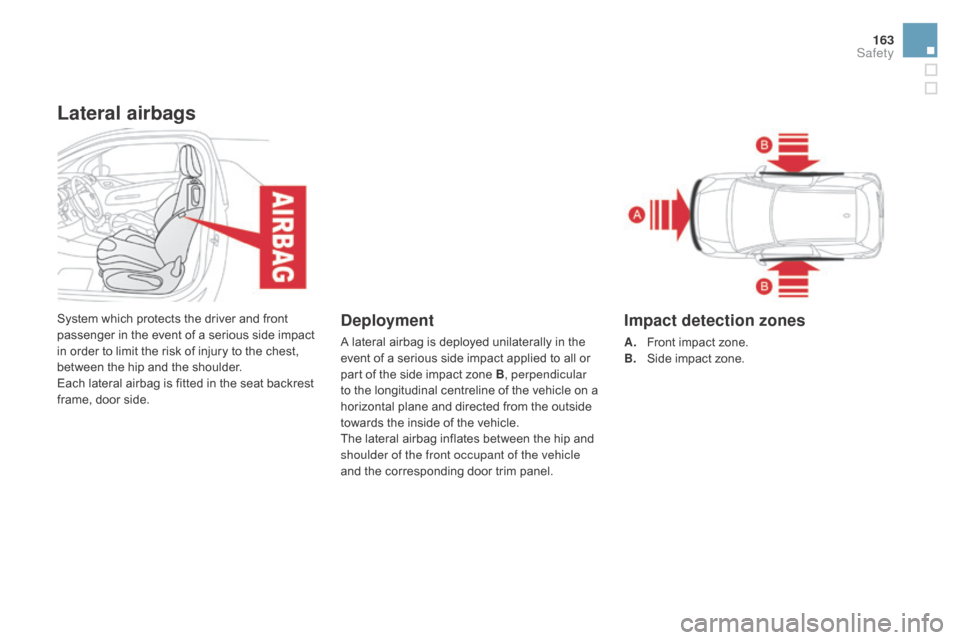
Lateral airbags
System which protects the driver and front passenger in the event of a serious side impact
i
n order to limit the risk of injury to the chest,
b
etween the hip and the shoulder.
Each
lateral airbag is fitted in the seat backrest
f
rame, door side.deployment Impact detection zones
A. Front impact zone.
B. S ide impact zone.
A
lateral
airbag
is
deployed
unilaterally
in
the
e
vent
of
a
serious
side
impact
applied
to
all
or
p
art
of
the
side
impact
zone
B, perpendicular
to
the
longitudinal
centreline
of
the
vehicle
on
a
h
orizontal
plane
and
directed
from
the
outside
t
owards
the
inside
of
the
vehicle.
The
lateral
airbag
inflates
between
the
hip
and
s
houlder of the front occupant of the vehicle
and
the
corresponding
door
trim
panel.
Safety
Page 167 of 415
165
DS3_en_Chap06_securite_ed01-2015
For the airbags to be fully effective, observe the following safety rules:Front airbags
Do not drive holding the steering wheel by its spokes or resting your hands on the centre
p
art of the wheel.
Passengers
must not place their feet on the
das
hboard.
Do
not smoke as deployment of the airbags
c
an cause burns or the risk of injury from a
c
igarette or pipe.
Never
remove or pierce the steering wheel or
h
it it violently.
Do
not fit or attach anything to the steering
w
heel or dashboard, this could cause injuries
w
ith deployment of the airbags.
Lateral airbags
Use only approved covers on the seats,
compatible with the deployment the lateral
a
irbags. For information on the range of seat
c
overs suitable for your vehicle, you can
contact
a CITROËN dealer.
Refer
to the "Accessories" section.
Do
not fix or attach anything to the seat
b
acks (clothing...). This could cause injury
t
o the chest or arms if the lateral airbag is
d
eployed.
Do not sit with the upper part of the body any
nearer
to the door than necessary.
Curtain airbags
Do not fix or attach anything to the roof. This could cause injury to the head if the
c
urtain airbag is deployed.
If
fitted on your vehicle, do not remove the
g
rab handles installed on the roof, they play
a
part in securing the curtain airbags.
Sit
in
a
normal
upright
position.
Wear
a
correctly
adjusted
seat
belt.
Do
n
ot
l
eave
a
nything
b
etween
t
he
o
ccupants
a
nd
the
airbags
(a
child,
pet,
object...).
This
c
ould
hamper
the
operation
of
the
airbags
or
i
njure
the
occupants.
After an accident or if the vehicle has been
stolen
or
broken
into,
have
the
airbag
s
ystems
checked.
All
work
on
the
airbag
system
must
be
c
arried out by a CITROËN dealer or a
qualified
w
orkshop.
Even
if
all
of
the
precautions
mentioned
a
re
observed,
a
risk
of
injury
or
of
minor
b
urns
to
the
head,
chest
or
arms
when
an
a
irbag
is
deployed
cannot
be
ruled
out.
The
b
ag
inflates
almost
instantly
(within
a
few
m
illiseconds)
then
deflates
within
the
same
t
ime
discharging
the
hot
gas
via
openings
p
rovided
for
this
purpose.
Safety
Page 168 of 415
DS3_en_Chap07_securite-enfants_ed01-2015
Child safety
Page 169 of 415
DS3_en_Chap07_securite-enfants_ed01-2015
Page 170 of 415
DS3_en_Chap07_securite-enfants_ed01-2015
General points relating to child seats
Although one of CITROËN main criteria when designing your vehicle, the safety of your children also depends on you.
CITROË
n
re
commends that children
should travel on the rear seats of your
vehicle:
-
r
earward facing
up to the age of 3,
-
fo
rward facing
over the age of 3.
For
maximum safety, please observe the
f
ollowing
r
ecommendations:
-
i
n accordance with European regulations,
a
ll children under the age of 12 or less
than one and a half metres tall must
travel in approved child seats suited to
their weight , on seats fitted with a seat
belt
or ISOFIX mountings*,
-
s
tatistically, the safest seats in your
vehicle for carr ying children are the
rear seats,
-
a c
hild weighing less than 9 kg must
travel in the rearward facing position
both in the front and in the rear.
*
T
he regulations on carrying children are
s
pecific to each country. Refer to the
l
egislation in force in your country.
Page 171 of 415
169
DS3_en_Chap07_securite-enfants_ed01-2015
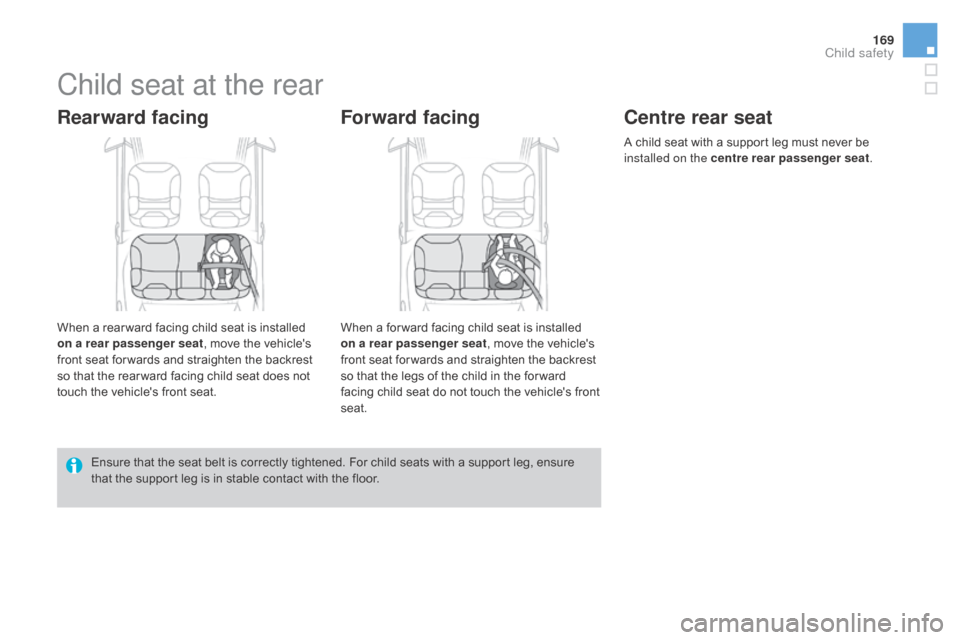
Child seat at the rear
Rearward facing
When a rear ward facing child seat is installed on a rear passenger seat ,
move the vehicle's
f
ront seat for wards and straighten the backrest
s
o that the rear ward facing child seat does not
t
ouch the vehicle's front seat.
Forward facing
When a for ward facing child seat is installed on a rear passenger seat ,
move the vehicle's
f
ront seat for wards and straighten the backrest
s
o that the legs of the child in the for ward
f
acing child seat do not touch the vehicle's front
sea
t.
Centre rear seat
A child seat with a support leg must never be installed on the centre rear passenger seat .
Ensure
that
the
seat
belt
is
correctly
tightened.
For
child
seats
with
a
support
leg,
ensure
t
hat
the
support
leg
is
in
stable
contact
with
the
floor.
Child safety