boot Citroen DS3 2015 1.G User Guide
[x] Cancel search | Manufacturer: CITROEN, Model Year: 2015, Model line: DS3, Model: Citroen DS3 2015 1.GPages: 415, PDF Size: 11.95 MB
Page 84 of 415
DS3_en_Chap03_confort_ed01-2015
Recommendations for ventilation and air conditioning
If after an extended stop in sunshine, the interior temperature is very
h
igh, first ventilate the passenger
c
ompartment for a few moments.
Put
the air flow control at a setting high
e
nough to quickly change the air in the
p
assenger
c
ompartment.
The
air conditioning system does not
c
ontain chlorine and does not present
any
danger to the ozone layer.
In
order
for
these
systems
to
be
fully
effective,
follow
the
operation
and
maintenance
g
uidelines belo
w:
F
T
o
obtain
an
even
air
distribution,
take
care
not
to
obstruct
the
exterior
air
intake
grilles
l
ocated at the base of the windscreen, the nozzles, the vents and the air outlets, as well
as
the
air
extractor
located
in
the
boot.
F
D
o
not
cover
the
sunshine
sensor,
located
on
the
dashboard;
this
is
used
for
regulation
o
f
the
air
conditioning
system.
F
O
perate
the
air
conditioning
system
for
at
least
5
to
10
minutes,
once
or
twice
a
month
t
o
keep
it
in
per fect
working
order.
F
E
nsure
that
the
passenger
compartment
filter
is
in
good
condition
and
have
the
filter
e
lements
replaced
regularly.
W
e
recommend
the
use
of
a
combined
passenger
compartment
filter.
Thanks
to
its
s
pecial active additive, it contributes to the purification of the air breathed by the
occupants
and
the
cleanliness
of
the
passenger
compartment
(reduction
of
allergic
s
ymptoms,
bad
odours
and
greasy
deposits).
F
T
o
ensure
correct
operation
of
the
air
conditioning
system,
you
are
also
advised
to
have
i
t
checked
regularly
as
recommended
in
the
maintenance
and
warranty
guide.
F
I
f
the
system
does
not
produce
cold
air,
switch
it
off
and
contact
a
CITROËN
dealer
or
a
qualified
workshop.
When
towing
the
maximum
load
on
a
steep
gradient
in
high
temperatures,
switching
off
the
a
ir
conditioning
increases
the
available
engine
power
and
so
improves
the
towing
ability. The condensation created by the air
conditioning
results in a discharge
o
f water under the vehicle which is
per fectly
normal.
Page 98 of 415
DS3_en_Chap03_confort_ed01-2015
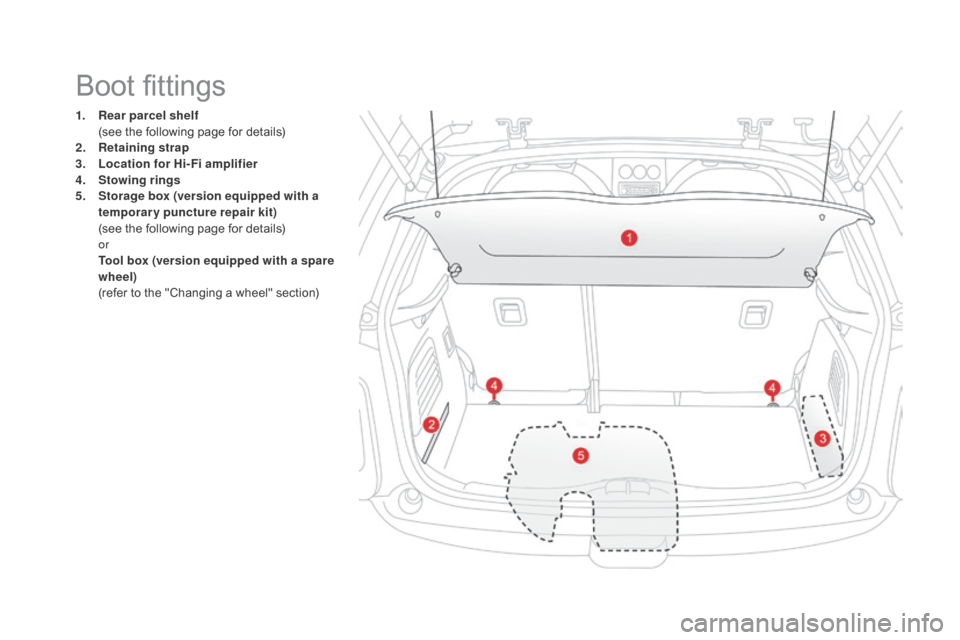
1. Rear parcel shelf (
see the following page for details)
2.
R
etaining strap
3.
L
ocation for Hi-Fi amplifier
4.
S
towing rings
5.
S
torage box (version equipped with a
temporary puncture repair kit)
(
see the following page for details)
or
T
ool box (version equipped with a spare
wheel)
(
refer to the "Changing a wheel" section)
Boot fittings
Page 99 of 415
97
DS3_en_Chap03_confort_ed01-2015
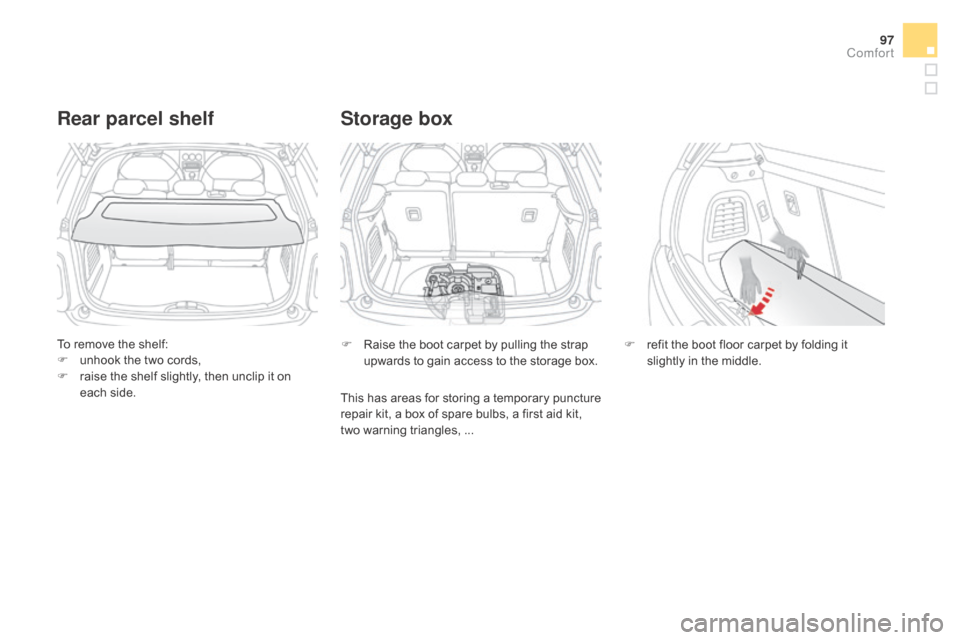
To remove the shelf:
F u nhook the two cords,
F
r
aise the shelf slightly, then unclip it on
e
ach side.
Rear parcel shelf
F Raise the boot carpet by pulling the strap u
pwards to gain access to the storage box.
Storage box
F refit the boot floor carpet by folding it s
lightly in the middle.
This
has
areas
for
storing
a
temporary
puncture
r
epair
kit,
a
box
of
spare
bulbs,
a
first
aid
kit,
t
wo
warning
triangles,
...
Comfort
Page 137 of 415

135
DS3_en_Chap05_visibilite_ed01-2015
Travelling abroad
LEd / Xenon front lamps
For motoring in countries that drive on the other s
ide of the road, it is necessary to adjust the
d
ipped beams so as to not dazzle the drivers of
a
pproaching
v
ehicles.
F
R
aise the bonnet for access to the adjuster
(
one adjuster per headlamp).
F
I
nsert a suitable allen key (not supplied)
i
nto the hexagonal head of the adjuster.
F
T
urn the allen key half a turn clockwise.
Headlamp adjustment
To avoid causing a nuisance to other road u
sers, the height of the headlamps should be
a
djusted in relation to the load in the vehicle.
0.
D
river only or driver + front passenger.
-.
I
ntermediate
s
etting.
1.
5
people.
-.
5
people + load in the boot.
2.
D
river only + maximum authorised load in
t
he boot.
This
position is sufficient to avoid causing
d
azzle.
Higher
settings may limit the spread of light
f
rom the headlamps.
The
initial setting is position "0". On
your return, don't forget to
a
djust your headlamps back to their
i
nitial setting, by carrying out these
o
perations in reverse order.
Visibility
Page 143 of 415
141
DS3_en_Chap05_visibilite_ed01-2015
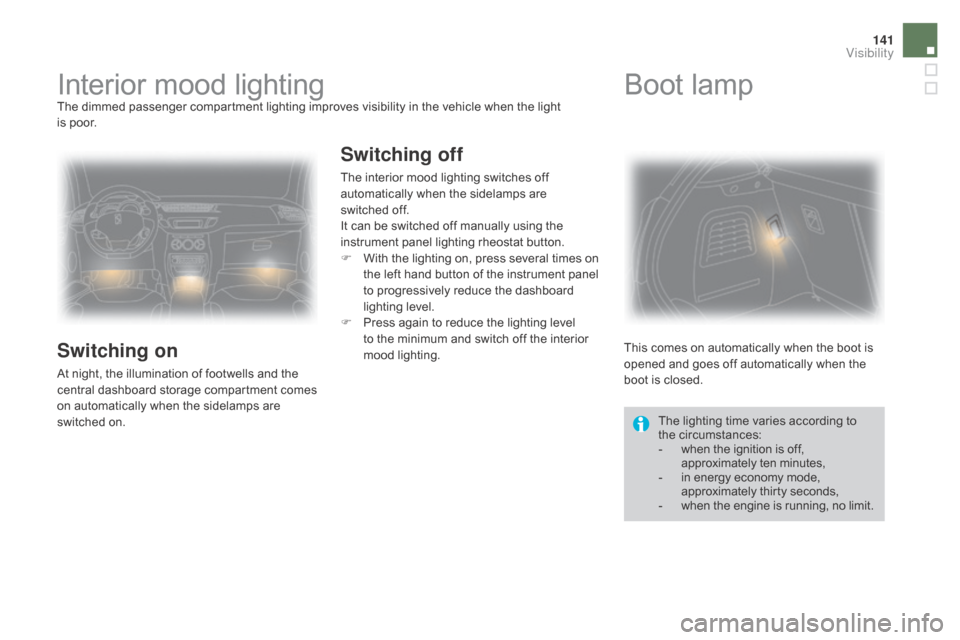
Interior mood lightingThe dimmed passenger compartment lighting improves visibility in the vehicle when the light
i s poor.
Switching on
At night, the illumination of footwells and the central dashboard storage compartment comes
o
n automatically when the sidelamps are
s
witched on.
Switching off
The interior mood lighting switches off automatically when the sidelamps are
switched
off.
It
can be switched off manually using the
i
nstrument panel lighting rheostat button.
F
W
ith the lighting on, press several times on
t
he left hand button of the instrument panel
t
o progressively reduce the dashboard
l
ighting level.
F
P
ress again to reduce the lighting level
t
o the minimum and switch off the interior
m
ood
l
ighting. This
comes on automatically when the boot is
o
pened and goes off automatically when the
b
oot is closed.
Boot lamp
The lighting time varies according to the c ircumstances:
-
w
hen the ignition is off,
a
pproximately ten minutes,
-
i
n energy economy mode,
a
pproximately thirty seconds,
-
w
hen the engine is running, no limit.
Visibility
Page 190 of 415
DS3_en_Chap08_info-pratiques_ed01-2015
AdBlue® additive and SCR system
f
or
BlueHDi Diesel engines
To assure respect for the environment and c
onformity with the new Euro 6 emissions
s
tandard, without adversely affecting the
p
er formance or fuel consumption of Diesel
e
ngines, CITROËN has taken the decision to
e
quip its vehicles with an effective system that
a
ssociates SCR (Selective Catalytic Reduction)
w
ith a particle filter (FAP) for the treatment of
e
xhaust gases.
Presentation of the SCR system
Using an additive called AdBlue® containing u
rea, a catalytic converter turns up to
85% of
nitrous
oxides
(NOx)
into
nitrogen
a
nd
water,
which
are
harmless
to health and
t
he environment. The AdBlue
® additive is held in a special
tank
located
under the boot at the rear of
t
he
vehicle.
It has a capacity of 17 litres: this
p
rovides
a
driving range of about 12 500 miles
(
20
000
km),
after which an alert is triggered
w
arning
you
when the reserve remaining is
e
nough
for
just 1 500 miles (2 400 km).
During
each
scheduled service of your vehicle
b
y
a
CITROËN dealer or a qualified workshop,
t
he AdBlue
® additive tank is refilled in order to a
llow
normal operation of the SCR system.
If
the
estimated mileage between two services
i
s
greater
than 12 500 miles (20 000 km), we
r
ecommend
that you go to a CITROËN dealer
o
r
a
qualified workshop to have the necessary
t
op-up
carried out. Once the AdBlue
® tank is empty, a
system
required
by regulations
p
revents
starting
of the engine.
If the SCR
is faulty, the level of
emissions
from
your vehicle will no
l
onger
meet
the
Euro 6 standard: you
v
ehicle
becomes
polluting.
In
the
event
of
a
confirmed fault
w
ith
the
SCR
system, you must go
t
o
a
CITROËN
dealer or a qualified
w
orkshop
as
soon as possible: after
a
running
distance of 650 miles
(
1 100
km),
a
system will be triggered
a
utomatically
to
prevent engine
s
tarting.
Page 196 of 415

DS3_en_Chap08_info-pratiques_ed01-2015
Important: if your vehicle's Ad
Blue® tank is completely empty - w
hich
is
confirmed by the alert
m
essages and the impossibility of
s
tarting
the engine, you must add at
l
east
3.8 litres (so two 1.89 litre bottles).If any additive is split or splashed, wash
immediately
with cold water or wipe
w
ith a damp cloth.
If the additive has crystallised, clean it
off using a sponge and hot water.Important:
i
n the event of a top-up after
a breakdown because of a lack of
additive , signalled by the message "Top
u
p emissions additive: Starting prevented",
y
ou must wait around 5 minutes before
s
witching
o
n
t
he
i
gnition,
w
ithout opening
the driver's door, locking the vehicle
or introducing the key into the ignition
switch .
Switch on the ignition, then, after
1
0 seconds, start the engine.
F
O
btain a bottle of AdBlue
®. After first c
hecking
the
use-by
date,
read carefully
t
he instructions on use on the label before
pouring
the
contents
of
the bottle into your
v
ehicle's
Ad
Blue
® tank. N ever dispose of AdBlue
® additive
bottles
in
the
household
waste. Place
t
hem
in
a
special
container provided
t
his
purpose
or
take
them
to your
d
ealer.
F
A
fter
emptying
the
bottle,
wipe
away
any
s
pillage
around
the
tank
filler
using
a
damp
c
loth.
F
R
efit
the
blue
cap
to
the
tank
and
turn
it
a
6
th of a turn clockwise, to its stop.
F
R
efit the black cap and turn it a quarter of
a
turn clockwise without pressing. Ensure
t
hat the indicator on the cap lines up with
the
indicator on the support.
F
D
epending on equipment, return the spare
w
heel and/or the storage box to the bottom
o
f
the boot.
F
R
efit the boot carpet and close the tailgate.
Page 202 of 415
DS3_en_Chap08_info-pratiques_ed01-2015
Changing a wheelProcedure for changing a faulty wheel for the spare wheel using the tools provided with the vehicle.
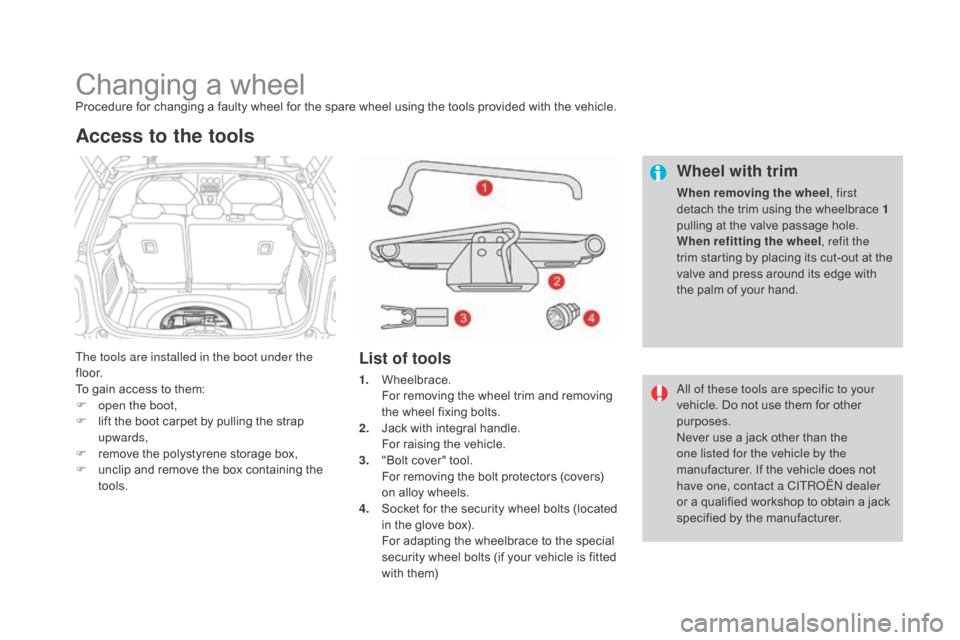
T he tools are installed in the boot under the
f l o o r.
To
gain access to them:
F
o
pen the boot,
F
l
ift the boot carpet by pulling the strap
up
wards,
F
r
emove the polystyrene storage box,
F
u
nclip and remove the box containing the
to
ols.
Access to the tools
List of tools Wheel with trim
When removing the wheel
, first
detach the trim using the wheelbrace 1
pulling
at the valve passage hole.
When refitting the wheel , refit the
trim
starting by placing its cut-out at the
v
alve and press around its edge with
t
he palm of your hand.
1.
W
heelbrace.
F
or
removing
the
wheel
trim
and
removing
t
he
wheel
fixing
bolts.
2.
J
ack
with
integral
handle.
F
or
raising
the
vehicle.
3.
"
Bolt
cover"
tool.
F
or
removing
the
bolt
protectors
(covers)
o
n
alloy
wheels.
4.
S
ocket
for
the
security
wheel
bolts
(located
i
n
the
glove
box).
F
or
adapting
the
wheelbrace
to
the
special
s
ecurity
wheel
bolts
(if
your
vehicle
is
fitted
w
ith
them) All of these tools are specific to your
vehicle.
Do not use them for other
p
urposes.
Never
use a jack other than the
o
ne listed for the vehicle by the
manufacturer.
If the vehicle does not
h
ave one, contact a CITROËN dealer
or
a qualified workshop to obtain a jack
s
pecified by the manufacturer.
Page 203 of 415
201
DS3_en_Chap08_info-pratiques_ed01-2015
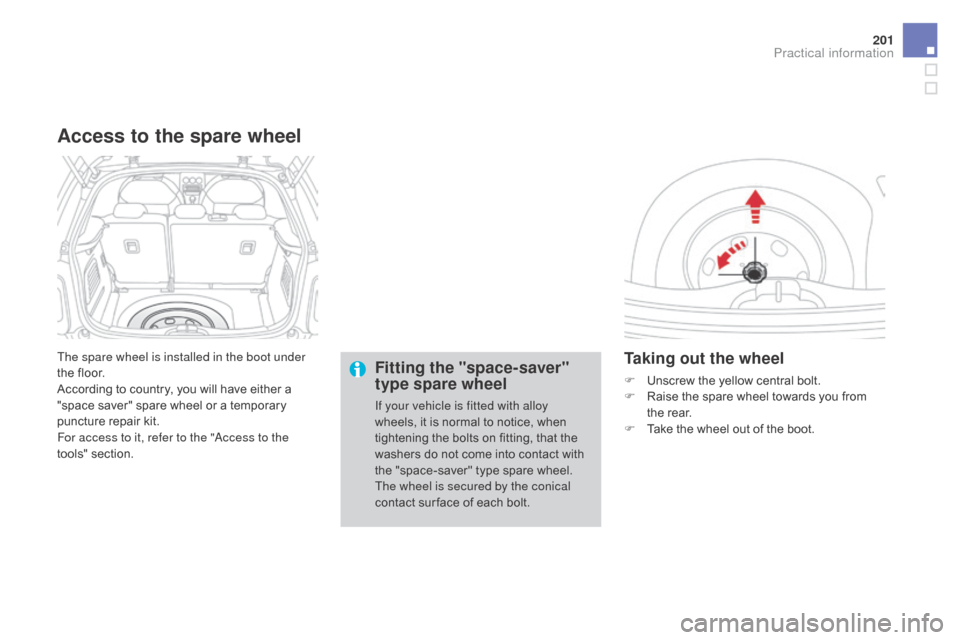
The spare wheel is installed in the boot under
the floor.
According
to country, you will have either a
"
space saver" spare wheel or a temporary
p
uncture repair kit.
For access to it, refer to the "Access to the
tools"
s
ection.
Access to the spare wheel
Fitting the "space-saver"
type spare wheel
If your vehicle is fitted with alloy
wheels, it is normal to notice, when
t
ightening the bolts on fitting, that the
w
ashers do not come into contact with
t
he "space-saver" type spare wheel.
T
he wheel is secured by the conical
contact
sur face of each bolt.
Taking out the wheel
F Unscrew the yellow central bolt.
F R aise the spare wheel towards you from
t
he rear.
F
T
ake the wheel out of the boot.
Practical information
Page 204 of 415
DS3_en_Chap08_info-pratiques_ed01-2015
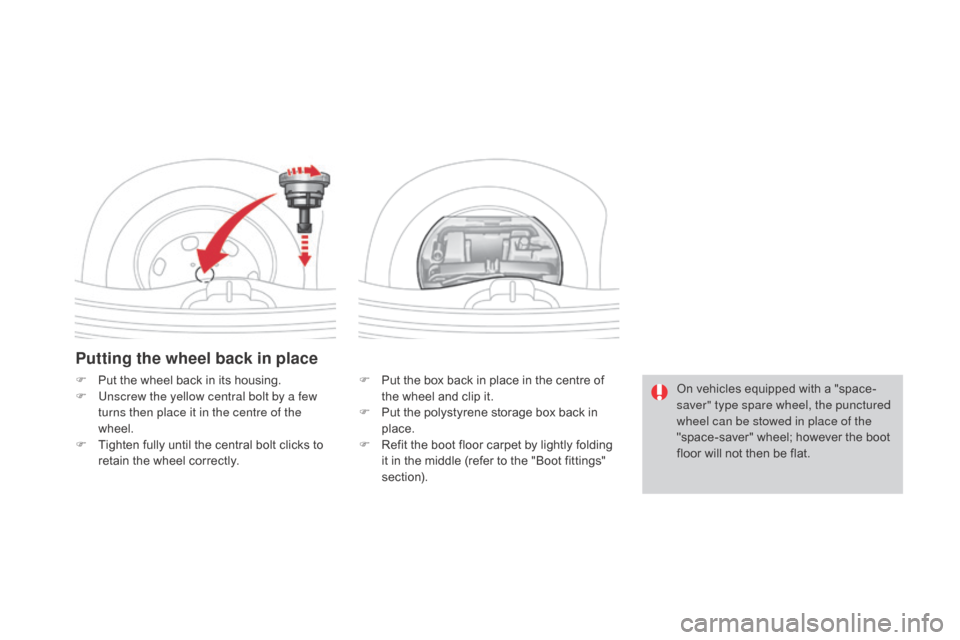
Putting the wheel back in place
F Put the box back in place in the centre of t
he wheel and clip it.
F
P
ut the polystyrene storage box back in
p
lace.
F
R
efit the boot floor carpet by lightly folding
i
t in the middle (refer to the "Boot fittings"
s
ection).
F
P
ut
the
wheel
back
in
its
housing.
F
U
nscrew the yellow central bolt by a few
turns then place it in the centre of the
wheel.
F
T
ighten
fully
until
the
central
bolt
clicks
to
r
etain
the
wheel
correctly. On
vehicles equipped with a "space-
saver" type spare wheel, the punctured
wheel can be stowed in place of the
"space-saver"
wheel; however the boot
f
loor will not then be flat.