ignition Citroen DS3 2015 1.G Service Manual
[x] Cancel search | Manufacturer: CITROEN, Model Year: 2015, Model line: DS3, Model: Citroen DS3 2015 1.GPages: 415, PDF Size: 11.95 MB
Page 146 of 415
Direction
indicators
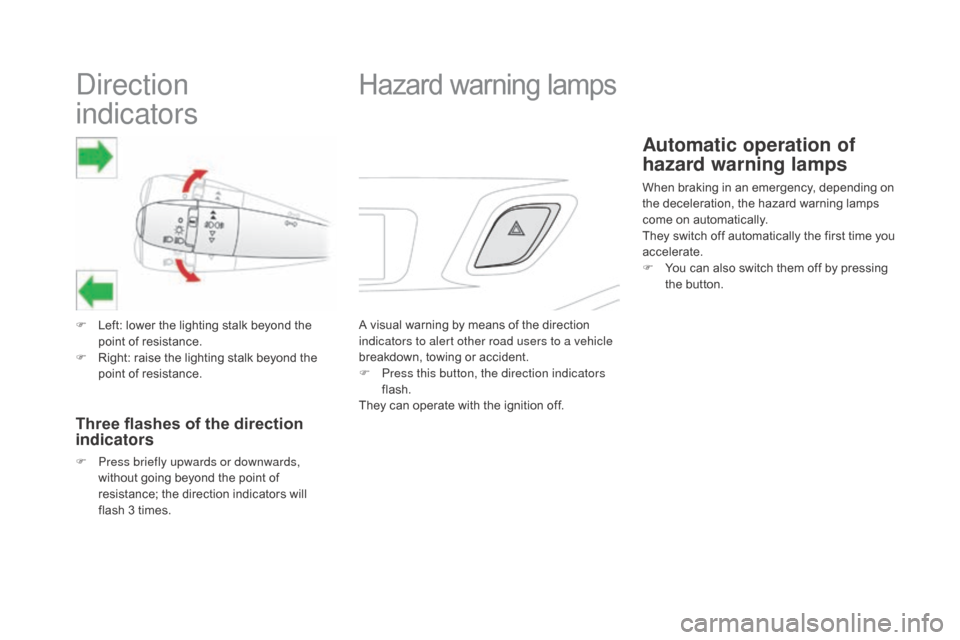
F Left: lower the lighting stalk beyond the p
oint of resistance.
F
R
ight: raise the lighting stalk beyond the
p
oint of resistance.
Three flashes of the direction
indicators
F Press briefly upwards or downwards, without going beyond the point of
r
esistance; the direction indicators will
f
lash 3 times.
Hazard warning lam ps
A visual warning by means of the direction i
ndicators to alert other road users to a vehicle
breakdown,
towing or accident.
F
P
ress this button, the direction indicators
flash.
They
can operate with the ignition off.
Automatic operation of
hazard warning lamps
When braking in an emergency, depending on the deceleration, the hazard warning lamps
c
ome on automatically.
They
switch off automatically the first time you
a
ccelerate.
F
Y
ou can also switch them off by pressing
t
he button.
Page 150 of 415
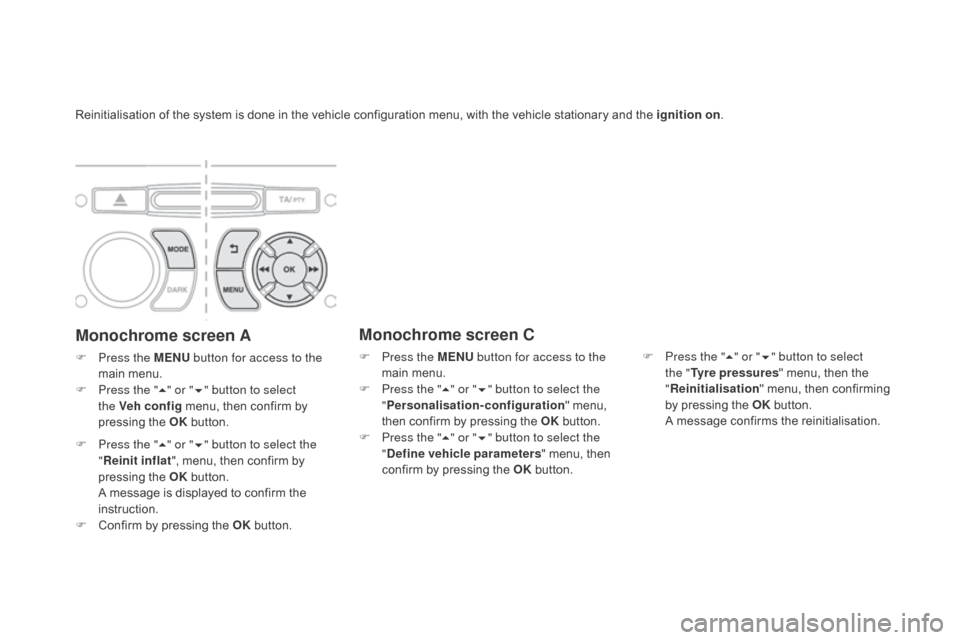
Reinitialisation of the system is done in the vehicle configuration menu, with the vehicle stationary and the ignition on.
Monochrome screen A
F Press the MEn U button for access to the
main menu.
F
P
ress the " 5" or " 6" button to select
the Veh conf ig
menu, then confirm by
p
ressing the OK
button.
F
P
ress the " 5" or " 6" button to select the
" Reinit inflat ",
menu, then confirm by
p
ressing the OK
button.
A
message is displayed to confirm the
in
struction.
F
C
onfirm by pressing the OK
button.
Monochrome screen C
F Press the MEnU button for access to the
main menu.
F
P
ress the " 5" or " 6" button to select the
" Personalisation-configuration "
menu,
t
hen confirm by pressing the OK
button.
F
P
ress the " 5" or " 6" button to select the
"
def
ine vehicle parameters "
menu, then
c
onfirm by pressing the OK
button.F
P ress the "
5" or " 6" button to select
the " Tyre pressures "
menu, then the
"R
einitialisation"
menu, then confirming
b
y pressing the OK
button.
A
message confirms the reinitialisation.
Page 154 of 415

deactivation
In extremely severe conditions (deep snow, mud...), when it is not possible to move off, it
m
ay be useful to temporarily deactivate the
s
ystems, so that the wheels can spin freely and
r
egain grip.
F
P
ress this button, located on the left below
the
steering wheel.
Illumination
of the lamp in the button indicates
t
hat the systems are deactivated.
Reactivation
These systems are reactivated automatically each time the ignition is switched back on
o
r from 30 mph (50 km/h) except 1.6 litre
(
THP 150, THP 155 and THP 160) and
R
ACING petrol engines.
F
P
ress this button again to reactivate them
m
anually.
Operating fault
The DSC/ASR systems offer exceptional s afety i n n ormal d riving, b ut
t
his should not encourage the driver to
t
ake extra risks or drive at high speed.
The
correct functioning of these
s
ystems depends on observation of the
ma
nufacturer's
r
ecommendations
o
n:
-
w
heels (tyres and rims),
-
b
raking components,
-
el
ectronic
c
omponents,
-
a
ssembly and repair procedures.
After
an impact, have these systems
c
hecked by a CITROËN dealer or a
q
ualified
w
orkshop.
Illumination
of this warning lamp in the
i
nstrument panel and the lamp in the
b
utton, accompanied by an audible
s
ignal and a message, this indicates a
m
alfunction of these systems.
Have
it checked by a CITROËN dealer or a
q
ualified
w
orkshop.
Page 156 of 415

Operation
When your vehicle is too close to or
approaches the vehicle ahead too quickly the
s
ystem automatically applies the brakes to
a
void a collision.
The
collision can be avoided automatically if the
d
ifference in speed between your vehicle and the
vehicle
ahead does not exceed 9 mph (15 km/h).
Above
this threshold, the system will do what
i
s possible to avoid or reduce the accident by
lowering
the speed of impact.
The
automatic braking may bring the vehicle to
a
complete stop if the situation requires it.
In this case, the vehicle is held stationary
temporarily
(for about 1.5 seconds) to allow
t
he driver to take back control by pressing the
b
rake
ped
al.
You are then alerted by the display of a
message.
The
brake lamps on your vehicle come on to
w
arn other road users.
After
an impact, the system is
a
utomatically put out of service: it no
lon
ger
ope
rates.
You
must go to a CITROËN dealer or a
q
ualified workshop to have the system
m
ade operational again.
During
automatic braking, the driver
c
an always obtain a higher rate of
d
eceleration than that controlled by the
system,
by pressing firmly on the brake
ped
al.
The
triggering of the system may cause
t
he engine to stall, unless the driver
d
epresses the clutch pedal quickly
e
nough during automatic braking.
deactivation
The system is deactivated in the vehicle configuration menu, accessible with the ignition on.
Its
state is memorised when the ignition is
s
witched off.
When the system is deactivated, a m essage is displayed every time the
i
gnition is switched on, to warn you.
Page 159 of 415
157
DS3_en_Chap06_securite_ed01-2015
Seat belts
Front seat belts
The front seat belts are fitted with a
pretensioning and force limiting system.
This
system improves safety in the front
s
eats in the event of a front or side impact.
D
epending on the severity of the impact, the
p
retensioning system instantly tightens the seat
b
elts against the body of the occupants.
The
pretensioning seat belts are active when
t
he ignition is on.
The
force limiter reduces the pressure of the
s
eat belt on the chest of the occupant, so
improving
their protection.
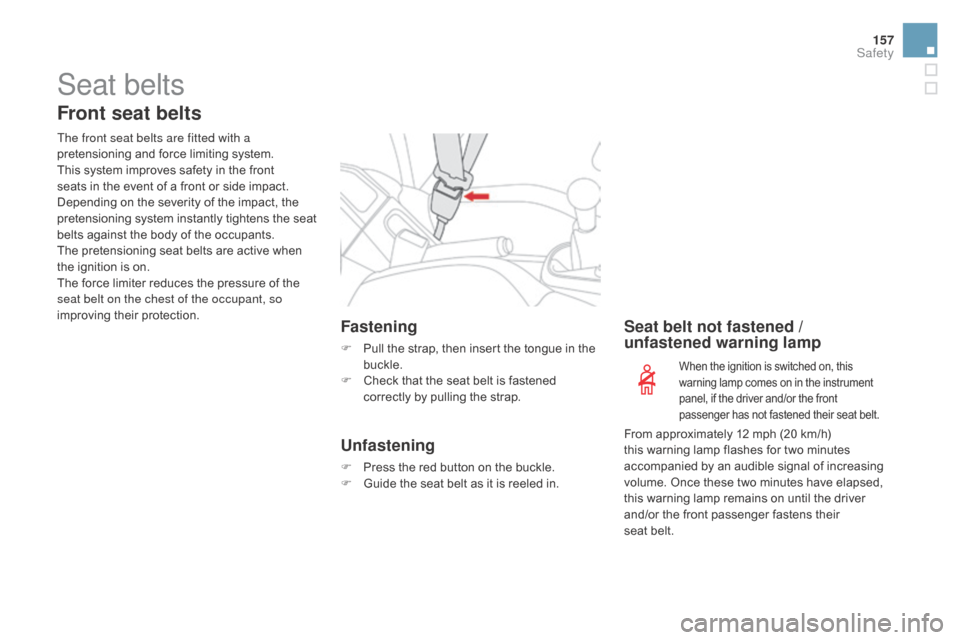
Fastening
F Pull the strap, then insert the tongue in the buc
kle.
F
C
heck that the seat belt is fastened
c
orrectly by pulling the strap.
Unfastening
F Press the red button on the buckle.
F G uide the seat belt as it is reeled in.
Seat belt not fastened /
unfastened warning lamp
When the ignition is switched on, this warning lamp comes on in the instrument p
anel, if the driver and/or the front
p
assenger has not fastened their seat belt.
From approximately 12 mph (20 km/h) this warning lamp flashes for two minutes
a
ccompanied by an audible signal of increasing
v
olume. Once these two minutes have elapsed,
t
his warning lamp remains on until the driver
a
nd/or the front passenger fastens their
seat
belt.
Safety
Page 162 of 415
Airbags
System designed to contribute towards improving the safety of the occupants (with
t
he exception of the rear centre passenger)
i
n the event of violent collisions. The airbags
s
upplement the action of the force-limiting
s
eat belts (with the exception of the centre rear
p
assenger).
If a collision occurs, the electronic detectors
record
and analyse the front and side impacts
s
ustained in the impact detection zones:
-
i
n the case of a serious impact, the airbags
a
re deployed instantly and contribute
towards better protection of the occupants
of
the vehicle (with the exception of the
r
ear centre passenger); immediately after
t
he impact, the airbags deflate rapidly so
t
hat they do not hinder visibility or the exit
o
f the occupants,
-
i
n the case of a minor or rear impact or in
c
ertain roll-over conditions, the airbags
m
ay not be deployed; the seat belt
a
lone contributes towards ensuring your
p
rotection in these situations. This
equipment will only deploy once.
I
f a second impact occurs (during the
s
ame or a subsequent accident), the
a
irbag will not be deployed again.
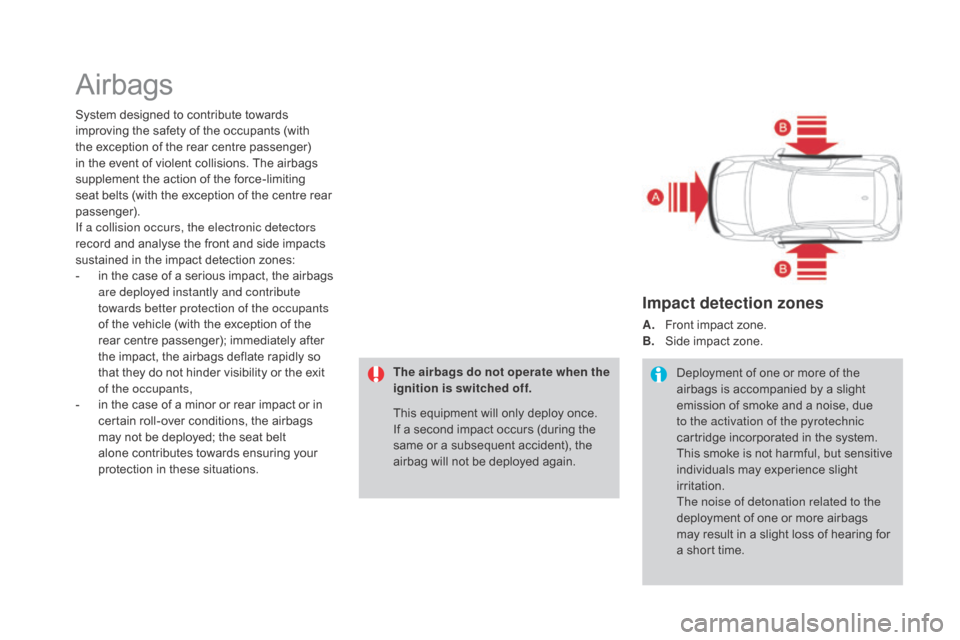
Impact detection zones
A. Front impact zone.
B. S ide impact zone.
Deployment
of one or more of the
a
irbags is accompanied by a slight
e
mission of smoke and a noise, due
t
o the activation of the pyrotechnic
cartridge
incorporated in the system.
This
smoke is not harmful, but sensitive
i
ndividuals may experience slight
ir
ritation.
The noise of detonation related to the
deployment
of one or more airbags
m
ay result in a slight loss of hearing for
a
short time.
The airbags do not operate when the
ignition is switched off.
Page 164 of 415
deactivation
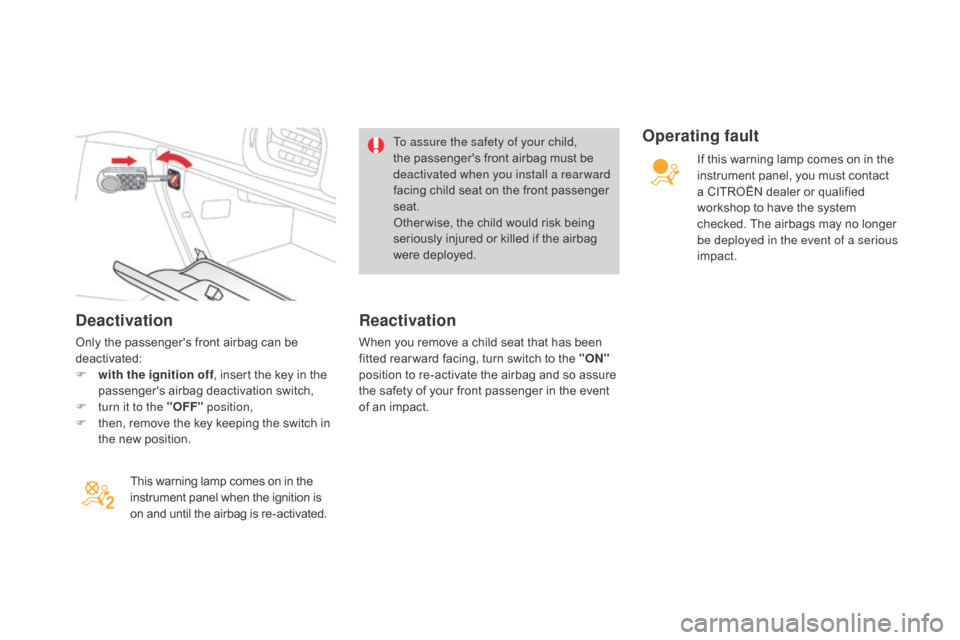
Only the passenger's front airbag can be deactivated:
F
w
ith the ignition off ,
insert the key in the
p
assenger's airbag deactivation switch,
F
t
urn it to the "OFF" position,
F
t
hen, remove the key keeping the switch in
t
he new position.
This
warning lamp comes on in the
i
nstrument panel when the ignition is
o
n and until the airbag is re-activated.To assure the safety of your child,
the
passenger's front airbag must be
d
eactivated when you install a rear ward
facing child seat on the front passenger
sea
t.
Other wise, the child would risk being
s
eriously injured or killed if the airbag
w
ere deployed.
Reactivation
When you remove a child seat that has been f
itted rear ward facing, turn switch to the "On"
p
osition to re-activate the airbag and so assure
t
he safety of your front passenger in the event
o
f an impact.
Operating fault
If this warning lamp comes on in the instrument panel, you must contact
a
CITROËN dealer or qualified
w
orkshop to have the system
c
hecked. The airbags may no longer
b
e deployed in the event of a serious
impact.
Page 186 of 415
DS3_en_Chap08_info-pratiques_ed01-2015
Fuel tankFuel tank capacity: approximately 50 litres (petrol) or 46 litres (diesel) or 33 litres (LPg) ;
(dep ending on version: approximately 30 litres (petrol or di esel)).
Low fuel level
Filling
A label affixed to the inside of the flap reminds you of the type of fuel to be used depending on
y
our
eng
ine.
Additions
of fuel must be of at least 7 litres, in
o
rder to be registered by the fuel gauge.The
key cannot be removed from the
l
ock until the cap is refitted.
Opening
the filler cap may create a
n
oise caused by an inrush of air. This
v
acuum is entirely normal, resulting
f
rom the sealing of the fuel system.
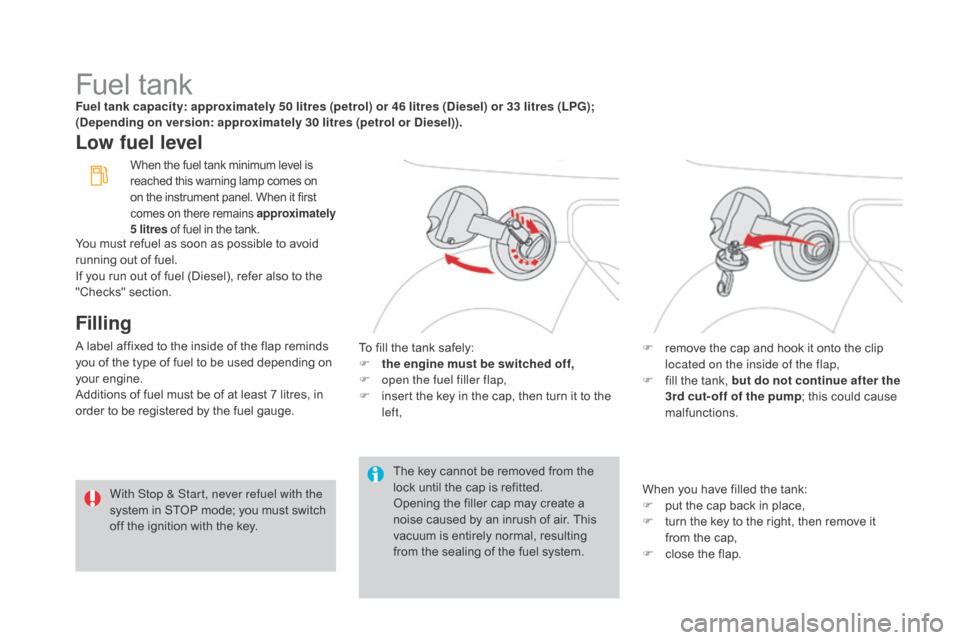
To
fill the tank safely:
F
t
he engine must be switched off,
F
o
pen the fuel filler flap,
F
i
nsert the key in the cap, then turn it to the
l
eft,F
r emove the cap and hook it onto the clip
l
ocated on the inside of the flap,
F
f
ill the tank, but do not continue after the
3rd cut- off of the pump ;
this could cause
m
alfunctions.
When
you have filled the tank:
F
p
ut the cap back in place,
F
t
urn the key to the right, then remove it
f
rom the cap,
F
c
lose the flap.
When the fuel tank minimum level is reached this warning lamp comes on o
n the instrument panel. When it first
c
omes on there remains approximately
5 litres
of fuel in the tank.
With Stop & Start, never refuel with the
system in STOP mode; you must switch
o
ff the ignition with the key.
You
must refuel as soon as possible to avoid
r
unning out of fuel.
If
you
run out of fuel (Diesel), refer also to the
"
Checks"
s
ection.
Page 189 of 415
187
DS3_en_Chap08_info-pratiques_ed01-2015
Running out of fuel (Diesel)If your vehicle has an HDi engine, the fuel system must be primed if you run out of fuel.
T his system consists of a priming pump and a transparent pipe under the bonnet.
F
F
ill the fuel tank with at least five litres of
D
iesel.
F
O
pen the bonnet.
F
D
epending on version, unclip the cover to
g
ain access to the priming pump.
F
S
queeze and release the priming pump
u
ntil resistance is felt (could be from the
f
irst application) and fuel appears in the
t
ransparent pipe with the green connector.
F
O
perate the starter until the engine starts.
F
D
epending on version, put the cover back
i
n position and clip it in place.
F
C
lose the bonnet.
BlueHdi 100 engines
F Fill the fuel tank with at least five litres of D
iesel.
F
S
witch on the ignition (without starting the
e
ngine).
F
W
ait around 6 seconds and switch off the
ignition.
F
R
epeat the operation 10 times.
F
O
perate the starter to run the engine.
If
the
engine
does
not
start
at
the
first
a
ttempt,
do
not
try
again.
Operate
the
priming
pump
again,
then
t
he
starter.
Practical information
Page 191 of 415

189
DS3_en_Chap08_info-pratiques_ed01-2015
Range indicators
Once the AdBlue® tank is on reserve or after d
etection
of
a
fault with the SCR emissions
c
ontrol
system,
when the ignition is switched
o
n,
an
indicator
displays an estimate of the
d
istance
that
can
be covered, the range, before
e
ngine
starting
is
prevented.
In
the
event
of
simultaneous system fault and
l
ow AdBlue
® level, the shortest range figure is t
he
one
displayed. The
engine start prevention system
r
equired by regulations is activated
a
utomatically once the AdBlue
® tank i
s
empty.
In the event of the risk of non-starting related to a lack of AdBlue®
Range greater than 1 500 miles (2 400 km)
When the ignition is switched on, no
i
nformation on range is displayed automatically
i
n the instrument panel.
Remaining range between 350 and 1500 miles (600 and 2 400 km)
When switching on the ignition, the UREA warning lamp comes on, accompanied
b
y an audible signal and the display of a
m
essage (e.g.: "Top up emissions additive:
S
tarting prevented in 900 miles") indicating
t
he remaining range expressed in miles or
k
ilometres.
When
driving, the message is displayed every
2
00 miles (300 km) until the additive tank has
be
en
t
opped-up.
Go
to a CITROËN dealer or a qualified
w
orkshop to have the AdBlue
® tank topped-up.
Y
ou
can
also
top-up
the
tank
yourself.
Refer
to
the
"Topping-up"
section.
Practical information