steering CITROEN DS4 2010 User Guide
[x] Cancel search | Manufacturer: CITROEN, Model Year: 2010, Model line: DS4, Model: CITROEN DS4 2010Pages: 421, PDF Size: 8.05 MB
Page 158 of 421
156
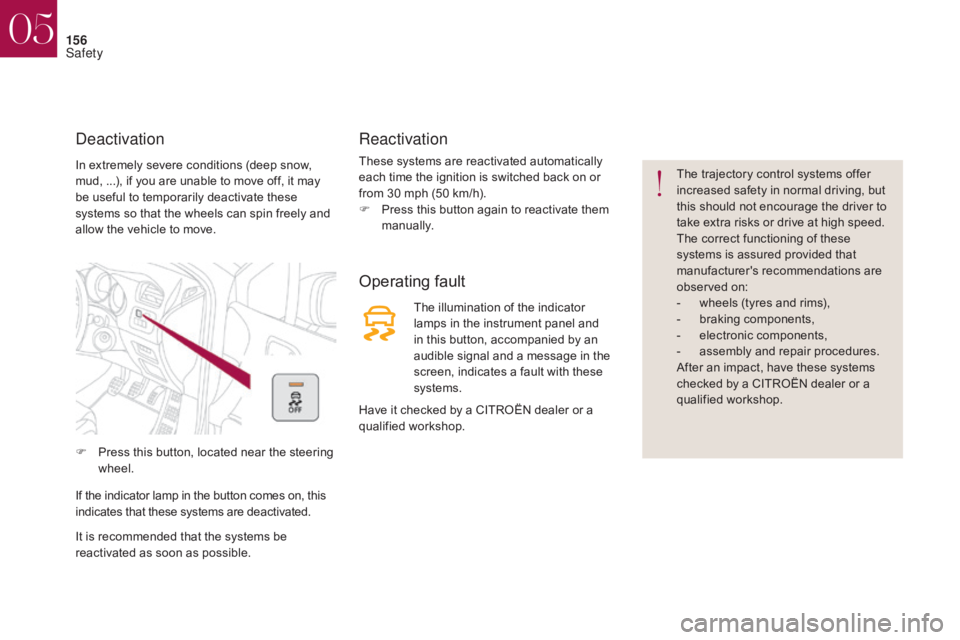
In extremely severe conditions (deep snow,
mud, ...), if you are unable to move off, it may
be useful to temporarily deactivate these
systems so that the wheels can spin freely and
allow the vehicle to move.
If the indicator lamp in the button comes on, this
indicates that these systems are deactivated.
Reactivation
These systems are reactivated automatically
each time the ignition is switched back on or
from 30 mph (50 km/h).
F
P
ress this button again to reactivate them
manually.
Operating fault
The trajectory control systems offer
increased safety in normal driving, but
this should not encourage the driver to
take extra risks or drive at high speed.
The correct functioning of these
systems is assured provided that
manufacturer's recommendations are
observed on:
-
w
heels (tyres and rims),
-
b
raking components,
-
el
ectronic components,
-
a
ssembly and repair procedures.
After an impact, have these systems
checked by a CITROËN dealer or a
qualified workshop.
The illumination of the indicator
lamps in the instrument panel and
in this button, accompanied by an
audible signal and a message in the
screen, indicates a fault with these
systems.
It is recommended that the systems be
reactivated as soon as possible. Have it checked by a CITROËN dealer or a
qualified workshop.
Deactivation
F Press this button, located near the steering
wheel.
05
Safety
Page 164 of 421

162
Front airbags
System which protects the driver and front
passenger in the event of a serious front impact
in order to limit the risk of injury to the head and
thorax.
The driver's airbag is fitted in the centre of the
steering wheel; the front passenger's airbag is
fitted in the dashboard above the glove box.
Deployment
The airbags are deployed, except the
passenger's front airbag if it is deactivated, in
the event of a serious front impact to all or part
of the front impact zone A, in the longitudinal
centreline of the vehicle on a horizontal plane
and directed from the front to the rear of the
vehicle.
The front airbag inflates between the thorax
and head of the front occupant of the vehicle
and the steering wheel, driver's side, and the
dashboard, passenger's side to cushion their
for ward movement.
05
Safety
Page 167 of 421

165
Advice
Front airbags
Do not drive holding the steering wheel by its
spokes or resting your hands on the centre
part of the wheel.
Passengers must not place their feet on the
dashboard.
Do not smoke as deployment of the airbags
can cause burns or the risk of injury from a
cigarette or pipe.
Never remove or pierce the steering wheel or
hit it violently.
Do not fit or attach anything to the steering
wheel or dashboard, this could cause injuries
with deployment of the airbags.
Lateral airbags
Use only approved covers on the seats,
compatible with the deployment the lateral
airbags. For information on the range of
seat covers suitable for your vehicle, you
can contact a CITROËN dealer.
Do not fix or attach anything to the seat
backs (clothing...). This could cause injury
to the chest or arms if the lateral airbag is
deployed.
Do not sit with the upper part of the body
any nearer to the door than necessary.
Sit in a normal upright position.
Wear a correctly adjusted seat belt.
Do not leave anything between the occupants
and the airbags (a child, pet, object...), nor
fix or attach anything close to the inflation
trajectory of the airbags; this could cause
injuries during their deployment.
Never modify the original definition of your
vehicle, particularly in the area directly
around the airbags.
After an accident or if the vehicle has been
stolen or broken into, have the airbag
systems checked.
All work on the airbag system must be
carried out by a CITROËN dealer or a
qualified workshop.
Even if all of the precautions mentioned
are observed, a risk of injury or of minor
burns to the head, chest or arms when an
airbag is deployed cannot be ruled out. The
bag inflates almost instantly (within a few
milliseconds) then deflates within the same
time discharging the hot gas via openings
provided for this purpose.
Curtain airbags
Do not fix or attach anything to the roof.
This could cause injury to the head if the
curtain airbag is deployed.
If fitted on your vehicle, do not remove the
grab handles installed on the roof, they play
a part in securing the curtain airbags.
For the airbags to be fully effective, observe the safety recommendations below:
The vehicle's front door panels include side
impact sensors.
A damaged door or any unauthorised or
incorrectly executed work (modification or
repair) on the front doors or their interior
trim could compromise the operation of
these sensors - Risk of malfunction of the
lateral airbags!
Such work must only be done by a
CITROËN dealer or a qualified workshop.
05
Safety
Page 188 of 421

186
Avoid attaching heavy objects to the
key or the remote control, which would
weigh down on its blade in the ignition
switch and could cause a malfunction.
It could adversely affect the
deployment of the front airbag.
Starting / Switching off the engine with the key
It has 3 positions:
- position 1 (Stop): insert and removing the
key, steering column locked,
-
position 2 (Ignition on) : steering column
unlocked, ignition on, Diesel preheating,
engine running,
-
position 3 (Starting) .
Ignition switch
Ignition on position
It allows the use of the vehicle's electric
equipment or portable devices to be charged.
Once the state of charge of the battery drops
to the reserve level, the system switches to
energy economy mode: the power supply is
cut off automatically to preserve the remaining
battery charge.
Switching off the engine leads to a loss
of braking assistance.
Anti-theft protection
Electronic engine immobiliser
In the event of a fault, you are
informed by illumination of this
warning lamp, an audible signal
and/or the display of a message,
depending on version.
Keep safely, away from your vehicle,
the label attached to the keys given to
you on acquisition of the vehicle.
In this case, your vehicle will not start; contact
a CITROËN dealer as soon as possible. The keys contain an electronic chip which has
a special code. When the ignition is switched
on, this code must be recognised for engine
starting to be authorised.
This electronic engine immobiliser locks the
engine management system a few minutes
after the ignition is switched off and prevents
starting of the engine by anyone who does not
have the key.
06
Driving
Page 189 of 421

187
In wintry conditions, the warning lamp
can stay on for a longer period. When
the engine is hot, the warning lamp
does not come on.
In certain cases, you may have to apply
more force to the steering (wheels on
full lock, for example). If the engine does not start straight
away, switch off the ignition. Wait a
few moments before operating the
starter motor again. If the engine does
not start after several attempts, do not
keep trying: you risk damaging the
starter motor or the engine. Contact
a CITROËN dealer or a qualified
workshop.In temperate conditions, do not leave
the engine at idle to warm up but move
off straight away and drive at moderate
speed.
Never leave the engine running in
an enclosed area without adequate
ventilation: internal combustion
engines emit toxic exhaust gases,
such as carbon monoxide. Danger of
intoxication and death!
In very severe wintry conditions
(temperatures below -23°C), to ensure
the correct operation and durability of
the mechanical components of your
vehicle, engine and gearbox, it is
necessary to leave the engine running
for 4 minutes before moving off.
Starting the engine
The parking brake must be applied.
F
W ith a manual gearbox, place the gear
lever in neutral and depress the clutch
pedal fully.
F
W
ith an automatic gearbox, place the
selector in position N or P and press the
brake pedal fully.
F
I
nsert the key into the ignition switch; the
system recognises the code.
F
U
nlock the steering column by
simultaneously turning the steering and the
key.
F
W
ith a petrol engine, operate the starter
motor by turning the key to position 3
without pressing the accelerator pedal,
until the engine starts. Once the engine is
running, release the key.
F
W
ith a Diesel engine, turn the key to
position 2 , ignition on, to operate the
engine pre-heating system.Wait until this warning lamp goes off in the
instrument panel then operate the starter
motor by turning the key to position
3
without pressing the accelerator pedal,
until the engine starts. Once the engine is
running, release the key.
06
Driving
Page 190 of 421

188
Key left in the "Ignition on"
position
If the key has been left in the ignition switch
at position 2 (Ignition on), the ignition will
be switched off automatically after one hour.
To switch the ignition back on, turn the
key to position 1 (Stop) , then back to
position
2
(Ignition on) .
F Stop the vehicle.
F
W ith the engine running at idle, turn the key
to position 1 .
F
R
emove the key from the ignition switch.
F
T
o lock the steering column, turn the
steering until it locks.
Switching off the engine
To facilitate unlocking of the steering
column, it is recommended that the
wheels be returned to the straight ahead
position before switching off the engine. When you leave the vehicle, keep the
key with you and lock the vehicle.
For more information on Energy
economy mode
, refer to the
corresponding section.
Never switch off the ignition before the
vehicle is at a complete stop. With the
engine off, the braking and steering
assistance systems are also cut off:
risk of loss of control of the vehicle.Energy economy mode
After switching off the engine (position 1- Stop
),
for a maximum of 30 minutes you can still use
functions such as the audio and telematic
system, the wipers, dipped beam headlamps,
courtesy lamps, ...
F
C
heck that the parking brake is correctly
applied, particularly on sloping ground.
06
Driving
Page 191 of 421

189
Starting / Switching off the engine with Keyless Entry and
S tarting
Starting the engine
F With a manual gearbox, place the gear
lever in neutral and declutch fully.
F
W
ith an automatic gearbox, place the gear
selector at P or N and press the brake
pedal. F
B
riefly press the "
S TA R T/
STOP " button while maintaining
pressure on the pedal until the
engine starts. If the electronic key is not detected
in the zone, a message is displayed.
Move the electronic key into the zone
so that the engine can be started.
If one of the starting conditions is not
met, a reminder message appears in
the instrument panel screen. In some
circumstances, it is necessary to
turn the steering wheel slightly while
pressing the " START/STOP " button
to assist unlocking of the steering;
a message warns you when this is
needed.
The presence of the "Keyless Entry
and Starting" electronic key in the
recognition zone is essential.
As a safety measure, do not leave this
zone with the vehicle running.
Diesel vehicles
In temperatures below zero
the engine will not start until
the preheater warning lamp
has gone off.
If this warning lamp comes on after
pressing " START/STOP ", you should
hold the brake or clutch pedal down
until the warning lamp goes off and do
not press the " START/STOP" button
again.
The steering column unlocks and the engine
starts.
See the advice for Diesel versions.
F
P
lace the electronic key inside the vehicle:
there is no need to place it in the reader.
06
Driving
Page 192 of 421

190
Switching off the engine
If the vehicle is not immobilised, the
engine will not stop.
Do not leave your vehicle with the
electronic key still inside.
Switching off the engine leads to a loss
of braking assistance.
F
I
mmobilise the vehicle.
F
W
ith a manual gearbox, place the gear
lever in neutral.
F
W
ith an automatic gearbox, place the gear
selector at P or N .
F
W
ith the electronic key inside
the vehicle, press the " S TA R T/
STOP " button.
The engine stops and the steering
column locks.
Emergency starting
When the electronic key is in the recognition
zone and, after pressing the " START/STOP"
button, the engine does not start:
F
W
ith a manual gearbox, place the gear
lever in neutral.
F
W
ith an automatic gearbox, place the gear
selector at P or N . F
O pen the front armrest.
F
R
aise the mat by its tab and remove it.
F
P
lace the electronic key in the back-up
reader.
F
W
ith an automatic gearbox, press the
brake pedal.
F
W
ith a manual gearbox, declutch fully.F
P
ress the "START/STOP "
button.
T
he engine starts.
06
Driving
Page 193 of 421

191
Emergency switch-off
In the event of an emergency only,
the engine can be switched of without
conditions. To do this, press and hold
the "START/STOP " button for about
3 seconds.
In this case the steering column locks as soon
as the vehicle stops.
Electronic key not recognised
If the electronic key is no longer in the
recognition zone when driving or when you
(later) request switching off the engine, a
message is displayed.
F
P
ress and hold the " S TA R T/
STOP " button for about
3
seconds if you want to force
switching off the engine (note
that restar ting will not be
possible without the key) .
Ignition on position
(without starting)
With the Keyless Entry and Starting key inside
the vehicle, pressing the "START/STOP"
button, with no action on the pedals , allows
the ignition to be switched on.
F
P
ress the "START/STOP " button,
the instrument panel comes on
but the engine does not start.
F
P
ress the button again to switch
off the ignition and so allow the
vehicle to be locked.
With the ignition on, the system
automatically goes into energy
economy mode when required to
maintain the state of charge of the
battery.
06
Driving
Page 207 of 421

205
Under-inflation alert
The loss of pressure detected does not
always lead to visible deformation of
the tyre.
Do not rely on just a visual check.This alert is also displayed when one or
more wheels is not fitted with a sensor
(e.g. a space-saver or steel spare
wheel).
The alert is maintained until the tyre or
tyres concerned is reinflated, repaired
or replaced.
The spare wheel (space-saver type or
a steel rim) does not have a sensor.
The alert is given by the fixed
illumination of this warning lamp,
accompanied by an audible signal,
and depending on equipment, the
display of a message.
In the event of a problem on one of the tyres,
the symbol or the message appears, depending
on equipment, to identify it.
F
R
educe speed immediately, avoid sudden
steering movements or harsh brake
applications.
F
S
top as soon as it is safe to do so.
Operating fault
The flashing and then fixed
illumination of the under-inflation
warning lamp accompanied by the
illumination of the service warning
lamp indicates a fault with the system.
Go to a CITROËN dealer or a qualified
workshop
to have the system checked or,
following the repair of a puncture, to have the
original wheel, equipped with a sensor, refitted.
F
I
f you have a compressor (e.g. the one in
the temporary puncture repair kit), check
the four tyre pressures when cold.
I
f it is not possible to check the tyre
pressures at the time, drive carefully at
reduced speed.
or
F
I
n the event of a puncture, use the
temporary puncture repair kit or the spare
wheel (depending on equipment).
Any tyre repair or replacement on a wheel
fitted with this system must be carried out by a
CITROËN dealer or a qualified workshop.
If after changing a tyre, a wheel is not detected
by your vehicle (e.g. fitting snow tyres),
you must have the system reinitialised by a
CITROËN dealer or a qualified workshop. In this case, monitoring of the tyre pressures is
not assured.
06
Driving