brake Citroen DS4 2011 1.G Service Manual
[x] Cancel search | Manufacturer: CITROEN, Model Year: 2011, Model line: DS4, Model: Citroen DS4 2011 1.GPages: 396, PDF Size: 31.05 MB
Page 236 of 396
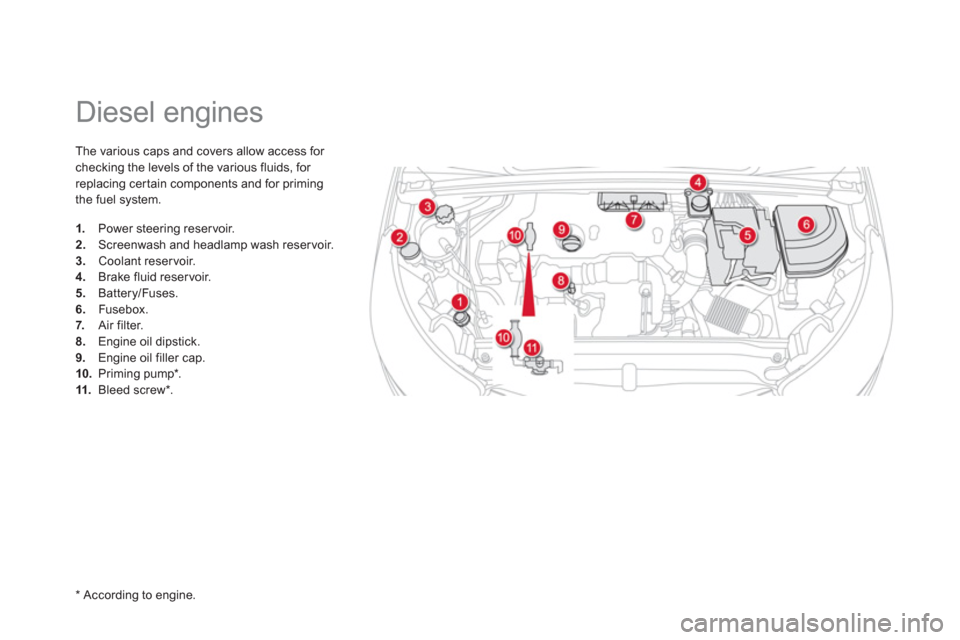
Diesel engines
The various caps and covers allow access for
checking the levels of the various fluids, for
replacing cer tain components and for priming
the fuel system.
1.
Power steering reservoir.
2.
Screenwash and headlamp wash reser voir.
3.
Coolant reser voir.
4.
Brake fluid reser voir.
5.
Battery/Fuses.
6.
Fusebox.
7.
Air filter.
8.
Engine oil dipstick.
9.
Engine oil filler cap.
10.
Priming pump * .
11.
Bleed screw * .
*
According to engine.
Page 237 of 396
235Checks
Checking levels
Check all of these levels regularly and top them up if necessary, unless other wise indicated.
If a level drops significantly, have the corresponding system checked by a CITROËN dealer or a qualified workshop.
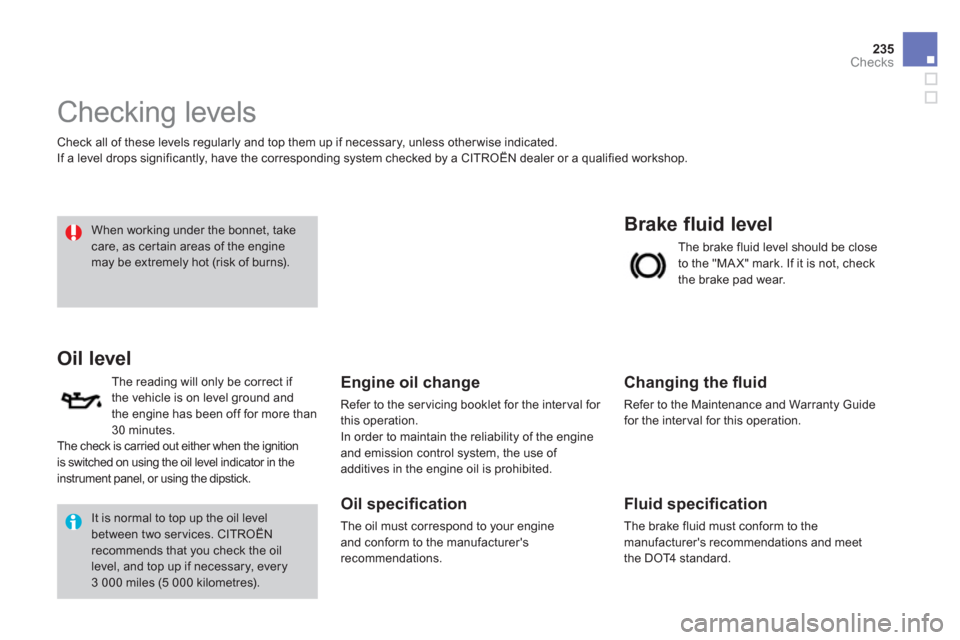
Oil level
Engine oil change
Refer to the ser vicing booklet for the inter val for
this operation.
In order to maintain the reliability of the engine
and emission control system, the use of
additives in the engine oil is prohibited.
Oil specifi cation
The oil must correspond to your engine
and conform to the manufacturer's
recommendations.
Brake fluid level
Changing the fl uid
Refer to the Maintenance and Warranty Guide
for the inter val for this operation.
Fluid specifi cation
The brake fluid must conform to the
manufacturer's recommendations and meet
the DOT4 standard.
The brake fluid level should be close
to the "MA X" mark. If it is not, check
the brake pad wear.
The reading will only be correct if
the vehicle is on level ground and
the engine has been off for more than
30 minutes.
The check is carried out either when the ignition
is switched on using the oil level indicator in the
instrument panel, or using the dipstick.
When working under the bonnet, take
care, as cer tain areas of the engine
may be extremely hot (risk of burns).
It is normal to top up the oil level
between two ser vices. CITROËN
recommends that you check the oil
level, and top up if necessary, every
3 000 miles (5 000 kilometres).
Page 242 of 396
Electric parking brake
This system does not require any
routine servicing. However, in the
event of a problem, have the system
checked by a CITROËN dealer or a
qualified workshop.
For more information, see "Driving - Electric
parking brake - § Operating faults".
Only use products recommended by
CITROËN or products of equivalent
quality and specification.
In order to optimise the operation
of units as impor tant as the braking
system, CITROËN selects and offers
very specific products.
To avoid damaging the electrical units,
the use of a high pressure washer
in the engine compar tment is strictly
prohibited
.
Brake disc wear
For information on checking brake
disc wear, contact a CITROËN dealer
or a qualified workshop.
Manual parking brake
If a loss of effectiveness of this
system is noticed, the parking brake
must be checked, even between
two ser vices.
Checking this system must be done by a
CITROËN dealer or a qualified workshop.
Brake pads
Brake wear depends on the style
of driving, par ticularly in the case
of vehicles used in town, over shor t
distances. It may be necessary to
have the condition of the brakes checked,
even between vehicle ser vices.
Unless there is a leak in the system, a drop in
the brake fluid level indicates that the brake
pads are worn.
Page 254 of 396
Removing a wheel
Parking the vehicle
Immobilise the vehicle where it does
not block traffic: the ground must be
level, stable and non-slippery ground.
Apply the parking brake unless it has
been programmed to automatic mode,
switch off the ignition and engage first
gear * to lock the wheels.
Check that the braking warning lamps
in the instrument panel are on
(not f lashing).
The occupants must get out of the
vehicle and wait where they are safe.
If necessary, place a chock under the
wheel diagonally opposite the wheel to
be changed.
Never go underneath a vehicle raised
using a jack; use an axle stand.
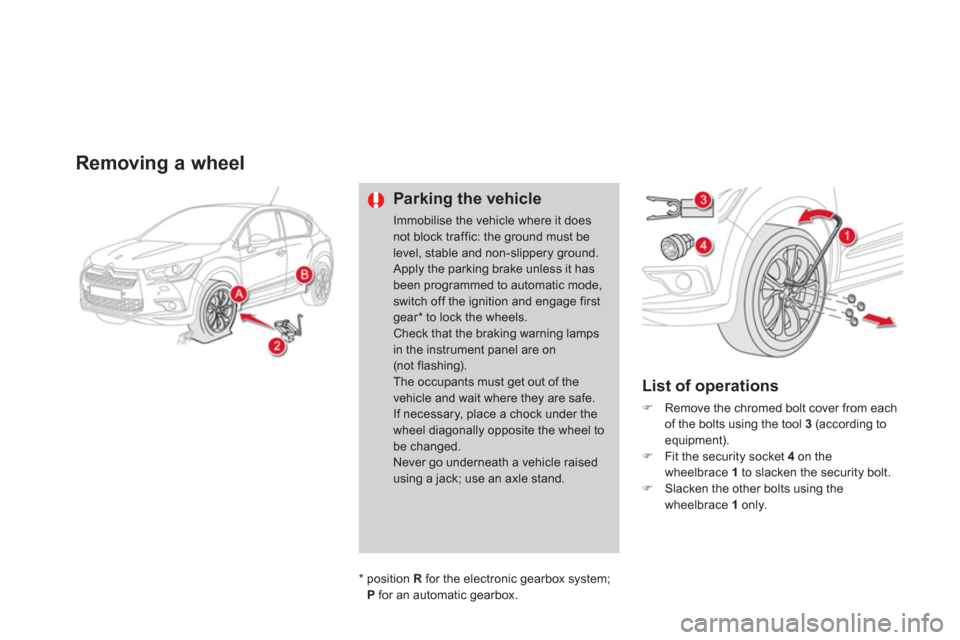
List of operations
)
Remove the chromed bolt cover from each
of the bolts using the tool 3
(according to
equipment).
)
Fit the security socket 4
on the
wheelbrace 1
to slacken the security bolt.
)
Slacken the other bolts using the
wheelbrace 1
only.
*
position R
for the electronic gearbox system;
P
for an automatic gearbox.
Page 263 of 396
261Practical information
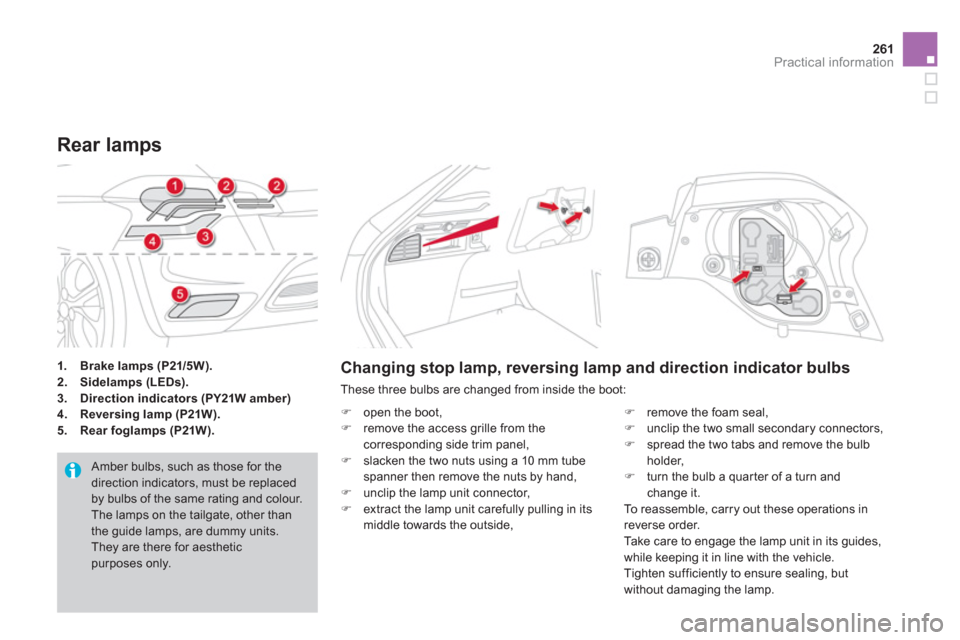
1.
Brake lamps (P21/5W).
2.
Sidelamps (LEDs).
3.
Direction indicators (PY21W amber)
4.
Reversing lamp (P21W).
5.
Rear foglamps (P21W).
Rear lamps
Amber bulbs, such as those for the
direction indicators, must be replaced
by bulbs of the same rating and colour.
The lamps on the tailgate, other than
the guide lamps, are dummy units.
They are there for aesthetic
purposes only.
Changing stop lamp, reversing lamp and direction indicator bulbs
These three bulbs are changed from inside the boot:
)
open the boot,
)
remove the access grille from the
corresponding side trim panel,
)
slacken the two nuts using a 10 mm tube
spanner then remove the nuts by hand,
)
unclip the lamp unit connector,
)
extract the lamp unit carefully pulling in its
middle towards the outside,
)
remove the foam seal,
)
unclip the two small secondary connectors,
)
spread the two tabs and remove the bulb
holder,
)
turn the bulb a quar ter of a turn and
change it.
To reassemble, carry out these operations in
reverse order.
Take care to engage the lamp unit in its guides,
while keeping it in line with the vehicle.
Tighten sufficiently to ensure sealing, but
without damaging the lamp.
Page 264 of 396
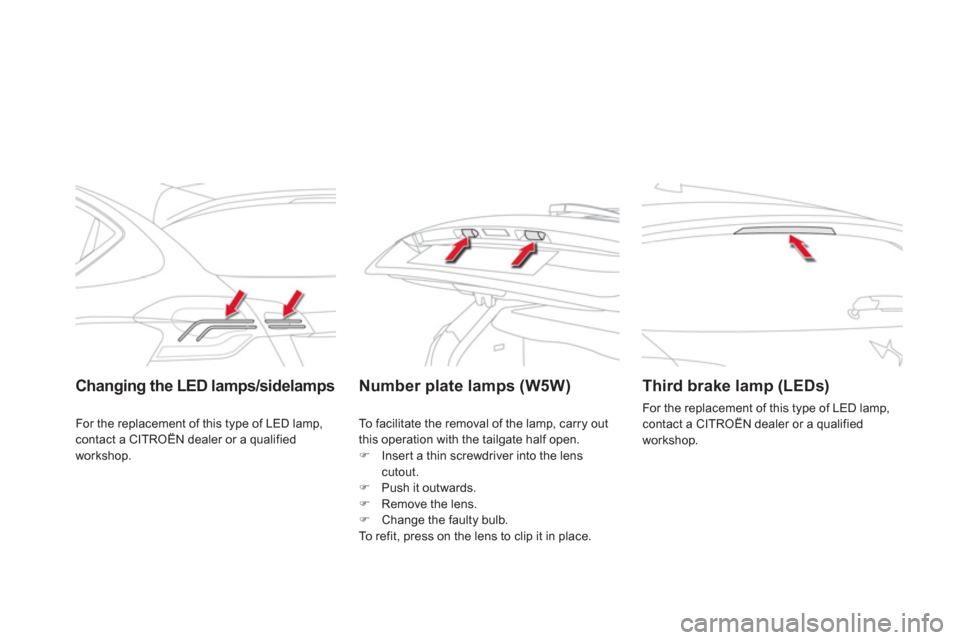
Changing the LED lamps/sidelamps
Number plate lamps (W5W)
Third brake lamp (LEDs)
For the replacement of this type of LED lamp,
contact a CITROËN dealer or a qualified
workshop.
For the replacement of this type of LED lamp,
contact a CITROËN dealer or a qualified
workshop. To facilitate the removal of the lamp, carry out
this operation with the tailgate half open.
)
Inser t a thin screwdriver into the lens
cutout.
)
Push it outwards.
)
Remove the lens.
)
Change the faulty bulb.
To refit, press on the lens to clip it in place.
Page 276 of 396
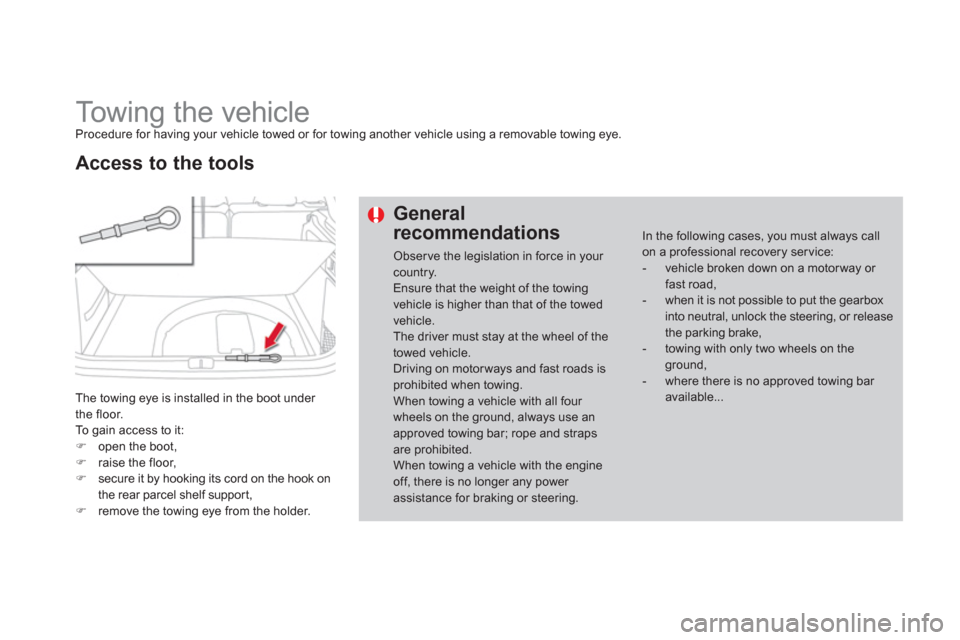
Towing the vehicle
Procedure for having your vehicle towed or for towing another vehicle using a removable towing eye.
The towing eye is installed in the boot under
the floor.
To gain access to it:
)
open the boot,
)
raise the floor,
)
secure it by hooking its cord on the hook on
the rear parcel shelf suppor t,
)
remove the towing eye from the holder.
Access to the tools
General
recommendations
Obser ve the legislation in force in your
country.
Ensure that the weight of the towing
vehicle is higher than that of the towed
vehicle.
The driver must stay at the wheel of the
towed vehicle.
Driving on motor ways and fast roads is
prohibited when towing.
When towing a vehicle with all four
wheels on the ground, always use an
approved towing bar; rope and straps
are prohibited.
When towing a vehicle with the engine
off, there is no longer any power
assistance for braking or steering. In the following cases, you must always call
on a professional recovery ser vice:
- vehicle broken down on a motor way or
fast road,
- when it is not possible to put the gearbox
into neutral, unlock the steering, or release
the parking brake,
- towing with only two wheels on the
ground,
- where there is no approved towing bar
available...
Page 277 of 396
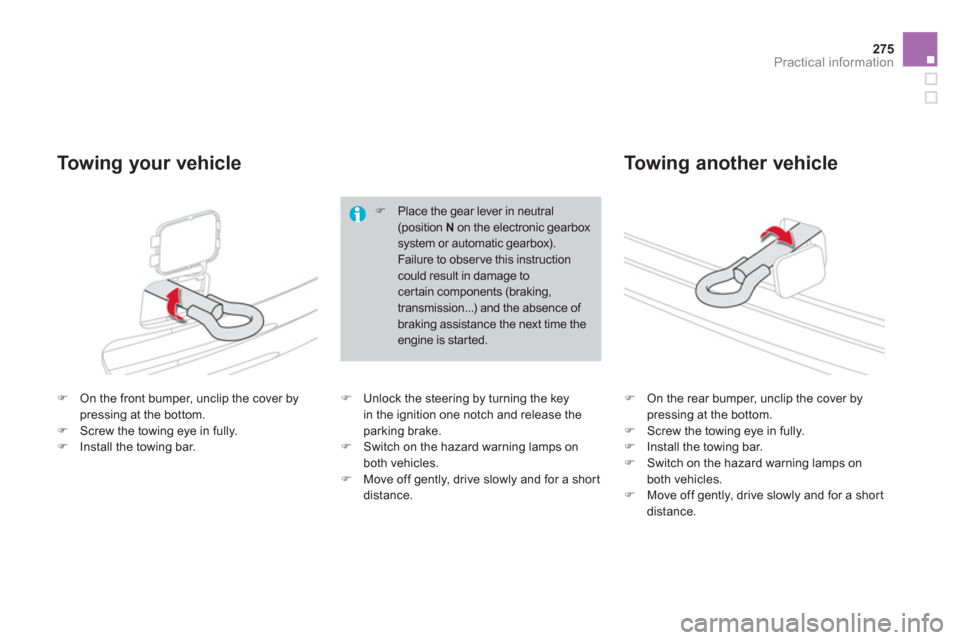
275Practical information
)
On the front bumper, unclip the cover by
pressing at the bottom.
)
Screw the towing eye in fully.
)
Install the towing bar.
)
On the rear bumper, unclip the cover by
pressing at the bottom.
)
Screw the towing eye in fully.
)
Install the towing bar.
)
Switch on the hazard warning lamps on
both vehicles.
)
Move off gently, drive slowly and for a short
distance.
Towing your vehicle
Towing another vehicle
)
Place the gear lever in neutral
(position N
on the electronic gearbox
system or automatic gearbox).
Failure to obser ve this instruction
could result in damage to
certain components (braking,
transmission...) and the absence of
braking assistance the next time the
engine is started.
)
Unlock the steering by turning the key
in the ignition one notch and release the
parking brake.
)
Switch on the hazard warning lamps on
both vehicles.
)
Move off gently, drive slowly and for a short
distance.
Page 279 of 396
277Practical information
The rear parking sensors will be
deactivated automatically if a genuine
CITROËN towbar is used.
Driving advice
Distribution of loads
)
Distribute the load in the trailer so that the
heaviest items are as close as possible to
the axle and the nose weight approaches the
maximum permitted without exceeding it.
Air density decreases with altitude, thus
reducing engine per formance. Above
1 000 metres, the maximum towed load must
be reduced by 10 % for every 1 000 metres of
altitude.
Refer to the "Technical Data" section for details
of the weights and towed loads which apply to
your vehicle.
Side wind
)
Take into account the increased sensitivity
to side wind.
Cooling
Towing a trailer on a slope increases the
temperature of the coolant.
As the fan is electrically controlled, its cooling
capacity is not dependent on the engine speed.
)
To lower the engine speed, reduce your
speed.
The maximum towed load on a long incline
depends on the gradient and the ambient
temperature.
In all cases, keep a check on the coolant
temperature.
Braking
Towing a trailer increases the braking distance.
To avoid overheating of the brakes on a long
mountain type of descent, the use of engine
braking is recommended.
Ty r e s
)
Check the tyre pressures of the towing
vehicle and of the trailer, obser ving the
recommended pressures.
Lighting
)
Check the electrical lighting and signalling
on the trailer.
)
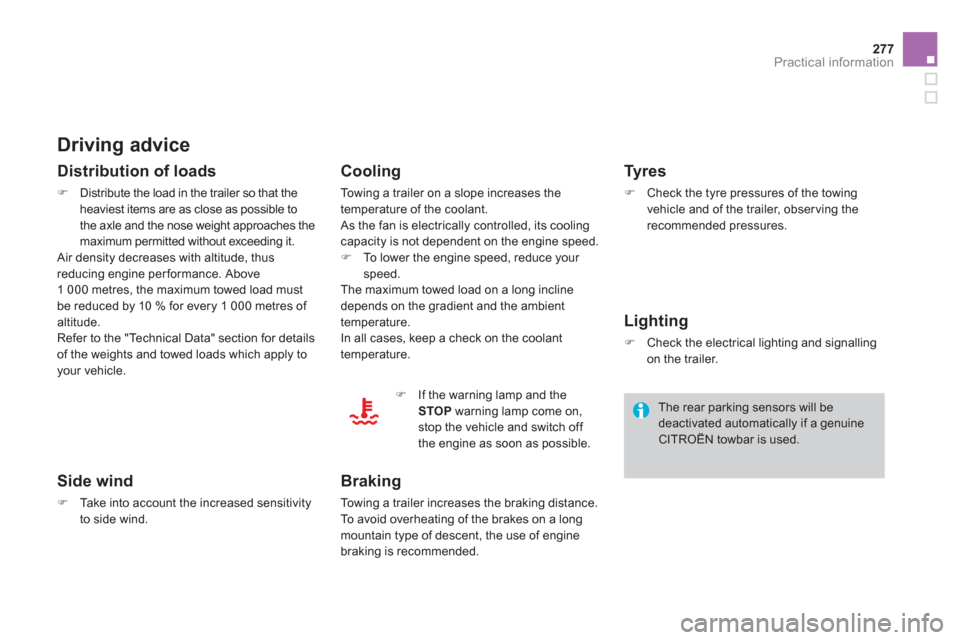
If the warning lamp and the
STOP
warning lamp come on,
stop the vehicle and switch off
the engine as soon as possible.
Page 285 of 396
283Technical data
WEIGHTS AND TOWED LOADS (in kg)
Petrol engines
VTi 120
THP 155
THP 160
THP 200
Gearboxes
Manual
Electronic gearbox system
Automatic
Manual
Model codes:
NX...
5FS0
5FV8/P
5FMA
5FU8
- Unladen weight
1 205
1 284
1 363
1 316
- Kerb weight
1 280
1 359
1 438
1 391
- Gross vehicle weight (GV W)
1 755
1 795
1 835
1 820
- Gross train weight (GTW)
on a 12 % gradient
2 955
3 195
2 635
2 820
- Braked trailer (within the GTW limit)
on a 12 % gradient
1 200
1 400
800
1 000
- Braked trailer * (with load transfer within the
GTW limit)
1 450
1 650
1 000
1 250
- Unbraked trailer
640
680
715
695
- Recommended nose weight
75
75
75
75
*
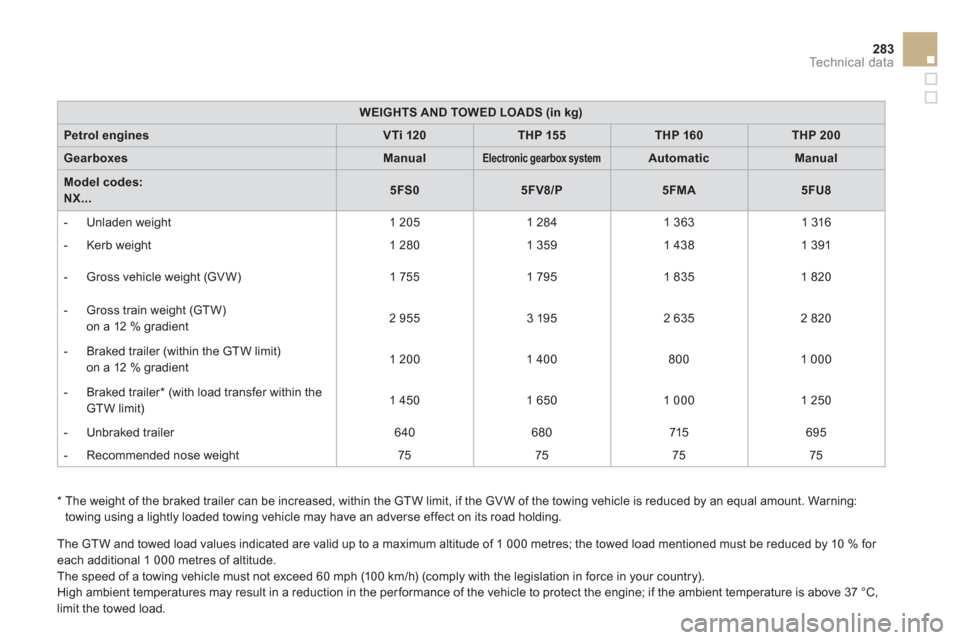
The weight of the braked trailer can be increased, within the GTW limit, if the GV W of the towing vehicle is reduced by an equal amount. Warning:
towing using a lightly loaded towing vehicle may have an adverse effect on its road holding.
The GTW and towed load values indicated are valid up to a maximum altitude of 1 000 metres; the towed load mentioned must be reduced by 10 % for
each additional 1 000 metres of altitude.
The speed of a towing vehicle must not exceed 60 mph (100 km/h) (comply with the legislation in force in your country).
High ambient temperatures may result in a reduction in the per formance of the vehicle to protect the engine; if the ambient temperature is above 37 °C,
limit the towed load.