fuel Citroen DS4 2012 1.G Owner's Manual
[x] Cancel search | Manufacturer: CITROEN, Model Year: 2012, Model line: DS4, Model: Citroen DS4 2012 1.GPages: 396, PDF Size: 12.14 MB
Page 5 of 396
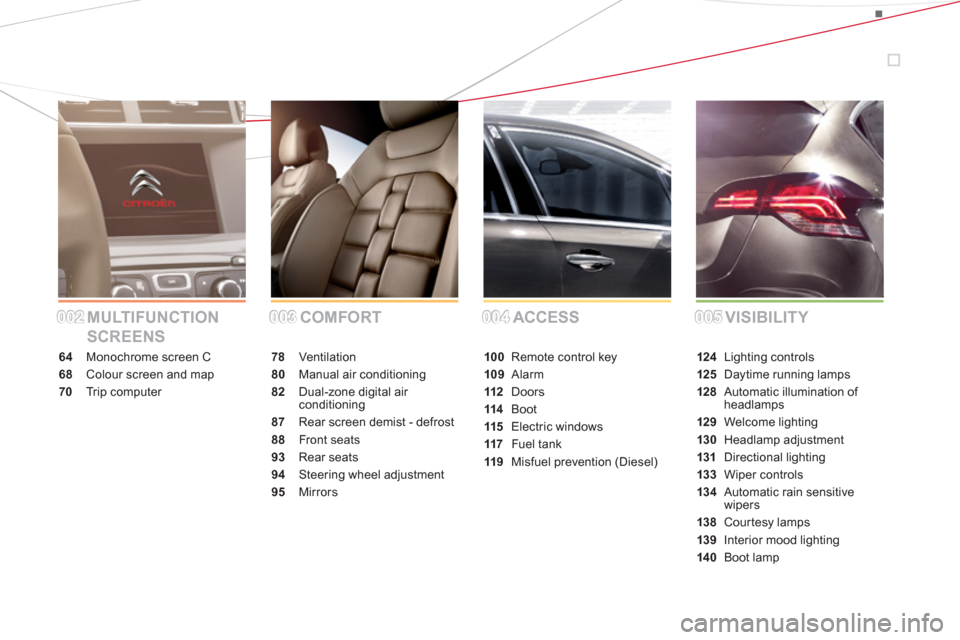
MULTIFUNCTION
SCREENSCOMFORT ACCESS VISIBILITY
64Monochrome screenC
68 Colour screen and map
70Trip computer
78 Ventilation
80Manual air conditioning
82Dual-zone digital air conditioning
87 Rear screen demist - defrost
88 Front seats
93 Rear seats
94 Steering wheel adjustment
95 Mirrors
100 Remote control key
109 Alarm
112Doors
114 Boot
115 Electric windows
117 Fuel tank
119 Misfuel prevention (Diesel)
124 Lighting controls
125 Daytime running lamps
128 Automatic illumination of headlamps
129Welcome lighting
130 Headlamp adjustment
131 Directional lighting
133 Wiper controls
13 4 Automatic rain sensitive
wipers
138Courtesy lamps
139Interior mood lighting
140 Boot lamp
004004005005002002003003
Page 7 of 396
CHECKS PRACTICAL
INFORMATIONTECHNICAL DATA AUDIO AND
TELEMATICS
233 Bonnet
234Running out of fuel (Diesel)
235Petrol engines
236 Diesel engines
237 Checking levels
240 Checks
246Te m p o r a ry puncture repair
kit
251 Changing a wheel
258 Changing a bulb
265Changing a fuse
271 12 V battery
274 Energy economy mode
275Changing a wiper blade
275Very cold climate screen
276Fitting roof bars
277 Towing the vehicle
279To w i ng a trailer
281 Accessories
286 Petrol engines
287 Petrol weights
288Diesel engines
289Diesel weights
290Dimensions
291Identifi cation markings
295 Emergency or assistance
297 eMyWay
349 Audio system
012012013013010010011011
Page 10 of 396
Exterior
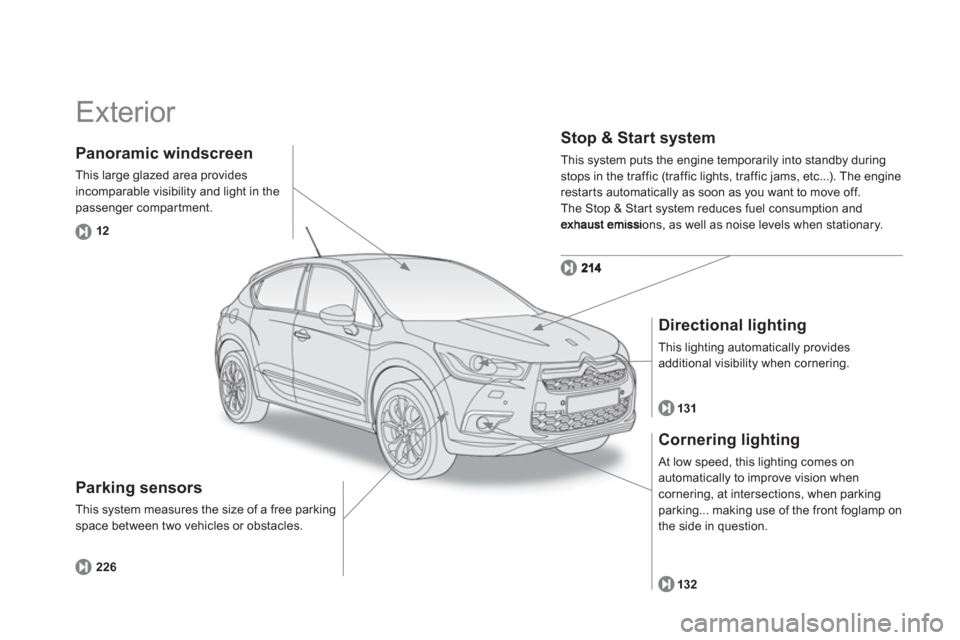
Parking sensors
This system measures the size of a free parking space between two vehicles or obstacles.
Stop & Start system
This system puts the engine temporarily into standby during stops in the traffic (traffic lights, traffic jams, etc...). The engine
restarts automatically as soon as you want to move off.
The Stop & Start system reduces fuel consumption and exhaust emissions, as well as noise levels when stationary.
226
Directional lighting
This lighting automatically provides
additional visibility when cornering.
13
1
Panoramic windscreen
This large glazed area provides
incomparable visibility and light in the passenger compartment.
1
2
Cornering lighting
At low speed, this lighting comes on
automatically to improve vision when cornering, at intersections, when parkingparking... making use of the front foglamp on
the side in question.
13
2
Page 13 of 396
11Familiarisation
117, 119
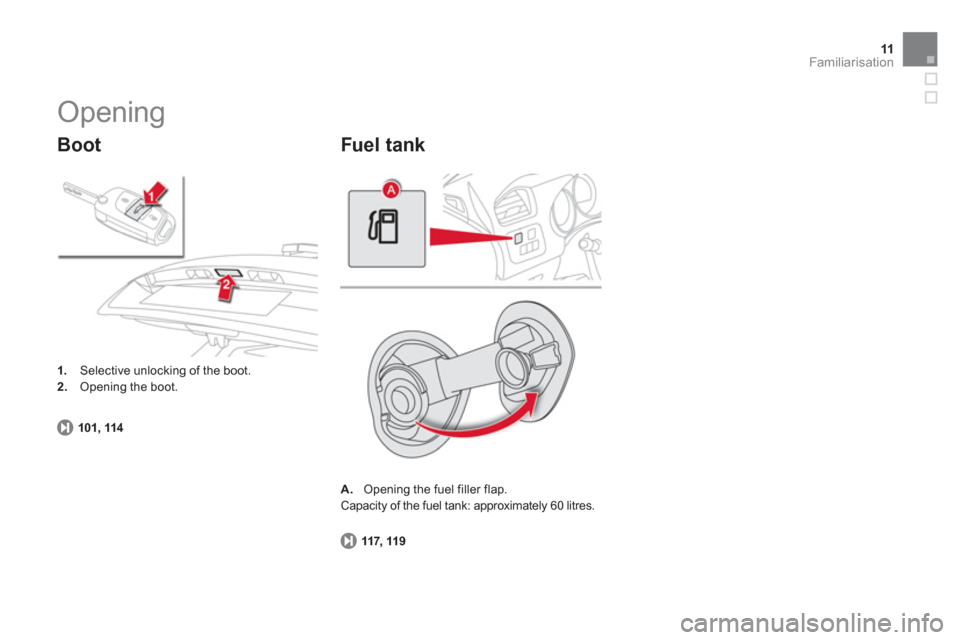
A. Opening the fuel filler flap. Capacity of the fuel tank: approximately 60 litres.
Fuel t ank
Opening
101, 114
1.
Selective unlocking of the boot. 2.Opening the boot.
Boot
Page 16 of 396
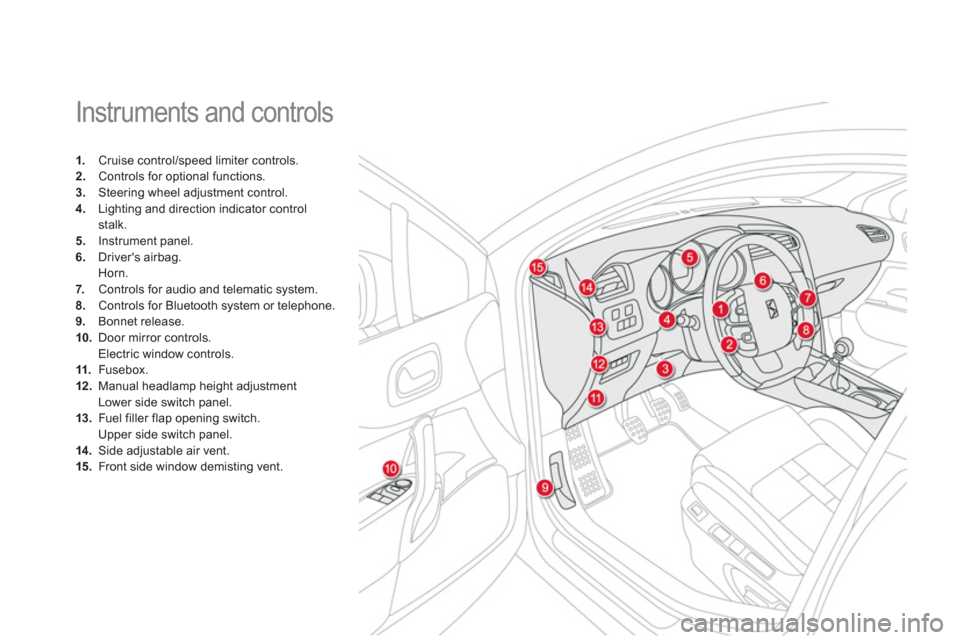
Instruments and controls
1.
Cruise control/speed limiter controls. 2.
Controls for optional functions.3.
Steering wheel adjustment control.4.
Lighting and direction indicator control stalk.5.
Instrument panel.
6.Driver's airbag.
Horn. 7. Controls for audio and telematic system. 8.Controls for Bluetooth system or telephone. 9.
Bonnet release. 10.Door mirror controls.
Electric window controls.11. Fusebox.12.Manual headlamp height adjustment
Lower side switch panel.
13.Fuel filler flap opening switch.Upper side switch panel. 14 .Side adjustable air vent. 15. Front side window demisting vent.
Page 25 of 396

23Familiarisation
Monitoring
A.With the ignition on, the bars indicate the
level of fuel remaining. B.With the engine running, its associated low
level warning lamp should go off. C.With the ignition on, the oil level indicator should show for a few seconds that thelevel is OK or correct, depending on
version.
If the levels are not correct, top up the levels
whi
ch are low.
Instrument panels
38
1.With the ignition on, the orange and red
warning lamps come on. 2. With the engine running, these warning lamps should go off.
If warning lamps remain on, refer to the page concerned.
Warning lamps
43
A.Make an emergency call.
Central switch panel
175 , 2 95
B.
Access to CITROËN services.
175 , 2 9
5
C. Hazard warning.
17
4
D.Central locking.
10
7
E.Black panel (black screen).
60
Page 29 of 396

27Familiarisation
104
1.Stopposition. 2.Ignition on
position. 3.Startingposition.
Ignition switch
When switching the ignition on and off, thespeedometer needle, and the rev counter and fuel gauge bars go to the extent of their travel and then return to 0.
Starting
Your vehicle is fitted with a system whichholds your vehicle stationary momentarily,
the time to move your foot from the brake to
the accelerator, to help with movin
g off on a gradient.
This function is only active when:
- the vehicle is completely stationary withyour foot on the brake pedal,
- cer tain conditions of gradient are met,
- the driver's door is closed.
213
Do not get out of the vehicle during the hill start assist temporary holdingphase.
Hill start assist
Page 33 of 396
31Familiarisation
Stop & Start
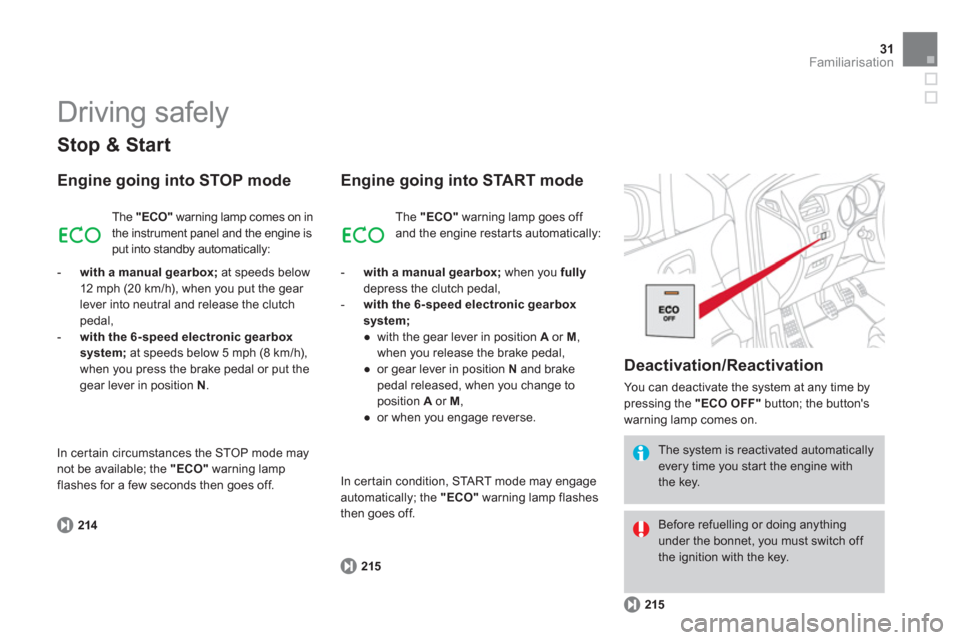
Engine going into STOP mode
214Th
e "ECO"warning lamp comes on in
the instrument panel and the engine isput into standby automatically:
- with a manual
gearbox;
at speeds below
12 mph (20 km/h), when you put the gear
lever into neutral and release the clutchpedal, -with the 6-speed electronic gearbox
system;at speeds below 5 mph (8 km/h),
when you press the brake pedal or put the
gear lever in position N.
Engine going into START mode
Deactivation/Reactivation
You can deactivate the system at any time bypressing the "ECO OFF"
button; the button's
warning lamp comes on.
215
215
The system is reactivated automatically every time you start the engine withthe key.
Before refuelling or doing anything under the bonnet, you must switch off the ignition with the key. Th
e "ECO"
warning lamp goes off
and the engine restarts automatically:
-
with a manual gearbox;when you fullydepress the clutch pedal, -
with the 6-speed electronic gearboxsystem;
●
with the gear lever in position A
or M ,
when you release the brake pedal,
●
or gear lever in position N
and brake
pedal released, when you change to
position
Aor M ,
●
or when you engage reverse.
In certain circumstances the ST
OP mode may not be available; the "ECO"warning lamp
flashes for a few seconds then goes off.In certain condition, START mode may engageautomatically; the "ECO"
warning lamp flashes
then goes off.
Driving safely
Page 36 of 396
Eco-driving
Eco-driving is a range of everyday practices that allow the motorist to optimise their fuel consumption and CO2emissions.
Optimise the use of your
gearbox
With a manual gearbox, move off gently,change up without waiting and drive by changing up quite soon. If your vehicle has the system, the gear shift indicator invites youto change up; it is displayed in the instrumentpanel, follow its instructions.
With an automatic or electronic gearbox, stay in Drive "D"or Auto "A"
, according to the type of gearbox, without pressing theaccelerator pedal heavily or suddenly.
Drive smoothly
Maintain a safe distance between vehicles, use engine braking rather than the brake pedal, and press the accelerator progressively. These practices contribute towards a reduction in fuel consumption and CO2emissions and also helpsreduce the background traffic noise.
If your vehicle has cruise control, make use of the system at speeds above 25 mph (40 km/h) when the traffic is flowing well.
Control the use of your
electrical equipment
Before moving off, if the passenger compartment is too warm, ventilate it by opening the windows and air vents before using the air conditioning. Above 30 mph (50 km/h), close the windowsand leave the air vents open.
Remember to make use of equipment that can help keep the temperature in thepassenger compar tment down (sunroof and window blinds...). Switch off the air conditioning, unless it hasautomatic digital regulation, as soon as the desired temperature is attained.
Switch off the demisting and defrosting controls, if not automatic. Switch off the heated seat as soon as possible.
Page 37 of 396
35
Limit the causes of excess
consumption
Spread loads throughout the vehicle; placethe heaviest items in the bottom of the boot, as close as possible to the rear seats. Limit the loads carried in the vehicle andreduce wind resistance (roof bars, roof rack,bicycle carrier, trailer...). Use a roof box in preference. Remove roof bars and roof racks after use.
At the end of winter, remove snow tyres andrefit your summer tyres.
Observe the recommendations
on maintenance
Check the tyre pressures regularly, whencold, referring to the label in the door aperture, driver's side.
Carry out this check in par ticular:
- before a long journey,
- at each change of season,
- after a long period out of use.
Don't forget the spare wheel and the tyres on any trailer or caravan.
Have your vehicle ser viced regularly (engineoil, oil filter, air filter...) and obser ve theschedule of operations recommended by the manufacturer.
When refuelling, do not continue after the 3 rdcut-off of the nozzle to avoid any overflow.
At the wheel of your new vehicle, it is only after the first 1 800 miles (3 000 kilometres) that you will see the fuel consumption settledown to a consistent average.
Switch off the headlamps and front foglamps when the level of light does not require their use.
Avoid running the engine before moving off,particularly in winter; your vehicle will warmup much faster while driving.
As a passenger, if you avoid connecting your multimedia devices (film, music, videogame...), you will contribute towards limitingthe consumption of electrical energy, and soof fuel. Disconnect your por table devices beforeleaving the vehicle.