light Citroen DS4 2016 1.G Workshop Manual
[x] Cancel search | Manufacturer: CITROEN, Model Year: 2016, Model line: DS4, Model: Citroen DS4 2016 1.GPages: 436, PDF Size: 10.28 MB
Page 251 of 436
249
DS4_en_Chap09_info-pratiques_ed03-2015
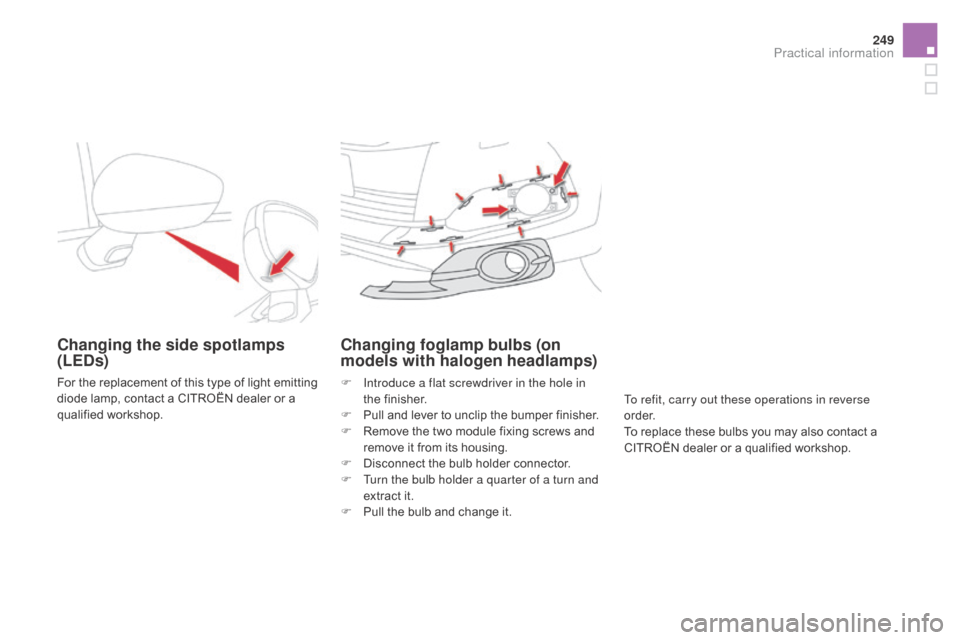
Changing the side spotlamps
(LEd s)
For the replacement of this type of light emitting
diode lamp, contact a CITROËN dealer or a
qualified workshop.
Changing foglamp bulbs (on
models with halogen headlamps)
F Introduce a flat screwdriver in the hole in
the finisher.
F
P
ull and lever to unclip the bumper finisher.
F
R
emove the two module fixing screws and
remove it from its housing.
F
D
isconnect the bulb holder connector.
F
T
urn the bulb holder a quarter of a turn and
extract it.
F
P
ull the bulb and change it. To refit, carry out these operations in reverse
o r d e r.
To replace these bulbs you may also contact a
CITROËN dealer or a qualified workshop.
Practical information
Page 252 of 436
DS4_en_Chap09_info-pratiques_ed03-2015
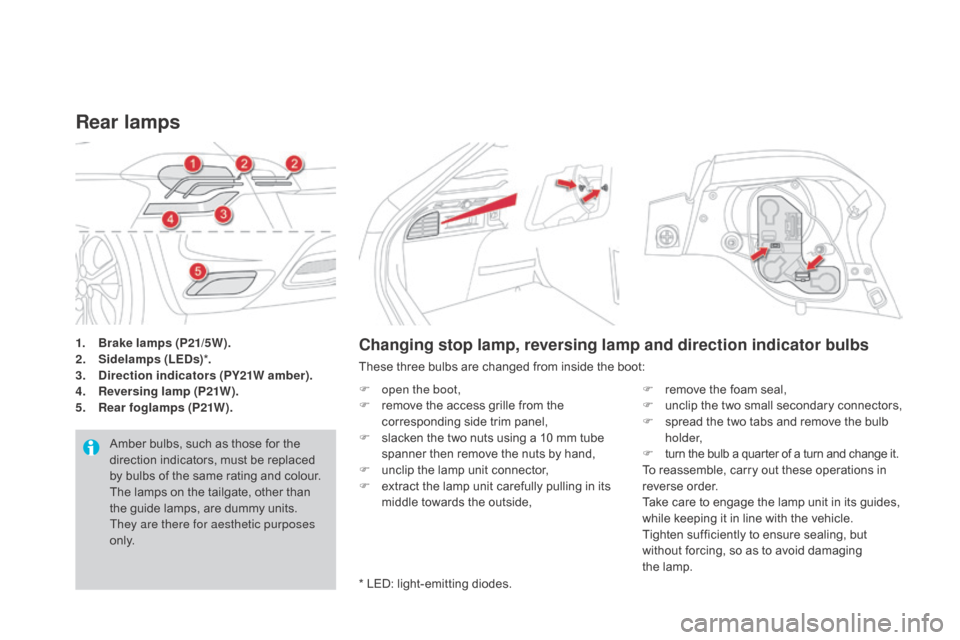
1. Brake lamps (P21/5W).
2. Sidelamps (LE d s)*.
3.
di
rection indicators (PY21W amber).
4.
R
eversing lamp (P21W).
5.
R
ear foglamps (P21W).
Rear lamps
Amber bulbs, such as those for the
direction indicators, must be replaced
by bulbs of the same rating and colour.
The lamps on the tailgate, other than
the guide lamps, are dummy units.
They are there for aesthetic purposes
o n l y.
Changing stop lamp, reversing lamp and direction indicator bulbs
These three bulbs are changed from inside the boot:
F
o
pen the boot,
F
r
emove the access grille from the
corresponding side trim panel,
F
s
lacken the two nuts using a 10 mm tube
spanner then remove the nuts by hand,
F
u
nclip the lamp unit connector,
F
e
xtract the lamp unit carefully pulling in its
middle towards the outside, F
r
emove the foam seal,
F
u
nclip the two small secondary connectors,
F
s
pread the two tabs and remove the bulb
h o l d e r,
F
t
urn the bulb a quarter of a turn and change it.
To reassemble, carry out these operations in
reverse order.
Take care to engage the lamp unit in its guides,
while keeping it in line with the vehicle.
Tighten sufficiently to ensure sealing, but
without forcing, so as to avoid damaging
the
lamp.
* LED: light-emitting diodes.
Page 253 of 436
251
DS4_en_Chap09_info-pratiques_ed03-2015
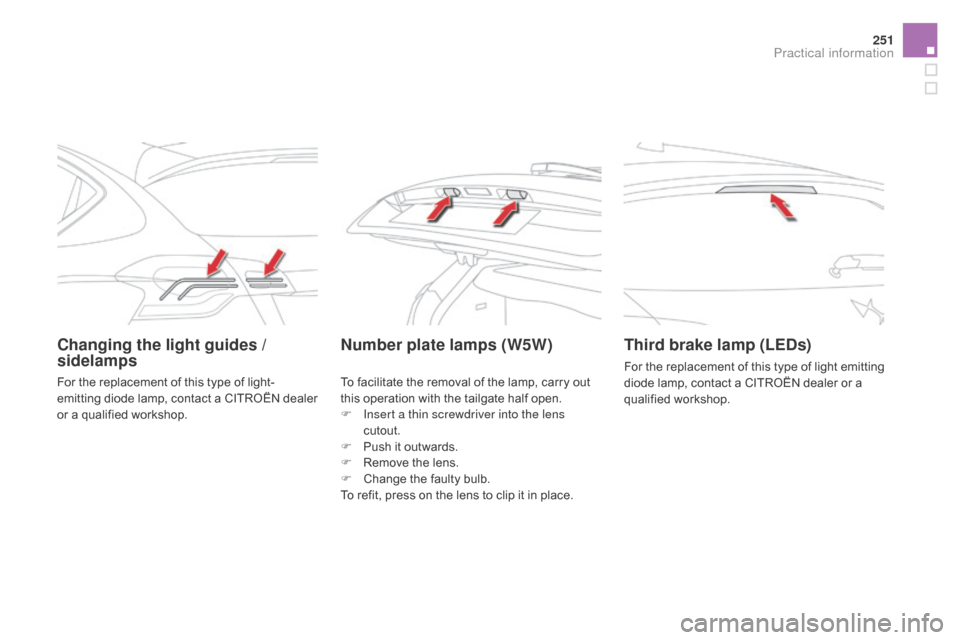
Changing the light guides /
sidelampsNumber plate lamps (W5W)
Third brake lamp (LEds )
For the replacement of this type of light emitting
diode lamp, contact a CITROËN dealer or a
qualified workshop.
For the replacement of this type of light-
emitting diode lamp, contact a CITROËN dealer
or a qualified workshop. To facilitate the removal of the lamp, carry out
this operation with the tailgate half open.
F
I
nsert a thin screwdriver into the lens
cutout.
F
P
ush it outwards.
F
R
emove the lens.
F
C
hange the faulty bulb.
To refit, press on the lens to clip it in place.
Practical information
Page 258 of 436
DS4_en_Chap09_info-pratiques_ed03-2015
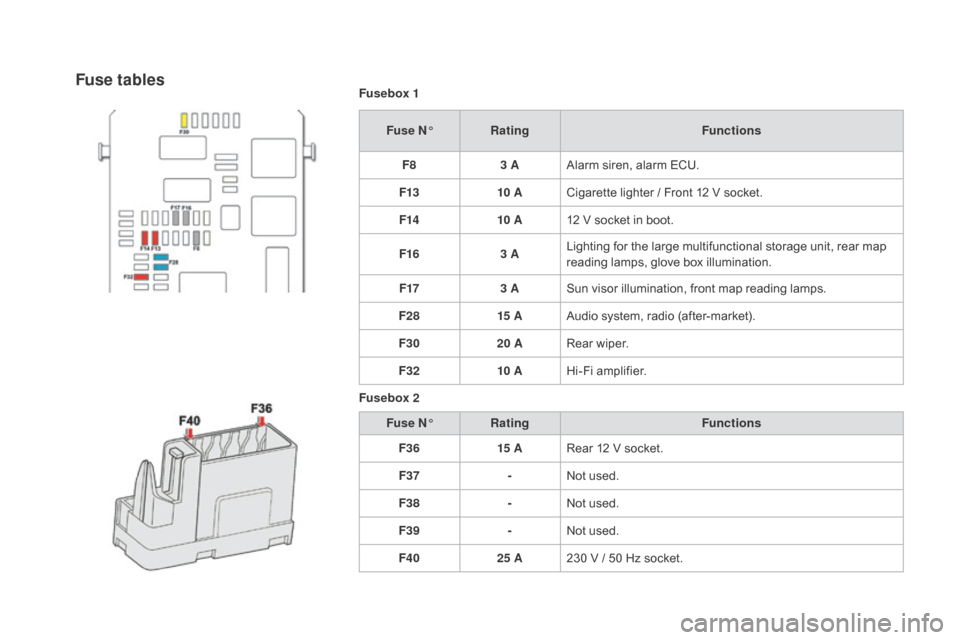
Fusebox 1Fuse N° Rating Functions
F8 3 AAlarm siren, alarm ECU.
F13 10 ACigarette lighter / Front 12 V socket.
F14 10 A12 V socket in boot.
F16 3 ALighting for the large multifunctional storage unit, rear map
reading lamps, glove box illumination.
F17 3 ASun visor illumination, front map reading lamps.
F28 15 AAudio system, radio (after-market).
F30 20 ARear wiper.
F32 10 AHi-Fi amplifier.
Fusebox 2 Fuse N° Rating Functions
F36 15 ARear 12 V socket.
F37 -Not used.
F38 -Not used.
F39 -Not used.
F40 25 A230 V / 50 Hz socket.Fuse tables
Page 272 of 436
DS4_en_Chap09_info-pratiques_ed03-2015
Before each use
Check that the towball is correctly fitted by verifying the following points:
- t he towball is correctly locked in place (position A ),
-
t
he security key lock is on and the key removed; the locking wheel can no longer be
operated,
-
t
he towball must no longer move at all in its carrier; try to shake it by hand.
during use
Never unlock the device when a trailer or load carrier is fitted to the towball.
Never exceed the maximum authorised weight for the vehicle plus trailer (Gross Train
Weight - GTW).
Before driving, check the adjustment of the headlamp beam height.
For more information on adjusting the headlamps, refer to the corresponding section.
After use
For journeys made without a trailer or load carrier, the trailer harness socket must be folded
away, the towball removed and the blanking plug inserted in the carrier. This measure
applies particularly if the towball could hinder visibility of the number plate or lighting.
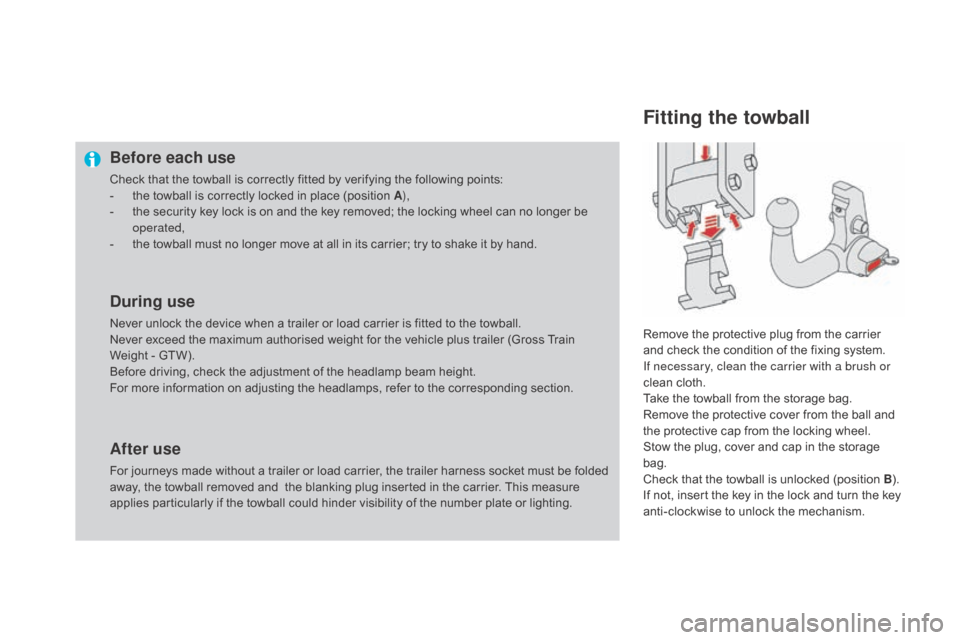
Fitting the towball
Remove the protective plug from the carrier
and check the condition of the fixing system.
If necessary, clean the carrier with a brush or
clean cloth.
Take the towball from the storage bag.
Remove the protective cover from the ball and
the protective cap from the locking wheel.
Stow the plug, cover and cap in the storage
bag.
Check that the towball is unlocked (position B ).
If not, insert the key in the lock and turn the key
anti-clockwise to unlock the mechanism.
Page 295 of 436
293
DS4_en_Chap10_verifications_ed03-2015
Electric parking brake
This system does not require any
routine servicing. However, in the
event of a problem, have the system
checked by a CITROËN dealer or a
qualified workshop.Only use products recommended by
CITROËN or products of equivalent
quality and specification.
In order to optimise the operation of
units as important as those in the
braking system, CITROËN selects and
offers very specific products.
After washing the vehicle, dampness,
or in wintry conditions, ice can form
on the brake discs and pads: braking
efficiency may be reduced. Make light
brake applications to dry and defrost
the brakes.
Brake disc wear
For information on checking brake
disc wear, contact a CITROËN dealer
or a qualified workshop.
Manual parking brake
If a loss of effectiveness of this
system is noticed, the parking brake
must be checked, even between two
services.
Brake pads
Brake wear depends on the style
of driving, particularly in the case
of vehicles used in town, over short
distances. It may be necessary to have
the condition of the brakes checked,
even between vehicle services.
For more information on the electric parking
brake, refer to the corresponding section.
Unless there is a leak in the circuit, a drop in
the brake fluid level indicates that the brake
pads are worn.
Checking this system must be done by a
CITROËN dealer or a qualified workshop.
Checks
Page 304 of 436

Never store bottles of AdBlue® in your
vehicle.
Recommendations on storage
AdBlue® freezes at about -11°C and
deteriorates above 25°C. It is recommended
that bottles be stored in a cool area and
protected from direct sunlight.
Under these conditions, the additive can be
kept for at least a year.
If the additive has frozen, it can be used once it
has completely thawed out. Before topping-up, ensure that the vehicle is
parked on a flat and level sur face.
In wintry conditions, ensure that the
temperature of the vehicle is above -11°C.
Otherwise the AdBlue
® may be frozen and
so cannot be poured into its tank. Park your
vehicle in a warmer area for a few hours to
allow the top-up to be carried out.
Procedure
F Switch off the ignition and remove the key, or if your vehicle has one, press the
START/STOP button to switch off the
engine. F
R
aise the boot floor for access to the
AdBlue
® tank. S
ecure the boot floor by attaching its cord
to the hook on the parcel shelf support.
F
U
nclip the black plastic blanking plug using
its tab.
F
I
nsert your fingers into the aperture and
turn the blue cap a 6
th of a turn anti-
clockwise.
F
C
arefully lift off the cap, without dropping it.
Page 310 of 436
DS4_en_Chap11_caracteristiques_ed03-2015
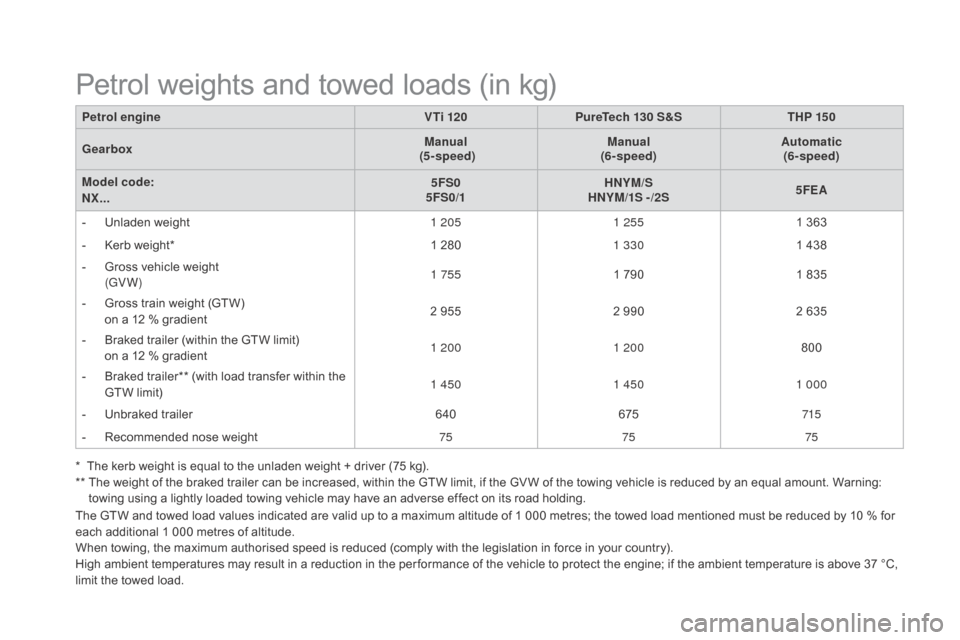
The GTW and towed load values indicated are valid up to a maximum altitude of 1 000 metres; the towed load mentioned must be reduced by 10 % for
each additional 1 000 metres of altitude.
When towing, the maximum authorised speed is reduced (comply with the legislation in force in your country).
High ambient temperatures may result in a reduction in the per formance of the vehicle to protect the engine; if the ambient temperature is above 37 °C,
limit the towed load.
Petrol weights and towed loads (in kg)
Petrol engineV Ti 120PureTech 130 S&S THP 15 0
Gearbox Manual
(5 - speed) Manual
(6- speed) Automatic
(6- speed)
Model code:
NX... 5FS0
5FS0/1 HNYM/S
HNYM/1S - /2S 5FEA
-
U
nladen weight 1 2051 2551 363
-
K
erb weight* 1 2801 330 1 438
-
G
ross vehicle weight
(GV W) 1 755
1 790 1 835
-
G
ross train weight (GTW)
o
n a 12 % gradient 2 955
2 990 2 635
-
B
raked trailer (within the GTW limit)
o
n a 12 % gradient 1 200
1 200 800
-
B
raked trailer** (with load transfer within the
GTW limit) 1 450
1 4501 000
-
U
nbraked trailer 640675715
-
R
ecommended nose weight 757575
*
T
he kerb weight is equal to the unladen weight + driver (75 kg).
**
T
he weight of the braked trailer can be increased, within the GTW limit, if the GV W of the towing vehicle is reduced by an equal amount. Warning:
towing using a lightly loaded towing vehicle may have an adverse effect on its road holding.
Page 311 of 436
309
DS4_en_Chap11_caracteristiques_ed03-2015
Petrol engineTHP 160THP 165 S&S THP 200THP 210 S&S
Gearbox Automatic
(6- speed) EAT6 automatic
(6- speed) Manual
(6- speed) Manual
(6- speed)
Model code:
NX... 5FMA
5GZT/S
5GZ T/1S 5FU8
5FU8/1 5GMM/S
-
U
nladen weight 1 3631 3101 316 1 313
-
K
erb weight* 1 4381 385 1 3911 388
-
G
ross vehicle weight (GV W) 1 8351 850 1 8201 845
-
G
ross train weight (GTW)
o
n a 12 % gradient 2 635
3 2502 8202 845
-
B
raked trailer (within the GTW limit)
o
n a 12 % gradient 800
1 400 1 000 1 000
-
B
raked trailer** (with load transfer within the
GTW limit) 1 000
1 6501 2501 250
-
U
nbraked trailer 715690 695655
-
R
ecommended nose weight 75757575
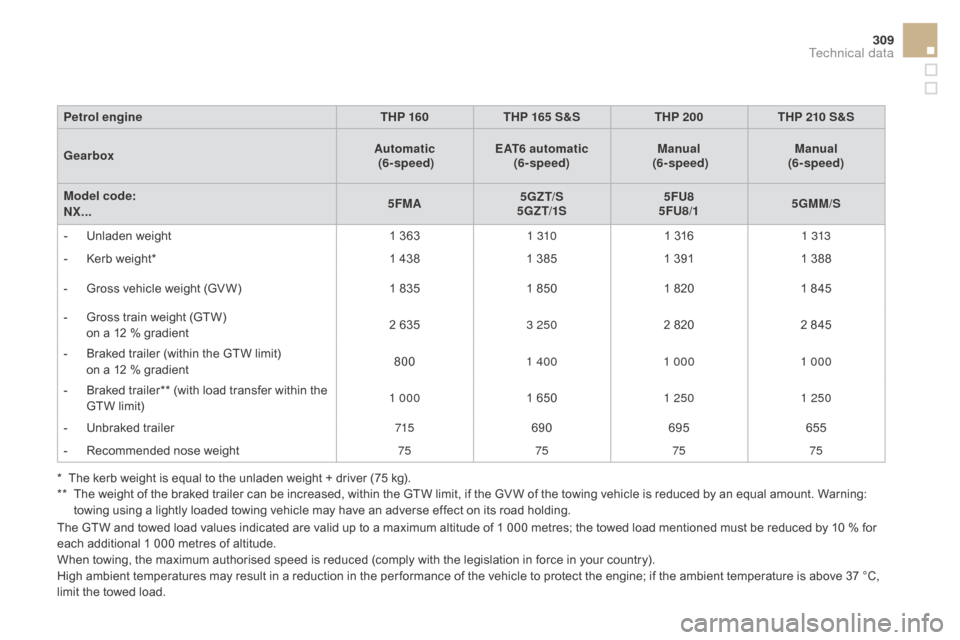
The GTW and towed load values indicated are valid up to a maximum altitude of 1 000 metres; the towed load mentioned must be reduced by 10 % for
each additional 1 000 metres of altitude.
When towing, the maximum authorised speed is reduced (comply with the legislation in force in your country).
High ambient temperatures may result in a reduction in the per formance of the vehicle to protect the engine; if the ambient temperature is above 37 °C,
limit the towed load. * The kerb weight is equal to the unladen weight + driver (75 kg).
**
T
he weight of the braked trailer can be increased, within the GTW limit, if the GV W of the towing vehicle is reduced by an equal amount. Warning:
towing using a lightly loaded towing vehicle may have an adverse effect on its road holding.
Technical data
Page 314 of 436
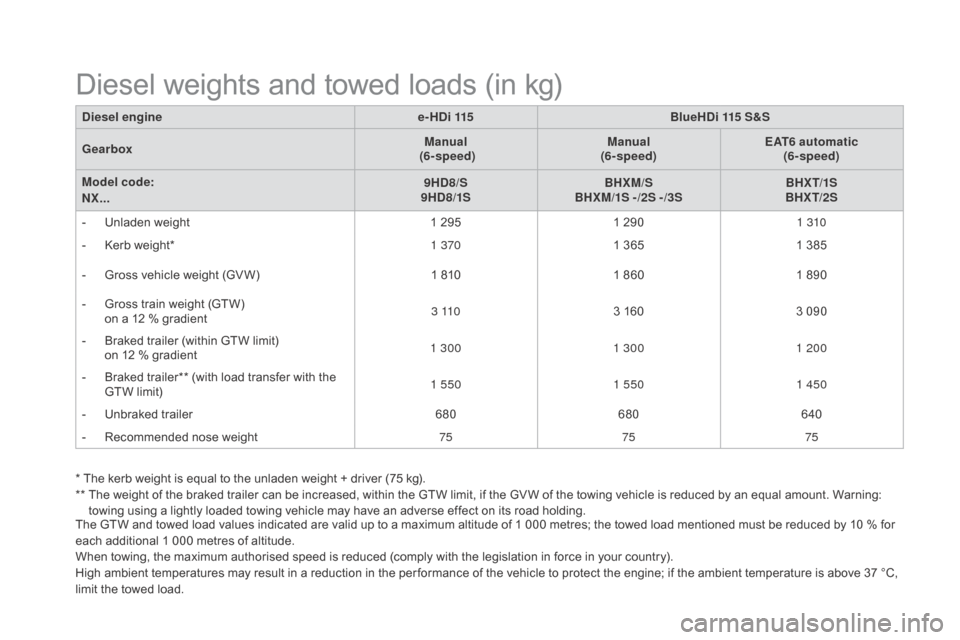
DS4_en_Chap11_caracteristiques_ed03-2015
diesel enginee-H d i 115BlueH d i 115 S&S
Gearbox Manual
(6- speed) Manual
(6- speed) EAT6 automatic
(6- speed)
Model code:
NX... 9H
d8
/S
9H
d8
/1SBHXM/S
BHXM/1S -/2S -/3S BHX T/1S
BHX T/2S
-
U
nladen weight 1 2951 290 1 310
-
K
erb weight* 1 3701 365 1 385
-
G
ross vehicle weight (GV W) 1 8101 860 1 890
-
G
ross train weight (GTW)
o
n a 12 % gradient 3 11 0
3 160 3 090
-
B
raked trailer (within GTW limit)
o
n 12 % gradient 1 300
1 300 1 200
-
B
raked trailer** (with load transfer with the
GTW limit) 1 550
1 550 1 450
-
U
nbraked trailer 680680640
-
R
ecommended nose weight 757575
Diesel weights and towed loads (in kg)
The GTW and towed load values indicated are valid up to a maximum altitude of 1 000 metres; the towed load mentioned must be reduced by 10 % for
each additional 1 000 metres of altitude.
When towing, the maximum authorised speed is reduced (comply with the legislation in force in your country).
High ambient temperatures may result in a reduction in the per formance of the vehicle to protect the engine; if the ambient temperature is above 37 °C,
limit the towed load. * The kerb weight is equal to the unladen weight + driver (75 kg).
**
T
he weight of the braked trailer can be increased, within the GTW limit, if the GV W of the towing vehicle is reduced by an equal amount. Warning:
towing using a lightly loaded towing vehicle may have an adverse effect on its road holding.