wheel CITROEN DS4 2018 User Guide
[x] Cancel search | Manufacturer: CITROEN, Model Year: 2018, Model line: DS4, Model: CITROEN DS4 2018Pages: 296, PDF Size: 9.91 MB
Page 84 of 296
82
To avoid any risk of jamming of the pedals:
- o nly use mats which are suited to the
fixings already present in the vehicle;
these fixings must be used,
-
n
ever place one mat on top of another.
The use of unapproved mats may inter fere
with access to the pedals and hinder the
operation of the cruise control/speed
limiter.
The approved mats have two fixings
located below the seat.
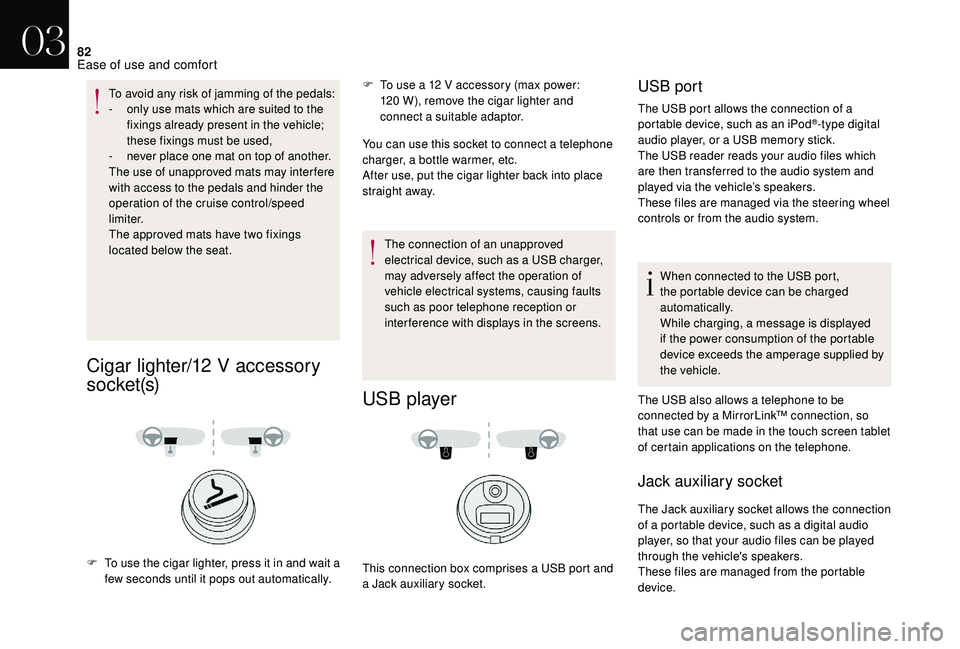
Cigar lighter/12 V accessory
s o c ket (s)
F To use a 12 V accessory (max power: 120 W), remove the cigar lighter and
connect a suitable adaptor.
You can use this socket to connect a telephone
charger, a bottle warmer, etc.
After use, put the cigar lighter
back into place
straight away.
F
T
o use the cigar lighter, press it in and wait a
few seconds until it pops out automatically. The connection of an unapproved
electrical device, such as a USB charger,
may adversely affect the operation of
vehicle electrical systems, causing faults
such as poor telephone reception or
interference with displays in the screens.
USB player
This connection box comprises a USB port and
a Jack auxiliary socket.
USB port
The USB port allows the connection of a
portable device, such as an iPod®-type digital
audio player, or a USB memory stick.
The USB reader reads your audio files which
are then transferred to the audio system and
played via the vehicle’s speakers.
These files are managed via the steering wheel
controls or from the audio system.
When connected to the USB port,
the portable device can be charged
automatically.
While charging, a message is displayed
if the power consumption of the portable
device exceeds the amperage supplied by
the vehicle.
The USB also allows a telephone to be
connected by a MirrorLink™ connection, so
that use can be made in the touch screen tablet
of certain applications on the telephone.
Jack auxiliary socket
The Jack auxiliary socket allows the connection
of a portable device, such as a digital audio
player, so that your audio files can be played
through the vehicle's speakers.
These files are managed from the portable
device.
03
Ease of use and comfort
Page 91 of 296
89
Hooks
These can be used to secure shopping bags.
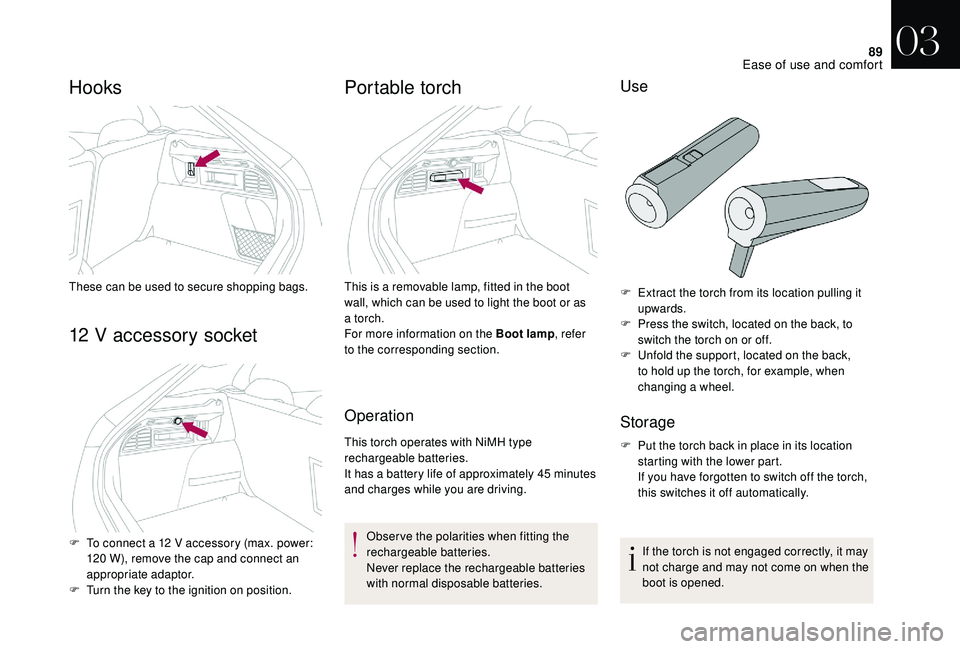
12 V accessory socket
F To connect a 12 V accessory (max. power: 120 W), remove the cap and connect an
appropriate adaptor.
F
T
urn the key to the ignition on position.
Portable torch
Operation
This torch operates with NiMH type
rechargeable batteries.
It has a battery life of approximately 45 minutes
and charges while you are driving.
Observe the polarities when fitting the
rechargeable batteries.
Never replace the rechargeable batteries
with normal disposable batteries.
This is a removable lamp, fitted in the boot
wall, which can be used to light the boot or as
a torch.
For more information on the Boot lamp
, refer
to the corresponding section.
Use
F Extract the torch from its location pulling it upwards.
F
P
ress the switch, located on the back, to
switch the torch on or off.
F
U
nfold the support, located on the back,
to hold up the torch, for example, when
changing a wheel.
Storage
F Put the torch back in place in its location starting with the lower part.
If you have forgotten to switch off the torch,
this switches it off automatically.
If the torch is not engaged correctly, it may
not charge and may not come on when the
boot is opened.
03
Ease of use and comfort
Page 100 of 296
98
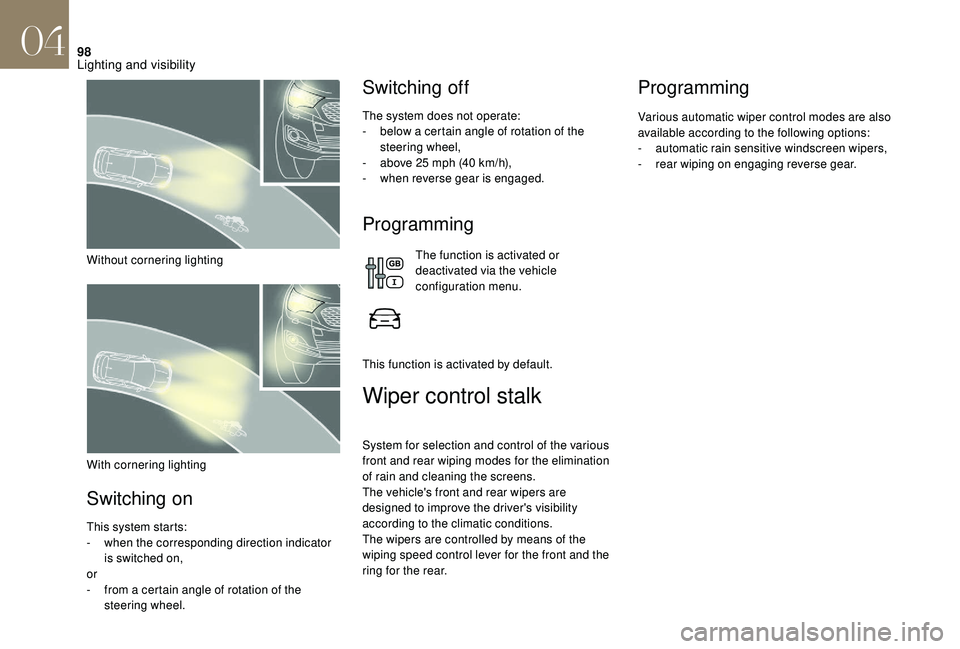
Without cornering lighting
Switching on
This system starts:
- w hen the corresponding direction indicator
is switched on,
or
-
f
rom a certain angle of rotation of the
steering wheel.
Switching off
The system does not operate:
- b elow a certain angle of rotation of the
steering wheel,
-
a
bove 25 mph (40 km/h),
-
w
hen reverse gear is engaged.
Programming
The function is activated or
deactivated via the vehicle
configuration menu.
This function is activated by default.
Wiper control stalk
System for selection and control of the various
front and rear wiping modes for the elimination
of rain and cleaning the screens.
The vehicle's front and rear wipers are
designed to improve the driver's visibility
according to the climatic conditions.
The wipers are controlled by means of the
wiping speed control lever for the front and the
ring for the rear.
Programming
Various automatic wiper control modes are also
available according to the following options:
-
a
utomatic rain sensitive windscreen wipers,
-
r
ear wiping on engaging reverse gear.
With cornering lighting
04
Lighting and visibility
Page 106 of 296
104
Hazard warning lamps
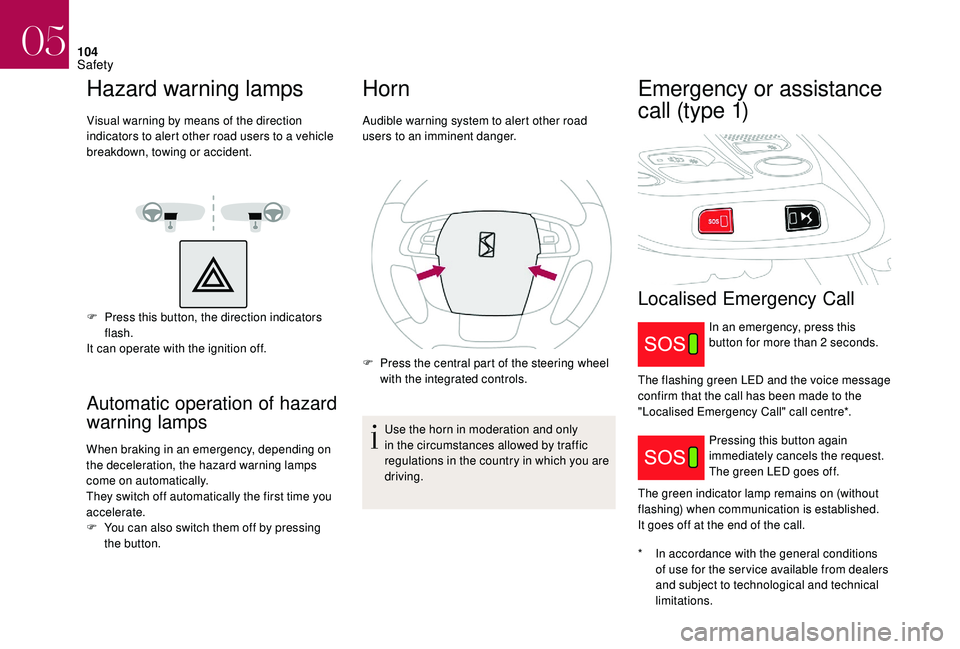
Visual warning by means of the direction
indicators to alert other road users to a vehicle
breakdown, towing or accident.
F
P
ress this button, the direction indicators
flash.
It can operate with the ignition off.
Automatic operation of hazard
warning lamps
When braking in an emergency, depending on
the deceleration, the hazard warning lamps
come on automatically.
They switch off automatically the first time you
accelerate.
F
Y
ou can also switch them off by pressing
the button.
Horn
Audible warning system to alert other road
users to an imminent danger.
F
P
ress the central part of the steering wheel
with the integrated controls.
Use the horn in moderation and only
in the circumstances allowed by traffic
regulations in the country in which you are
driving.
Emergency or assistance
call (type 1)
Localised Emergency Call
* In accordance with the general conditions of use for the ser vice available from dealers
and subject to technological and technical
limitations. In an emergency, press this
button for more than 2 seconds.
The flashing green LED and the voice message
confirm that the call has been made to the
"Localised Emergency Call" call centre*. Pressing this button again
immediately cancels the request.
The green LED goes off.
The green indicator lamp remains on (without
flashing) when communication is established.
It goes off at the end of the call.
05
Safety
Page 110 of 296
108
Electronic stability control
(ESC)
Electronic stability control (ESC: Electronic
Stability Control) integrating the following
systems:
-
a
nti-lock braking system (ABS) and
electronic brake force distribution (EBFD),
-
em
ergency braking assistance (EBA),
-
w
heel anti-slip regulation (ASR) or traction
control,
-
d
ynamic stability control (DSC).
Definitions
Anti-lock braking system (ABS) and
electronic brake force distribution
(EBFD)
These systems improve the stability and
manoeuvrability of your vehicle when braking
and contribute towards improved control in
corners, in particular on poor or slippery road
surfaces.
The ABS prevents wheel lock in the event of
emergency braking.
The electronic brake force distribution system
manages the braking pressure wheel by wheel.
Emergency braking assistance
(EBA)
In an emergency, this system enables you to
reach the optimum braking pressure more
quickly and therefore reduce the stopping
distance.
It is triggered in relation to the speed at which
the brake pedal is pressed. This is felt by a
reduction in the resistance of the pedal and an
increase in the effectiveness of the braking.
Anti-slip regulation (ASR)
This system (also known as Traction Control)
optimises traction in order to limit wheel slip by
acting on the brakes of the driving wheels and
on the engine. It also improves the directional
stability of the vehicle on acceleration.
Dynamic stability control (DSC)
If there is a difference between the path
followed by the vehicle and that required by
the driver, the DSC monitors each wheel and
automatically acts on the brake of one or more
wheels and on the engine to return the vehicle
to the required path, within the limits of the laws
of physics.
Intelligent traction control
system ("Snow motion")
Depending on version, your vehicle has a
system to help driving on snow: intelligent
traction control.
This system detects situations of poor sur face
grip that could make it difficult to move off
or make progress on deep fresh snow or
compacted snow.
In these situations, the intelligent traction
control limits the amount of wheel spin to
provide the best traction and trajectory control
for your vehicle.
The use of snow tyres is strongly
recommended on sur faces offering low
levels of adhesion.
Anti-lock braking system
(ABS) and electronic brake
force distribution (EBFD)
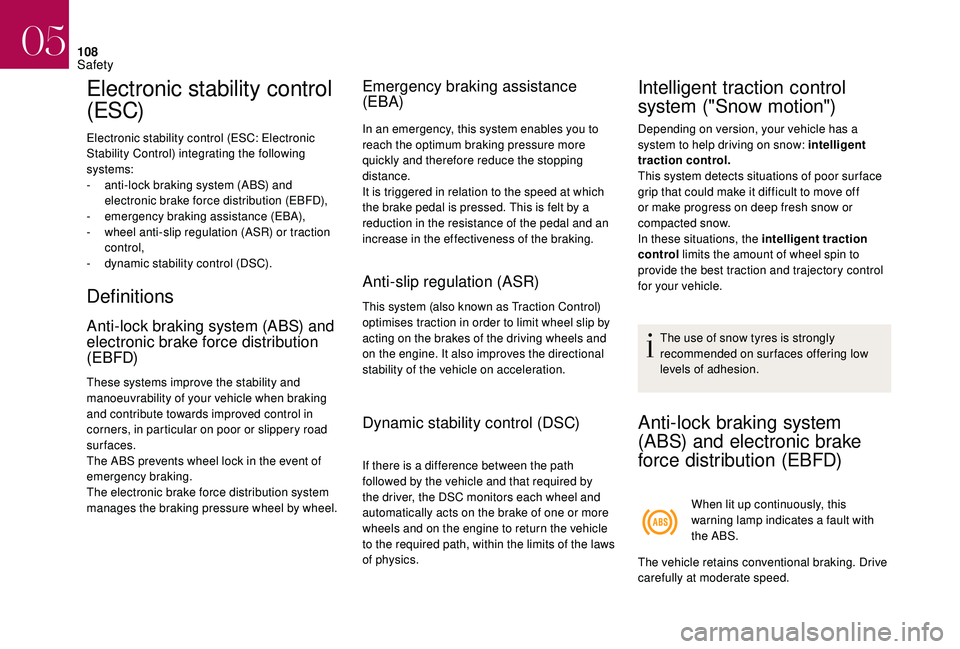
When lit up continuously, this
warning lamp indicates a fault with
the ABS.
The vehicle retains conventional braking. Drive
carefully at moderate speed.
05
Safety
Page 111 of 296
109
If these warning lamps come on,
accompanied by an audible signal
and a message, this indicates a
fault with the electronic brake force
distribution (EBFD).
When changing wheels (tyres and rims),
make sure that these are approved for
your vehicle.
Normal operation of the ABS system may
be indicated by slight vibration felt at the
brake pedal.
In case of emergency braking, press
ver y hard without releasing the
pressure at all.
After an impact, have these systems
checked in the dealer network or by a
qualified workshop.Anti-slip regulation (ASR)/
Dynamic stability control
(DSC)
Operation
These systems are activated automatically
every time the vehicle is started.
They come into operation in the event of a
problem with grip or trajectory.
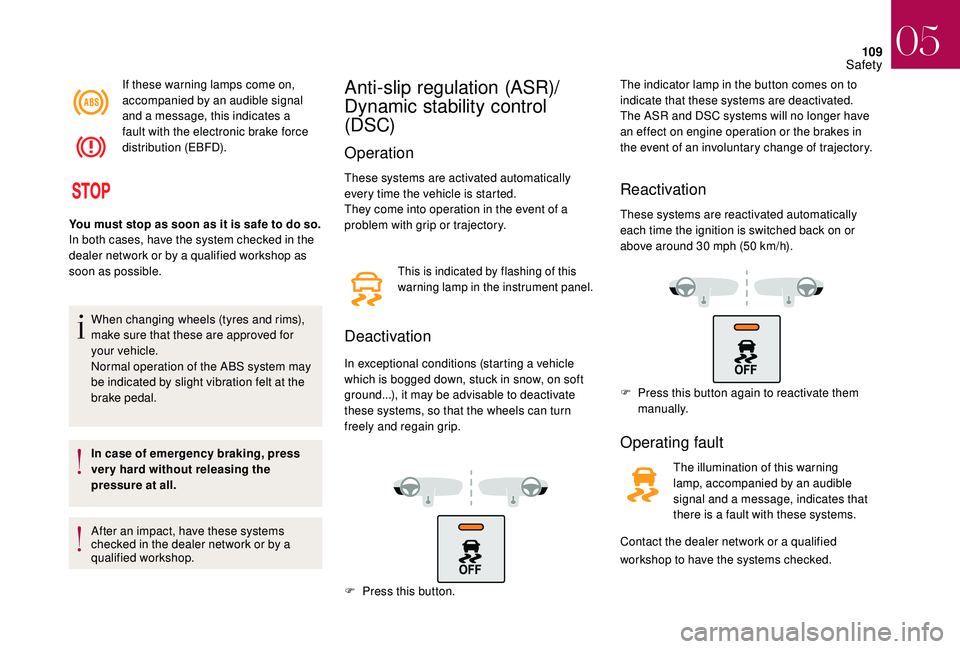
Deactivation
In exceptional conditions (starting a vehicle
which is bogged down, stuck in snow, on soft
ground...), it may be advisable to deactivate
these systems, so that the wheels can turn
freely and regain grip. The indicator lamp in the button comes on to
indicate that these systems are deactivated.
The ASR and DSC systems will no longer have
an effect on engine operation or the brakes in
the event of an involuntary change of trajectory.
Reactivation
These systems are reactivated automatically
each time the ignition is switched back on or
above around 30 mph (50 km/h).
F
P
ress this button again to reactivate them
manually.
Operating fault
The illumination of this warning
lamp, accompanied by an audible
signal and a message, indicates that
there is a fault with these systems.
Contact the dealer network or a qualified
You must stop as soon as it is safe to do so.
In both cases, have the system checked in the
dealer network or by a qualified workshop as
soon as possible.
This is indicated by flashing of this
warning lamp in the instrument panel.
workshop to have the systems checked.
F
P
ress this button.
05
Safety
Page 112 of 296
11 0
ASR/DSC
These systems offer increased safety
in normal driving, but they should not
encourage the driver to take extra risks or
drive at high speed.
It is in conditions of reduced grip (rain,
snow, ice) that the risk of loss of grip
increases. It is therefore important for your
safety to keep these systems activated in
all conditions, and particularly in difficult
conditions.
The correct operation of these systems
depends on observation of the
manufacturer's recommendations, not
only about the wheels (tyres and rims),
braking and electronic components but
also the assembly and repair procedures
used in the dealer network.
To benefit in full from the effectiveness
of these systems in wintry conditions,
the vehicle must be fitted with four snow
tyres, allowing the vehicle to retain neutral
behaviour on the road.Seat belts
Front seat belts
The front seat belts are fitted with a
pretensioning and force limiting system.
This system improves safety in the front
seats in the event of a front or side impact.
Depending on the severity of the impact, the
pretensioning system instantly tightens the seat
belts against the body of the occupants.
The pretensioning seat belts are active when
the ignition is on.
The force limiter reduces the pressure of
the seat belt on the passenger’s chest, thus
improving their protection.
Fastening
F Pull the strap then insert the tongue in the buckle.
F
C
heck that the seat belt is fastened
correctly by pulling the strap.
Unfastening
F Press the red button on the buckle.
F G uide the seat belt as it reels in.
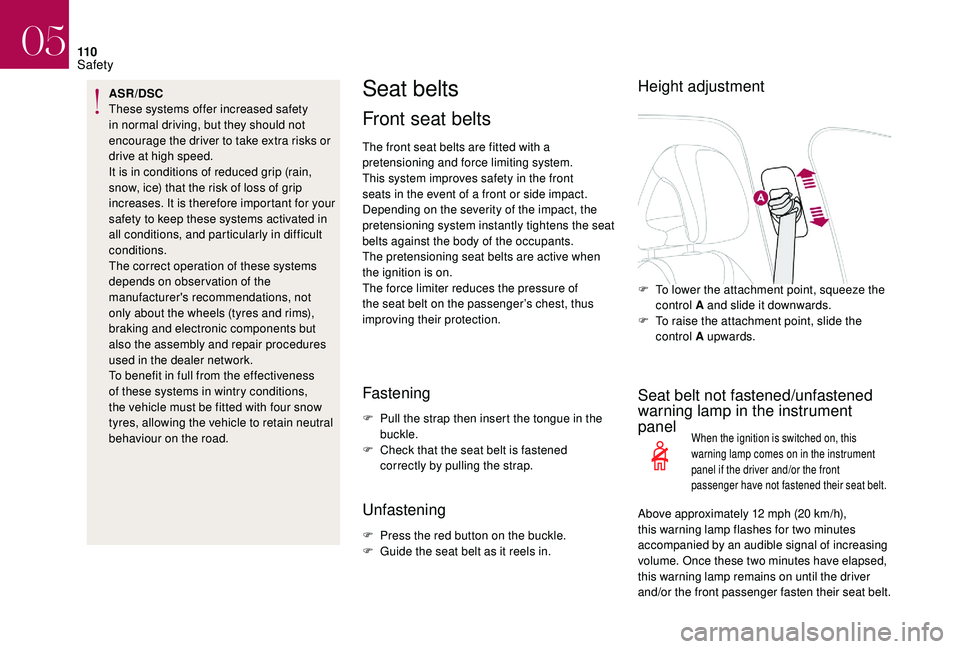
Height adjustment
F To lower the attachment point, squeeze the control A and slide it downwards.
F
T
o raise the attachment point, slide the
control A upwards.
Seat belt not fastened/unfastened
warning lamp in the instrument
panel
When the ignition is switched on, this
warning lamp comes on in the instrument
panel if the driver and/or the front
passenger have not fastened their seat belt.
Above approximately 12 mph (20 km/h),
this warning lamp flashes for two minutes
accompanied by an audible signal of increasing
volume. Once these two minutes have elapsed,
this warning lamp remains on until the driver
and/or the front passenger fasten their seat belt.
05
Safety
Page 115 of 296
11 3
Airbags
General information
This system contributes towards improving
the safety of passengers (with the exception
of the rear centre passenger) in the event of
violent collisions. The airbags supplement the
action of the seat belts fitted with force limiters
(all
except the centre rear passenger belt).
If a collision occurs, the electronic detectors
record and analyse the front and side impacts
sustained in the impact detection zones:
-
i
n the event of a serious impact, the airbags
are deployed instantly and contribute
towards better protection of the passengers
(with the exception of the rear centre
passenger); immediately after the impact,
the airbags deflate rapidly so that they
do not hinder visibility or the exit of the
passengers,
-
i
n the case of a minor or rear impact or in
certain roll-over conditions, the airbags
may not be deployed; the seat belt
alone contributes towards ensuring your
protection in these situations.
The airbags do not operate when the
ignition is switched off.
This equipment will only deploy once. If a
second impact occurs (during the same or
a subsequent accident), the airbag will not
be deployed again.
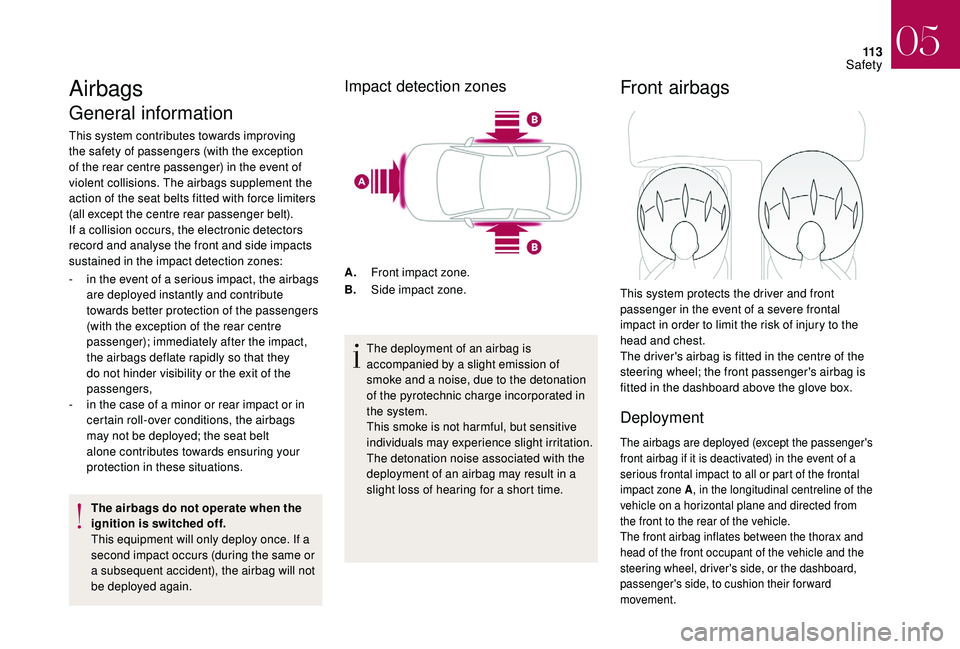
Impact detection zones
A. Front impact zone.
B. Side impact zone.
The deployment of an airbag is
accompanied by a slight emission of
smoke and a noise, due to the detonation
of the pyrotechnic charge incorporated in
the system.
This smoke is not harmful, but sensitive
individuals may experience slight irritation.
The detonation noise associated with the
deployment of an airbag may result in a
slight loss of hearing for a short time.
Front airbags
Deployment
The airbags are deployed (except the passenger's
front airbag if it is deactivated) in the event of a
serious frontal impact to all or part of the frontal
impact zone A , in the longitudinal centreline of the
vehicle on a horizontal plane and directed from
the front to the rear of the vehicle.
The front airbag inflates between the thorax and
head of the front occupant of the vehicle and the
steering wheel, driver's side, or the dashboard,
passenger's side, to cushion their for ward
movement.
This system protects the driver and front
passenger in the event of a severe frontal
impact in order to limit the risk of injury to the
head and chest.
The driver's airbag is fitted in the centre of the
steering wheel; the front passenger's airbag is
fitted in the dashboard above the glove box.
05
Safety
Page 117 of 296
11 5
Instructions
For the airbags to be fully effective,
observe the safety recommendations
below.
Adopt a normal and upright sitting position.
Wear a correctly adjusted seat belt.
Do not leave anything between the occupants
and the airbags (a child, pet, object...), nor fix
or attach anything close to or in the way of
the airbag release trajectory; this could cause
injuries during their deployment.
Never modify the original definition of your
vehicle, particularly in the area directly
around the airbags.
After an accident or if the vehicle has been
stolen, have the airbag systems checked.
All work on the airbag systems must be
per formed in the dealer network or by a
qualified workshop.
Even if all of the precautions mentioned
are obser ved, a risk of injury or of minor
burns to the head, chest or arms when an
airbag is deployed cannot be ruled out. The
bag inflates almost instantly (within a few
milliseconds) then deflates within the same
time discharging the hot gas via openings
provided for this purpose.Front airbags
Do not drive holding the steering wheel by its
spokes or resting your hands on the centre
part of the wheel.
Passengers must not place their feet on the
dashboard.
Do not smoke as deployment of the airbags
can cause burns or the risk of injury from a
cigarette or pipe.
Never remove or pierce the steering wheel or
hit it violently.
Do not fit or attach anything to the steering
wheel or dashboard, this could cause injuries
in case of airbag deployment.
Lateral airbags
Use only approved covers on the seats,
compatible with the deployment of the lateral
airbags. For information on the range of seat
covers suitable for your vehicle, contact the
dealer network.
Do not attach anything to or hang anything
from the seat backrests (clothes, etc.) as
this could cause injuries to the thorax or arm
when the lateral airbag is deployed.
Do not sit with the upper part of the body any
nearer to the door than necessary. The vehicle's front door panels include side
impact sensors.
A damaged door or any unauthorised or
incorrectly executed work (modification or
repair) on the front doors or their interior trim
could compromise the operation of these
sensors – risk of malfunction of the lateral
airbags!
Such work must only be done in the dealer
network or by a qualified workshop.
Curtain airbags
Do not attach anything or hang anything to
the roof, as this could cause head injuries
when the curtain airbag is deployed.
If fitted to your vehicle, do not remove the
grab handles installed on the roof, they play a
part in securing the curtain airbags.
05
Safety
Page 134 of 296
132
Driving recommendations
Observe the driving regulations and remain
vigilant whatever the traffic conditions.
Pay close attention to the traffic and keep your
hands on the wheel so that you are ready to
react at any time to any eventuality.
As a safety measure, the driver should only
carry out any operations that require close
attention when the vehicle is stationary.
On a long journey, a break every two hours is
strongly recommended.
In bad weather, drive smoothly, anticipate the
need to brake and increase the distance from
other vehicles.Never leave the engine running in
an enclosed area without adequate
ventilation: internal combustion engines
emit toxic exhaust gases, such as carbon
monoxide. There is a risk of poisoning and
death!
In very severe wintry conditions
(temperatures below -23°C), to guarantee
correct operation and the longevity of
the mechanical elements of your vehicle,
engine and gearbox, the engine must be
left running for 4 minutes before driving.
Important!
Never drive with the parking brake applied
– Risk of overheating and damage to the
braking system!
Do not park and do not run the engine,
the vehicle is stationary, in areas where
substances and combustible materials
(dry grass, leaves ...) can come into
contact with the hot exhaust system – Risk
of fire!
Never leave a vehicle unsuper vised with
the engine running. If you have to leave
your vehicle with the engine running, apply
the parking brake and put the gearbox into
neutral or position N or P , depending on
the type of gearbox.
Driving on flooded roads
We strongly advise against driving on flooded
roads, as this could cause serious damage
to the engine or gearbox, as well as to the
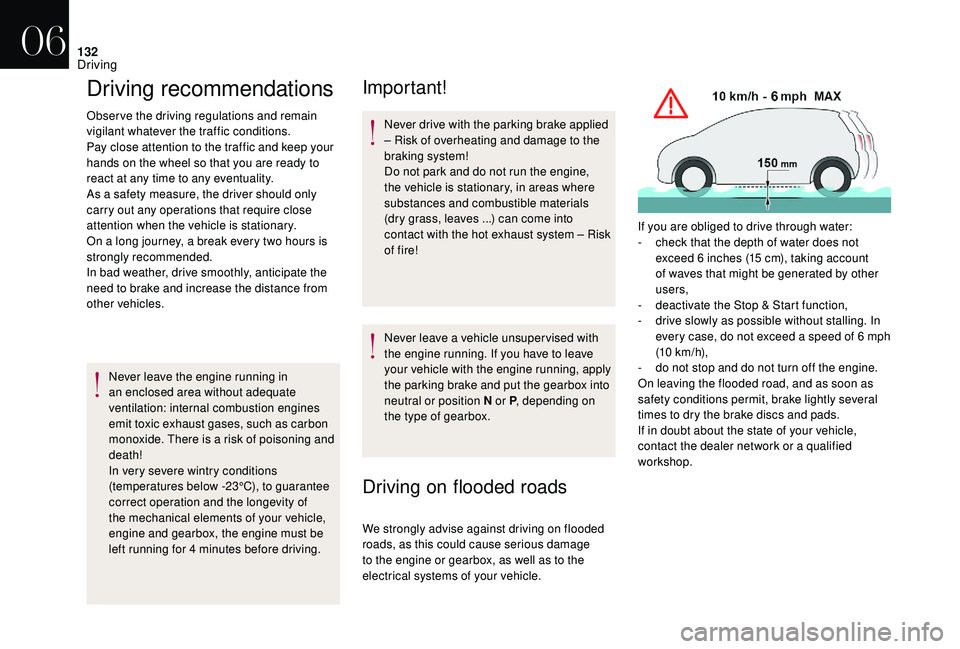
electrical systems of your vehicle. If you are obliged to drive through water:
-
c
heck that the depth of water does not
exceed 6 inches (15 cm), taking account
of waves that might be generated by other
users,
-
d
eactivate the Stop & Start function,
-
d
rive slowly as possible without stalling. In
every case, do not exceed a speed of 6 mph
(10 km/h),
-
d
o not stop and do not turn off the engine.
On leaving the flooded road, and as soon as
safety conditions permit, brake lightly several
times to dry the brake discs and pads.
If in doubt about the state of your vehicle,
contact the dealer network or a qualified
workshop.
06
Driving