fuel CITROEN DS4 2018 Owner's Manual
[x] Cancel search | Manufacturer: CITROEN, Model Year: 2018, Model line: DS4, Model: CITROEN DS4 2018Pages: 296, PDF Size: 9.91 MB
Page 170 of 296
168
Compatibility of fuels
Fuel used for petrol engines
The petrol engines are compatible with biofuels
that conform to current and future European
standards and which can be obtained from
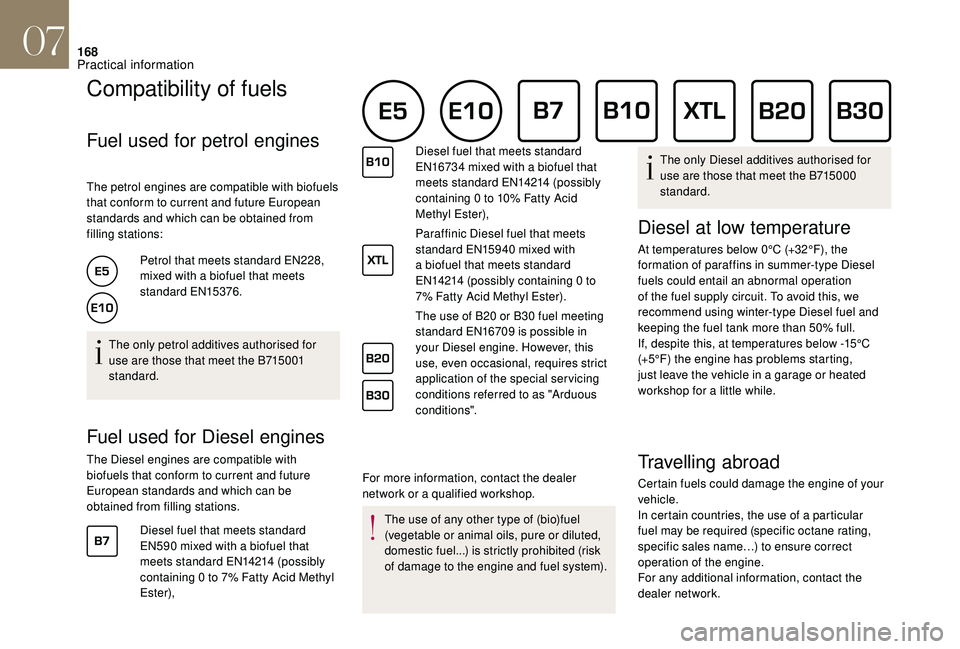
filling stations:Petrol that meets standard EN228,
mixed with a biofuel that meets
standard EN15376.
The only petrol additives authorised for
use are those that meet the B715001
standard.
Fuel used for Diesel engines
The Diesel engines are compatible with
biofuels that conform to current and future
European standards and which can be
obtained from filling stations. Diesel fuel that meets standard
EN590 mixed with a biofuel that
meets standard EN14214 (possibly
containing 0 to 7% Fatty Acid Methyl
Ester), For more information, contact the dealer
network or a qualified workshop.Diesel fuel that meets standard
EN16734 mixed with a biofuel that
meets standard EN14214 (possibly
containing 0 to 10% Fatty Acid
Methyl Ester),
Paraffinic Diesel fuel that meets
standard EN15940 mixed with
a biofuel that meets standard
EN14214 (possibly containing 0 to
7% Fatty Acid Methyl Ester).
The use of B20 or B30 fuel meeting
standard EN16709 is possible in
your Diesel engine. However, this
use, even occasional, requires strict
application of the special ser vicing
conditions referred to as "Arduous
conditions".
The use of any other type of (bio)fuel
(vegetable or animal oils, pure or diluted,
domestic fuel...) is strictly prohibited (risk
of damage to the engine and fuel system). The only Diesel additives authorised for
use are those that meet the B715000
standard.
Diesel at low temperature
At temperatures below 0°C (+32°F), the
formation of paraffins in summer-type Diesel
fuels could entail an abnormal operation
of the fuel supply circuit. To avoid this, we
recommend using winter-type Diesel fuel and
keeping the fuel tank more than 50% full.
If, despite this, at temperatures below -15°C
(+5°F) the engine has problems starting,
just leave the vehicle in a garage or heated
workshop for a little while.
Travelling abroad
Certain fuels could damage the engine of your
vehicle.
In certain countries, the use of a particular
fuel may be required (specific octane rating,
specific sales name…) to ensure correct
operation of the engine.
For any additional information, contact the
dealer network.
07
Practical information
Page 183 of 296
181
Screenwash/headlamp wash
level
To check the level or top up the fluid
on vehicles fitted with headlamp
washers, immobilise the vehicle and
switch off the engine.
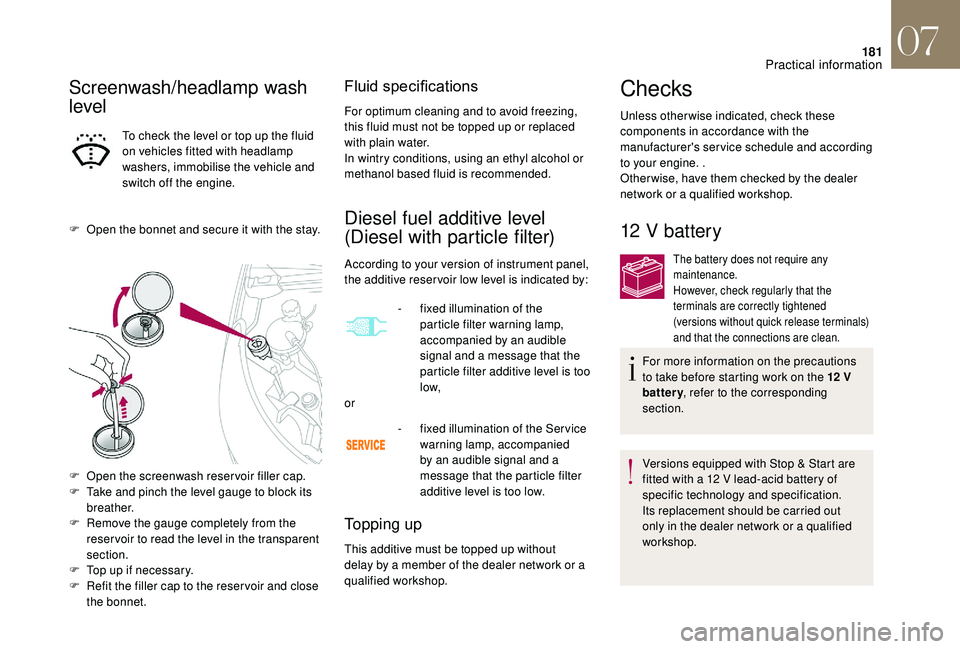
F
O
pen the bonnet and secure it with the stay.
F
O
pen the screenwash reservoir filler cap.
F
T
ake and pinch the level gauge to block its
breather.
F
R
emove the gauge completely from the
reser voir to read the level in the transparent
section.
F
T
op up if necessary.
F
R
efit the filler cap to the reser voir and close
the bonnet.
Fluid specifications
For optimum cleaning and to avoid freezing,
this fluid must not be topped up or replaced
with plain water.
In wintry conditions, using an ethyl alcohol or
methanol based fluid is recommended.
Diesel fuel additive level
(Diesel with particle filter)
According to your version of instrument panel,
the additive reser voir low level is indicated by:
Topping up
This additive must be topped up without
delay by a member of the dealer network or a
qualified workshop. -
f
ixed illumination of the
particle filter warning lamp,
accompanied by an audible
signal and a message that the
particle filter additive level is too
low,
or
-
f
ixed illumination of the Ser vice
warning lamp, accompanied
by an audible signal and a
message that the particle filter
additive level is too low.
Checks
Unless otherwise indicated, check these
components in accordance with the
manufacturer's service schedule and according
to your engine. .
Otherwise, have them checked by the dealer
network or a qualified workshop.
12 V battery
The battery does not require any
maintenance.
However, check regularly that the
terminals are correctly tightened
(versions without quick release terminals)
and that the connections are clean.
For more information on the precautions
to take before starting work on the 12 V
battery , refer to the corresponding
section.
Versions equipped with Stop & Start are
fitted with a 12 V lead-acid battery of
specific technology and specification.
Its replacement should be carried out
only in the dealer network or a qualified
workshop.
07
Practical information
Page 185 of 296

183
Manual parking brake
If excessive travel or a loss of
effectiveness of this system is
noticed, the parking brake must
be checked, even between two
services.
This system must be checked in the dealer
network or by a qualified workshop.
Electric parking brake
This system does not require any
routine servicing. However, in the
event of a problem, have the system
checked in the dealer network or by
a qualified workshop.
For more information on the Electric
parking brake , refer to the corresponding
section.
Only use products recommended by DS
AUTOMOBILES or products of equivalent
quality and specification.
In order to optimise the operation of
components as important as those in
the braking system, DS AUTOMOBILES
selects and offers very specific products.
After washing the vehicle, dampness, or
in wintry conditions, ice can form on the
brake discs and pads: braking efficiency
may be reduced. Make light brake
applications to dry and defrost the brakes.
AdBlue® (BlueHDi
engines)
To respect the environment and ensure
compliance with the Euro 6 standard, without
adversely affecting the performance or
fuel consumption of Diesel engines, DS
AUTOMOBILES has taken the decision to
equip its vehicles with a system that associates
SCR (Selective Catalytic Reduction) with a
Diesel particle filter (DPF) for the treatment of
exhaust gases.
SCR system
Using a liquid called AdBlue® that contains
urea, a catalytic converter turns up to 85% of
the oxides of nitrogen (NOx) into nitrogen and
water, which are harmless to health and the
environment.
Brake pads
Brake wear depends on the style
of driving, particularly in the case
of vehicles used in town, over short
distances. It may be necessary to
have the condition of the brakes
checked, even between vehicle
services.
Unless there is a leak in the circuit, a drop in
the brake fluid level indicates that the brake
pads are worn.
Brake disc/drum wear
For information on checking brake
disc wear, contact the dealer
network or a qualified workshop.
07
Practical information
Page 187 of 296
185
Keep AdBlue® out of the reach of children,
in its original container or bottle.
Never transfer AdBlue
® to another
container: it would lose its purity.
Never dilute AdBlue
® with water.
Never pour AdBlue® into the Diesel fuel
tank. Containers or bottles are available from the
dealer network or a qualified workshop.
Never top up from an AdBlue
® dispenser
reserved for heavy goods vehicles.
Recommendations on storage
AdBlue® freezes below around -11°C and
deteriorates above 25°C. It is recommended
that bottles or containers be stored in a cool
place and protected from direct sunlight.
Under these conditions, the fluid can be kept
for at least a year.
If the additive has frozen, it can be used once it
has completely thawed out.
Never store bottles or containers of
AdBlue
® in your vehicle.
Procedure
Before topping up, ensure that the vehicle is
parked on a flat and level sur face.
In wintry conditions, ensure that the
temperature of the vehicle is above -11°C.
Otherwise the AdBlue
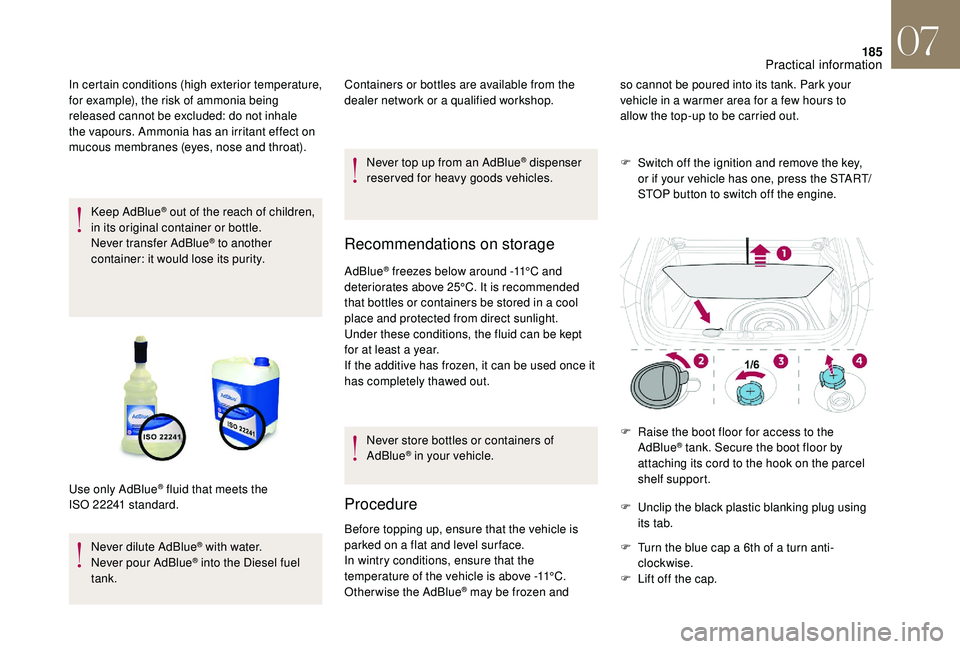
® may be frozen and F
S
witch off the ignition and remove the key,
or if your vehicle has one, press the START/
STOP button to switch off the engine.
F
R
aise the boot floor for access to the
AdBlue
® tank. Secure the boot floor by
attaching its cord to the hook on the parcel
shelf support.
F
U
nclip the black plastic blanking plug using
its tab.
F
T
urn the blue cap a 6th of a turn anti-
clockwise.
F
L
ift off the cap.
In certain conditions (high exterior temperature,
for example), the risk of ammonia being
released cannot be excluded: do not inhale
the vapours. Ammonia has an irritant effect on
mucous membranes (eyes, nose and throat).
Use only AdBlue
® fluid that meets the
ISO
22241 standard. so cannot be poured into its tank. Park your
vehicle in a warmer area for a few hours to
allow the top-up to be carried out.
07
Practical information
Page 189 of 296
187
Observe the following recommendations to
avoid damaging the paint finish:
-
N
ever clean the vehicle without water.
-
N
ever clean your vehicle in an
automatic roller-brush car wash.
-
N
ever select the programme with hot
wax finish.
-
N
ever use a high pressure jet washer
fitted with a brush as this may scratch
the paint sur face.
-
N
ever polish the body or the alloy
wheels. This makes the paint bright.
-
D
o not use paint restorers, abrasive
or polishing products, or bright paint
preser vers (wax polish, for example).
These products are only suitable for
bright finishes. Using them on vehicles
finished with matt paint seriously
damages the sur face finish of the
vehicle, resulting in particular in the
appearance of irreversible bright or
stained areas. It is always preferable to have paint
repairs carried out in the dealer network or
by a qualified workshop.
Leather
Leather is a natural product. Appropriate
regular care and cleaning is essential for its
durability.
Refer to your vehicle's Maintenance and
Warranty Guide for information on all the
special precautions to observe.
In addition:
-
C
hoose a high pressure wash, or at least a
high-flow water jet.
-
R
inse the vehicle with demineralised water.
-
G
ently wipe the body with a clean
microfibre cloth.
-
C
arefully wipe off any fuel spilt on the body
using a soft cloth, then allow to dry.
-
C
lean off minor marks (for example, finger
marks), using the maintenance product
recommended by DS AUTOMOBILES.
07
Practical information
Page 216 of 296
214
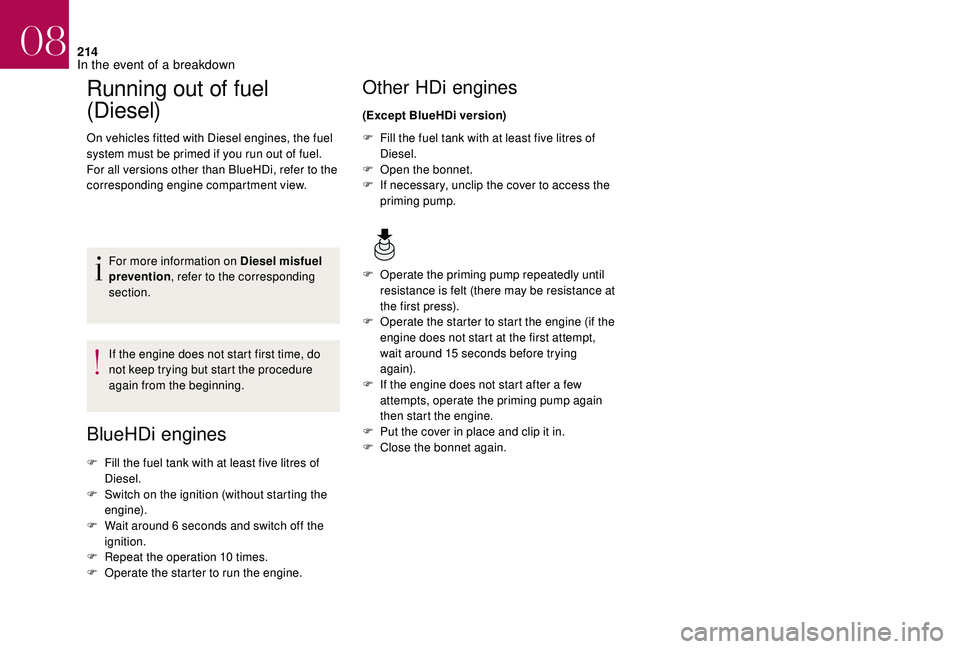
Running out of fuel
(Diesel)
On vehicles fitted with Diesel engines, the fuel
system must be primed if you run out of fuel.
For all versions other than BlueHDi, refer to the
corresponding engine compartment view.For more information on Diesel misfuel
prevention , refer to the corresponding
section.
If the engine does not start first time, do
not keep trying but start the procedure
again from the beginning.
BlueHDi engines
F Fill the fuel tank with at least five litres of Diesel.
F
S
witch on the ignition (without starting the
engine).
F
W
ait around 6 seconds and switch off the
ignition.
F
R
epeat the operation 10 times.
F
O
perate the starter to run the engine.
Other HDi engines
(Except BlueHDi version)
F
F
ill the fuel tank with at least five litres of
Diesel.
F
O
pen the bonnet.
F
I
f necessary, unclip the cover to access the
priming pump.
F
O
perate the priming pump repeatedly until
resistance is felt (there may be resistance at
the first press).
F
O
perate the starter to start the engine (if the
engine does not start at the first attempt,
wait around 15 seconds before trying
again).
F
I
f the engine does not start after a few
attempts, operate the priming pump again
then start the engine.
F
P
ut the cover in place and clip it in.
F
C
lose the bonnet again.
08
In the event of a breakdown
Page 219 of 296
217
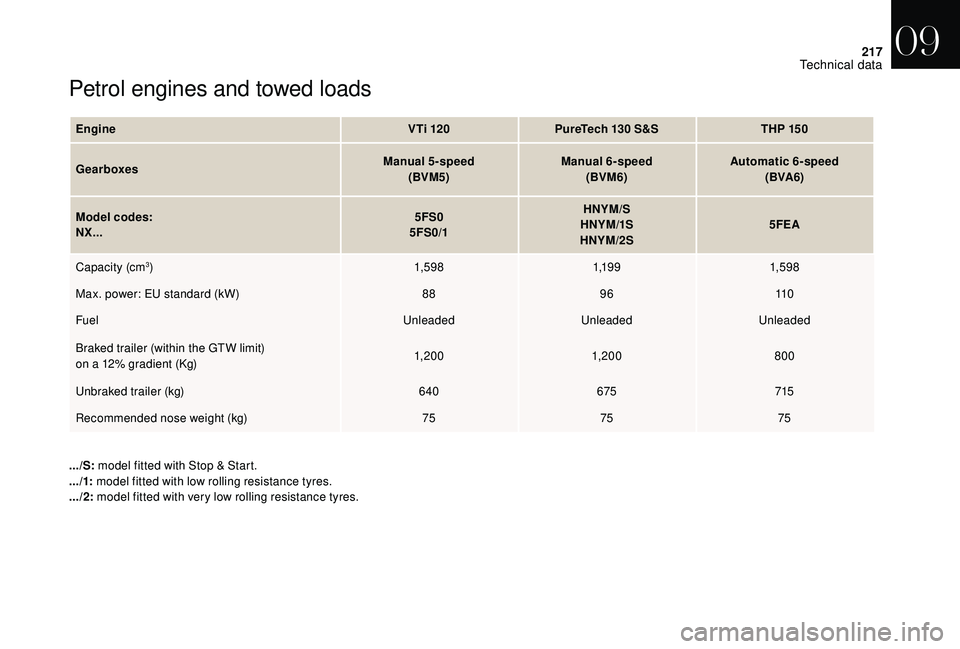
Petrol engines and towed loads
EngineV Ti 120PureTech 130 S&S THP 15 0
Gearboxes Manual 5-speed
(BVM5) Manual 6-speed
(BVM6) Automatic 6-speed
(BVA6)
Model codes:
NX... 5FS0
5FS0/1 HNYM/S
HNYM/1S
HNYM/2S 5FEA
Capacity (cm
3) 1,59 81,1 9 91,59 8
Max. power: EU standard (kW) 889611 0
Fuel UnleadedUnleadedUnleaded
Braked trailer (within the GTW limit)
on a 12% gradient (Kg) 1, 20 0
1, 20 0 800
Unbraked trailer (kg) 640675715
Recommended nose weight (kg) 757575
.../S: model fitted with Stop & Start.
.../1: model fitted with low rolling resistance tyres.
.../2: model fitted with very low rolling resistance tyres.
09
Technical data
Page 220 of 296
218
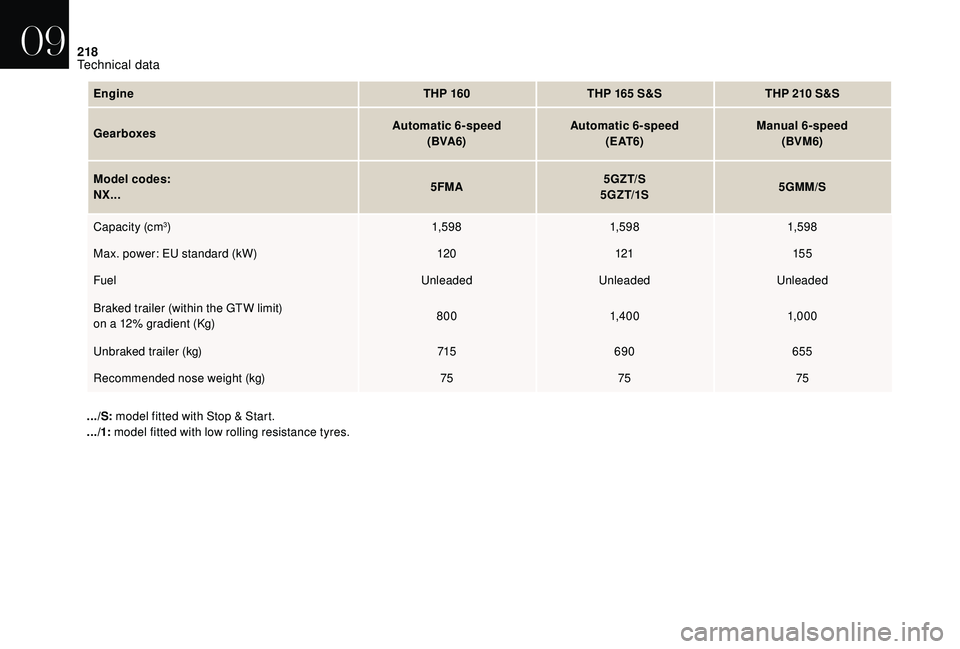
EngineTHP 160THP 165 S&S THP 210 S&S
Gearboxes Automatic 6-speed
(BVA6) Automatic 6-speed
( E AT 6 ) Manual 6-speed
(BVM6)
Model codes:
NX... 5FMA5GZT/S
5GZ T/1S 5GMM/S
Capacity (cm
3) 1,59 81,59 81,59 8
Max. power: EU standard (kW) 12012115 5
Fuel UnleadedUnleadedUnleaded
Braked trailer (within the GTW limit)
on a 12% gradient (Kg) 800
1,4 0 0 1,000
Unbraked trailer (kg) 715690 655
Recommended nose weight (kg) 757575
.../S: model fitted with Stop & Start.
.../1: model fitted with low rolling resistance tyres.
09
Technical data
Page 221 of 296
219
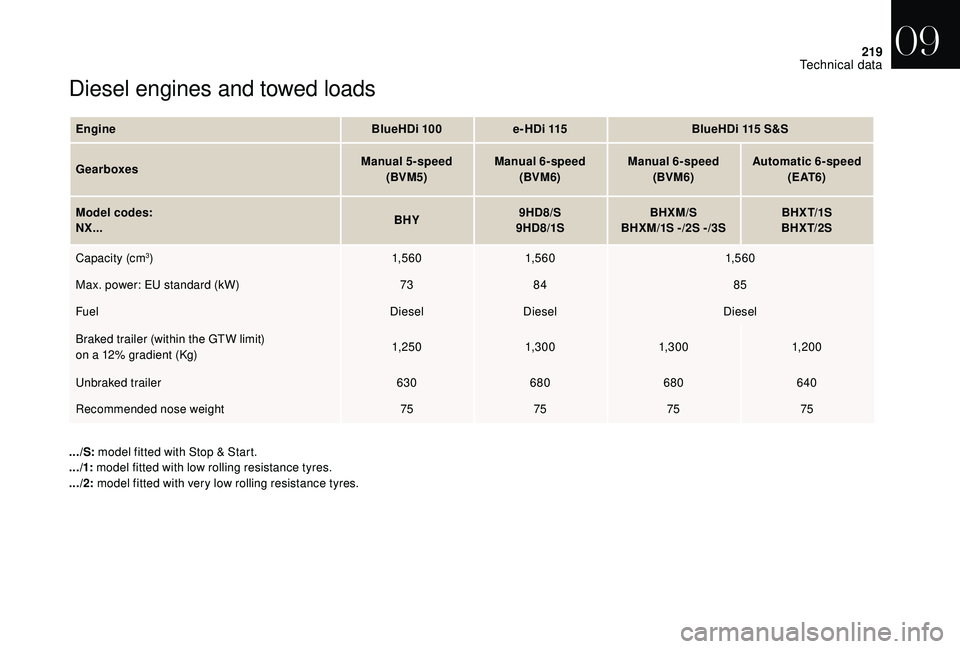
Diesel engines and towed loads
EngineBlueHDi 100e-HDi 115 BlueHDi 115 S&S
Gearboxes Manual 5-speed
(BVM5) Manual 6-speed
(BVM6) Manual 6-speed
(BVM6) Automatic 6-speed
( E AT 6 )
Model codes:
NX... BHY9HD8/S
9HD8/1S BHXM/S
BHXM/1S - /2S - /3S BHX T/1S
BHX T/2S
Capacity (cm
3) 1,5 6 01,5 6 0 1,5 6 0
Max. power: EU standard (kW) 7384 85
Fuel DieselDiesel Diesel
Braked trailer (within the GTW limit)
on a 12% gradient (Kg) 1, 25 0
1,3 0 0 1,3 0 01, 20 0
Unbraked trailer 630680 680640
Recommended nose weight 75757575
.../S: model fitted with Stop & Start.
.../1: model fitted with low rolling resistance tyres.
.../2: model fitted with very low rolling resistance tyres.
09
Technical data
Page 222 of 296
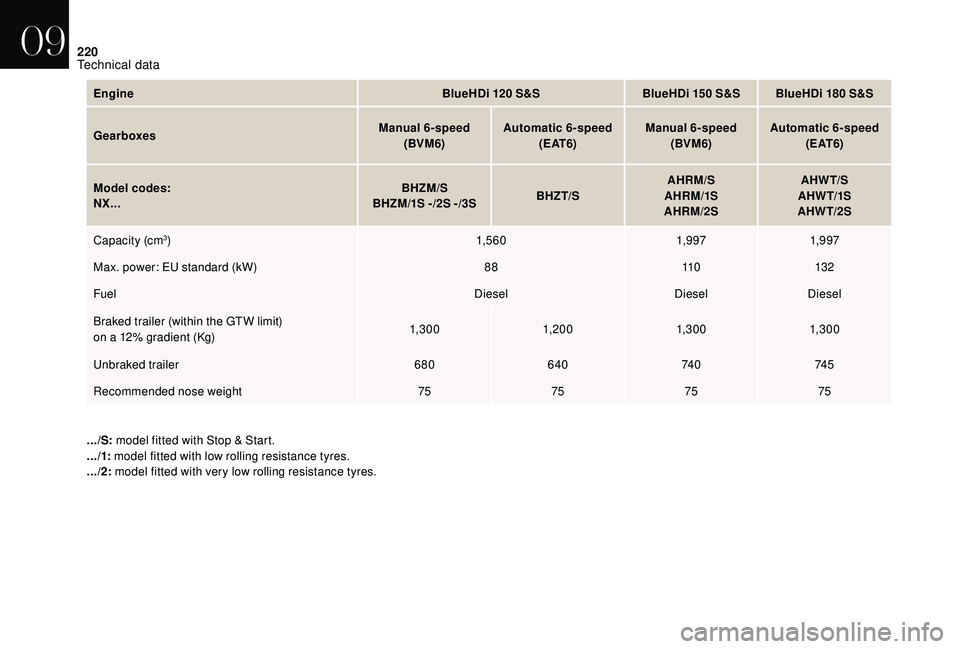
220
EngineBlueHDi 120 S&SBlueHDi 150 S&S BlueHDi 180 S&S
Gearboxes Manual 6-speed
(BVM6) Automatic 6-speed
( E AT 6 ) Manual 6-speed
(BVM6) Automatic 6-speed
( E AT 6 )
Model codes:
NX... BHZM/S
BHZM/1S - /2S - /3S BHZT/SAHRM/S
AHRM/1S
AHRM/2S AHW T/S
AHW T/1S
AHW T/2S
Capacity (cm
3) 1,5 6 01,9 971,9 97
Max. power: EU standard (kW) 8811 0132
Fuel DieselDieselDiesel
Braked trailer (within the GTW limit)
on a 12% gradient (Kg) 1,3 0 0
1, 20 0 1,3 0 01,3 0 0
Unbraked trailer 680640 74 074 5
Recommended nose weight 75757575
.../S: model fitted with Stop & Start.
.../1: model fitted with low rolling resistance tyres.
.../2: model fitted with very low rolling resistance tyres.
09
Technical data