Door CITROEN DS4 2023 Owner's Guide
[x] Cancel search | Manufacturer: CITROEN, Model Year: 2023, Model line: DS4, Model: CITROEN DS4 2023Pages: 296, PDF Size: 9.91 MB
Page 98 of 296

96
Switching on
F Press the open padlock on the remote control or one of
the front door handles with the
"Keyless Entry and Starting"
system.
The sidelamps and dipped beam headlamps,
as well as the side spotlamps, located under
the door mirrors, come on; your vehicle is also
unlocked.
Switching off
The welcome lighting switches off automatically
after a programmed time, when the ignition is
switched on or on locking the vehicle.
Programming
Activation or deactivation, as well
as the duration of the welcome
lighting can be set via the vehicle
configuration menu.
Headlamp adjustment
Manual adjustment of the
halogen headlamps
To avoid causing a nuisance to other road
users, the height of the halogen headlamp
beams should be adjusted according to the
load in the vehicle.
0. 1 or 2 people in the front seats.
-. 3 people.
1. 5 people.
-. Intermediate setting.
2. 5 people + maximum authorised load.
-. Intermediate setting.
3. Driver + maximum authorised load.
Automatic adjustment
of xenon and full-LED
headlamps
The initial setting is position " 0".
This system adjusts the height of the xenon
headlamp beams automatically and when
stationary, according to the vehicle's load, so as
to avoid causing a nuisance to other road users.
If a malfunction occurs, this warning
lamp is displayed in the instrument
panel, accompanied by an audible
signal and a message in the screen.
The system then places your headlamps in the
lowest position. In the event of a fault, do not touch the
xenon bulbs.
Have them checked in the dealer network
or by a qualified workshop.
04
Lighting and visibility
Page 116 of 296

11 4
Operating fault
If this warning lamp in the instrument
panel comes on, you must contact the
dealer network or a qualified workshop
to have the system checked. The
airbags might no longer deploy in a
crash.
Lateral airbags
This system protects the driver and front
passenger in the event of a severe side impact
to minimise the risk of injury to the chest,
between hip and shoulder.
Each lateral airbag is fitted in the seat backrest
frame, door side.
Impact detection zones
A.Front impact zone.
B. Side impact zone.
Deployment
The airbag is deployed unilaterally in the
event of a severe side impact covering all or
part of side impact zone B , perpendicular to
the longitudinal centreline of the vehicle on a
horizontal plane and directed from the outside
towards the inside of the vehicle.
The lateral airbag inflates between the hip
and shoulder of the front passenger and the
corresponding door trim panel.
Curtain airbags
System contributing towards greater protection
for the driver and passengers (with the
exception of the rear centre passenger) in the
event of a serious side impact in order to limit
the risk of injury to the side of the head.
Deployment
The airbag is deployed at the same time as
the corresponding lateral airbag in the event
of a serious side impact applied to all or part
of the side impact zone B , perpendicular to
the longitudinal centreline of the vehicle on a
horizontal plane and directed from the outside
towards the inside of the vehicle.
The curtain airbag inflates between the front or
rear occupant of the vehicle and the windows.
Malfunction
If this warning lamp in the instrument
panel comes on, you must contact the
dealer network or a qualified workshop
to have the system checked. The
airbags might no longer deploy in a
crash.
In the event of a minor impact or bump on
the side of the vehicle or if the vehicle rolls
over, the airbag may not be deployed.
In the event of a rear or front collision, the
airbag is not deployed.
Each curtain airbag is built into the pillars and
the upper passenger compartment area.
05
Safety
Page 117 of 296
11 5
Instructions
For the airbags to be fully effective,
observe the safety recommendations
below.
Adopt a normal and upright sitting position.
Wear a correctly adjusted seat belt.
Do not leave anything between the occupants
and the airbags (a child, pet, object...), nor fix
or attach anything close to or in the way of
the airbag release trajectory; this could cause
injuries during their deployment.
Never modify the original definition of your
vehicle, particularly in the area directly
around the airbags.
After an accident or if the vehicle has been
stolen, have the airbag systems checked.
All work on the airbag systems must be
per formed in the dealer network or by a
qualified workshop.
Even if all of the precautions mentioned
are obser ved, a risk of injury or of minor
burns to the head, chest or arms when an
airbag is deployed cannot be ruled out. The
bag inflates almost instantly (within a few
milliseconds) then deflates within the same
time discharging the hot gas via openings
provided for this purpose.Front airbags
Do not drive holding the steering wheel by its
spokes or resting your hands on the centre
part of the wheel.
Passengers must not place their feet on the
dashboard.
Do not smoke as deployment of the airbags
can cause burns or the risk of injury from a
cigarette or pipe.
Never remove or pierce the steering wheel or
hit it violently.
Do not fit or attach anything to the steering
wheel or dashboard, this could cause injuries
in case of airbag deployment.
Lateral airbags
Use only approved covers on the seats,
compatible with the deployment of the lateral
airbags. For information on the range of seat
covers suitable for your vehicle, contact the
dealer network.
Do not attach anything to or hang anything
from the seat backrests (clothes, etc.) as
this could cause injuries to the thorax or arm
when the lateral airbag is deployed.
Do not sit with the upper part of the body any
nearer to the door than necessary. The vehicle's front door panels include side
impact sensors.
A damaged door or any unauthorised or
incorrectly executed work (modification or
repair) on the front doors or their interior trim
could compromise the operation of these
sensors – risk of malfunction of the lateral
airbags!
Such work must only be done in the dealer
network or by a qualified workshop.
Curtain airbags
Do not attach anything or hang anything to
the roof, as this could cause head injuries
when the curtain airbag is deployed.
If fitted to your vehicle, do not remove the
grab handles installed on the roof, they play a
part in securing the curtain airbags.
05
Safety
Page 130 of 296

128
The incorrect installation of a child seat in a
vehicle compromises the child's protection in
the event of an accident.
Ensure that there is no seat belt or seat belt
buckle under the child seat, as this could
destabilise it.
Remember to fasten the seat belts or the
child seat harnesses keeping the slack
relative to the child's body to a minimum,
even for short journeys.
When installing a child seat using the seat
belt, ensure that the seat belt is tightened
correctly on the child seat and that it secures
the child seat firmly on the seat of your
vehicle. If your passenger seat is adjustable,
move it for wards if necessary.
At rear seating positions, always leave
sufficient space between the front seat and:
-
a r
ear ward facing child seat,
-
t
he child's feet for a child seat fitted
forward facing.
To do this, move the front seat for wards
and, if necessary, move its backrest into the
upright position.
For optimal installation of the forward facing
child seat, verify that its backrest is as close
as possible to the backrest of the vehicle
seat, if possible in contact with it.
Advice
The head restraint must be removed
before installing a child seat with a
backrest on a passenger seat.
Ensure that the head restraint is stored or
attached securely to prevent it from being
thrown around the vehicle in the event of
sharp braking. Refit the head restraint when
the child seat is removed.
Front seat belts
The legislation on carrying children on the
front passenger seat is specific to each
country. Refer to the legislation in force in
your country.
Deactivate the passenger's front airbag when
a rear ward facing child seat is installed on the
front passenger seat.
Otherwise, the child risks being seriously
injured or killed if the airbag is deployed.
Installing a booster seat
The chest part of the seat belt must be
positioned on the child's shoulder without
touching the neck.
Ensure that the lap part of the seat belt
passes correctly over the child's thighs. We recommend using a booster seat with
a backrest equipped with a belt guide at
shoulder level.
As a safety precaution, do not leave:
-
a c
hild or children alone and unattended in
a vehicle,
-
a c
hild or an animal in a vehicle under the
sun, with the windows closed,
-
t
he keys within the reach of children inside
the vehicle.
To prevent accidental opening of the doors
and rear windows, use the child lock.
Take care not to open the rear windows by
more than one third.
To protect young children from the rays of the
sun, fit side blinds on the rear windows.
05
Safety
Page 131 of 296

129
Manual child lock
Locking
F Using the ignition key or the integral key, depending on version, turn the red control
as far as it will go:
-
t
o the left on the left-hand rear door,
-
t
o the right on the right-hand rear door.
Unlocking
F Using the ignition key or the integral key, depending on version, turn the red control
as far as it will go:
-
t
o the right on the left-hand rear door,
-
t
o the left on the right-hand rear door.
Do not confuse the child lock control,
which is red, with the back-up locking
control, which is black.
Mechanical system to prevent opening of a rear
door using its interior control.
The control, red in colour, is located on the
edge of each rear door.
It is identified by a mark on the bodywork.
05
Safety
Page 132 of 296

130
Electric child lock
Activation
F Press this button.
The indicator lamp in the button comes on,
accompanied by a message in the screen.
This indicator lamp remains on until the child
lock is switched off.
Deactivation
F Press the button again.
The indicator lamp in the button goes off,
accompanied by a message in the screen.
This indicator lamp remains off while the child
lock is switched off.Any other status of the indicator lamp
indicates a fault with the electric child lock.
Have it checked in the dealer network or a
qualified workshop.
This system is independent and in no
circumstances does it take the place of
the central locking control.
Check the status of the child lock each
time you switch on the ignition.
Always remove the key from the ignition
when leaving the vehicle, even for a short
time.
In the event of a serious impact, the
electric child lock is switched off
automatically to permit the exit of the rear
passengers.
Remotely operated system to prevent opening
of the rear doors using their interior controls.
The control is located on the dashboard,
driver's side.
05
Safety
Page 141 of 296
139
When the vehicle is being driven,
if this warning lamp and the STOP
warning lamp come on, accompanied
by an audible signal and a message
on the multifunction screen, this
indicates that the parking brake is still
on or has not been fully released.
When parking on a slope, direct your
wheels towards the kerb, apply the
parking brake, engage a gear and switch
off the ignition.
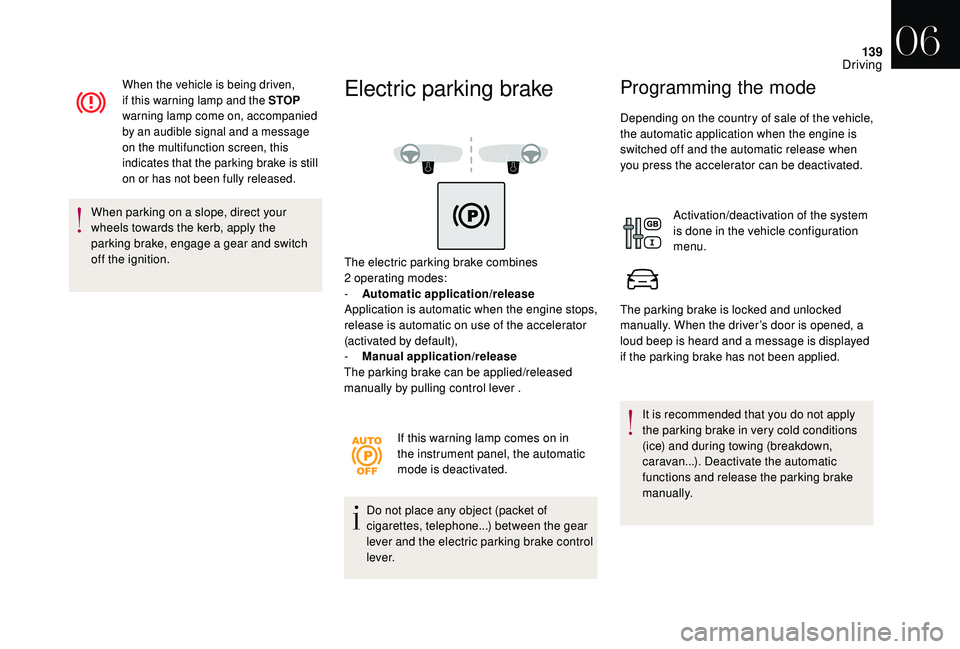
Electric parking brake
The electric parking brake combines
2 operating modes:
-
A
utomatic application/release
Application is automatic when the engine stops,
release is automatic on use of the accelerator
(activated by default),
-
M
anual application/release
The parking brake can be applied/released
manually by pulling control lever .
If this warning lamp comes on in
the instrument panel, the automatic
mode is deactivated.
Do not place any object (packet of
cigarettes, telephone...) between the gear
lever and the electric parking brake control
l eve r.
Programming the mode
Depending on the country of sale of the vehicle,
the automatic application when the engine is
switched off and the automatic release when
you press the accelerator can be deactivated.
Activation/deactivation of the system
is done in the vehicle configuration
menu.
The parking brake is locked and unlocked
manually. When the driver’s door is opened, a
loud beep is heard and a message is displayed
if the parking brake has not been applied. It is recommended that you do not apply
the parking brake in very cold conditions
(ice) and during towing (breakdown,
caravan...). Deactivate the automatic
functions and release the parking brake
manually.
06
Driving
Page 142 of 296

140
Manual application
With the vehicle stationary, to apply the parking
brake regardless of whether the engine is
running or switched off, pull the control lever.
The application of the parking brake is
confirmed by:
When the driver’s door is opened with the
engine running, a message is displayed
accompanied by an audible signal if the parking
brake has not been applied, except in the case
of an automatic gearbox with the gear selector
in position P .
Before leaving the vehicle, ensure
that parking brake warning lamp in the
instrument panel is on fixed, not flashing.
Manual release
With the ignition on or the engine running, to
release the parking brake, press on the brake
pedal or the accelerator, pull then release
control. Full release of the parking brake is confirmed
by:
-
d
isplay of the message "Parking
brake released/off".
If you pull the control lever without
pressing the brake pedal, the parking
brake will not be released and a
warning lamp will come on in the
instrument panel.
Maximum application
If necessary, you can make maximum
application of the parking brake. It is obtained
by means of a long pull on control lever , until
you see the message "Parking brake applied
fully" accompanied by an audible signal.
Maximum application is essential:
-
i
n the case of a vehicle towing a caravan
or a trailer, if the automatic functions are
activated but you are applying the parking
brake manually,
-
w
hen the gradient you are parked on may
vary (e.g. on a ferry, on a lorry, during
towing). In the case of towing, a loaded vehicle or
parking on a gradient, make a maximum
application of the parking brake then turn
the front wheels towards the kerb and
engage a gear when you park.
After a maximum application, the release
time will be longer.
Automatic application, engine
off
With the vehicle stationary, the parking brake
is automatically applied when the engine is
switched off
.
The application of the parking brake is
confirmed by:
-
d
isplay of the message "Parking
brake applied/on".
-
i
llumination of the braking
warning lamp and the P warning
lamp in the control lever,
-
d
isplay of the message "Parking
brake applied". -
t
he braking warning lamp and
the P warning lamp in the
control lever going off,
-
i
llumination of the braking
warning lamp and the P warning
lamp in the control lever ,
06
Driving
Page 143 of 296

141
Before leaving the vehicle, ensure
that parking brake warning lamp in the
instrument panel is on fixed, not flashing.
Never leave a child alone inside the
vehicle with the ignition on, as they could
release the parking brake.
In the case of towing, a loaded vehicle
or parking on a gradient, turn the front
wheels towards the kerb and engage a
gear when you park.
Automatic release
The electric parking brake releases
automatically and progressively when you
press the accelerator:
F
M
anual gearbox: press down fully on the
clutch pedal, engage 1st gear or reverse,
press on the accelerator pedal and move
of f.
F
A
utomatic gearbox : select position D, M or
R then press the accelerator pedal.
Full release of the parking brake is confirmed
by:
When stationary with the engine running, do
not press the accelerator pedal unnecessarily,
as you may release the parking brake.
Immobilisation of the vehicle
with the engine running
With the engine running and the vehicle
stationary, in order to immobilise the vehicle
it is essential to manually apply the parking
brake by pulling the control lever.
The application of the parking brake is
confirmed by:
When the driver’s door is opened, a message is
displayed accompanied by an audible signal if
the parking brake has not been applied, except
in the case of an automatic gearbox with the
gear selector in position P . Before leaving the vehicle, ensure
that parking brake warning lamp in the
instrument panel is on fixed, not flashing.
Special situations
In some circumstances (engine start, etc.),
the parking brake may automatically adjust its
force. This is normal operation.
To move your vehicle a few centimetres without
starting the engine, with the ignition on, press
the brake pedal and release the parking brake
by pulling
then releasing the control lever. The
full release of the parking brake is confirmed by
the warning lamps in the control lever and in the
instrument panel going off and by the display of
the message "Parking brake released/off ".
- the braking warning lamp and the P warning lamp in the
control lever going off, -
d
isplay of the message "Parking
brake released/off".
-
i
llumination of the braking
warning lamp and the P warning
lamp in the control lever,
-
d
isplay of the message "Parking
brake applied/on".
Emergency braking
In the event of a failure of the main ser vice
brake or in an exceptional situation (e.g. driver
taken ill, under instruction, etc.), a continuous
pull on the control lever will stop the vehicle.
The electronic stability control provides stability
during emergency braking.
If the emergency braking malfunctions,
the message "Parking brake faulty" will be
displayed.
06
Driving
Page 146 of 296

144
Moving off
F With your foot on the brake, select position P or N .
F
S
tart the engine.
If this procedure is not followed, an audible
signal is heard, accompanied by a message in
the instrument panel screen.
F
W
ith the engine running, press the brake
pedal.
F
Sel
ect position R , D or M.
If you do not press the brake pedal
when trying to move the gear selector
out of position P , this warning lamp or
this symbol appears in the instrument
panel accompanied by the flashing
of the P symbol, the display of a
message and an audible signal.
F Check that the display in the instrument panel agrees with the position engaged.
F
G
radually release the brake pedal.
If the parking brake is released manually, the
vehicle moves off immediately.
If the parking brake is applied and automatic
mode is activated, accelerate progressively. If the parking brake does not release
automatically, check that the front doors
are fully closed.
If position N is selected inadvertently while
driving, allow the engine to return to idle,
then select position D to accelerate.
When the engine is running at idle, with
the brakes released, if position R
, D or
M is selected, the vehicle moves even
without the accelerator being pressed.
Never leave children unsuper vised in the
vehicle when the engine is running.
When carrying out maintenance with the
engine running, apply the parking brake
and select position P .
Automatic operation
the profile of the road and the load in the
vehicle.
For maximum acceleration without touching
the selector, press the accelerator fully down
(kick-down). The gearbox changes down
automatically or holds the gear selected until
the maximum engine speed is reached.
On braking, the gearbox changes down
automatically to provide effective engine
braking.
If you release the accelerator sharply, the
gearbox will not shift to a higher gear for safety
reasons.
Never select position N while the vehicle
is moving.
Never select position P or R unless the
vehicle is completely stationary.
Sport and snow programmes
These two special programmes supplement the
automatic operation in very specific conditions
of use.
F
Sel
ect position D to change the six gears
automatically .
The gearbox then operates in auto-adaptive
mode, without any inter vention on the part
of the driver. It continuously selects the most
suitable gear according to the style of driving,
06
Driving