Door CITROEN DS4 2023 Service Manual
[x] Cancel search | Manufacturer: CITROEN, Model Year: 2023, Model line: DS4, Model: CITROEN DS4 2023Pages: 296, PDF Size: 9.91 MB
Page 147 of 296

145
Sport programme "S"
F Press the "S" button after starting the
engine.
The gearbox automatically favours a dynamic
style of driving.
S appears on the instrument panel.
Snow programme " T"
F With the engine running, press the " T"
button.
The gearbox adapts to driving on slippery
roads.
This programme improves starting and
handling when traction is poor.
T appears in the instrument panel.
Return to auto-adaptive mode
F At any time, press the selected button again to leave the special programme engaged
and return to auto-adaptive mode.
Manual operation
F Select the M position for sequential
changing of the six gears.
F
P
ush the selector towards the " +" sign to
change up a gear.
F
P
ull the selector towards the " -" sign to
change down a gear.
It is only possible to change from one gear to
another if the vehicle speed and engine speed
permit; otherwise, the gearbox will operate
temporarily in automatic mode.
D disappears, and the gears
engaged appear in succession on
the instrument panel.
If the engine is under-revving or over-revving,
the gear selected flashes for a few seconds,
then the actual gear engaged is displayed.
When the vehicle is stationary or moving very
slowly, the gearbox automatically selects gear 1 .
It is not necessary to release the accelerator
when changing gear.
It is possible to change from position D
(automatic) to position M (manual) at any time.
The sport and snow programmes are inactive
in manual operation.
Invalid value during manual
operation
This symbol is displayed if a gear
is not engaged correctly (selector
between two positions).
Stopping the vehicle
Before switching off the engine, put the selector
in position P or N to place the gearbox in
neutral.
In both cases, apply the parking brake to
immobilise the vehicle, unless it is programmed
to automatic mode.
If the selector is not in position P , when the
driver's door is opened or approximately
45 seconds after the ignition is switched
off, an audible signal sounds and a
message appears.
F
R
eturn the gear selector to position
P ; the audible signal stops and the
message disappears.
06
Driving
Page 149 of 296

147
Stop & Start
The Stop & Start system puts the engine
t emporarily into standby – STOP mode – during
stops in the traffic (red lights, traffic jams,...).
The engine restarts automatically – START
mode – as soon as you want to move off.
The restart takes place instantly, quickly and
silently.
Per fect for urban use, the Stop & Start system
reduces fuel consumption and exhaust
emissions as well as the noise level when
stationary.
Operation
Going into engine STOP mode
The " ECO" warning lamp comes on in
the instrument panel and the engine
goes into standby automatically:
- with a manual gearbox , at speeds below
12 mph (20 km/h) or when the vehicle is
stationary with the PureTech 130 petrol and
BlueHDi 115 and 120 Diesel versions, when
you place the gear lever in neutral and you
release the clutch pedal,
-
W
ith an automatic gearbox , when the
vehicle is stationary and when you press
the brake pedal or put the gear selector in
position N . If your vehicle is fitted with this
system, a time counter calculates
the time spent in STOP mode
during a journey. It resets to
zero every time the ignition is
switched on with the key or the
"START/STOP" button.
STOP mode does not affect the operation
of vehicle systems such as braking, power
steering...
Never refuel with the engine in STOP
mode; you must switch off the ignition with
the key or the "START/STOP" button.
Special cases: STOP mode not
available
STOP mode is not activated when:
- t he vehicle is on a steep slope (uphill or
downhill),
-
t
he driver's door is open,
-
t
he driver's seat belt is not fastened,
-
t
he vehicle has not exceeded 6 mph (10
km/h) since the last engine start (with the
key or the "START/STOP" button),
-
t
he electric parking brake is applied or being
applied, -
t
he engine is needed to maintain a
comfortable temperature in the passenger
compartment,
-
d
emisting is active,
-
c
ertain special conditions (battery charge,
engine temperature, braking assistance,
exterior temperature, etc.) require the
engine to be running to assure control of a
system.
In this case, the " ECO" warning
lamp flashes for a few seconds then
goes off.
This operation is perfectly normal.
Going into engine START mode
The ECO warning lamp goes off and
the engine starts automatically:
-
w
ith a manual gearbox , when you fully
depress the clutch pedal,
-
w
ith an automatic gearbox:
•
g
ear selector in position D or M , when
you release the brake pedal,
•
o
r gear selector in position N and brake
pedal released, when you place the gear
selector in position D or M ,
•
o
r when you engage reverse gear.
06
Driving
Page 150 of 296

148
With a manual gearbox in STOP mode, if
a gear is engaged without fully depressing
the clutch pedal, a warning lamp comes
on or an alert message is displayed asking
you to depress the clutch pedal to restart
the engine.
Special cases: START mode
activated automatically
As a safety measure or to maintain comfort
levels in the vehicle, START mode is activated
automatically when:
-
y
ou open the driver's door,
-
y
ou unfasten the driver's seat belt,
-
t
he speed of the vehicle exceeds 16 mph
(25 km/h) with a manual gearbox (2 mph
(3
km/h) with PureTech 130 petrol and
BlueHDi 115 and 120 Diesel versions), or
2
mph (3 km/h) with an automatic gearbox.
-
t
he electric parking brake is being applied,
-
s
ome special conditions (battery charge,
engine temperature, braking assistance,
exterior temperature...) require the engine to
be running to assure control of a system. In this case, the "
ECO" warning
lamp flashes for a few seconds then
goes off.
This operation is perfectly normal.
Deactivation
At any time, press the ECO OFF switch to
d eactivate the system.
This is confirmed by the switch warning lamp
coming on accompanied by the display of a
message.
If the system has been deactivated
in STOP mode, the engine restarts
immediately.
Reactivation
F Press the ECO OFF switch again.
The system is active again; this is confirmed
by the switch warning lamp going off and the
display of a message. The system is reactivated automatically
at every new start using the key or the
"START/STOP" button.
Operating fault
In the event of a malfunction with the system,
the ECO OFF switch warning lamp flashes,
then comes on continuously.
Have it checked in the dealer network or by a
qualified workshop.
In the event of a fault in STOP mode, the
vehicle may stall: all the instrument panel
warning lamps come on.
Depending on version, an alert message
may also be displayed asking you to put
the gear lever into position N and put your
foot on the brake pedal.
It is then necessary to switch off the
ignition, then restart the engine using the
key or the "START/STOP" button.
06
Driving
Page 151 of 296

149
The Stop & Start system requires a
12 V battery of specific technology and
specification.
All work on this type of battery must only
be carried out in the dealer network or by
a qualified workshop.
For more information on the 12 V batter y ,
refer to the corresponding section.
Opening the bonnet
Driving on flooded roads
Before driving in a flooded area, it is
strongly recommended that you deactivate
the Stop & Start system.
For more information on Driving advice ,
particularly on flooded roads, refer to the
corresponding section. Before doing anything under the bonnet,
deactivate the Stop & Start system to
avoid any risk of injury resulting from an
automatic change to START mode.Hill start assist
System which keeps your vehicle immobilised
temporarily (approximately 2 seconds) when
starting on a gradient, the time it takes to
move your foot from the brake pedal to the
accelerator pedal.
This system only operates when:
-
t
he vehicle is completely stationary, with
your foot on the brake pedal,
-
c
ertain slope conditions are met,
-
w
ith the driver’s door closed.
The hill start assist function cannot be
deactivated.
Operation
On an ascending slope, with the vehicle
stationar y, the vehicle is held for a shor t
time when you release the brake pedal:
-
i
f you are in first gear or neutral with a
manual gearbox, On a descending slope, with the vehicle
stationary and reverse gear engaged, the
vehicle is held for a shor t time when you
release the brake pedal.
Do not leave the vehicle while it is being
held temporarily in the hill start assist
phase.
If you need to leave the vehicle with the
engine running, apply the parking brake
manually then ensure that the parking
brake warning lamps light up constantly on
the instrument panel.
-
i
f you are in position D or M with an
automatic gearbox.
06
Driving
Page 159 of 296

157
Detection may be impeded:
- i f the sensors are dirty (mud, snow...),
-
i
f the road markings are not clearly
visible,
-
i
f there is little contrast between the
markings on the road and the road
sur face.Blind spot monitoring
This driving assistance system warns the driver
of the presence of another vehicle in the blind
spot angle of their vehicle (areas hidden from
the driver's field of vision), as soon as this
presents a potential danger. This system is designed to improve safety
when driving and is in no circumstances
a substitute for the use of the interior rear
view mirror and door mirrors. It is the
driver's responsibility to constantly check
the traffic, to assess the distances and
relative speeds of other vehicles and to
predict their movements before deciding
whether to change lane.
The blind spot monitoring system can
never replace the need for vigilance on the
part of the driver.
A warning lamp appears in the door mirror on
the side in question:
- i
mmediately, when being overtaken,
- a fter a delay of about one second, when
overtaking a vehicle slowly.
06
Driving
Page 160 of 296

158
F When switching on the ignition or with the engine running, press this button to activate
the system; the indicator lamp comes on.
Sensors fitted in the front and rear bumpers
monitor the blind spots.
The alert is given by a warning lamp which
comes on in the door mirror on the side in
question as soon as a vehicle – car, lorry, cycle
– is detected.
For this, the following conditions must be met:
-
a
ll the vehicles must be moving in the same
direction,
-
t
he speed of your vehicle is between 7 and
87 mph (12 and 140 km/h),
-
y
ou overtake a vehicle with a speed
difference of less than 6 mph (10 km/h),
-
w
hen a vehicle overtakes you with a speed
difference of less than 16 mph (25 km/h),
-
t
he traffic must be flowing normally, No alert will be given in the following situations:
-
i
n the presence of non-moving objects
(parked vehicles, barriers, street lamps,
road signs, etc.),
-
w
ith vehicles moving in the opposite
direction,
-
d
riving on a winding road or a sharp corner,-
w
hen overtaking or being overtaken by a
very long vehicle (lorry, bus, etc.) which is
also in the rear blind spot and present in the
driver’s front field of vision,
-
w
hen overtaking quickly,
-
i
n very heavy traffic: vehicles detected in
front and behind are confused with a lorry or
a stationary object.
Operation- in the case of an overtaking manoeuvre, if this is prolonged and the vehicle being
overtaken remains in the blind spot,
-
y
ou are driving on a straight or slightly
curved road,
-
y
our vehicle is not pulling a trailer,
a
caravan...
06
Driving
Page 161 of 296

159
F To deactivate the system, press this button again; the warning lamp goes off.
The status of the system remains in memory
when the ignition is switched off.
The system is automatically deactivated
when towing with a towbar approved by
DS AUTOMOBILES.
Malfunction
In the event of a fault, the warning lamp in the
button flashes then goes off.
Contact the dealer network or a qualified
workshop. The system may suffer temporary
interference in certain weather conditions
(rain, hail, etc.).
In particular, driving on a wet sur face
or moving from a dry area to a wet area
can cause false alerts (for example, the
presence of a fog of water droplets in
the blind spot angle is interpreted as a
vehicle).
In bad or wintry weather, ensure that the
sensors are not covered with mud, ice or
snow.
Take care not to cover the warning zone in
the door mirrors or the detection zones on
the front and rear bumpers with adhesive
labels or other objects; they may hamper
the correct operation of the system.
Parking sensors
This system cannot in any circumstances
replace the need for vigilance on the part
of the driver.
This system indicates the proximity of an
obstacle (person, vehicle, tree, gate, etc.)
entering the detection range of the sensors
located in the bumper.
Certain types of obstacle (post, roadworks
cone, etc.) detected initially will no longer
be detected at the end of the manoeuvre, if
they are located in blind spots in the sensors'
detection range.
06
Driving
Page 178 of 296

176
Changing a wiper blade
Before removing a front wiper
F Within one minute after switching off the ignition, operate the wiper control stalk to
position the wiper blades in the middle of
the windscreen (maintenance position).
Removing
F Lift the corresponding wiper arm away from the windscreen.
F
U
nclip and remove the wiper blade.
FittingF Position and clip the new wiper blade to the arm.
F
C
arefully lower the wiper arm.
After reassembling a front
wiper
F Switch on the ignition.
F O perate the wiper lever again to park the
wiper blades.
Fitting roof bars
As a safety measure and to avoid
damaging the roof, it is essential to use
the transverse bars approved for your
vehicle. Follow the instructions for fitting
and use supplied with the roof bars.
Some models come fitted with longitudinal
bars. These are purely aesthetic.
Transverse bars must not be fitted to
these longitudinal bars.
When fitting roof bars, use only the four
anchorage points located in the roof frame.
The points are masked by the vehicle doors
when closed.
Remove the protective covers, levering them
off with a screwdriver. Be careful not to scratch
the paint.
The roof bar mountings include a stud which
should be fitted to the opening in each
anchorage point.
Keep the protective covers safe so that they
can be refitted after removing the roof bars.
07
Practical information
Page 179 of 296

177
Maximum authorised load distributed
over the roof bars, for a load height not
exceeding 40 cm (with the exception of
bicycle carriers):
-
f
or roof bars with 90 mm pads: 50 kg ,
-
f
or roof bars with 15 0 mm pads: 80 kg.
For more information, contact the dealer
network or a qualified workshop.
If the height exceeds 40 cm, adapt the
speed of the vehicle to the profile of the
road to avoid damaging the roof bars and
the mountings on the vehicle.
Please refer to local legislation in order
to comply with the regulations related to
transporting objects which are longer than
the vehicle.
Bonnet
The cooling fan may star t after
switching off the engine: take care
with articles and clothing that might be
caught by the fan blades.
Opening
F Open the left-hand front door.
F
P
ull the interior bonnet release lever A ,
located at the bottom of the door aperture. F
P
ush the exterior safety catch B to the left
and raise the bonnet.
F
U
nclip the stay C from its housing on the
back of the bonnet.
F
F
ix the stay in the slot to hold the bonnet
open.
Before doing anything under the bonnet,
deactivate the Stop & Start system to
avoid the risk of injury related to an
automatic change to START mode.
07
Practical information
Page 180 of 296
178
The location of the interior bonnet release
lever prevents opening of the bonnet when
the left-hand front door is shut.
Do not open the bonnet when there is a
very strong wind.
When the engine is hot, handle the
exterior safety catch and the stay with
care (risk of burns).
Closing
F Take the stay out of the support slot.
F C lip the stay in its housing on the back of
the bonnet.
F
L
ower the bonnet and release it near the
end of its travel.
F
P
ull on the bonnet to check that it is fully
latched.
Because of the presence of electrical
equipment under the bonnet, it is
recommended that exposure to water
(rain, washing, etc.) be limited.
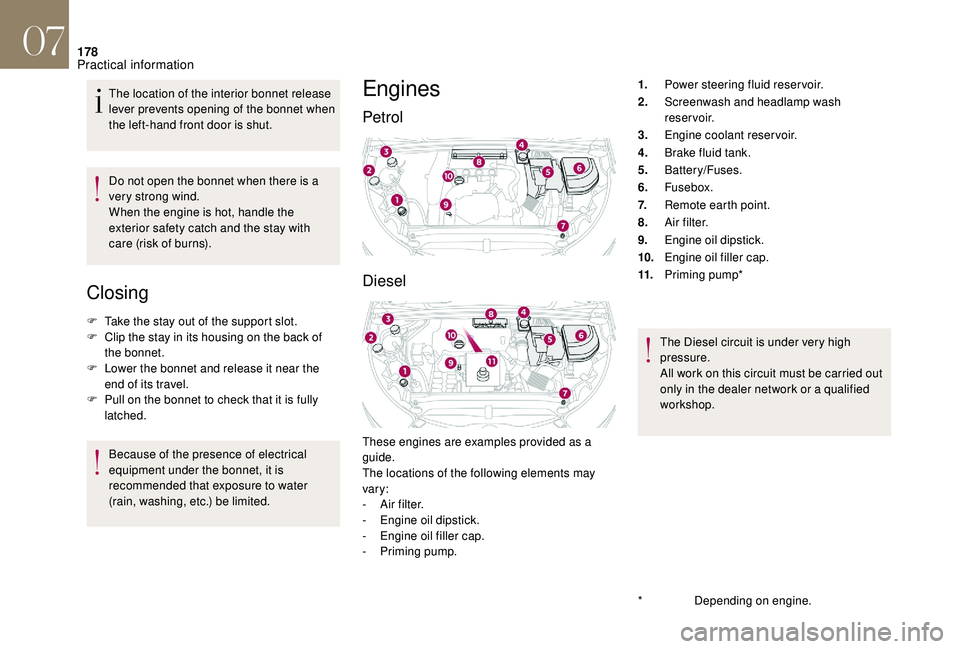
Engines
Petrol
Diesel
These engines are examples provided as a
guide.
The locations of the following elements may
vary:
-
A
ir filter.
-
E
ngine oil dipstick.
-
E
ngine oil filler cap.
-
P
riming pump. 1.
Power steering fluid reservoir.
2. Screenwash and headlamp wash
reservoir.
3. Engine coolant reservoir.
4. Brake fluid tank.
5. Battery/Fuses.
6. Fusebox.
7. Remote earth point.
8. A i r f i l t e r.
9. Engine oil dipstick.
10. Engine oil filler cap.
11. Priming pump*
The Diesel circuit is under very high
pressure.
All work on this circuit must be carried out
only in the dealer network or a qualified
workshop.
*
D
epending on engine.
07
Practical information