seat CITROEN DS4 2023 Owners Manual
[x] Cancel search | Manufacturer: CITROEN, Model Year: 2023, Model line: DS4, Model: CITROEN DS4 2023Pages: 296, PDF Size: 9.91 MB
Page 4 of 296
2
01
02
0304
05
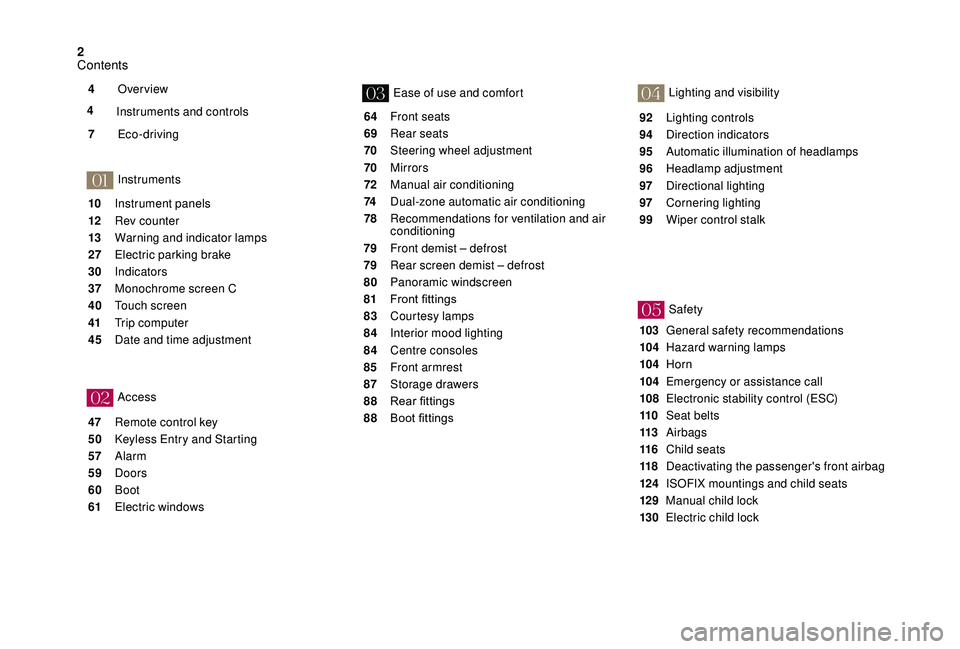
10 Instrument panels
12
R
ev counter
13
W
arning and indicator lamps
27
E
lectric parking brake
30
I
ndicators
37
M
onochrome screen C
40
T
ouch screen
41
T
rip computer
45
D
ate and time adjustment
47
R
emote control key
50
K
eyless Entry and Starting
57
Alarm
59
Doors
60
Boot
61
E
lectric windows 64
F
ront seats
69
R
ear seats
70
S
teering wheel adjustment
70
M
irrors
72
M
anual air conditioning
74 D ual-zone automatic air conditioning
78 R ecommendations for ventilation and air
conditioning
79
F
ront demist – defrost
79
R
ear screen demist – defrost
80
P
anoramic windscreen
81 Front
fittings
83
C
ourtesy lamps
84
I
nterior mood lighting
84
C
entre consoles
85
Fr
ont armrest
87
St
orage drawers
88 Rear
fi
ttings
88 Boot
fittings92
L
ighting controls
94
D
irection indicators
95
A
utomatic illumination of headlamps
96
H
eadlamp adjustment
97
D
irectional lighting
97 C ornering lighting
99
W
iper control stalk
103
G
eneral safety recommendations
104
H
azard warning lamps
104
Horn
104
E
mergency or assistance call
108
E
lectronic stability control (ESC)
110
Se
at belts
113
Airbags
116
Ch
ild seats
118
D
eactivating the passenger's front airbag
124
I
SOFIX mountings and child seats
129
M
anual child lock
130
E
lectric child lock
Over view
Instruments
Access Ease of use and comfort
Safety Lighting and visibility
Eco-driving
7 4
4 Instruments and controls
Contents
Page 9 of 296
7
Eco-driving
Eco-driving is a range of everyday practices
that allow the motorist to optimise their fuel
consumption and CO
2 emissions.
Optimise the use of your gearbox
With a manual gearbox, move off gently
and change up without waiting. During
acceleration, change up early.
With an automatic gearbox, give preference
to automatic mode and avoid pressing the
accelerator pedal heavily or suddenly.
The gear efficiency indicator invites you to
engage the most suitable gear: as soon as the
indication is displayed in the instrument panel,
follow it straight away.
For vehicles fitted with an automatic gearbox,
this indicator appears only in manual mode.
Drive smoothly
Maintain a safe distance between vehicles,
use engine braking rather than the
brake pedal, and press the accelerator
progressively. These practices contribute
towards a reduction in fuel consumption and
CO
2 emissions and also help reduce the
background traffic noise.
If your vehicle has cruise control, make use of
the system at speeds above 25 mph (40 km/h)
when the traffic is flowing well.
Control the use of your electrical
equipment
Before moving off, if the passenger
compartment is too warm, ventilate it by
opening the windows and air vents before
using the air conditioning.
Above around 30 mph (50 km/h), close the
windows and leave the air vents open.
Consider using equipment that can help
keep the temperature in the passenger
compartment down (sunroof blind and window
blinds...).
Unless it has automatic regulation, switch off
the air conditioning as soon as the desired
temperature has been reached. Switch off the headlamps and front foglamps
when the ambient light level does not require
their use.
Avoid running the engine before moving off,
particularly in winter; your vehicle will warm up
much faster while driving. Switch off the demisting and defrosting
controls, if these are not automatically
managed.
Switch off the heated seat as soon as possible.
As a passenger, if you avoid connecting your
multimedia devices (film, music, video game
etc.), you will contribute towards limiting the
consumption of electrical energy, and so of
fuel.
Disconnect your portable devices before
leaving the vehicle.
Eco-driving
Page 10 of 296
8
Limit the causes of excess
consumption
Spread loads throughout the vehicle; place
the heaviest items in the bottom of the boot,
as close as possible to the rear seats.
Limit the loads carried in the vehicle and
reduce wind resistance (roof bars, roof rack,
bicycle carrier, trailer...). Preferably, use a roof
box.
Remove roof bars and roof racks after use.
At the end of winter, remove snow tyres and
refit your summer tyres.
Observe the recommendations on
maintenance
Check the tyre pressures regularly, when cold,
referring to the label in the door aperture,
driver's side.
Carry out this check in particular:
-
b
efore a long journey,
-
a
t each change of season,
-
a
fter a long period out of use. Have your vehicle ser viced regularly (engine
oil, oil filter, air filter, cabin filter...) and
obser ve the schedule of operations in the
manufacturer's service schedule.
With a BlueHDi Diesel engine, if the SCR
system is faulty, your vehicle becomes
polluting. As soon as possible, visit a member
of the dealer network or a qualified workshop
to make your vehicle’s level of nitrogen oxides
emissions compliant to the standard.
When filling the tank, do not continue after the
3rd cut-off of the nozzle to avoid over flow.
At the wheel of your new vehicle, it is only
after around the first 1,900 miles (3,000
kilometres) that you will see the fuel
consumption settle down to a consistent
average. Do not forget the spare wheel and the tyres on
any trailer or caravan.
Eco-driving
Page 16 of 296
14
Warning/indicator lampStateCause Action/Observations
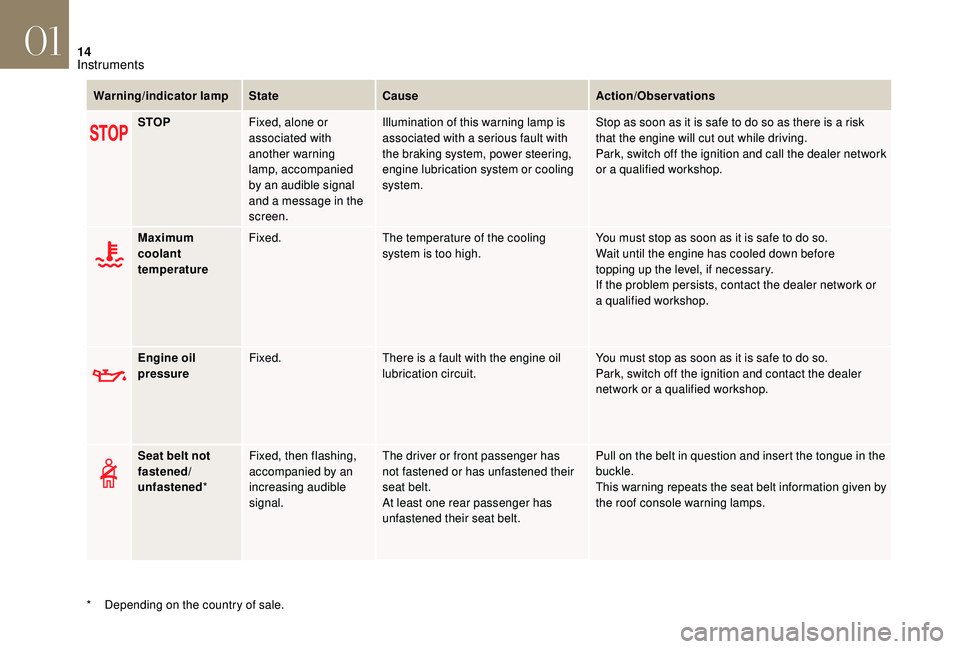
STOP Fixed, alone or
associated with
another warning
lamp, accompanied
by an audible signal
and a message in the
screen. Illumination of this warning lamp is
associated with a serious fault with
the braking system, power steering,
engine lubrication system or cooling
system.
Stop as soon as it is safe to do so as there is a risk
that the engine will cut out while driving.
Park, switch off the ignition and call the dealer network
or a qualified workshop.
Maximum
coolant
temperature Fixed.
The temperature of the cooling
system is too high. You must stop as soon as it is safe to do so.
Wait until the engine has cooled down before
topping up the level, if necessary.
If the problem persists, contact the dealer network or
a
qualified workshop.
Engine oil
pressure Fixed.
There is a fault with the engine oil
lubrication circuit. You must stop as soon as it is safe to do so.
Park, switch off the ignition and contact the dealer
network or a qualified workshop.
Seat belt not
fastened/
unfastened *Fixed, then flashing,
accompanied by an
increasing audible
signal. The driver or front passenger has
not fastened or has unfastened their
seat belt.
At least one rear passenger has
unfastened their seat belt. Pull on the belt in question and insert the tongue in the
buckle.
This warning repeats the seat belt information given by
the roof console warning lamps.
*
D
epending on the country of sale.
01
Instruments
Page 21 of 296
19
Warning/indicator lampStateCause Action/Observations
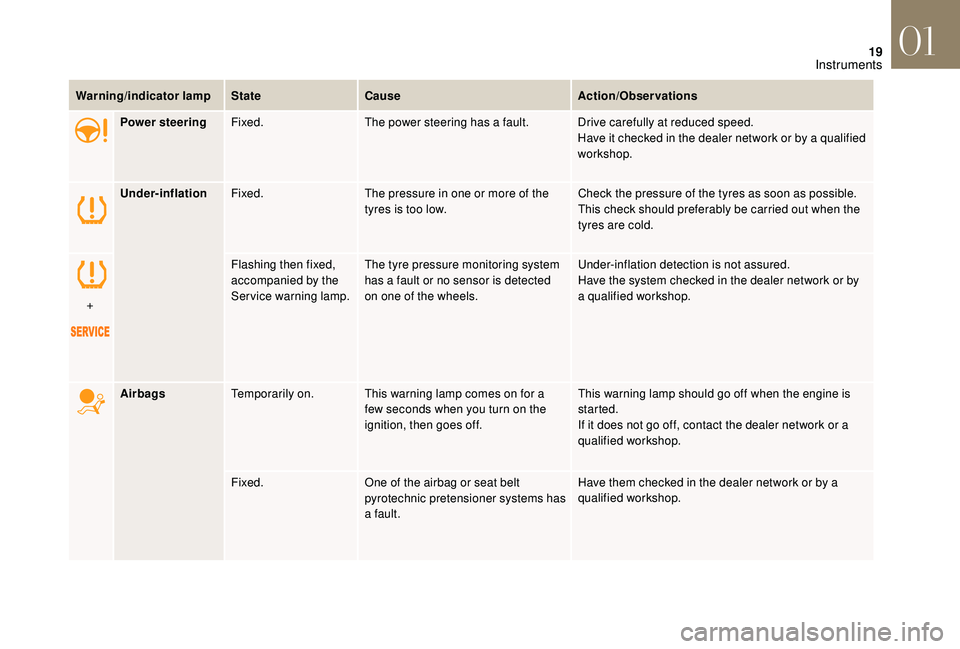
Power steering Fixed. The power steering has a fault. Drive carefully at reduced speed.
Have it checked in the dealer network or by a qualified
workshop.
Under-inflation Fixed. The pressure in one or more of the
tyres is too low. Check the pressure of the tyres as soon as possible.
This check should preferably be carried out when the
tyres are cold.
+ Flashing then fixed,
accompanied by the
Service warning lamp.
The tyre pressure monitoring system
has a fault or no sensor is detected
on one of the wheels. Under-inflation detection is not assured.
Have the system checked in the dealer network or by
a
qualified workshop.
Airbags Temporarily on. This warning lamp comes on for a
few seconds when you turn on the
ignition, then goes off. This warning lamp should go off when the engine is
started.
If it does not go off, contact the dealer network or a
qualified workshop.
Fixed. One of the airbag or seat belt
pyrotechnic pretensioner systems has
a fault. Have them checked in the dealer network or by a
qualified workshop.
01
Instruments
Page 24 of 296
22
Warning/indicator lampStateCause Action/Observations
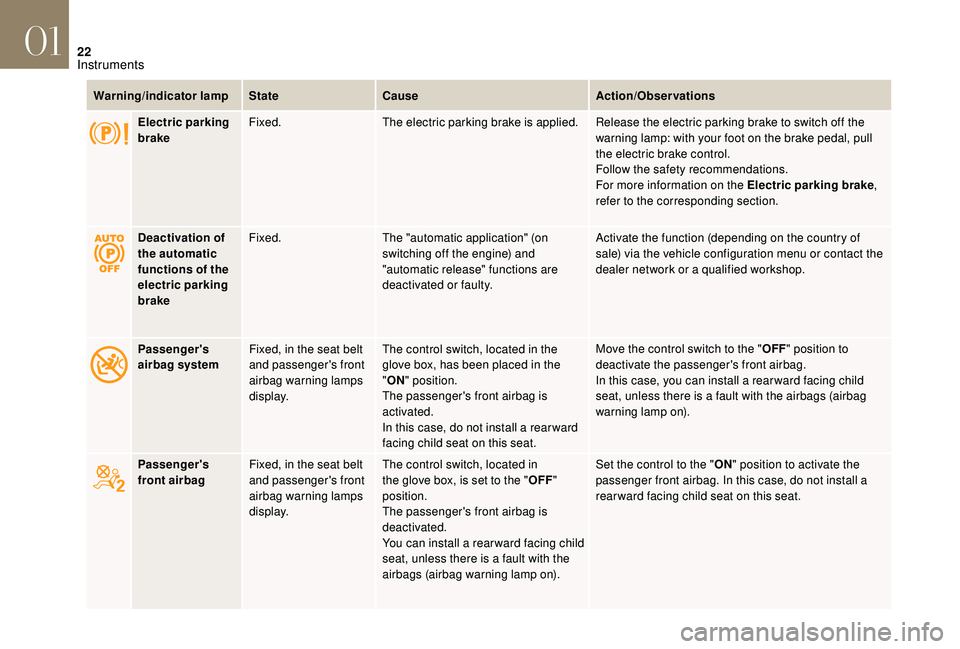
Electric parking
brake Fixed.
The electric parking brake is applied. Release the electric parking brake to switch off the
warning lamp: with your foot on the brake pedal, pull
the electric brake control.
Follow the safety recommendations.
For more information on the Electric parking brake ,
refer to the corresponding section.
Deactivation of
the automatic
functions of the
electric parking
brake Fixed.
The "automatic application" (on
switching off the engine) and
"automatic release" functions are
deactivated or faulty. Activate the function (depending on the country of
sale) via the vehicle configuration menu or contact the
dealer network or a qualified workshop.
Passenger's
airbag system Fixed, in the seat belt
and passenger's front
airbag warning lamps
display. The control switch, located in the
glove box, has been placed in the
"
ON " position.
The passenger's front airbag is
activated.
In this case, do not install a rear ward
facing child seat on this seat. Move the control switch to the "
OFF" position to
deactivate the passenger's front airbag.
In this case, you can install a rear ward facing child
seat, unless there is a fault with the airbags (airbag
warning lamp on).
Passenger's
front airbag Fixed, in the seat belt
and passenger's front
airbag warning lamps
display. The control switch, located in
the glove box, is set to the "
OFF"
position.
The passenger's front airbag is
deactivated.
You can install a rear ward facing child
seat, unless there is a fault with the
airbags (airbag warning lamp on). Set the control to the "
ON" position to activate the
passenger front airbag. In this case, do not install a
rear ward facing child seat on this seat.
01
Instruments
Page 63 of 296

61
When unlocking of the boot only is activated:
F W ith the electronic key on your person and
in the recognition zone A , press the boot
unlocking control to unlock just the boot,
then raise the tailgate.
Unlocking is signalled by rapid flashing of the
direction indicators for a few seconds.
Closing
F Lower the tailgate using one of the interior grab handles.
If the tailgate is not fully closed:
-
w
ith the engine running or the
vehicle moving (speed below
6
mph (10 km/h)), this warning lamp
comes on, accompanied by an alert
message for a few seconds.
-
w
ith the vehicle moving (speed
above 6 mph (10 km/h), in addition
to the warning lamp and alert
message, there is an audible signal
for a few seconds.
Back-up control
System allowing the mechanical unlocking
of the boot in the event of a battery or central
locking system malfunction.
Unlocking
F Fold the rear seats to gain access to the lock from inside the boot.
Locking after closing
If the fault persists after closing again, the boot
will remain locked. F
I
nsert a small screwdriver into hole A of the
lock to unlock the tailgate.
F
M
ove the latch to the left.
Electric windows
Fitted with a safety anti-pinch system.
1.
Driver.
2. Pa s se n g e r.
Manual operation
F Press or pull the control, without
passing the point of resistance.
The window stops as soon as the control is
released.
Selective unlocking
The complete or selective boot
unlocking parameter is set via the
vehicle configuration menu.
02
Access
Page 66 of 296

64
Front seats
Correct driving position
Before taking to the road and to make the most of the
ergonomic layout of the instruments and controls, carry out
these adjustments in the following order:
-
t
he height of the head restraint,
-
t
he seat backrest angle,
-
t
he seat cushion height,
-
t
he longitudinal (forwards-backwards) position of the seat,
-
t
he height of the steering wheel,
-
t
he rear view mirror and door mirrors.
Once these adjustments have been made,
check the instrument panel can be viewed
correctly from your driving position.
Manual adjustments
Forwards-backwards
F Raise the control and slide the seat forwards or backwards.
F
R
elease the control to lock the position. Before moving the seat backwards,
ensure that there is no object or person in
the way, preventing full travel of the seat.
There is a risk of trapping or pinching
passengers if present in the rear seats
or jamming the seat if large objects are
placed on the floor behind the seat.
Seat height
F Pull the control upwards to raise or push
it downwards to lower, as many times as
necessary, to obtain the position required.
As a safety measure, adjustments to the
driver's seat must only be done when
stationary.
03
Ease of use and comfort
Page 67 of 296
65
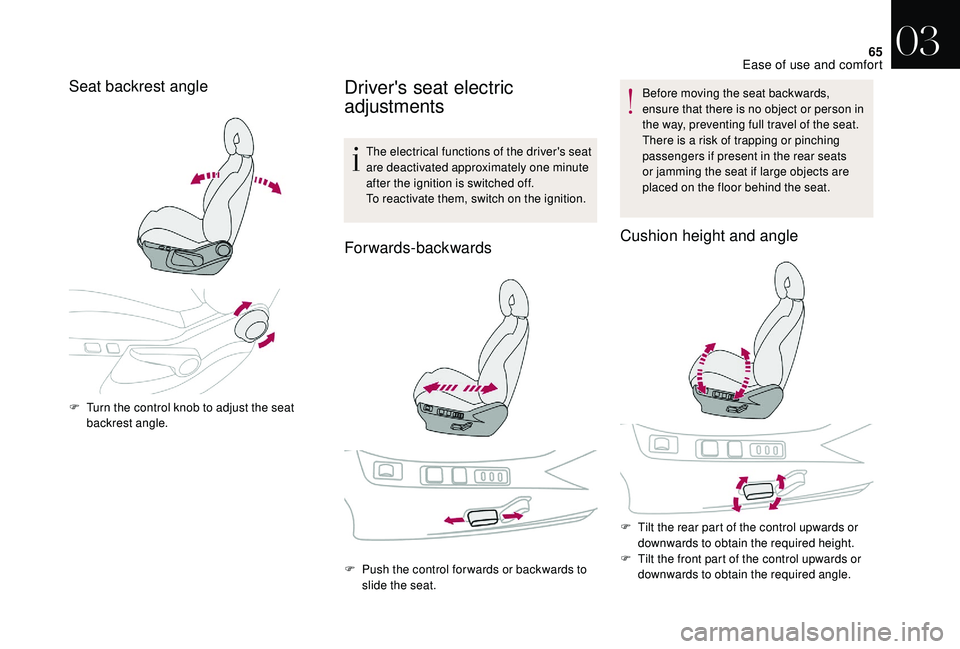
Seat backrest angle
F Turn the control knob to adjust the seat backrest angle.
Driver's seat electric
adjustments
The electrical functions of the driver's seat
are deactivated approximately one minute
after the ignition is switched off.
To reactivate them, switch on the ignition.
Forwards-backwards
F Push the control for wards or backwards to slide the seat. Before moving the seat backwards,
ensure that there is no object or person in
the way, preventing full travel of the seat.
There is a risk of trapping or pinching
passengers if present in the rear seats
or jamming the seat if large objects are
placed on the floor behind the seat.
Cushion height and angle
F Tilt the rear part of the control upwards or
downwards to obtain the required height.
F
T
ilt the front part of the control upwards or
downwards to obtain the required angle.
03
Ease of use and comfort
Page 68 of 296
66
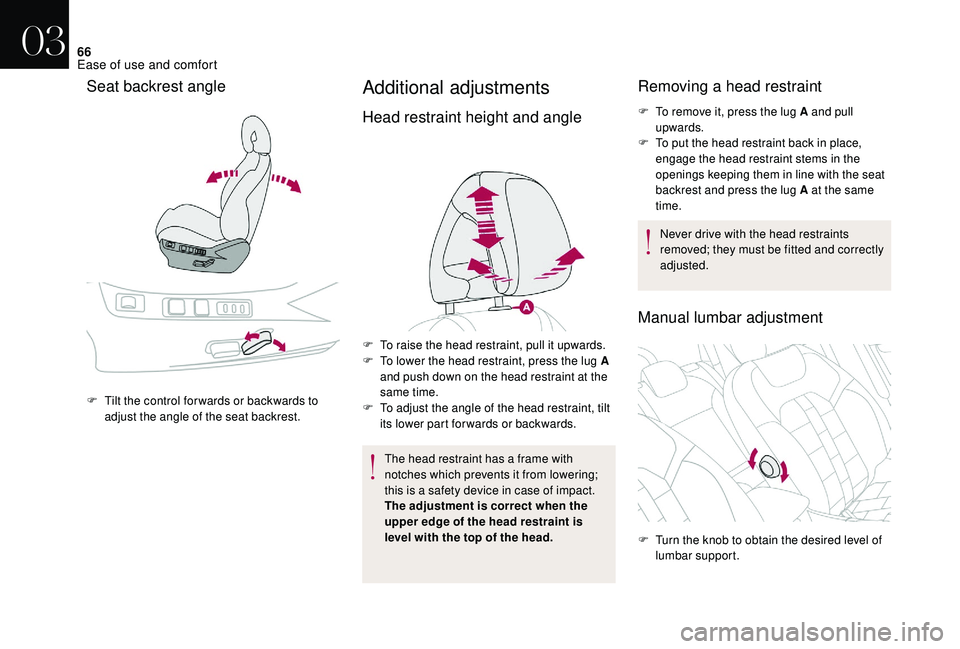
Seat backrest angle
F Tilt the control for wards or backwards to adjust the angle of the seat backrest.
Additional adjustments
Head restraint height and angle
F To raise the head restraint, pull it upwards.
F T o lower the head restraint, press the lug A
and push down on the head restraint at the
same time.
F
T
o adjust the angle of the head restraint, tilt
its lower part forwards or backwards.
The head restraint has a frame with
notches which prevents it from lowering;
this is a safety device in case of impact.
The adjustment is correct when the
upper edge of the head restraint is
level with the top of the head.
Removing a head restraint
F To remove it, press the lug A and pull upwards.
F
T
o put the head restraint back in place,
engage the head restraint stems in the
openings keeping them in line with the seat
backrest and press the lug A at the same
time.
Never drive with the head restraints
removed; they must be fitted and correctly
adjusted.
Manual lumbar adjustment
F Turn the knob to obtain the desired level of lumbar support.
03
Ease of use and comfort