engine Citroen DS4 RHD 2013.5 1.G Owner's Guide
[x] Cancel search | Manufacturer: CITROEN, Model Year: 2013.5, Model line: DS4 RHD, Model: Citroen DS4 RHD 2013.5 1.GPages: 400, PDF Size: 31.86 MB
Page 53 of 400
51Monitoring
Warning lamp
is on
Cause
Action/Observations
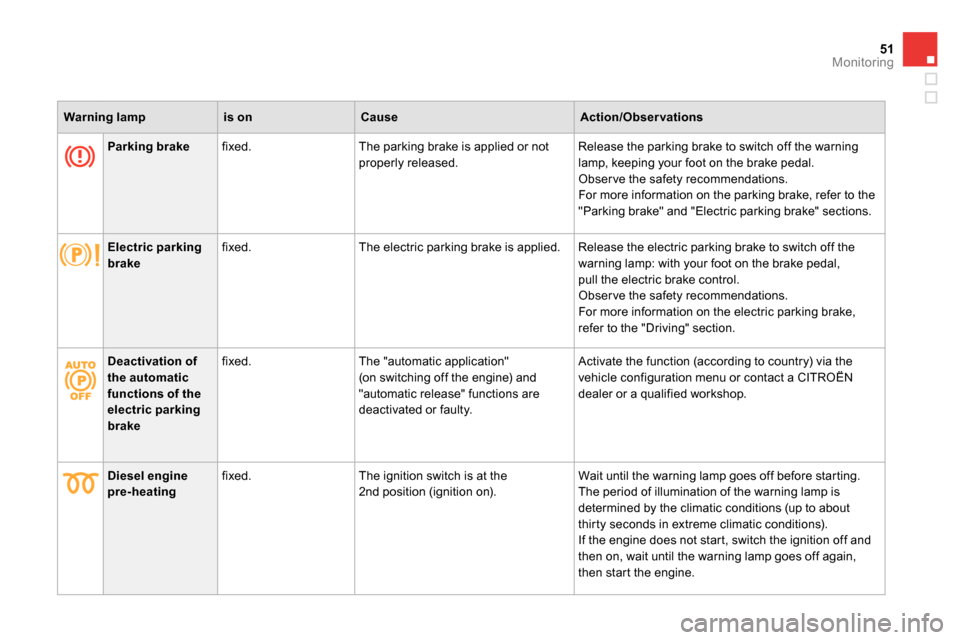
Parking brake
fixed. The parking brake is applied or not
properly released. Release the parking brake to switch off the warning
lamp, keeping your foot on the brake pedal.
Obser ve the safety recommendations.
For more information on the parking brake, refer to the
"Parking brake" and "Electric parking brake" sections.
Electric parking
brake
fixed. The electric parking brake is applied. Release the electric parking brake to switch off the
warning lamp: with your foot on the brake pedal,
pull the electric brake control.
Obser ve the safety recommendations.
For more information on the electric parking brake,
refer to the "Driving" section.
Deactivation of
the automatic
functions of the
electric parking
brake
fixed. The "automatic application"
(on switching off the engine) and
"automatic release" functions are
deactivated or faulty. Activate the function (according to country) via the
vehicle configuration menu or contact a CITROËN
dealer or a qualified workshop.
Diesel engine
pre-heating
fixed. The ignition switch is at the
2nd position (ignition on). Wait until the warning lamp goes off before starting.
The period of illumination of the warning lamp is
determined by the climatic conditions (up to about
thirty seconds in extreme climatic conditions).
If the engine does not start, switch the ignition off and
then on, wait until the warning lamp goes off again,
then start the engine.
Page 54 of 400
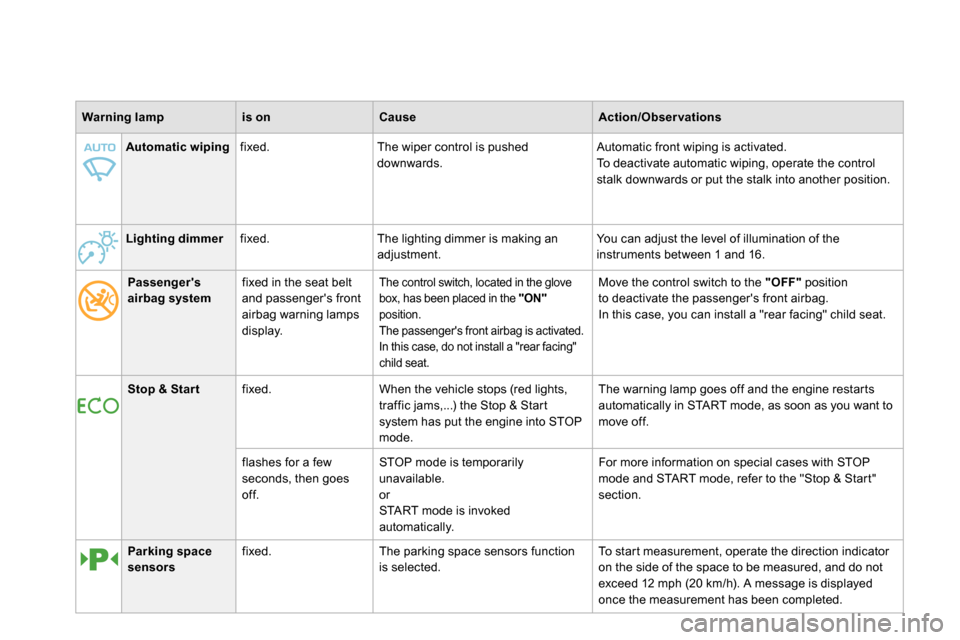
Lighting dimmer
fixed. The lighting dimmer is making an
adjustment. You can adjust the level of illumination of the
instruments between 1 and 16.
Passenger's
airbag system
fixed in the seat belt
and passenger's front
airbag warning lamps
display.
The control switch, located in the glove
box, has been placed in the "ON"
position.
The passenger's front airbag is activated.
In this case, do not install a "rear facing"
child seat. Move the control switch to the "OFF"
position
to deactivate the passenger's front airbag.
In this case, you can install a "rear facing" child seat.
Automatic wiping
fixed. The wiper control is pushed
downwards. Automatic front wiping is activated.
To deactivate automatic wiping, operate the control
stalk downwards or put the stalk into another position.
Warning lamp
is on
Cause
Action/Observations
Stop & Start
fixed. When the vehicle stops (red lights,
traffic jams,...) the Stop & Start
system has put the engine into STOP
mode. The warning lamp goes off and the engine restarts
automatically in START mode, as soon as you want to
move off.
flashes for a few
seconds, then goes
off. STOP mode is temporarily
unavailable.
or
START mode is invoked
automatically. For more information on special cases with STOP
mode and START mode, refer to the "Stop & Start"
section.
Parking space
sensors
fixed. The parking space sensors function
is selected. To start measurement, operate the direction indicator
on the side of the space to be measured, and do not
exceed 12 mph (20 km/h). A message is displayed
once the measurement has been completed.
Page 56 of 400
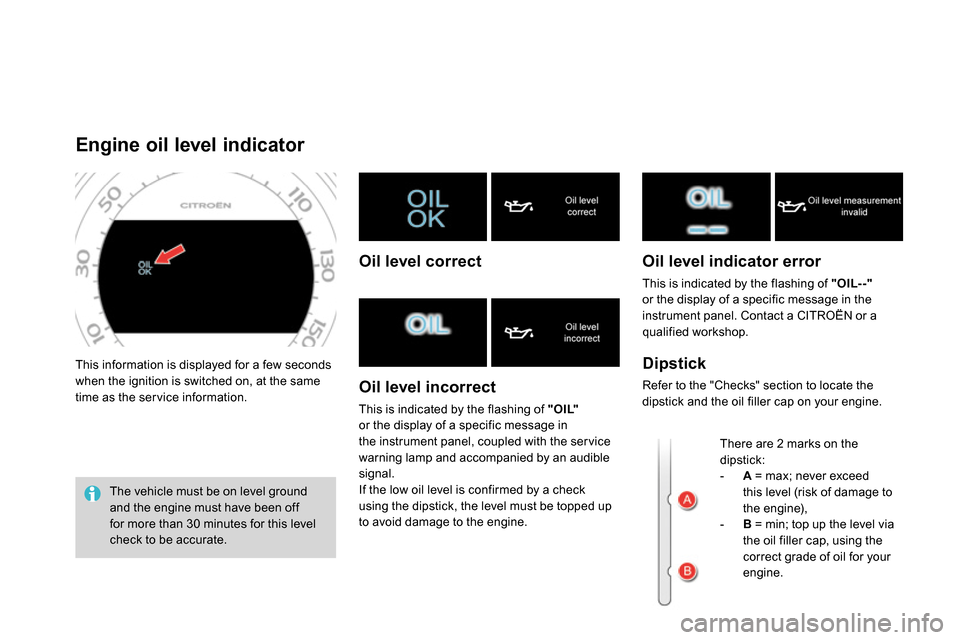
This information is displayed for a few seconds
when the ignition is switched on, at the same
time as the ser vice information.
Engine oil level indicator
The vehicle must be on level ground
and the engine must have been off
for more than 30 minutes for this level
check to be accurate.
Oil level correct
Oil level incorrect
This is indicated by the flashing of "OIL"
or the display of a specific message in
the instrument panel, coupled with the service
warning lamp and accompanied by an audible
signal.
If the low oil level is confirmed by a check
using the dipstick, the level must be topped up
to avoid damage to the engine.
Oil level indicator error
This is indicated by the flashing of "OIL--"
or the display of a specific message in the
instrument panel. Contact a CITROËN or a
qualified workshop.
There are 2 marks on the
dipstick:
- A
= max; never exceed
this level (risk of damage to
the engine),
- B
= min; top up the level via
the oil filler cap, using the
correct grade of oil for your
engine.
Dipstick
Refer to the "Checks" section to locate the
dipstick and the oil filler cap on your engine.
Page 59 of 400
57Monitoring
Manual test in the type 2 instrument panel central screen
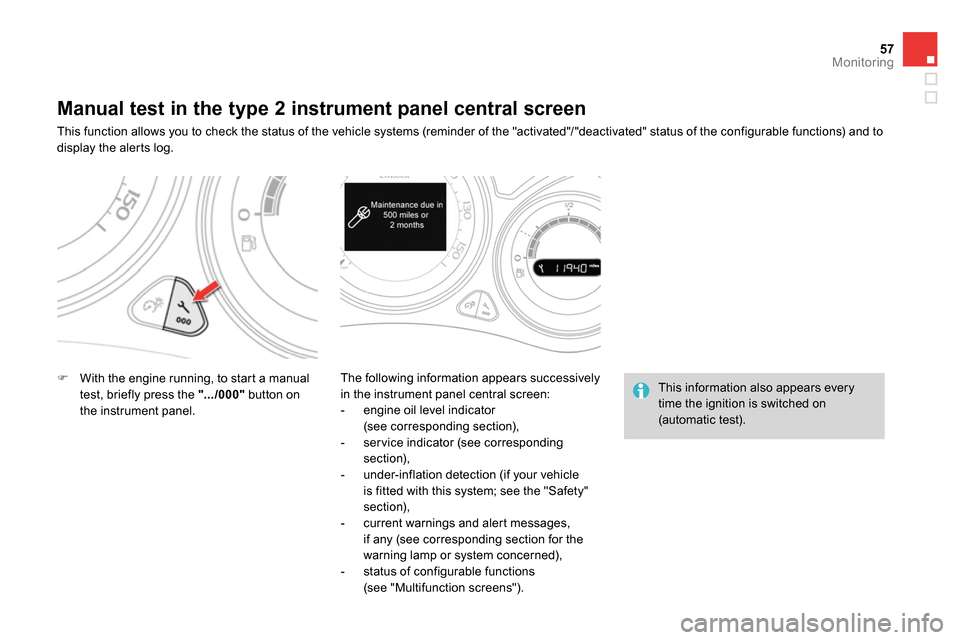
This function allows you to check the status of the vehicle systems (reminder of the "activated"/"deactivated" status of the configurable functions) and to
display the alerts log.
With the engine running, to start a manual
test, briefly press the ".../000"
button on
the instrument panel. The following information appears successively
in the instrument panel central screen:
- engine oil level indicator
(see corresponding section),
- ser vice indicator (see corresponding
section),
- under-inflation detection (if your vehicle
is fitted with this system; see the "Safety"
section),
- current warnings and alert messages,
if any (see corresponding section for the
warning lamp or system concerned),
- status of configurable functions
(see "Multifunction screens"). This information also appears every
time the ignition is switched on
(automatic test).
Page 81 of 400
79Comfort
Recommendations for ventilation and air conditioning
If after an extended stop in sunshine,
the interior temperature is very
high, first ventilate the passenger
compartment for a few moments.
Put the air flow control at a setting high
enough to quickly change the air in the
passenger compartment.
The air conditioning system does not
contain chlorine and does not present
any danger to the ozone layer. In order for these systems to be fully effective, follow the operation and maintenance
guidelines below:
To obtain an even air distribution, take care not to obstruct the exterior air intake grilles
located at the base of the windscreen, the nozzles, the vents and the air outlets, as well
as the air extractor located in the boot.
Do not cover the sunshine sensor, located on the dashboard; this is used for regulation
of the air conditioning system.
Operate the air conditioning system for at least 5 to 10 minutes, once or twice a month
to keep it in per fect working order.
Ensure that the passenger compartment filter is in good condition and have the filter
elements replaced regularly.
We recommend the use of a combined passenger compartment filter. Thanks to its
special active additive, it contributes to the purification of the air breathed by the
occupants and the cleanliness of the passenger compartment (reduction of allergic
symptoms, bad odours and greasy deposits).
To ensure correct operation of the air conditioning system, you are also advised to have
it checked regularly as recommended in the maintenance and warranty guide.
If the system does not produce cold air, switch it off and contact a CITROËN dealer or
a qualified workshop.
When towing the maximum load on a steep gradient in high temperatures, switching off the
air conditioning increases the available engine power and so improves the towing ability.
The condensation created by the air
conditioning results in a discharge
of water under the vehicle which is
per fectly normal.
Stop & Start
The heating and air conditioning systems only work when the engine is running. To maintain
a comfortable temperature in the passenger compartment, you can temporarily deactivate
the Stop & Start system (see the corresponding section).
Page 82 of 400
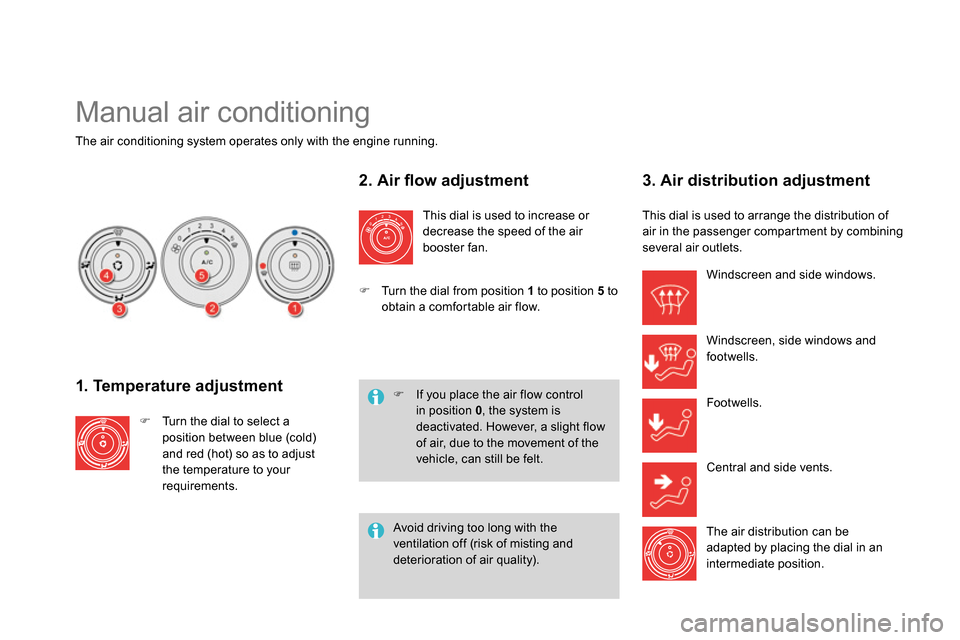
Manual air conditioning
The air conditioning system operates only with the engine running.
1. Temperature adjustment
Turn the dial to select a
position between blue (cold)
and red (hot) so as to adjust
the temperature to your
requirements.
2. Air fl ow adjustment
This dial is used to increase or
decrease the speed of the air
booster fan.
3. Air distribution adjustment
This dial is used to arrange the distribution of
air in the passenger compartment by combining
several air outlets.
If you place the air flow control
in position 0
, the system is
deactivated. However, a slight flow
of air, due to the movement of the
vehicle, can still be felt.
Turn the dial from position 1
to position 5
to
obtain a comfortable air flow. Windscreen and side windows.
Windscreen, side windows and
footwells.
Footwells.
Central and side vents.
The air distribution can be
adapted by placing the dial in an
intermediate position.
Avoid driving too long with the
ventilation off (risk of misting and
deterioration of air quality).
Page 84 of 400
Dual-zone digital air conditioning
The air conditioning system operates when the engine is running.
Automatic operation
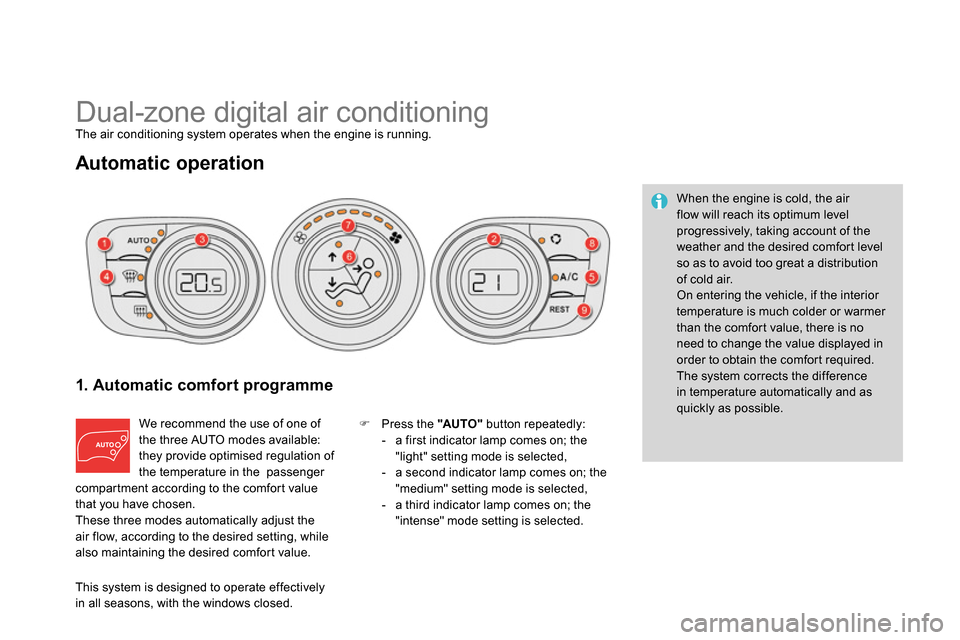
1. Automatic comfort programme
We recommend the use of one of
the three AUTO modes available:
they provide optimised regulation of
the temperature in the passenger
compartment according to the comfort value
that you have chosen.
These three modes automatically adjust the
air flow, according to the desired setting, while
also maintaining the desired comfort value.
Press the "AUTO "
button repeatedly:
- a first indicator lamp comes on; the
"light" setting mode is selected,
- a second indicator lamp comes on; the
"medium" setting mode is selected,
- a third indicator lamp comes on; the
"intense" mode setting is selected.
When the engine is cold, the air
flow will reach its optimum level
progressively, taking account of the
weather and the desired comfort level
so as to avoid too great a distribution
of cold air.
On entering the vehicle, if the interior
temperature is much colder or warmer
than the comfort value, there is no
need to change the value displayed in
order to obtain the comfort required.
The system corrects the difference
in temperature automatically and as
quickly as possible.
This system is designed to operate effectively
in all seasons, with the windows closed.
Page 86 of 400
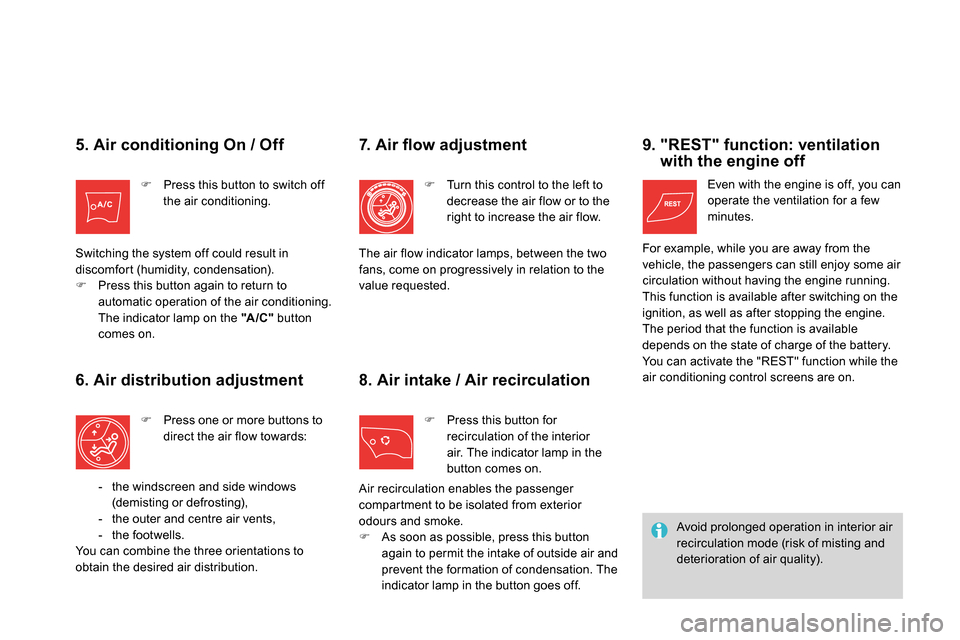
5. Air conditioning On / Off
Press this button to switch off
the air conditioning.
Switching the system off could result in
discomfort (humidity, condensation).
Press this button again to return to
automatic operation of the air conditioning.
The indicator lamp on the "A /C "
button
comes on.
6. Air distribution adjustment
Press one or more buttons to
direct the air flow towards:
- the windscreen and side windows
(demisting or defrosting),
- the outer and centre air vents,
- the footwells.
You can combine the three orientations to
obtain the desired air distribution.
7. Air fl ow adjustment
Turn this control to the left to
decrease the air flow or to the
right to increase the air flow.
8. Air intake / Air recirculation
Press this button for
recirculation of the interior
air. The indicator lamp in the
button comes on. The air flow indicator lamps, between the two
fans, come on progressively in relation to the
value requested.
9. "REST" function: ventilation
with the engine off
Even with the engine is off, you can
operate the ventilation for a few
minutes.
Air recirculation enables the passenger
compartment to be isolated from exterior
odours and smoke.
As soon as possible, press this button
again to permit the intake of outside air and
prevent the formation of condensation. The
indicator lamp in the button goes off.
For example, while you are away from the
vehicle, the passengers can still enjoy some air
circulation without having the engine running.
This function is available after switching on the
ignition, as well as after stopping the engine.
The period that the function is available
depends on the state of charge of the battery.
You can activate the "REST" function while the
air conditioning control screens are on.
Avoid prolonged operation in interior air
recirculation mode (risk of misting and
deterioration of air quality).
Page 87 of 400
85Comfort
Switching the system off
Turn the air flow control to the
left until all of the indicator
lamps go off.
This switch does not operate the air conditioning, only the air fan.
When the "REST" function is activated, you cannot modify the temperature, air flow
and distribution settings: these are controlled automatically according to the ambient
temperature.
This function is not available in the STOP mode of Stop & Start.
Avoid prolonged operation in interior
air recirculation mode or driving for
long periods with the system off (risk of
misting and deterioration of air quality).
On switching on the engine
- The control screens come on: the function
is available.
- Pressing the REST
button activates the
ventilation for a few minutes. Activation of
the function is confirmed by the display of
two dashes in the control screens and four
air flow level indicator lamps.
- The function can be deactivated and
reactivated if the control screens are on.
- The screens go off at the end of this
period.
On stopping the engine
- While the control screens remain on: the
function is available.
- Pressing the REST
button activates the
ventilation for a few minutes. Activation of
the function is confirmed by the display of
two dashes in the control screens and four
air flow level indicator lamps.
Locking the vehicle has no effect on this
function.
- The control screens go off at the end of this
period.
Pressing again before the end of the period
interrupts off the ventilation definitively: the
control screens go off and the function is
no longer available. This action switches off the air conditioning and
the ventilation.
Temperature related comfort is no longer
assured but a slight flow of air, due to the
movement of the vehicle, can still be felt.
Modify the settings (temperature, air flow
or air distribution) or press the "AUTO "
button to reactivate the system with the
values set before it was switched off.
Page 89 of 400
87Comfort
Rear screen demist - defrost
The control button is located on the air conditioning system control panel.
Switching on
The rear screen demisting/defrosting can only
operate when the engine is running.
Press this button to demist /defrost the
rear screen and (depending on version)
the door mirrors. The indicator lamp
associated with the button comes on.
Switching off
The demisting/defrosting switches off
automatically to prevent an excessive
consumption of current.
It is possible to stop the demisting/
defrosting operation before it is switched
off automatically by pressing the button
again. The indicator lamp associated with
the button goes off.
Switch off the demisting/defrosting
of the rear screen and door mirrors
as soon as appropriate, as lower
current consumption results in
reduced fuel consumption.