air condition Citroen DS4 RHD 2014.5 1.G Owner's Manual
[x] Cancel search | Manufacturer: CITROEN, Model Year: 2014.5, Model line: DS4 RHD, Model: Citroen DS4 RHD 2014.5 1.GPages: 444, PDF Size: 12.99 MB
Page 5 of 444
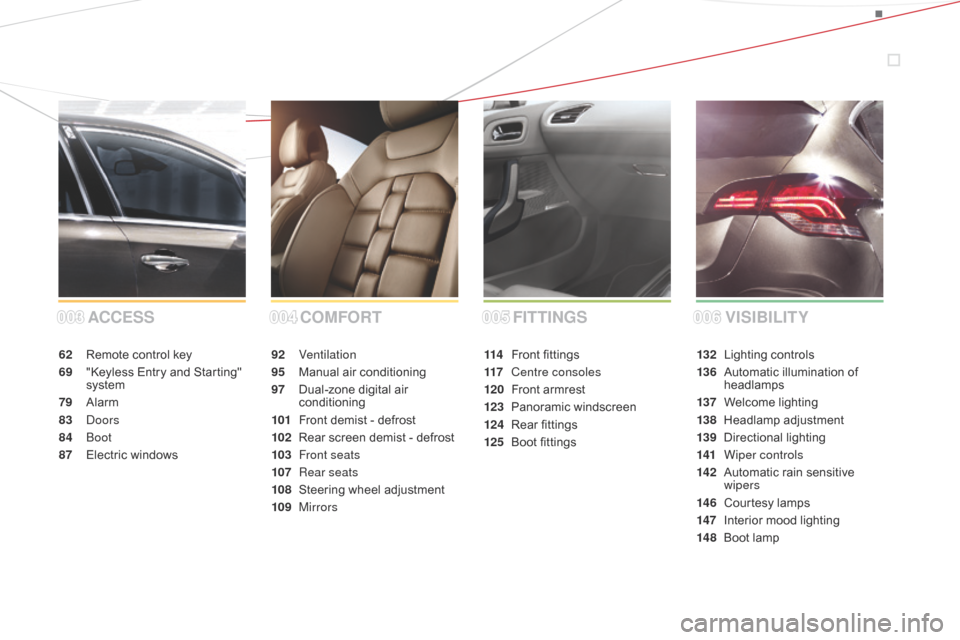
COMFORT
ACCESS
62 Remote control key
69
"
Keyless Entry and Starting"
system
79
A
larm
83
Doors
84
Boot
87
E
lectric windows 92 V
entilation
95
M
anual air conditioning
97
D
ual-zone digital air
conditioning
101
F
ront demist - defrost
102
R
ear screen demist - defrost
103
F
ront seats
107
R
ear seats
108
S
teering wheel adjustment
109
Mirrors114 F
ront fittings
117
C
entre consoles
120
F
ront armrest
123
P
anoramic windscreen
124
R
ear fittings
125
B
oot fittings
004005003FITTINGS
132 Lighting controls
136
A
utomatic illumination of
headlamps
137
W
elcome lighting
138
H
eadlamp adjustment
139
D
irectional lighting
141
W
iper controls
142
A
utomatic rain sensitive
wipers
14 6
C
ourtesy lamps
147
I
nterior mood lighting
14 8
B
oot lamp
006VISIBILITY
Page 12 of 444
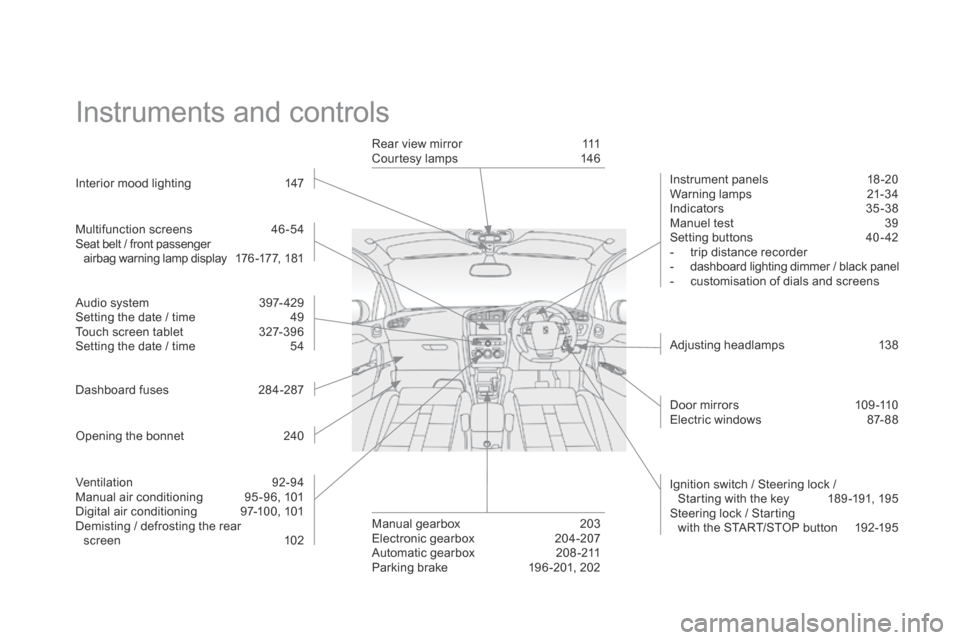
Instruments and controls
Instrument panels 18 -20
Warning lamps 2 1-34
Indicators
35
-38
Manuel test
3
9
Setting buttons
4
0 - 42
-
t
rip distance recorder
-
d
ashboard lighting dimmer / black panel
-
c
ustomisation of dials and screens
Adjusting headlamps
1
38
Door mirrors
1
09 -110
Electric windows
87
- 88
Dashboard fuses
2
84-287
Opening the bonnet
2
40
Multifunction screens
4
6 -54
Seat belt / front passenger
airbag warning lamp display
1
76 -177, 181
Manual gearbox
2
03
Electronic gearbox
20
4-207
Automatic gearbox
2
08 -211
Parking brake
1
96 -201, 202
Rear view mirror
1
11
Courtesy lamps
1
46
Ventilation
9
2-94
Manual air conditioning
9
5 -96, 101
Digital air conditioning
9
7-100, 101
Demisting / defrosting the rear screen
1
02
Audio system
3
97- 429
Setting the date / time
4
9
Touch screen tablet
3
27-396
Setting the date / time
5
4
Interior mood lighting
1
47
Ignition switch / Steering lock /
Starting with the key
1
89 -191, 195
Steering lock / Starting with the START/STOP button
1
92-195
Page 16 of 444
As a passenger, if you avoid connecting your multimedia devices
(film, music, video game...), you will contribute towards limiting the
consumption of electrical energy, and so of fuel.
Disconnect your portable devices before leaving the vehicle.
Eco-driving
Eco-driving is a range of everyday practices that allow the motorist to optimise their fuel consumption and CO2 emissions.
Optimise the use of your gearbox
With a manual gearbox, move off gently and change up without waiting.
During acceleration change up early.
With an automatic or electronic gearbox, give preference to automatic
mode and avoid pressing the accelerator pedal heavily or suddenly.
The gear efficiency indicator invites you engage the most suitable gear:
as soon as the indication is displayed in the instrument panel, follow it
straight away.
For vehicles fitted with an electronic or automatic gearbox, this
indicator appears only in manual mode.
Drive smoothly
Maintain a safe distance between vehicles, use engine braking rather
than the brake pedal, and press the accelerator progressively. These
practices contribute towards a reduction in fuel consumption and
CO
2 emissions and also helps reduce the background traffic noise.
If your vehicle has cruise control, make use of the system at speeds
above 25 mph (40 km/h) when the traffic is flowing well.
Control the use of your electrical
equipment
Before moving off, if the passenger compartment is too warm,
ventilate it by opening the windows and air vents before using the air
conditioning.
Above 30 mph (50 km/h), close the windows and leave the air vents open.
Remember to make use of equipment that can help keep the
temperature in the passenger compartment down (sunroof and window
blinds...).
Switch off the air conditioning, unless it has automatic regulation, as
soon as the desired temperature is attained.
Switch off the demisting and defrosting controls, if not automatic.
Switch off the heated seat as soon as possible.
Switch off the headlamps and front foglamps when the level of light
does not require their use.
Avoid running the engine before moving off, particularly in winter; your
vehicle will warm up much faster while driving.
Page 94 of 444
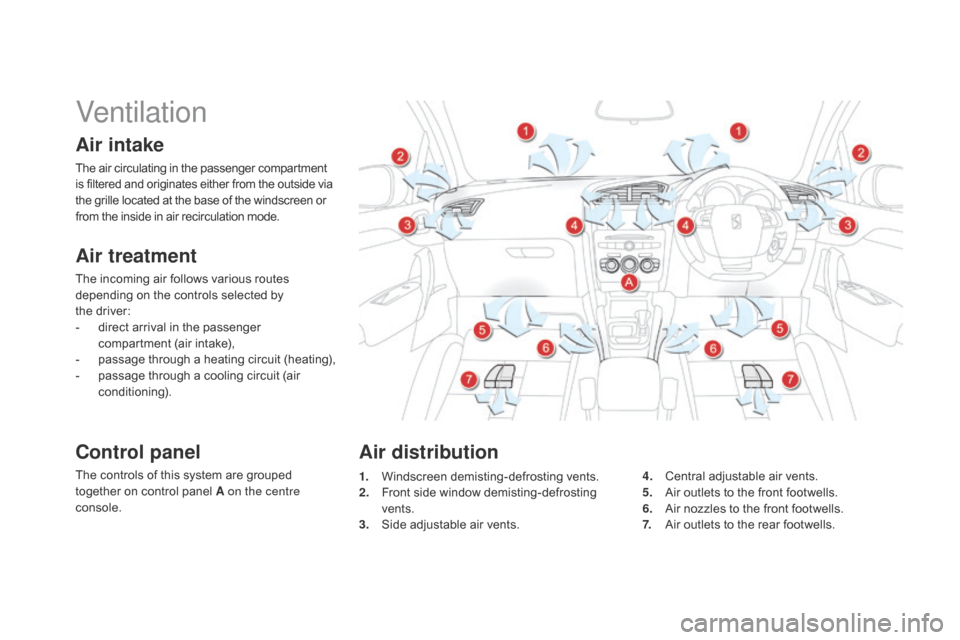
Ventilation
Air intake
The air circulating in the passenger compartment
is filtered and originates either from the outside via
the grille located at the base of the windscreen or
from the inside in air recirculation mode.
Air treatment
The incoming air follows various routes
depending on the controls selected by
the
d
river:
-
d
irect arrival in the passenger
compartment (air intake),
-
p
assage through a heating circuit (heating),
-
p
assage through a cooling circuit (air
conditioning).
Control panel
The controls of this system are grouped
together on control panel A on the centre
console.
Air distribution
1. Windscreen demisting-defrosting vents.
2. F ront side window demisting-defrosting
vents.
3.
S
ide adjustable air vents. 4. C
entral adjustable air vents.
5. A ir outlets to the front footwells.
6.
A
ir nozzles to the front footwells.
7.
A
ir outlets to the rear footwells.
Page 95 of 444
93
Recommendations for ventilation and air conditioning
If after an extended stop in sunshine,
the interior temperature is very
high, first ventilate the passenger
compartment for a few moments.
Put the air flow control at a setting high
enough to quickly change the air in the
passenger compartment.
The air conditioning system does not
contain chlorine and does not present
any danger to the ozone layer.
In order for these systems to be fully effective, follow the operation and maintenance
guidelines below:
F
T
o obtain an even air distribution, take care not to obstruct the exterior air intake grilles
located at the base of the windscreen, the nozzles, the vents and the air outlets, as well
as the air extractor located in the boot.
F
D
o not cover the sunshine sensor, located on the dashboard; this is used for regulation
of the air conditioning system.
F
O
perate the air conditioning system for at least 5 to 10 minutes, once or twice a month
to keep it in per fect working order.
F
E
nsure that the passenger compartment filter is in good condition and have the filter
elements replaced regularly.
W
e recommend the use of a combined passenger compartment filter. Thanks to its
special active additive, it contributes to the purification of the air breathed by the
occupants and the cleanliness of the passenger compartment (reduction of allergic
symptoms, bad odours and greasy deposits).
F
T
o ensure correct operation of the air conditioning system, you are also advised to have
it checked regularly as recommended in the maintenance and warranty guide.
F
I
f the system does not produce cold air, switch it off and contact a CITROËN dealer or
a qualified workshop.
When towing the maximum load on a steep gradient in high temperatures, switching off the
air conditioning increases the available engine power and so improves the towing ability. The condensation created by the air
conditioning results in a discharge
of water under the vehicle which is
per fectly normal.
Stop & Start
The heating and air conditioning systems only work when the engine is running. To maintain
a comfortable temperature in the passenger compartment, you can temporarily deactivate
the Stop & Start system (see the corresponding section).
Comfort
Page 96 of 444

Recommended interior settings
I require...Heating or Manual air conditioning
Air distribution Air flowRecirculation of
interior air / Intake of exterior air Temperature
Manual AC
HOT
COLD
DEMISTING
DEFROSTING
Digital air conditioning: use the automatic mode in preference by pressing the "AUTO" button.
Page 97 of 444
95
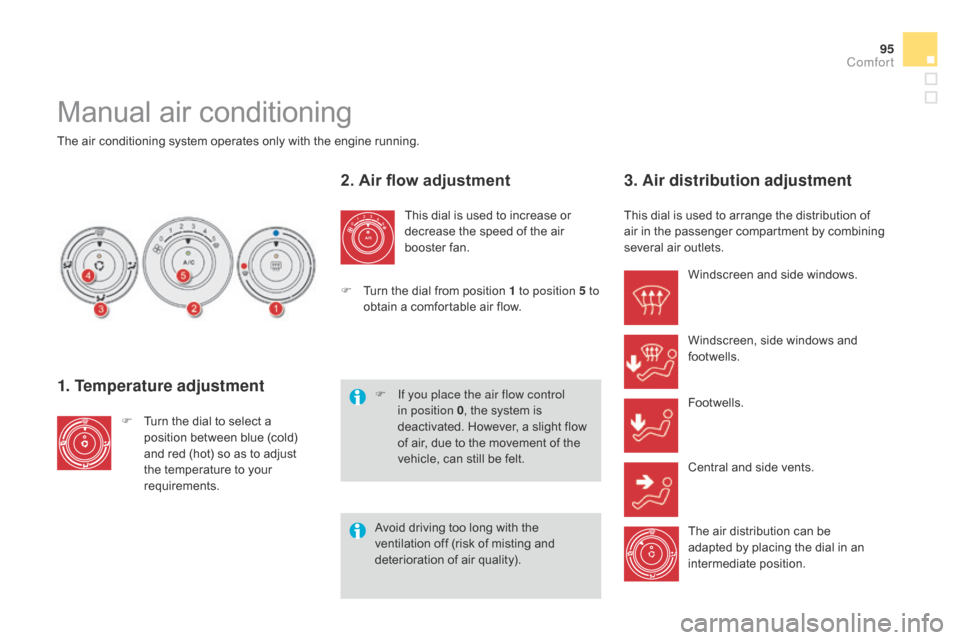
Manual air conditioning
The air conditioning system operates only with the engine running.
1. Temperature adjustment
F Turn the dial to select a position between blue (cold)
and red (hot) so as to adjust
the temperature to your
requirements.
2. Air flow adjustment
This dial is used to increase or
decrease the speed of the air
booster fan.
3. Air distribution adjustment
This dial is used to arrange the distribution of
air in the passenger compartment by combining
several air outlets.
F
I
f you place the air flow control
in position 0 , the system is
deactivated. However, a slight flow
of air, due to the movement of the
vehicle, can still be felt.
F
T
urn the dial from position 1 to position 5 to
obtain a comfortable air flow. Windscreen and side windows.
Windscreen, side windows and
footwells.
Footwells.
Central and side vents.
The air distribution can be
adapted by placing the dial in an
intermediate position.
Avoid driving too long with the
ventilation off (risk of misting and
deterioration of air quality).
Comfort
Page 98 of 444
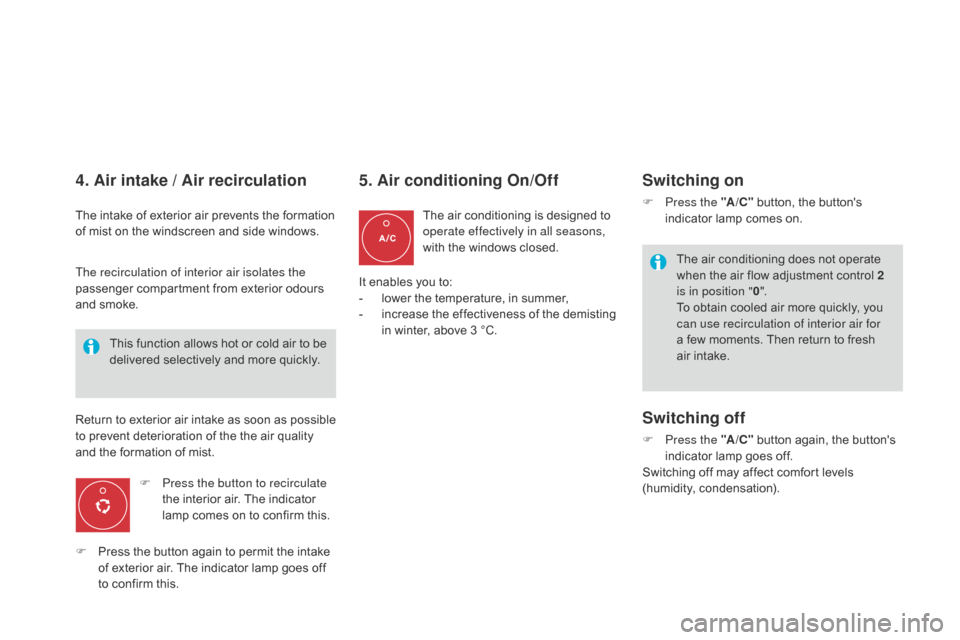
4. Air intake / Air recirculation
The intake of exterior air prevents the formation
of mist on the windscreen and side windows.F
P
ress the button to recirculate
the interior air. The indicator
lamp comes on to confirm this.
This function allows hot or cold air to be
delivered selectively and more quickly.
5. Air conditioning On/Off
The air conditioning is designed to
operate effectively in all seasons,
with the windows closed.
Switching on
F Press the "A /C "
button, the button's
indicator lamp comes on.
The air conditioning does not operate
when the air flow adjustment control 2
is in position " 0".
To obtain cooled air more quickly, you
can use recirculation of interior air for
a few moments. Then return to fresh
air intake.
The recirculation of interior air isolates the
passenger compartment from exterior odours
and smoke.
Return to exterior air intake as soon as possible
to prevent deterioration of the the air quality
and the formation of mist.
F
P
ress the button again to permit the intake
of exterior air. The indicator lamp goes off
to confirm this. It enables you to:
-
l
ower the temperature, in summer,
-
i
ncrease the effectiveness of the demisting
in winter, above 3 °C.
Switching off
F Press the "A /C " button again, the button's
indicator lamp goes off.
Switching off may affect comfort levels
(humidity, condensation).
Page 99 of 444

97
Dual-zone digital air conditioningThe air conditioning system operates when the engine is running.
Automatic operation
1. Automatic comfort programme
We recommend the use of one of
the three AUTO modes available:
they provide optimised regulation of
the temperature in the passenger
compartment according to the comfort value
that you have chosen.
These three modes automatically adjust the
air flow, according to the desired setting, while
also maintaining the desired comfort value. F
P ress the "AUTO" button repeatedly:
-
a f
irst indicator lamp comes on;
the
"light" setting mode is selected,
-
a s
econd indicator lamp comes on;
the
"medium" setting mode is selected,
-
a t
hird indicator lamp comes on;
the
"intense" mode setting is selected.When the engine is cold, the air
flow will reach its optimum level
progressively, taking account of the
weather and the desired comfort level
so as to avoid too great a distribution
of cold air.
On entering the vehicle, if the interior
temperature is much colder or warmer
than the comfort value, there is no
need to change the value displayed in
order to obtain the comfort required.
The system corrects the difference
in temperature automatically and as
quickly as possible.
This system is designed to operate effectively
in all seasons, with the windows closed.
Comfort
Page 101 of 444
99
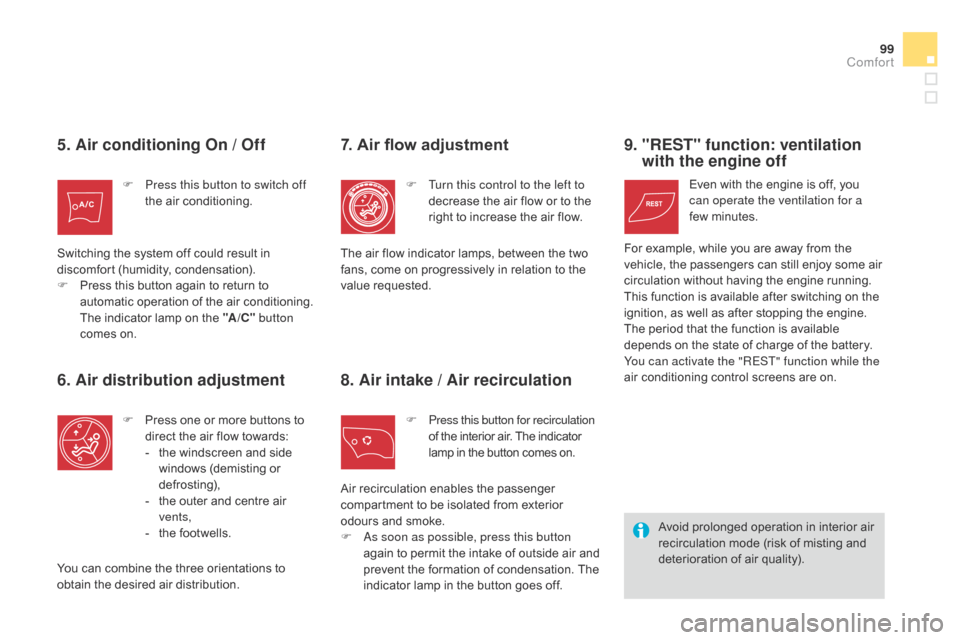
5. Air conditioning On / Off
F Press this button to switch off the air conditioning.
Switching the system off could result in
discomfort (humidity, condensation).
F
P
ress this button again to return to
automatic operation of the air conditioning.
The indicator lamp on the "A /C " button
comes on.
6. Air distribution adjustment
F Press one or more buttons to direct the air flow towards:
-
t
he windscreen and side
windows (demisting or
def r o st ing),
-
t
he outer and centre air
vents,
-
t
he footwells.
You can combine the three orientations to
obtain the desired air distribution.
7. Air flow adjustment
F Turn this control to the left to decrease the air flow or to the
right to increase the air flow.
8. Air intake / Air recirculation
F Press this button for recirculation of the interior air. The indicator
lamp in the button comes on.
The air flow indicator lamps, between the two
fans, come on progressively in relation to the
value requested.
9. "REST" function: ventilation
with the engine off
Even with the engine is off, you
can operate the ventilation for a
few
m
inutes.
Air recirculation enables the passenger
compartment to be isolated from exterior
odours and smoke.
F
A
s soon as possible, press this button
again to permit the intake of outside air and
prevent the formation of condensation. The
indicator lamp in the button goes off. For example, while you are away from the
vehicle, the passengers can still enjoy some air
circulation without having the engine running.
This function is available after switching on the
ignition, as well as after stopping the engine.
The period that the function is available
depends on the state of charge of the battery.
You can activate the "REST" function while the
air conditioning control screens are on.
Avoid prolonged operation in interior air
recirculation mode (risk of misting and
deterioration of air quality).
Comfort