wheel CITROEN DS5 2017 User Guide
[x] Cancel search | Manufacturer: CITROEN, Model Year: 2017, Model line: DS5, Model: CITROEN DS5 2017Pages: 403, PDF Size: 15.62 MB
Page 83 of 403
81
DS5_en_Chap03_confort_ed01-2015
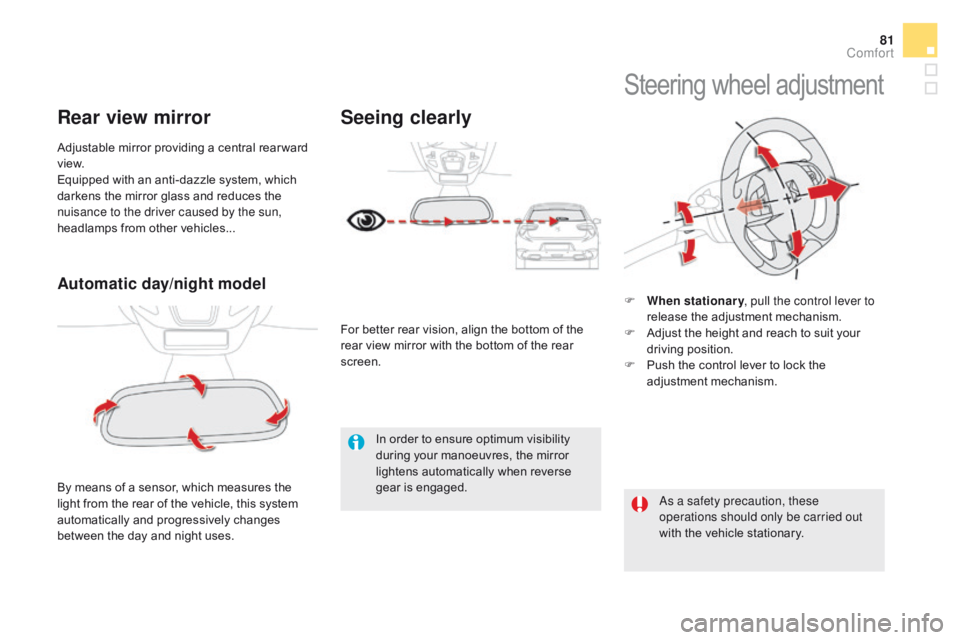
Automatic day/night model
By means of a sensor, which measures the
light from the rear of the vehicle, this system
automatically and progressively changes
between the day and night uses. Adjustable mirror providing a central rear ward
view.
Equipped with an anti-dazzle system, which
darkens the mirror glass and reduces the
nuisance to the driver caused by the sun,
headlamps from other vehicles...
Rear view mirror
In order to ensure optimum visibility
during your manoeuvres, the mirror
lightens automatically when reverse
gear is engaged.
Steering wheel adjustment
F When stationary, pull the control lever to
release the adjustment mechanism.
F
A
djust the height and reach to suit your
driving position.
F
P
ush the control lever to lock the
adjustment mechanism.
As a safety precaution, these
operations should only be carried out
with the vehicle stationary.
Seeing clearly
For better rear vision, align the bottom of the
rear view mirror with the bottom of the rear
screen.
comfort
Page 100 of 403
DS5_en_Chap04_conduite_ed01-2015
A few driving recommendations
Observe the driving regulations at all times and remain vigilant whatever the traffic conditions.
Pay close attention to the traffic and keep your hands on the wheel so that you are ready to react at
any time to any eventuality.
On a long journey, a break every two hours is strongly recommended.
In difficult weather, drive smoothly, anticipate the need to brake and increase the distance from
other vehicles.
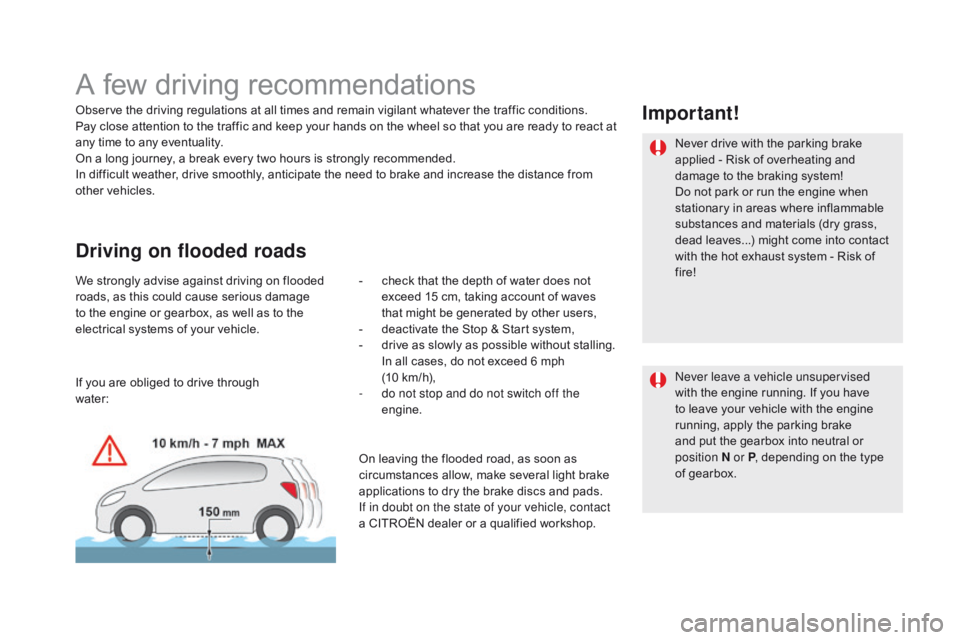
driving on flooded roads
We strongly advise against driving on flooded
roads, as this could cause serious damage
to the engine or gearbox, as well as to the
electrical systems of your vehicle.-
c heck that the depth of water does not
exceed 15 cm, taking account of waves
that might be generated by other users,
-
d
eactivate the Stop & Start system,
-
d
rive as slowly as possible without stalling.
In all cases, do not exceed 6 mph
(10 km/h),
-
d
o not stop and do not switch off the
engine.
Important!
Never drive with the parking brake
applied - Risk of overheating and
damage to the braking system!
Do not park or run the engine when
stationary in areas where inflammable
substances and materials (dry grass,
dead leaves...) might come into contact
with the hot exhaust system - Risk of
fire!
Never leave a vehicle unsupervised
with the engine running. If you have
to leave your vehicle with the engine
running, apply the parking brake
and put the gearbox into neutral or
position
N or P, depending on the type
of gearbox.
If you are obliged to drive through
water:
On leaving the flooded road, as soon as
circumstances allow, make several light brake
applications to dry the brake discs and pads.
If in doubt on the state of your vehicle, contact
a CITROËN dealer or a qualified workshop.
Page 101 of 403
99
DS5_en_Chap04_conduite_ed01-2015
Starting-switching off the engine
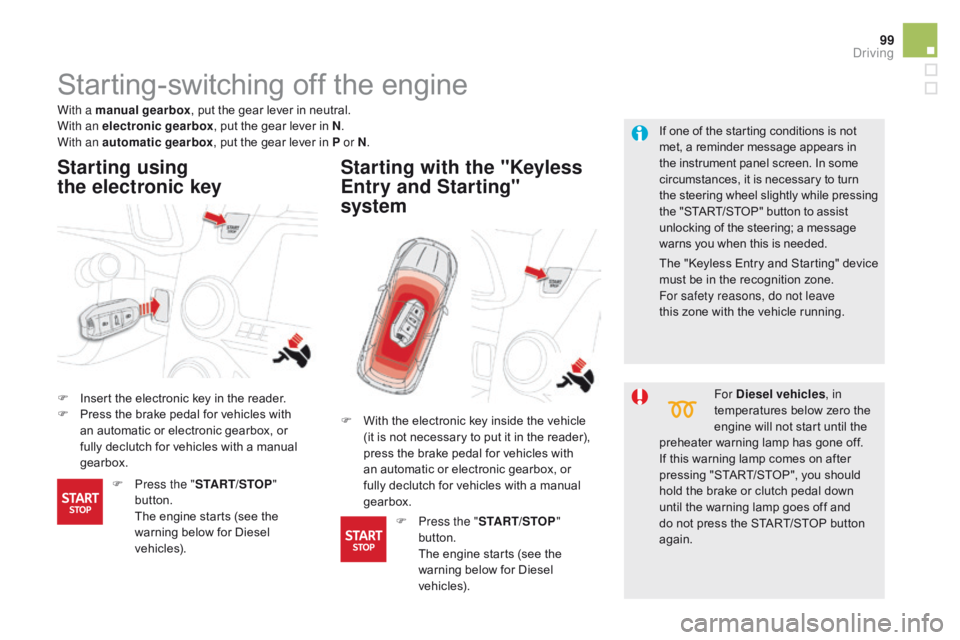
F Insert the electronic key in the reader.
F P ress the brake pedal for vehicles with
an automatic or electronic gearbox, or
fully declutch for vehicles with a manual
gearbox.
Starting using
the electronic key Starting with the "Keyless
Entry and Starting"
system
If one of the starting conditions is not
met, a reminder message appears in
the instrument panel screen. In some
circumstances, it is necessary to turn
the steering wheel slightly while pressing
the "START/STOP" button to assist
unlocking of the steering; a message
warns you when this is needed.
With a manual gearbox
, put the gear lever in neutral.
With an electronic gearbox , put the gear lever in N.
With an automatic gearbox , put the gear lever in P or N.
For
d iesel vehicles, in
temperatures below zero the
engine will not start until the
preheater warning lamp has gone off.
If this warning lamp comes on after
pressing "START/STOP", you should
hold the brake or clutch pedal down
until the warning lamp goes off and
do not press the START/STOP button
again.
F
W
ith the electronic key inside the vehicle
(it is not necessary to put it in the reader),
press the brake pedal for vehicles with
an automatic or electronic gearbox, or
fully declutch for vehicles with a manual
gearbox.
F
P
ress the " START/STOP "
button.
T
he engine starts (see the
warning below for Diesel
vehicles). F
P
ress the " START/STOP "
button.
T
he engine starts (see the
warning below for Diesel
vehicles). The "Keyless Entry and Starting" device
must be in the recognition zone.
For safety reasons, do not leave
this
zone with the vehicle running.
driving
Page 104 of 403
DS5_en_Chap04_conduite_ed01-2015
very cold conditions or
when towing
In these circumstances, it is
recommended that you do not apply the
parking brake.
For this, with the ignition on, deactivate
the automatic functions and release the
parking brake manually:
F
M
anual gearbox: engage first gear
or reverse.
F
E
lectronic gearbox : select
position A or R .
F
A
utomatic gearbox: select
position P or R .
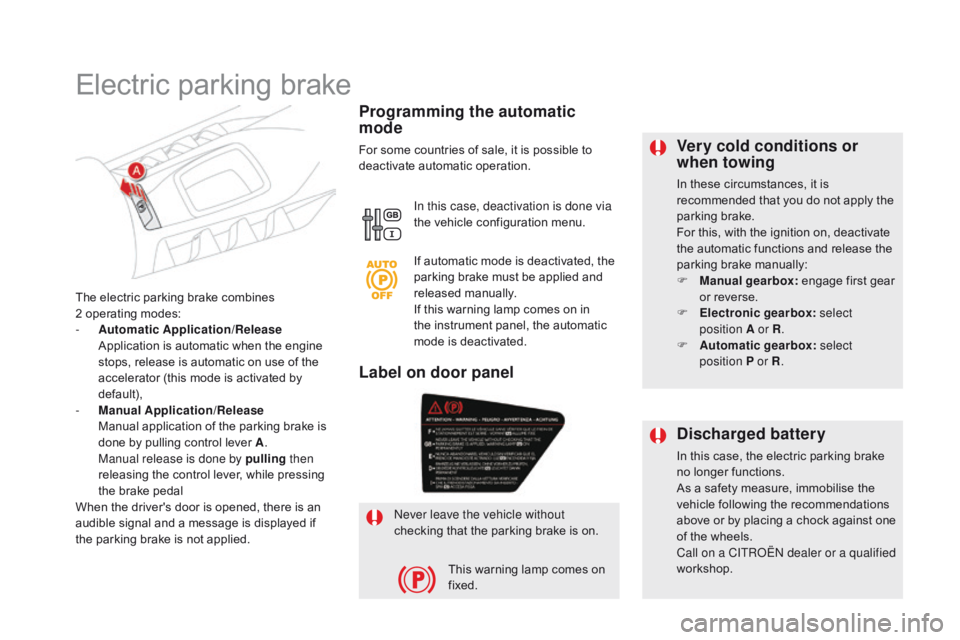
The electric parking brake combines
2 operating modes:
-
A
utomatic Application/Release
A
pplication is automatic when the engine
stops, release is automatic on use of the
accelerator (this mode is activated by
default),
-
M
anual Application/Release
M
anual application of the parking brake is
done by pulling control lever A .
M
anual release is done by pulling then
releasing the control lever, while pressing
the brake pedal
When the driver's door is opened, there is an
audible signal and a message is displayed if
the parking brake is not applied.
Programming the automatic
mode
For some countries of sale, it is possible to
deactivate automatic operation.
In this case, deactivation is done via
the vehicle configuration menu.
Electric parking brake
If automatic mode is deactivated, the
parking brake must be applied and
released manually.
If this warning lamp comes on in
the instrument panel, the automatic
mode is deactivated.
Never leave the vehicle without
checking that the parking brake is on. This warning lamp comes on
fixed.
Label on door panel
di
scharged battery
In this case, the electric parking brake
no longer functions.
As a safety measure, immobilise the
vehicle following the recommendations
above or by placing a chock against one
of the wheels.
Call on a CITROËN dealer or a qualified
workshop.
Page 105 of 403
103
DS5_en_Chap04_conduite_ed01-2015
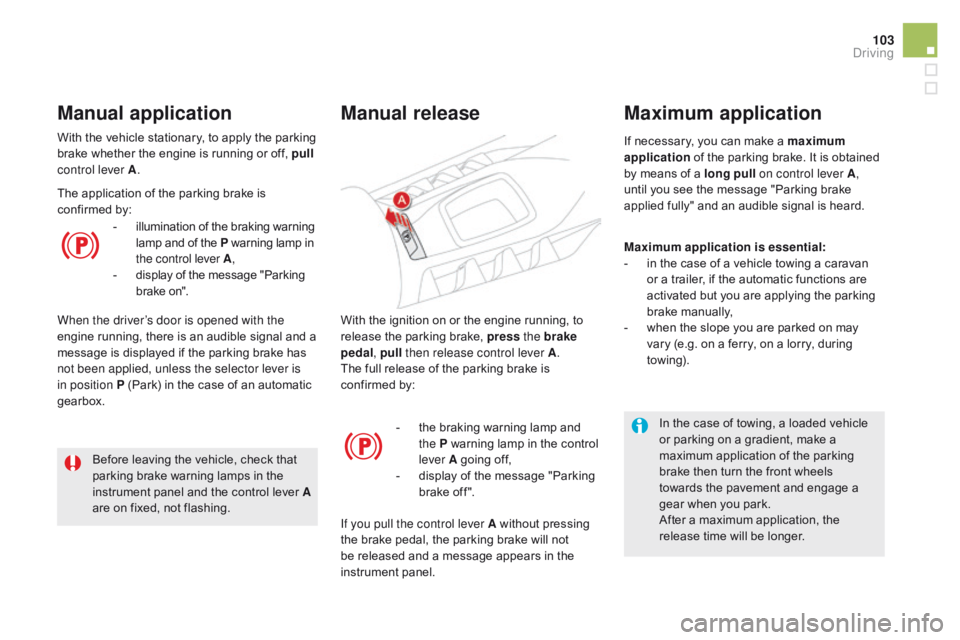
With the ignition on or the engine running, to
release the parking brake, press the brake
pedal , pull then release control lever A .
The full release of the parking brake is
confirmed by:
Manual release
- the braking warning lamp and the P warning lamp in the control
lever A going off,
-
d
isplay of the message "Parking
brake off ".
If you pull the control lever A without pressing
the brake pedal, the parking brake will not
be released and a message appears in the
instrument panel.
Before leaving the vehicle, check that
parking brake warning lamps in the
instrument panel and the control lever A
are on fixed, not flashing.
With the vehicle stationary, to apply the parking
brake whether the engine is running or off, pull
control lever A .
Manual application
The application of the parking brake is
confirmed by:
-
i
llumination of the braking warning
lamp and of the P warning lamp in
the control lever A ,
-
d
isplay of the message "Parking
brake on".
When the driver’s door is opened with the
engine running, there is an audible signal and a
message is displayed if the parking brake has
not been applied, unless the selector lever is
in position P (Park) in the case of an automatic
gearbox. Maximum application is essential:
-
i
n the case of a vehicle towing a caravan
or a trailer, if the automatic functions are
activated but you are applying the parking
brake manually,
-
w
hen the slope you are parked on may
vary (e.g. on a ferry, on a lorry, during
towing).
If necessary, you can make a maximum
application
of the parking brake. It is obtained
by means of a long pull on control lever A,
until you see the message "Parking brake
applied fully" and an audible signal is heard.
In the case of towing, a loaded vehicle
or parking on a gradient, make a
maximum application of the parking
brake then turn the front wheels
towards the pavement and engage a
gear when you park.
After a maximum application, the
release time will be longer.
Maximum application
driving
Page 108 of 403
DS5_en_Chap04_conduite_ed01-2015
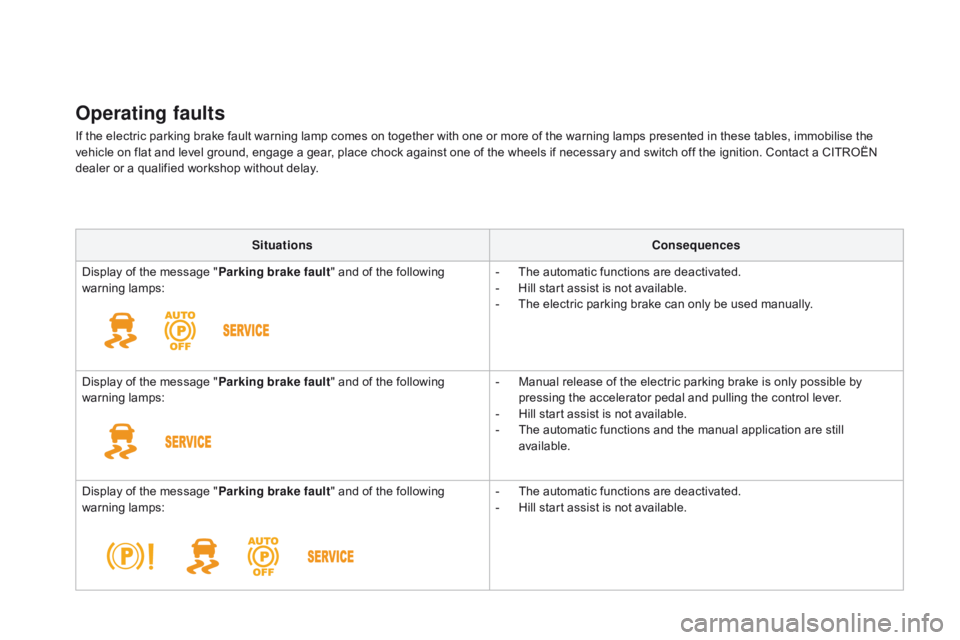
Operating faults
If the electric parking brake fault warning lamp comes on together with one or more of the warning lamps presented in these tables, immobilise the
vehicle on flat and level ground, engage a gear, place chock against one of the wheels if necessary and switch off the ignition. Contact a CITROËN
dealer or a qualified workshop without delay.Situations
co
nsequences
Display of the message " Parking brake fault" and of the following
warning lamps: -
T
he automatic functions are deactivated.
-
H
ill start assist is not available.
-
T
he electric parking brake can only be used manually.
Display of the message " Parking brake fault" and of the following
warning lamps: -
M
anual release of the electric parking brake is only possible by
pressing the accelerator pedal and pulling the control lever.
-
H
ill start assist is not available.
-
T
he automatic functions and the manual application are still
available.
Display of the message " Parking brake fault" and of the following
warning lamps: -
T
he automatic functions are deactivated.
-
H
ill start assist is not available.
Page 109 of 403
107
DS5_en_Chap04_conduite_ed01-2015
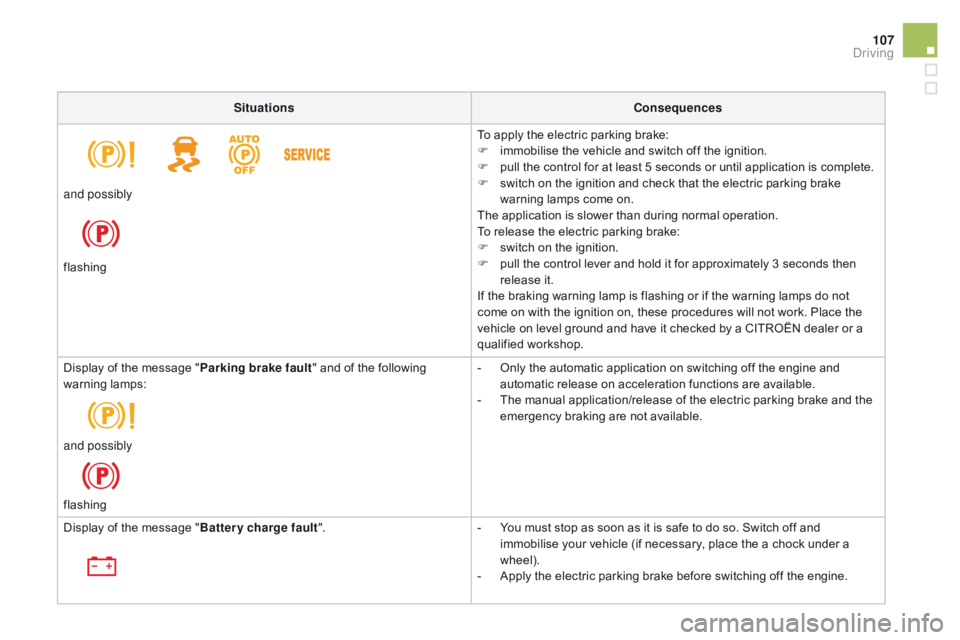
Situationsconsequences
To apply the electric parking brake:
F
i
mmobilise the vehicle and switch off the ignition.
F
p
ull the control for at least 5 seconds or until application is complete.
F
s
witch on the ignition and check that the electric parking brake
warning lamps come on.
The application is slower than during normal operation.
To release the electric parking brake:
F
s
witch on the ignition.
F
p
ull the control lever and hold it for approximately 3 seconds then
release it.
If the braking warning lamp is flashing or if the warning lamps do not
come on with the ignition on, these procedures will not work. Place the
vehicle on level ground and have it checked by a CITROËN dealer or a
qualified workshop.
and possibly
flashing
Display of the message "
Parking brake fault" and of the following
warning lamps: -
O
nly the automatic application on switching off the engine and
automatic release on acceleration functions are available.
-
T
he manual application/release of the electric parking brake and the
emergency braking are not available.
and possibly
flashing
Display of the message " Battery charge fault". -
Y
ou must stop as soon as it is safe to do so. Switch off and
immobilise your vehicle (if necessary, place the a chock under a
wheel).
-
A
pply the electric parking brake before switching off the engine.
driving
Page 116 of 403
DS5_en_Chap04_conduite_ed01-2015
Electronic gearbox
Six-speed electronic gearbox system which
offers a choice between the comfort of fully
automatic operation or the pleasure of manual
gear changing.
There are two driving modes:
-
a
utomatic mode for automatic control of
the gears by the gearbox,
-
m
anual mode for sequential gear changing
by the driver.
For each of these two modes, there is a
a Sport setting, corresponding to a more
dynamic driving style.
In automatic mode, it remains possible to
change gear manually by using the steering
mounted control paddles when required, when
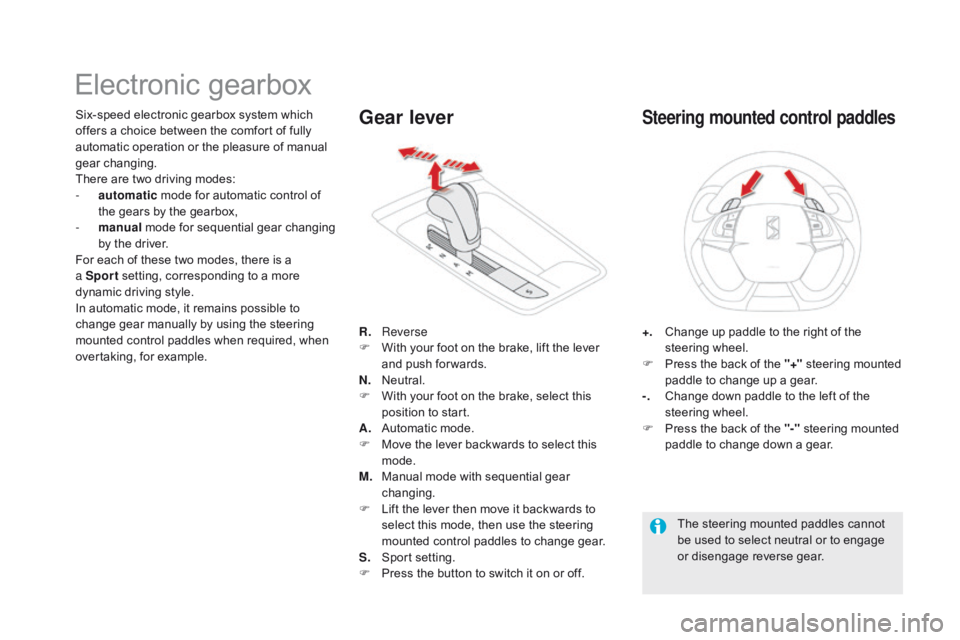
overtaking, for example. R.
R
everse
F
W
ith your foot on the brake, lift the lever
and push forwards.
N.
N
eutral.
F
W
ith your foot on the brake, select this
position to start.
A.
A
utomatic mode.
F
M
ove the lever backwards to select this
mode.
M.
M
anual mode with sequential gear
changing.
F
L
ift the lever then move it backwards to
select this mode, then use the steering
mounted control paddles to change gear.
S.
S
port setting.
F
P
ress the button to switch it on or off.Gear lever
+. Change up paddle to the right of the steering wheel.
F
P
ress the back of the "+" steering mounted
paddle to change up a gear.
-.
C
hange down paddle to the left of the
steering wheel.
F
P
ress the back of the "-" steering mounted
paddle to change down a gear.
Steering mounted control paddles
The steering mounted paddles cannot
be used to select neutral or to engage
or disengage reverse gear.
Page 121 of 403
11 9
DS5_en_Chap04_conduite_ed01-2015
Tyre under-inflation detection
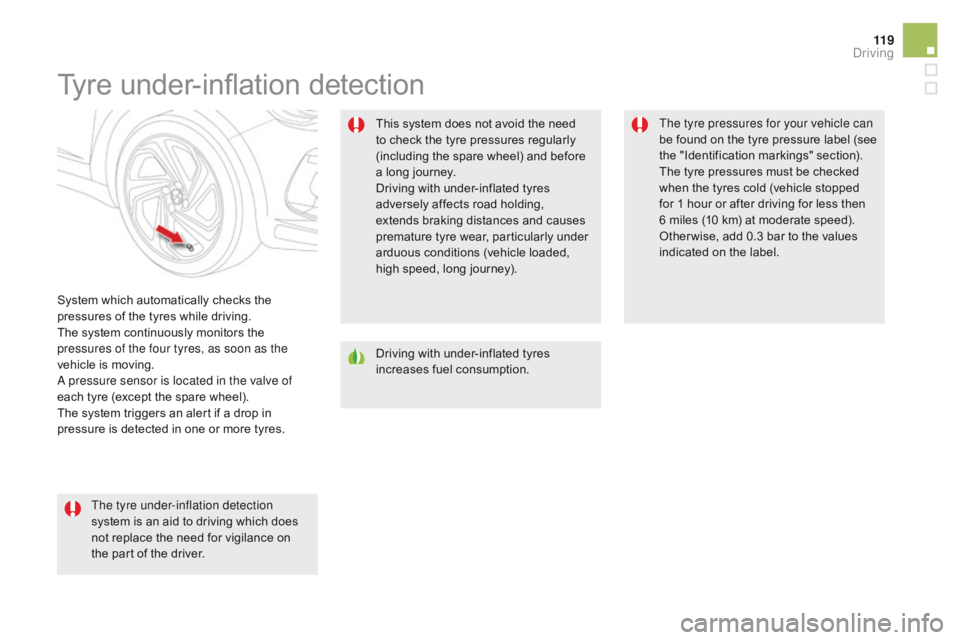
System which automatically checks the
pressures of the tyres while driving.
The system continuously monitors the
pressures of the four tyres, as soon as the
vehicle is moving.
A pressure sensor is located in the valve of
each tyre (except the spare wheel).
The system triggers an alert if a drop in
pressure is detected in one or more tyres.This system does not avoid the need
to check the tyre pressures regularly
(including the spare wheel) and before
a long journey.
Driving with under-inflated tyres
adversely affects road holding,
extends braking distances and causes
premature tyre wear, particularly under
arduous conditions (vehicle loaded,
high speed, long journey).
Driving with under-inflated tyres
increases fuel consumption.
The tyre pressures for your vehicle can
be found on the tyre pressure label (see
the "Identification markings" section).
The tyre pressures must be checked
when the tyres cold (vehicle stopped
for 1 hour or after driving for less then
6 miles (10 km) at moderate speed).
Other wise, add 0.3 bar to the values
indicated on the label.
The tyre under-inflation detection
system is an aid to driving which does
not replace the need for vigilance on
the part of the driver.
driving
Page 122 of 403
DS5_en_Chap04_conduite_ed01-2015
Under-inflation alert
The alert is given by the fixed illumination
of this warning lamp, accompanied by
an audible signal, and depending on
equipment, the display of a message.
In the event of a problem on one of the tyres ,
the symbol or the message appears, according
to equipment, to identify it.
F
R
educe speed, avoid sudden steering
movements or harsh brake applications.
F
S
top as soon as it is safe to do so. The alert is maintained until the tyre or
tyres concerned is reinflated, repaired
or replaced.
The spare wheel (space-saver type or a
steel rim) does not have a sensor.
The loss of pressure detected does not
always lead to visible deformation of the
tyre. Do not rely on just a visual check.
Operating fault
The flashing and then fixed
illumination of the under-inflation
warning lamp accompanied by the
illumination of the service warning
lamp indicates a fault with the system.
This alert is also displayed when one or
more wheels is not fitted with a sensor
(for example, a space-saver or steel
spare wheel).
Go to a CITROËN dealer or a qualified
workshop
to have the system checked or,
following the repair of a puncture, to have the
original wheel, equipped with a sensor, refitted. In this case, monitoring of the tyre pressures is
not assured.
F
I
f you have a compressor (the one in the
temporary puncture repair kit for example),
check the four tyre pressures when cold.
I
f it is not possible to check the tyre
pressures at the time, drive carefully at
reduced speed.
or
F
I
n the event of a puncture, use the
temporary puncture repair kit or the spare
wheel (according to equipment). Any tyre repair or replacement on a wheel
fitted with this system must be carried out by a
CITROËN dealer or a qualified workshop.
If after changing a tyre, a wheel is not detected
by your vehicle (fitting snow tyres for example),
you must have the system reinitialised by a
CITROËN dealer or a qualified workshop.