instrument panel CITROEN DS5 2017 Owner's Manual
[x] Cancel search | Manufacturer: CITROEN, Model Year: 2017, Model line: DS5, Model: CITROEN DS5 2017Pages: 403, PDF Size: 15.62 MB
Page 103 of 403
101
DS5_en_Chap04_conduite_ed01-2015
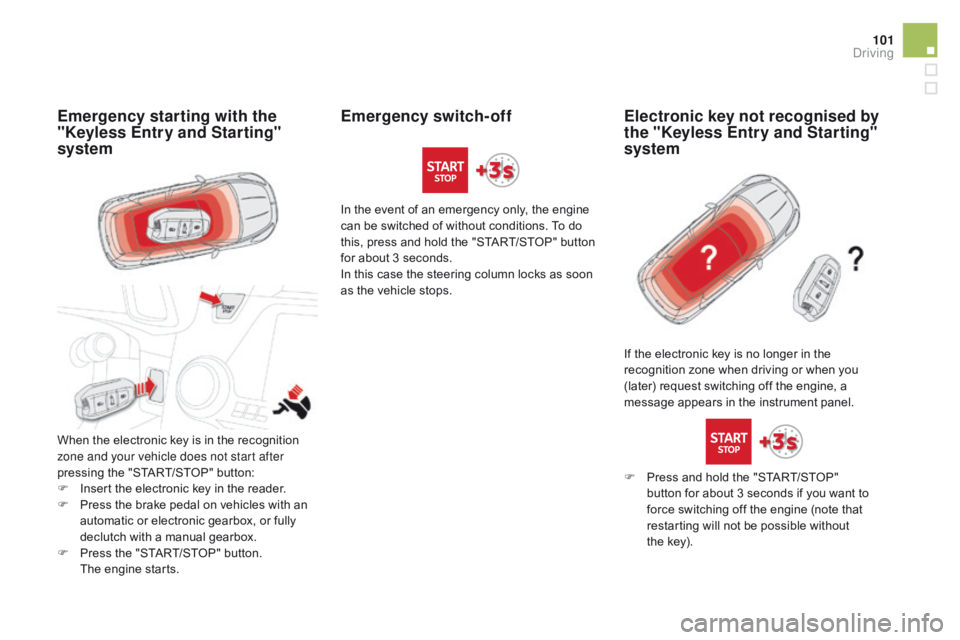
Emergency starting with the
"Keyless Entry and Starting"
system
When the electronic key is in the recognition
zone and your vehicle does not start after
pressing the "START/STOP" button:
F
I
nsert the electronic key in the reader.
F
P
ress the brake pedal on vehicles with an
automatic or electronic gearbox, or fully
declutch with a manual gearbox.
F
P
ress the "START/STOP" button.
T
he engine starts. In the event of an emergency only, the engine
can be switched of without conditions. To do
this, press and hold the "START/STOP" button
for about 3 seconds.
In this case the steering column locks as soon
as the vehicle stops.
If the electronic key is no longer in the
recognition zone when driving or when you
(later) request switching off the engine, a
message appears in the instrument panel.
Emergency switch-offElectronic key not recognised by
the "Keyless Entry and Starting"
system
F Press and hold the "START/STOP"
button for about 3 seconds if you want to
force switching off the engine (note that
restarting will not be possible without
the
key).
driving
Page 104 of 403
DS5_en_Chap04_conduite_ed01-2015
very cold conditions or
when towing
In these circumstances, it is
recommended that you do not apply the
parking brake.
For this, with the ignition on, deactivate
the automatic functions and release the
parking brake manually:
F
M
anual gearbox: engage first gear
or reverse.
F
E
lectronic gearbox : select
position A or R .
F
A
utomatic gearbox: select
position P or R .
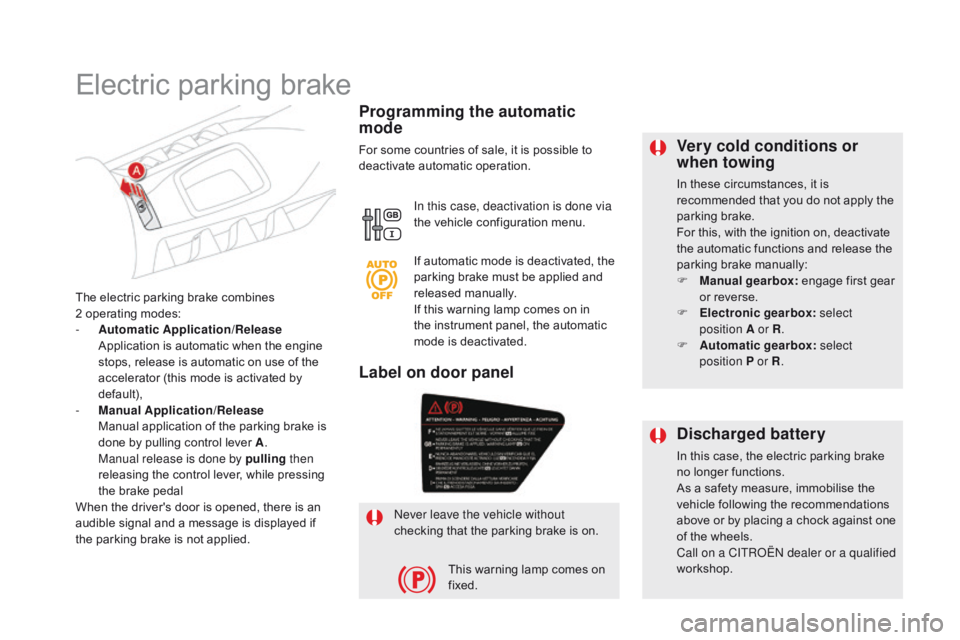
The electric parking brake combines
2 operating modes:
-
A
utomatic Application/Release
A
pplication is automatic when the engine
stops, release is automatic on use of the
accelerator (this mode is activated by
default),
-
M
anual Application/Release
M
anual application of the parking brake is
done by pulling control lever A .
M
anual release is done by pulling then
releasing the control lever, while pressing
the brake pedal
When the driver's door is opened, there is an
audible signal and a message is displayed if
the parking brake is not applied.
Programming the automatic
mode
For some countries of sale, it is possible to
deactivate automatic operation.
In this case, deactivation is done via
the vehicle configuration menu.
Electric parking brake
If automatic mode is deactivated, the
parking brake must be applied and
released manually.
If this warning lamp comes on in
the instrument panel, the automatic
mode is deactivated.
Never leave the vehicle without
checking that the parking brake is on. This warning lamp comes on
fixed.
Label on door panel
di
scharged battery
In this case, the electric parking brake
no longer functions.
As a safety measure, immobilise the
vehicle following the recommendations
above or by placing a chock against one
of the wheels.
Call on a CITROËN dealer or a qualified
workshop.
Page 105 of 403
103
DS5_en_Chap04_conduite_ed01-2015
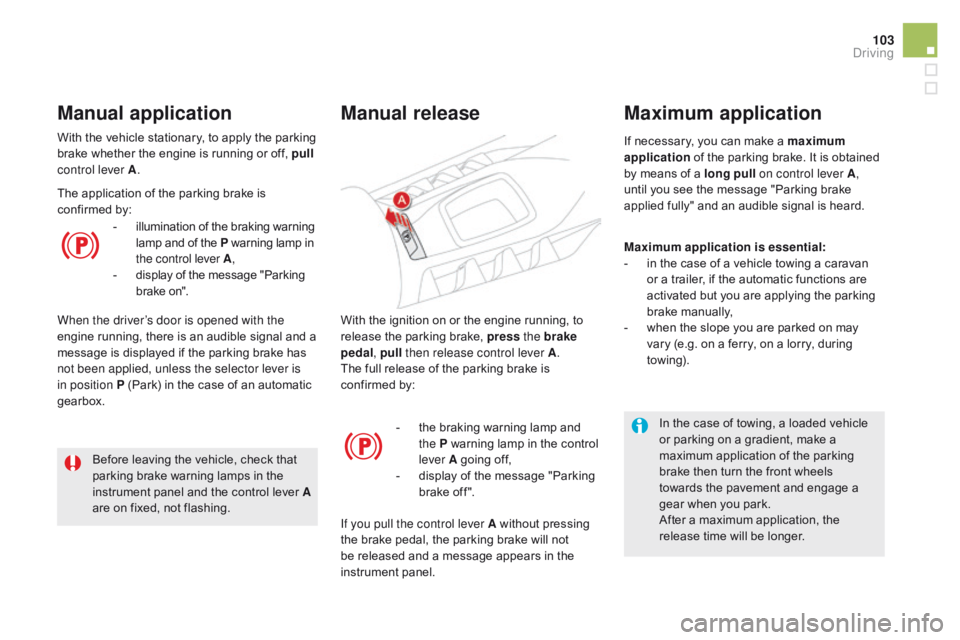
With the ignition on or the engine running, to
release the parking brake, press the brake
pedal , pull then release control lever A .
The full release of the parking brake is
confirmed by:
Manual release
- the braking warning lamp and the P warning lamp in the control
lever A going off,
-
d
isplay of the message "Parking
brake off ".
If you pull the control lever A without pressing
the brake pedal, the parking brake will not
be released and a message appears in the
instrument panel.
Before leaving the vehicle, check that
parking brake warning lamps in the
instrument panel and the control lever A
are on fixed, not flashing.
With the vehicle stationary, to apply the parking
brake whether the engine is running or off, pull
control lever A .
Manual application
The application of the parking brake is
confirmed by:
-
i
llumination of the braking warning
lamp and of the P warning lamp in
the control lever A ,
-
d
isplay of the message "Parking
brake on".
When the driver’s door is opened with the
engine running, there is an audible signal and a
message is displayed if the parking brake has
not been applied, unless the selector lever is
in position P (Park) in the case of an automatic
gearbox. Maximum application is essential:
-
i
n the case of a vehicle towing a caravan
or a trailer, if the automatic functions are
activated but you are applying the parking
brake manually,
-
w
hen the slope you are parked on may
vary (e.g. on a ferry, on a lorry, during
towing).
If necessary, you can make a maximum
application
of the parking brake. It is obtained
by means of a long pull on control lever A,
until you see the message "Parking brake
applied fully" and an audible signal is heard.
In the case of towing, a loaded vehicle
or parking on a gradient, make a
maximum application of the parking
brake then turn the front wheels
towards the pavement and engage a
gear when you park.
After a maximum application, the
release time will be longer.
Maximum application
driving
Page 106 of 403
DS5_en_Chap04_conduite_ed01-2015
Before leaving the vehicle, check that
parking brake warning lamps in the
instrument panel and in the control
lever A are on fixed (not flashing).
Never leave a child alone inside the
vehicle with the ignition on, as they
could release the parking brake.
Automatic application,
engine off
- illumination of the braking warning lamp and of the P
warning lamp in the control
lever
A,
-
d
isplay of the message "Parking
brake on".
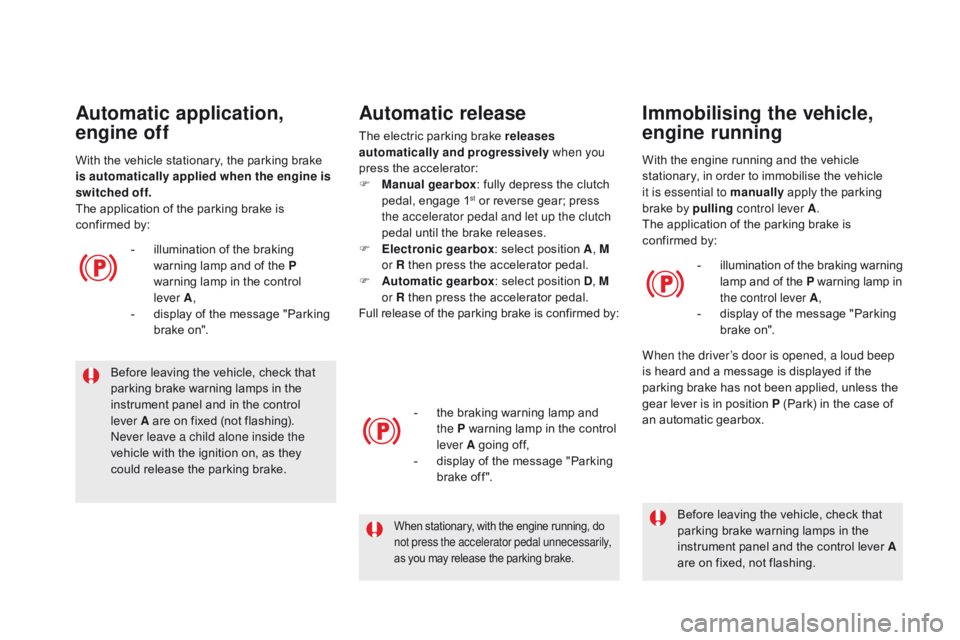
With the vehicle stationary, the parking brake
is automatically applied when the engine is
switched off.
The application of the parking brake is
confirmed by:
Automatic release
The electric parking brake releases
automatically and progressively
when you
press the accelerator:
F
M
anual gearbox : fully depress the clutch
pedal, engage 1
st or reverse gear; press
the accelerator pedal and let up the clutch
pedal until the brake releases.
F
E
lectronic gearbox : select position A, M
or R then press the accelerator pedal.
F
A
utomatic gearbox : select position
d
,
M
or R then press the accelerator pedal.
Full release of the parking brake is confirmed by:
-
t
he braking warning lamp and
the P warning lamp in the control
lever A going off,
-
d
isplay of the message "Parking
brake off ".
When stationary, with the engine running, do
not press the accelerator pedal unnecessarily,
as you may release the parking brake.Before leaving the vehicle, check that
parking brake warning lamps in the
instrument panel and the control lever A
are on fixed, not flashing.
With the engine running and the vehicle
stationary, in order to immobilise the vehicle
it is essential to manually
apply the parking
brake by pulling control lever A.
The application of the parking brake is
confirmed by:
-
i
llumination of the braking warning
lamp and of the P warning lamp in
the control lever A ,
-
d
isplay of the message "Parking
brake on".
When the driver’s door is opened, a loud beep
is heard and a message is displayed if the
parking brake has not been applied, unless the
gear lever is in position P (Park) in the case of
an automatic gearbox.
Immobilising the vehicle,
engine running
Page 107 of 403
105
DS5_en_Chap04_conduite_ed01-2015
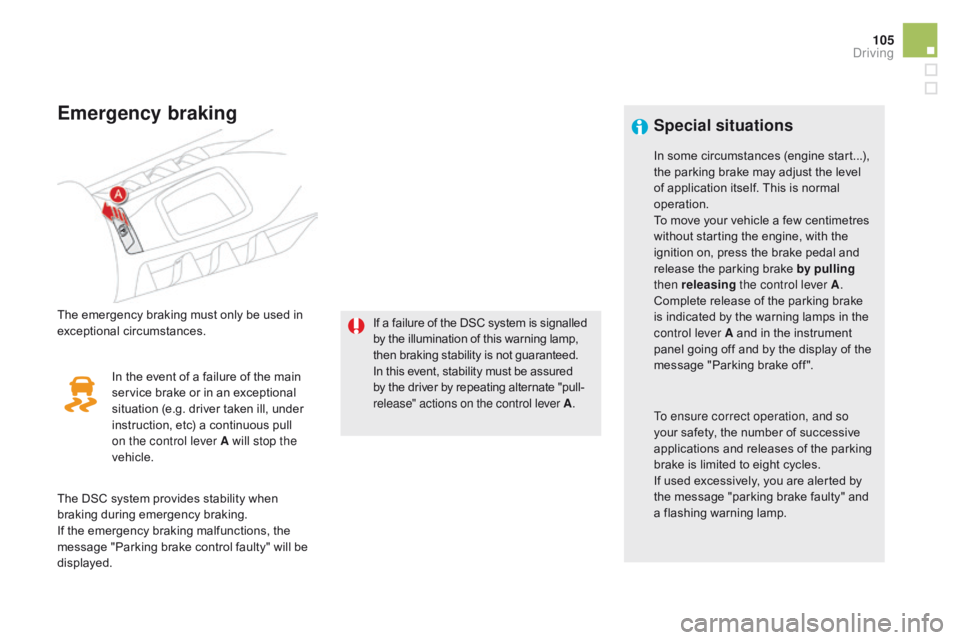
Emergency braking
The emergency braking must only be used in
exceptional circumstances.If a failure of the DSC system is signalled
by the illumination of this warning lamp,
then braking stability is not guaranteed.
In this event, stability must be assured
by the driver by repeating alternate "pull-
release" actions on the control lever A
.
In the event of a failure of the main
service brake or in an exceptional
situation (e.g. driver taken ill, under
instruction, etc) a continuous pull
on the control lever A will stop the
vehicle.
The DSC system provides stability when
braking during emergency braking.
If the emergency braking malfunctions, the
message "Parking brake control faulty" will be
displayed.
Special situations
To ensure correct operation, and so
your safety, the number of successive
applications and releases of the parking
brake is limited to eight cycles.
If used excessively, you are alerted by
the message "parking brake faulty" and
a flashing warning lamp. In some circumstances (engine start...),
the parking brake may adjust the level
of application itself. This is normal
operation.
To move your vehicle a few centimetres
without starting the engine, with the
ignition on, press the brake pedal and
release the parking brake by pulling
then releasing the control lever A .
Complete release of the parking brake
is indicated by the warning lamps in the
control lever A and in the instrument
panel going off and by the display of the
message "Parking brake off ".
driving
Page 112 of 403
DS5_en_Chap04_conduite_ed01-2015
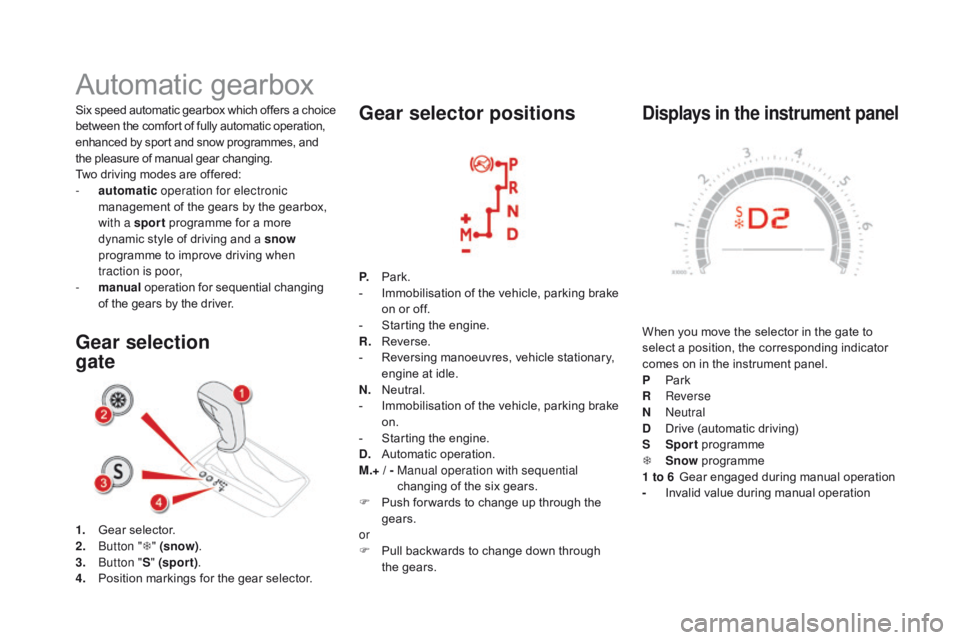
displays in the instrument panel
When you move the selector in the gate to
select a position, the corresponding indicator
comes on in the instrument panel.
P
Pa
rk
R
Reverse
N
Neutral
d
D
rive (automatic driving)
S
Sp
ort programme
T
S
now programme
1 to 6
G
ear engaged during manual operation
-
I
nvalid value during manual operation
Six speed automatic gearbox which of fers a choice
between the comfort of fully automatic operation,
enhanced by sport and snow programmes, and
the pleasure of manual gear changing.
Two driving modes are offered:
-
a
utomatic
operation for electronic
management of the gears by the gearbox,
with a sport programme for a more
dynamic style of driving and a snow
programme to improve driving when
traction is poor,
-
m
anual
operation for sequential changing
of the gears by the driver.
Automatic gearbox
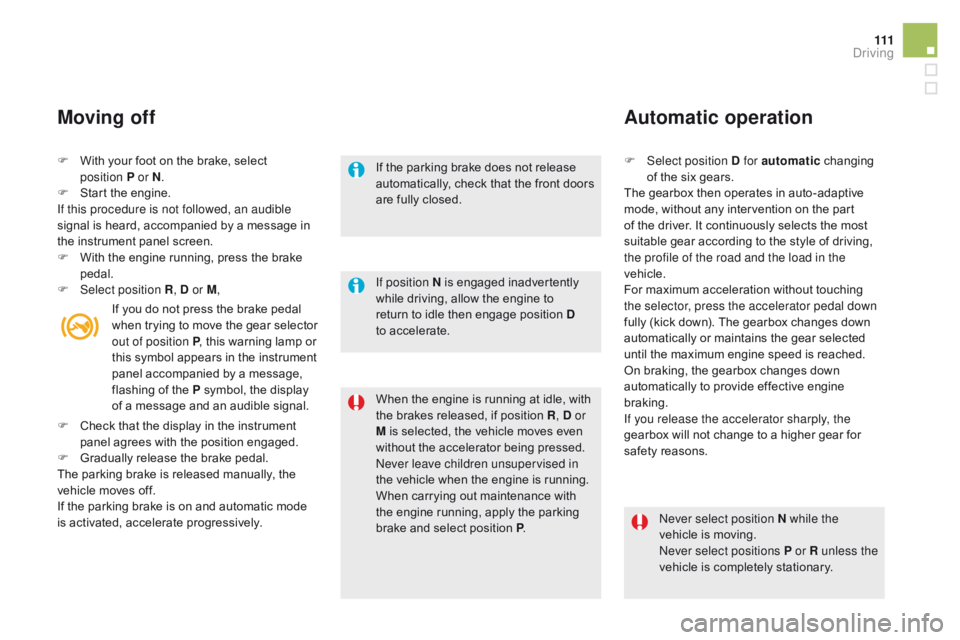
1. Gear selector.
2. B utton " T" (snow) .
3.
B
utton " S" (spor t) .
4.
P
osition markings for the gear selector.
Gear selection
gate Gear selector positions
P. Park.
-
I mmobilisation of the vehicle, parking brake
on or off.
-
S
tarting the engine.
R.
R
everse.
-
R
eversing manoeuvres, vehicle stationary,
engine at idle.
N.
N
eutral.
-
I
mmobilisation of the vehicle, parking brake
on.
-
S
tarting the engine.
d
.
A
utomatic operation.
M.+ / -
M
anual operation with sequential
changing of the six gears.
F
P
ush for wards to change up through the
gears.
or
F
P
ull backwards to change down through
the gears.
Page 113 of 403
111
DS5_en_Chap04_conduite_ed01-2015
F With your foot on the brake, select position P or N.
F
S
tart the engine.
If this procedure is not followed, an audible
signal is heard, accompanied by a message in
the instrument panel screen.
F
W
ith the engine running, press the brake
pedal.
F
Sel
ect position R ,
d or M,
Moving off
When the engine is running at idle, with
the brakes released, if position R ,
d or
M is selected, the vehicle moves even
without the accelerator being pressed.
Never leave children unsupervised in
the vehicle when the engine is running.
When carrying out maintenance with
the engine running, apply the parking
brake and select position P .
If the parking brake does not release
automatically, check that the front doors
are fully closed.
Never select position N while the
vehicle is moving.
Never select positions P or R unless the
vehicle is completely stationary.
Automatic operation
F Select position d for automatic changing
of the six gears.
The gearbox then operates in auto-adaptive
mode, without any intervention on the part
of the driver. It continuously selects the most
suitable gear according to the style of driving,
the profile of the road and the load in the
vehicle.
For maximum acceleration without touching
the selector, press the accelerator pedal down
fully (kick down). The gearbox changes down
automatically or maintains the gear selected
until the maximum engine speed is reached.
On braking, the gearbox changes down
automatically to provide effective engine
braking.
If you release the accelerator sharply, the
gearbox will not change to a higher gear for
safety reasons.
If position N is engaged inadvertently
while driving, allow the engine to
return to idle then engage position
d
to
accelerate.
If you do not press the brake pedal
when trying to move the gear selector
out of position P
, this warning lamp or
this symbol appears in the instrument
panel accompanied by a message,
flashing of the P symbol, the display
of a message and an audible signal.
F
C
heck that the display in the instrument
panel agrees with the position engaged.
F
G
radually release the brake pedal.
The parking brake is released manually, the
vehicle moves off.
If the parking brake is on and automatic mode
is activated, accelerate progressively.
driving
Page 114 of 403
DS5_en_Chap04_conduite_ed01-2015
Manual operation
F Select position M for sequential changing
of the six gears.
F
P
ush the selector towards the + sign to
change up a gear.
F
P
ull the selector towards the - sign to
change down a gear.
It is only possible to change from one gear to
another if the vehicle speed and engine speed
permit; other wise, the gearbox will operate
temporarily in automatic mode.
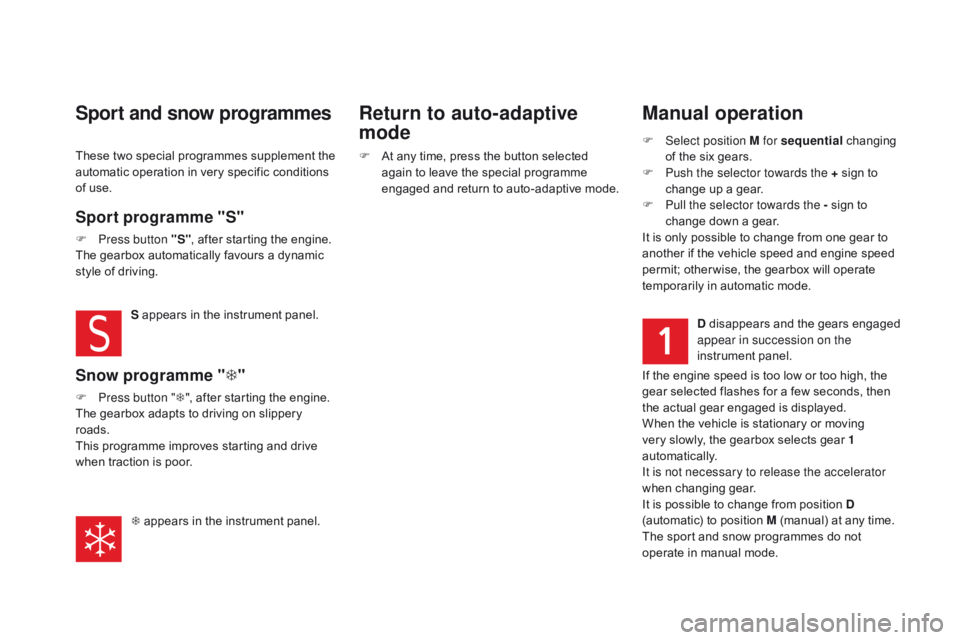
d
disappears and the gears engaged
appear in succession on the
instrument panel.
If the engine speed is too low or too high, the
gear selected flashes for a few seconds, then
the actual gear engaged is displayed.
When the vehicle is stationary or moving
very slowly, the gearbox selects gear 1
automatically.
It is not necessary to release the accelerator
when changing gear.
It is possible to change from position
d
(automatic) to position M (manual) at any time.
The sport and snow programmes do not
operate in manual mode.
Sport and snow programmes
Sport programme "S"
F Press button "S" , after starting the engine.
The gearbox automatically favours a dynamic
style of driving.
S appears in the instrument panel.
Snow programme " T"
F Press button " T", after starting the engine.
The gearbox adapts to driving on slippery
roads.
This programme improves starting and drive
when traction is poor.
T appears in the instrument panel.
Return to auto-adaptive
mode
F At any time, press the button selected again to leave the special programme
engaged and return to auto-adaptive mode.
These two special programmes supplement the
automatic operation in very specific conditions
of use.
Page 115 of 403
11 3
DS5_en_Chap04_conduite_ed01-2015
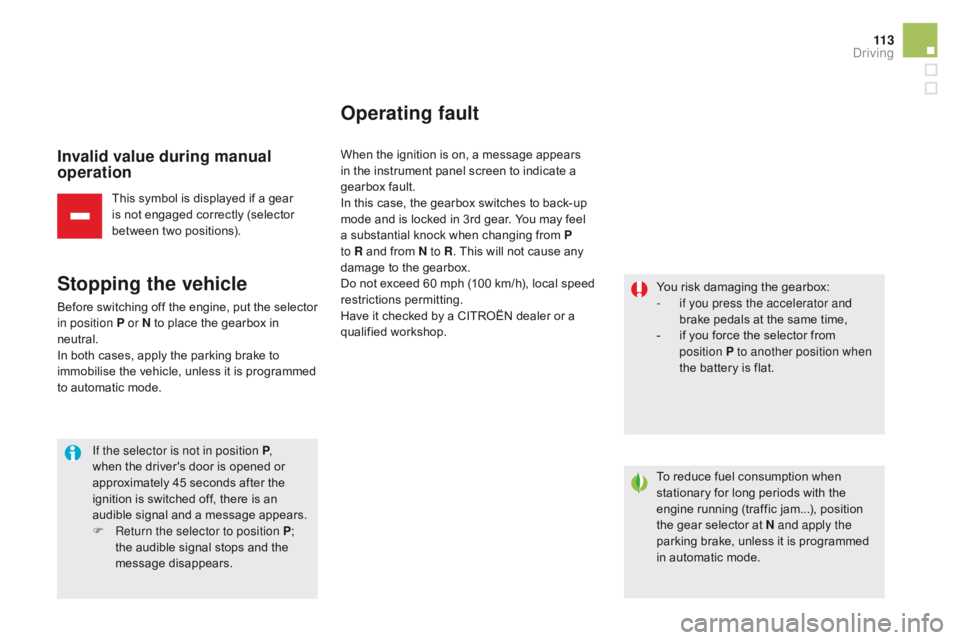
Invalid value during manual
operation
This symbol is displayed if a gear
is not engaged correctly (selector
between two positions).
Stopping the vehicle
Before switching off the engine, put the selector
in position P or N to place the gearbox in
neutral.
In both cases, apply the parking brake to
immobilise the vehicle, unless it is programmed
to automatic mode.If the selector is not in position P ,
when the driver's door is opened or
approximately 45 seconds after the
ignition is switched off, there is an
audible signal and a message appears.
F
R
eturn the selector to position P ;
the audible signal stops and the
message disappears.
Operating fault
When the ignition is on, a message appears
in the instrument panel screen to indicate a
gearbox fault.
In this case, the gearbox switches to back-up
mode and is locked in 3rd gear. You may feel
a substantial knock when changing from P
to R and from N to R . This will not cause any
damage to the gearbox.
Do not exceed 60 mph (100 km/h), local speed
restrictions permitting.
Have it checked by a CITROËN dealer or a
qualified workshop. You risk damaging the gearbox:
-
i
f you press the accelerator and
brake pedals at the same time,
-
i
f you force the selector from
position P to another position when
the battery is flat.
To reduce fuel consumption when
stationary for long periods with the
engine running (traffic jam...), position
the gear selector at N and apply the
parking brake, unless it is programmed
in automatic mode.
driving
Page 117 of 403
11 5
DS5_en_Chap04_conduite_ed01-2015
Engagement of reverse gear is
accompanied by an audible signal.If the engine does not start:
-
If
N is flashing in the instrument
panel, move the gear lever to
position A then to position N .
-
I
f the message "
foot on the brake "
is displayed, press the brake pedal
f i r m l y. When the engine is idling with the
brakes off, if position R
, A or M is
selected, the vehicle will move off
on its own without any action on the
accelerator.
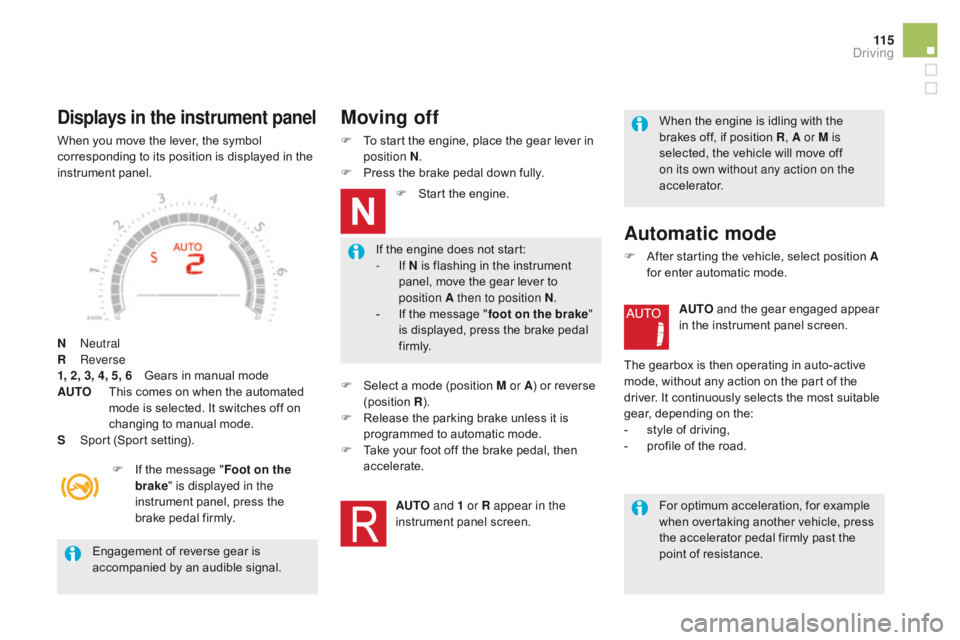
displays in the instrument panel
When you move the lever, the symbol
corresponding to its position is displayed in the
instrument panel.
N
Neutral
R
Reverse
1, 2, 3, 4, 5, 6
G
ears in manual mode
AUTO
T
his comes on when the automated
mode is selected. It switches off on
changing to manual mode.
S
S
port (Sport setting).F
I
f the message " Foot on the
brake " is displayed in the
instrument panel, press the
brake pedal firmly.
Moving off
F To start the engine, place the gear lever in position N .
F
P
ress the brake pedal down fully.F
S
tart the engine.
F
S
elect a mode (position M or A ) or reverse
(position R).
F
R
elease the parking brake unless it is
programmed to automatic mode.
F
T
ake your foot off the brake pedal, then
accelerate.
AUTO and 1 or R appear in the
instrument panel screen.
Automatic mode
F After starting the vehicle, select position A for enter automatic mode.
AUTO and the gear engaged appear
in the instrument panel screen.
The gearbox is then operating in auto-active
mode, without any action on the part of the
driver. It continuously selects the most suitable
gear, depending on the:
-
s
tyle of driving,
-
p
rofile of the road.For optimum acceleration, for example
when overtaking another vehicle, press
the accelerator pedal firmly past the
point of resistance.
driving