fuel Citroen DS5 HYBRID 2016 1.G User Guide
[x] Cancel search | Manufacturer: CITROEN, Model Year: 2016, Model line: DS5 HYBRID, Model: Citroen DS5 HYBRID 2016 1.GPages: 376, PDF Size: 12.57 MB
Page 92 of 376
DS5_en_Chap03_confort_ed02-2015
In order for these systems to be fully effective, follow the operation and maintenance
guidelines below:
F
To o
btain an even air distribution, take care not to obstruct the exterior air intake grilles
located at the base of the windscreen, the nozzles, the vents and the air outlets, as well
as the air extractor located in the boot.
F
Do n
ot cover the sunshine sensor, located on the dashboard; this is used for regulation
of the digital air conditioning system.
F
Op
erate the air conditioning system for at least 5 to 10 minutes, once or twice a month
to keep it in per fect working order.
F
En
sure that the passenger compartment filter is in good condition and have the filter
elements replaced regularly (refer to the "Checks" section).
We r
ecommend the use of a combined passenger compartment filter. Thanks to its
special active additive, it contributes to the purification of the air breathed by the
occupants and the cleanliness of the passenger compartment (reduction of allergic
symptoms, bad odours and greasy deposits).
F
To e
nsure correct operation of the air conditioning system, you are also advised to have
it checked regularly as recommended in the maintenance and warranty guide.
F
If t
he system does not produce cold air, switch it off and contact a CITROËN dealer or a
qualified workshop.
You can switch off the air conditioning (AC button) and stay in Automatic mode in order
to limit fuel consumption. If misting appears while in this mode, you can switch the air
conditioning back on temporarily to improve the situation.
When towing the maximum load on a steep gradient in high temperatures, switching off the
air conditioning increases the available engine power and so improves the towing ability.
Recommendations for ventilation and air conditioning
If after an extended stop in sunshine,
the interior temperature is very high, first
ventilate the passenger compartment for
a few moments.
Put the air flow control at a setting high
enough to quickly change the air in the
passenger compartment.
The air conditioning system does not
contain chlorine and does not present
any danger to the ozone layer.
The condensation created by the air
conditioning results in a discharge
of water under the vehicle which is
per fectly normal.
If you want to prioritise heating, start
and leave the engine running by
pressing ECO OFF.
Page 97 of 376
95
DS5_en_Chap03_confort_ed02-2015
F Switch off the demisting/defrosting
of the rear screen and door mirrors
as soon as appropriate, as lower
current consumption results in
reduced fuel consumption.
Front demist -
defrost Rear screen and door mirrors demist -
d efrost
F It is possible to stop the
d
emisting/defrosting operation
before it is switched off
automatically by pressing the
button again. The indicator
lamp associated with the
button goes off.
Automatic visibility programmeSwitching on
With Stop & Start, when demisting has
been activated, the STOP mode is not
available.
Switching off
The demisting/defrosting switches off automatically
to prevent an excessive consumption of current.
F Select this programme
t o demist or defrost the
windscreen and side windows
as quickly as possible.
The system automatically manages the air
conditioning, air flow and air intake, and provides
optimum distribution towards the windscreen and
side windows.
F To stop the programme, press either
the "vi sibility" button again or "AUTO" , the
indicator lamp in the button goes off and the
indicator lamp in the "AUTO" button comes on.
The system starts again with the values in use
before it was overridden by the visibility programme.
F Press this button (located on
t he air conditioning system
control panel) to demist /defrost
the rear screen and the door
mirrors. The indicator lamp
associated with the button
comes on.
The rear screen demist - defrost
can only operate when the engine is
running.
comfort
Page 116 of 376
DS5_en_Chap04_conduite_ed02-2015
Invalid value during manual
operation
This symbol is displayed if a gear
is not engaged correctly (selector
between two positions).
Stopping the vehicle
Before switching off the engine, put the selector
in position P or N to place the gearbox in
neutral.
In both cases, apply the parking brake to
immobilise the vehicle, unless it is programmed
to automatic mode.If the selector is not in position P ,
when the driver's door is opened or
approximately 45 seconds after the
ignition is switched off, there is an
audible signal and a message appears.
F
Re
turn the selector to position P ;
the audible signal stops and the
message disappears.
Operating fault
When the ignition is on, a message appears
in the instrument panel screen to indicate a
gearbox fault.
In this case, the gearbox switches to back-up
mode and is locked in 3rd gear. You may feel
a substantial knock when changing from P
to R and from N to R . This will not cause any
damage to the gearbox.
Do not exceed 60 mph (100 km/h), local speed
restrictions permitting.
Have it checked by a CITROËN dealer or a
qualified workshop. You risk damaging the gearbox:
-
if y
ou press the accelerator and
brake pedals at the same time,
-
if y
ou force the selector from
position P to another position when
the battery is flat.
To reduce fuel consumption when
stationary for long periods with the
engine running (traffic jam...), position
the gear selector at N and apply the
parking brake, unless it is programmed
in automatic mode.
Page 117 of 376
11 5
DS5_en_Chap04_conduite_ed02-2015
Gear efficiency indicator*
On vehicle fitted with a manual gearbox,
the arrow may be accompanied by the
gear recommended.The system adapts its gear change
recommendation according to the
driving conditions (slope, load, ...) and
the demands of the driver (power,
acceleration, braking, ...).
The system never suggests:
-
en
gaging first gear,
-
engag
ing reverse gear.
With an automatic gearbox, the system
is only active in manual mode.
* Depending on engine.
On BlueHDi Diesel 135 and 150 versions with
manual gearbox, in certain driving conditions
the system may suggest changing into neutral
so that the engine can go into standby (STOP
mode with Stop & Start). In this case, N is
displayed in the instrument panel. System which reduces fuel consumption by recommending the most appropriate gear.
Operation
Depending on the driving situation and your
vehicle's equipment, the system may advise
you to skip one (or more) gear(s). You can
follow this instruction without engaging the
intermediate gears.
The gear engagement recommendations must
not be considered compulsory. In fact, the
configuration of the road, the amount of traffic
and safety remain determining factors when
choosing the best gear. Therefore, the driver
remains responsible for deciding whether or not
to follow the advice given by the system.
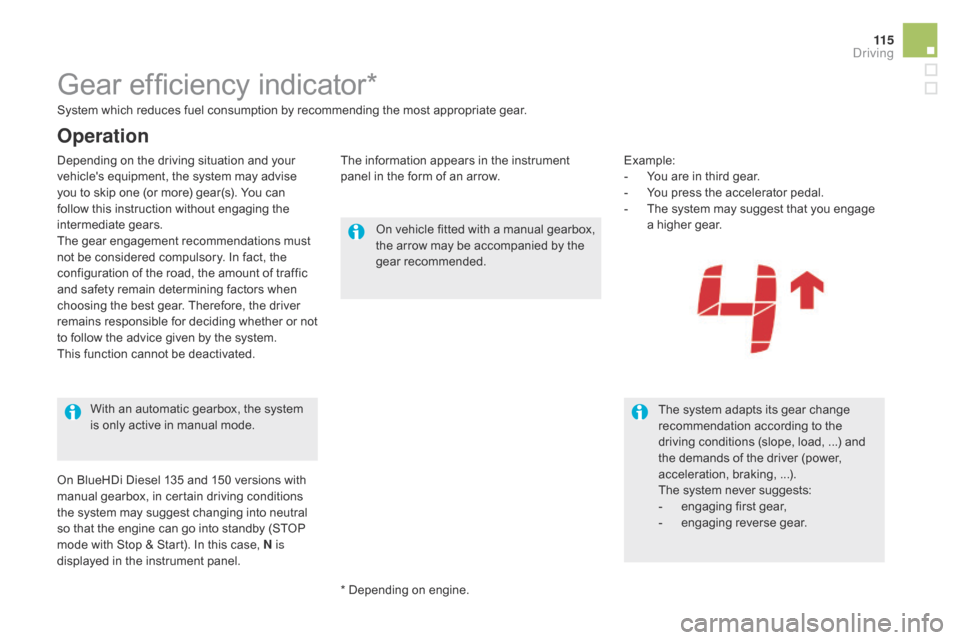
This function cannot be deactivated. Example:
- Yo
u are in third gear.
-
Yo
u press the accelerator pedal.
-
Th
e system may suggest that you engage
a higher gear.
The information appears in the instrument
panel in the form of an arrow.
driving
Page 118 of 376
DS5_en_Chap04_conduite_ed02-2015
Tyre under-inflation detection
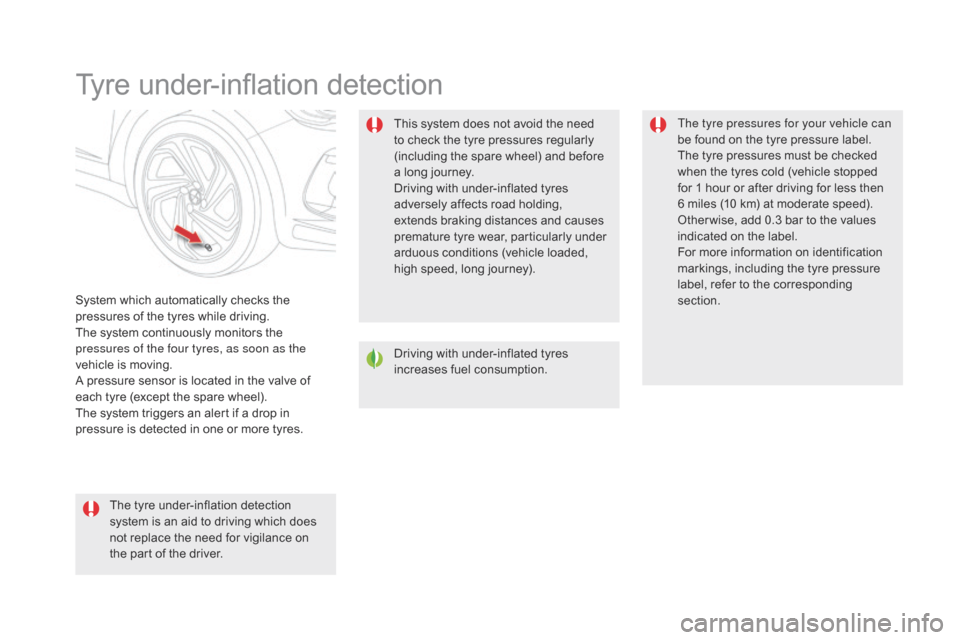
System which automatically checks the
pressures of the tyres while driving.
The system continuously monitors the
pressures of the four tyres, as soon as the
vehicle is moving.
A pressure sensor is located in the valve of
each tyre (except the spare wheel).
The system triggers an alert if a drop in
pressure is detected in one or more tyres.This system does not avoid the need
to check the tyre pressures regularly
(including the spare wheel) and before
a long journey.
Driving with under-inflated tyres
adversely affects road holding,
extends braking distances and causes
premature tyre wear, particularly under
arduous conditions (vehicle loaded,
high speed, long journey).
Driving with under-inflated tyres
increases fuel consumption.
The tyre pressures for your vehicle can
be found on the tyre pressure label.
The tyre pressures must be checked
when the tyres cold (vehicle stopped
for 1 hour or after driving for less then
6 miles (10 km) at moderate speed).
Other wise, add 0.3 bar to the values
indicated on the label.
For more information on identification
markings, including the tyre pressure
label, refer to the corresponding
section.
The tyre under-inflation detection
system is an aid to driving which does
not replace the need for vigilance on
the part of the driver.
Page 120 of 376
DS5_en_Chap04_conduite_ed02-2015
Stop & Start
Operation
Going into engine STOP mode
The "EcO" w arning lamp comes on
in the instrument panel and the engine
goes into standby automatically:
-
wi
th a manual gearbox , at speeds below
12 mph (20 km/h) or vehicle stationary with
the THP 120 petrol and BlueHDi 115 and
120 Diesel versions, when you place the
gear lever in neutral and you release the
clutch pedal,
-
wi
th an automatic gearbox , vehicle
stationary, when you press the brake pedal
or put the gear selector in position N .If your vehicle is fitted with the
system, a time counter calculates
the sum of the periods in STOP
mode during a journey. It resets itself
to zero every time the ignition is
switched on with the START/STOP
button.
Never refuel with the engine in STOP
mode; you must switch off the ignition
with the START/STOP button.
For your comfort, during parking
maoeuvres, STOP mode is not
available for a few seconds after
coming out of reverse gear.
Stop & Start does not affect the
operation of vehicle systems such as
braking, power steering...
The Stop & Start
s
ystem puts the engine temporarily into standby - STOP mode - during stops in the traffic (red lights, traffic jams, ...). The engine
restarts automatically - START mode - as soon as you want to move off. The restart takes place instantly, quickly and silently.
Per fect for urban use, the Stop & Start system reduces fuel consumption and exhaust emissions as well as the noise level when stationary.
Page 240 of 376
DS5_en_Chap09_verifications_ed02-2015
For more than 45 years, TOTAL and DS have
shared common values: excellence, creativity and
technological innovation.
It is in this same spirit that TOTAL has developed
a range of TOTAL QUARTZ lubricants adapted to
DS
e
ngines,
making them even more fuel efficient and protective of
the environment.
cho
ose TOTAL QUARTZ lubricants
for servicing your vehicle,
this is your assurance of optimum
durability and per formance from your
engine.
A dYNAMIc P ARTNERSHIP,
dIR
E
cTEd T
OWAR
dS TH
E FUTURE.
Page 241 of 376
239
DS5_en_Chap09_verifications_ed02-2015
Fuel tankcapacity of the tank: approximately 60 litres.A dditions of fuel must be of at least 5 litres to
be registered by the fuel gauge.
Opening the filler cap may result in an inrush of
air. This vacuum is entirely normal and results
from the sealing of the fuel system.
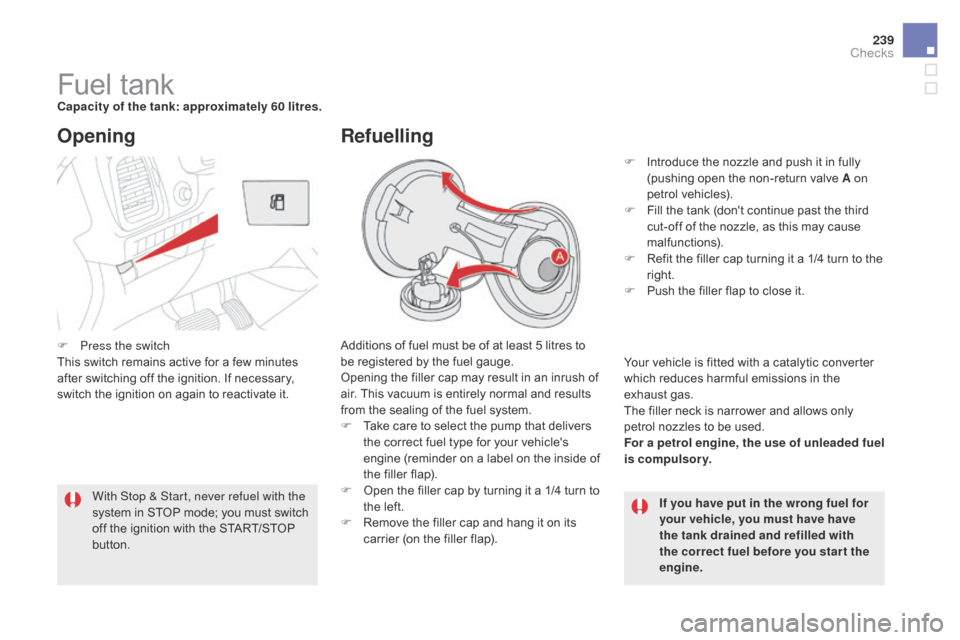
F
Ta
ke care to select the pump that delivers
the correct fuel type for your vehicle's
engine (reminder on a label on the inside of
the filler flap).
F
Op
en the filler cap by turning it a 1/4 turn to
the left.
F
Re
move the filler cap and hang it on its
carrier (on the filler flap).
Opening
If you have put in the wrong fuel for
your vehicle, you must have have
the tank drained and refilled with
the correct fuel before you star t the
engine.
With Stop & Start, never refuel with the
system in STOP mode; you must switch
off the ignition with the START/STOP
button.
Refuelling
F Introduce the nozzle and push it in fully
(
pushing open the non-return valve A on
petrol vehicles).
F
Fi
ll the tank (don't continue past the third
cut-off of the nozzle, as this may cause
malfunctions).
F
Re
fit the filler cap turning it a 1/4 turn to the
right.
F
Pu
sh the filler flap to close it.
Your vehicle is fitted with a catalytic converter
which reduces harmful emissions in the
exhaust gas.
The filler neck is narrower and allows only
petrol nozzles to be used.
For a petrol engine, the use of unleaded fuel
is compulsory.
F
Pr
ess the switch
This switch remains active for a few minutes
after switching off the ignition. If necessary,
switch the ignition on again to reactivate it.
checks
Page 242 of 376
DS5_en_Chap09_verifications_ed02-2015
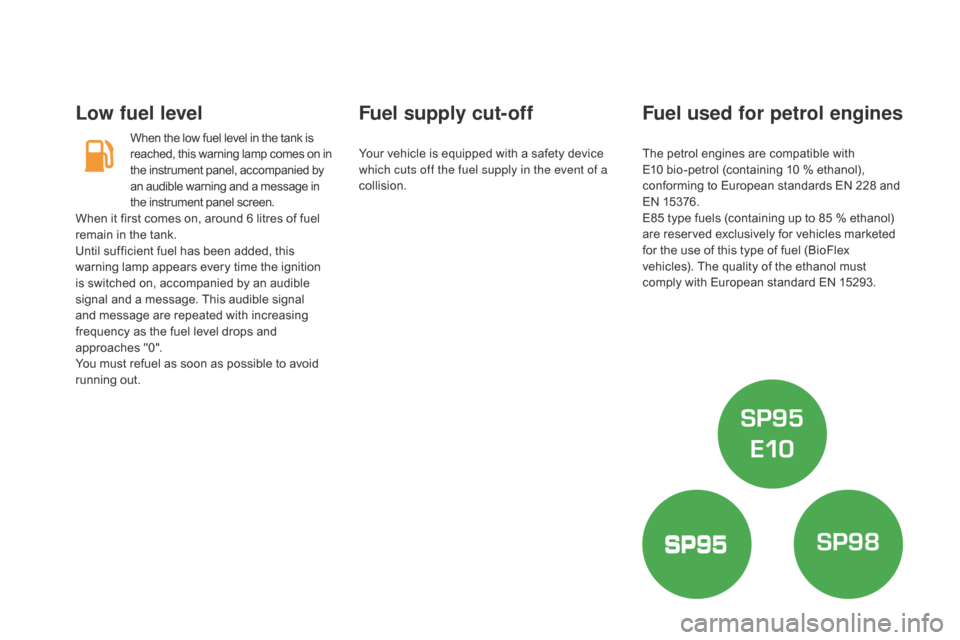
Low fuel level
When the low fuel level in the tank is
reached, this warning lamp comes on in
the instrument panel, accompanied by
an audible warning and a message in
the instrument panel screen.
Fuel supply cut-offFuel used for petrol engines
The petrol engines are compatible with
E10 bio-petrol (containing 10 % ethanol),
conforming to European standards EN 228 and
EN 15376.
E85 type fuels (containing up to 85 % ethanol)
are reserved exclusively for vehicles marketed
for the use of this type of fuel (BioFlex
vehicles). The quality of the ethanol must
comply with European standard EN 15293.
When it first comes on, around 6 litres of fuel
remain in the tank.
Until sufficient fuel has been added, this
warning lamp appears every time the ignition
is switched on, accompanied by an audible
signal and a message. This audible signal
and message are repeated with increasing
frequency as the fuel level drops and
approaches "0".
You must refuel as soon as possible to avoid
running out. Your vehicle is equipped with a safety device
which cuts off the fuel supply in the event of a
collision.
Page 243 of 376
DIESEL
241
DS5_en_Chap09_verifications_ed02-2015
Fuel used for diesel
engines
The Diesel engines are compatible with
biofuels available at the pumps which meet
current and future European standards:
-
Di
esel fuel that meets standard EN 590
mixed with a biofuel that meets standard
EN 14214,
-
Di
esel fuel that meets standard EN16734
mixed with a biofuel that meets standard
EN14214 (possibly containing up
to
1
0
% F
atty Acid Methyl Ester),
-
Pa
raffinic Diesel fuel that meets standard
EN15940 mixed with a biofuel that meets
standard EN14214 (possibly containing up
to 7 % Fatty Acid Methyl Ester). The use of B20 or B30 fuel meeting standard
EN16709 is possible in your Diesel engines.
However, this use, even occasional, requires
strict application of the special servicing
conditions referred to as "Arduous conditions".
For more information, contact a CITROËN
dealer or a qualified workshop.
The use of any other type of (bio)fuel
(vegetable or animal oils, pure or diluted,
domestic fuel...) is strictly prohibited (risk of
damage to the engine and fuel system).
Only the use of Diesel fuel additives that meet
the standard B715000 is authorised.
checks