fuel Citroen JUMPY 2013 2.G User Guide
[x] Cancel search | Manufacturer: CITROEN, Model Year: 2013, Model line: JUMPY, Model: Citroen JUMPY 2013 2.GPages: 248, PDF Size: 8.07 MB
Page 39 of 248
37
Instruments and controls
READY TO GO
2
Operation
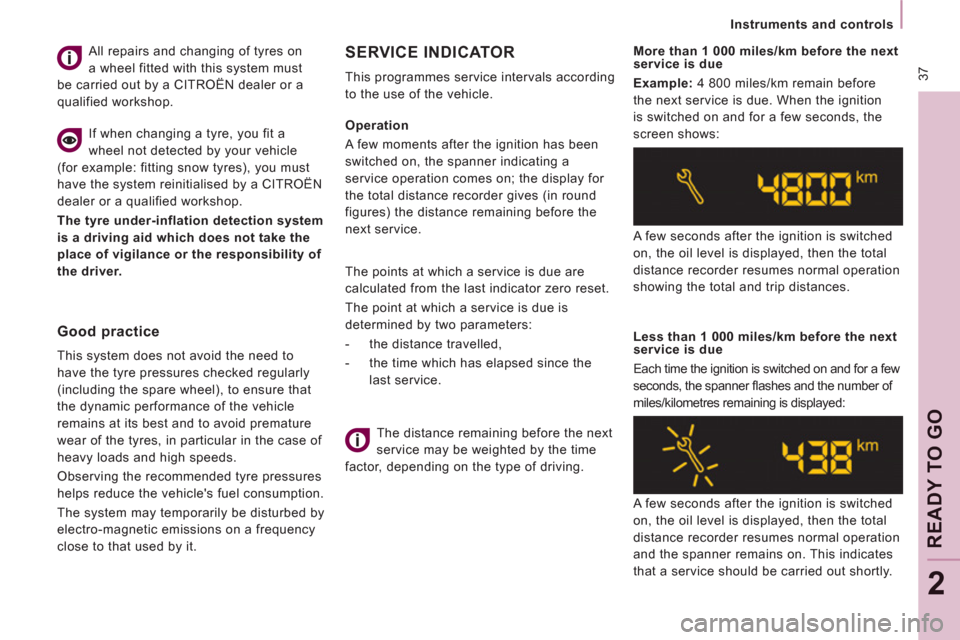
A few moments after the ignition has been
switched on, the spanner indicating a
service operation comes on; the display for
the total distance recorder gives (in round
figures) the distance remaining before the
next service.
A few seconds after the ignition is switched
on, the oil level is displayed, then the total
distance recorder resumes normal operation
showing the total and trip distances.
Less than 1 000 miles/km before the next
service is due
Each time the ignition is switched on and for a few
seconds, the spanner fl ashes and the number of
miles/kilometres remaining is displayed:
A few seconds after the ignition is switched
on, the oil level is displayed, then the total
distance recorder resumes normal operation
and the spanner remains on. This indicates
that a service should be carried out shortly. The distance remaining before the next
service may be weighted by the time
factor, depending on the type of driving.
More than 1 000 miles/km before the next
service is due
Example:
4 800 miles/km remain before
the next service is due. When the ignition
is switched on and for a few seconds, the
screen shows:
SERVICE INDICATOR
This programmes service intervals according
to the use of the vehicle.
The points at which a service is due are
calculated from the last indicator zero reset.
The point at which a service is due is
determined by two parameters:
- the distance travelled,
- the time which has elapsed since the
last service. All repairs and changing of tyres on
a wheel fitted with this system must
be carried out by a CITROËN dealer or a
qualified workshop.
Good practice
This system does not avoid the need to
have the tyre pressures checked regularly
(including the spare wheel), to ensure that
the dynamic performance of the vehicle
remains at its best and to avoid premature
wear of the tyres, in particular in the case of
heavy loads and high speeds.
Observing the recommended tyre pressures
helps reduce the vehicle's fuel consumption.
The system may temporarily be disturbed by
electro-magnetic emissions on a frequency
close to that used by it. If when changing a tyre, you fit a
wheel not detected by your vehicle
(for example: fitting snow tyres), you must
have the system reinitialised by a CITROËN
dealer or a qualified workshop.
The tyre under-inflation detection system
is a driving aid which does not take the
place of vigilance or the responsibility of
the driver.
Page 42 of 248

40
Gearboxes and steering wheel
GEAR SHIFT INDICATOR
This system allows fuel consumption to be
reduced by suggesting when to change up.
With an electronic gearbox, the system is
only active in Manual mode.
Depending on the driving conditions and the
equipment of your vehicle, the system may
recommend skipping one or more gears.
You can follow this indication without going
through the intermediate gears.
Illumination of this symbol
indicates that the driver can
change up.
On vehicles with a manual gearbox,
the arrow may be accompanied by the
recommended gear.
The system adapts its gear change
recommendations according to the driving
conditions (slope, load,...) and demands
from the driver (for power, acceleration,
braking,...). The gear engagement recommendations
should not be considered to be compulsory.
This because the configuration of the
road, the traffic density and safety remain
determining factors when choosing the
best gear. Therefore, the driver remains
responsible for deciding whether or not to
follow the advice given by the system.
This system cannot be deactivated.
The system never recommends engaging
first gear or reverse, or changing down.
Page 66 of 248
64
Ventilation
Good practice
To avoid any risk of poisoning or
asphyxiation, the heater must not be used,
even for short periods, in an enclosed space
such as a garage or workshop which is not
fitted with an exhaust gas extraction system.
Do not park the vehicle on an inflammable
surface (dry grass, dead leaves, paper…),
there is a risk of fire. The temperature near the heater must not
exceed 120 °C. A temperature higher than
this (for example in the case of painting in
an oven) could damage the components of
the electronic circuits.
The heater is supplied by the vehicle's fuel
tank. Ensure that the low fuel warning lamp
is not on.
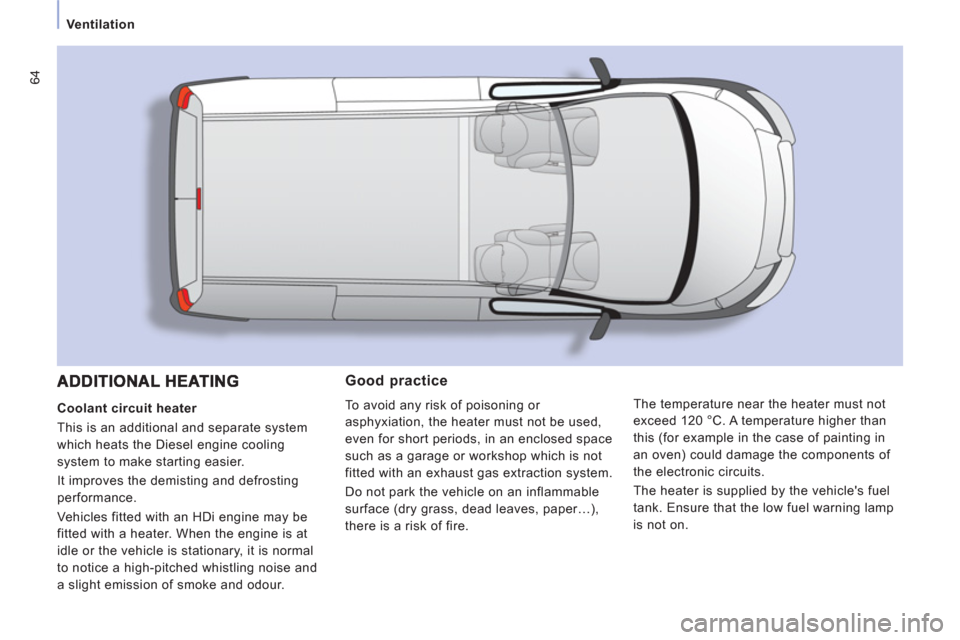
Coolant circuit heater
This is an additional and separate system
which heats the Diesel engine cooling
system to make starting easier.
It improves the demisting and defrosting
performance.
Vehicles fitted with an HDi engine may be
fitted with a heater. When the engine is at
idle or the vehicle is stationary, it is normal
to notice a high-pitched whistling noise and
a slight emission of smoke and odour.
Page 90 of 248

88
Driving safely
"GRIP CONTROL"
On snow, mud and sand, this traction
system, associated with the Michelin ® Agilis
51 M+S all terrain tyres, provides a
compromise between safety, adhesion and
traction.
It allows progress to be made in most
conditions of low adhesion. The accelerator pedal must
be pressed sufficiently
so that the engine power
can be used to effectively
manage the various
parameters.
Correct use
Your vehicle is designed principally to drive
on tarmac roads but it allows you to drive on
other less passable terrain occasionally.
However, particularly when your vehicle is
heavily laden, it does not permit off-road
activities such as:
- crossing and driving on ground which
could damage the underbody or tear off
components (fuel pipe, fuel cooler, ...),
particularly by obstacles or stones,
- driving on ground with steep gradients
and poor grip,
- crossing a stream.
Page 118 of 248

11 6
Fuel
FILLING WITH FUEL
Filling with fuel
The fuel tank must be fi lled with the engine off
.
Low fuel level
When this warning lamp fi rst comes
on and when the needle is at the
start of the red zone, the minimum
fuel tank level has been reached.
At this moment, you have approximately
8 litres
of fuel remaining.
Fill up without delay to avoid running out of fuel. When filling with fuel, do not open the
left-hand side door, if fitted on your
vehicle, as there is a risk of damage to the
fuel filler flap.
- Open the fuel filler flap.
Insert the key, then turn it a quarter turn.
- Remove the cap and hook it onto the
clip located on the inside of the flap.
It is normal to hear the noise of an inrush
of air when the cap is opened as there is a
vacuum caused by the sealing of the fuel
system.
A label affixed to the inside of the flap
reminds you of the type of fuel to be used.
More than 8 litres of fuel must be added in
order to be registered by the fuel gauge.
When filling the fuel tank, do not continue
after the 3 rd cut-off of the nozzle. This could
cause malfunctions.
The capacity of the fuel tank is
approximately 80 litres.
- After filling the fuel tank, lock the cap
and close the flap.
Never continue to drive until you run
out of fuel as this may damage the
emission control and injection systems.
Page 119 of 248
DIESEL
11
7
Fuel
CHECK
S
6
FUEL CUT-OFF
DIESEL PRIMING PUMP
If you should run out of fuel, it is necessary
to prime the circuit:
- fill the fuel tank with at least five litres of
diesel,
- squeeze and release the manual priming
pump, under the bonnet under the
protective cover, until fuel appears in the
transparent pipe,
- operate the starter until the engine
starts. In a serious collision, a mechanism
automatically prevents fuel from reaching
the engine.
The flashing of this warning lamp
is accompanied by a message in
the screen.
Check that there is no odour or leakage of
fuel outside the vehicle and re-establish the
fuel supply:
- switch off the ignition (STOP position),
- remove the key,
- put the key back in the ignition,
- switch on the ignition and start.
Quality of the fuel used for petrol
engines
Quality of the fuel used for Diesel
engines
The petrol engines are perfectly compatible
with E10 or E24 type petrol biofuels
(containing 10 % or 24 % ethanol),
conforming to European standards EN 228
and EN 15376.
E85 type fuels (containing up to 85 %
ethanol) are reserved exclusively for
vehicles marketed for the use of this type
of fuel (BioFlex vehicles). The quality of
the ethanol must comply with European
standard EN 15293.
For Brazil only, special vehicles are
marketed to run on fuels containing up to
100 % ethanol (E100 type).
The Diesel engines are perfectly compatible
with biofuels which conform to current
and future European standards (Diesel
fuel which complies with standard EN 590
mixed with a biofuel which complies with
standard EN 14214) available at the pumps
(containing up to 7 % Fatty Acid Methyl
Ester).
The B30 biofuel can be used in certain
Diesel engines; however, this use is subject
to strict application of the special servicing
conditions. Contact a CITROËN dealer or a
qualified workshop.
The use of any other type of (bio)fuel
(vegetable or animal oils, pure or diluted,
domestic fuel...) is strictly prohibited (risk of
damage to the engine and fuel system).
Page 120 of 248

118
Fuel
DIESEL PRIMING BUTTON
If you should run out of fuel, it is necessary
to prime the system using the priming
button:
- fill the fuel tank with at least five litres of
Diesel fuel,
- open the bonnet,
- unclip the protective cover for access to
the priming push button,
- place the cover to the right of the
engine,
- firmly squeeze and release the manual
priming pump until fuel stiffens the pipe,
- operate the starter until the engine
starts,
- place the two slots in the lugs behind the
engine to allow the protective cover to
be refitted,
- clip the protective cover in place,
- close the bonnet. If the engine does not start first time,
do not keep trying.
Operate the priming push button again,
then start the engine.
Page 139 of 248
137
Changing a fuse
QUICK HEL
P
7
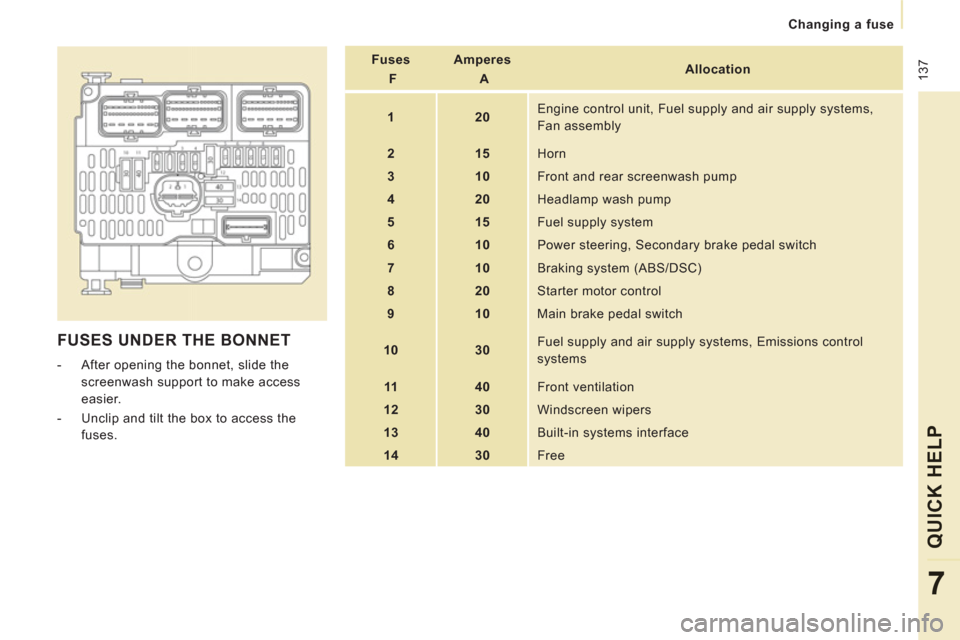
FUSES UNDER THE BONNET
- After opening the bonnet, slide the
screenwash support to make access
easier.
- Unclip and tilt the box to access the
fuses.
Fuses
F
Amperes
A
Allocation
1
20
Engine control unit, Fuel supply and air supply systems,
Fan assembly
2
15
Horn
3
10
Front and rear screenwash pump
4
20
Headlamp wash pump
5
15
Fuel supply system
6
10
Power steering, Secondary brake pedal switch
7
10
Braking system (ABS/DSC)
8
20
Starter motor control
9
10
Main brake pedal switch
10
30
Fuel supply and air supply systems, Emissions control
systems
11
40
Front ventilation
12
30 Windscreen wipers
13
40
Built-in systems interface
14
30
Free
Page 203 of 248
9.51
11TRIP COMPUTER
TRIP COMPUTER
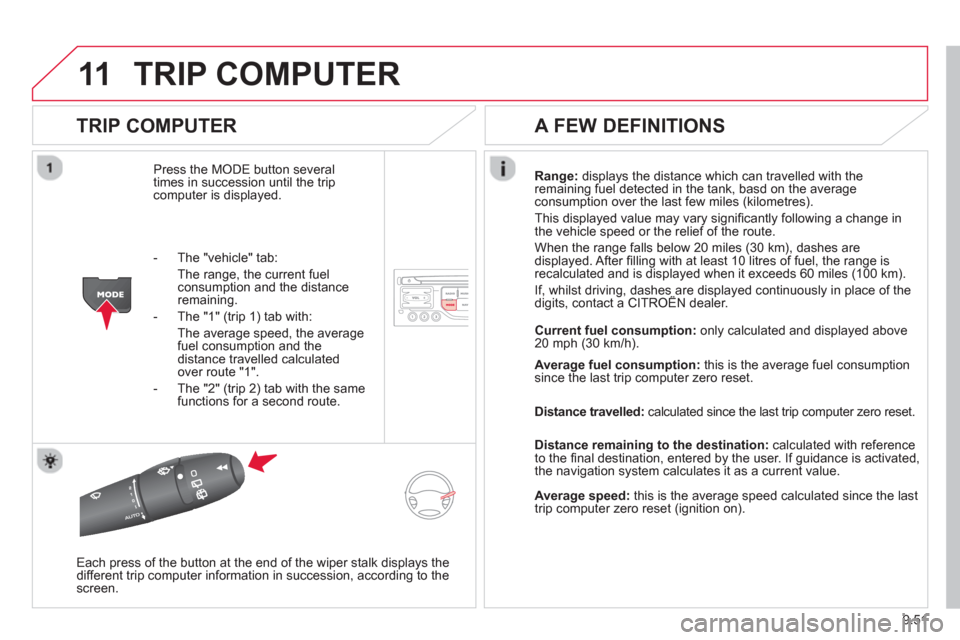
Press the MODE button several
times in succession until the tripcomputer is displayed.Ran
ge: displays the distance which can travelled with the
remaining fuel detected in the tank, basd on the averageconsumption over the last few miles (kilometres).
This displa
yed value may vary signifi cantly following a change in
the vehicle speed or the relief of the route.
When the ran
ge falls below 20 miles (30 km), dashes are
displayed. After fi lling with at least 10 litres of fuel, the range is
recalculated and is displayed when it exceeds 60 miles (100 km).
If, whilst driving, dashes are displayed continuously in place of the digits, contact a CITROÀN dealer.,g, p
Each press of the button at the end of the wiper stalk displays the
different trip computer information in succession, according to the screen.
A FEW DEFINITIONS
- The "vehicle" tab:
The ran
ge, the current fuelconsumption and the distance remaining.
- The "1"
(trip 1) tab with:
The average speed, the average fuel consumption and the distance travelled calculatedover route "1".
- The "2"
(trip 2) tab with the same
functions for a second route. Current fuel consum
ption:only calculated and displayed above
20 mph (30 km/h).
Avera
ge fuel consumption:this is the average fuel consumption since the last trip computer zero reset.
Distance travelled:
calculated since the last trip computer zero reset.
Distance remaining to the destination:calculated with referenceto the fi nal destination, entered by the user. If guidance is activated,
the navigation system calculates it as a current value.
Average speed:this is the average speed calculated since the last
trip computer zero reset (ignition on).
Page 229 of 248
9.77
08
13
TRIP COMPUTER
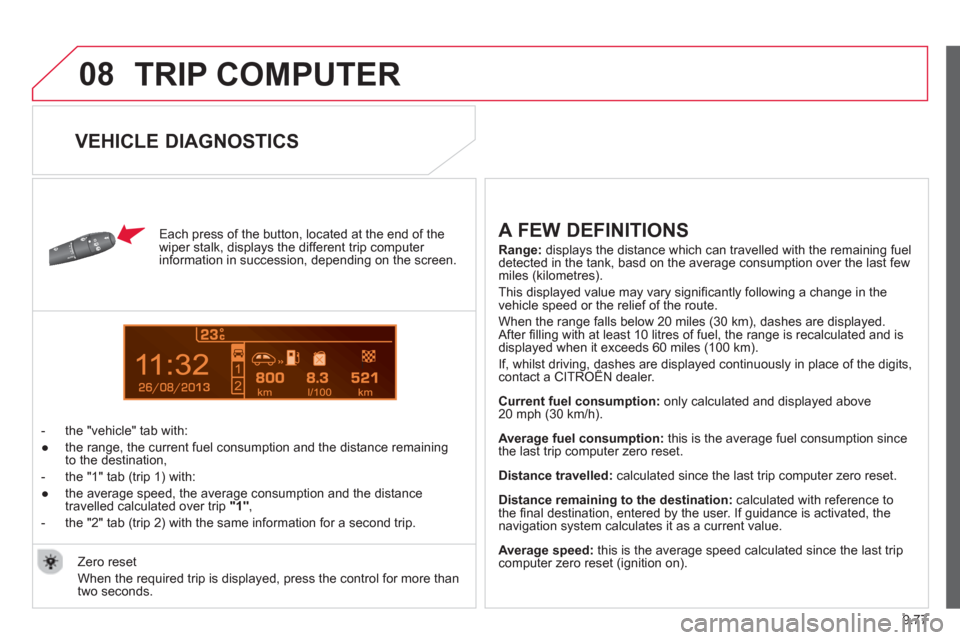
Each press of the button, located at the end of the
wiper stalk, displays the different trip computer
information in succession, depending on the screen.
- t
he "vehicle" tab with:
●
the ran
ge, the current fuel consumption and the distance remainingto the destination,
- the "1" tab
(trip 1) with:
●
the avera
ge speed, the average consumption and the distance
travelled calculated over trip "1"
,
- the "2" tab
(trip 2) with the same information for a second trip.
A FEW DEFINITIONS
Range:displays the distance which can travelled with the remaining fuel
detected in the tank, basd on the average consumption over the last few miles (kilometres).
This displa
yed value may vary signifi cantly following a change in the
vehicle speed or the relief of the route.
When the ran
ge falls below 20 miles (30 km), dashes are displayed.After fi lling with at least 10 litres of fuel, the range is recalculated and is
displayed when it exceeds 60 miles (100 km).
If, whilst driving, dashes are displayed continuously in place of the digits, contact a CITROËN dealer.,g,
Current fuel consumption: only calculated and displayed above
20 mph (30 km/h).
Avera
ge fuel consumption: this is the average fuel consumption since
the last trip computer zero reset.
Distance travelled:calculated since the last trip computer zero reset.
Distance remaining to the destination: calculated with reference to
the fi nal destination, entered by the user. If guidance is activated, thenavigation system calculates it as a current value.
Average speed: this is the average speed calculated since the last tripcomputer zero reset (ignition on). Zero reset
When the required trip is displa
yed, press the control for more than
two seconds.
VEHICLE DIAGNOSTICS