seat Citroen JUMPY 2013 2.G User Guide
[x] Cancel search | Manufacturer: CITROEN, Model Year: 2013, Model line: JUMPY, Model: Citroen JUMPY 2013 2.GPages: 248, PDF Size: 8.07 MB
Page 33 of 248

31
Instruments and controls
READY TO GO
2
Warning lamp
is
indicates
Solution-action
Front / lateral /
curtain airbag flashing or
remains on. failure of an airbag. Have the system checked by a CITROËN dealer or a
qualified workshop without delay. Chapter 4, "Airbags"
section.
Front
passenger
airbag
deactivated on. intentional deactivation of this
airbag in the presence of a
rearwards facing child seat. Chapter 4, "Airbags-children on board" section.
Low fuel level on with gauge
needle in the red
zone. that when it first comes on
approximately 8 litres
of fuel
remain. It is essential to fill the tank to avoid running out of fuel.
Never continue to drive until you run out of fuel, this
could damage the emissions control and injection
systems.
Tank capacity: approximately 80 litres. remains on each
time the ignition
is switched on. not enough fuel added.
flashing. fuel supply cut off following a
serious impact. Restore the supply. Chapter 6, "Fuel" section.
EOBD emission
control system flashing or
remains on. malfunction of the system. Have the system checked by a CITROËN dealer or a
qualified workshop as soon as possible.
Battery charge on. fault in the charging circuit. Check the battery terminals, … Chapter 7, "Battery"
section.
flashing. placing of the active functions
on standby (economy mode). Chapter 7, "Battery" section.
remaining on,
in spite of the
checks. faulty circuit, injection or
ignition malfunction. Contact a CITROËN dealer or a qualified workshop.
Page 69 of 248

67
Seats
EASE OF USE
and COMFOR
T
3
FRONT SEATS
Depending on the version and configuration
of your vehicle, different front seats are
fitted, either:
- a driver's seat and a passenger seat,
- an individual driver's seat and a two-
seat passenger bench.
Depending on the models, the following
adjustments are available:
3 - Driver's seat height adjustment
Depending on the version and configuration
of your vehicle, you have either:
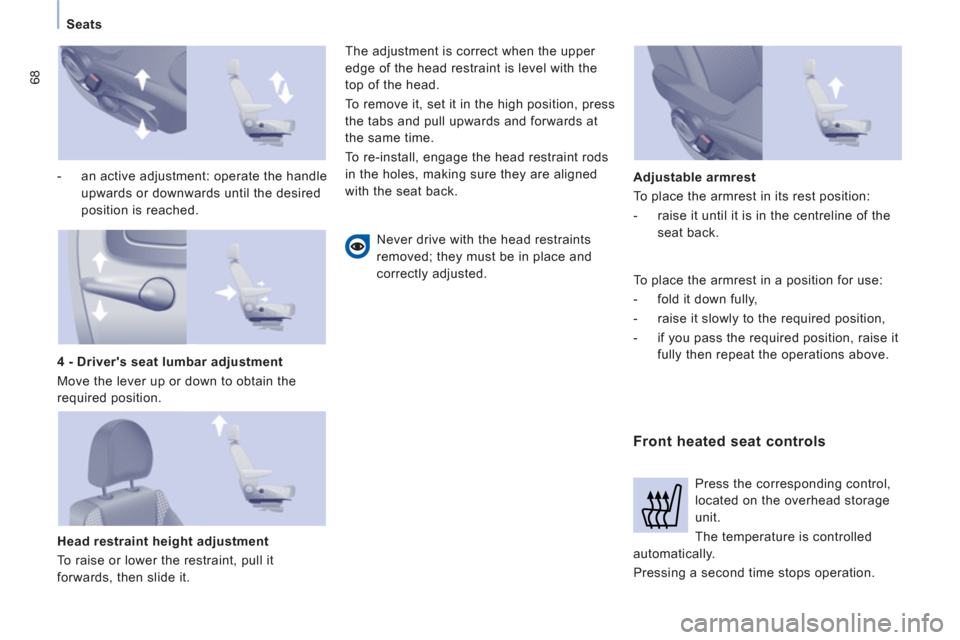
- a passive adjustment: pull the handle
upwards then take your weight off the
seat to raise, or push on the seat to
lower,
2 - Seat back angle adjustment
Pull the lever upwards and set the required
angle.
1 - Forwards/backwards adjustment
Lift the bar and slide the seat forwards or
backwards.
Page 70 of 248
68
Seats
- an active adjustment: operate the handle
upwards or downwards until the desired
position is reached.
Head restraint height adjustment
To raise or lower the restraint, pull it
forwards, then slide it. The adjustment is correct when the upper
edge of the head restraint is level with the
top of the head.
To remove it, set it in the high position, press
the tabs and pull upwards and forwards at
the same time.
To re-install, engage the head restraint rods
in the holes, making sure they are aligned
with the seat back.
Never drive with the head restraints
removed; they must be in place and
correctly adjusted.
Front heated seat controls
Adjustable armrest
To place the armrest in its rest position:
- raise it until it is in the centreline of the
seat back.
4 - Driver's seat lumbar adjustment
Move the lever up or down to obtain the
required position.
Press the corresponding control,
located on the overhead storage
unit.
The temperature is controlled
automatically.
Pressing a second time stops operation. To place the armrest in a position for use:
- fold it down fully,
- raise it slowly to the required position,
- if you pass the required position, raise it
fully then repeat the operations above.
Page 71 of 248

69
Seats
EASE OF USE
and COMFOR
T
3
2-SEAT FRONT BENCH
If your vehicle is fitted with this bench seat,
it is fixed and has a 3rd seat belt.
Head restraint
Press the tab to adjust the height of the
head restraint.
To remove the head restraint, press the tabs
and raise the head restraint.
The adjustment is correct when the upper
edge of the head restraint is level with the
top of the head.
Never drive with the head restraints
removed; they must be in place and
adjusted correctly.
Page 72 of 248
70
Seats
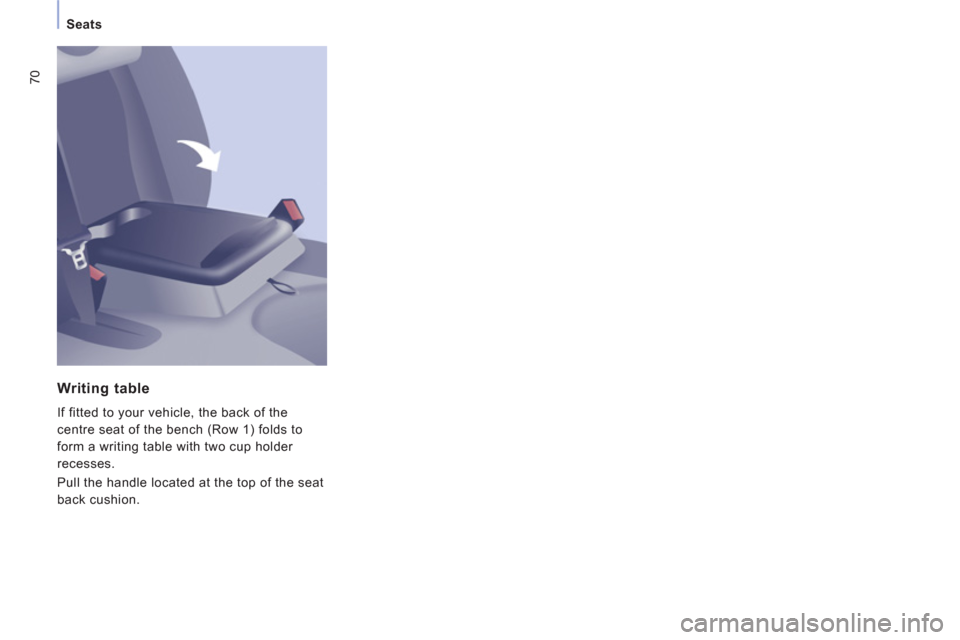
Writing table
If fitted to your vehicle, the back of the
centre seat of the bench (Row 1) folds to
form a writing table with two cup holder
recesses.
Pull the handle located at the top of the seat
back cushion.
Page 77 of 248

75
Practical information
EASE OF USE
and
COMFOR
T
3
CREW CAB
Bench seat
The crew cab consists of a 3-seat bench,
located in row 2, the one-piece back of
which is fixed to the "load retainer" glazed
partition.
Access to the rear seats is via the sliding
side door.
Head rests and seat belts
Each seat has a head rest adjustable for
height and angle.
The three seats are equipped with inertia
reel seat belts. The seat belts are integral
with the backrest of the bench seat.
Ensure that the seat belt is attached to the
correct buckle.
For more information on the use of this
equipment, refer to "Seat belts" in section 4.
Good practice
The rear seat belt stalks are not designed for securing the load transported. Use the lashing rings on the floor only.
The bench seat of the crew cab is not suitable for the installation of a child seat.
Rear side glasses
If fitted to your vehicle, the side glasses can
be opened.
Squeeze the two controls together then slide
the window. There are 4 position notches.
When driving, the glass should be closed or
secured at one of the 4 notches.
Page 79 of 248

77
Practical information
EASE OF USE
and COMFOR
T
3
12 volt socket
This operates with the ignition on.
Maximum power: 120 W.
Load retainer
On the floor, behind the front seats, a
horizontal partition protects the driver and
front passengers against the risk of load
movement.
Panel or glazed separation partitions permit
separation of the load space from the cab.
Ladder type vertical separation or
partition
Behind the driver's seat, a ladder type
vertical separation or partition protects the
driver against the risk of load movement.
Page 92 of 248

90
Seat belts
Height adjustment
Squeeze the control with the return and slide
the assembly on the driver's seat side and
on the individual passenger seat side.
If your vehicle is fitted with a front bench,
the height of the seat belt associated with
the centre seat cannot be adjusted.
Unfastening
Press the red button.
SEAT BELTS
Good practice
The driver must ensure that passengers
use the seat belts correctly and that they
are all strapped in securely before moving
off.
Wherever you are seated in the vehicle,
always fasten your seat belt, even for short
journeys.
The seat belts are fitted with an inertia reel
which automatically adjusts the length of the
strap to your size.
Do not use accessories (clothes pegs, clips,
safety pins, etc.) which allow the seat belt
straps to fit loosely.
Ensure that the seat belt has reeled in
correctly after use.
After folding or moving a seat or a rear
bench seat, ensure that the seat belt has
reeled in correctly and that the buckle is
ready to accommodate the tongue.
Depending on the nature and seriousness
of any impact, the pretensioning device may
be deployed before and independently of
inflation of the airbags. It instantly tightens
the seat belts against the body of the
occupants.
Deployment of the pretensioners is
accompanied by a slight discharge of
harmless smoke and a noise, due to the
activation of the pyrotechnic cartridge
incorporated in the system.
Fastening
Pull the strap, then insert the tongue into the
buckle.
Check that the seat belt is fastened correctly
by pulling the strap.
Driver's seat belt not fastened warning
lamp
Passenger seat belt not fastened warning
lamp When the vehicle is started, this
warning lamp comes on if the
driver has not fastened their seat
belt.
If your vehicle is fitted with a front
passenger seat, when the vehicle
is started, this warning lamp
comes on if the passenger has not
fastened their seat belt.
Page 93 of 248

91
Seat belts
SAFETY
4
The force limiter reduces the pressure of
the seat belt against the body of the
occupants.
The pretensioning seat belts are active when
the ignition is switched on.
The inertia reels are fitted with a device
which automatically locks the strap in the
event of a collision or emergency braking or
if the vehicle rolls over.
You can unfasten the seat belt by pressing
the red button on the buckle. Guide the seat
belt after unfastening.
The airbag warning lamp comes on if
the pretensioners are deployed. Contact
a CITROËN dealer or a qualified
workshop.
In order to be effective, a seat belt
must:
- restrain one person only,
- must not be twisted, check by pulling
in front of you with an even
movement,
- be tightened as close to the body as
possible.
The upper part of the seat belt should
be positioned in the hollow of
the shoulder.
The lap part should be placed as low as
possible on the pelvis.
Do not invert the seat belt buckles as they
will not fulfil their role completely. If the
Recommendations for children:
- use a suitable child seat if the
passenger is less than 12 years old or
shorter than one metre fifty,
- never allow a child to travel on your lap,
even with the seat belt fastened.
FRONT SEAT BELTS
For more information on child seats,
refer to the "Children on board" section
of chapter 4.
In accordance with current safety
regulations, your CITROËN dealer can
guarantee all work or any checks, from
testing to maintenance, on your seat belt
equipment.
Have the seat belts checked regularly (even
after a minor impact) by a CITROËN dealer
or a qualified workshop: they must not show
any signs of wear, cutting or fraying and they
must not be converted or modified.
Clean the seat belt straps with soapy
water or a textile cleaning product, sold
by CITROËN dealers.
With front airbags
The front seats are fitted with pretensioners
and force limiters.
Without front airbag
If your vehicle is fitted with a front bench
without front airbag, the centre passenger's
seat belt does not have a pretensioner.
With bench seat
If your vehicle is fitted with a front bench
seat, take care to fasten the correct seat
belt using the correct buckle. Do not mix the
driver's seat belt or buckle with the buckle or
seat belt of the centre seat. seats are fitted with armrests, the lap part of
the seat belt should always pass under the
armrest.
Check that the seat belt is fastened correctly
by pulling the strap firmly.
Page 95 of 248

93
Airbags
SAFETY
4
The airbags have been designed to
maximise the safety of the occupants in the
event of a serious collision; they work in
conjunction with the force limiting seat belts.
In the event of a serious collision, the
electronic detectors record and analyse the
front and side impacts suffered in the impact
detection zones:
- in the event of a serious impact, the
airbags infl ate instantly and contribute
towards better protecting the occupants of
the vehicle. Immediately after the impact,
the airbags defl ate rapidly, so that they do
not hinder the visibility of the occupants
nor their possible exit from the vehicle.
- in the event of a minor or rear impact
and in certain roll-over conditions, the
airbags will not be deployed; the seat
belt alone is sufficient to contribute
towards your protection in these
situations.
The seriousness of the collision depends on
the nature of the obstacle and the speed of
the vehicle at the moment of impact. It is imperative that the passenger's
airbag is deactivated if a child seat
is installed facing rearwards. Refer to the
"Children on board" section of chapter 4.
Airbags only operate when the
ignition is switched on.
AIRBAGS
This equipment only operates once. If a
second impact occurs (during the same or
a subsequent accident), the airbag will not
operate.
The deployment of an airbag or airbags is
accompanied by a slight discharge of smoke
and a noise, due to the activation of the
pyrotechnic cartridge incorporated in the
system.
This smoke is not harmful, but sensitive
individuals may experience some irritation.
The noise of the detonation may result in a
slight loss of hearing for a short time.