safety CITROEN JUMPY 2018 User Guide
[x] Cancel search | Manufacturer: CITROEN, Model Year: 2018, Model line: JUMPY, Model: CITROEN JUMPY 2018Pages: 324, PDF Size: 10.05 MB
Page 42 of 324
40
Access
CITROËN dealer or a qualified workshop if
you want to deactivate this warning.
Lock the vehicle when you use an automatic
car wash.
Before opening or closing and while
moving doors, ensure that no person,
animal or object is in the door frame or any
other position that would block the desired
movement, inside or outside the vehicle.
If this advice is not followed, injuries or
damage may occur if any part of a person or
an object is trapped or caught.
Electrical door opening is disabled at speeds
above 2 mph (3 km/h):
–
However
, if the vehicle started moving
while the doors were open, the speed must
be reduced below 19 mph (30
km/h) before
they can be closed.
–
Any attempt to open a door electrically
using the interior handle while driving results
in it only being possible to open the door
manually
.
–
This situation is accompanied by the
audible warning, the lighting of the "door
open" warning lamp and the message on the
screen.
To release the door and be able to
operate it again, it is necessary to stop the
vehicle.
Take care not to block the guide space on the floor so that the door can slide
correctly.
For safety and functional reasons, do not
drive with the sliding side door open.
The electric controls are disabled in the event of an impact. Manual opening and
closing remain possible.
While starting the engine, door
movements are paused, resuming when
the engine is running.
Depending on the engine fitted, if
the door is closed and an opening
request is issued in Stop mode of Stop &
Start, the door will open slightly and then
stop. In Start mode, the door will resume its
movement when the engine re-starts.
To hold the sliding side door in the open position, open the door fully to engage
the latch (located at the bottom of the door).
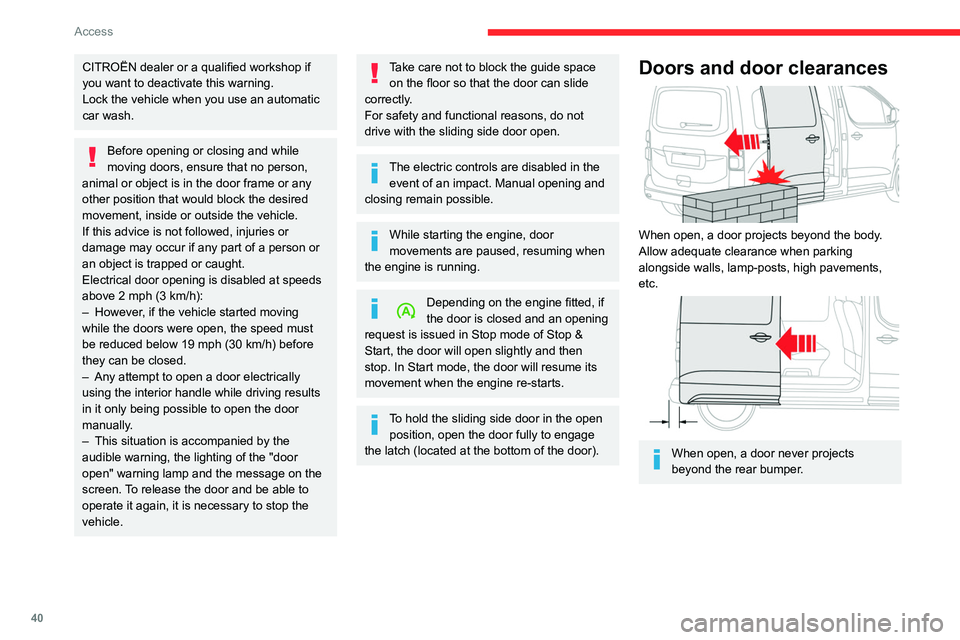
Doors and door clearances
When open, a door projects beyond the body.
Allow adequate clearance when parking
alongside walls, lamp-posts, high pavements,
etc.
When open, a door never projects
beyond the rear bumper.
Page 43 of 324

41
Access
2Safety/Obstacle detection
with electric door(s)
The obstacle detection system is triggered when
the moving door encounters an obstacle with a
certain level of physical resistance. If an obstacle
is detected:
–
while the door is closing, the door stops then
opens fully
.
–
while the door is opening, the door stops then
closes.
–
twice in succession during a movement of the
door
, the door will no longer close electrically
(uninitialisation).
On a steep slope: a safety system slows down
the movement of the door.
In all cases, wait a few seconds before operating
the door (closing or opening).
Close the door manually for safety reasons.
Then reinitialise the door.
Reinitialising electric doors
If electrical operations no longer work:
► Fully close the door(s) manually
.►
Fully open the door(s)
electrically
.
►
Close the door(s)
electrically
.
On completion of this procedure, electric
operation of the doors is restored.
However, if a problem persists following this
procedure, contact a CITROËN dealer or a
qualified workshop.
On a steep slope
It is possible to open and close the doors
electrically on slopes of up to a 20% gradient.
If the vehicle is on a slope, with the front of the
vehicle facing up the slope, open the door with
care. The door may open more quickly due to
the incline.
On a steep slope, guide the side door manually
to help it to close.
If your vehicle is on a slope, with the front of the
vehicle facing down the slope, the door may not
stay open and may close violently with the risk
of injury.
In the case of a steep slope, the door
may be driven by its own weight and as a
consequence may open or close violently.
There would not be time for action at the
electric controls to take effect.
There would not be time for the obstacle
detection system to react.
Take care not to leave the vehicle on a
steep slope with the door(s) open without
supervision. If this advice is not followed,
injuries or damage may occur if a person or
an object is trapped or caught.
Page 49 of 324
47
Access
2Automatic activation
(Depending on version)
The system is activated automatically 2 minutes
after the last door or the boot is closed.
►
T
o avoid triggering the alarm on entering the
vehicle, first press the unlocking button on the
remote control or unlock the vehicle using the
"Keyless Entry and Start" system.
Electric windows
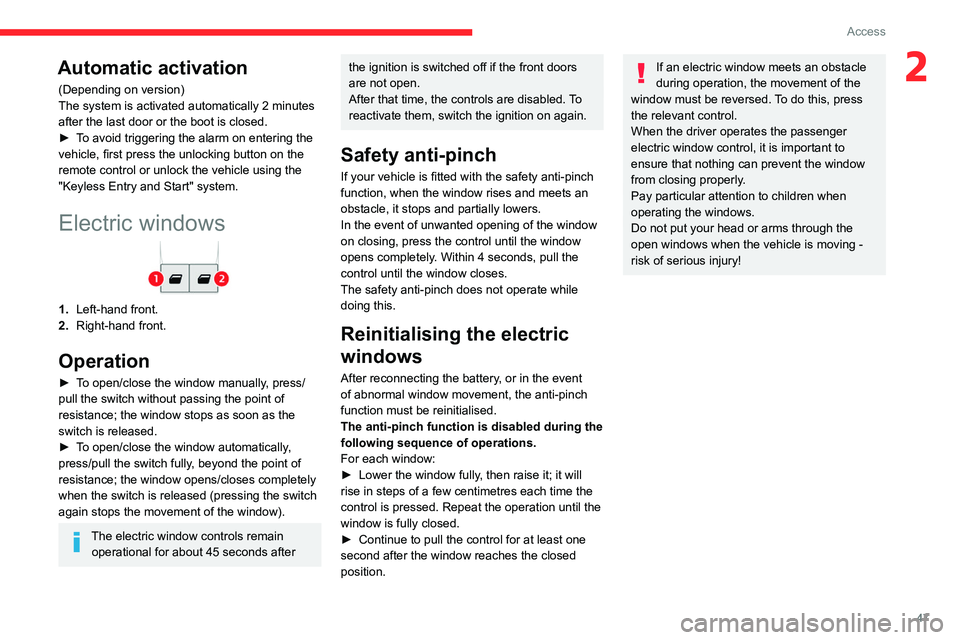
1. Left-hand front.
2. Right-hand front.
Operation
► To open/close the window manually, press/
pull the switch without passing the point of
resistance; the window stops as soon as the
switch is released.
►
T
o open/close the window automatically,
press/pull the switch fully, beyond the point of
resistance; the window opens/closes completely
when the switch is released (pressing the switch
again stops the movement of the window).
The electric window controls remain operational for about 45 seconds after
the ignition is switched off if the front doors
are not open.
After that time, the controls are disabled. To
reactivate them, switch the ignition on again.
Safety anti-pinch
If your vehicle is fitted with the safety anti-pinch
function, when the window rises and meets an
obstacle, it stops and partially lowers.
In the event of unwanted opening of the window
on closing, press the control until the window
opens completely. Within 4 seconds, pull the
control until the window closes.
The safety anti-pinch does not operate while
doing this.
Reinitialising the electric
windows
After reconnecting the battery, or in the event
of abnormal window movement, the anti-pinch
function must be reinitialised.
The anti-pinch function is disabled during the
following sequence of operations.
For each window:
►
Lower the window fully
, then raise it; it will
rise in steps of a few centimetres each time the
control is pressed. Repeat the operation until the
window is fully closed.
►
Continue to pull the control for at least one
second after the window reaches the closed
position.
If an electric window meets an obstacle
during operation, the movement of the
window must be reversed. To do this, press
the relevant control.
When the driver operates the passenger
electric window control, it is important to
ensure that nothing can prevent the window
from closing properly.
Pay particular attention to children when
operating the windows.
Do not put your head or arms through the
open windows when the vehicle is moving -
risk of serious injury!
Page 52 of 324

50
Ease of use and comfort
Backrest angle
► Tilt the control forwards or rearwards to
adjust the angle of the backrest.
Head restraint height
adjustment
If fitted to your vehicle.
► T o raise it, pull it upwards as far as possible
(notch).
►
T
o remove it, press the lug A and pull it
upwards.
► To put it back in place, engage the head
restraint rods in the openings keeping them in
line with the seat backrest.
►
T
o lower it, press the lug A and push down on
the head restraint at the same time.
The head restraint has a frame with notches which prevents it from lowering;
this is a safety device in case of impact.
The adjustment is correct when the upper
edge of the head restraint is level with the
top of the head.
Never drive with the head restraints removed;
they must be fitted and correctly adjusted.
2-seat front bench seat
If fitted in the vehicle, this is fixed and has a seat
belt built into the backrest for the seat next to the
driver’s seat.
For more information on the Seat belts,
refer to the corresponding section.
Under-seat storage
If the vehicle is so equipped, a storage space is
provided under the seat.
►
Pull the strap towards you to tip the seat
cushion.
Armrest
The armrest has notches.
► Pull the armrest fully up
►
Lower it fully down.
►
Raise the armrest to the desired position.
Page 54 of 324
52
Ease of use and comfort
This function provides lumbar massage; it only
operates when the engine is running as well as
in STOP mode of the Stop & Start system.
Activation/Deactivation
► Press this button to activate/deactivate
the function.
Upon activation, the indicator lamp comes on.
The massage function is activated for a period
of one hour
.
During this time, massage is performed in
6
cycles of 10 minutes (6 minutes of massage
followed by a 4-minute break).
After one hour, the function is deactivated; the
indicator lamp goes off.
Adjustment of intensity
Press this button to adjust the intensity of
the massage.
Two levels of massage are available.
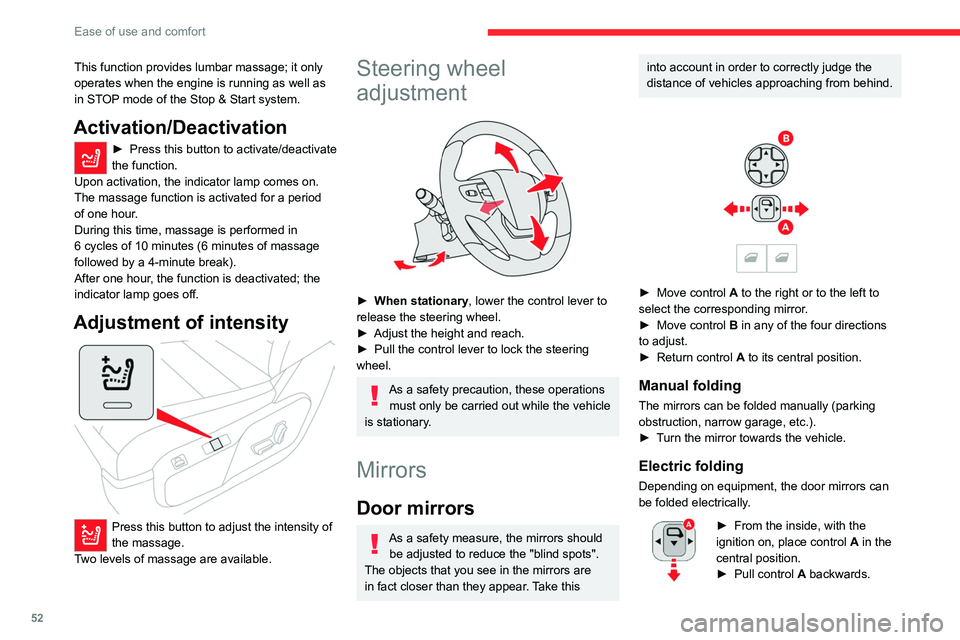
Steering wheel
adjustment
► When stationary , lower the control lever to
release the steering wheel.
►
Adjust the height and reach.
►
Pull the control lever to lock the steering
wheel.
As a safety precaution, these operations must only be carried out while the vehicle
is stationary.
Mirrors
Door mirrors
As a safety measure, the mirrors should be adjusted to reduce the "blind spots".
The objects that you see in the mirrors are
in fact closer than they appear. Take this
into account in order to correctly judge the
distance of vehicles approaching from behind.
► Move control A to the right or to the left to
select the corresponding mirror.
►
Move control
B in any of the four directions
to adjust.
►
Return control A
to its central position.
Manual folding
The mirrors can be folded manually (parking
obstruction, narrow garage, etc.).
►
T
urn the mirror towards the vehicle.
Electric folding
Depending on equipment, the door mirrors can
be folded electrically.
► From the inside, with the
ignition on, place control A
in the
central position.
►
Pull control A
backwards.
Page 58 of 324

56
Ease of use and comfort
turn it a quarter turn (in a clockwise direction) to
lock it.
►
Put the second fastener into the lower cut-out
2
, located on the seat base. Keep the fastener
pressed against the structure, then turn it a
quarter turn (in a clockwise direction) to lock it.
► Secure the first hook to the ring 3 located in
the glove box.
►
Secure the second hook to the ring 4
located
on the floor.
Removing the net
► Release the hooks from the rings 4 and 3.
► Remove the lower fastener 2
then the upper
fastener 1, turning them by a quarter turn
backwards to unlock them.
Make sure that the size, shape and
volume of the loads carried are
compatible with the highway code and safety
regulations and do not impair the driver’s field
of vision.
All loads must be appropriately secured
to prevent or minimise displacement and
prevent injury.
Install the anti-slip net (supplied with the
vehicle) every time that the seat is raised and
the partition flap removed.
Never use the net for any other purposes.
Regularly check the condition of the anti-
slip net. As soon as signs of wear or tear
appear, contact a CITROËN dealer to have
it replaced by an anti-slip net that meets the
specifications required by CITROËN for the
vehicle.
Always fit the removable flap back into place
when you are not carrying any long loads.
"Rotating writing table"
If fitted to your vehicle, the central seat cushion
of the bench seat can be tilted to form a pivoting
writing table, thus creating a mobile desk (with
the vehicle stationary).
►
Pull the handle located at the top of the
backrest cushion.
Never use the table while the vehicle is
being driven.
In the event of sudden braking or impact, any
objects on the table might become dangerous
projectiles that could cause injury.
Page 73 of 324

71
Ease of use and comfort
3If the power consumption becomes too
high and when required by the vehicle's
electrical system (particular weather
conditions, electrical overload, etc.), the
power supply to the socket will be cut off; the
green indicator lamp goes off
Load space cover
► To remove it, lift it up.
► T o install it, insert the guides into their
housings.
In the event of sudden deceleration,
objects placed on the load space cover
can turn into projectiles.
Loading area fittings
Stowing rings
Use the stowing rings on the rear floor to secure
loads.
As a safety precaution in case of sharp braking,
we recommend placing heavy objects as far
forwards as possible (i.e. near the cab).
We recommend immobilising the load by firmly
securing it using the stowing rings present on
the floor.
Load retaining partition
On the floor, behind the front seats, a vertical
partition protects the driver and front passengers
against the risk of load movement.
Page 74 of 324

72
Ease of use and comfort
Steel or glazed partitions separate the loading
area from the cab.
Recommendations on
loading
The weight of the load must comply with the Gross Train Weight (GTW).
For more information on Engine technical
data and towed loads , refer to the
corresponding section.
If you are using a carrying system (roof
bars/roof rack), comply with the
maximum loads associated with this system.
For more information on Roof bars/Roof
rack , refer to the corresponding section.
Make sure that the size, shape and
volume of the loads carried are
compatible with the highway code and safety
regulations and do not impair the driver’s field
of vision.
The load must be evenly distributed in the loading area so as not to interfere
with driving the vehicle.
Place the load close to the side wall panels,
or push it against the side wall panels
between the wheel arches.
However, it is recommended that heavy
objects are placed as close to the cab as
possible as a precaution in case of sharp
braking.
Firmly secure all parts of the load using
the stowing rings on the floor of the
loading area.
For more information on the Interior fittings
and in particular on the stowing rings, refer to
the corresponding section.
To avoid the risk of injury or accident, the load must be made stable so that it
cannot slide, tip over, fall or be projected. To
do this, use only retaining straps that conform
to current standards (DIN, for example).
For more information on putting straps in
place, refer to the manufacturer’s user guide.
To prevent the load from sliding, there must
not be any empty spaces between the load
items and the vehicle wall panels.
As well as the straps, optimise the stability
of the load with stable handling equipment
(wedges, rigid blocks of wood or padding).
When washing your vehicle, never clean
the inside directly using a water jet.
Seating area fittings
High load retaining net
This allows the use of the entire loading capacity,
up to the roof:
–
behind the front seats in row 1, when the rear
seats (and bench seats) in rows 2 and 3 are
folded or removed,
–
behind the rear seats (and bench seats) in row
2, when the rear seats (and bench seats) in row
3 are folded or removed.
Upper fixings
► Unclip the anchorage cover in the roof on
each side.
Lower fixings (behind row 1)
If your vehicle has fixed one-piece bench seats
or seats and bench seats:
Page 77 of 324

75
Ease of use and comfort
3The storage space can only support a maximum weight of 3 kg; do not exceed
this maximum load in use.
Moving forward or backward
► Lift the control (without going beyond the
point of resistance) and slide the assembly
forwards or backwards.
►
Release the control when it is in the desired
position.
►
Check that the table is secured on the runner
.
If this is not the case, move the assembly slightly
to the next notch on the runner.
You can move the table in both the open and stowed position. However, to ensure
safety, it is advised that you handle the
assembly in the stowed position.
For the table to run smoothly, ensure that
no objects are blocking the space used
by the runner on the floor.
Before manoeuvring the table, check that
there is nothing on the table.
Unfolding
► Operate the control on the top and pull the
table assembly up until it clicks into place.
►
Pull each table top fully up then pivot them on
each side into the horizontal position.
Folding
► Raise each table top, going beyond the point
of resistance, to the vertical position.
►
Push each table top down into its housing
until it clicks into place.
► Push the control then tip the table assembly
downward until it clicks into place.
Before stowing the table tops, check that
they are clear. Before tipping the
assembly down, check that the two table tops
have clicked home in the low position and that
there is nothing in the cup holder area (such
as a can or pen).
Cup holders
Two cups or cans and small objects (such as
a credit card, portable ashtray or pen) can be
carried in the middle of the unfolded table.
Liquids carried in an open vessel (a cup
or mug) could be spilt, presenting a risk.
Be careful.
Never use the table in this position while the
vehicle is being driven.
Page 94 of 324

92
Lighting and visibility
– Vehicles whose lighting is obscured (for
example, vehicles driving behind a safety
barrier on a motorway).
–
V
ehicles at the top or bottom of a steep
slope, on winding roads, on crossroads.
Clean the windscreen regularly,
particularly the area in front of the
camera.
The internal surface of the windscreen can
also become misted around the camera.
In humid and cold weather, demist the
windscreen regularly.
Do not allow snow to accumulate on the
bonnet or roof of the vehicle as this could
obstruct the detection camera.
Headlamp beam height
adjustment
To avoid inconvenience to other road users,
the height of the halogen headlamps must be
adjusted according to the load in the vehicle.
0 Empty (initial setting)
1 Partial load
2 Medium load
3 Maximum authorised load
4 5 6 Not used
01 or 2 people in the front seats (initial
setting)
1 5 people
2 6 to 9 people
3 Driver + maximum authorised load
4 5 6 Not used
Interior ambient lighting
The dimmed passenger compartment lighting
improves visibility inside the vehicle when the
light is poor.
Switching on
At night, the front roof lighting and panoramic
roof lighting (if fitted to your vehicle) comes on
automatically when the sidelamps are switched
on.
The ambient lighting switches off automatically
when the sidelamps are switched off.
Programming
With audio system or touch screen
The activation, deactivation and
the choice of brightness of the
ambience lighting can be set via the vehicle
configuration menu.
Wiper control stalk
Before operating the wipers in wintry
conditions, clear any snow, ice or frost
from the windscreen and around the wiper
arms and blades.
Do not operate the wipers on a dry
windscreen. In extremely hot or cold
weather, check that the wiper blades are not
stuck to the windscreen before operating the
wipers.
After using an automatic car wash, you may temporarily notice abnormal noises
and poorer wiping performance.
You do not
need to replace the wiper blades.