Check Citroen NEMO 2008 1.G User Guide
[x] Cancel search | Manufacturer: CITROEN, Model Year: 2008, Model line: NEMO, Model: Citroen NEMO 2008 1.GPages: 131, PDF Size: 1.96 MB
Page 32 of 131
29
1
READY TO SET OFF
Accesses
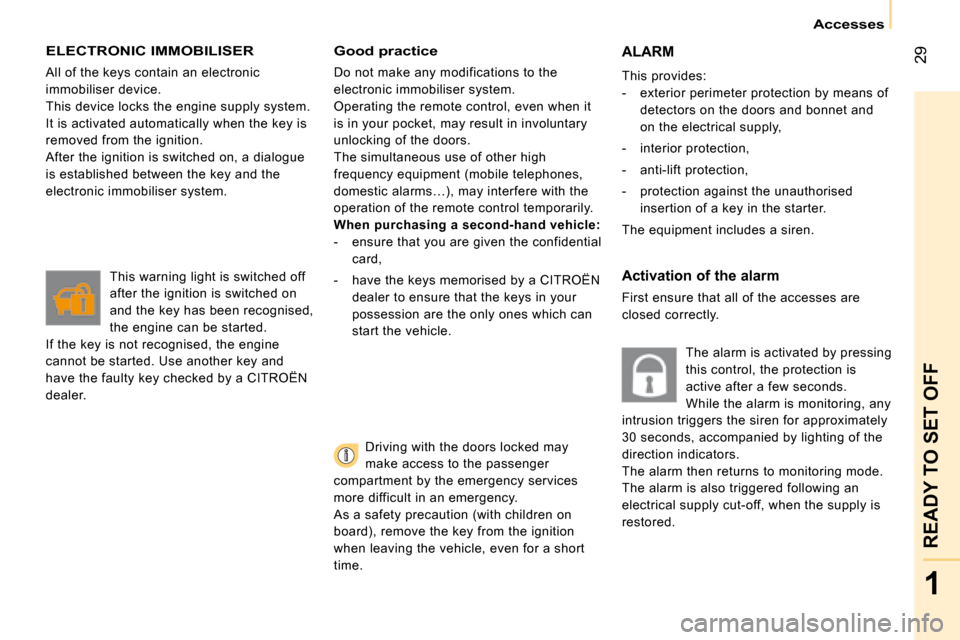
ELECTRONIC IMMOBILISER
All of the keys contain an electronic
immobiliser device.
This device locks the engine supply system.
It is activated automatically when the key is
removed from the ignition.
After the ignition is switched on, a dialogue
is established between the key and the
electronic immobiliser system. This warning light is switched off
after the ignition is switched on
and the key has been recognised,
the engine can be started.
If the key is not recognised, the engine
cannot be started. Use another key and
have the faulty key checked by a CITROËN
dealer .
Good practice
Do not make any modifications to the
electronic immobiliser system.
Operating the remote control, even when it
is in your pocket, may result in involuntary
unlocking of the doors.
The simultaneous use of other high
frequency equipment (mobile telephones,
domestic alarms…), may interfere with the
operation of the remote control temporarily.
When purchasing a second-hand vehicle:
- ensure that you are given the confidential card,
- have the keys memorised by a CITROËN dealer to ensure that the keys in your
possession are the only ones which can
start the vehicle.
Driving with the doors locked may
make access to the passenger
compartment by the emergency services
more difficult in an emergency.
As a safety precaution (with children on
board), remove the key from the ignition
when leaving the vehicle, even for a short
time.
ALARM
This provides:
- exterior perimeter protection by means of detectors on the doors and bonnet and
on the electrical supply,
- interior protection,
- anti-lift protection,
- protection against the unauthorised insertion of a key in the starter.
The equipment includes a siren.
Activation of the alarm
First ensure that all of the accesses are
closed correctly.
The alarm is activated by pressing
this control, the protection is
active after a few seconds.
While the alarm is monitoring, any
intrusion triggers the siren for approximately
30 seconds, accompanied by lighting of the
direction indicators.
The alarm then returns to monitoring mode.
The alarm is also triggered following an
electrical supply cut-off, when the supply is
restored.
Page 33 of 131
29
1
READY TO SET OFF
Accesses
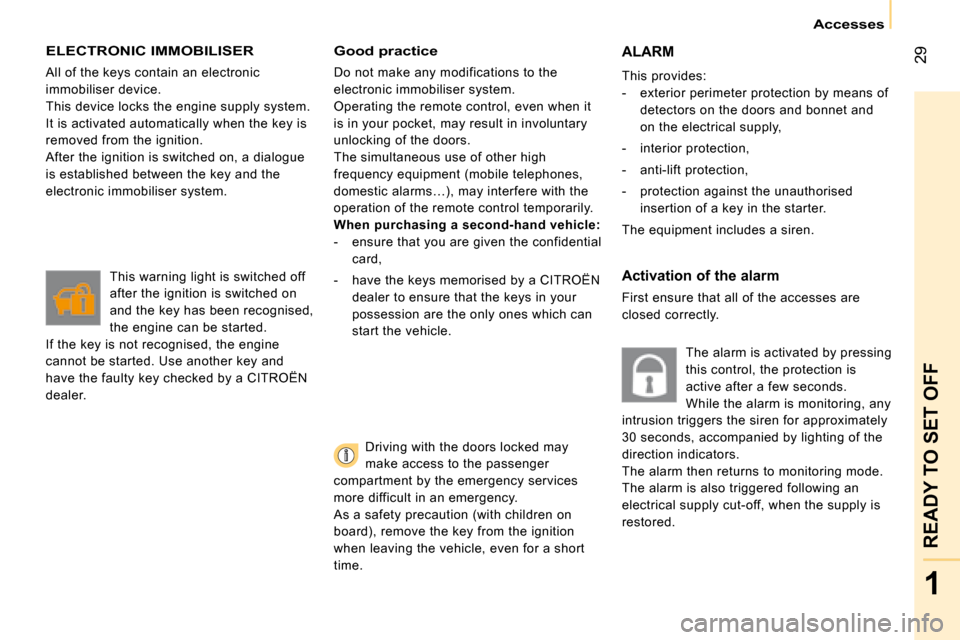
ELECTRONIC IMMOBILISER
All of the keys contain an electronic
immobiliser device.
This device locks the engine supply system.
It is activated automatically when the key is
removed from the ignition.
After the ignition is switched on, a dialogue
is established between the key and the
electronic immobiliser system. This warning light is switched off
after the ignition is switched on
and the key has been recognised,
the engine can be started.
If the key is not recognised, the engine
cannot be started. Use another key and
have the faulty key checked by a CITROËN
dealer .
Good practice
Do not make any modifications to the
electronic immobiliser system.
Operating the remote control, even when it
is in your pocket, may result in involuntary
unlocking of the doors.
The simultaneous use of other high
frequency equipment (mobile telephones,
domestic alarms…), may interfere with the
operation of the remote control temporarily.
When purchasing a second-hand vehicle:
- ensure that you are given the confidential card,
- have the keys memorised by a CITROËN dealer to ensure that the keys in your
possession are the only ones which can
start the vehicle.
Driving with the doors locked may
make access to the passenger
compartment by the emergency services
more difficult in an emergency.
As a safety precaution (with children on
board), remove the key from the ignition
when leaving the vehicle, even for a short
time.
ALARM
This provides:
- exterior perimeter protection by means of detectors on the doors and bonnet and
on the electrical supply,
- interior protection,
- anti-lift protection,
- protection against the unauthorised insertion of a key in the starter.
The equipment includes a siren.
Activation of the alarm
First ensure that all of the accesses are
closed correctly.
The alarm is activated by pressing
this control, the protection is
active after a few seconds.
While the alarm is monitoring, any
intrusion triggers the siren for approximately
30 seconds, accompanied by lighting of the
direction indicators.
The alarm then returns to monitoring mode.
The alarm is also triggered following an
electrical supply cut-off, when the supply is
restored.
Page 36 of 131
31
1
READY TO SET OFF
Accesses
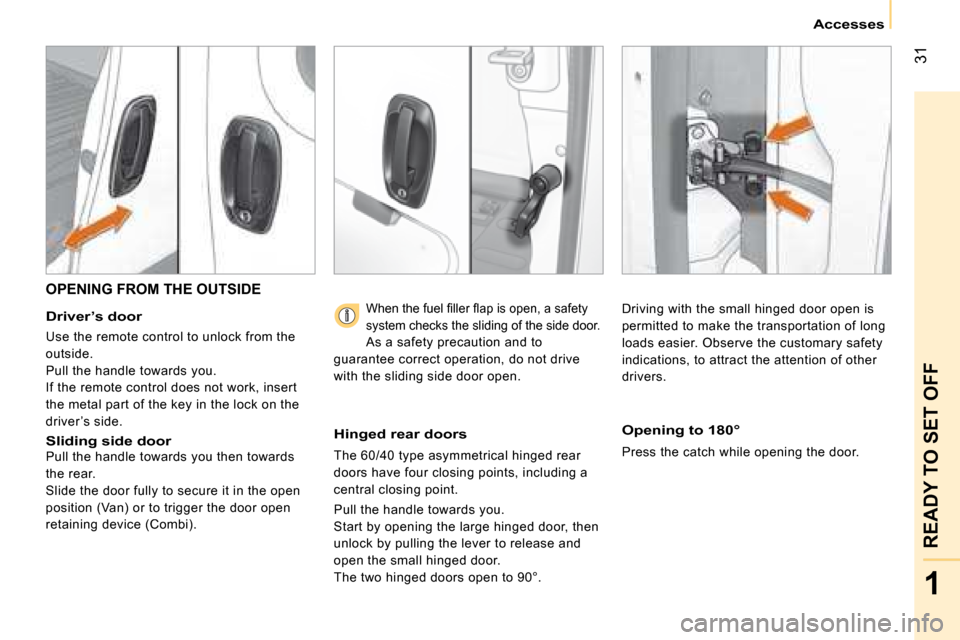
OPENING FROM THE OUTSIDE
Driver’s door
Use the remote control to unlock from the
outside.
Pull the handle towards you.
If the remote control does not work, insert
the metal part of the key in the lock on the
driver ’s side.
Sliding side door Pull the handle towards you then towards
the rear.
Slide the door fully to secure it in the open
position (Van) or to trigger the door open
retaining device (Combi).
Hinged rear doors
The 60/40 type asymmetrical hinged rear
doors have four closing points, including a
central closing point.
Pull the handle towards you.
Start by opening the large hinged door, then
unlock by pulling the lever to release and
open the small hinged door.
The two hinged doors open to 90°.
Opening to 180°
Press the catch while opening the door.
When the fuel fi ller fl ap is open, a safety
system checks the sliding of the side door.
As a safety precaution and to
guarantee correct operation, do not drive
with the sliding side door open. Driving with the small hinged door open is
permitted to make the transportation of long
loads easier. Observe the customary safety
indications, to attract the attention of other
drivers.
Page 38 of 131

33
1
READY TO SET OFF
Accesses
CLOSING FROM INSIDE
Central locking
Push the interior handle to lock the entire
vehicle or the door concerned. However,
if one of the doors is open or is not closed
correctly, the central locking does not work. Always remove the key from the
ignition when leaving the vehicle, even
for a short time.
Closing from 180°
The check strap will re-attach automatically
when the hinged doors are closed, the small
door being closed first.
Load space
Protection against attack
When the vehicle is started, the system
locks the cab and load space doors
automatically when you reach approximately
12 mph (20 km/h).
This “AUTOCLOSE” function is activated or
deactivated via the “MENU”.
If none of the doors are opened during the
journey, the locking remains active.
This function is deactivated when the vehicle
is delivered.
Press to lock the sliding side
doors and the rear doors (Van)
from the cab.
Page 44 of 131
37
1
READY TO SET OFF
Steering wheel controls
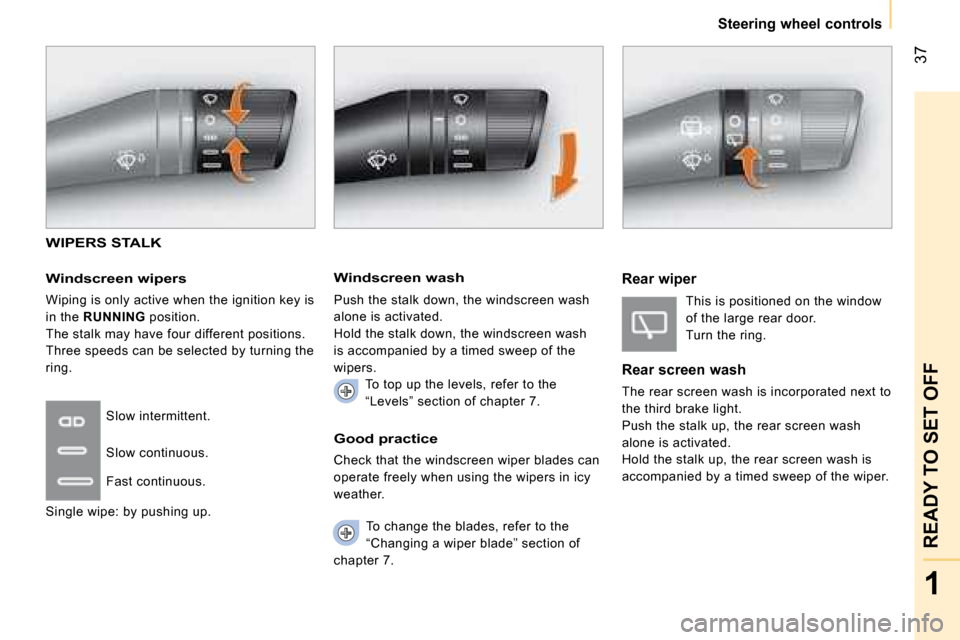
WIPERS STALK
Windscreen wipers
Wiping is only active when the ignition key is
in the RUNNING position.
The stalk may have four different positions.
Three speeds can be selected by turning the
ring.
To change the blades, refer to the
“Changing a wiper blade” section of
chapter 7.
Good practice
Check that the windscreen wiper blades can
operate freely when using the wipers in icy
weather.
Slow intermittent.
Slow continuous.
Fast continuous.
Single wipe: by pushing up.
Windscreen wash
Push the stalk down, the windscreen wash
alone is activated.
Hold the stalk down, the windscreen wash
is accompanied by a timed sweep of the
wipers. To top up the levels, refer to the
“Levels” section of chapter 7.
Rear wiper
This is positioned on the window
of the large rear door.
Turn the ring.
Rear screen wash
The rear screen wash is incorporated next to
the third brake light.
Push the stalk up, the rear screen wash
alone is activated.
Hold the stalk up, the rear screen wash is
accompanied by a timed sweep of the wiper.
Page 48 of 131
41
1
READY TO SET OFF
Gearbox and steering wheel
Stopping – Starting on a gradient
This is an electronic gearbox system without
a clutch pedal.
To immobilise the vehicle on a gradient,
you must use the parking brake and not
the accelerator.
When starting on a gradient, accelerate
gradually while releasing the parking brake.
Changing to sequential mode
Once you have started the engine, you
can go into sequential mode by selecting
position M.
“AUTO” disappears and
the gears selected appear
successively on the instrument
panel display.
Gear change requests are only possible if
the engine speed allows them.
Gently lift your foot from the accelerator
pedal to select the gear.
When driving at low speed (e.g. approaching
a stop sign or at traffic lights), the gearbox
automatically changes down to first gear.
Changing to automatic mode
When in sequential mode, you can return to
automatic mode by selecting position A.
Stopping the vehicle
Before switching off the engine, you can :
- select position N to engage neutral.
- leave a gear engaged, such as first or
reverse gear.
In either case, you must engage the parking
brake to immobilise the vehicle.
Reinitialising
Following a battery disconnection, you must
reinitialise the gearbox :
- switch on the ignition, “AUTO” appears
on the instrument panel display,
- press on the brake pedal,
- wait for about 30 seconds until “N” or
a gear appears on the instrument panel
display,
- release the brake pedal.
The gearbox is now operational again.
Operating anomaly
With the ignition switched on, the fl ashing of “AUTO” and the lighting of this warning lamp, accompanied by a sound signal and a message on the instrument panel display, indicate a
gearbox malfunction.
Have the system checked by your CITROËN dealer.
You must always press the brake pedal
down when starting the engine.
When the vehicle is moving, never
select neutral N.
Only select reverse gear R with the vehicle
stationary and your foot on the brake pedal.
In all cases, you must engage the parking
brake to immobilise the vehicle.
When on a steep gradient, you are advised
to use sequential mode.
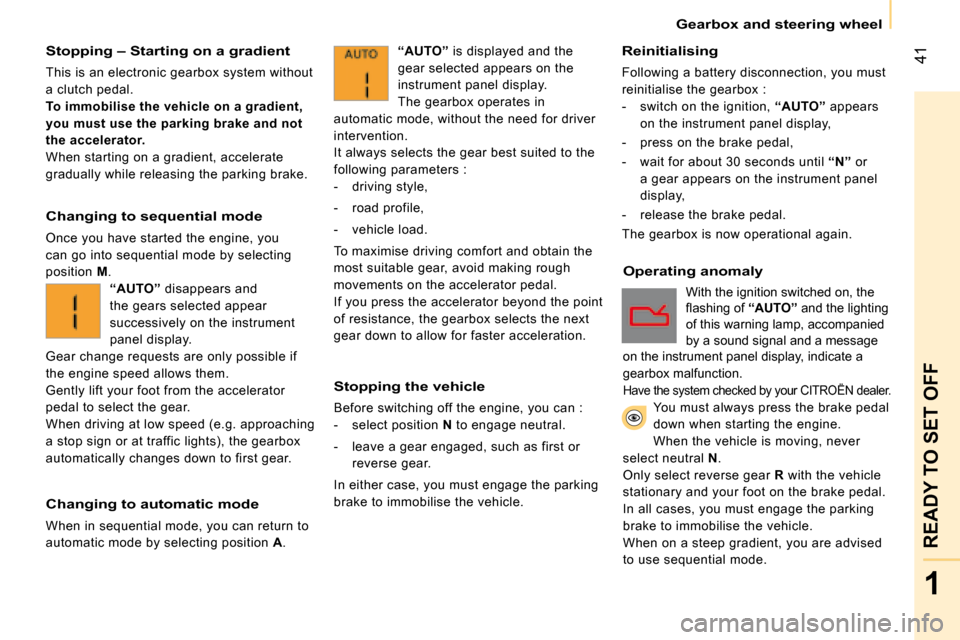
“AUTO” is displayed and the
gear selected appears on the
instrument panel display.
The gearbox operates in
automatic mode, without the need for driver
intervention.
It always selects the gear best suited to the
following parameters :
- driving style,
- road profile,
- vehicle load.
To maximise driving comfort and obtain the
most suitable gear, avoid making rough
movements on the accelerator pedal.
If you press the accelerator beyond the point
of resistance, the gearbox selects the next
gear down to allow for faster acceleration.
Page 84 of 131

78
Driving safety
PARKING BRAKE
Applying
Pull the parking brake to immobilise your
vehicle.
Check that the parking brake is applied
firmly before leaving the vehicle. If the parking brake is still on or has
not been released properly, this is
indicated by this warning light which
comes on on the instrument panel.
When parking on a slope, direct your wheels
towards the pavement and pull the parking
brake. There is no advantage in engaging a
gear after parking the vehicle, particularly if
the vehicle is loaded.
Releasing
Pull the handle and press the button to lower
the parking brake.
HAZARD WARNING LIGHTS
Press this button, the two direction
indicators flash.
They operate with the ignition off.
When the hazard warning lights are switched
on, the change of direction function, via the
right-hand or left-hand direction indicator, is
deactivated.
Page 86 of 131

80
Seat belts
CAB SEAT BELTS
The front seats are fitted with pre-tensioners
and force limiters.
Fastening
Pull the strap, then insert the tongue into the
buckle.
Check that the seat belt is fastened correctly
by pulling the strap.
The lap belt must be positioned as low as
possible on the pelvis. The chest belt must
pass over the hollow of the shoulder.
Check that the seat belt is fastened correctly
by pulling the strap.
Inertia reel seat belts
These are fitted with a device which locks
automatically in the event of a collision or
emergency braking.
Safety in the event of a front impact has
been improved by the introduction of
pretensioning and force limiting seat belts.
Depending on the seriousness of the
impact, the pretensioning system instantly
tightens the seat belt against the body of the
occupant.
The pretensioning seat belts are active when
the ignition is on.
The force limiter reduces the pressure of the
seat belt against the body of the occupant in
the event of an accident.
Driver ’s seat belt not fastened warning light
When the vehicle is started, this
warning light comes on if the
driver has not fastened his seat
belt.
REAR SEAT BELTS (COMBI)
The 3-seater benchseat is fitted with 3-point
seat belts with force limiting reels.
The centre seat has a guide and a reel,
connected to the seat backrest.
When a seat belt is not in use, you
can store its buckle in the storage
space provided in the seat cushion of the
benchseat.
Page 87 of 131

81
5
SAFETY
Seat belts
Good practice
Wherever you are seated in the vehicle,
always fasten your seat belt, even for short
journeys.
The seat belts are fitted with an inertia reel
which automatically adjusts the length of the
strap to your size. The seat belt is rolled up
automatically when not in use.
Ensure that the seat belt is rolled up
correctly after use.
After folding or moving a seat, ensure that
the seat belt is rolled up correctly in its
compartment and that the buckle is ready to
accommodate the tongue. The inertia reels are fitted with a device
which automatically locks the strap in the
event of a collision or emergency braking or
if the vehicle rolls over.
The air bag warning light comes
on if the pretensioners are
triggered. Consult a CITROËN
dealer .
Depending on the nature and seriousness
of any impact, the pretensioning device may
be triggered before and independently of
inflation of the air bags. It instantly tightens
the seat belts against the body of the
occupants.
The force limiter reduces the pressure of the
seat belt against the body of the occupants.
The equipment fitted to these seat belts is
operational when the ignition is switched on. In order to be effective, a seat belt must:
- restrain one person only,
- not be twisted , check by pulling in front
of you with an even movement,
- be tightened as close to the body as possible.
The upper part of the seat belt should be
positioned in the hollow of the shoulder.
The lap part should be placed as low as
possible on the pelvis.
Do not invert the seat belt buckles as they
will not fulfil their role completely. If the
seats are fitted with armrests, the lap part of
the seat belt should always pass under the
armrest.
Check that the seat belt is fastened correctly
by pulling the strap firmly.
Recommendations for children:
- use a suitable child seat if the passenger is less than 12 years old or shorter than
one metre fifty,
- never allow a child to travel on your lap, even with the seat belt fastened.
For further information regarding child
seats, refer to the “Child safety” section
of chapter 5.
In accordance with current safety
regulations, your CITROËN dealer
guarantees all work or any checks, from
testing to maintenance, on your seat belt
equipment.
Have the seat belts checked regularly
(even after a minor impact) by a CITROËN
dealer : they must not show any signs of
wear, cutting or fraying and they must not be
transformed or modified.
Clean the seat belt straps with soapy
water or a textile cleaning product, sold
by a CITROËN dealer .
Page 89 of 131

83
5
SAFETY
Air bags
SIDE AIR BAGS
Activation
It is triggered unilaterally in the event of a
serious side impact, perpendicular to the
longitudinal centreline of the vehicle on
a horizontal plane and directed from the
outside towards the inside of the vehicle.
The side air bag inflates between the
front occupant of the vehicle and the
corresponding door trim pad. In the event of a minor impact or bump
on the side of the vehicle or if the
vehicle rolls over, the air bag may not be
triggered.
Operating fault
If this warning light comes on on
the instrument panel, consult a
CITROËN dealer without delay to
have the system checked. The air
bags may no longer be triggered
in the event of a serious impact.