Check Citroen NEMO 2008 1.G Owner's Guide
[x] Cancel search | Manufacturer: CITROEN, Model Year: 2008, Model line: NEMO, Model: Citroen NEMO 2008 1.GPages: 131, PDF Size: 1.96 MB
Page 90 of 131
85
5
SAFETY
Air bags
For the air bags to be fully effective, observe the following safety rules:
Sit in a normal upright position.
Wear a correctly adjusted seat belt.
Do not leave anything between the
occupants and the air bags (a child, pet,
object...). This could hamper the operation
of the air bags or injure the occupants.
After an accident or if the vehicle has been
stolen or broken into, have the air bag
systems checked.
All work on the air bag systems is strictly
forbidden unless it is carried out by the
qualified personnel of a CITROËN dealer .
Even if all of the precautions mentioned are
observed, a risk of injury or of slight burns
to the head, chest or arms when an air bag
is triggered cannot be ruled out. In fact,
the bag inflates almost instantly (within a
few milliseconds) then deflates within the
same time, discharging the hot gas through
openings provided for this purpose.
Front air bags
Do not drive holding the steering wheel
by its spokes or resting your hands on the
centre part of the wheel.
Passengers must not place their feet on the
fascia.
Smoke as little as possible as deployment of
the air bags can cause burns or the risk of
injury from a cigarette or pipe.
Never remove or pierce the steering wheel
or hit it violently.
Side air bags
Only put approved covers on the seats.
These will not hinder the triggering of the
side air bags. Consult a CITROËN dealer .
Do not fix or glue anything to the seat backs.
This could cause injury to the chest or arms
when the side air bag inflates.
Do not sit with the upper part of the body
any nearer to the door than necessary.
Page 92 of 131
84
Air bags
FRONT AIR BAGS
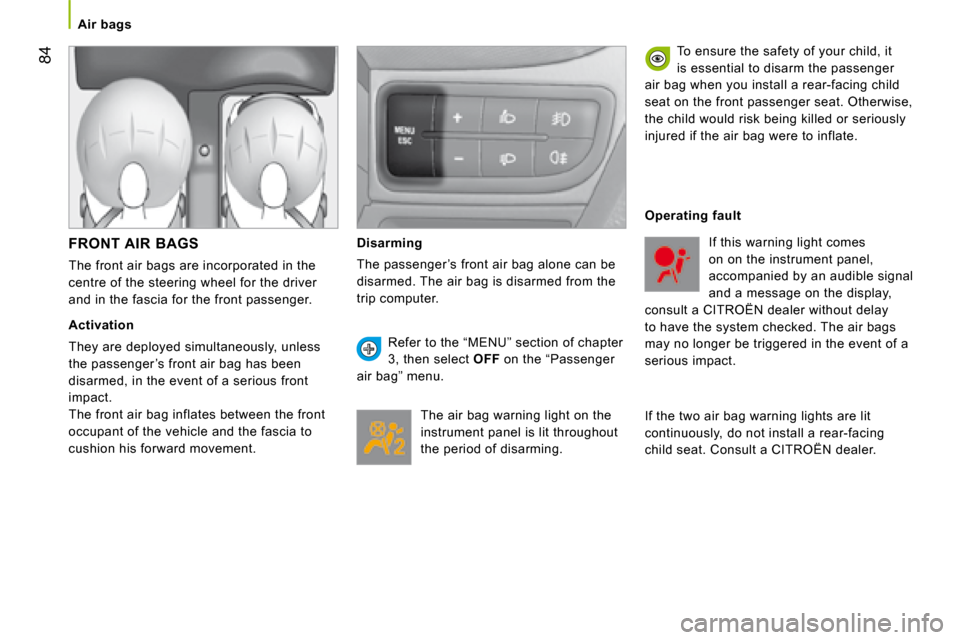
The front air bags are incorporated in the
centre of the steering wheel for the driver
and in the fascia for the front passenger.
Activation
They are deployed simultaneously, unless
the passenger ’s front air bag has been
disarmed, in the event of a serious front
impact.
The front air bag inflates between the front
occupant of the vehicle and the fascia to
cushion his forward movement.
Disarming
The passenger ’s front air bag alone can be
disarmed. The air bag is disarmed from the
trip computer. The air bag warning light on the
instrument panel is lit throughout
the period of disarming. To ensure the safety of your child, it
is essential to disarm the passenger
air bag when you install a rear-facing child
seat on the front passenger seat. Otherwise,
the child would risk being killed or seriously
injured if the air bag were to inflate.
Refer to the “MENU” section of chapter
3, then select OFF on the “Passenger
air bag” menu.
Operating fault
If the two air bag warning lights are lit
continuously, do not install a rear-facing
child seat. Consult a CITROËN dealer . If this warning light comes
on on the instrument panel,
accompanied by an audible signal
and a message on the display,
consult a CITROËN dealer without delay
to have the system checked. The air bags
may no longer be triggered in the event of a
serious impact.
Page 93 of 131
85
5
SAFETY
Air bags
For the air bags to be fully effective, observe the following safety rules:
Sit in a normal upright position.
Wear a correctly adjusted seat belt.
Do not leave anything between the
occupants and the air bags (a child, pet,
object...). This could hamper the operation
of the air bags or injure the occupants.
After an accident or if the vehicle has been
stolen or broken into, have the air bag
systems checked.
All work on the air bag systems is strictly
forbidden unless it is carried out by the
qualified personnel of a CITROËN dealer .
Even if all of the precautions mentioned are
observed, a risk of injury or of slight burns
to the head, chest or arms when an air bag
is triggered cannot be ruled out. In fact,
the bag inflates almost instantly (within a
few milliseconds) then deflates within the
same time, discharging the hot gas through
openings provided for this purpose.
Front air bags
Do not drive holding the steering wheel
by its spokes or resting your hands on the
centre part of the wheel.
Passengers must not place their feet on the
fascia.
Smoke as little as possible as deployment of
the air bags can cause burns or the risk of
injury from a cigarette or pipe.
Never remove or pierce the steering wheel
or hit it violently.
Side air bags
Only put approved covers on the seats.
These will not hinder the triggering of the
side air bags. Consult a CITROËN dealer .
Do not fix or glue anything to the seat backs.
This could cause injury to the chest or arms
when the side air bag inflates.
Do not sit with the upper part of the body
any nearer to the door than necessary.
Page 103 of 131
94
Towing a trailer
In certain cases of particularly arduous
use (towing the maximum load up a steep
slope in high temperatures), the engine
automatically limits its power. In this
case, the automatic cutting off of the air
conditioning allows the engine power to be
recovered.
If the coolant temperature
warning light comes on, stop the
vehicle and switch off the engine
as soon as possible.
See the “Levels” section of chapter 7.
Tyres: check the tyre pressures of the
towing vehicle (see the “Identification
features” section of chapter 7) and of
the trailer, observing the recommended
pressure.
Brakes: towing increases the braking
distance. Drive at a moderate speed,
change down early and brake gradually.
Side wind: sensitivity to side wind is
increased. Drive smoothly and at a
moderate speed.
ABS: the system only controls the vehicle,
not the trailer.
Rear parking assistance:
the assistance will be deactivated
automatically when a CITROËN towbar is
used (see the “Rear parking assistance”
section of chapter 4).
Towbar
We recommend the use of CITROËN
towbars and their harnesses, which have
been tested and approved from the design
stage of your vehicle, and that the fitting of
this equipment is entrusted to a CITROËN
dealer .
If this equipment is not fitted by a CITROËN
dealer , it is essential that it is fitted using
the electrical pre-equipment located at the
rear of the vehicle in accordance with the
manufacturer ’s instructions.
The operation of the sensors is deactivated
automatically when the pin of the trailer
cable is inserted in the towbar socket.
When the trailer cable pin is removed, the
sensors are re-activated.
Distribution of loads
Distribute the load in the trailer so that the
heaviest objects are as close as possible
to the axle and the nose weight is close to
the maximum authorised without, however,
exceeding it. The air density decreases with
altitude, so reducing the performance of
the engine. The maximum towed load must
be reduced by 10 % for each 1000 metres
of altitude. Refer to the “Technical data”
chapter for details of the weights and
towed loads applicable to your vehicle and
also to the administrative documents (V5
registration document, etc.).
Page 105 of 131
97
7
TROUBLESHOOTING
Battery
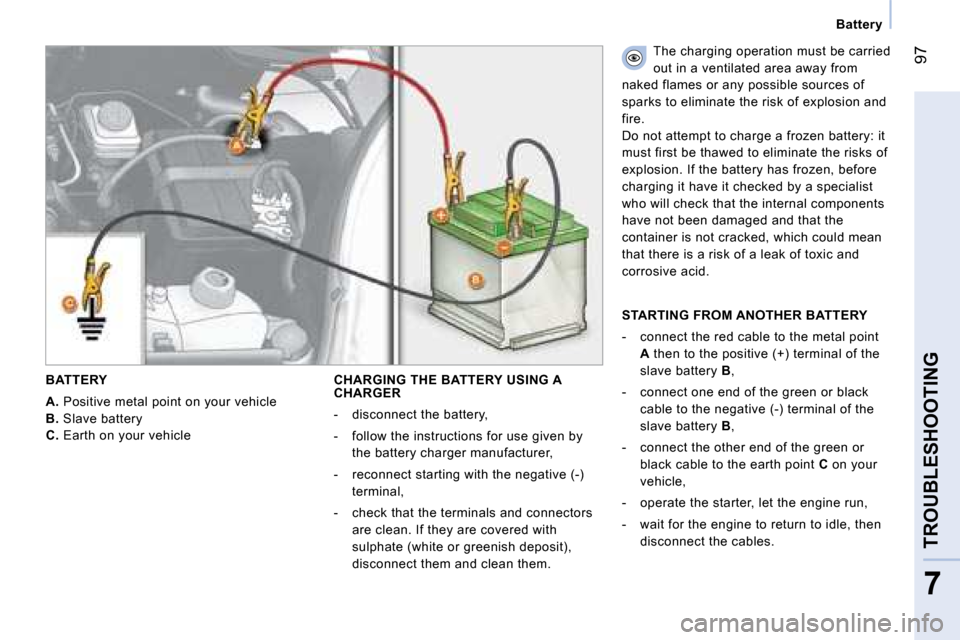
BATTERY
A. Positive metal point on your vehicle
B. Slave battery
C. Earth on your vehicle
CHARGING THE BATTERY USING A CHARGER
- disconnect the battery,
- follow the instructions for use given by
the battery charger manufacturer,
- reconnect starting with the negative (-) terminal,
- check that the terminals and connectors are clean. If they are covered with
sulphate (white or greenish deposit),
disconnect them and clean them. The charging operation must be carried
out in a ventilated area away from
naked flames or any possible sources of
sparks to eliminate the risk of explosion and
fire.
Do not attempt to charge a frozen battery: it
must first be thawed to eliminate the risks of
explosion. If the battery has frozen, before
charging it have it checked by a specialist
who will check that the internal components
have not been damaged and that the
container is not cracked, which could mean
that there is a risk of a leak of toxic and
corrosive acid.
STARTING FROM ANOTHER BATTERY
- connect the red cable to the metal point
A then to the positive (+) terminal of the
slave battery B ,
- connect one end of the green or black cable to the negative (-) terminal of the
slave battery B ,
- connect the other end of the green or black cable to the earth point C on your
vehicle,
- operate the starter, let the engine run,
- wait for the engine to return to idle, then disconnect the cables.
Page 109 of 131
101
7
TROUBLESHOOTING
Changing a wheel
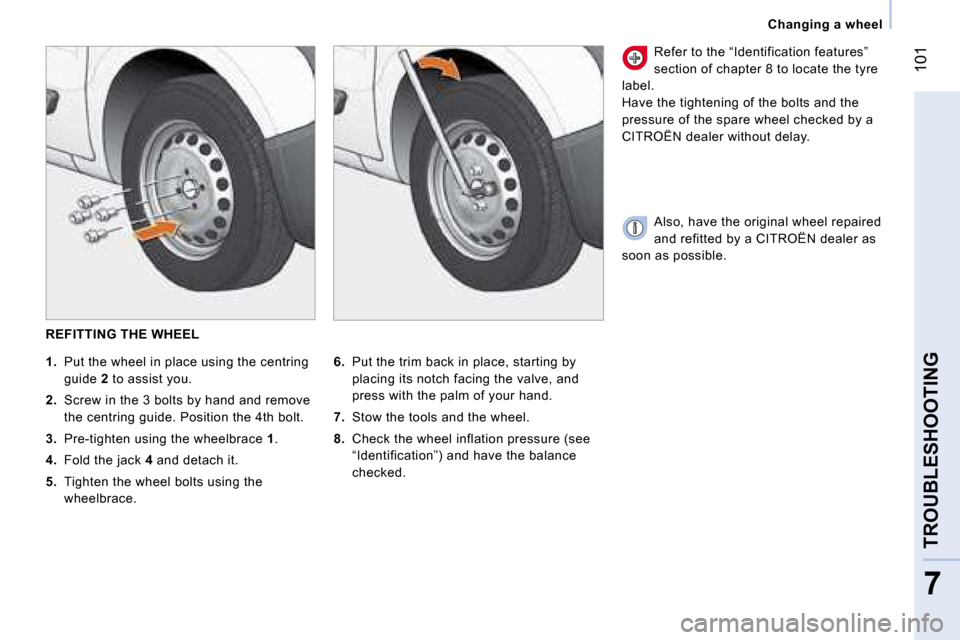
REFITTING THE WHEEL
6. Put the trim back in place, starting by
placing its notch facing the valve, and
press with the palm of your hand.
7. Stow the tools and the wheel.
8. Check the wheel inflation pressure (see
“Identification”) and have the balance
checked. Refer to the “Identification features”
section of chapter 8 to locate the tyre
label.
Have the tightening of the bolts and the
pressure of the spare wheel checked by a
CITROËN dealer without delay.
1. Put the wheel in place using the centring
guide 2 to assist you.
2. Screw in the 3 bolts by hand and remove
the centring guide. Position the 4th bolt.
3. Pre-tighten using the wheelbrace 1 .
4. Fold the jack 4 and detach it.
5. Tighten the wheel bolts using the
wheelbrace. Also, have the original wheel repaired
and refitted by a CITROËN dealer as
soon as possible.
Page 113 of 131
105
7
TROUBLESHOOTING
Changing a bulb
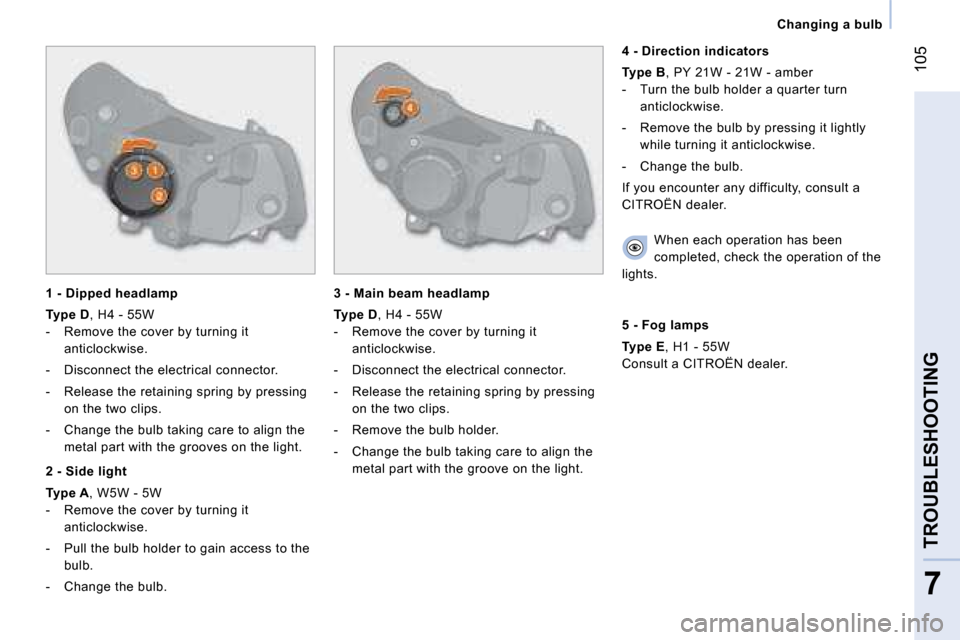
1 - Dipped headlamp
Type D , H4 - 55W
- Remove the cover by turning it anticlockwise.
- Disconnect the electrical connector.
- Release the retaining spring by pressing on the two clips.
- Change the bulb taking care to align the metal part with the grooves on the light.
2 - Side light
Type A , W5W - 5W
- Remove the cover by turning it anticlockwise.
- Pull the bulb holder to gain access to the bulb.
- Change the bulb.
3 - Main beam headlamp
Type D , H4 - 55W
- Remove the cover by turning it anticlockwise.
- Disconnect the electrical connector.
- Release the retaining spring by pressing on the two clips.
- Remove the bulb holder.
- Change the bulb taking care to align the metal part with the groove on the light.
4 - Direction indicators
Type B , PY 21W - 21W - amber
- Turn the bulb holder a quarter turn anticlockwise.
- Remove the bulb by pressing it lightly while turning it anticlockwise.
- Change the bulb.
If you encounter any difficulty, consult a
CITROËN dealer.
When each operation has been
completed, check the operation of the
lights.
5 - Fog lamps
Type E , H1 - 55W
Consult a CITROËN dealer .
Page 125 of 131
114
Fuel
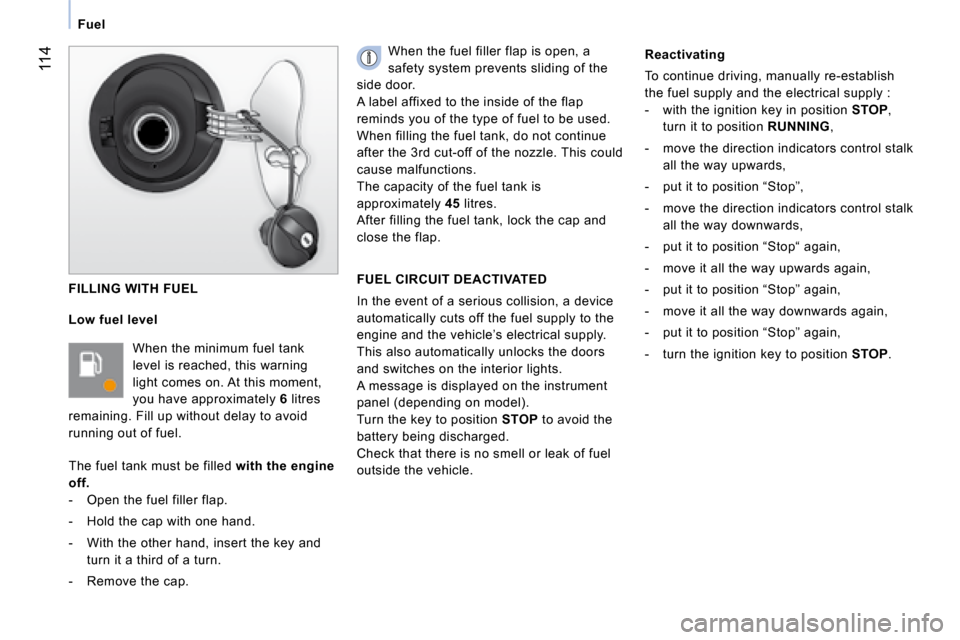
FILLING WITH FUEL
Low fuel level
When the minimum fuel tank
level is reached, this warning
light comes on. At this moment,
you have approximately 6 litres
remaining. Fill up without delay to avoid
running out of fuel.
The fuel tank must be filled with the engine
off.
- Open the fuel filler flap.
- Hold the cap with one hand.
- With the other hand, insert the key and turn it a third of a turn.
- Remove the cap.
FUEL CIRCUIT DEACTIVATED
In the event of a serious collision, a device
automatically cuts off the fuel supply to the
engine and the vehicle’s electrical supply.
This also automatically unlocks the doors
and switches on the interior lights.
A message is displayed on the instrument
panel (depending on model).
Turn the key to position STOP to avoid the
battery being discharged.
Check that there is no smell or leak of fuel
outside the vehicle.
When the fuel filler flap is open, a
safety system prevents sliding of the
side door.
A label affixed to the inside of the flap
reminds you of the type of fuel to be used.
When filling the fuel tank, do not continue
after the 3rd cut-off of the nozzle. This could
cause malfunctions.
The capacity of the fuel tank is
approximately 45 litres.
After filling the fuel tank, lock the cap and
close the flap.
Reactivating
To continue driving, manually re-establish
the fuel supply and the electrical supply :
- with the ignition key in position STOP,
turn it to position RUNNING,
- move the direction indicators control stalk all the way upwards,
- put it to position “Stop”,
- move the direction indicators control stalk all the way downwards,
- put it to position “Stop“ again,
- move it all the way upwards again,
- put it to position “Stop” again,
- move it all the way downwards again,
- put it to position “Stop” again,
- turn the ignition key to position STOP.
Page 126 of 131

116
Opening the bonnet
OPENING THE BONNET
On the inside
Pull the lever under the fascia panel towards
you.
On the outside
Raise the bonnet slightly, placing your hand
flat under the bonnet to make the operation
easier.
Push the lever to the left, then open the
bonnet fully.
While holding the bonnet open, check that
the locking control A is engaged by pressing
it.
To close
Gently lift up the bonnet and pull on the
release control A to release.
Lower the bonnet and release it at the end
of its travel. Check that the bonnet is locked.
Avoid manoeuvring the bonnet in strong
winds.
Page 129 of 131
119
7
TROUBLESHOOTING
Levels
These regular maintenance operations
will keep your vehicle in good
running order. Consult the instructions at a
CITROËN dealer or in the servicing booklet
enclosed in the handbook pack.
LEVELS
Oil level
Check the level regularly and top up
between changes. The maximum
consumption is 0.5 l per 600 miles
(1 000 km). Check the level with the vehicle
level, engine cold, using the dipstick.
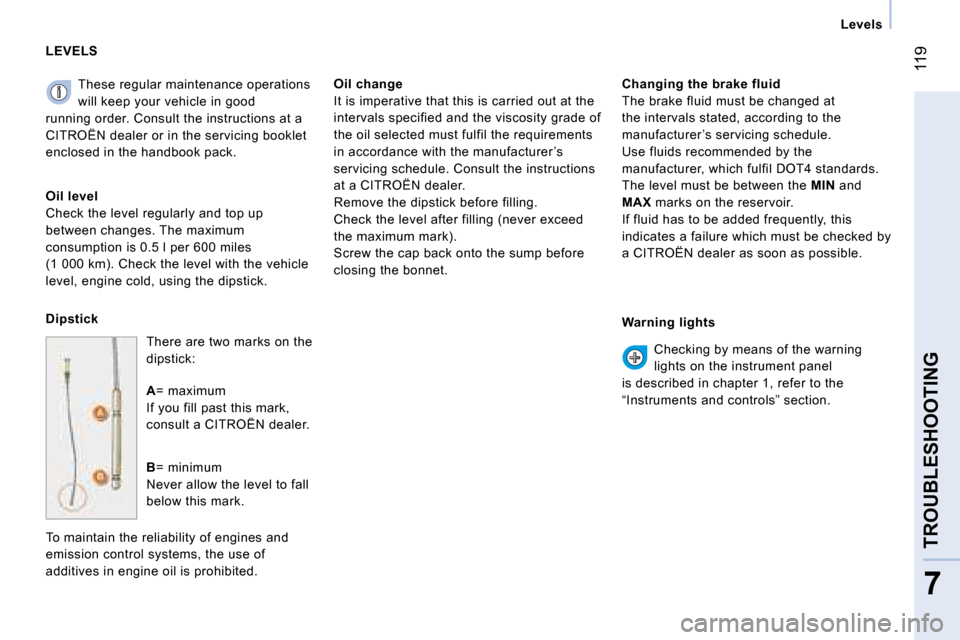
Dipstick
There are two marks on the
dipstick:
A = maximum
If you fill past this mark,
consult a CITROËN dealer .
B = minimum
Never allow the level to fall
below this mark.
To maintain the reliability of engines and
emission control systems, the use of
additives in engine oil is prohibited.
Oil change
It is imperative that this is carried out at the
intervals specified and the viscosity grade of
the oil selected must fulfil the requirements
in accordance with the manufacturer ’s
servicing schedule. Consult the instructions
at a CITROËN dealer .
Remove the dipstick before filling.
Check the level after filling (never exceed
the maximum mark).
Screw the cap back onto the sump before
closing the bonnet.
Changing the brake fluid
The brake fluid must be changed at
the intervals stated, according to the
manufacturer ’s servicing schedule.
Use fluids recommended by the
manufacturer, which fulfil DOT4 standards.
The level must be between the MIN and
MAX marks on the reservoir.
If fluid has to be added frequently, this
indicates a failure which must be checked by
a CITROËN dealer as soon as possible.
Warning lights
Checking by means of the warning
lights on the instrument panel
is described in chapter 1, refer to the
“Instruments and controls” section.