warning Citroen NEMO 2008.5 1.G Owner's Guide
[x] Cancel search | Manufacturer: CITROEN, Model Year: 2008.5, Model line: NEMO, Model: Citroen NEMO 2008.5 1.GPages: 140, PDF Size: 2.21 MB
Page 37 of 140
32
Accesses
Deactivation using the remote control
Deactivation using the key
Unlock the doors using the key and enter
the vehicle. Switch on the ignition to the
RUNNING position, identification of the key
code will switch off the alarm.
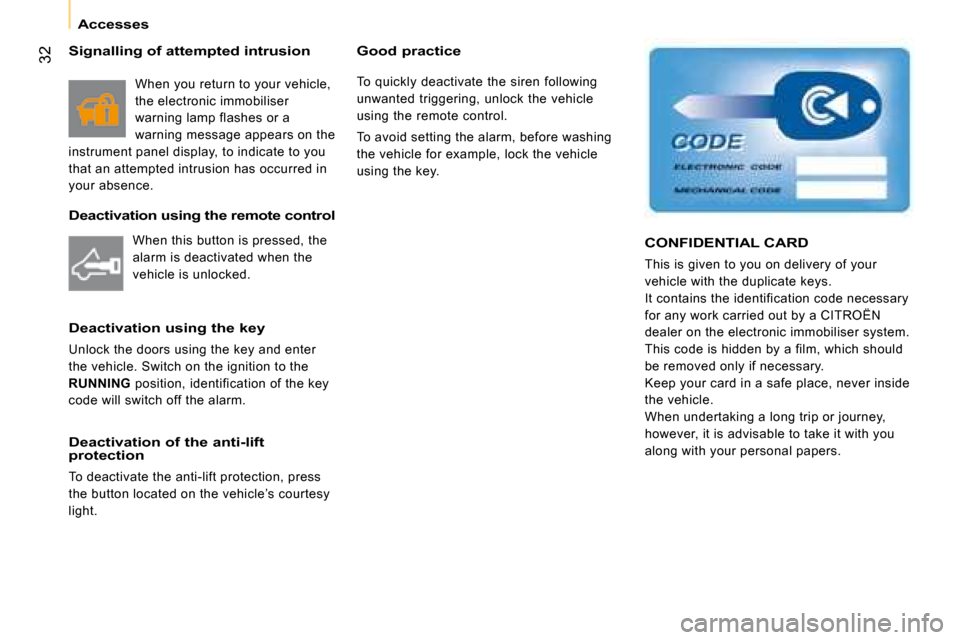
CONFIDENTIAL CARD
This is given to you on delivery of your
vehicle with the duplicate keys.
It contains the identification code necessary
for any work carried out by a CITROËN
dealer on the electronic immobiliser system.
This code is hidden by a film, which should
be removed only if necessary.
Keep your card in a safe place, never inside
the vehicle.
When undertaking a long trip or journey,
however, it is advisable to take it with you
along with your personal papers. Deactivation of the anti-lift
protection
To deactivate the anti-lift protection, press
the button located on the vehicle’s courtesy
light.
Good practice
To quickly deactivate the siren following
unwanted triggering, unlock the vehicle
using the remote control.
To avoid setting the alarm, before washing
the vehicle for example, lock the vehicle
using the key.
When this button is pressed, the
alarm is deactivated when the
vehicle is unlocked.
Signalling of attempted intrusion
When you return to your vehicle,
the electronic immobiliser
warning lamp flashes or a
warning message appears on the
instrument panel display, to indicate to you
that an attempted intrusion has occurred in
your absence.
Page 43 of 140
37
1
READY TO SET OFF
Steering wheel controls
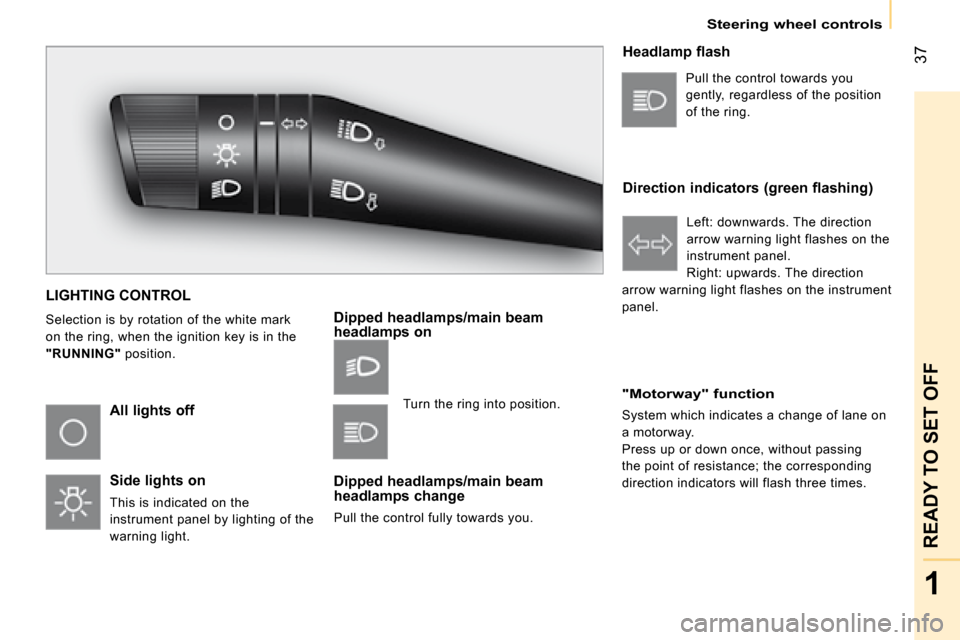
LIGHTING CONTROL
Selection is by rotation of the white mark
on the ring, when the ignition key is in the
"RUNNING" position.
All lights off
Side lights on
This is indicated on the
instrument panel by lighting of the
warning light.
Dipped headlamps/main beam
headlamps on
Dipped headlamps/main beam
headlamps change
Pull the control fully towards you.
Headlamp flash
Direction indicators (green flashing)
"Motorway" function
System which indicates a change of lane on
a motorway.
Press up or down once, without passing
the point of resistance; the corresponding
direction indicators will flash three times.
Pull the control towards you
gently, regardless of the position
of the ring. Left: downwards. The direction
arrow warning light flashes on the
instrument panel.
Right: upwards. The direction
arrow warning light flashes on the instrument
panel.
Turn the ring into position.
Page 44 of 140
38
Steering wheel controls
Headlamp beam
You are advised to adjust the height of the
headlamp beams in accordance with the
load in your vehicle.
This function can only be accessed in
the main beam headlamps and dipped
headlamps position.
Press these controls, located
on the fascia panel, several
times in succession to adjust the
headlamps.
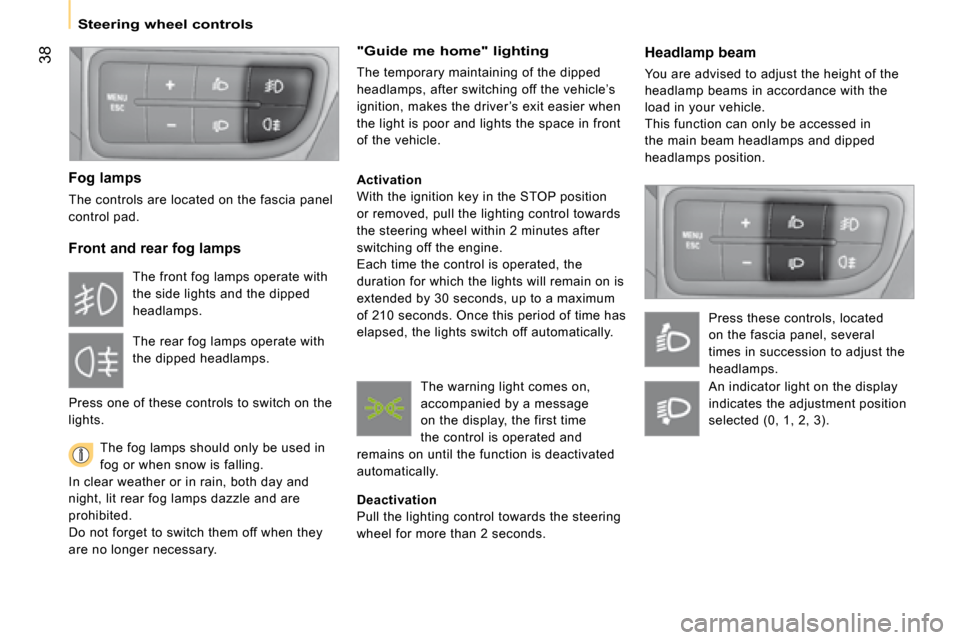
Fog lamps
The controls are located on the fascia panel
control pad.
Front and rear fog lamps
The fog lamps should only be used in
fog or when snow is falling.
In clear weather or in rain, both day and
night, lit rear fog lamps dazzle and are
prohibited.
Do not forget to switch them off when they
are no longer necessary.
"Guide me home" lighting
The temporary maintaining of the dipped
headlamps, after switching off the vehicle’s
ignition, makes the driver ’s exit easier when
the light is poor and lights the space in front
of the vehicle.
Activation
With the ignition key in the STOP position
or removed, pull the lighting control towards
the steering wheel within 2 minutes after
switching off the engine.
Each time the control is operated, the
duration for which the lights will remain on is
extended by 30 seconds, up to a maximum
of 210 seconds. Once this period of time has
elapsed, the lights switch off automatically.
Deactivation
Pull the lighting control towards the steering
wheel for more than 2 seconds.
The front fog lamps operate with
the side lights and the dipped
headlamps.
The rear fog lamps operate with
the dipped headlamps.
Press one of these controls to switch on the
lights.
The warning light comes on,
accompanied by a message
on the display, the first time
the control is operated and
remains on until the function is deactivated
automatically.
An indicator light on the display
indicates the adjustment position
selected (0, 1, 2, 3).
Page 45 of 140
38
Steering wheel controls
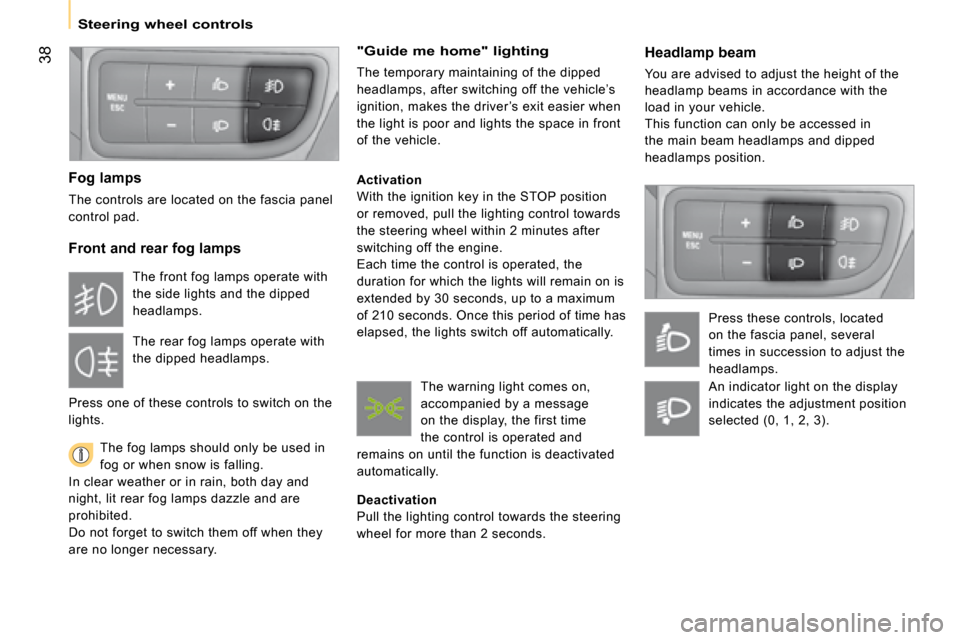
Headlamp beam
You are advised to adjust the height of the
headlamp beams in accordance with the
load in your vehicle.
This function can only be accessed in
the main beam headlamps and dipped
headlamps position.
Press these controls, located
on the fascia panel, several
times in succession to adjust the
headlamps.
Fog lamps
The controls are located on the fascia panel
control pad.
Front and rear fog lamps
The fog lamps should only be used in
fog or when snow is falling.
In clear weather or in rain, both day and
night, lit rear fog lamps dazzle and are
prohibited.
Do not forget to switch them off when they
are no longer necessary.
"Guide me home" lighting
The temporary maintaining of the dipped
headlamps, after switching off the vehicle’s
ignition, makes the driver ’s exit easier when
the light is poor and lights the space in front
of the vehicle.
Activation
With the ignition key in the STOP position
or removed, pull the lighting control towards
the steering wheel within 2 minutes after
switching off the engine.
Each time the control is operated, the
duration for which the lights will remain on is
extended by 30 seconds, up to a maximum
of 210 seconds. Once this period of time has
elapsed, the lights switch off automatically.
Deactivation
Pull the lighting control towards the steering
wheel for more than 2 seconds.
The front fog lamps operate with
the side lights and the dipped
headlamps.
The rear fog lamps operate with
the dipped headlamps.
Press one of these controls to switch on the
lights.
The warning light comes on,
accompanied by a message
on the display, the first time
the control is operated and
remains on until the function is deactivated
automatically.
An indicator light on the display
indicates the adjustment position
selected (0, 1, 2, 3).
Page 51 of 140
44
Gearbox and steering wheel
Stopping - Starting on a gradient
This is an electronic gearbox system without
a clutch pedal.
To immobilise the vehicle on a gradient,
you must use the parking brake and not
the accelerator.
When starting on a gradient, accelerate
gradually while releasing the parking brake.
Changing to sequential mode
Once you have started the engine, you
can go into sequential mode by selecting
position M.
Changing to automatic mode
When in sequential mode, you can return to
automatic mode by selecting position A.
Stopping the vehicle
Before switching off the engine, you can:
- select position N to engage neutral.
- leave a gear engaged, such as first or
reverse gear.
In either case, you must engage the parking
brake to immobilise the vehicle.
Reinitialising
Following a battery disconnection, you must
reinitialise the gearbox:
- switch on the ignition, "AUTO" appears
on the instrument panel display,
- press on the brake pedal,
- wait for about 30 seconds until "N" or
a gear appears on the instrument panel
display,
- release the brake pedal.
The gearbox is now operational again.
Operating anomaly
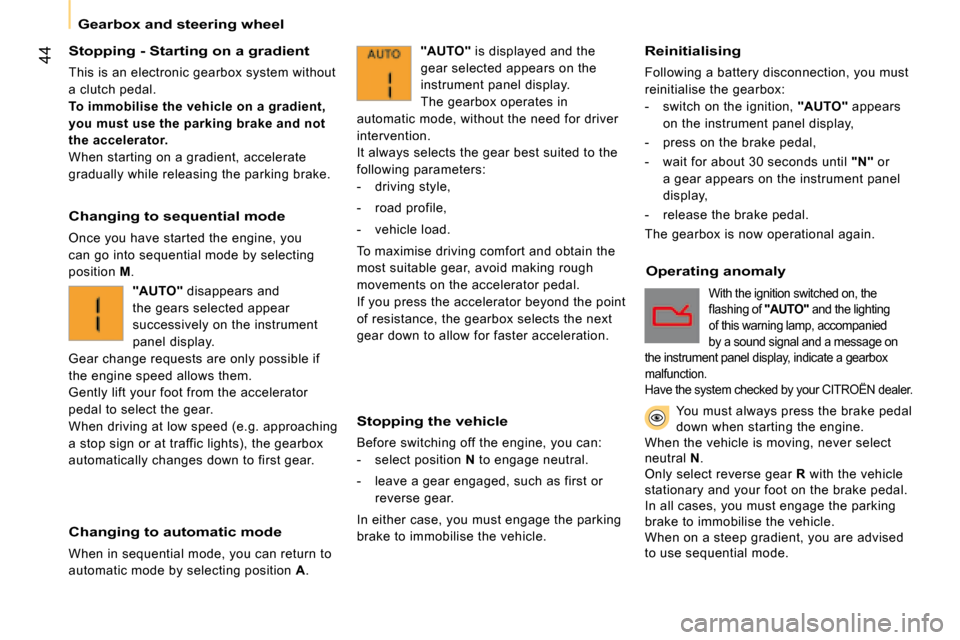
"AUTO" is displayed and the
gear selected appears on the
instrument panel display.
The gearbox operates in
automatic mode, without the need for driver
intervention.
It always selects the gear best suited to the
following parameters:
- driving style,
- road profile,
- vehicle load.
To maximise driving comfort and obtain the
most suitable gear, avoid making rough
movements on the accelerator pedal.
If you press the accelerator beyond the point
of resistance, the gearbox selects the next
gear down to allow for faster acceleration.
"AUTO" disappears and
the gears selected appear
successively on the instrument
panel display.
Gear change requests are only possible if
the engine speed allows them.
Gently lift your foot from the accelerator
pedal to select the gear.
When driving at low speed (e.g. approaching
a stop sign or at traffic lights), the gearbox
automatically changes down to first gear.
With the ignition switched on, the
fl ashing of "AUTO" and the lighting
of this warning lamp, accompanied
by a sound signal and a message on
the instrument panel display, indicate a gearbox
malfunction.
Have the system checked by your CITROËN dealer.
You must always press the brake pedal down when starting the engine. When the vehicle is moving, never select neutral N.Only select reverse gear R with the vehicle stationary and your foot on the brake pedal.In all cases, you must engage the parking brake to immobilise the vehicle.When on a steep gradient, you are advised to use sequential mode.
Page 52 of 140
1
READY TO SET OFF
Gearbox and steering wheel
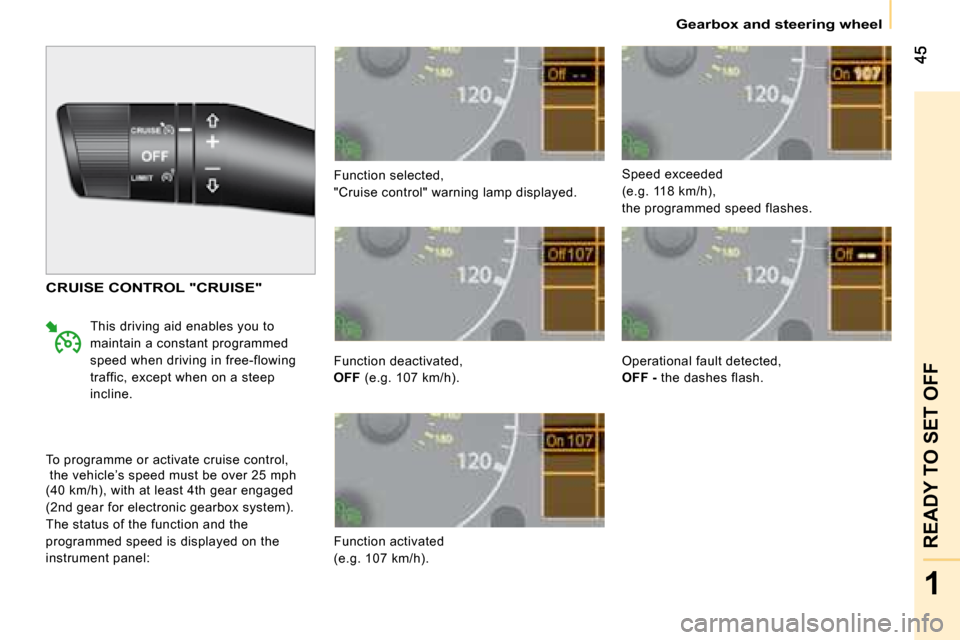
Function selected,
"Cruise control" warning lamp displayed.
Function deactivated,
OFF (e.g. 107 km/h).
Function activated
(e.g. 107 km/h). Speed exceeded
(e.g. 118 km/h),
the programmed speed flashes.
CRUISE CONTROL "CRUISE"
This driving aid enables you to
maintain a constant programmed
speed when driving in free-flowing
traffic, except when on a steep
incline.
To programme or activate cruise control,
the vehicle’s speed must be over 25 mph
(40 km/h), with at least 4th gear engaged
(2nd gear for electronic gearbox system).
The status of the function and the
programmed speed is displayed on the
instrument panel: Operational fault detected,
OFF
- the dashes flash.
Page 55 of 140
48
Gearbox and steering wheel
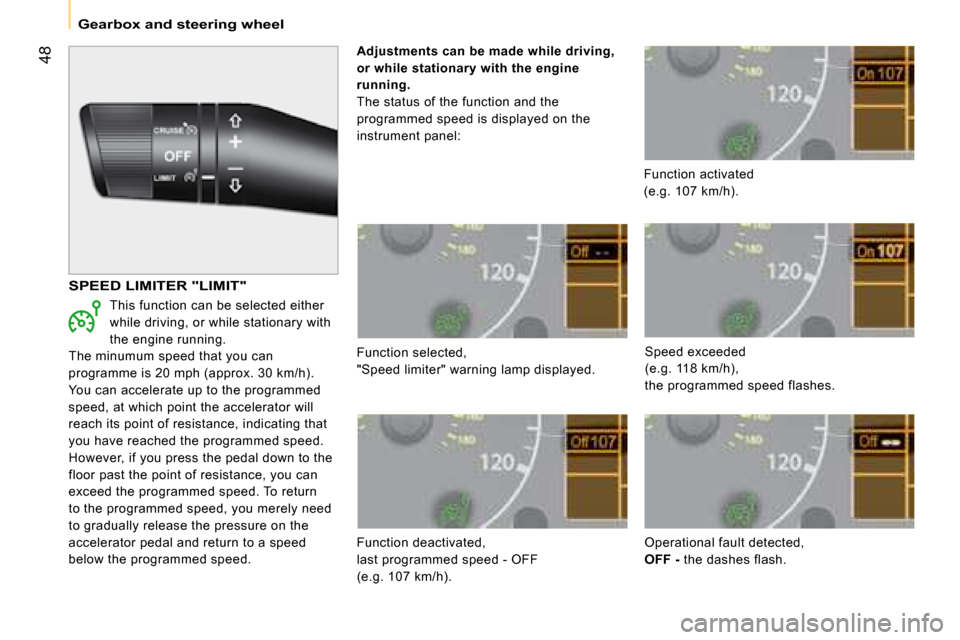
Function selected,
"Speed limiter" warning lamp displayed.
Function deactivated,
last programmed speed - OFF
(e.g. 107 km/h).Function activated
(e.g. 107 km/h).
Speed exceeded
(e.g. 118 km/h),
the programmed speed flashes.
Operational fault detected,
OFF - the dashes flash.
SPEED LIMITER "LIMIT"
This function can be selected either
while driving, or while stationary with
the engine running.
The minumum speed that you can
programme is 20 mph (approx. 30 km/h).
You can accelerate up to the programmed
speed, at which point the accelerator will
reach its point of resistance, indicating that
you have reached the programmed speed.
However, if you press the pedal down to the
floor past the point of resistance, you can
exceed the programmed speed. To return
to the programmed speed, you merely need
to gradually release the pressure on the
accelerator pedal and return to a speed
below the programmed speed. Adjustments can be made while driving,
or while stationary with the engine
running.
The status of the function and the
programmed speed is displayed on the
instrument panel:
Page 69 of 140
63
3
IN-CAR TECHNOLOGY
Menu
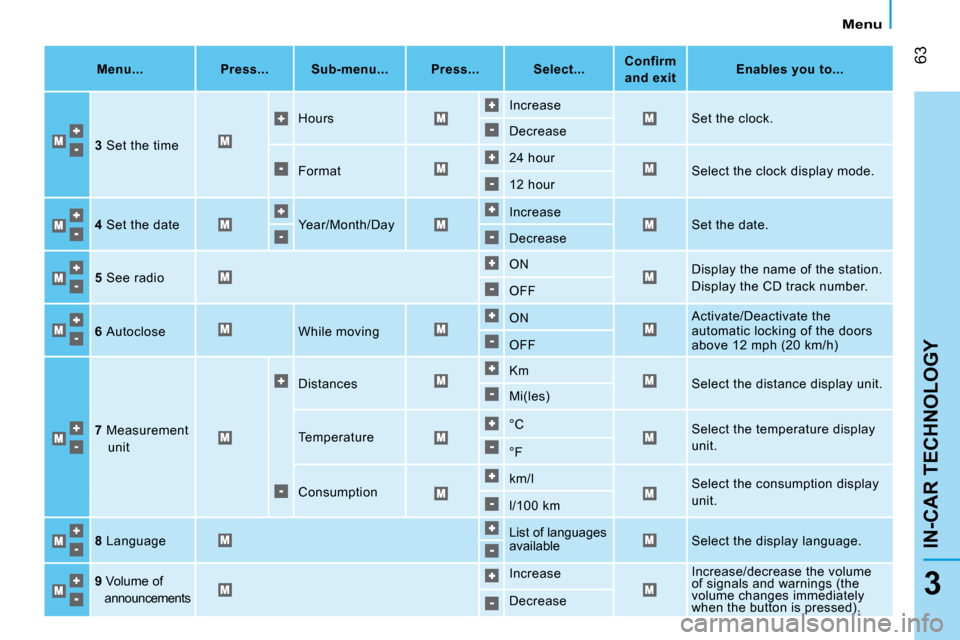
Menu...
Press... Sub-menu... Press... Select...
Confirm
and exit
Enables you to...
3 Set the time Hours
Increase
Set the clock.
Decrease
Format 24 hour
Select the clock display mode.
12 hour
4 Set the date Year/Month/Day Increase
Set the date.
Decrease
5 See radio ON
Display the name of the station.
Display the CD track number.
OFF
6 Autoclose While moving ON
Activate/Deactivate the
automatic locking of the doors
above 12 mph (20 km/h)
OFF
7 Measurement
unit Distances
Km
Select the distance display unit.
Mi(les)
Temperature °C
Select the temperature display
unit.
°F
Consumption km/l
Select the consumption display
unit.
l/100 km
8 Language List of languages
available
Select the display language.
9 Volume of
announcements Increase
Increase/decrease the volume
of signals and warnings (the
volume changes immediately
when the button is pressed).
Decrease
Page 71 of 140
65
3
IN-CAR TECHNOLOGY
Parking assistance
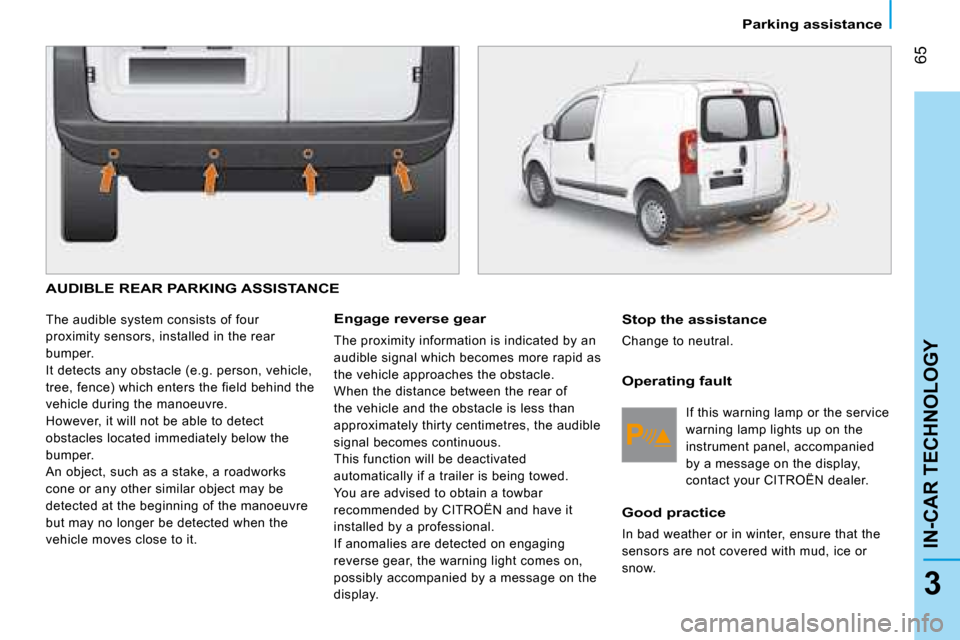
AUDIBLE REAR PARKING ASSISTANCE
The audible system consists of four
proximity sensors, installed in the rear
bumper.
It detects any obstacle (e.g. person, vehicle,
tree, fence) which enters the field behind the
vehicle during the manoeuvre.
However, it will not be able to detect
obstacles located immediately below the
bumper.
An object, such as a stake, a roadworks
cone or any other similar object may be
detected at the beginning of the manoeuvre
but may no longer be detected when the
vehicle moves close to it. Stop the assistance
Change to neutral.
Operating fault
If this warning lamp or the service
warning lamp lights up on the
instrument panel, accompanied
by a message on the display,
contact your CITROËN dealer.
Good practice
In bad weather or in winter, ensure that the
sensors are not covered with mud, ice or
snow.
Engage reverse gear
The proximity information is indicated by an
audible signal which becomes more rapid as
the vehicle approaches the obstacle.
When the distance between the rear of
the vehicle and the obstacle is less than
approximately thirty centimetres, the audible
signal becomes continuous.
This function will be deactivated
automatically if a trailer is being towed.
You are advised to obtain a towbar
recommended by CITROËN and have it
installed by a professional.
If anomalies are detected on engaging
reverse gear, the warning light comes on,
possibly accompanied by a message on the
display.
Page 92 of 140
86
Driving safety
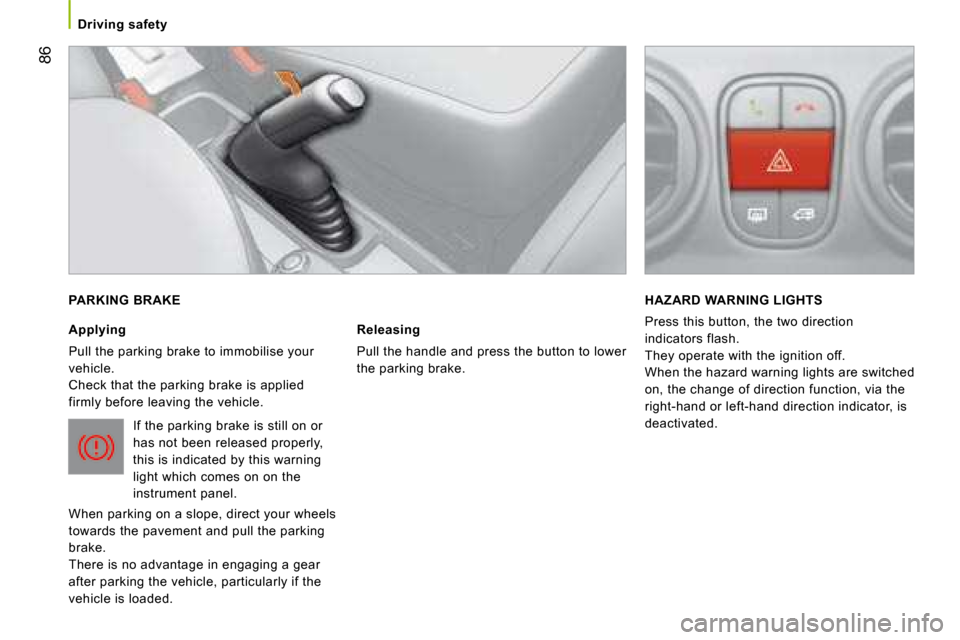
PARKING BRAKE
Applying
Pull the parking brake to immobilise your
vehicle.
Check that the parking brake is applied
firmly before leaving the vehicle.
If the parking brake is still on or
has not been released properly,
this is indicated by this warning
light which comes on on the
instrument panel.
When parking on a slope, direct your wheels
towards the pavement and pull the parking
brake.
There is no advantage in engaging a gear
after parking the vehicle, particularly if the
vehicle is loaded. Releasing
Pull the handle and press the button to lower
the parking brake.
HAZARD WARNING LIGHTS
Press this button, the two direction
indicators flash.
They operate with the ignition off.
When the hazard warning lights are switched
on, the change of direction function, via the
right-hand or left-hand direction indicator, is
deactivated.