Reverse CITROEN NEMO 2010 User Guide
[x] Cancel search | Manufacturer: CITROEN, Model Year: 2010, Model line: NEMO, Model: CITROEN NEMO 2010Pages: 166, PDF Size: 4.22 MB
Page 78 of 166
Parking sensors
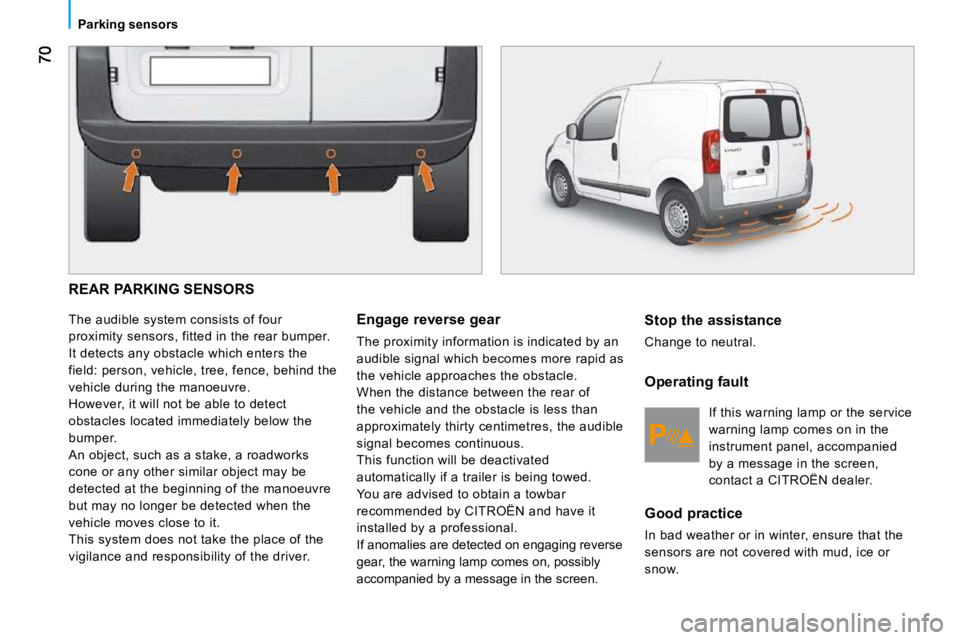
REAR PARKING SENSORS
The audible system consists of four
proximity sensors, fitted in the rear bumper.
It detects any obstacle which enters the
field: person, vehicle, tree, fence, behind the
vehicle during the manoeuvre.
However, it will not be able to detect
obstacles located immediately below the
bumper.
An object, such as a stake, a roadworks
cone or any other similar object may be
detected at the beginning of the manoeuvre
but may no longer be detected when the
vehicle moves close to it.
This system does not take the place of the
vigilance and responsibility of the driver. Stop the assistance
Change to neutral.
Operating fault
If this warning lamp or the service
warning lamp comes on in the
instrument panel, accompanied
by a message in the screen,
contact a CITROËN dealer.
Good practice
In bad weather or in winter, ensure that the
sensors are not covered with mud, ice or
snow.
Engage reverse gear
The proximity information is indicated by an
audible signal which becomes more rapid as
the vehicle approaches the obstacle.
When the distance between the rear of
the vehicle and the obstacle is less than
approximately thirty centimetres, the audible
signal becomes continuous.
This function will be deactivated
automatically if a trailer is being towed.
You are advised to obtain a towbar
recommended by CITROËN and have it
installed by a professional.
If anomalies are detected on engaging reverse
gear, the warning lamp comes on, possibly
accompanied by a message in the screen.
7070
Page 101 of 166
93
4
EASE OF USE and COMFORT
Practical information
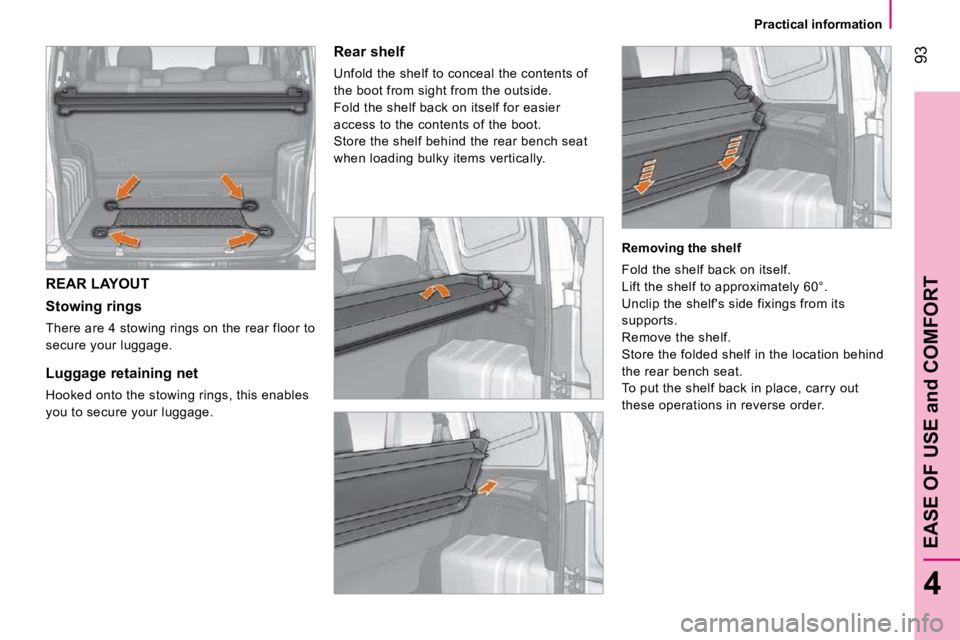
REAR LAYOUT
Stowing rings
There are 4 stowing rings on the rear floor to
secure your luggage.
Luggage retaining net
Hooked onto the stowing rings, this enables
you to secure your luggage. Rear shelf
Unfold the shelf to conceal the contents of
the boot from sight from the outside.
Fold the shelf back on itself for easier
access to the contents of the boot.
Store the shelf behind the rear bench seat
when loading bulky items vertically.
Removing the shelf
Fold the shelf back on itself.
Lift the shelf to approximately 60°.
Unclip the shelf's side fixings from its
supports.
Remove the shelf.
Store the folded shelf in the location behind
the rear bench seat.
To put the shelf back in place, carry out
these operations in reverse order.
Page 137 of 166
122
Changing a wheel Removing
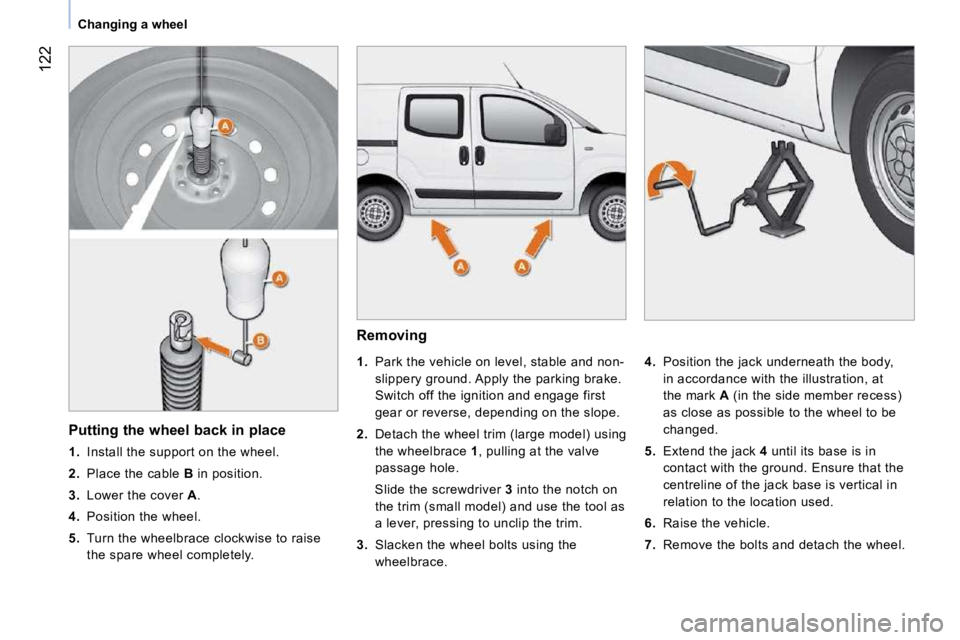
1. Park the vehicle on level, stable and non-
slippery ground. Apply the parking brake.
Switch off the ignition and engage first
gear or reverse, depending on the slope.
2. Detach the wheel trim (large model) using
the wheelbrace 1 , pulling at the valve
passage hole.
Slide the screwdriver 3 into the notch on
the trim (small model) and use the tool as
a lever, pressing to unclip the trim.
3. Slacken the wheel bolts using the
wheelbrace.
4. Position the jack underneath the body,
in accordance with the illustration, at
the mark A (in the side member recess)
as close as possible to the wheel to be
changed.
5. Extend the jack 4 until its base is in
contact with the ground. Ensure that the
centreline of the jack base is vertical in
relation to the location used.
6. Raise the vehicle.
7. Remove the bolts and detach the wheel.
Putting the wheel back in place
1. Install the support on the wheel.
2. Place the cable B in position.
3. Lower the cover A .
4. Position the wheel.
5. Turn the wheelbrace clockwise to raise
the spare wheel completely.
Page 141 of 166
126
Changing a bulb
Front lamps
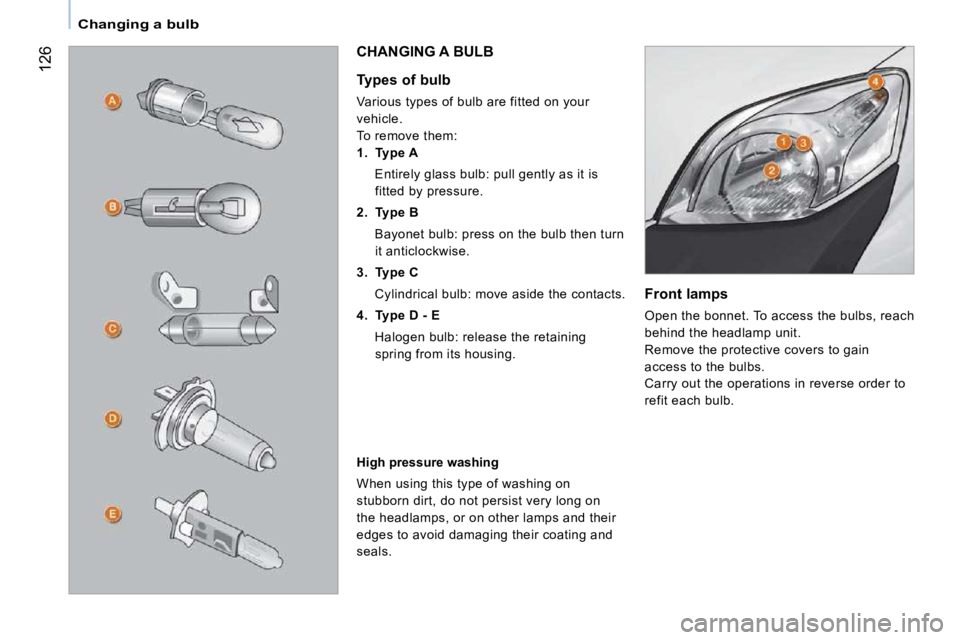
Open the bonnet. To access the bulbs, reach
behind the headlamp unit.
Remove the protective covers to gain
access to the bulbs.
Carry out the operations in reverse order to
refit each bulb.
CHANGING A BULB
Types of bulb
Various types of bulb are fitted on your
vehicle.
To remove them:
1. Type A
Entirely glass bulb: pull gently as it is fitted by pressure.
2. Type B
Bayonet bulb: press on the bulb then turn it anticlockwise.
3. Type C
Cylindrical bulb: move aside the contacts.
4. Type D - E
Halogen bulb: release the retaining spring from its housing.
High pressure washing
When using this type of washing on
stubborn dirt, do not persist very long on
the headlamps, or on other lamps and their
edges to avoid damaging their coating and
seals.