brake CITROEN NEMO 2010 Owner's Manual
[x] Cancel search | Manufacturer: CITROEN, Model Year: 2010, Model line: NEMO, Model: CITROEN NEMO 2010Pages: 166, PDF Size: 4.22 MB
Page 136 of 166
121
7
QUICK HELP
Changing a wheel
CHANGING A WHEEL
Parking the vehicle
As far as possible, park the vehicle on level,
stable and non-slippery ground.
Apply the handbrake, switch off the ignition
and engage first gear (on a hill).
It is imperative that you ensure that the
occupants get out of the vehicle and wait in
a safe location.
If possible, place a chock under the
wheel diagonally opposite the wheel to be
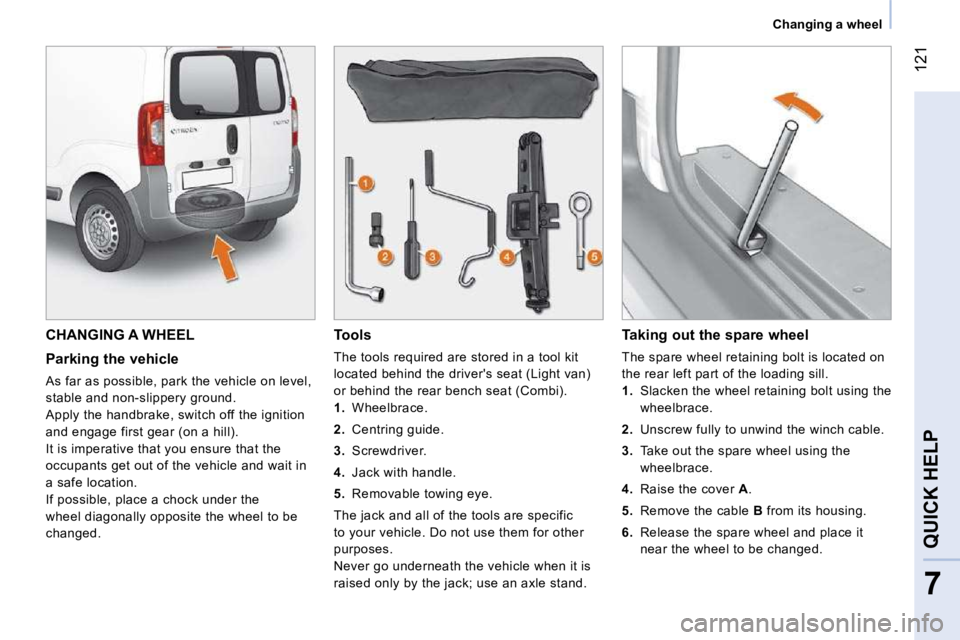
changed. Tools
The tools required are stored in a tool kit
located behind the driver's seat (Light van)
or behind the rear bench seat (Combi).
1. Wheelbrace.
2. Centring guide.
3. Screwdriver.
4. Jack with handle.
5. Removable towing eye.
The jack and all of the tools are specific
to your vehicle. Do not use them for other
purposes.
Never go underneath the vehicle when it is
raised only by the jack; use an axle stand. Taking out the spare wheel
The spare wheel retaining bolt is located on
the rear left part of the loading sill.
1. Slacken the wheel retaining bolt using the
wheelbrace.
2. Unscrew fully to unwind the winch cable.
3. Take out the spare wheel using the
wheelbrace.
4. Raise the cover A .
5. Remove the cable B from its housing.
6. Release the spare wheel and place it
near the wheel to be changed.
Page 137 of 166
122
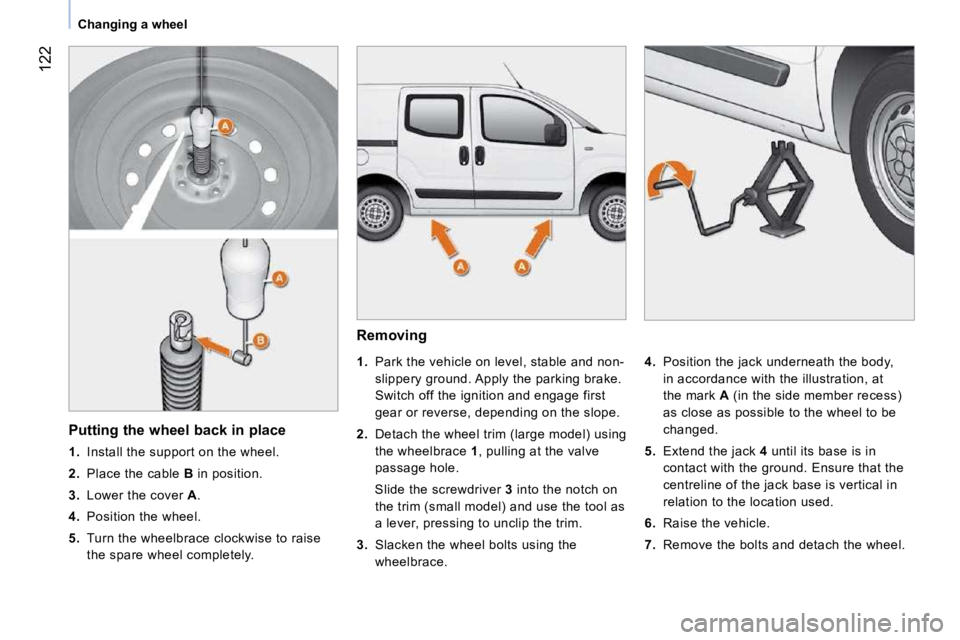
Changing a wheel Removing
1. Park the vehicle on level, stable and non-
slippery ground. Apply the parking brake.
Switch off the ignition and engage first
gear or reverse, depending on the slope.
2. Detach the wheel trim (large model) using
the wheelbrace 1 , pulling at the valve
passage hole.
Slide the screwdriver 3 into the notch on
the trim (small model) and use the tool as
a lever, pressing to unclip the trim.
3. Slacken the wheel bolts using the
wheelbrace.
4. Position the jack underneath the body,
in accordance with the illustration, at
the mark A (in the side member recess)
as close as possible to the wheel to be
changed.
5. Extend the jack 4 until its base is in
contact with the ground. Ensure that the
centreline of the jack base is vertical in
relation to the location used.
6. Raise the vehicle.
7. Remove the bolts and detach the wheel.
Putting the wheel back in place
1. Install the support on the wheel.
2. Place the cable B in position.
3. Lower the cover A .
4. Position the wheel.
5. Turn the wheelbrace clockwise to raise
the spare wheel completely.
Page 145 of 166
129
7
QUICK HELP
Changing a bulb
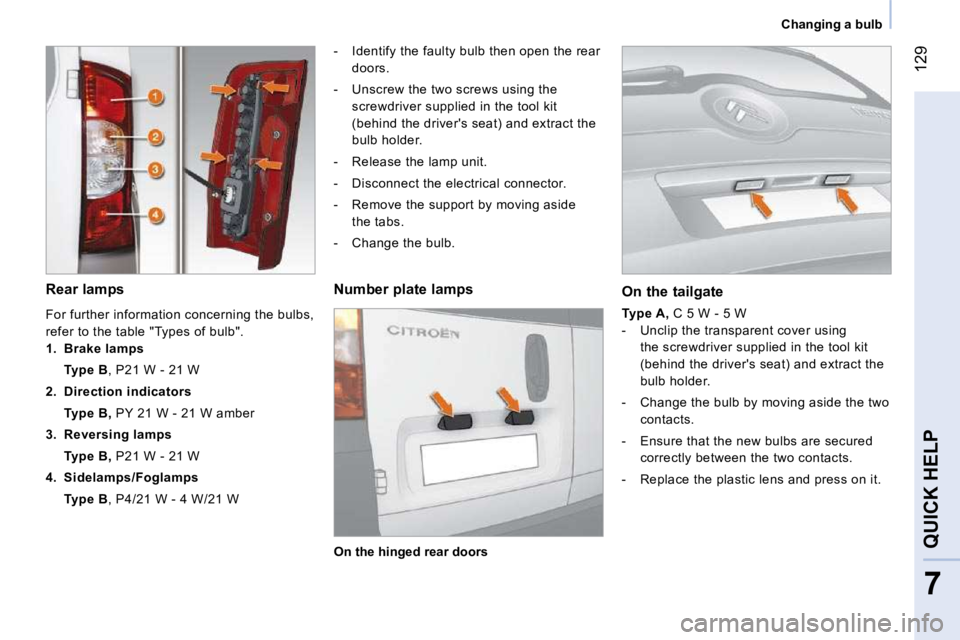
Rear lamps - Identify the faulty bulb then open the rear
doors.
- Unscrew the two screws using the screwdriver supplied in the tool kit
(behind the driver's seat) and extract the
bulb holder.
- Release the lamp unit.
- Disconnect the electrical connector.
- Remove the support by moving aside the tabs.
- Change the bulb.
Number plate lamps
Type A, C 5 W - 5 W
- Unclip the transparent cover using the screwdriver supplied in the tool kit
(behind the driver's seat) and extract the
bulb holder.
- Change the bulb by moving aside the two contacts.
- Ensure that the new bulbs are secured correctly between the two contacts.
- Replace the plastic lens and press on it.
For further information concerning the bulbs,
refer to the table "Types of bulb".
1. Brake lamps
Type B , P21 W - 21 W
2. Direction indicators
Type B, PY 21 W - 21 W amber
3. Reversing lamps
Type B, P21 W - 21 W
4. Sidelamps/Foglamps
Type B , P4/21 W - 4 W/21 W
On the hinged rear doors On the tailgate
Page 146 of 166
130
Changing a bulb
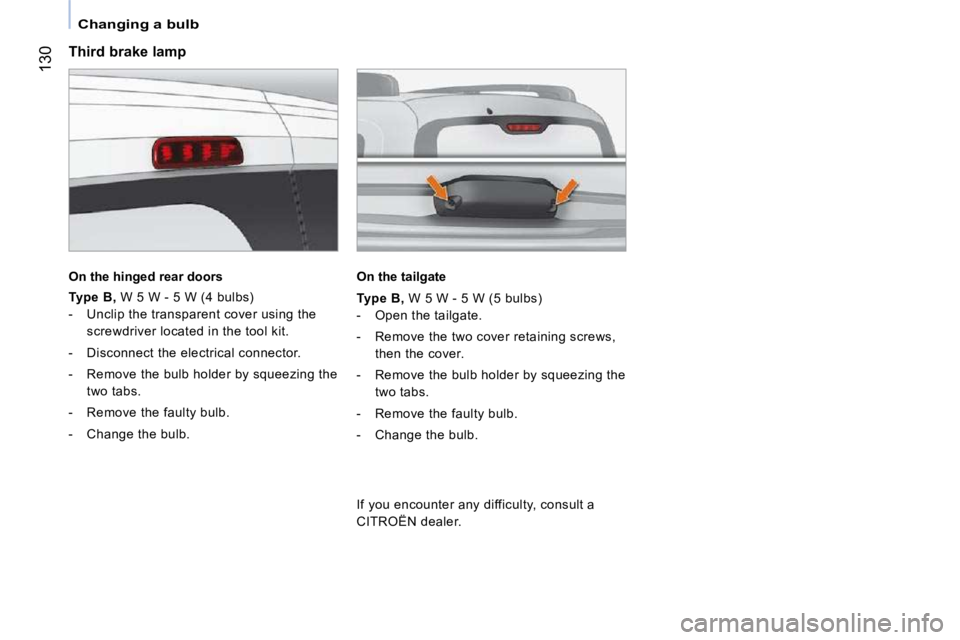
Third brake lamp
On the hinged rear doors
Type B , W 5 W - 5 W (4 bulbs)
- Unclip the transparent cover using the screwdriver located in the tool kit.
- Disconnect the electrical connector.
- Remove the bulb holder by squeezing the two tabs.
- Remove the faulty bulb.
- Change the bulb. On the tailgate
Type B, W 5 W - 5 W (5 bulbs)
- Open the tailgate.
- Remove the two cover retaining screws, then the cover.
- Remove the bulb holder by squeezing the two tabs.
- Remove the faulty bulb.
- Change the bulb.
If you encounter any difficulty, consult a
CITROËN dealer.
Page 150 of 166
133
7
QUICK HELP
Changing a fuse
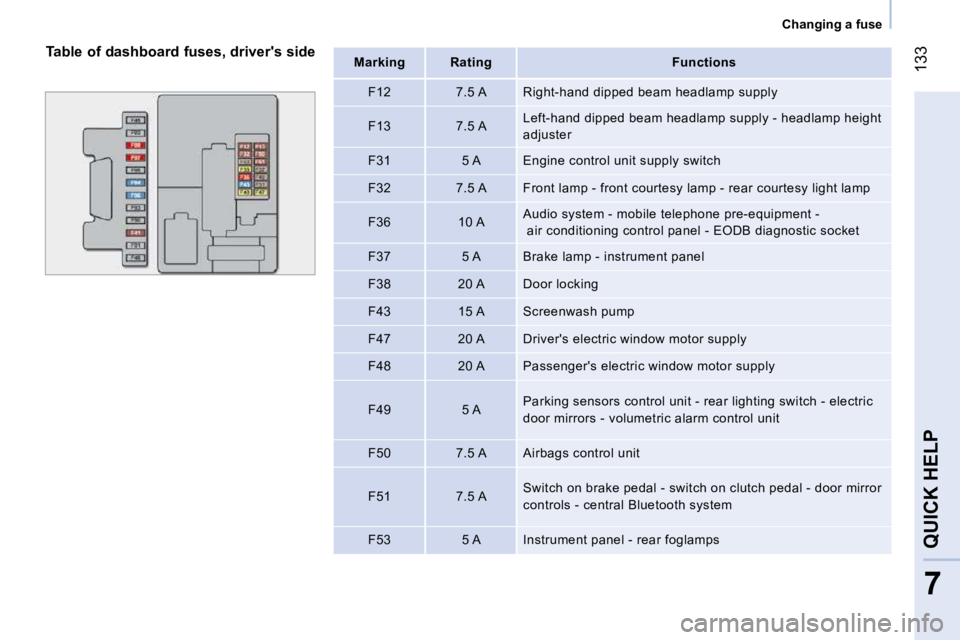
Table of dashboard fuses, driver's side
Mark
ing Rating Functions
F12 7.5 A Right-hand dipped beam headlamp su pply
F13 7.5 A Left-hand dipped beam headlamp supply - headlamp h
eight
adjuster
F31 5 A Engine control unit supply switch
F32 7.5 A Front lamp - front courtesy lamp - rear courtesy light lamp
F36 10 A Audio system - mobile telephone pre-equipment -
air conditioning control panel - EODB diagnostic s
ocket
F37 5 A Brake lamp - instrument panel
F38 20 A Door locking
F43 15 A Screenwash pump
F47 20 A Driver's electric window motor supp ly
F48 20 A Passenger's electric window motor s upply
F49 5 A Parking sensors control unit - rear lighting switc
h - electric
door mirrors - volumetric alarm control unit
F50 7.5 A Airbags control unit
F51 7.5 A Switch on brake pedal - switch on clutch pedal - d
oor mirror
controls - central Bluetooth system
F53 5 A Instrument panel - rear foglamps
Page 155 of 166
137
7
QUICK HELP
Having your vehicle towed
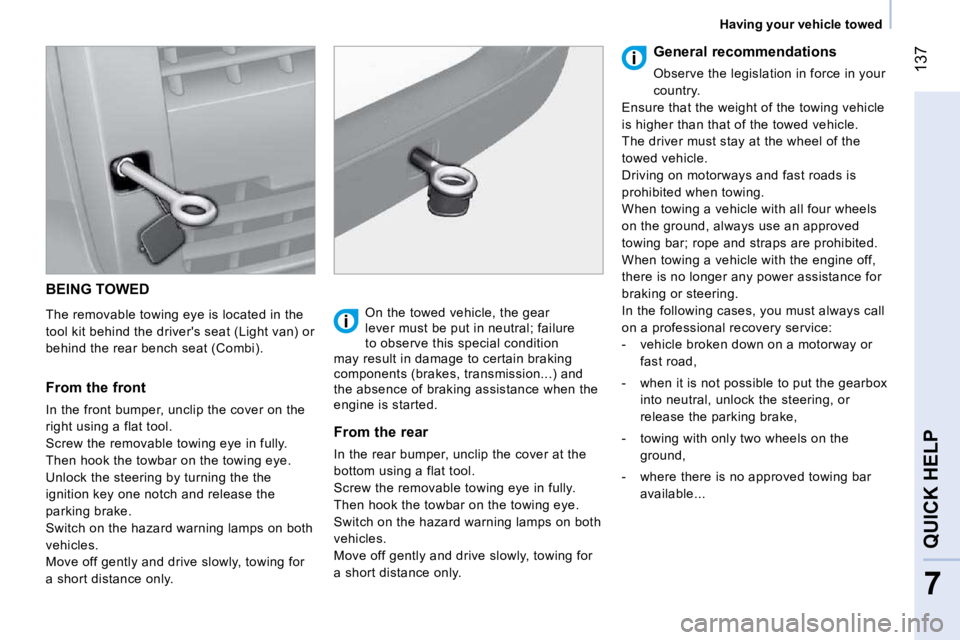
BEING TOWED
The removable towing eye is located in the
tool kit behind the driver's seat (Light van) or
behind the rear bench seat (Combi).
From the front
In the front bumper, unclip the cover on the
right using a flat tool.
Screw the removable towing eye in fully.
Then hook the towbar on the towing eye.
Unlock the steering by turning the the
ignition key one notch and release the
parking brake.
Switch on the hazard warning lamps on both
vehicles.
Move off gently and drive slowly, towing for
a short distance only. On the towed vehicle, the gear
lever must be put in neutral; failure
to observe this special condition
may result in damage to certain braking
components (brakes, transmission...) and
the absence of braking assistance when the
engine is started.
From the rear
In the rear bumper, unclip the cover at the
bottom using a flat tool.
Screw the removable towing eye in fully.
Then hook the towbar on the towing eye.
Switch on the hazard warning lamps on both
vehicles.
Move off gently and drive slowly, towing for
a short distance only. General recommendations
Observe the legislation in force in your
country.
Ensure that the weight of the towing vehicle
is higher than that of the towed vehicle.
The driver must stay at the wheel of the
towed vehicle.
Driving on motorways and fast roads is
prohibited when towing.
When towing a vehicle with all four wheels
on the ground, always use an approved
towing bar; rope and straps are prohibited.
When towing a vehicle with the engine off,
there is no longer any power assistance for
braking or steering.
In the following cases, you must always call
on a professional recovery service:
- vehicle broken down on a motorway or fast road,
- when it is not possible to put the gearbox into neutral, unlock the steering, or
release the parking brake,
- towing with only two wheels on the ground,
- where there is no approved towing bar available...
Page 161 of 166
143
7
QUICK HELP
Under the bonnet
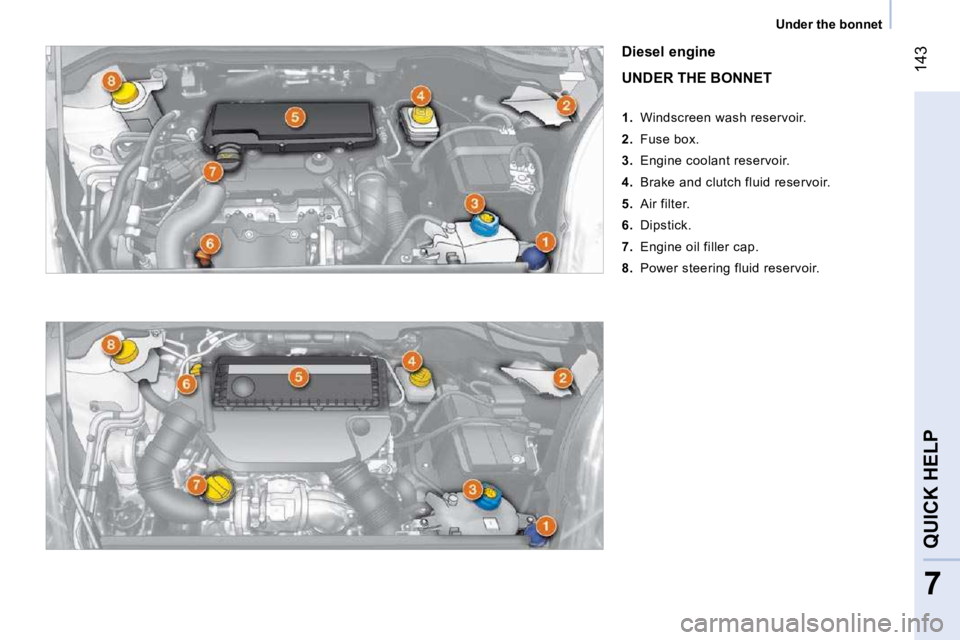
Diesel engine
UNDER THE BONNET
1. Windscreen wash reservoir.
2. Fuse box.
3. Engine coolant reservoir.
4. Brake and clutch fluid reservoir.
5. Air filter.
6. Dipstick.
7. Engine oil filler cap.
8. Power steering fluid reservoir.
Page 162 of 166
144
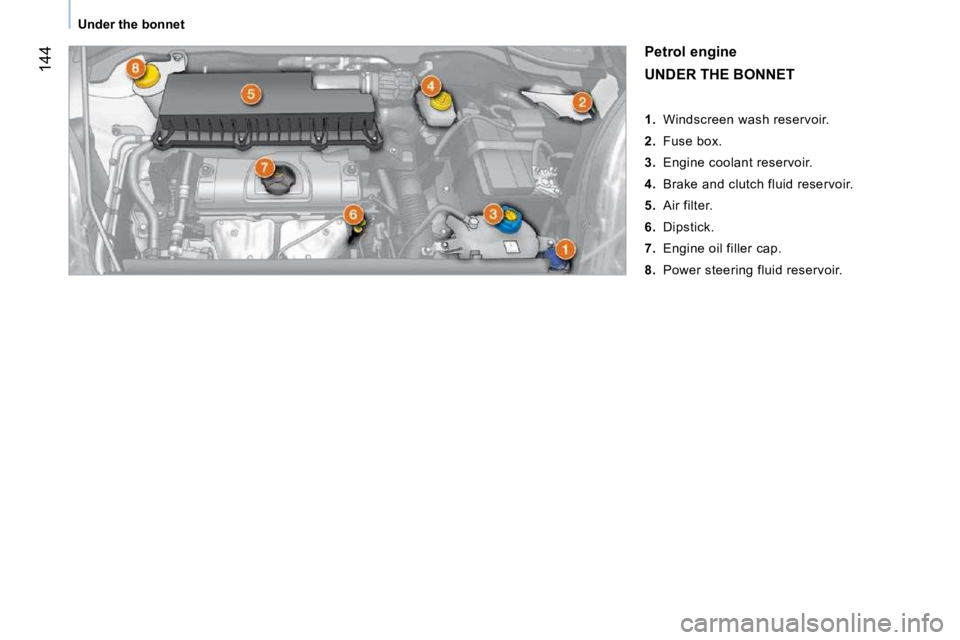
Under the bonnet Petrol engine
UNDER THE BONNET
1. Windscreen wash reservoir.
2. Fuse box.
3. Engine coolant reservoir.
4. Brake and clutch fluid reservoir.
5. Air filter.
6. Dipstick.
7. Engine oil filler cap.
8. Power steering fluid reservoir.
Page 163 of 166
145
7
QUICK HELP
Levels
These regular maintenance operations
will keep your vehicle in good working
order. Ask for advice from a CITROËN
dealer or refer to the servicing booklet
provided in the handbook pack.
LEVELS
Oil level
Check the level regularly and top up
between changes. The maximum oil
consumption is 0.5 litre per 600 miles
(1 000 km). Check the level with the vehicle
level, engine cold, using the dipstick.
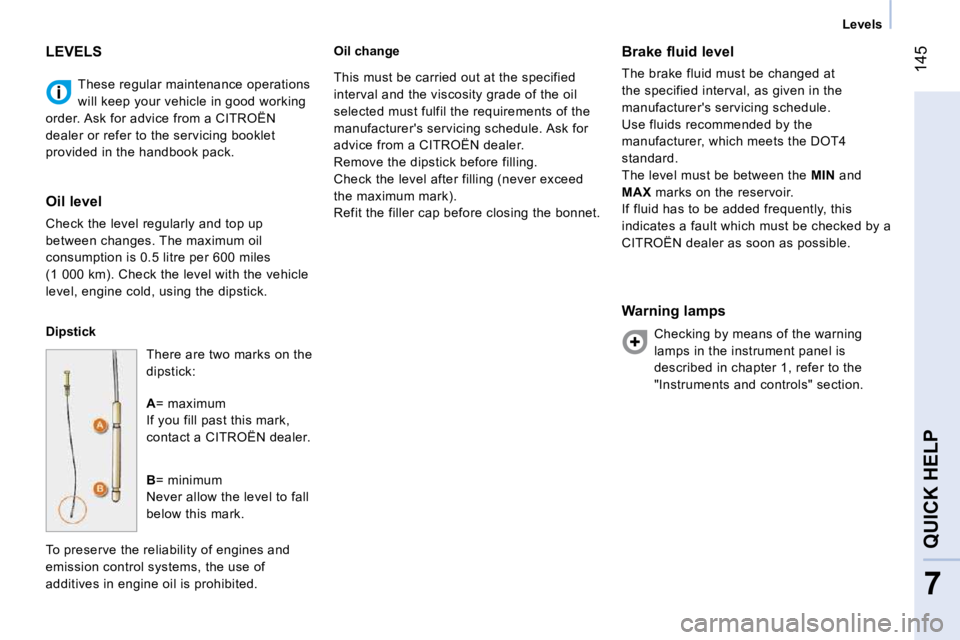
Dipstick There are two marks on the
dipstick:
A = maximum
If you fill past this mark,
contact a CITROËN dealer.
B = minimum
Never allow the level to fall
below this mark.
To preserve the reliability of engines and
emission control systems, the use of
additives in engine oil is prohibited. Oil change
Brake fluid level
The brake fluid must be changed at
the specified interval, as given in the
manufacturer's servicing schedule.
Use fluids recommended by the
manufacturer, which meets the DOT4
standard.
The level must be between the MIN and
MAX marks on the reservoir.
If fluid has to be added frequently, this
indicates a fault which must be checked by a
CITROËN dealer as soon as possible.
Warning lamps
Checking by means of the warning
lamps in the instrument panel is
described in chapter 1, refer to the
"Instruments and controls" section.
This must be carried out at the specified
interval and the viscosity grade of the oil
selected must fulfil the requirements of the
manufacturer's servicing schedule. Ask for
advice from a CITROËN dealer.
Remove the dipstick before filling.
Check the level after filling (never exceed
the maximum mark).
Refit the filler cap before closing the bonnet.
Page 164 of 166

146
Levels
Engine coolant level
Only use the fluid recommended by the
manufacturer. Otherwise, you risk seriously
damaging your engine. When the engine
is warm, the temperature of the coolant is
controlled by the engine cooling fan. As
this fan can operate with the ignition key
removed and because the cooling system is
pressurised, wait for at least one hour after
the engine has stopped before carrying out
any work.
Topping up
The level must be between the MIN and
MAX marks on the header tank. If more than
1 litre of fluid is required to top up the level,
have the system checked by a CITROËN
dealer. Power steering fluid level
The vehicle must be parked on level ground
with the engine cold. Unscrew the cap with
integral gauge and check the level which
must be between the
MIN and MAX marks.
Screenwash fluid level
For optimum cleaning and to avoid freezing,
topping up or replacement of this fluid
should never be with plain water; we
recommend the use of products available
from CITROËN dealers.
Capacity of the reservoir: approximately
5.5 litres.
Slacken the cap by two turns to release the
pressure to prevent any risk of scalding.
When the pressure has dropped, remove the
cap and top up the level with coolant.
If fluid has to be added frequently, this
indicates a fault which must be checked by a
CITROËN dealer as soon as possible. Used products
Avoid prolonged contact of used oil with
the skin.
Brake fluid is harmful to health and very
corrosive.
Do not dispose of used oil, brake fluid
or coolant into drains or into the ground,
but into the containers provided for this
purpose at CITROËN dealers (France) or
at an authorised waste disposal site.