seats CITROEN RELAY 2019 Handbook (in English)
[x] Cancel search | Manufacturer: CITROEN, Model Year: 2019, Model line: RELAY, Model: CITROEN RELAY 2019Pages: 232, PDF Size: 8.21 MB
Page 77 of 232

75
AirbagsThe airbags do not operate when the
engine is not running.
This equipment will only deploy once. If
a second impact occurs (during the same
or a
subsequent accident), the airbag will
not be deployed again.
The airbags have been designed to optimise
the safety of the occupants in the event of
a
serious collision; they work in conjunction
with the force limiting seat belts.
In the event of a
serious collision, electronic
detectors record and analyse any abrupt
deceleration of the vehicle:
-
i
n the event of a
serious collision, the
airbags are deployed instantly and
contribute towards better protection of
occupants of the vehicle; immediately after
the impact, the airbags deflate rapidly so as
not to hinder visibility or a
potential exit by
the occupants,
-
i
n the case of a
minor or rear impact or in
certain rollover conditions, the airbags are
not deployed; the seat belt alone contributes
towards ensuring your protection in these
situations. Deployment of the airbags is accompanied
by a
slight discharge of smoke and
a
noise, resulting from activation of the
pyrotechnic charge incorporated in the
system.
Although this smoke is not harmful,
sensitive individuals may experience slight
irritation.
The noise of the detonation may result in
a
slight loss of hearing for a short time.
Front airbags
System which protects the driver and
passenger(s) in the event of a serious front
impact in order to limit the risk of injury to the
head and thorax.
The driver's airbag is fitted in the centre of the
steering wheel; the front passenger(s) airbag is
fitted in the dashboard above the glove box.
Malfunction
If this warning lamp comes on,
contact a CITROËN dealer to have
the system checked.
Lateral airbags and curtain
airbags
If your vehicle is fitted with lateral airbags,
these are fitted to the front seat backrests on
the door side.
Curtain airbags are fitted to the door pillars and
the upper part of the passenger compartment,
in the roof over the front cab seats.
They inflate between the occupant and the
glazed area.
They are deployed independently of each other
depending on which side the collision occurs.
Malfunction
If this warning lamp comes on,
contact a CITROËN dealer to have
the system checked.
5
5
Safety
Page 78 of 232

76
Advice
For the airbags to be fully effective,
observe the safety recommendations
below.
Adopt a normal and upright sitting position.
Fasten your seat belt, ensuring it is positioned
c o r r e c t l y.
Do not leave anything between the occupants
and the airbags (a child, pet, object, etc.), nor
fix or attach anything close to the inflation
trajectory of the airbags; this could cause
injuries during their deployment.
Never modify the original definition of your
vehicle, particularly in the area directly
around the airbags.
After an accident or if the vehicle has been
stolen or broken into, have the airbag systems
checked.
All work on the airbag system must be carried
out by a
CITROËN dealer or a qualified
workshop.
Even if all of the precautions mentioned
are obser ved, a risk of injury or of minor
burns to the head, chest or arms when an
airbag is deployed cannot be ruled out. The
bag inflates almost instantly (within a
few
milliseconds) then deflates within the same
time discharging the hot gas via openings
provided for this purpose. Front airbags
Do not drive holding the steering wheel by its
spokes or resting your hands on the centre
part of the wheel.
Passengers must not place their feet on the
dashboard.
Do not smoke as deployment of the airbags
can cause burns or the risk of injury from
a
cigarette or pipe.
Never remove or pierce the steering wheel or
hit it violently.
Do not fit or attach anything to the steering
wheel or dashboard, this could cause injuries
with deployment of the airbags.
Lateral airbags
Use only approved covers on the seats,
compatible with the deployment the lateral
airbags. For information on the range of seat
covers suitable for your vehicle, you can
contact a
CITROËN dealer.
Do not attach anything to or hang anything
from the seat backrests (clothes, etc.) as
this could cause injuries to the thorax or arm
when the lateral airbag is deployed.
Do not sit with the upper part of the body any
nearer to the door than necessary. Curtain airbags
Do not attach anything to or hang anything
from the roof, as this could cause head
injuries when the curtain airbag is deployed.
If fitted on your vehicle, do not remove the
grab handles installed on the roof, they play
a
part in securing the curtain airbags.
Safety
Page 79 of 232

77
General points relating to
child seats
The regulations on carrying children are
specific to each country. Refer to the
legislation in force in your country.
For maximum safety, please obser ve the
following recommendations:
-
i
n accordance with European regulations,
all children under the age of 12
or less
than one and a
half metres tall must
travel in approved child seats suited to
their weight , on seats fitted with a
seat belt
or ISOFIX mountings,
-
s
tatistically, the safest seats in your
vehicle for carr ying children are the rear
seats,
-
a c
hild weighing less than 9 kg must
travel in the rear ward facing position
both in the front and in the rear. It is recommended
that children travel in
the rear seats of your vehicle:
-
re
arward facing
up to the age of 3,
- fo rward facing
over the age of 3.
Child seat at the rear
"Rearward facing"
When a "rear ward facing" child seat
is installed on a
rear passenger
seat , move the vehicle's front seat
for ward and straighten the backrest
so that the "rear ward facing" child
seat does not touch the vehicle's
front seat.
" Forward facing "
When a "for ward facing" child seat
is installed on a
rear passenger
seat , move the vehicle's front seat
for wards and straighten the backrest
so that the legs of the child in the
"for ward facing" child seat do not
touch the vehicle's front seat. Ensure that the seat belt is correctly
tensioned.
For child seats with a
support leg, ensure
that the latter is in firm contact with the
floor. If necessary, adjust the front seat of
the vehicle.
Child seat at the front
(Refer to the legislation in force in your country
before installing your child on this seat.)
" Rearward facing"
When a "rear ward facing" child seat
is installed on the front passenger
seat , adjust the vehicle's seat to
the intermediate longitudinal and
highest position, with the backrest
upright.
The passenger's front airbag must be
deactivated. Otherwise, the child risks
being seriously injured or killed in case
of airbag deployment .
5
5
Safety
Page 80 of 232

78
"Forward facing "
When a "for ward facing" child seat
is installed on the front passenger
seat, adjust the vehicle's seat to
the intermediate longitudinal and
highest position with seat backrest
upright, and leave the passenger's
front airbag activated.
Ensure that the seat belt is correctly
tensioned.
For child seats with a
support leg, ensure
that the latter is in firm contact with the
floor. If necessary, adjust the passenger
seat.
Deactivating the
passenger's front airbag
Never install a rear ward facing child
r estraint system on a seat protected by an
active front airbag. This could cause the
death of the child or serious injury. The warning label present on both sides of the
passenger's sun visor repeats this advice.
In line with current legislation, the following
tables contain this warning in all of the
languages required.
Passenger airbag OFF
Deactivation
To assure your child's safety, you must
deactivate the front passenger airbag
when you install a
rear ward facing child
seat on the front passenger seat or bench
seat. Otherwise, the child risks being
killed or seriously injured if the airbag is
deployed.
If the front passenger airbag cannot be
deactivated in your vehicle: you must not
install a
rearward facing child seat.
F
F
unction is set with the MODE
button; in the
"Passenger airbag" menu, select "OFF".
Safety
Page 84 of 232

82
Locations for child seats secured using a seat belt
In accordance with the European regulation, this table indicates the options for installing child seats secured using a seat belt and universally approved
i n accordance with the weight of the child and the seating position in the vehicle.
a: Group 0: from birth to 10
kg.
b: Refer to the legislation in force in your
country before installing your child in this
seating position. U:
Seat suitable for the installation of a
child
seat secured using a
seat belt and
universally approved, rearward facing
and/or forward facing. Remove and stow the head restraint
before installing a
child seat with backrest
on a
passenger seat.
Refit the head restraint once the child seat
has been removed.
Seating position
Weight of the child and indicative age
Under 13
kg
(groups 0 ( a) and 0+)
Up to about 1
year old9 -18
kg
(g r o u p 1)
From about 1 to 3
years old15 -25
kg
(group 2)
From about 3 to 6
years old22-36
kg
(group 3)
From about 6 to 10
years old
Front passenger seat ( b) UUUU
Front passenger bench seat with centre and outer seats ( b) U
UUU
Outer and centre seats in rows 2
and 3 U
UUU
Safety
Page 85 of 232

83
'ISOFIX' mountings
If fitted on your vehicle, the regulation ISOFIX
mountings are identified by labels.
There are three rings for each seat:This ISOFIX mounting system provides fast,
reliable and safe fitting of the child seat in your
vehicle.
The ISOFIX child seats are fitted with two
latches which are secured easily on the two
front rings.
Some also have an upper strap which is
attached to the rear ring.
To attach this strap, remove and stow the head
restraint before installing the child seat at the
seating position (refit it once the child seat has
been removed). Then secure the hook on the
rear ring and tighten the upper strap.
Your vehicle has been approved in accordance
with the latest ISOFIX regulation.
-
t
wo front rings, located between the vehicle
seat backrest and cushion, identified by
a
label, -
a r ear ring, for securing the upper strap,
called the TOP TETHER and identified by
another label. The incorrect installation of a
child seat
in a vehicle compromises the child's
protection in the event of an accident.
For information on the possibilities for
fitting ISOFIX child seats to your vehicle,
refer to the summary table for the location
of the ISOFIX child seats.
5
5
Safety
Page 86 of 232

84
I UF:Seat suitable for the installation of
an ISOFIX child seat of the universal
category. "For ward facing" ISOFIX child
seats fitted with an upper strap secured
to the upper ring of the vehicle seats
equipped with ISOFIX mountings. X:
Seat not suitable for the installation
of an ISOFIX child seat of the size
category indicated. Remove and stow the head restraint
before installing a
child seat with backrest
on a
passenger seat.
Refit the head restraint once the child seat
has been removed.
Under 10
kg
(group 0)
Up to about 6 months
old Under 10 kg
(group 0)
Under 13 kg
(group 0+)
Up to about 1 year old
9 -18
(g ro up 1)
From about 1 to to 3 years old
Type of ISOFIX child seat Cotrearward facing forward facing
ISOFIX size categor y F G C D E C D A B1
Row 2 outer rear seats with
individual seats in Row 1
IUFIUF IUF
Row 2 outer rear seats with 2-seat
bench seat in Row 1
IUFXIUF X IUF
Summary table of locations for ISOFIX child seats
In accordance with European regulations, this table indicates the options for installing ISOFIX child seats on the vehicle seats fitted with
ISOFIX mountings.
In the case of the universal and semi-universal ISOFIX child seats, the child seat's ISOFIX size category, designated by a
letter from A to
G , is indicated on the child seat next to the ISOFIX logo.
Safety
Page 153 of 232

151
Door pillar, right-hand side,
fuses
F Unclip the cover.
When you have finished, close the cover
very carefully.Fuses A (amps)
Allocation
54 -Not used
55 15Heated seats
56 15Rear passenger 12
V socket
57 10Under seat additional heating
58 15Heated rear screen, left-hand
59 15Heated rear screen, right-hand
60 -Not used
61 -Not used
62 -Not used
63 10Rear passenger additional heating control
64 -Not used
65 30Rear passenger additional heating fan
8
In the event of a breakdown
Page 173 of 232
171
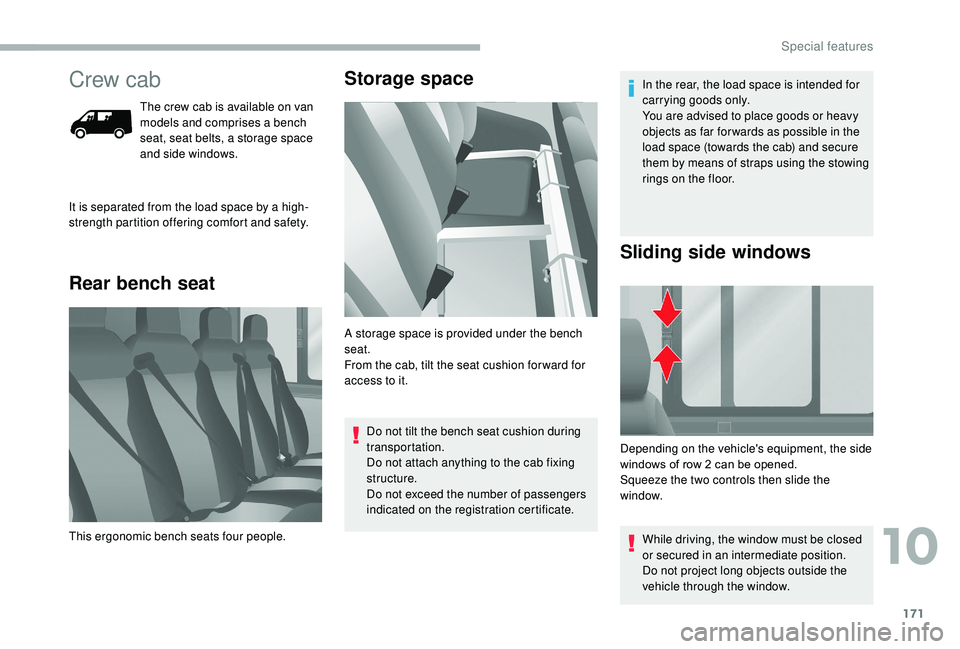
Crew cab
The crew cab is available on van
models and comprises a bench
seat, seat belts, a storage space
and side windows.
Rear bench seat Storage space
It is separated from the load space by a high-
s trength partition offering comfort and safety.
This ergonomic bench seats four people. A storage space is provided under the bench
seat.
From the cab, tilt the seat cushion for ward for
access to it.
Do not tilt the bench seat cushion during
transportation.
Do not attach anything to the cab fixing
structure.
Do not exceed the number of passengers
indicated on the registration certificate. In the rear, the load space is intended for
carrying goods only.
You are advised to place goods or heavy
objects as far for wards as possible in the
load space (towards the cab) and secure
them by means of straps using the stowing
rings on the floor.
Depending on the vehicle's equipment, the side
windows of row 2 can be opened.
Squeeze the two controls then slide the
window.
While driving, the window must be closed
or secured in an intermediate position.
Do not project long objects outside the
vehicle through the window.
Sliding side windows
10
Special features
Page 174 of 232
172
Seat belts
Fastening
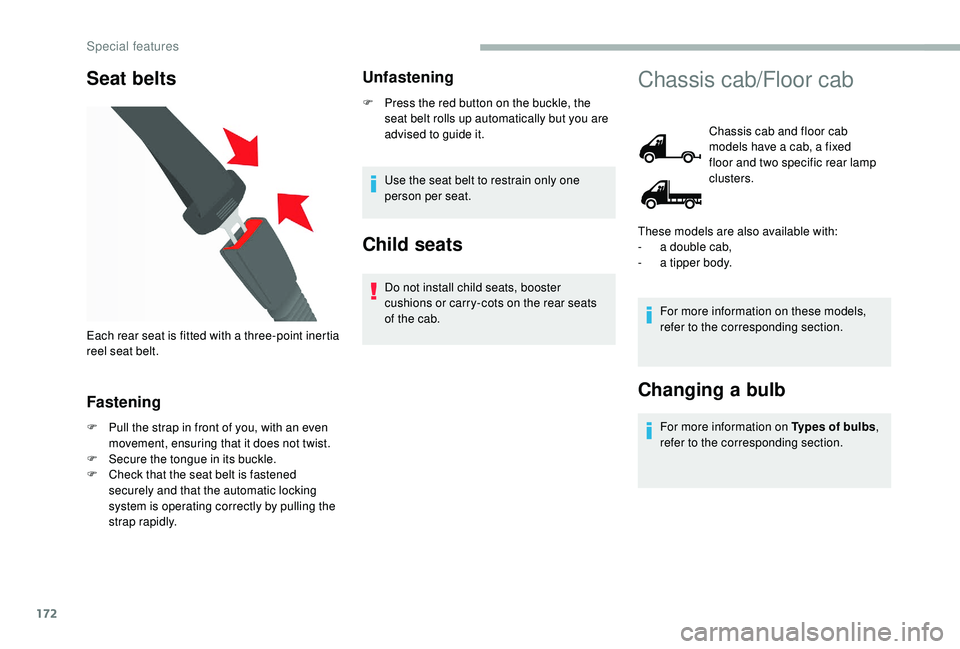
F Pull the strap in front of you, with an even movement, ensuring that it does not twist.
F
S
ecure the tongue in its buckle.
F
C
heck that the seat belt is fastened
securely and that the automatic locking
system is operating correctly by pulling the
strap rapidly.
Unfastening
F Press the red button on the buckle, the seat belt rolls up automatically but you are
advised to guide it.
Use the seat belt to restrain only one
person per seat.
Child seats
Do not install child seats, booster
cushions or carry-cots on the rear seats
of the cab.
Each rear seat is fitted with a
three-point inertia
reel seat belt.
Chassis cab/Floor cab
Chassis cab and floor cab
models have a cab, a fixed
floor and two specific rear lamp
clusters.
For more information on these models,
refer to the corresponding section.
Changing a bulb
For more information on Types of bulbs ,
refer to the corresponding section.
These models are also available with:
-
a d
ouble cab,
-
a t
ipper body.
Special features